
Three heavy copper axe-adzes from the Sancta Clara Collection — and what they reveal about native copper, arsenic, the memory of stone, and the one design flaw that would take two thousand years to solve.
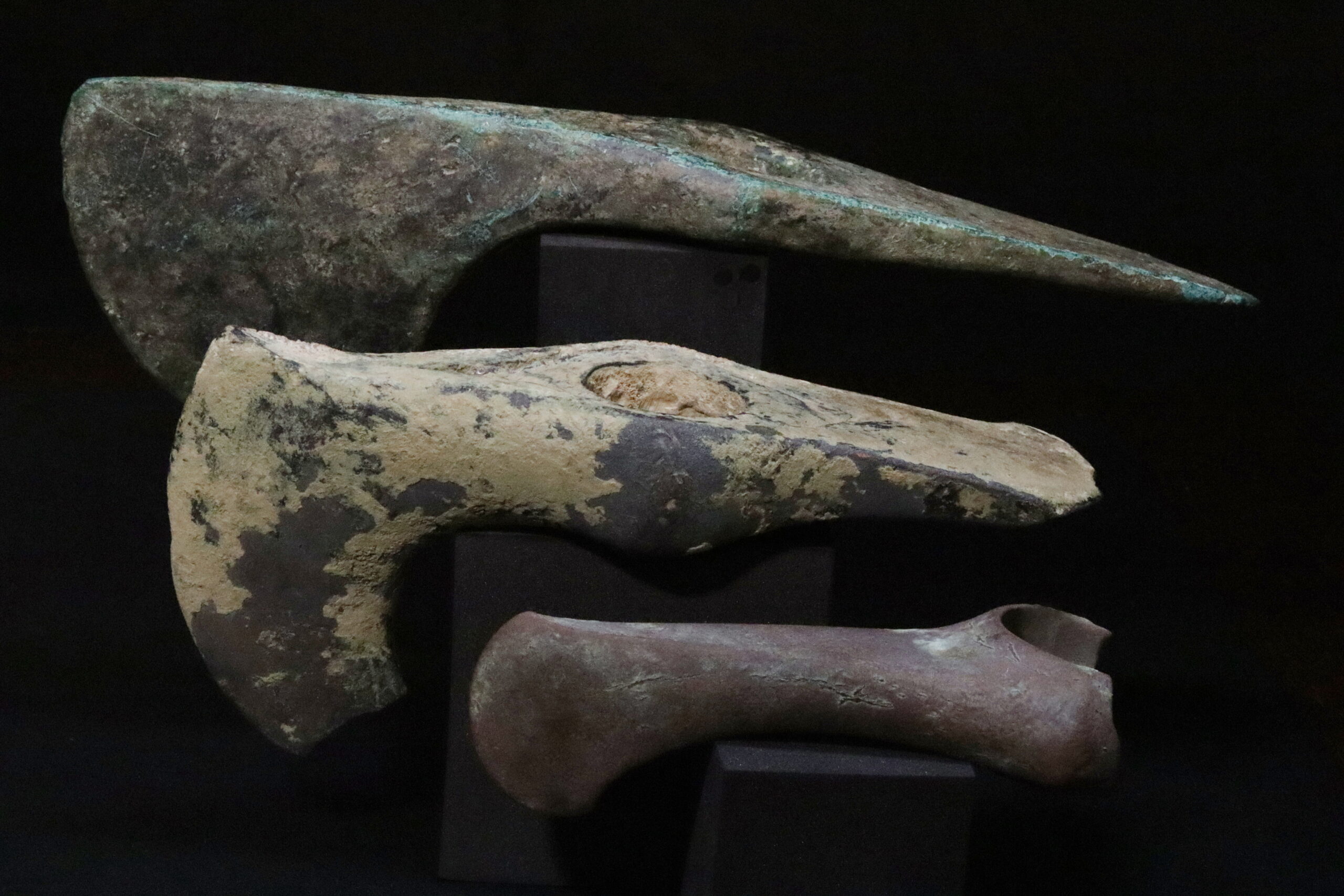
Three axes sit together on a black stand. Between them they weigh a little over three kilogrammes. Not one of them contains tin in any quantity worth naming. All three were made before the Bronze Age proper — before the alloy that gave the age its name existed as a routine technology anywhere in Europe or the Near East — and all three are, in their different ways, arguments about what copper could and could not be persuaded to do.
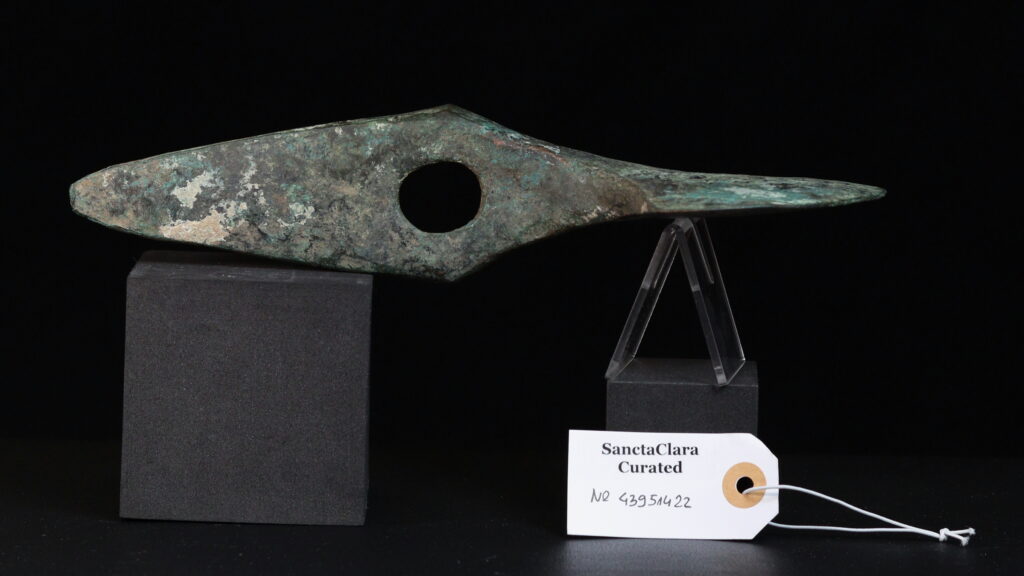
The uppermost piece is the Copper “Old Europe” Axe-Adze (Lot 43951422): 270 mm long, 1,211 g, a broad crescentic blade opposed by a long tapering pike, and — critically — a shaft tunnel just 17 mm deep.
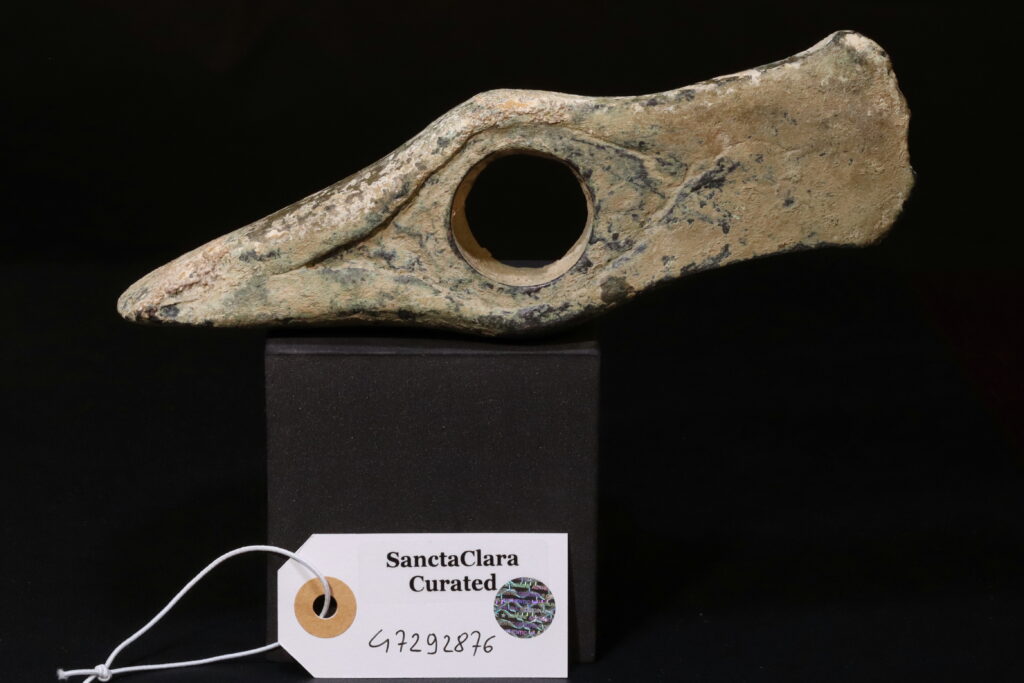
The middle piece is the Chalcolithic Copper Şiria-type bearded axe-adze (Lot 47292876): shorter at 201 mm but heavier at 1,521 g, wholly curvilinear, with no projecting sleeve and a tunnel of 34 mm.
The lowest is the Carpathian Eneolithic axe-adze of Bodrogkeresztúr (Lot 378539), and it is the most eloquent of the three, because it is broken. It snapped through the shaft hole in antiquity. What survives is 136.6 mm and 508.4 g of an object that was, on the geometry of the surviving arm, something like 240 mm and 950 g when it was whole.
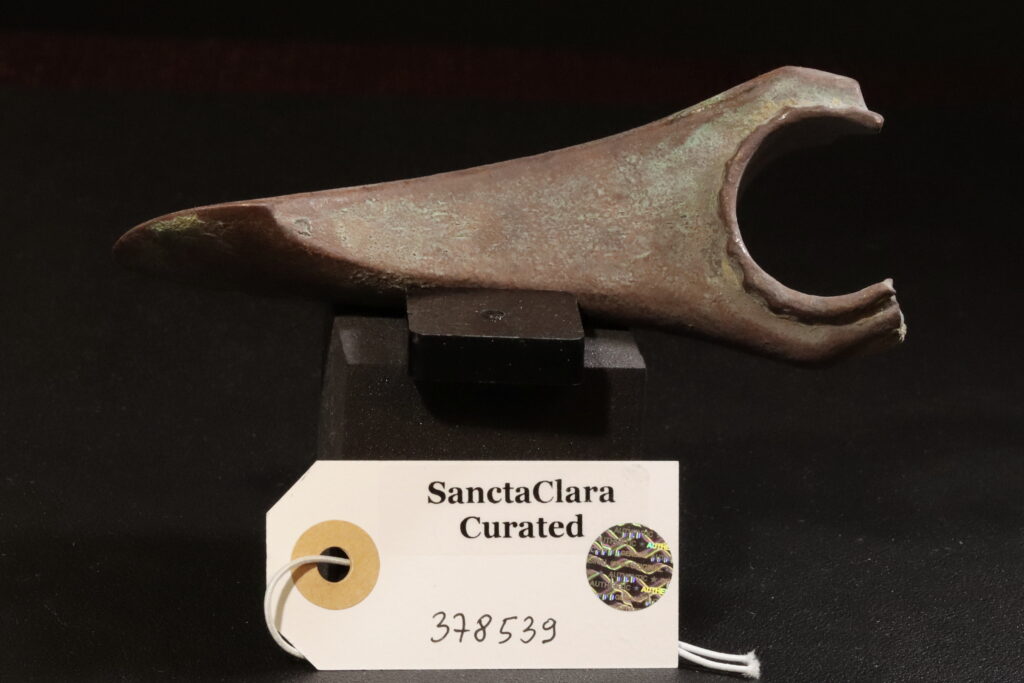
That break is the reason I have put these three pieces together. Read in isolation, each is a fine Copper Age casting. Read as a sequence, they trace a single unresolved engineering problem from its origin in stone through its expression in copper to its inevitable consequence — and they show that the problem was not one of metallurgical ignorance. The people who made these objects understood their material extremely well. What they had not yet done was abandon a shape they had inherited from a different material altogether.
The Material Before the Alloy
It is worth being precise about what “copper” meant to a fifth-millennium metalworker, because the popular sequence — stone, then copper, then bronze, then iron — flattens something that was neither linear nor simple.
The first copper worked by human hands was not smelted at all. Native copper occurs as metal in the ground, in nuggets and dendritic masses, and it can be worked cold with a hammerstone into beads, awls, hooks and small blades. This is not metallurgy in the chemical sense; it is stone-working technique applied to an unusually cooperative rock. The practice is very old and very widely distributed — Anatolian sites of the ninth and eighth millennia BC yield cold-hammered native copper ornaments, and on the other side of the world the Old Copper Complex of the North American Great Lakes produced a substantial native-copper tool industry that never developed into smelting at all. That last point deserves emphasis, because it demolishes the idea that copper-working leads inevitably to bronze. It does not. It leads there only under particular conditions.
Cold-hammering copper has one immediate and one delayed consequence. The immediate one is useful: the metal work-hardens, becoming stiffer and holding an edge better than it did as a nugget. The delayed one is fatal: keep hammering and the accumulated internal strain makes it crack. The discovery that resolves this — annealing, heating the metal to a few hundred degrees to let the crystal structure reorganise, then working it again — is the true beginning of metallurgy as a distinct craft. It requires the recognition that heat can restore a property that work destroys. That is a genuinely abstract idea, and it took a long time to arrive.
Smelting, the extraction of metal from ore, is a further and larger step. The earliest securely dated evidence anywhere comes not from the Near East but from the Balkans: <cite index=”3-1″>the first documented smelting event at Belovode, a Vinča culture site in eastern Serbia, occurs at around 5000 BC, which makes it the earliest securely dated record of extractive metallurgy anywhere, at a location far from the Near East and in a region exceptionally rich in early metal artefacts</cite>. <cite index=”5-1″>The Vinča culture smelters show a persistent selection of black and green manganese-rich copper ores, and the abundance of manganese oxide in the post-5000 BC slags is significant because manganese facilitates the formation of a melt under the variable conditions one would expect from hole-in-the-ground smelting installations</cite>. That is a recipe, not an accident — a specific and repeated choice of ore made for reasons the smelters could articulate to each other, even if we cannot reconstruct the words.
This matters directly for our three axes. The Sagaris (Lot 43951422) sits squarely within the horizon that this technology made possible: the Carpathian and Danubian copper boom of the later fifth and earlier fourth millennia, when heavy cast copper implements appear in numbers that have no precedent anywhere on earth. A 1,211 g axe is not a bead. It represents a smelting and casting operation of real scale, and behind that, a mining operation, and behind that, an economy capable of feeding people who were not producing food.
For the broader picture of how this technology diffused — and where it did not — see the Collection’s survey of global Bronze Age metallurgy and its treatment of the axe as a morphological family.
The Arsenic Question, Handled Honestly
Every account of Copper Age metallurgy reaches for arsenical copper, and most of them overstate it. Since two of these three pieces are catalogued as copper with arsenic content, it is worth setting out what the alloy actually does.
The received story runs: pure copper is too soft for serious tools; arsenic-bearing ores yielded a naturally harder alloy; this “arsenical bronze” bridged the gap until tin arrived. The middle clause is where the trouble is.
Heather Lechtman’s experimental programme on the copper–arsenic system gives the numbers. <cite index=”31-1″>As-cast ingots containing between 0.5 and 2% arsenic are only minimally harder than copper — around 50 VHN for copper against 53 VHN at 2% arsenic. At 3.5% arsenic the solid-solution hardness rises to roughly 62 VHN, and just below the solubility limit at 7% arsenic it reaches about 72 VHN, an increase of 44% over cast copper.</cite> Independent laboratory work reaches the same conclusion from the other direction: <cite index=”32-1″>a composition of 96% copper, 2% arsenic and 2% antimony was found to have a hardness almost identical to pure copper in the as-cast state at 50 HV, but rising rapidly if cold-worked</cite>.
The implication is unambiguous and it is not the one usually drawn. At the trace-to-low arsenic levels typical of unintentionally alloyed Chalcolithic copper, casting an axe in arsenical copper buys you almost nothing. The hardness gain lives entirely in the cold-working — in hammering the cutting edge after the casting has cooled. Arsenic’s real virtue is that it lets you hammer further before the metal cracks, and it raises the ceiling that hammering can reach. It is a processing advantage, not a casting advantage.
So when the Sagaris (Lot 43951422) is described as copper with natural trace arsenic content, that description should not be read as an explanation of its performance. Its performance came from two other places: from 1,211 g of mass delivered on a two-handed haft, and from whatever cold work the maker applied to the crescentic edge and the pike after casting. A trace-arsenic casting and a pure-copper casting would have felt identical in the hand as they came out of the mould.
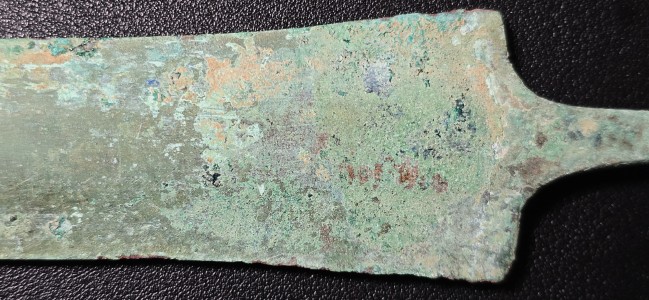
There is a second arsenic phenomenon relevant to the Şiria-type piece (Lot 47292876), and here I want to flag a genuine uncertainty rather than resolve it. During solidification, arsenic tends to migrate outward — inverse segregation, sometimes called “arsenic sweat” — producing a surface layer that is harder, darker and sometimes silvery. Ancient metallurgists in several regions appear to have exploited this deliberately. Lot 47292876 carries glossy black patches, and arsenic segregation is one candidate explanation. It is not the only one. Tenorite (CuO), copper sulphides formed under anaerobic burial, manganese-oxide soil crusts, and the cassiterite-rich surface produced by decuprification of a tin bronze all present similarly to the eye. I have discussed exactly this identification problem at length in The Language of Patina and in the black bronze and hepatizon article, and the conclusion there holds here: a lustrous black surface on an excavated copper alloy is a question, not an answer.
The same caution applies to density. Lot 47292876 measures 8.68 g/cm³ (1,521 g in 176 ml); the Sagaris measures 8.71 g/cm³ (1,211 g in 139 ml). Both figures are frequently read as confirming unalloyed or lightly alloyed copper against pure copper’s 8.96. They do not confirm it. Corrosion products are all substantially less dense than metal — cuprite around 6.1, malachite around 4.0, tenorite around 6.3, cassiterite around 6.9–7.1 — and internal casting porosity depresses the figure further. A bulk density measured on a patinated object is a lower bound on true alloy density, and 8.68 is comfortably consistent with unalloyed copper, arsenical copper, a tin bronze or a leaded bronze alike. Handheld XRF would not settle it either: on a patinated surface it reads only the outermost tens of micrometres and reports corrosion chemistry rather than bulk alloy, and surface tin enrichment can make a bronze read tin-rich while a decuprified copper reads misleadingly.
⚠️ A note on the Collection’s own records. The item entry for Lot 47292876 currently contains both positions — an earlier passage stating that density “strictly rules out a tin-bronze alloy,” and a later, more careful passage stating that the density does not discriminate copper from bronze. The later position is the correct one and the earlier sentence should be revised. I would rather say so here than let it stand.
Where the Copper Came From — and Why That Is Harder Than It Looks
The Sagaris entry attributes its arsenic content to Carpathian mines. This is the standard assumption, and it is now under sustained challenge from lead isotope work — which is precisely the kind of quiet revision that rarely reaches general readers.
The problem is methodological. <cite index=”62-1″>Because of the enormous quantity of heavy copper tools found on the Great Hungarian Plain, several scholars concluded that local metallurgy existed and treated the territory of the Bodrogkeresztúr culture and the Carpathian Basin as the centre of production. These models, built on the distribution of copper artefacts, frequently confused the place of production with the place of final use or deposition — and it is a serious difficulty that the majority of these finds come from unknown find contexts.</cite> Where lead isotope analysis has been applied to well-contextualised assemblages, the answer has often pointed south: <cite index=”64-1″>analysis suggested that the raw material of axes and spiral bracelets likely derives from the Balkans, most probably from Majdanpek and from present-day central Bulgaria, indicating that the Great Hungarian Plain belonged to the Central Balkan copper supply network</cite>.
Distribution is not production. A region can be drowning in heavy copper axes and be importing every gramme of the metal.
The single most famous demonstration of this principle is Ötzi’s axe. <cite index=”43-1″>Lead isotope analysis compared the isotopic fingerprint of the blade against numerous ore deposits across Europe and the Mediterranean, and the result pointed unequivocally to South Tuscany — a complete surprise, since archaeologists had assumed that copper used in the Alpine region came from Alpine deposits or the Balkans.</cite> <cite index=”44-1″>The ore source lies roughly 500 km south of where the Iceman died, and it remains unclear whether he acquired the Tuscan copper as raw material or as a finished blade.</cite> ⚠️ It should be noted that the wider framework of that study is itself contested — <cite index=”47-1″>a copper axe blade from Zug-Riedmatt in Switzerland with links to metallurgical traditions south of the Alps has been used to argue against the depiction of the Alps as a neat cultural barrier separating distinct metal circuits</cite>. The specific provenance of Ötzi’s blade is robust; the map of circuits drawn around it is not yet settled.
Ötzi’s axe is also instructive for a second reason, which returns us to hafting. <cite index=”45-1″>The copper blade was cast in a mould, cooled, then compressed by hammering, and it is fixed into the forked shaft of a yew haft with birch tar and tightly bound with leather straps; signs of wear show the axe had been frequently used and repeatedly re-sharpened.</cite> That is the other solution to the hafting problem — the flat axe, wedged and lashed into a knee-shaft, with no hole in the metal at all. The Collection holds small copper flat axes of this general family (Lots 4949 and 4950), and they are worth setting mentally beside the three shaft-hole pieces, because they represent the road not taken by Carpathian metalworkers. The flat axe puts all the stress into the binding and the wood. The shaft-hole axe puts it into the metal. Each choice has a characteristic failure mode.
Making the Hole
How do you get a hole through a cast copper axe head? There are three routes, and the archaeological and experimental evidence supports at least two of them being in genuine use.
Casting around a core. A shaped clay or sand core is set into the mould, the metal is poured around it, and the core is broken out afterwards. This produces a hole from the start and requires no subsequent metalworking, but it introduces a serious metallurgical liability, which I will come back to.
Casting solid and punching or drilling. The head is cast as a blank and the hole is driven through hot or cold, or bored. Julia Heeb’s integrated study of south-eastern European copper shaft-hole axes tested both routes experimentally — <cite index=”56-1″>running a clay core series and a separate punching series, and comparing the resulting objects and their microstructures against archaeological axes of the Jászladány type</cite>. Her project also rested on physical evidence for the second route: <cite index=”51-1″>aspects of production were considered through experimental archaeology, metallographic analysis, and a re-discovered axe blank with a missing shaft-hole</cite>. An unfinished blank without its hole is about as direct a piece of testimony as this subject offers.
Lost wax. Rare in this material and period. In the Lower Danube region, <cite index=”14-1″>most Early Bronze Age shaft-hole axes were cast in closed bivalve moulds, a technology which soon took over throughout the Carpathian-Balkan area, and only two axes cast by the lost-wax method are known in the area of interest, both from southern Romania and both of the Dumbrăvioara type — identified by the absence of the seams that normally appear on axes cast in bivalve moulds</cite>. Two examples across a region and a period is a footnote, not a tradition.
Heeb’s broader conclusion is one I would underline, because it cuts against the tidy typological instinct: <cite index=”52-1″>the great variability in shape clearly shows that a variety of production techniques were used, but it is difficult to relate these to specific geographic areas</cite>. We are looking at a craft with many local solutions, not a single diffusing recipe.
The metallurgical liability I mentioned is this. When molten copper solidifies against a core, the region immediately around the hole is where the last metal freezes and where gas comes out of solution. Shrinkage cavities and gas porosity concentrate there. In other words, the annular ring of metal around the shaft hole — the part of the object under the highest service stress — is systematically the part most likely to contain casting defects. A punched hole avoids this, at the cost of a great deal more work and a risk of cracking the blank.
The Sagaris (Lot 43951422) has been catalogued as a single-piece, single-mould casting with what Boroffka’s scheme classes as a Type I sleeveless tunnel. Whether its hole was cored or punched is not resolvable without metallography, and I would not claim otherwise.
The Memory of Stone
Here is the observation that sets the Sagaris apart, and it is the reason I chose it to open this article.
The metal around its shaft hole is 15–18 mm thick. Its tunnel is 17 mm deep. The whole head weighs 1,211 g. And none of that bulk is metallurgically necessary. Copper is roughly three times denser than the greenstones and amphibolites from which Late Neolithic shaft-hole hammer-axes were ground, and enormously tougher in tension. A copper axe head designed from first principles for copper would be thinner, lighter, and would put its material where the bending moments actually are. Instead this axe reproduces the massive, angular, bulk-around-the-eye profile of its stone predecessors — a profile which in stone was structurally obligatory, because stone around a drilled hole will split if it is not thick.
This is skeuomorphism: a form carried over into a new material because of what it meant, not because of what it did. The Collection also holds a Neolithic polished stone axe (Lot 97808350), and the family resemblance is not subtle.
I want to be careful about the direction of the argument, because the traffic runs both ways and the literature can be read carelessly in either direction.
✅ Well anchored: the earliest copper shaft-hole axes emerge in regions with a long-established stone shaft-hole hammer-axe and battle-axe tradition, and their general architecture — central perforation, opposed working ends, mass concentrated centrally — is that tradition’s architecture.
◆ My reading, argued not established: the retention of excess mass around the eye in heavy Carpathian copper axes is a deliberate transfer of symbolic authority rather than a failure to understand the material. The metalworkers who produced the Vinča smelting recipe were not naïve about copper. Choosing to spend an extra several hundred grammes of the most valuable substance in the economy on a feature with no mechanical payoff is a statement about who the axe is for.
⚠️ Contested and frequently muddled: later stone battle-axes in several European traditions imitate metal prototypes, reproducing cast seams and mould flash in ground stone. Both currents are real; they belong to different centuries and should never be collapsed into a single “stone copies metal” or “metal copies stone” narrative.
The Sagaris also carries a terminological freight worth unpicking. It is catalogued as a Sagaris type, and the term is useful shorthand for the axe-with-opposed-pike architecture. But sagaris is a Greek word for a much later steppe weapon — <cite index=”25-1″>an ancient shafted weapon used by the horse-riding Saka and Scythian peoples of the Eurasian steppe, also used by Medes, Persians and Parthians, and a kind of battle-axe or war hammer with an axe-like or blunt edge on one side and a sharp edge on the other</cite>. Applying it to a fifth-millennium Carpathian object is a morphological convenience, not a cultural claim, and readers should not infer any continuity across the four thousand years between them. The same caution applies in reverse to Lot 47292876, catalogued as “Şiria-type” — a Carpathian type-name — while the Collection’s own analysis of its morphology argues for an Iranian or north Caucasian origin. The type-name describes the body geometry; it is not an attribution.
The Geometry of Failure
Now the argument that ties the three pieces into a sequence.
A hafted axe head is not simply pushed by its handle. Every strike that lands off the intended plane — and in real felling, most do — applies a twisting couple between head and haft. That couple has to be resisted somewhere, and in a shaft-hole axe it is resisted by bearing pressure between the wood and the inside wall of the tunnel: the wood pushes outward at the top of the tunnel on one side and at the bottom on the other.
The lever arm available to resist that couple is the tunnel depth. This is the whole ballgame. Shorten the tunnel and you increase the force at each bearing point in inverse proportion — and you simultaneously reduce the contact area over which that force is spread. Contact pressure on the haft therefore rises roughly with the square of the reduction. Halve the tunnel depth and you roughly quadruple the pressure crushing the wood.
Let me put the Collection’s three pieces on the same scale. The meaningful figure is tunnel depth divided by shaft-hole diameter — call it the bearing ratio.
| Tunnel depth | Shaft hole (upper/lower) | Bearing ratio | Sleeve | |
|---|---|---|---|---|
| Lot 43951422 — Old Europe Sagaris | 17 mm | 29 × 25 mm | ≈ 0.63 | none (Boroffka Type I) |
| Lot 378539 — Bodrogkeresztúr axe-adze | 28 mm | 32.8 / 30.9 mm | ≈ 0.88 | 3 mm stepped lower collar only |
| Lot 47292876 — Şiria-type bearded axe-adze | 34 mm | 32.0 / 30.5 mm | ≈ 1.09 | none projecting |
| Modern felling axe (comparison) | 55–65 mm | ≈ 35 mm | ≈ 1.7–1.9 | n/a |
Every one of these Copper Age heads is operating at between a third and two-thirds of the bearing ratio a modern axe considers normal — and they are doing it while weighing between two and five times what a modern felling axe head weighs. Higher mass, higher impact energy, shorter lever arm to resist the resulting couple.
There are only two places for that to go. The wood crushes, or the metal fails.
The wood crushes first, usually. A 17 mm bearing length on a 1,211 g head is brutal on a haft. This is why the Sagaris entry reasons toward a robust ash or oak haft reinforced against lateral shock, and why the piece reads as a two-handed weapon rather than a one-handed working tool: with a two-handed grip and a controlled, in-plane swing, the off-axis couple is minimised. That is not a solution to the geometry; it is an operating restriction imposed by the geometry. A tool you must swing carefully is a tool with a design problem.
When the metal fails, it fails at the eye. And this is Lot 378539.
Look at what its maker did. The arm thickens progressively from about 17 mm to about 25 mm as it approaches the shaft hole, and the swelling is entirely dorsal — the upper contour rises in a convex shoulder while the underside stays essentially planar. That is a reinforcement. Someone understood that the eye was the vulnerable section and deliberately put metal there, on the tension face, without breaking the flat working geometry of the underside. Beneath the socket there is a discrete, sharply stepped collar 3 mm high, forming a thin plate under and slightly beyond the shaft hole — a partial sleeve, extending the bearing surface downward. The minimum tunnel wall thickness is 9.6 mm, which is not thin.
It broke anyway. Straight through the shaft hole, taking away the entire butt end — well over half the original mass on the reconstruction. And the Collection’s examination records no structural weakness detected on the break surface, which is the single most important observation on the object. This was not a casting flaw failing. There was no blowhole waiting to open, no shrinkage cavity, no cold shut. This was sound metal, adequately thick, deliberately reinforced, breaking through the section that geometry had condemned.
Why? Three mechanisms compound, and I set them out as my reading rather than as published analysis:
◆ First, section modulus collapse. The eye converts a solid arm into an annulus. Whatever the wall thickness, an annulus resists bending far less well than the solid section on either side of it. The eye is the minimum-strength station in a load path that carries the full impact energy of the blade.
◆ Second, stress concentration at the transition. The change from solid arm to perforated ring is a geometric notch. Notches concentrate stress at their root, and the sharply stepped 3 mm collar on Lot 378539 — helpful for bearing — is itself a re-entrant corner and a stress raiser. Copper Age design frequently improved bearing at the cost of introducing a notch, without any way of knowing it was making that trade.
◆ Third, and most insidious, progressive embrittlement in service. Copper work-hardens. Every impact transmitted through the eye deforms the metal there very slightly, and dislocation density accumulates. Over a working life the eye becomes harder — and less ductile. The property that makes copper forgiving of a bad blow when new is precisely the property that a working life removes. Unlike the cutting edge, which can be annealed and re-hammered as part of routine maintenance, the shaft-hole region is buried under the haft, invisible, and unlikely to be treated. It quietly hardens toward its own fracture.
An axe that begins ductile and ends brittle, at exactly the section with the lowest strength and the highest stress concentration, subjected to a bending couple amplified by an inadequate bearing length: Lot 378539 is not an anomaly. It is the predicted outcome.
Which is also why I would resist reading the break as evidence of poor workmanship or of “primitive” metallurgy. As the Collection’s own note on the piece puts it, the advanced geometry and skilled casting of the Late Chalcolithic stand in fascinating contrast to some later Early Bronze Age crudity. The Bodrogkeresztúr smith did good work within an inherited form. The form was the problem.
The Solutions That Followed
If the diagnosis is right, we should be able to see the answer arriving in the archaeological record. We can, and it takes three distinct paths.
Lengthen the tunnel. The most direct fix, and visible already within the Chalcolithic. Lot 47292876, at a bearing ratio of 1.09, is nearly twice as well proportioned as the Sagaris. Note that this piece achieves its longer tunnel without a projecting sleeve — it simply carries more body depth at the eye. Its recessed, eye-like depression around the upper shaft tunnel is worth reading correctly: that recess is a mass-saving feature, removing metal from the thickest part of the cast where it contributes least, not a strengthening one. It is exactly the kind of considered material economy that the Sagaris conspicuously does not practise — which is one reason the two pieces, superficially similar, belong to different design mentalities.
Add a sleeve. The classic Carpathian answer. The diagnostic Jászladány axe-adzes of the Bodrogkeresztúr sphere very often carry pronounced tubular sleeves projecting above and below the body, extending the bearing surface well beyond the thickness of the head itself. Lot 378539 has only the beginning of this — a 3 mm lower collar with serrated decoration, and no projecting upper sleeve at all. It sits at an early point on that development. The Collection’s later collared pieces, notably the axe-adze with collar socket mount (Lot 101625225) and the Giant Oxus axe-adze with four collars ringing the shaft tunnel (Lot 102371201), show the mature form of the idea: multiple collars, a long tunnel, and a bearing ratio that finally makes mechanical sense.
Abandon the hole entirely. The Atlantic and Central European Bronze Age took the other road: flat axe, then flanged axe, then palstave, then true socketed axe — the sequence in which the metal wraps around the wood rather than the wood passing through the metal. The socketed axe is the elegant terminal solution, because a socket has effectively unlimited bearing length and puts the metal in pure compression and hoop tension rather than bending across a hole. It took, from the Sagaris to the socketed axe, roughly two and a half thousand years.
Nothing about this sequence was inevitable and none of it was the working out of a plan. It was the accumulated consequence of a very large number of axes breaking.
What They Were Actually For
The temptation with heavy Copper Age axes is to assign each one a single function. The evidence does not permit it, and the sensible position is that these objects moved between registers over their lifetimes.
Forest clearance and carpentry. The axe-adze exists because two operations are needed on every felled tree: the axe blade cuts across the grain to bring the trunk down, the adze blade dresses it into planks, beams, posts and dugout hulls. Folding both into one casting is the reason the axe-adze is the most strongly represented single form in this Collection and across Chalcolithic and Bronze Age Eurasia. The Neolithic transformation of the European landscape was executed with stone axes, and the experimental record is clear that ground stone fells timber perfectly well; copper’s advantage was never raw cutting power but recoverability — a rolled copper edge can be hammered straight and re-sharpened indefinitely, where a chipped flint edge is simply gone. Ötzi’s blade shows the pattern archaeologically: repeated use, repeated re-sharpening.
⚠️ The frequently repeated claim that a replica of Ötzi’s axe felled a yew tree in 35 minutes circulates widely, and I have not been able to trace it to a primary experimental publication. Treat it as an order-of-magnitude indication rather than a datum.
Mining and quarrying. Occasionally proposed, and specifically raised for the heavy Lot 47292876, where the mass and the robust, unarticulated shaft-hole zone would suit heavy percussive work. I regard it as possible but weakly supported. The Chalcolithic mining record — Rudna Glava, Ai Bunar — is dominated by stone mauls and antler picks, which are cheap, replaceable, and better suited to hammering rock than an object representing a substantial fraction of a community’s metal wealth.
Warfare. Real, but easily overstated. The heavy pike-butted form of the Sagaris concentrates 1,211 g behind a narrow point, and against the organic armour available in the fifth millennium — hide, quilted textile, wood — a spike delivers far more penetrating energy per unit of contact area than a broad blade. The Collection’s Eneolithic Copper Shaft-Hole Battle Axe (Lot 891) is a lighter, more clearly martial variant of the same idea. That a distinctly military axe form crystallises at all in the late fourth and early third millennia is itself significant: metal was being committed not only to felling trees but to felling people. But the martial reading of any individual heavy axe-adze needs use-wear evidence to support it, and most such objects lack a documented find context altogether.
Wealth, capital and rank. This is where the heavy pieces most clearly belong. In the eastern Carpathian Basin, <cite index=”61-1″>daggers and axes, both flat and of Jászladány type, are interpreted as markers of focal points of power, and their associations with other funerary goods allow recognition of a structured world-view in which such objects served the needs of the living for negotiating individual identities and those of their close social group</cite>. A kilogramme and a quarter of smelted copper, in a world where copper arrived through long trade chains from Balkan ore bodies, is not a tool budget. It is a treasury. The axe is simultaneously an implement, a store of value, and an argument about who its owner is.
Deposition — including in water. Şiria-type axes are recorded from wet contexts, including Lake Gopło in Poland, and the pattern of prehistoric metalwork entering rivers, lakes and bogs is one of the most consistent phenomena in European archaeology. ⚠️ The interpretation is not as settled as popular accounts suggest. Three readings compete: deliberate votive offering to a place or a power; safe storage never recovered; and simple loss, over-represented in the record because waterlogged anaerobic conditions preserve copper alloys superbly. My own assessment, offered as a judgement rather than a finding: for single heavy prestige items deposited in water, the votive reading is the strongest of the three, because the objects are too valuable for casual loss, too singular for a merchant’s cache, and too consistently placed at boundaries and watercourses. For mixed scrap hoards the balance shifts toward storage. Careless generalisation across those two categories has done a lot of damage to this literature. What can be said flatly is that <cite index=”63-1″>the method of deposition implies that such items were associated with special social contexts, represented exceptional values, and that the context of deposition was itself highly prescribed</cite>.
There is a coda to this. Lot 378539 broke at the shaft hole in antiquity and its butt end is gone. A broken axe is not necessarily a discarded axe. Deliberate fragmentation — breaking an object to divide it, to kill it, or to close its biography before deposition — is a well-attested Copper Age practice, and fragmentation patterns were among the categories Heeb built her database around. I cannot distinguish, from the object alone, between a working failure that ended its life and a working failure that began a second life. Both are ordinary outcomes. The break surface’s own patination would be the place to start looking.
Reading the Three Together
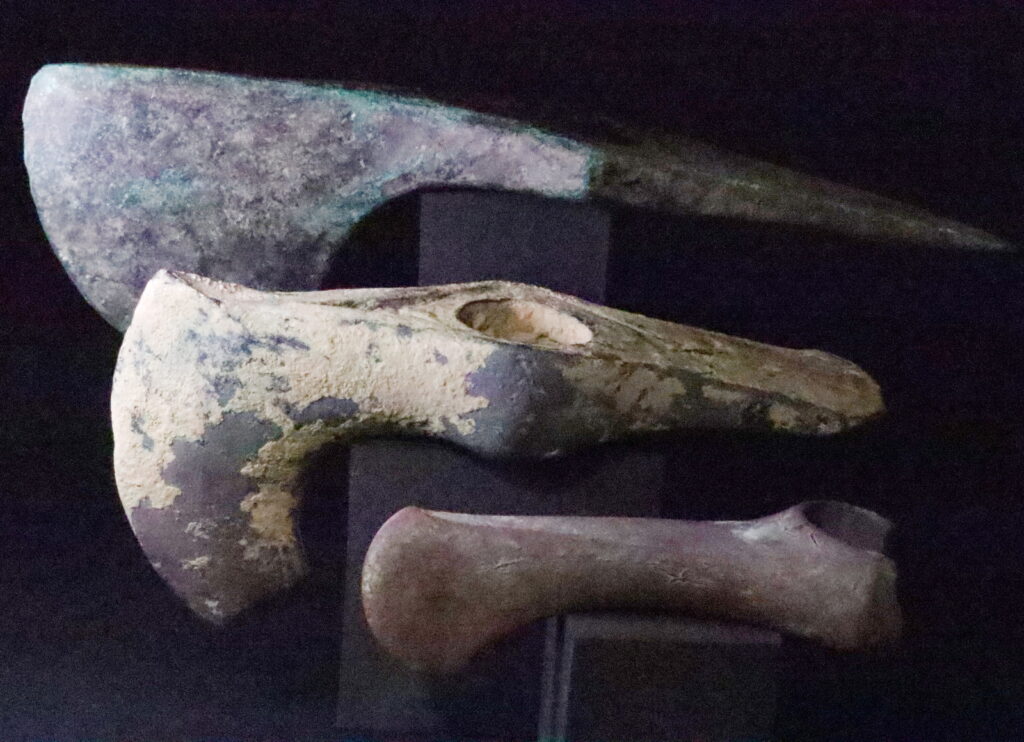
Set side by side, these three axes describe an arc that has nothing to do with progress and everything to do with an unresolved constraint.
The Old Europe Axe Adze, which I like to anachronistically call the Sagaris, (Lot 43951422), at roughly 4300–3800 BC, is the most conservative object of the three and the most socially loaded. It carries stone’s proportions into copper because stone’s proportions carried stone’s authority. Its 17 mm tunnel is the shortest bearing surface in the group by a wide margin, and its 1,211 g the second heaviest — the worst combination of the three from a mechanical standpoint, and almost certainly the most impressive to look at across a fifth-millennium clearing. It is an object built for meaning first.
The Bodrogkeresztúr axe-adze (Lot 378539), at roughly 3900–3600 BC, shows a maker actively working the problem: a longer tunnel, a dorsal thickening at the eye, a stepped collar to extend the bearing surface downward. Every one of those features is a correct intuition. Together they were not enough, and the piece survives as the group’s evidence rather than its argument.
The Şiria-type bearded axe-adze (Lot 47292876) is the most mechanically mature of the three — the longest tunnel, the best bearing ratio, wholly curvilinear geometry with no flat planes and therefore no sharp internal corners to raise stress, and material deliberately removed from where it did not earn its place. It is also, on the Collection’s morphological analysis, the piece least likely to be Carpathian at all, which is itself worth sitting with. The engineering conversation was happening across the whole Chalcolithic world at once, and different regions were at different points in it. ⚠️ Its attribution remains open; the Iranian reading rests on morphology and on the British Museum’s Nihavand axe-adze (1936,0613.77) as the closest published parallel in both form and mass, while its weight alone would have argued for the Balkans.
What none of the three has is a socket. That is the point. For something like two and a half millennia, from the Vinča smelters to the Urnfield founders, European metalworkers made axes with a hole through the middle because that is what an axe was — an idea inherited from a material with entirely different mechanical properties, defended by everything the shape had come to mean, and abandoned only when enough of them had broken.
The Bodrogkeresztúr piece is one of the ones that broke. It is, in its way, the most articulate object in the group.
Cross-references within the Collection
- Copper “Old Europe” Axe-Adze Sagaris (Lot 43951422)
- Chalcolithic Copper Şiria-type bearded axe-adze (Lot 47292876)
- Carpathian Eneolithic axe-adze of Bodrogkeresztúr (Lot 378539)
- Evolution of the Ancient Axe Morphology — the full typological sequence from flat axe to socketed axe
- The Language of Patina: Understanding Corrosion Layers on Ancient Bronze and Copper Alloy Artifacts
- Black Bronze: Corinthian Bronze, Hepatizon, and How the Ancients Coloured Metal
- Arslantepe: The Rupture in Bronze Age Martial Chronologies — arsenical copper weaponry at the other end of the Chalcolithic world
Selected References
- Radivojević, M., Rehren, T., Pernicka, E., Šljivar, D., Brauns, M. & Borić, D. (2010). On the origins of extractive metallurgy: new evidence from Europe. Journal of Archaeological Science 37(11).
- Radivojević, M. & Roberts, B. W. (2021). Early Balkan Metallurgy: Origins, Evolution and Society, 6200–3700 BC. Journal of World Prehistory 34.
- Lechtman, H. (1996). Arsenic Bronze: Dirty Copper or Chosen Alloy? A View from the Americas. Journal of Field Archaeology 23(4).
- Heeb, J. (2014). Copper Shaft-Hole Axes and Early Metallurgy in South-Eastern Europe: An Integrated Approach. Oxford: Archaeopress.
- Schubert, F. (1965). Zu den südosteuropäischen Kupferäxten. Germania 43.
- Patay, P. (1984). Kupferzeitliche Meissel, Beile und Äxte in Ungarn. Prähistorische Bronzefunde IX/15. Munich.
- Vulpe, A. (1970). Äxte und Beile in Rumänien I. Prähistorische Bronzefunde IX/2. Munich.
- Boroffka, N. (2009). Simple technology: casting moulds for axe-adzes. In Kienlin, T. L. & Roberts, B. W. (eds), Metals and Societies: Studies in honour of Barbara S. Ottaway. Bonn: Habelt, 246–257.
- Deshayes, J. (1960). Les outils de bronze, de l’Indus au Danube (IVe au IIe millénaire). Paris.
- Deshayes, J. (1963). Haches-herminettes iraniennes. Syria 40, 273–276, pl. XXIV.
- Artioli, G. et al. (2017). Long-distance connections in the Copper Age: New evidence from the Alpine Iceman’s copper axe. PLOS ONE 12(7).
- Siklósi, Zs. et al. (2019). New data on the provenance of copper finds from the Early–Middle Copper Age of the Great Hungarian Plain. Archaeological and Anthropological Sciences 11.
- Klochko, V. I. (2001). Weaponry of Societies of the Northern Pontic Culture Circle: 5000–700 BC. Poznań.
- British Museum 1936,0613.77 (copper alloy shaft-hole axe/adze head, Nihavand, Iran).
Transparency Note
This article draws on a mix of established scholarship and my own argued positions, and I have tried to keep the two visibly separate throughout.
Established in the literature: the c. 5000 BC date for copper smelting at Belovode and the manganese-rich ore selection of Vinča smelters; the hardness values for as-cast and cold-worked copper–arsenic alloys; the existence of both clay-core and punching routes to the shaft hole, and the rarity of lost-wax in this material and region; the South Tuscan provenance of Ötzi’s axe copper; the lead-isotope evidence that heavy Great Hungarian Plain copper implements often derive from Balkan ore bodies; the interpretation of Copper Age daggers and axes as markers of social rank.
My inference and argument, not established fact: the mechanical account of shaft-hole failure given in “The Geometry of Failure” — the bearing-ratio comparison, the section-modulus and stress-concentration reasoning, and the progressive-embrittlement mechanism. These follow from standard engineering principles applied to the measured dimensions of the three pieces, but I know of no published finite-element or experimental fracture study of Copper Age shaft-hole axes that tests them. The bearing ratios themselves are derived from the Collection’s own measurements and are arithmetic, not interpretation. My reading of excess mass around the eye as deliberate symbolic transfer rather than metallurgical naïveté is likewise an argument, not a finding.
Genuinely contested, and presented as such: the attribution of Lot 47292876, where mass argues for a Balkan origin and morphology for an Iranian one; the interpretation of metalwork in wet contexts as votive, stored or lost; the mapping of Copper Age metal circulation circuits around the Ötzi provenance result; and the identity of the glossy black surface phases on Lot 47292876, which cannot be established visually or by surface XRF.
Corrections made to the Collection’s own records in the course of writing: the density figure of 8.68 g/cm³ does not rule out a tin bronze and the earlier catalogue statement that it does should be revised; the attribution of the Sagaris’s arsenic content to Carpathian mines should be softened in light of the lead-isotope evidence for Balkan sourcing; and the widely circulated “35 minutes to fell a yew” figure for Ötzi axe replicas could not be traced to a primary publication.
The type-names Sagaris and Şiria are used here as morphological shorthand and carry no implication of cultural continuity or geographic origin.
Andrzej M. Izyk — AncientBronzes.com, curator of the Sancta Clara Collection and author of The Sky Father: The Lost Bronze Age God Behind Zeus, Jupiter, Tyr, and Deus.
All three artefacts discussed are in the Sancta Clara Collection. Measurements are the Collection’s own. Photography: Sancta Clara Collection.