
Cultural heritage of Persia, the earliest copper smelters of the Iranian Plateau, and what the Luristan bronzes in the Sancta Clara Collection can — and cannot — prove
Epistemic key used throughout this article: ✅ established scholarship · ⚠️ argued inference or actively contested · ◆ the author’s own framework
Why this collection leans east
Anyone who works through the Sancta Clara Collection catalogue notices the imbalance quickly. Spearheads, daggers, javelin heads, adze-axes, arrowheads — a strikingly large share of the finest copper-alloy objects here carry attributions to Luristan, to Elam, to north-western Iran. Lot 84068495, a Luristan bronze long spearhead of 456 mm with a prominent midrib. Lot 44398282, a comparable piece at 454 mm with a narrow rounded central ridge and a square shaft eye. Lot 84058911, a leaf-shaped spearhead of 437 mm whose blade carries multiple ancient strike marks — a weapon that was used, repeatedly, against something hard.
This is not an accident of my own collecting taste. It reflects a genuine feature of the antiquities market, which in turn reflects a genuine feature of the ancient world: the Iranian Plateau produced an extraordinary volume of accomplished metalwork, over an extraordinarily long period, and a great deal of it left the ground in the twentieth century.
But abundance in the market is not the same as importance in history. So the question this article sets out to answer is a serious one, and I want to answer it honestly rather than flatteringly: was the region the Greeks came to call Ariana genuinely a crossroads of Bronze Age metallurgy — a place where the technology of the ancient world converged, mixed and moved on — or is that a romance we tell ourselves because so many beautiful objects from there ended up in our vitrines?
The honest answer turns out to be more interesting than either the romance or the debunking. But we cannot get to it without first clearing away three pieces of received framing that will not survive contact with the evidence.
Three corrections before we can begin
Correction one: “Ariana” is a Greek word from the wrong millennium ✅
The term Ariana (Ἀριανή) does not belong to the Bronze Age at all. It was introduced by Eratosthenes of Cyrene (c. 276–195 BC) as a cartographic convenience — one of his sphragides, the great rectangular “seals” into which he divided the inhabited world — and it comes down to us principally through Strabo, who describes it in detail at Geography 15.2.1–9 and touches on Eratosthenes’ scheme at 2.1.22f.
What Strabo means by Ariana is a specific block of territory: the lands bounded by the Indus to the east, the sea to the south, a line running from Carmania to the Caspian Gates to the west, and the Taurus to the north — Carmania, Gedrosia, Drangiana, Arachosia, Aria, the Paropamisadae, Bactria. Apollodorus of Artemita, quoted by Strabo (11.11.1), calls Bactria “the ornament of Ariana as a whole.” Note what this excludes: Elam, Fars, most of the Zagros — precisely the regions that produced the bulk of the metalwork we are discussing.
Note also that Herodotus does not use the term as a unit. Neither does Ptolemy, nor Arrian, nor Stephanus of Byzantium in the same sense. Pliny (Naturalis Historia 6.23) confused Ariana with the much smaller province of Aria. Encyclopaedia Iranica’s entry on Aria is blunt about the underlying problem: Eratosthenes’ usage rests on an ethnographic error, since the inhabitants of this vast block did not in fact belong to a single tribe, and the designation ariya- was originally an ethnic self-description that only later acquired political and geographic breadth.
Retrojecting a Hellenistic mapmaker’s rectangle onto the fourth and third millennia BC is an anachronism of roughly two thousand years. It is a useful shorthand for a blog title. It is not an analytical unit. ✅
There is a second, quite separate concept that gets tangled with it: Airyanem Vaejah, the mythic homeland of the Avesta, the “expanse of the Aryas.” This is a religious-cosmological idea, not a mappable territory, and its proposed locations range from Chorasmia to the Aral region to eastern Iran and Afghanistan. ⚠️ It cannot be used to license claims about Bronze Age geography either.
What we are actually left with is the Iranian Plateau — a physical-geographic descriptor, legitimate for prehistoric archaeology precisely because it makes no claim about who lived there or what they called themselves. That is the term this article will use when precision matters.
Correction two: the famous Luristan bronzes are Iron Age ✅
This is the correction that stings, because it cuts directly against how these objects are marketed and how most collectors first encounter them.
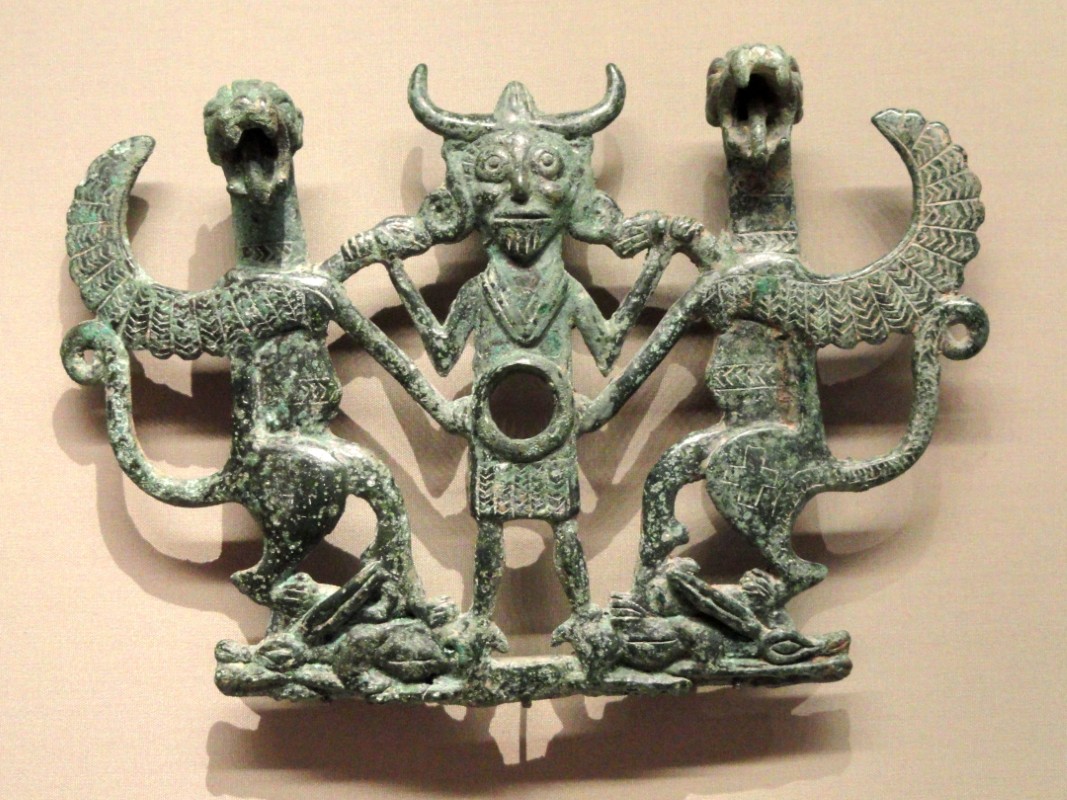
The canonical Luristan bronzes — the openwork standards, the master-of-animals finials, the elaborate cheek-pieces, the pins with cast figural heads — are Iron Age, conventionally Iron Age I–III, roughly 1250–650 BC. This chronology comes from the Belgian Archaeological Mission in Iran under Louis Vanden Berghe, working in the Pusht-i Kuh between 1965 and 1979, and from Bruno Overlaet’s synthesis of that material (The Early Iron Age in the Pusht-i Kuh, Acta Iranica 40, 2003; and his chronology entry in Encyclopaedia Iranica). ✅
There is a genuine Bronze Age horizon in Luristan — tombs at Kalleh Nisar, Bani Surmah, War Kabud, Chamahzi Mumah, reaching back to around 2600 BC. But that corpus is materially different: simpler, less flamboyant, and far less represented on the market precisely because it is less spectacular. When a sale description says “Bronze Age Luristan,” it is sometimes correct and often not.
This matters directly for objects in this collection. Lot 84375835, described as a Luristan copper and Bronze Age dagger group dated 2750–2250 BC, would belong to that earlier tomb horizon if the dating holds. Lot 78638597, a Luristan bronze dagger given as c. 1000 BC, sits squarely in the Iron Age proper. These are not the same tradition separated by a stylistic nuance; they are separated by well over a thousand years. Any article that treats “Luristan bronzes” as a Bronze Age phenomenon has already lost the thread. ✅
Correction three: language, ancestry and material culture are three different things ✅
Popular writing about this region routinely collapses three independent variables into one story. It is worth separating them at the outset, because almost every serious misreading of Bronze Age Iran begins here.
Language family is a linguistic fact, reconstructible from comparative philology. Genetic ancestry is a biological fact, now directly measurable from ancient DNA. Archaeological culture is a pattern in material remains — pottery, burial practice, metalwork typology. These three things spread by different mechanisms, at different speeds, in different directions, and carried by different people.
The past two decades of research have made a specialty of demonstrating exactly how badly they map onto one another. A language can spread without a population replacement. A material culture can be adopted wholesale by people with no ancestral connection to its originators. And populations move constantly without carrying either language or material culture intact.
The practical consequence for this site is a firm rule: no modern ethnic or national labels are applied to Bronze Age populations here. Not “Iranians,” not “Persians,” not “Aryans” used as an ethnic descriptor. This is not squeamishness about terminology. It is that the evidence positively forbids the inference — as the ancient DNA from the Oxus region, discussed below, demonstrates with unusual clarity. ✅
What the Iranian Plateau actually did first: the earliest smelters ✅
Having cleared the framing, here is the substance — and it is genuinely impressive.
The Iranian Plateau hosts some of the earliest secure evidence anywhere on earth for the deliberate, controlled smelting of copper from ore. Not the cold-hammering of native copper, which is older and more widespread, but extractive metallurgy: the reduction of ore in a furnace or crucible, with control over temperature and atmosphere.
Tal-i Iblis in Kerman province produced a crucible-smelting industry whose earliest levels fall in the range c. 5200–4400 BC. Recent reassessment confirms controlled crucible smelting with careful management of the reducing atmosphere, alongside considerable variability in the ores selected — the signature of experimentation rather than routine.
Tepe Sialk near Kashan yielded slag, furnace-wall fragments, crucibles and moulds from the Sialk Reconsideration Project (Malek Shahmirzadi and Nokandeh, from 2002). This material had been largely overlooked because Ghirshman’s original excavations did not report the industrial quarter — a reminder that absence of published evidence is not evidence of absence.
Tepe Ghabristan and Tepe Zagheh add mid-to-late fifth-millennium smelting evidence from the central plateau.
But the flagship is Arisman, near Kashan, excavated jointly by Iranian and German teams and published as Early Mining and Metallurgy on the Western Central Iranian Plateau (Vatandoust, Parzinger and Helwing, 2011). The scale is what startles: an estimated twenty tonnes of slag, evidence of sustained large-scale production using both furnaces and crucibles. Boscher, Pernicka and colleagues (Journal of Archaeological Science, 2013) established that Arisman smelted not only arsenical copper but also speiss — an iron-arsenide alloy — deliberately and separately. That is a startlingly sophisticated bit of process control: it implies the smiths understood arsenic as a controllable additive, not merely as an accident of the ore.
Arisman also produced early silver by cupellation, in the late fourth to early third millennium BC (Pernicka 2004; Nezafati, Pernicka and Malek Shahmirzadi 2008). Cupellation is a genuinely difficult process requiring high temperatures and an oxidising atmosphere to drive lead off from silver.
The interpretive point matters more than the site list. These are not the traces of a region receiving technology from somewhere else. This is primary innovation, in place, at a very early date, on a substantial industrial scale. Whatever else the plateau was, it was not a passive recipient. ✅
Arsenical copper, tin bronze, and the problem nobody has solved
The transition from arsenical copper to tin bronze is the central technological event of the Bronze Age, and the Iranian Plateau documents it well.
At Susa, the Elamite capital, the sequence is clear. Deliberate arsenical copper — alloys running up to around 5% arsenic — is general by the turn of the fourth to third millennium. Tin bronze is introduced in the mid-third millennium, in the Early Dynastic III horizon around 2600–2300 BC. By the second millennium, most copper-alloy metal at Susa is tin bronze. (Rafiei-Alavi’s reassessment of 319 Susa artefacts; Malfoy and Menu’s earlier analytical series; synthesis in Helwing’s overview of early plateau metallurgy.) ✅
Several pieces in this collection sit inside that transition. Lot 101315690, an Elamite copper-alloy knife blade. Lot 83351729, a Copper Age Elamite arrowhead of 130 mm given as 3000–1600 BC. Lot 83518675, an archaic Elamite copper javelin head of 120 mm with the same broad range. Lot 117, an Elamite large copper arrowhead of 142 mm. That recurring “3000–1600 BC” bracket is worth pausing on: it is not precision, it is the honest width of typological dating for simple forms with no excavated context. A tanged arrowhead of this kind genuinely cannot be dated more tightly than that on morphology alone. ⚠️
Then comes the question that has consumed archaeometallurgy for forty years and remains open: where did the tin come from?
Tin is rare, geologically capricious, and almost never found near copper. The Bronze Age’s defining alloy therefore required long-distance procurement from the outset — which is exactly why the tin question is also the crossroads question in its sharpest form.
The Iranian case. Nezafati, Pernicka and Momenzadeh have argued for years that Deh Hosein, a tin-copper-gold deposit in the eastern Zagros about 45 km south-west of Arak, was an ancient mine worked from the third to the first millennium BC, and a plausible supplier for Luristan and Mesopotamian bronzes (TÜBA-AR 12, 2009: 223–236; primary data in Nezafati’s 2006 Tübingen doctoral thesis). If this holds, the plateau was not merely a consumer of tin but a source of it. ⚠️
The Central Asian case. Boroffka, Parzinger and Weisgerber documented Bronze Age tin mining at Mushiston in Tajikistan and Karnab in Uzbekistan, and Kaniuth’s work on Sapalli-culture metallurgy connects these to the wider “tin question.” ✅ for the mines; ⚠️ for their reach.
The dispute made public. In 2022, Powell, Frachetti, Pulak, Yener and colleagues published an analysis of 105 tin ingots — 91% of the cargo — from the Uluburun shipwreck off the Turkish coast (Science Advances 8:eabq3766). Using lead isotope, trace element and tin isotope analysis, they concluded that roughly one-third of the Uluburun tin came from Central Asian ores in Uzbekistan and Tajikistan, with most of the remainder Anatolian. That result implied a tin route running thousands of kilometres westward — and crossing, necessarily, the northern edge of the Iranian world.
In 2023, Berger, Kaniuth, Brügmann and Pernicka published a direct rebuttal (Frontiers in Earth Science 11, DOI 10.3389/feart.2023.1211478). Their conclusion: Mushiston is unlikely to be a source for the Uluburun ingots, and the isotopic similarities point instead towards south-west England and other European regions.
I am not going to adjudicate that here, and I would be suspicious of any collector’s blog that claimed to. What I will say is that the two teams overlap in personnel and expertise, use comparable methods, and reach opposite conclusions — which tells you how genuinely underdetermined tin provenance remains. ⚠️
This pattern has form. Yener’s 1989 claim of Early Bronze Age tin mining at Kestel and Göltepe in the Taurus (Science 244: 200–203) was contested by Muhly and others for decades. Tin-source claims are fought harder than almost anything else in the field, because whoever owns the tin owns the trade narrative.
A caution for our own objects. Lot 38071001, a large spearhead of 448 mm attributed to north-western Iran with Tepe Hisar, Tureng Tepe and Marlik comparanda cited in an expertise by the archaeologist Antoni Mierzejewski, is described as showing a bright yellow brass-like metal beneath the patina. That observation is interesting but it cannot bear compositional weight. Surface XRF on an uncleaned patina systematically misrepresents tin content, because selective corrosion strips copper preferentially and leaves a tin-enriched noble layer at the surface. A reading taken on that layer will report a high-tin alloy that never existed. Anyone drawing conclusions about alloy composition from an untouched patina is measuring the corrosion, not the bronze. I have written about the mechanism at length elsewhere: the language of patina. ✅
Elam and the leverage of metal ✅
If you want the single clearest documented instance of the plateau exercising real power through control of metal, it is not a metallurgical result at all. It is a diplomatic one.
By the Sukkalmah period, in the early-to-middle eighteenth century BC, Elamite rulers controlled significant tin supplies moving westward. The Mari archives of Zimri-Lim (c. 1775–1762 BC) show that this control was politically usable: Elam could throttle the tin reaching its western competitors and thereby constrain their capacity to make bronze (see the recent synthesis in Old World: Journal of Ancient Africa and Eurasia 3.1, 2023, on copper-base production and mortuary consumption at Susa).
That is what a crossroads looks like when it works — not as a passive conduit through which goods drift, but as a chokepoint whose holder can close it. It is a genuinely important data point in favour of the plateau’s centrality, and it is documentary rather than inferential. ✅
The Elamite pieces in this collection — Lot 1062, an Elamite bronze javelin head of 115 mm given as 1200–800 BC, alongside the earlier copper-alloy pieces already mentioned — sit downstream of that world. They are ordinary weapons from an extraordinary economy.
The eastern flank: the Oxus Civilisation, and a lesson in what genetics does not tell us
East of the plateau, in what is now Turkmenistan, northern Afghanistan, southern Uzbekistan and western Tajikistan, the Bactria-Margiana Archaeological Complex — the Oxus Civilisation — flourished roughly 2300–1700 BC. Gonur Depe, Togolok, Sapalli, Dzharkutan, Dashly. Monumental architecture, compartmented seals, and a highly accomplished metallurgy: tin bronze, lead bronze, silver, shaft-hole axes and the celebrated ceremonial axe-adzes. ✅
Pierre Amiet drew detailed parallels between the Oxus material and the Elamite world of the Sukkalmah period — beads, stone vessels, ceremonial metal axes, the harpé, seals. And recent multi-analytical work by Berger and colleagues (Frontiers in Earth Science, 2023, DOI 10.3389/feart.2023.1224873) has isotopically linked some Oxus bronzes to Iranian ores — Deh Hosein, Anarak — and to Afghan sources. This is direct physical evidence of metal moving across the plateau, in quantity, in the Bronze Age. It is probably the strongest single piece of evidence for the crossroads thesis in its defensible form. ⚠️ on specific attributions, ✅ on the general finding of cross-plateau movement.
Now the lesson promised in Correction Three. Sarianidi, who defined the complex, and many after him have wanted to identify these people ethnolinguistically — as Indo-Iranians, as proto-Zoroastrians, as the bearers of the Avestan tradition. Lyonnet and Dubova’s edited volume Questioning the Oxus Civilization (2021) surveys how contested those readings have become. ⚠️
And then there is the ancient DNA. Narasimhan and colleagues (Science 365, 2019, eaat7487) found that the main Oxus population carried no ancestry from Steppe pastoralists and did not contribute substantially to later South Asian populations. Steppe ancestry appears only in outlier individuals at Oxus sites around the turn of the second millennium BC, before integrating further south — eventually contributing up to 30% of the ancestry of some modern South Asian groups. ✅
Read that carefully. The people who built Gonur Depe were not “Indo-Iranians” in any genetic sense we can currently demonstrate. A language family spread through this region; a set of material practices spread through this region; populations moved through this region — and these three processes had different timings, different directions and different carriers. Collapsing them into a single ethnic story is not simplification, it is error.
Jiroft, and the temptation of a name ⚠️
In 2001, floods in the Halil Rud valley of Kerman province exposed a cemetery. Looters reached it first, in numbers. What followed was the excavation of Konar Sandal, a substantial late-third-millennium urban centre, by Yousef Madjidzadeh — and a torrent of chlorite vessels in the so-called “intercultural style,” inlaid with carnelian and lapis, flooding onto the market.
Madjidzadeh proposed that Jiroft was Aratta, the lapis-rich highland kingdom of the Sumerian Enmerkar epics. It is a seductive identification: a real city, in roughly the right direction from Uruk, at roughly the right date, rich in exactly the exotic stone the epics describe.
Oscar White Muscarella’s review article (“Jiroft and ‘Jiroft-Aratta’,” Bulletin of the Asia Institute 15, 2001[2005]: 173–98) is the necessary corrective. Muscarella acknowledged the site’s genuine importance while criticising the sensationalism, the over-early dating, and above all the reliance on confiscated and unexcavated objects as evidence. Alizadeh rejects the Aratta link outright; Potts has argued for Marhashi as a better candidate for the region’s Mesopotamian name.
Where does that leave us? With a real and important third-millennium centre, demonstrating high craft sophistication on the south-eastern plateau, whose Sumerian name we do not know. The metallurgical evidence from Jiroft remains thin relative to the chlorite corpus — a gap worth stating rather than papering over. ⚠️
The north-western door: Kura-Araxes and the Caucasus interface
The plateau’s north-western edge was permeable in a different way. The Kura-Araxes (Early Transcaucasian) cultural complex spread from the southern Caucasus into north-western Iran in the late fourth and early third millennium — Yanik Tepe, Kul Tepe Hadishahr (Abedi and Omrani). Summers has argued the expansion was relatively sudden, possibly connected to the collapse of the Late Uruk system around 3100 BC. Later Kura-Araxes communities scaled up metal production substantially (Marro and Stöllner, On Salt, Copper and Gold, 2021). ✅
Whether metallurgical practice moved with people here is exactly the kind of question that resists resolution. Philip Kohl’s “Origins, Homelands and Migrations” (Tel Aviv 36, 2009: 241–265) is the careful treatment. ⚠️
Two objects in this collection sit near this frontier in ways worth flagging. Lot 902, a Near Eastern bronze rapier-type shortsword of 480 mm, was reidentified in-house as Medvedskaya Type I rather than a Naue II — a reclassification I stand by. Lot 901, a rapier-type short sword or dagger of 344 mm, carries an association with the Babylonian king Marduk-nadin-ahhe, c. 1090 BC. That association would be enormously valuable if it could be verified. It cannot. Medvedskaya’s own verdict on this class of object is unambiguous: not one of the weapons bearing such royal inscriptions came from a legitimate archaeological excavation (Iran: Iron Age I, BAR International Series 126, 1982). An inscription on an unexcavated weapon is a claim, not a date. ⚠️
Luristan: the corpus, the looting, and the swords that were never ancient
We now come to the material that dominates this collection, and to the most uncomfortable part of the argument.
What Luristan actually produced
The western Zagros produced, over roughly two millennia, a metalworking tradition of remarkable technical range: socketed and tanged spearheads, daggers with cast-on hilts, adze-axes, horse fittings, openwork standards, figural pins. Objects in this collection representing that range include Lot 84026513 (a Luristan bronze javelin head of 182 mm, 1200–700 BC), Lot 83518649 (a Luristan bronze javelin head of 132 mm), Lot 97583774 (a Western Asiatic Luristan large dagger of 298 mm), Lot 84338037 (a Luristan bronze adze-axe head), Lot 2639, and Lot 2248, a Luristan bronze ibex figurine. Comparanda for all of these are in Moorey’s Catalogue of the Ancient Persian Bronzes in the Ashmolean Museum (1971), in Overlaet, and in Vanden Berghe’s excavation reports.
The problem with the corpus
Luristan material began leaving the ground in quantity from 1928 onwards, through looting rather than excavation. Muscarella’s Bronze and Iron (1988) and The Lie Became Great (2000) document the consequences: after-casts, genuine ancient objects with modern decoration added, and outright modern fabrications in “Luristan style.” Quiver plaques were broken up so that individual elements could be sold separately; single cheek-pieces were detached from pairs.
The scale of the contextual loss is easy to underestimate. Consider this: only two canonical Luristan bronzes have ever been found outside Luristan in a controlled archaeological context — a standard fragment at the Samos Heraion, and a pendant at Fortetsa on Crete. No other site in Iran or the Near East has produced a single stratified example. Everything else in every museum and every private collection, including mine, arrived through the market. ✅
That does not make these objects fake. It makes them mute about their own origins in a way that excavated objects are not. It also means that the typological frameworks we rely on — Maxwell-Hyslop’s “Daggers and Swords in Western Asia” (Iraq 8, 1946: 1–65), Deshayes’s Les outils de bronze (1960), Medvedskaya’s dagger typology (Iranica Antiqua 24, 1989: 1–42) — are doing enormous load-bearing work on material whose findspots are unknown.
The bimetallic swords, and a recent shock
For decades, one of the celebrated achievements attributed to Iranian Iron Age smiths was a class of “bimetallic” swords: bronze hilts cast onto concealed iron cores, interpreted as a deliberate and sophisticated tradition marrying two metals in one weapon.
Simpson and La Niece examined this material at the British Museum (British Museum Technical Research Bulletin 4, 2010: 95–101) and concluded that one well-known class of these objects is a pastiche invented by the art market — and, more damagingly, that it is now possible to call seriously into question whether an ancient Iranian tradition of deliberately creating bimetallic objects with concealed iron cores existed at all.
Rodzinka and colleagues extended this in 2024 using neutron tomography (Journal of Archaeological Science 165: 105969), revealing extensive modern modification inside Iron Age Iranian swords that appear intact from the outside.
I include this not to discourage anyone from collecting Iranian material — I collect it myself — but because a collection’s credibility rests on being first to publish the bad news about its own field. A named technological tradition, taught for decades, appears to have been substantially manufactured by the twentieth-century antiquities trade. That should adjust everyone’s priors about what else in this corpus is what it claims to be. ✅
This bears directly on some attributions here. Lot 90939651, a socketed spearhead sold with an Ugarit attribution but described in the same listing as Luristan, cannot be pinned to Ugarit on morphology — socketed spearheads of this form are broadly Western Asiatic, and the attribution should be treated as unreliable wherever this piece is cited. Lot 946, described as a Trojan archaic copper arrowhead, carries an equally unsupportable attribution and should be treated as generic Western Asiatic. Both are flagged permanently in this collection’s records. ⚠️
What the objects tell us about how they were made
Against that background, Manouchehr Moshtagh Khorasani’s Arms and Armor from Iran: The Bronze Age to the End of the Qajar Period (Legat Verlag, 2006) is a genuinely valuable book.
Its value lies in the catalogue: some 780 pages, drawing on ten Iranian museum collections plus private holdings, with over 2,800 colour images. Babak Rezvani’s review in Iranian Studies 41.1 (2008: 103–106) called it a masterwork deserving the name of an encyclopaedia, praising the systematic museum-inventory referencing and the presentation of arguments for and against contested positions.
Its technical content is the part that matters for our objects. Khorasani sets out three casting methods for early Iranian weapons:
- Open or one-piece moulds (qāleb-e bāz), used for flanged blades.
- Bivalve or close moulds (do kafe), used for socketed axes, adzes and spearheads, with the shaft-hole formed by a core.
- Lost-wax casting (cire perdue), reserved for intricate hilt elements.
To these he adds the cast-on method, in which the grip is cast directly onto a pre-existing blade tang — blade first, hilt second — and the essential point that bronze cannot be tempered, so edges were hardened by hammering and work-hardening alone.
That taxonomy does real work on this collection. Lot 84338037, the Luristan adze-axe head, is a bivalve-mould product with a cored shaft-hole — the technique is legible in the object. The socketed spearheads, Lot 84026513 and Lot 83518649 among them, belong to the same manufacturing family. The rat-tail tang of Lot 84058911 belongs to a different tradition entirely, one where the blade was hafted into a wooden shaft rather than socketed over it — and the flaring hook at the tang’s end is the mechanical solution to the problem of a tang pulling free under load. The ancient strike marks along that blade suggest the solution was tested.
For classification, Khorasani divides edged weapons into tanged, flanged and cast-on-hilt types, and follows Moorey and Gordon’s length conventions: dagger up to 36 cm; dirk or short sword 36–50 cm; sword above 50 cm. By that scheme, Lot 97583774 at 298 mm is a large dagger; Lot 901 at 344 mm remains a dagger; Lot 902 at 480 mm is a dirk or short sword, not a sword.
On composition, he reports typical Luristan tin-bronze at approximately 90% copper, 8% tin, and 2% lead, iron, nickel and arsenic combined — noting after Moorey that weapons cluster around a standard tin quotient while pins and finials run higher, which makes mechanical sense: you want a harder alloy in a decorative casting and a tougher one in something that will be struck.
Book’s limits should be stated too. Khorasani is a brilliant philologist and respected arms historian, not an archaeometallurgist; his compositional data is compiled rather than generated, and his radiocarbon discussion — including dates around 1094 BC ± 60 for certain iron mask swords — comes with his own sensible caveat that radiocarbon dates the smelting of the iron, not the assembly of the object, so recycled metal can mislead. Rezvani’s review, warm as it is, does not scrutinise provenance or metallurgy. And the most substantive challenge to the book is not a review at all: it is Simpson and La Niece’s and Rodzinka’s demonstration that a share of the Iron Age sword types Khorasani catalogued might be modern pastiches. ⚠️
He is, to his credit, candid about the underlying problem. He states plainly that not a single one of the Luristan tombs was excavated in a proper scientific manner, and that many bronze objects from elsewhere were marketed as Luristan when they were not.
An aside on why the plateau reads as peripheral ◆
Before answering the central question, one observation about the shape of the literature itself.
Open almost any general survey of the ancient Near East and the Iranian Plateau appears at the margins — a supplier of raw materials to Mesopotamia, a route to somewhere else, a periphery. That positioning deserves more scrutiny than it usually receives, because it may reflect the history of excavation rather than the distribution of ancient achievement.
Consider what this article has covered. The plateau was smelting copper at Tal-i Iblis before Sumer had cities. Arisman was running twenty tonnes of slag through furnaces and crucibles, and controlling arsenic deliberately, at a moment when the conventional narrative has metallurgy arriving from the west. Elam could constrain Mesopotamian bronze production at will in the eighteenth century BC. Konar Sandal was a substantial urban centre whose Mesopotamian name we cannot securely identify, because our textual record was written from the other side of the mountains.
Mesopotamia wrote more, was excavated earlier, and was excavated by the institutions that then wrote the synthetic histories. Iranian sites were dug later, published in a wider spread of languages, and interrupted for long stretches by political circumstance. None of this is a conspiracy; it is the ordinary sociology of a discipline. But it does mean that “peripheral” may describe our evidence base more accurately than it describes the Bronze Age. ◆
That is a claim about historiography, and it stands on its own. It does not license any conclusion about ancient identity, continuity or descent — the constraints set out in Correction Three still apply, and apply most strictly exactly where the temptation to overreach is strongest.
So — was it a crossroads?
Here is my answer, in three parts, with the disagreement kept visible.
The strongest case FOR ✅⚠️
Gregory Possehl’s “Middle Asian Interaction Sphere” model (Expedition 49.1, 2007: 40–48) assembles the affirmative evidence: Indus seals at Gonur, carnelian at Tepe Hissar, Indus etched beads across the region, chlorite from Tepe Yahya exported to Mesopotamia and the Gulf. Add the lapis route from Sar-i Sang, the Great Khorasan Road, the Elamite chokehold on tin in the Mari archives, and the isotopic linkage of Oxus bronzes to Iranian and Afghan ores. Proponents: Possehl, Tosi, Amiet, Sarianidi, Lamberg-Karlovsky.
The strongest case AGAINST ⚠️
Philip Kohl’s “The Balance of Trade in Southwestern Asia in the Mid-Third Millennium B.C.” (1978) and the tradition following it argue that highland communities were substantially autonomous regional producers, not links in a chain. On this reading the plateau was a source region — of copper, chlorite, stone — rather than a corridor, and its metal often competed with rather than complemented other suppliers. Oman and Magan copper repeatedly outcompeted plateau copper in Gulf and Mesopotamian markets. And the archaeological record shows not one metallurgical tradition but several distinct regional provinces with distinct typologies: Sialk and the central plateau, Luristan in the west, Hissar in the north-east, Yahya in the south-east, Elam in the south-west.
The defensible middle ◆
My own reading, offered as a framework rather than a finding: the Iranian Plateau was a network of innovating regional centres that were also intermediaries — and the “crossroads” metaphor fails mainly by implying passivity.
A crossroads is a place where other people’s traffic happens to intersect. That is not what the evidence shows. The plateau smelted first, or among the first. It controlled arsenic deliberately at Arisman. It may have supplied its own tin from Deh Hosein. It could close the tin road when Elam chose to. Its metal turns up isotopically in Oxus bronzes. These are the behaviours of a producer with leverage, not of a corridor.
At the same time, there was no Bronze Age political, ethnic or linguistic unity corresponding to anything called Ariana. There was no single Iranian metallurgical tradition. There were provinces — geographically separated by some of the most difficult terrain in western Asia — that innovated independently, traded selectively, and occasionally converged.
The honest formulation is therefore not “the crossroads of Bronze Age metallurgy” but something less quotable and more defensible: an early independent hearth of extractive metallurgy, comprising several regional traditions, positioned so that it could and did control long-distance metal flows when its polities were strong enough to do so. ◆
What our own objects can and cannot prove
A closing discipline, because it is the point of running a catalogue alongside a blog.
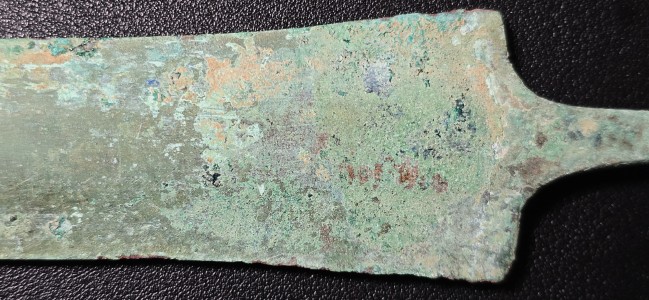
The spearheads at the head of this article — Lot 84068495, Lot 44398282, Lot 84058911 — are excellent objects. They demonstrate real things: the bivalve mould, the cored socket, the rat-tail tang and its mechanical logic, the work-hardened edge, and in the case of Lot 84058911 the fact of combat. They are legitimate evidence about technique.
They are not evidence about geography, because none of them was excavated. Their attributions to Luristan rest on typology and on the dealer chain, and typology cannot distinguish Luristan from several neighbouring traditions with confidence. Lot 38071001’s north-western Iranian attribution rests on an expertise citing Tepe Hisar, Tureng Tepe and Marlik comparanda — a reasonable typological argument, and no more than that.
And they are not evidence about alloy composition unless someone cleans a surface and measures beneath the patina, for the reason set out above.
That is not a counsel of despair. It is the actual epistemic position of every private collection of Iranian metalwork on earth, including the great ones, and stating it plainly is the only thing that distinguishes a catalogue from a sales brochure.
The culture of Iran in the Bronze Age was extraordinary, and the cultural heritage of Persia includes a metallurgical achievement that the standard narrative genuinely under-weights. That case can be made entirely from excavated evidence. It does not need our objects to prop it up — and our objects are more interesting when we are honest about what they are.
Further reading in this collection
- The Language of Patina: Understanding Corrosion Layers on Ancient Bronze and Copper Alloy Artifacts
- Luristan Bronzes: The Metalworkers of the Zagros
- Western Asiatic Axes and Adzes: A Working Classification
- Anunnaki, Elohim and the Weapons of the Gods: What Was Going On with the Sky Council of the Bronze Age?
Principal sources
Arms and armour Moshtagh Khorasani, M. (2006) Arms and Armor from Iran: The Bronze Age to the End of the Qajar Period. Legat Verlag. Rezvani, B. (2008) Review of the above. Iranian Studies 41.1: 103–106.
Early metallurgy of the plateau Vatandoust, A., Parzinger, H. & Helwing, B. (eds, 2011) Early Mining and Metallurgy on the Western Central Iranian Plateau. Archäologie in Iran und Turan 9. Boscher, L., Pernicka, E. et al. (2013) ‘Large scale smelting of speiss and arsenical copper at Early Bronze Age Arisman, Iran’. Journal of Archaeological Science. Pernicka, E. (2004) on fifth-millennium smelting evidence, Tepe Ghabristan and Tepe Zagheh. Malek Shahmirzadi, S. & Nokandeh, J. (from 2002) Sialk Reconsideration Project.
Tin and provenance Nezafati, N., Pernicka, E. & Momenzadeh, M. (2009) ‘Deh Hosein…’ TÜBA-AR 12: 223–236. Powell, W., Frachetti, M., Pulak, C., Yener, K. A. et al. (2022) Science Advances 8: eabq3766. Berger, D., Kaniuth, K., Brügmann, G. & Pernicka, E. (2023) Frontiers in Earth Science 11, DOI 10.3389/feart.2023.1211478; and DOI 10.3389/feart.2023.1224873 on Central Asian bronzes. Yener, K. A. (1989) Science 244: 200–203 (Kestel/Göltepe).
Elam, Oxus, Jiroft, Caucasus Narasimhan, V. et al. (2019) ‘The formation of human populations in South and Central Asia’. Science 365: eaat7487. Lyonnet, B. & Dubova, N. (eds, 2021) Questioning the Oxus Civilization. Muscarella, O. W. (2001[2005]) ‘Jiroft and “Jiroft-Aratta”‘. Bulletin of the Asia Institute 15: 173–98. Kohl, P. (2009) ‘Origins, Homelands and Migrations’. Tel Aviv 36: 241–265. Marro, C. & Stöllner, T. (eds, 2021) On Salt, Copper and Gold.
Luristan corpus, typology and authenticity Overlaet, B. (2003) The Early Iron Age in the Pusht-i Kuh. Acta Iranica 40; and ‘Luristan Bronzes ii. Chronology’, Encyclopaedia Iranica. Muscarella, O. W. (1988) Bronze and Iron; (2000) The Lie Became Great. Moorey, P. R. S. (1971) Catalogue of the Ancient Persian Bronzes in the Ashmolean Museum. Maxwell-Hyslop, K. R. (1946) ‘Daggers and Swords in Western Asia’. Iraq 8: 1–65. Deshayes, J. (1960) Les outils de bronze. Medvedskaya, I. N. (1982) Iran: Iron Age I, BAR Int. Ser. 126; (1989) Iranica Antiqua 24: 1–42. Simpson, St J. & La Niece, S. (2010) British Museum Technical Research Bulletin 4: 95–101. Rodzinka, K. et al. (2024) ‘Neutron tomography reveals extensive modern modification in Iron Age Iranian swords’. Journal of Archaeological Science 165: 105969.
Ancient geography Strabo, Geography 2.1.22f.; 11.11.1; 15.2.1–9. Encyclopaedia Iranica, s.v. ‘Aria’, ‘Bronze Age’, ‘Elam ii’, ‘Luristan Bronzes i–iii’, ‘Jiroft iii’.
Transparency statement
This article uses the house marking system throughout:
✅ Established scholarship — claims supported by excavated evidence and peer-reviewed publication, where the field is broadly settled. ⚠️ Argued inference or contested — claims where competent specialists disagree, or where the inference goes beyond what the evidence strictly compels. Named proponents are given on each side wherever possible. ◆ Author’s own framework — interpretive positions original to this site, offered as argument rather than as finding.
Compositional statements about objects in this collection rest on typological and visual assessment unless a cleaned-surface analysis is explicitly cited. Surface XRF on uncleaned patina is not treated as valid evidence of alloy composition anywhere in this article. Attributions for Lot 90939651 and Lot 946 are flagged as unreliable and are not used to support any argument in this piece.