
Atacamite or Malachite? A Collector’s Field Protocol for Active Corrosion
By Andrzej M. Izyk — Sancta Clara Collection / AncientBronzes.com
There is a companion article on this site, The Language of Patina, which is about reading a surface: what the minerals are, how they stack, what they tell you about the soil an object lay in for three thousand years. That article treats patina as a document.
This one is about what to do when the document is still being written — when the corrosion on the piece in your hand has not finished, and is not going to finish, and will keep eating the object on your shelf until either you intervene or there is nothing left to intervene in.
Bronze disease is the only corrosion process a private collector genuinely has to act on. Everything else on an ancient copper alloy surface is history. This one is a present-tense event. And the reason it deserves a full article rather than the five hundred words I gave it last time is that almost everything written about it for collectors is either wrong, dangerously over-confident, or — most commonly — correct about the chemistry and catastrophically wrong about what you should therefore do with a three-thousand-year-old object.
I want to start with the principle that governs every decision in this article, because if you take nothing else from it, take this.
1. What You Are Actually Protecting
The instinct, when you see pale green powder blooming on a bronze, is to get rid of the green. That instinct is the single largest cause of destroyed archaeological information in private collections.
What you are protecting is not the colour. It is not even, strictly, the metal. What you are protecting is the original surface — the surface the smith ground, filed, polished, and in some cases inscribed. On a tin bronze, that surface is not gone just because the metal has corroded inward by a millimetre. It survives as a chemical horizon inside the corrosion structure, at the level of the tin-oxide (cassiterite) enrichment zone, because tin oxidises essentially in place while copper migrates outward. I set out that mechanism in detail in The Language of Patina, and it is worth reading that section before you touch anything, because it is the reason the following statement is true:
A cleaning that removes the green also removes the record of what the object looked like when it was made.
✅ This is established conservation science, not a house opinion. The preservation of original surface at the tin-oxide horizon is why heavily mineralised Bronze Age objects can still yield casting seams, grinding striations, file marks, and occasionally an ancient fingerprint.
So the operative question is never “how do I get this clean?” It is: is this object stable, and if not, what is the least invasive thing that will make it stable? In a meaningful number of cases the answer to that second question is “nothing, plus a dry box.”
That is not evasion. It is, on the current evidence, frequently the correct treatment.
2. Surface Corrosion Versus Transformed Fabric — the Distinction That Decides Everything
Before the chemistry, a structural point that I consider the most useful single diagnostic available to a collector without a laboratory, and which I have not seen stated plainly anywhere in the collector literature.
On a genuine ancient copper-alloy object, corrosion is not a coating. It is a transformation of the material itself, and it runs into the depth of the piece.
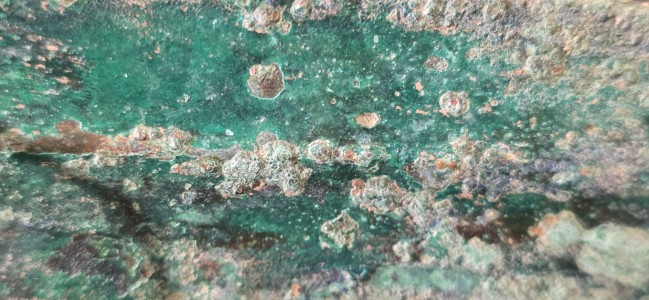
On a modern object with an induced patina, corrosion is a coating. It sits on top of metal that is otherwise unaltered. The distinction is not a matter of degree. It is a difference of kind, and it is visible at any point where the object is broken, chipped, or abraded.
What the transformed fabric looks like
When a copper alloy spends three or four thousand years in the ground, the corrosion front does not stop at the surface. It advances inward along grain boundaries, along the interdendritic spaces left by the original casting, along every microstructural weakness in the metal. Copper is progressively mobilised and carried outward. Tin oxide accumulates where it stands. What is left behind, in the interior, is not the alloy the smith poured. It is a mineral fabric that occupies the same shape.
This is why a heavily corroded ancient bronze, when it breaks, does not break like metal. Metal tears, bends, and leaves a bright ductile fracture face. A deeply mineralised ancient bronze breaks like a mineral — it snaps, and the fracture face is granular, crystalline, matte, and coloured all the way through.
The Oxus axe
The clearest example of this in the Sancta Clara Collection is Lot 102371201, the giant Bactria–Margiana axe-adze — 1,364 g of copper alloy, four reinforcing collars on the shaft tunnel, the heaviest single casting in the collection.
There are places on this piece where the patina has been chipped away, and what those chips expose is not metal. It is more crystallised material. The fabric of the object continues, in mineral form, into its depth. What was poured as a metal casting is now, at least through a substantial part of its section, a crystalline pseudomorph that has kept the axe’s geometry while abandoning its metallurgy.
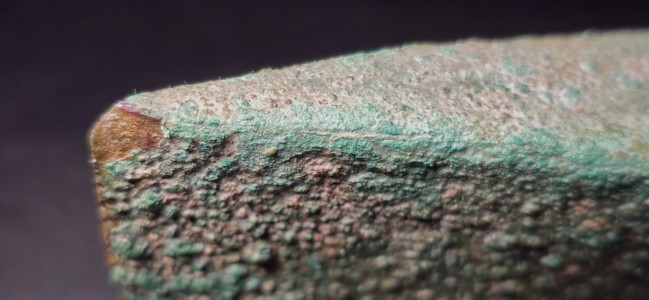
⚠️ I state that as a hand-and-loupe observation, not as an analysed result. Confirming the phase composition and the depth of the transformation would require sectioning and X-ray diffraction, which on a piece of this quality I am not prepared to do and would not recommend. What can be said with confidence is what the eye can verify: the exposed interior surfaces are crystalline and mineral in character, not metallic, and they are continuous with the exterior corrosion rather than separated from it by a boundary.
The practical consequences of this run in two directions at once.
For authentication, it is close to decisive. A forger can produce a convincing surface. Producing a convincing interior is a different problem entirely, and one that accelerated chemistry does not solve, because chemical attack works inward from the outside on a timescale of days and weeks and simply does not have time to restructure a casting through its section. This is why the single most informative place to look on a suspect bronze is any break, chip, or old damage — and why a piece with no exposed section anywhere on it deserves more scepticism, not less.
For handling, it is a warning. An object whose core has become mineral has lost the toughness of metal. It has the mechanical properties of a piece of malachite: hard, brittle, and completely intolerant of flexion or impact. Heavy mineralised pieces are dropped and shatter far more often than collectors expect, because the hand expects the weight of bronze to behave like bronze.
The same feature in other pieces
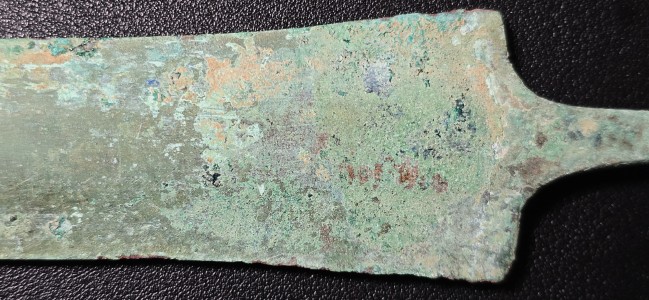
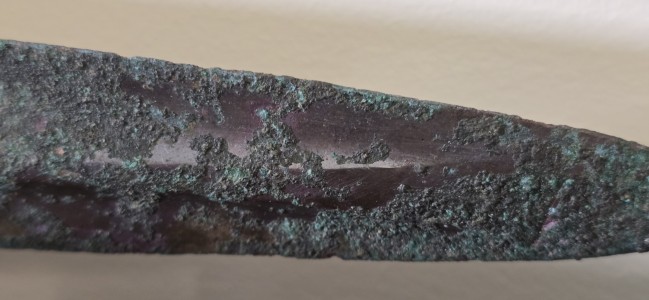
Varying degrees of the same process are visible across the collection. Lot 83039827, the copper dagger of before 1600 BC, is very nearly all the way there — the thick azurite and malachite layering has consumed most of the section, leaving only a few millimetres of core. Lot 32737, the split-socket pike, shows a cassiterite level beneath the malachite, which is the tin-oxide horizon becoming visible where the outer layers have been lost. Lot 84122607, the black-surfaced Egyptian blade, sits at the other end of the range: a mature, glassy, tin-rich surface over a blade that remains substantially metallic beneath.
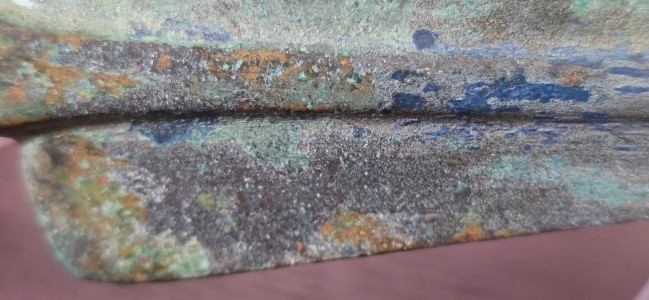
Hold those three in mind as a scale. The question you should ask of any piece is not “does it have patina” but “how far has the fabric of this object been converted, and does the conversion behave like something that took millennia or something that took a fortnight?”
3. What Bronze Disease Actually Is
Now the chemistry, briefly, because the treatment decisions only make sense against it.
Chloride ions enter the corrosion system from the burial environment — saline soils, coastal or marine deposition, and in some contexts groundwater carrying chloride from much further afield. At the metal surface, beneath the cuprite layer, they form nantokite (CuCl), cuprous chloride: a pale, waxy, poorly soluble mineral that sits in subsurface pits and is essentially invisible from outside.
While the object is in the ground, in a stable low-oxygen environment, nantokite does nothing. It can sit there for three millennia. The problem begins at excavation, when the object meets atmospheric oxygen and atmospheric moisture simultaneously for the first time since the Bronze Age.
Under those conditions nantokite undergoes oxidative hydrolysis to copper trihydroxychloride — atacamite and its polymorphs paratacamite, clinoatacamite, and botallackite. Two things follow, and both are destructive:
- The reaction releases hydrochloric acid, which attacks fresh metal, liberating more copper and regenerating more chloride. The cycle is autocatalytic. It does not exhaust itself while metal and moisture remain.
- The reaction products occupy far more volume than the reactants. ✅ The relative molar volume increase involved in the conversion is substantial — Scott’s 1990 review notes that the expansion is even more marked than for the comparable cuprite transformation. That expansion generates internal pressure sufficient to burst the overlying patina outward. This is why bronze disease presents as pustules and blisters rather than as a stain. It is a mechanical event driven by a chemical one.
Two corrections to widespread collector belief while we are here.
Bronze disease is not contagious in the ordinary sense. You will read that an infected coin must be quarantined lest it infect its neighbours. Quarantine is good practice for other reasons — it lets you monitor, and it stops you confusing which piece is active — but the mechanism being imagined is wrong. Chloride does not migrate through air from one object to another. A piece that develops bronze disease had chloride in it already, from burial. What changed was the humidity. ⚠️ Confidence: high on the chemistry; I acknowledge that a shared humid enclosure genuinely does raise risk for every object in it, which is probably the observation that produced the folk belief.
“Verdigris” is not a synonym for bronze disease. Verdigris is a loose term for green copper corrosion generally, and in its strict sense refers to copper acetate. Using it for chloride corrosion collapses precisely the distinction — stable green versus active green — that a collector most needs to hold. I have used the two terms loosely myself in earlier writing on this site and have corrected it.
4. The Humidity Threshold, and Why the Published Numbers Disagree
Every guide will give you a relative humidity figure below which bronze disease stops. The figures do not agree, and the disagreement is not trivial rounding.
- Scott (1990, JAIC 29/2) examined the thermodynamics and concluded that for the majority of bronzes an RH of 42–46% is sufficient, on the basis that cuprous chloride will not undergo the hydrolysis reaction at that level. ✅
- Other laboratory work, including studies cited in the conservation literature through the 2000s, puts the safe level considerably lower, at below 35%, on the basis of observed suppression of paratacamite formation. ✅
- Contemporary institutional practice commonly specifies below 40%, with high-risk archaeological material held lower still.
- Recent experimental work (2025, Heritage) revisits the relationship between oxidative hydrolysis of CuCl and RH precisely because the older figures have proved difficult to reconcile with observed object behaviour.
Why the spread? Because the threshold is not a property of the chemistry alone. Scott himself notes complicating factors that make a single number hard to defend: nantokite’s low solubility limits how far hydrolysis can proceed; the possible presence of copper chloro-complexes within the corrosion crust is an unknown; and water can be adsorbed or trapped internally by microcapillarity, meaning the humidity inside a pit is not the humidity your hygrometer reads. An object can be locally wet in a dry room.
My reading, and I put it forward as a reading rather than a fact:
⚠️ There is no single threshold, and any source that gives you one to the nearest percentage point is overselling. The defensible position is that risk falls steeply somewhere in the 35–45% band and that lower is safer for actively diseased material. For a piece showing active corrosion I would target below 35% and accept that this is more than the thermodynamics strictly requires. For stable material I would hold 40–50% and not obsess.
That last point deserves emphasis, because the collector reflex is to desiccate everything. ✅ Scott’s own conclusion was that there is no particular reason to reduce the RH of stored bronzes that show no signs of disease. And there is a real cost to over-drying: several pieces in this collection retain organic material. The Dong Son axe, Lot 98277415, preserves remains of its wooden handle. Wood, bone, leather, and textile remnants in sockets and hafts are among the rarest survivals in the entire field, and holding them at 15% RH will crack and check them. Desiccation is a treatment for a specific condition, not a universal storage philosophy.
Practical humidity control
- A sealed polyethylene or polypropylene box with a gasket, conditioned silica gel, and a cheap digital hygrometer costs less than any single object worth protecting. This is the whole of the technology.
- Silica gel must be conditioned to the target RH, not simply dried to zero and thrown in. Bone-dry gel in a sealed box takes the enclosure to a level you did not intend.
- Gel exhausts. Indicating gel changes colour; non-indicating gel gives you no warning at all. Put a date on it.
- Do not seal a damp object into a box. If a piece has been washed or has come out of a humid environment, let it equilibrate first.
- Silicone-sealed display cases are better than open shelves; open shelves in a heated room in a Central European winter are, incidentally, drier than most collectors assume.
5. Field Diagnosis: Is It Actually Bronze Disease?
More pieces are treated for bronze disease than have it. Here is the sequence I use.
Step 1 — Colour is the weakest evidence
Atacamite runs from a pale apple green to a yellowish or bluish green. Malachite runs from sage to deep emerald. The ranges overlap. Colour alone will tell you nothing reliable, and every collector who has confidently diagnosed from a photograph has been wrong at some point.
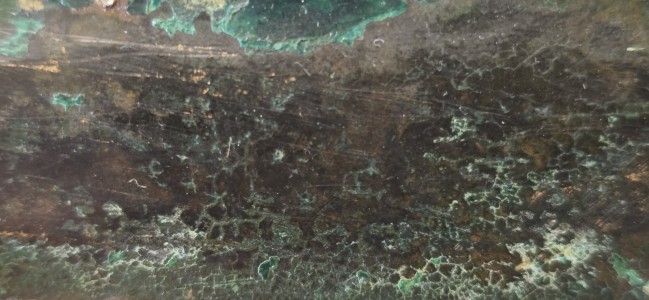
Step 2 — Texture and hardness
This is where the real information is.
| Stable malachite | Active chloride corrosion | |
|---|---|---|
| Texture | Smooth, hard, adherent | Powdery, waxy, friable |
| Fingernail | Resists | Crumbles, marks easily |
| Cotton swab | No transfer | Pale green streak on the swab |
| Location | Follows the whole surface | Concentrated in pits, cracks, breaks |
| Form | Layer or crust | Pustule, blister, warty eruption |
| Under a loupe | Banded, botryoidal, fibrous | Loose, sugary, disorganised |
The single most telling feature is the pustule. Stable patina is a layer. Bronze disease is a thing pushing through a layer from beneath. If the green is erupting out of a hole in the surrounding patina, that is chloride until proven otherwise. If the green is the surrounding patina, it is probably fine.
Step 3 — Where is it?
Chloride corrosion concentrates where moisture can get to buried nantokite: inside sockets, in casting flaws, along old breaks, under rivets, at the interface between the object and any mounting adhesive. Check the interiors of socketed pieces, which are exactly the places nobody looks. On a socketed spearhead such as Lot 98465245, the interior of the socket is both the most protected surface on the object and, if chloride is present, the most vulnerable.
Step 4 — Rule out the false alarms
Several things look alarming and are not.
Ferrian copper surfaces. A group of pieces in this collection — Lot 912, Lot 913, Lot 911, and Lot 1111 — carry reddish-brown, rust-coloured surfaces produced by iron content in the smelted copper. To an eye trained on green they look wrong, and more than one seller has described such pieces as “corroded” or “damaged.” They are stable, and the colour is a smelting signature rather than a pathology. I have set this out at length in Ferrian Copper: What Rusty Bronze Age Daggers Reveal About Ancient Smelting.
Soil-derived powder. Dried clay, gypsum, and carbonate dust from the burial environment can sit loose in recesses and look powdery. It is the wrong colour when you look properly, and it does not regenerate after removal.
Degraded old restoration. Wax, shellac, cellulose nitrate, and mid-twentieth-century consolidants degrade to powders and blooms. Acetone on a swab will lift an organic coating and leave a coloured or cloudy trace; it does nothing at all to a mineral.
Azurite. Blue, crystalline, and stable. It sometimes sits in pockets that look eruptive. Under a loupe it has crystal faces; atacamite does not.
Step 5 — The test that actually settles it
Everything above is inference. There is one test that is close to definitive and it costs nothing:
Photograph it, isolate it dry, and look again in a month.
Stable patina is static. It looks identical in April and in October. Active chloride corrosion is dynamic — untreated, it grows, spreads, and generates new eruptions over weeks, particularly above 45% RH. Nothing else in the collector’s toolkit distinguishes stable from active with the same reliability, and the only cost is patience.
The method, properly done:
- Photograph the affected area at fixed magnification, with a scale, under consistent lighting — raking light from a fixed angle shows relief far better than flat light.
- Note the date and the ambient RH.
- Isolate the piece in a sealed box at 35% RH or below.
- Re-photograph at four weeks, then at three months.
- Compare like for like. Growth means chloride. No change over three dry months means you were probably looking at stable mineral, or the desiccation has already done its job.
That last ambiguity is real and worth naming: a dry box is simultaneously a diagnostic and a treatment, so a negative result does not distinguish between “it was never active” and “it was active and has stopped.” For practical purposes it does not matter. Both are the outcome you wanted.
6. Treatment, and the Fact That Conservators Do Not Agree
The collector internet presents treatment as settled procedure: mechanically remove the pustules, soak in sodium sesquicarbonate, stabilise with benzotriazole, seal with a lacquer. Every one of those steps is contested in the professional literature, and the contest is not marginal.
I am going to set out the options honestly, including the case against each, because I would rather you made an informed decision than followed a recipe.
Option A — Environmental control alone
Reduce and hold RH below the active threshold. Do nothing else. Monitor.
In favour: it cannot damage the object, cannot remove the original surface, cannot stain, cannot alter the patina, and costs almost nothing. Available moisture is the necessary condition for the reaction, and removing it stops the process for as long as it stays removed. It is, for a private collection with a small number of affected pieces, the treatment with by far the best ratio of benefit to risk.
Against: it does not remove the chloride. The nantokite is still in the object, and the object is one humid summer, one house move, or one careless heir away from resuming. It is management rather than cure.
◆ My own position: for the great majority of pieces in a private collection, this is the correct first and often only treatment. The chemical treatments below are worth their risk on objects that are actively disintegrating, and are frequently not worth it on objects that are merely spotted.
Option B — Mechanical removal
Excavating the pustules and the underlying pale nantokite under magnification, with a scalpel, glass-fibre brush, or micro-abrasive, then desiccating.
In favour: removes material directly, allows you to see whether you have reached sound structure, and does not introduce any chemistry to the object.
Against: it is destructive by design, and the thing it is most likely to destroy is the original surface horizon discussed in section 1. Working blind into a pit, it is extremely easy to cut past the cassiterite level. This is genuinely a skilled procedure requiring a stereo microscope, and I would not attempt it on any piece I valued.
Option C — Chloride extraction (sodium sesquicarbonate and relatives)
Immersion in alkaline solution — classically ~5% sodium sesquicarbonate, sometimes sodium carbonate, sodium hydroxide, or with electrolytic assistance — to convert and leach out chloride.
In favour: it addresses the actual cause rather than the symptom, and in institutional hands with proper solution control it has a long track record. ✅ The British Museum work on sesquicarbonate is the origin of the standard 5% figure.
Against, and this is substantial:
- ⚠️ Concentration matters enormously and is routinely got wrong. A meaningful part of the reported “sesquicarbonate ruined my patina” experience appears to trace to solutions that were not what the maker believed them to be — sodium sesquicarbonate is not reliably improvisable from household chemicals, a point made firmly in the numismatic conservation literature.
- ⚠️ Alkaline dechlorination can make things worse before it makes them better. Quantitative work on NaOH dechlorination shows the treatment operates by converting CuCl to trihydroxychloride — and that this conversion expands the chloride layer, in one experimental series nearly doubling its thickness at a given current density. The mechanism you are relying on to save the object is the same expansive mechanism that cracks patina.
- ⚠️ It is slow and unforgiving. Adequate extraction is measured in months, followed by months of rinsing in deionised water, followed by controlled drying. Objects are lost in the middle of this process by people who lost interest in month four.
- It changes the surface. Even successful treatment alters colour and texture. The patina you get back is not the patina you sent in.
Option D — Corrosion inhibitors (benzotriazole and alternatives)
BTA complexes with the copper surface to form a protective barrier film.
In favour: widely used, effective as a barrier, comparatively simple to apply.
Against:
- ⚠️ It inhibits rather than cures. BTA does not remove chloride. It interposes a film between the chloride and the moisture. Where the film is imperfect — and on a pitted, porous archaeological surface it will be imperfect — the reaction can continue underneath.
- ⚠️ Its use is being actively questioned on toxicity grounds, and this is one of the clearer instances of received conservation practice under revision. Recent work on alternatives explicitly frames the search as motivated by BTA’s toxicity, testing sodium oxalate followed by limewater as replacements. Other lines of research have pursued zinc dust, silver oxide, and alkaline dithionite.
- It complicates later analysis. An inhibitor film sits between your object and any future surface analysis, and it is not always documented by whoever applied it.
Option E — Lacquering and sealing
Frequently recommended, frequently regretted.
⚠️ Sealing an object that still contains chloride traps moisture rather than excluding it, and gives you a piece that continues to corrode where you cannot see it. Coatings also age, yellow, and become progressively harder to remove without damaging what is beneath. If the underlying problem has not been solved, a coating is a way of not being told about it.
The honest summary
There is no procedure that both removes chloride reliably and leaves the object unchanged. ⚠️ Every effective treatment trades archaeological information for stability, and the professional literature is presently arguing about the exchange rate. The collector’s advantage over the museum is that the collector is not obliged to treat: a piece can simply be held dry and watched, indefinitely, at no cost to the object.
When to stop and call a conservator: when the object is structurally at risk; when pitting has reached through a thin section; when a piece has surviving organic material that a wet treatment would destroy; when it is important enough that you would not forgive yourself. Any of the treatments above, performed badly, does more harm than the disease does in a year.
7. A Note on XRF and Instrumental Shortcuts
Handheld XRF is now cheap enough that serious collectors own one, and it is genuinely useful. It is also systematically misleading in exactly the situation described in this article.
✅ On an uncleared archaeological surface, the analysed volume is the corrosion crust, not the alloy. Because copper is preferentially mobilised and carried outward while tin oxide is left behind, the surface layer of a corroded tin bronze is enriched in tin relative to the metal beneath it. An XRF reading taken on the patina will therefore overstate tin content, sometimes grossly — I have seen surface readings return figures that would imply alloys no Bronze Age smith ever poured.
The same limitation applies to chloride. A surface reading tells you about chloride at the surface, which is where atacamite already is. It tells you very little about nantokite sitting in subsurface pits, which is the material that matters. A clean XRF chloride result is not a clean bill of health.
Use XRF for what it does well — screening for anachronistic elements such as zinc, nickel, or modern refining signatures, which is the one job where surface analysis of a suspect piece is genuinely decisive. Do not use it to quantify an ancient alloy through a patina, and do not use it to rule out bronze disease.
8. Forgers Now Use Active Chemistry as an Ageing Process
This section requires me to qualify something I wrote in The Language of Patina. I stated there that the layered structure of genuine patina “cannot be faked.” That was too strong, and the state of the art has moved.
The current reality is this. Workshops producing forged bronzes — I described their methods in The Collector’s Eye: Identifying Modern Forgeries in Ancient Bronze Markets — do not paint patina on. They induce real corrosion chemically, typically by immersion in baths containing copper chloride, hydrochloric acid, and sometimes ammonia, followed by burial in treated soil for weeks to months.
The important and uncomfortable point is that the products of this process are genuine minerals. ✅ Experimental work published in 2025–2026 on time-efficient ageing methods demonstrates that an electrochemical protocol can produce a compact patina with a convincing cuprite–malachite stratigraphy in four days, and that a burial-based approach — explicitly built on knowledge derived from historical counterfeiting practice — generates more complex corrosion systems incorporating soil-derived encrustations and chloride-bearing phases on a drastically compressed timescale. Atacamite has been identified in such artificially aged material.
So: yes, a forger can now give you real cuprite under real malachite, with real soil in it, and can give you chloride phases into the bargain.
This means the pale green pustule is no longer, by itself, evidence of antiquity. I want to be blunt about that, because “it has bronze disease, so it must be ancient” is an argument I have heard made in the market, and it is now worthless. A chloride-bath forgery is supposed to produce chloride corrosion. Some of these objects arrive genuinely diseased.
What still separates them
Three things, in ascending order of reliability.
Mineral assemblage. ⚠️ Chemically forced corrosion tends to produce metastable and unusual phases that slow burial does not favour. Raman and XRD studies of seized fakes have reported assemblages containing covellite, antlerite, langite, chalcanthite, and rouaite — species traceable to chemical attack and thermal treatment — while the malachite and azurite characteristic of naturally aged patinas were absent. This is powerful evidence but requires instrumentation.
Stratigraphic logic. Accelerated patina is thin and uniform. Genuine patina varies across a surface for reasons that make archaeological sense — thicker where the object lay against soil, different where it touched wood or bone, thinner where it was protected. Uniformity is suspicious; so is variation that follows no plausible depositional logic.
And, decisively, section 2 of this article. Four days of electrochemistry produces a surface. Three thousand years produces a transformed object. The forger’s patina sits on top of unaltered modern metal, and the moment you find any chip, break, or abraded area, the difference is not subtle: bright ductile metal under a mineral skin, versus the crystalline fabric that the Oxus axe shows in its chipped areas.
◆ This is the diagnostic I would put at the top of the list for anyone buying without laboratory access. Look for a break and look into it. Not at the surface — into the section. A genuine deeply corroded ancient bronze has become, in part, a mineral; a fake has merely been painted with mineralogy by a chemist. No accelerated process available to a workshop restructures a casting through its depth, because the thing that does that is time, and time is the one reagent that cannot be bought.
The corollary is worth stating: this is one of the few respects in which a damaged object is diagnostically superior to a perfect one. A chipped edge is an open window. A flawless piece with no exposed section anywhere is a piece that gives you nothing to look into.
9. Collection-Level Practice
A short protocol, which is what I actually do.
On acquisition. Photograph everything, including the interiors of sockets, at fixed magnification with a scale. Note ambient RH. Quarantine new arrivals in a dry box for three months before they join the collection — new material is where active corrosion arrives from, and three months of separate monitoring is cheap insurance.
Storage. Stable pieces at 40–50% RH. Anything with a history of activity, marine or coastal provenance, or visible pitting at 35% or below. Pieces retaining organic material — the Dong Son axe among them — never below about 40%, and never in contact with desiccant.
Inspection. Twice yearly, with a loupe and raking light, including socket interiors and every old break. This is where you find things a year before they become emergencies.
Documentation. Every treatment, every solvent, every consolidant, dated, in the catalogue record. An undocumented treatment is a trap laid for whoever handles the piece next — including your future self, and including any analyst who later wonders why the surface chemistry makes no sense.
Handling. Clean, dry hands or nitrile gloves; chloride from perspiration is a real contribution, not a theoretical one. Support mineralised pieces along their length rather than by an end. Assume anything heavily corroded is brittle, because it is.
10. What This Comes Down To
Bronze disease is the one thing in a collection of ancient copper alloys that is genuinely happening rather than merely having happened, and it deserves the vigilance. But the panic it produces does more damage than the chemistry, because panic reaches for the abrasive and the acid, and what it destroys is precisely what makes the object worth owning: the surface the smith left, preserved for three thousand years inside the very corrosion the collector is trying to scrub off.
The disciplined response is unglamorous. Look properly. Distinguish the eruption from the layer. Photograph, isolate, dry, and wait a month before believing anything. Treat chemically only when the object is actually being lost, and know that when you do, you are trading information for stability. And when you are trying to decide whether a piece is what it claims to be, stop looking at its face and look into its wounds — because it is in the broken section, where the crystalline fabric either continues into the depth or stops abruptly at bright metal, that the object finally tells the truth about how long it has been becoming what it is.
Transparency of claims
✅ Established scholarship — the autocatalytic nantokite–atacamite mechanism and its volume expansion; Scott’s 1990 42–46% RH conclusion and the competing sub-35% figure; preservation of original surface at the tin-oxide horizon; preferential copper migration and consequent tin enrichment at the surface; 2025–2026 experimental demonstration that convincing cuprite–malachite stratigraphy and chloride phases can be produced in days to weeks; documented metastable mineral assemblages in seized forgeries; the expansive mechanism of alkaline dechlorination; the toxicity-driven search for benzotriazole alternatives.
⚠️ Argued inference — that no single defensible RH threshold exists and the 35–45% band should be treated as a gradient; that the “contagion” model of bronze disease is mechanistically wrong; that BTA inhibits rather than cures on porous archaeological surfaces; the depth and phase composition of the crystallised fabric in Lot 102371201, which is stated as a hand-and-loupe observation and has not been analytically confirmed; the diagnostic weight assigned to mineral assemblage in forgery detection.
◆ Author’s own framework — the surface-corrosion versus transformed-fabric distinction as the primary field diagnostic for authenticity; the recommendation that environmental control alone is the correct treatment for most privately held affected pieces; the argument that a damaged piece is diagnostically superior to an undamaged one; the collection-level protocol in section 9.
This article is part of the reference materials published by the Sancta Clara Collection at AncientBronzes.com. Content is provided for educational purposes and reflects observations drawn from direct study of the collection’s holdings. It is not a conservation manual: any intervention on an object of significance should be undertaken by, or in consultation with, a qualified conservator. For related discussions, see The Language of Patina, The Collector’s Eye: Identifying Modern Forgeries in Ancient Bronze Markets, Ferrian Copper: What Rusty Bronze Age Daggers Reveal About Ancient Smelting, Paleo-Metallurgical Techniques and Their Signatures on Ancient Bronzes, and Collecting with Conscience.