
Reading the Hand of the Smith
When I lift a Bronze Age spearhead from its tray and turn it under raking light, I am not simply admiring an object — I am reading a manuscript. Every facet, faint seam, each drilled rivet hole and stone-ground bevel is a sentence in a language that the smith spoke with hammer, mould, and abrasive. The artifact carries within itself a complete record of how it came into being. The collector who learns to read this record gains an indispensable interpretive tool — not only for understanding the craft of ancient metallurgists, but for evaluating authenticity, dating, regional attribution, and the relative skill of the workshop that produced the piece.
The Sancta Clara Collection spans roughly five millennia of human engagement with metal, from the cold-hammered native copper of the Chalcolithic through the cast-and-finished bronze masterpieces of the early first millennium BCE to bronze details form the first millenium CE. Across hundreds of catalogued objects, the same essential repertoire of techniques recurs again and again — but executed with such variation in skill, material, and intent that no two pieces tell quite the same story. What follows is a working guide to the principal paleo-metallurgical techniques and to the diagnostic features by which we recognize them on ancient objects.
This essay is a counterpart to my earlier surveys on the stone-to-metal transition and on Bronze Age metallurgical cultures, and complements the discussions of patina analysis and forgery identification elsewhere on this site. Where those articles look outward to context and culture, this one looks inward, at the object itself: at how the smith made it, and at how, three or four thousand years later, we know.
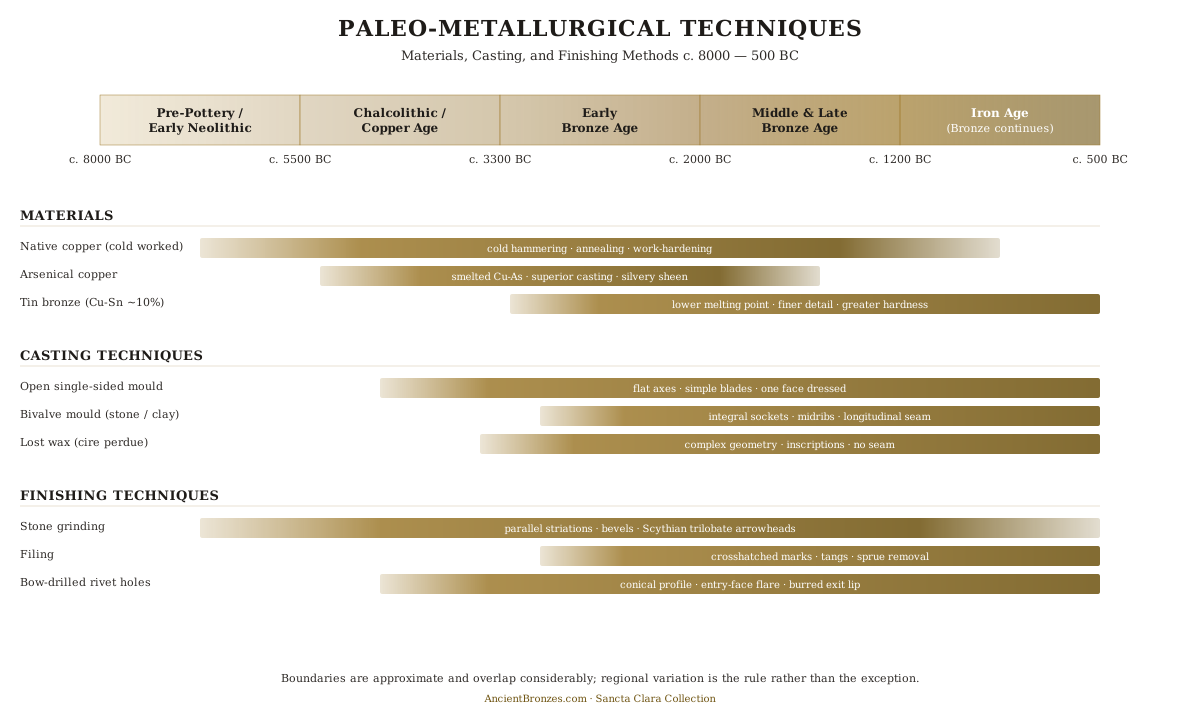
The Cold Start: Working Native Copper
Long before anyone had built a furnace, copper was being shaped into tools. Native copper — metallic copper that occurs unalloyed in nature, most famously around the southern shores of Lake Superior, in the Caucasus, and in scattered deposits across the Iranian Plateau and Anatolia — was the first metal that human hands worked. It is malleable enough to deform under stone hammers without any heat treatment, and it could be cold-hammered into sheets, points, awls, and small blades from roughly the ninth millennium BC onwards in the most precocious regions.
The signature of cold-worked native copper is unmistakable once one has handled it. The surface shows a slightly fibrous, irregular character at the microscale — small overlapping facets where successive hammer blows compressed the metal — and the edges are typically thickened and slightly rounded rather than sharply bevelled. There is no symmetry of flow, no neck transition from a casting socket, and no integral midrib of the kind that only a mould can produce. The piece tends to be thicker in the middle and to thin unevenly toward the edges, betraying the asymmetric pressure of the smith’s hand.
Cold hammering work-hardens copper, raising its hardness substantially but also rendering it brittle. Smiths learned, very early, to anneal the metal — to heat it in a charcoal hearth and quench or air-cool it — restoring ductility and allowing further deformation. The cycle of hammer, anneal, hammer, anneal lies behind a great many of the simplest copper artifacts in the collection, including Lot 5111, a hammered copper pike-adze head with its characteristically curled split socket, and Lot 1516, a wide Cycladic copper spear-point of c. 2300 BC with elongated attachment slots and the unmistakable surface texture of repeated cold work. These objects predate the casting technologies that would shortly displace such laborious procedures, and they preserve in their geometry the limits of what a hammer alone can do.
There is an important corollary for the authenticator. Genuinely cold-hammered native copper artifacts never display the perfectly even thickness, the integral cast sockets, or the symmetrical raised midribs that characterize cast bronzes. When a piece advertised as Chalcolithic native copper exhibits a cast socket, suspicion is warranted — and one should turn to the forgery identification article for the full battery of diagnostic checks.
The First True Alloy: Arsenical Copper
The leap from native copper to smelted metal occurred independently in several regions between roughly the sixth and fourth millennia BC, and once it had occurred, the technological landscape changed permanently. Smiths quickly discovered — or, more likely, accumulated through generations of empirical observation — that copper ores containing arsenic produced a metal with markedly superior properties. Arsenical copper, with arsenic contents typically in the range of 1 to 5 per cent and occasionally higher, casts more cleanly than pure copper, work-hardens to a greater extent, and pours with fewer porosity defects. It also takes a more silvery surface finish, a property exploited deliberately on certain Cypriot daggers of the Early Bronze Age.
The arsenical copper tradition is particularly visible in the Iranian Plateau, in the Carpathian and Balkan region, in the Caucasus, in Anatolia, and in Cyprus — and the Sancta Clara Collection contains several characteristic examples. The Cypriot and Cycladic copper daggers and spearheads with rat-tail tangs (such as Lot 83118347, the Cypriot/Cycladic spearhead of c. 2400–2100 BC, and Lot 84058911, the Luristan leaf-shaped spearhead with rat-tail tang) tend to assay as arsenical coppers, and the closely related Cypriot dagger tradition is treated in greater depth in the article on ferrian copper and Cypriot daggers.
Two diagnostic features of arsenical copper are worth flagging. First, the colour of the freshly broken or polished metal beneath the patina tends toward a pale, slightly silvery yellow rather than the warm orange-red of pure copper or the golden yellow of tin bronze. Second, the corrosion products often include a distinctive greyish or olive-grey component alongside the more familiar greens — a consequence of the arsenic chemistry of the patina.
It is worth pausing on the human cost of arsenical copper. The smelting of arsenic-bearing ores releases highly toxic arsenic-rich fumes, and the chronic exposure of ancient smiths to these vapours produced documented patterns of peripheral neuropathy and skeletal damage that are detectable in skeletal remains from metallurgical workshops of the period. The myth of a powerful yet lame smith, like Hephaestus or Vulcan, and as the Norse dwarven smiths (like Brok and Sindri), may originate from the effects of exposure of arsenical bronze craftsmen to arsenic fumes which caused limping and wasting of the legs. The replacement of arsenic with tin as the principal copper alloying element, beginning in the late fourth and accelerating through the third millennium BC, was thus not only a metallurgical improvement but a major occupational-health advance — though one suspects the early smiths who suffered for it would have appreciated being told.
The Mature Alloy: Tin Bronze
Tin bronze — copper alloyed with roughly 8 to 12 per cent tin, with the optimum hovering around 10 per cent — represents the apex of pre-iron metallurgy and gives its name to the Bronze Age proper. Compared to pure copper or arsenical copper, tin bronze pours at a lower temperature, fills moulds more reliably, casts with finer surface detail, and after appropriate cold-work or quenching reaches significantly greater hardness. It is also a beautifully workable material in the smith’s hand: ductile when annealed, hardenable by hammering, and capable of being filed, ground, and polished to a high finish.
The tin-bronze tradition required long-distance trade networks, because tin deposits are sparse and geographically restricted. The Cornish, Iberian, Anatolian, and Central Asian tin sources sustained the great metallurgical centres of the second millennium, and the trade in tin ingots — attested in the Uluburun shipwreck of c. 1300 BC and in countless texts from Mari, Ugarit, and other Bronze Age archives — was a foundational economic fact of the period.
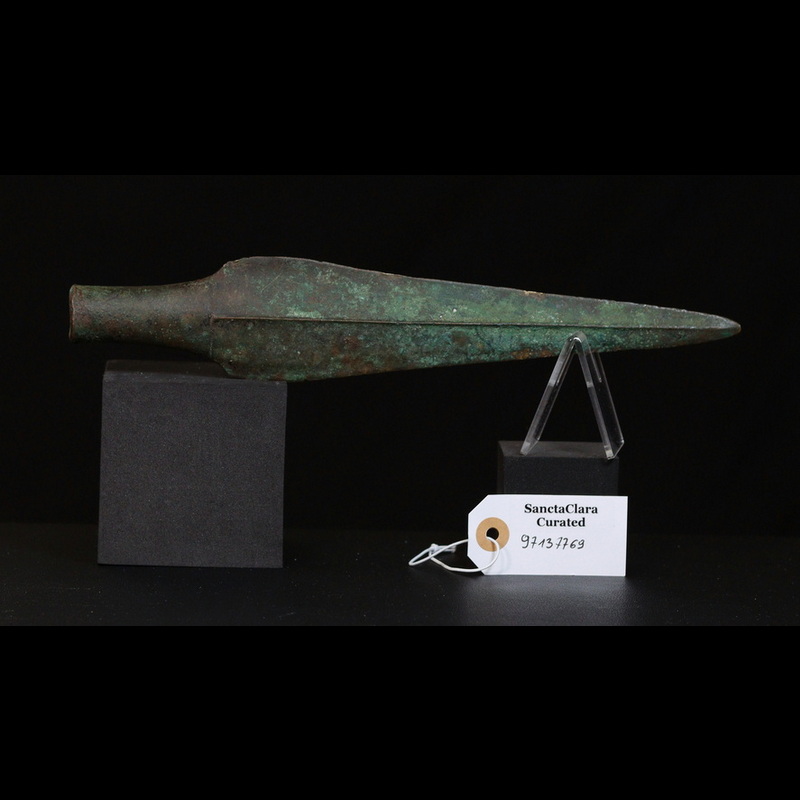
Bronze can usually be distinguished from arsenical copper at the macroscale by colour beneath the patina (warmer yellow, with a hint of gold), by the cleaner edges and finer surface detail of cast features, and by the structural integrity of cast sockets and midribs. The European Bronze Age socketed spearheads of the Urnfield and Atlantic traditions — represented in the collection by Lot 97137769, a magnificent socketed spearhead of c. 1500–1100 BC, and by Lot 97806108, a smaller socketed example of similar date — display the technical confidence that mature tin bronze allowed: thin walls, sharp midribs, integral cast sockets with paired rivet holes, and overall weights remarkably low relative to size.
Casting Methods: From Open Mould to Lost Wax
If the choice of alloy defines the metallurgical era, the choice of mould defines the workshop. Four principal casting methods are attested in the archaeological record, and all four have left clear diagnostic signatures on objects in the collection.
Open Single-Sided Moulds
The simplest casting technology is the open mould — a single block of stone (typically a fine-grained sandstone, steatite, or limestone) into which the negative of the desired object has been carved. Molten metal is poured into the open cavity, and the upper surface of the cast object — exposed to the air — solidifies flat and somewhat rough, with out-gassing bubbles sometimes visible, while the lower and side surfaces take the polished profile of the mould.
Open-mould castings are therefore unmistakable: one face is dressed, the other crude. They are best suited to simple flat objects, and the principal artifact category they produced is the flat axe. The small copper flat axes in the collection — Lot 4949, Lot 4950, and the small copper double-axe Lot 4944 — display exactly this asymmetric finish: a well-defined lower face, a rougher upper face, and edges that have been subsequently dressed by cold hammering and grinding to bring them to true. Open-mould castings dominate the Chalcolithic and persist into the Early Bronze Age for the simplest tool forms.
Bivalve Moulds: Stone and Clay
The decisive technical advance is the bivalve mould — two halves of carved stone (or moulded and fired clay) that fit together precisely, leaving a closed cavity into which metal is poured through a sprue at the top. Bivalve moulds permit the casting of fully three-dimensional objects, including integral sockets, raised midribs, symmetrical blades, and complex hafting features. The technology is attested from the third millennium BC and dominates the Bronze Age proper.
The diagnostic signature of a bivalve casting is the seam: a faint raised line, running longitudinally down the object, where the two halves of the mould met and a thin fin of metal escaped between them. On well-finished objects this seam has been ground down or polished away, but it remains detectable as a slight asymmetry, a faint discoloration of the patina along the line, or a microscopic ridge visible under raking light. Lot 97137769, the large European Bronze Age spearhead discussed earlier, preserves a visible joint line perpendicular to the midrib at the neck of the socket — exactly the location where a bivalve mould’s parting plane would have been positioned. The catalogue description notes this feature explicitly, and it is, in this case, the single most informative manufacturing detail on the entire object.
Stone bivalve moulds were reusable and produced consistent results within a single workshop; surviving examples (none in this collection, but well-known from sites across the Bronze Age world) show wear patterns consistent with repeated use over many seasons. Clay piece-moulds, by contrast, were typically broken away after a single casting, which is why they survive far less often as objects but show up everywhere as fragments in workshop debris.
Lost-Wax Casting (Cire Perdue)
The technical apex of pre-industrial metalwork is lost-wax casting. The smith models the desired object in beeswax (or a mixture of beeswax and tree resin), invests the wax model in a clay or clay-and-sand jacket, then heats the assembly so that the wax melts and runs out through a vent — leaving a perfectly faithful negative cavity in the now-hardened clay. Molten bronze is then poured into the cavity, and once cooled, the mould is broken open to reveal a casting that reproduces every detail of the original wax model.
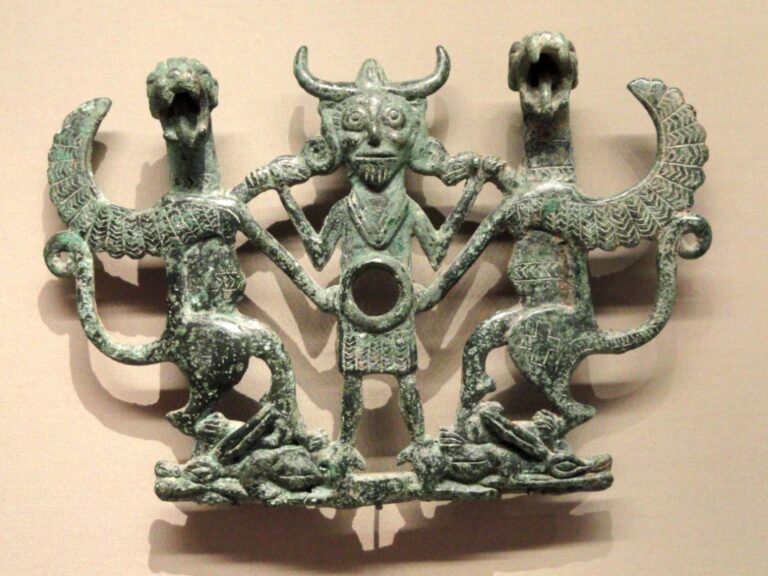
Lost wax permits geometric complexity that no other ancient technique can match. Undercuts, internal voids, openwork ornament, fine inscriptions, and complex three-dimensional figural work all become possible. The Luristan bronzes of the late second and early first millennium BC — many of them produced in this technique — display the virtuosity that lost wax allowed. The catalogue entry for Lot 38071001, a large Iranian Bronze Age spearhead, notes specifically that the piece was cast with lost-wax technique, indicating the central fact that the object was produced from a single-use clay investment making the intricate and detail stop-ridge form possible.
The diagnostic signature of lost-wax casting is, paradoxically, the absence of certain features rather than their presence. There is no mould seam — none, anywhere on the object — because the investment was a single integral mass. The surface, before any finishing, preserves the texture of the original wax model, which can include fingerprints, tool marks from the modelling process, or fine surface details impossible to cut into a hard stone mould. Sprue stubs and vent attachments often survive at the back or base of the piece, sometimes filed flush but sometimes left visible. The other indicative features are intricate, detailed and complex forms which would be very hard to achieve even in clay moulds.
Hybrid and Composite Techniques
Many Bronze Age objects combine elements of several techniques. A large rapier might be cast in a bivalve mould but have its rivet plate executed by lost wax in a secondary operation; a Luristan figurine might be lost-wax-cast in stages, the components later joined by mechanical or thermal means. The diagnostic reading of such pieces requires examining each region of the object on its own terms.
Finishing the Casting
A raw casting, fresh from the mould, is never finished work. It is the substrate from which the object is brought to functional form. The repertoire of finishing techniques on Bronze Age objects is remarkably consistent across cultures and millennia, and the marks they leave are the most reliable single category of authenticity diagnostic available to the collector.
Stone Grinding
The most common finishing operation is grinding against a stone abrasive — typically a fine-grained sandstone, but also quartzite, schist, or any locally available hard stone. The cast object is rubbed against the stationary abrasive (or, less commonly, the abrasive is rubbed against the object), removing the casting skin, levelling surface irregularities, sharpening edges, and producing the characteristic flat or gently convex facets that we associate with finished Bronze Age work.
Stone-ground surfaces have an unmistakable signature: long, slightly parallel striations running in the direction of the grinding stroke, varying in coarseness with the grain of the abrasive used. The Scythian trilobate full-bodied arrowheads are a particularly instructive case. Objects such as Lot 11481, Lot 11482, Lot 11486, and Lot 11487 show on each of their three bladed faces the long, regular grinding striations that brought the cast core down to its final triangular cross-section. The bevelled bases of the lobes, where they meet the socket, are particularly diagnostic: these surfaces are almost always stone-ground, often visibly so, with the striations radiating from the centre.
Grinding striations are extraordinarily resistant to forgery. Modern fakes produced by power tools display rotary or oscillatory marks rather than the long unidirectional strokes of hand grinding; modern fakes produced by hand grinding rarely have the patient, repeated quality of genuine ancient work, and the patina overlying authentic grinding striations follows the topography of those marks in a way that is essentially impossible to fake convincingly.
Filing
Finer finishing is achieved with files — typically copper-alloy or, later, iron files with cut teeth. Filing produces a characteristic crosshatched pattern of fine parallel marks, often running at an angle to the long axis of the object and frequently superimposed at oblique angles where the smith has rotated the work or changed direction.
File marks are common on tang surfaces, on the flat faces of midribs, on the back edges of cast figurines, and on the bases of cast objects where sprues have been removed. The Mycenaean dagger blades in the collection, such as Lot 82723193 (a Mycenaean dagger of c. 1600–1200 BC) and Lot 83518555 (a Mycenaean or Minoan copper-alloy dagger of c. 1600 BC), exhibit file marks along the flat tang surfaces where the smith dressed the casting to fit a wooden or bone hilt.
Cold Hammering and Edge Hardening
Once a casting had been ground and filed to shape, the cutting edges were almost always cold-hammered — a process that simultaneously trues the edge geometry and dramatically increases its hardness by work-hardening the surface layer. Cold hammering produces a slightly compressed and faceted edge zone, often visible as a narrow strip of subtly different texture running along the cutting surface of a blade.
The principal diagnostic of cold-hammered edges is what they are not: they are not the gently rounded edges of a pure casting, nor the perfectly straight bevels of a power-tool grind. They show, instead, a slightly irregular, faintly faceted micro-geometry that is the cumulative result of dozens or hundreds of small hammer blows. Combined with the patina, which often penetrates differently into the work-hardened zone than into the bulk metal, the cold-hammered edge becomes one of the most reliable authenticity indicators on a Bronze Age blade.
Polishing
The final operation, on prestige objects at least, is polishing — typically against fine sand or rouge-charged leather, but sometimes against the smith’s own palm. Polishing produces a uniform reflective surface that the patina, over millennia, has overlaid with its characteristic colours and crystalline formations. The Luristan high-status pieces, the Mycenaean ceremonial daggers, and the Babylonian rapier blades all show this final treatment, and the underlying surface — visible occasionally where modern handling or cleaning has exposed it — retains a smoothness that no casting alone could have produced.
Rivet Hole Drilling
Hilted blades require rivet holes for attachment to organic handles, and these holes are almost always drilled rather than cast. Drilling was accomplished with a bow drill — a horizontal rod tipped with a hard point (a flint, a quartzite pebble, or a copper-alloy bit) and driven by a leather thong wrapped around a bow that was sawed back and forth. The technique is ancient, well-attested in carpentry and lithic working long before metalworking, and was adapted to copper and bronze with no fundamental modification.
Drilled holes display a recognizable signature: a slightly conical profile (wider at the entry face, narrower at the exit, because the bit cuts more aggressively as it begins), occasional concentric striations running around the inner surface, and frequently a slightly burred lip on the exit face where the breakthrough occurred. Cast rivet holes, by contrast, are perfectly cylindrical with smooth interior walls and no burr. The dagger and rapier blades in the collection consistently show drilled rather than cast rivet holes, and the geometry of those drillings — number, spacing, diameter, and alignment — is a useful regional and chronological indicator. The treatment of this aspect in the dagger typology article treats specific variations in greater depth.
A Case Study in Convergence: Lot 901
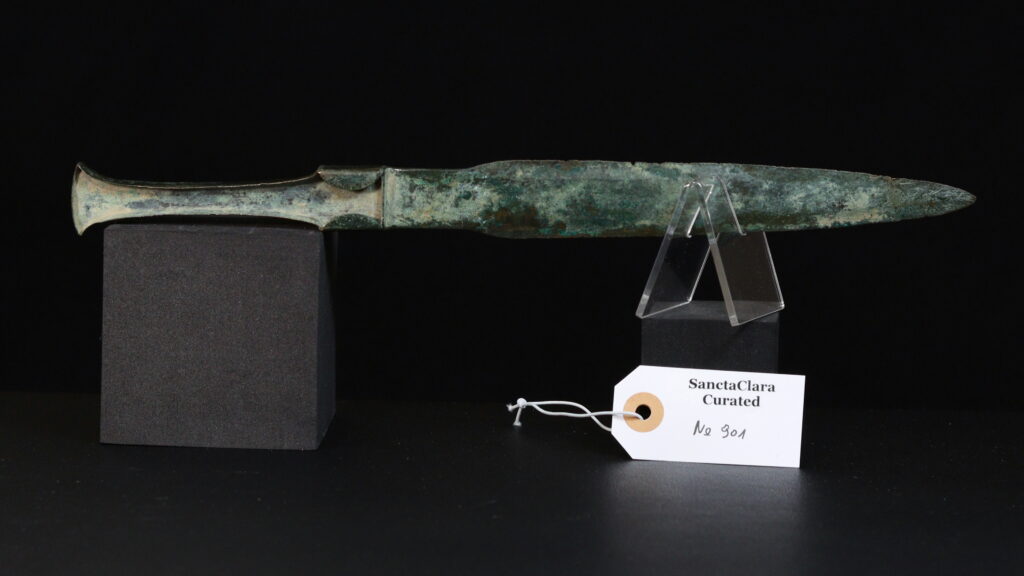
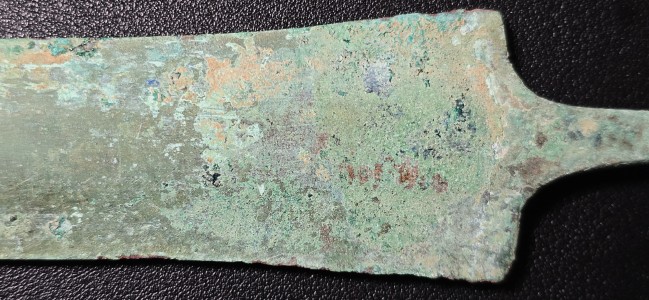
Among the most technically accomplished objects in the Sancta Clara Collection is Lot 901, a Near Eastern bronze rapier-type shortsword or long dagger, 344 mm in length, attributed on the basis of its inscription borne by it’s twin specimen, to the reign of Marduk-nadin-ahhe, king of Babylon in the late second millennium BC (c. 1090 BC, Second Dynasty of Isin). It is worth pausing on this object because nearly the entire repertoire of paleo-metallurgical techniques discussed in this article is visible on a single piece.
The blade was cast by the lost-wax process. This is evident from the absence of any longitudinal mould seam down the central midrib or along the cutting edges; from the fine integrity of the cast handle inlay box that could not have survived a bivalve mould’s parting plane; and from the geometric subtlety of the blade profile, which transitions smoothly from the rivet plate at the hilt end to the elongated triangular point. A bivalve mould could in principle have produced an approximation of this geometry, but the details in the corners of the handle clinches the matter — form of this fineness was almost invariably executed by using a detailed wax model and then casting the result.
After casting, the blade was extensively dressed. Stone-ground bevels run from the central midrib to the cutting edges on both faces, with the long parallel striations of hand grinding visible under raking light along the entire blade length. The midrib itself shows the slight crowning that results from being shaped against a stone abrasive — a feature impossible to fake without revealing modern tool marks. The flat tang of the rivet plate has been filed, and the file marks cross the original cast surface at the characteristic oblique angles of hand work.
The cutting edges were then cold-hammered. The slightly compressed, faintly faceted edge zone is visible as a narrow strip distinct from the bulk metal of the blade body, and the patina has formed differently across this zone — a consequence of the work-hardened surface layer reacting more slowly to corrosive agents than the cast interior. The rivet holes in the hilt plate are drilled, not cast: they show the slight entry-face flare and the faint concentric striations characteristic of bow-drilled holes, and one of them retains the trace of a slightly burred exit lip.
Finally, the entire blade was polished. The blade was shiny and razor sharp, three thousand years ago, and remains in part shiny and razor sharp today, the surface beneath the patina — visible at the few small abraded spots — retains the smoothness of a piece intended to be seen and not merely used. Whether Lot 901 was a functional weapon, a ceremonial deposition, or a royal gift, it was executed at a level of technical accomplishment that places it among the finest pre-iron metalwork in the collection.
It is, in short, an entire textbook of paleo-metallurgical practice compressed into 344 mm of bronze. To handle it is to feel, very directly, the continuity of human craft with the smiths who shaped it — and to recognize, with proper humility, how much of what they knew has had to be reconstructed by patient observation of objects exactly like this one.
Reading the Hand
The diagnostic features that I have described here are not arcane. With practice — and with a hand lens, a strong raking light, and a few weeks of close attention to genuine objects — any serious collector can learn to recognize them. The reward is considerable: the ability to read an object’s manufacturing history from its surface, to distinguish authentic ancient work from later imitation, to attribute pieces to regional traditions on technical grounds, and ultimately to bring to one’s collection a depth of understanding that no provenance document or auction catalogue can supply.
The bronzes of the Sancta Clara Collection are not silent. They speak the language of mould and hammer, of stone abrasive and bow drill, of charcoal hearth and cold-worked edge. The articles assembled on this site are, in the end, an attempt to translate what they have to say.
This article forms part of the scholarly reference series of AncientBronzes.com, the catalogue and research blog of the Sancta Clara Collection. All artifacts referenced by Lot number are documented in the searchable collection catalogue. For related discussions, see the companion articles on stone-to-metal transition, patina analysis and authentication, Bronze Age metallurgical cultures, Bronze Age forgery identification, dagger typology, spearhead typology, and arrowhead typology.