
Zagros Mountains of doubt
There is a problem with Luristan bronzes that the field has spent the better part of a century politely not staring at directly. It is this: an enormous, technically dazzling, and bewilderingly varied body of ancient metalwork — Beast Master finials and horse-bits, ibex axes and daggers, pins and vessels and figurines, spanning more than two thousand years of production — has been attached to the name of a single, comparatively obscure mountain region of western Iran, and by extension to the people who live there now. The corpus is too rich, too diverse, and too long-lived to be the achievement of one small tribe of Zagros herders. So what are we actually looking at when we say “Luristan”?
That question is the spine of this article. I want to do more than rehearse the canon of famous types, though we will get to the beastmaster standards and the ibex-crested axes. I want to take seriously the suspicion that “Luristan” is, in part, a label of convenience — a way historians and the market between them have managed an embarrassment of riches by filing it under a single tidy heading. And I want to ask who the metalworkers really were, why so much survives from this one corner of the Zagros when their wealthier neighbours have left so much less, and how a people who demonstrably traded with Mesopotamia came to deposit such a flood of bronze in their own mountain valleys.
What we mean — and don’t mean — by “Luristan”
The first thing to understand is that “Luristan bronzes” is not, and never was, an archaeological term in the strict sense. It is a market term that hardened into a scholarly one.
The objects began arriving on the Western art market in quantity around 1928, and through the 1930s the flood became a deluge. They came almost entirely without context — the product of clandestine digging in the cemeteries of the central Zagros, in the valleys of Pish-i Kuh and Pusht-i Kuh in modern Lorestan Province. Dealers needed a name; “Luristan” was where the dealers’ agents said the material came from, and so “Luristan bronzes” it became. André Godard’s Les bronzes du Luristan fixed the term in 1931, before a single one of these objects had been recovered under controlled excavation. We named the corpus before we understood it, and the name has been quietly distorting our understanding ever since.
Real archaeology came late and came piecemeal. Erich Schmidt’s excavation of the sanctuary at Surkh Dum-i Luri in 1938 gave us, for the first time, a body of material from a known findspot — a mountain shrine where votive bronzes had accumulated over generations. But the decisive work was the long Belgian campaign under Louis Vanden Berghe in Pusht-i Kuh, running from the mid-1960s into the late 1970s, which excavated cemetery after cemetery — Bani Surmah, Kalleh Nisar, War Kabud, Chigha Sabz, and others — and at last gave the bronzes a stratigraphy and a chronology. Only then did the scale of the misunderstanding become visible. The graves did not contain one culture’s output. They contained the layered deposits of a metalworking tradition that had been running, with interruptions and transformations, since the third millennium BC.
So when a piece is offered as “Luristan,” the honest reading of that word is geographic and approximate, not ethnic and not precise. It means, more or less, “a bronze of the central Zagros type, of the kind that came out of the Lorestan cemeteries.” It does not mean “made by the Lurs.” It cannot mean that, for a reason worth stating plainly.
The “Lur” anachronism
The Lurs are a real Iranian people, and Lorestan is genuinely their land today. But the Lurs as an ethnic and linguistic community are a phenomenon of the medieval and modern eras. There is no warrant for projecting them back onto the Iron Age craftsmen who cast the finials, still less onto the Early Bronze Age smiths who hammered the first arsenical-copper daggers in these valleys two thousand years earlier. To call these objects “Lur” work is rather like calling a Roman fibula “Italian” — true only in the loosest geographic sense, and actively misleading about who made it and what they thought they were doing.
This matters because the name does quiet ideological work. It implies a single people, a single workshop tradition, a single cultural author. And that implication is precisely what the evidence will not support. The moment you accept that “Luristan” is a place rather than a people, the central paradox dissolves into something much more interesting: not “how did one small tribe make all this?” but “what was happening in these mountains, over two millennia, that produced such a sustained and varied output of fine metal?”
The depth of time: this is not one period
Nothing punctures the single-culture assumption faster than the chronology. The objects swept together under the Luristan label do not belong to one moment. They belong to at least two great phases separated by the better part of a thousand years.
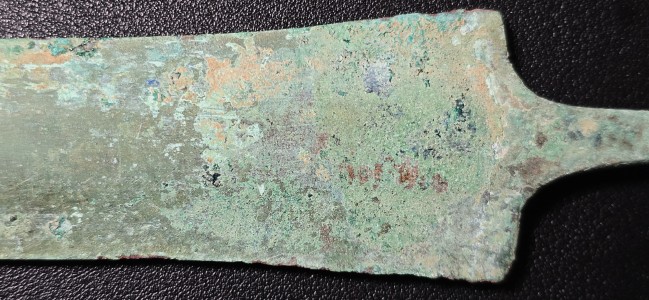
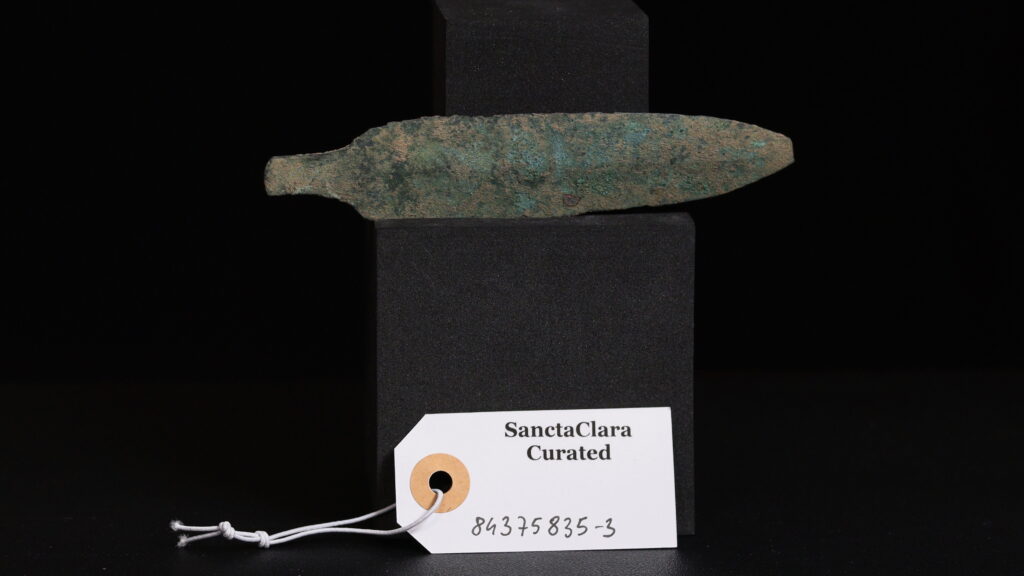
The earlier phase reaches back into the third millennium BC. The corbelled tombs of Bani Surmah and Kalleh Nisar yielded weapons and tools of arsenical copper and early tin bronze — daggers, shaft-hole axes, pins — from roughly 2900 to 2000 BC. This is Early Bronze Age material, contemporary with the Royal Cemetery of Ur and with Proto-Elamite Susa, and it has nothing whatever to do with the elaborate openwork ritual bronzes that most people picture when they hear the word “Luristan.” In the Sancta Clara Collection this deep stratum is represented by the Luristan copper-and-bronze dagger group of Lot 84375835, dated 2750–2250 BC — objects already a thousand years old when the famous finials had not yet been imagined.
The later, canonical phase is an Iron Age phenomenon, broadly Iron Age I through III, with its true peak in the eighth and seventh centuries BC. This is when the master-of-animals standards, the openwork horse-bits, the disc-headed votive pins, and the spike-butted axes were produced — the “classic” Luristan bronzes of the museum vitrine. Between the early tombs and this late flowering lies a long development, not a single event.
A tradition that runs, however discontinuously, from before 2500 BC to after 700 BC is not the signature of a people. It is the signature of a region — a zone of the Zagros where, for reasons of geography and economy I will come to, the working of metal remained central to life across the rise and fall of empires in the lowlands below.
The canon — and the much larger corpus around it
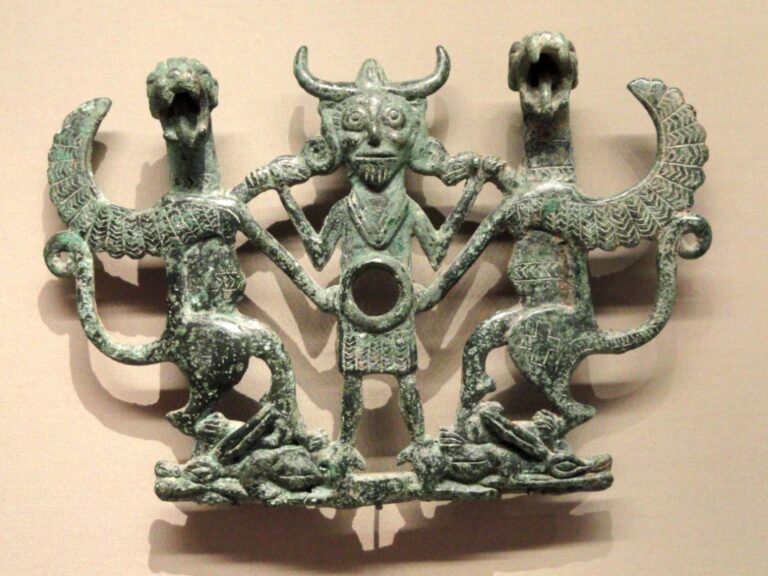
The famous types deserve their fame. The standard finials, often catalogued as “idols” and known to the literature as the Master of Animals (the maître des animaux), are among the most arresting objects of the ancient Near East: openwork bronzes in which a central anthropomorphic figure grasps two rampant beasts, the whole cast in the round by the lost-wax method and mounted on tubular supports with zoomorphic bases. Their function is genuinely uncertain — cult standards, talismans, the heads of ceremonial implements — and I am content to leave that uncertainty open, because the honest state of the evidence is that we do not know. The openwork horse-bits and cheekpieces, shaped as ibexes, mouflons, winged bulls, and composite monsters, are the other great show-pieces, and they confirm that whoever these people were, they were horsemen who lavished extraordinary craft on the gear of their mounts.
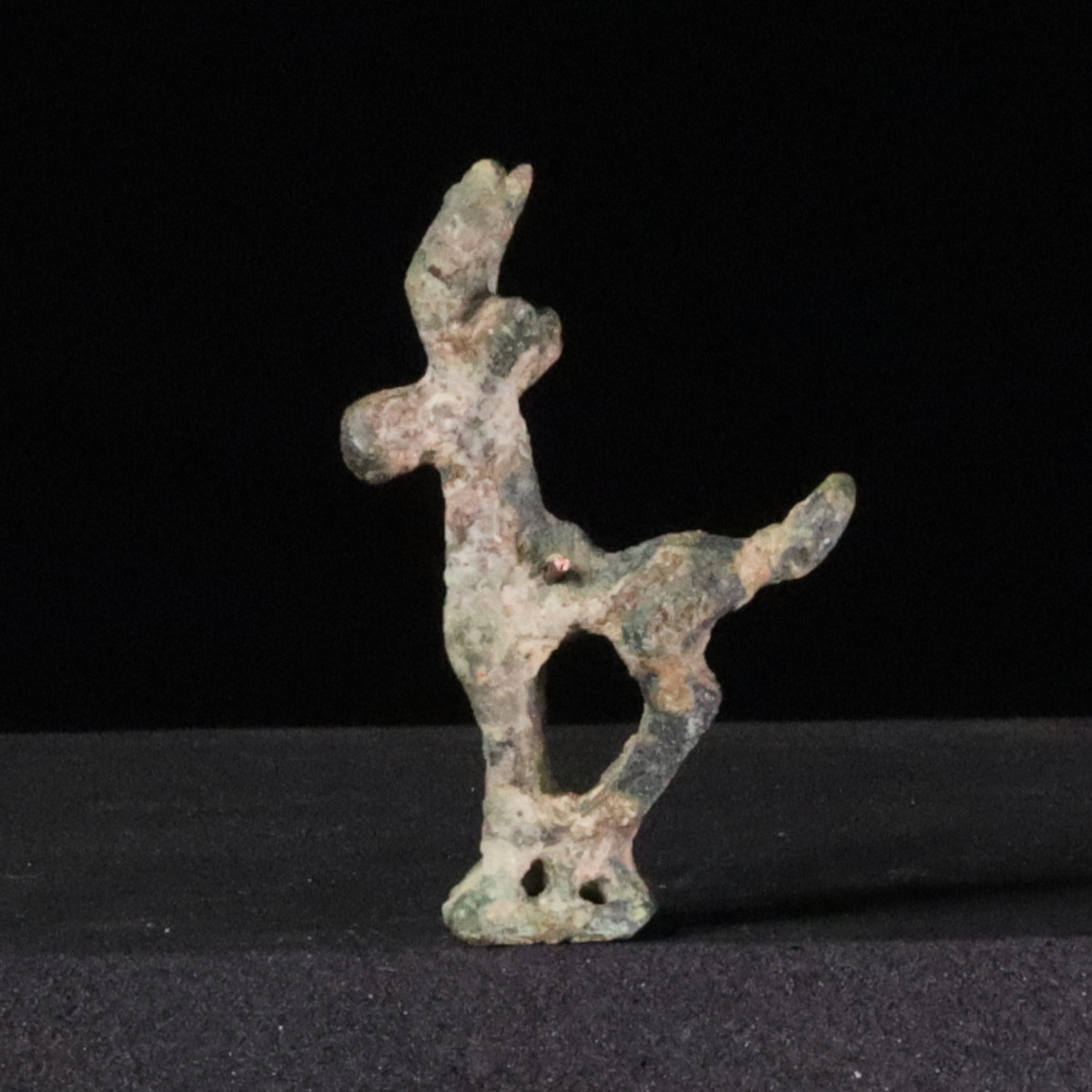
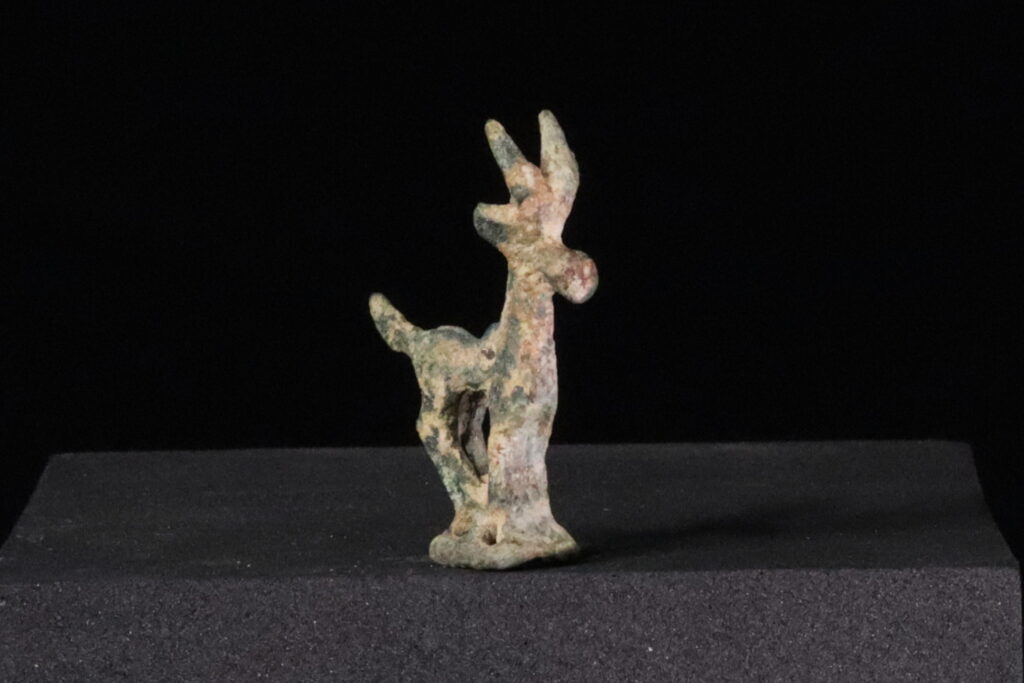
Then there are the axes — and here your own framing is exactly right. The spike-butted shaft-hole axe, sometimes crested with a crouching feline or a wild goat, is a Luristan signature, and the wild goat, the ibex or “capricorn” of the collector’s vocabulary, runs like a leitmotif through the whole iconographic repertoire. The Collection’s Luristan ibex figurine, Lot 2248, is a small but pure expression of that obsession: the same horned beast that springs from the axe-butt and curls into the cheekpiece, here standing alone as a votive or ornament. To hold it is to hold the central animal of a mountain people’s imagination.
But — and this is the point that the canon obscures — the celebrated ritual bronzes are a small fraction of what these valleys produced. The overwhelming bulk of the corpus is not openwork idols at all. It is equipment: spearheads and javelin heads in their hundreds, daggers and swords, arrowheads, ordinary tools, and a vast quantity of personal ornament — pins, bracelets, rings, fibulae. The Collection’s holdings reflect this true proportion far better than any museum highlight reel does. The long spearhead of Lot 84068495, at 456 mm; the massive spear-tip of Lot 44398282; the leaf-shaped spearhead with its rat-tail tang, Lot 84058911; the javelin heads of Lots 84026513 and 83518649; the daggers of Lots 78638597 and 97583774 — these workmanlike weapons are the real Luristan, the daily output of a metalworking economy of which the finials were only the ceremonial apex. Any account that begins and ends with the beastmaster standards has mistaken the crown for the whole body.
The technical range is just as wide as the typological range. The fine openwork pieces demand sophisticated lost-wax casting, with all the control of cores, gates, and venting that implies — for which see my discussion in Select Paleo-Metallurgical Techniques and Their Signatures on Ancient Bronzes. The weapons and tools, by contrast, were largely produced in bivalve moulds and finished by hammering and grinding. A tradition that commands both the highest casting art and efficient serial production of arms is not a cottage curiosity. It is an industry.
So who were the metalworkers?
If not “the Lurs,” then who? Here we must be honest that the question may not have a single answer — and that the search for one may itself be a category error. But the candidates are worth laying out, because each captures part of the truth.
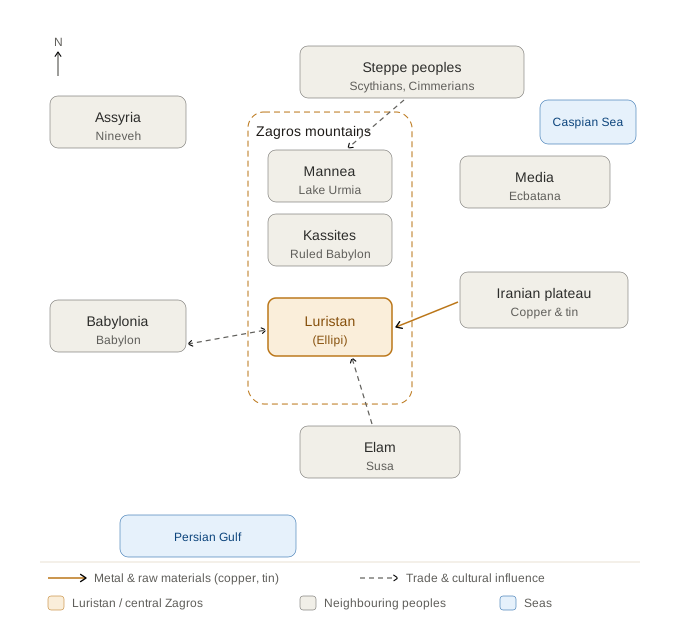
The Kassites. The Kassites came down out of the Zagros to rule Babylon for the better part of four centuries, from around 1595 to 1155 BC, and their homeland lay in or beside these very mountains. It is therefore tempting — and earlier scholarship did succumb to the temptation — to make them the authors of the Luristan bronzes. The chronology, however, only partly cooperates: the Kassite dynasty in Babylon had fallen before the classic Iron Age finials were made. What the Kassite connection really gives us is the deeper substrate — evidence that the central Zagros was a reservoir of organised, ambitious mountain peoples capable of conquering the richest city in the world, long before the famous bronzes appear. The metalworking valleys did not spring from nowhere. I have explored this Zagros-and-its-margins world, the Kassites among them, in The Forgotten Forges: Metallurgy of the Helmand Culture, Kassites, and Lullubi.
The Elamites. To the south and west lay Elam, the great highland-and-lowland civilization of Susa and Anshan, and Elamite power and influence reached into the Zagros repeatedly. The Neo-Elamite period, roughly 1100 to 540 BC, overlaps the Luristan floruit precisely, and Elamite parallels in iconography and form are real. Elam is, to my mind, the most underweighted partner in the conventional story. The Collection’s Elamite pieces — the large copper arrowhead of Lot 117, the copper-alloy knife of Lot 101315690, the Elamite javelin and arrowheads of the third and second millennia — sit on the same cultural gradient as the “Luristan” material, and the line between “Elamite highland” and “Luristan” is far blurrier than the two separate labels suggest. Some of what we file as Luristan is surely Elamite, or made by people for whom that distinction would have been meaningless.
The Medes and the incoming Iranians. The early first millennium BC is exactly when Iranian-speaking peoples — Medes, Persians, and their kin — were settling into the Zagros, the Medes coalescing around Ecbatana into the power that would help bring down Nineveh in 612 BC. The classic Luristan bronzes flower in step with this arrival. It is entirely plausible that the latest and most elaborate material owes much to these newcomers, or to the fusion of incoming Iranian and resident populations. The “animal style” affinities that link some Luristan work to the steppe point in the same direction.
The polities the Assyrians actually named. Here is the detail that the popular accounts almost always omit, and that I think deserves far more weight. The Assyrian royal annals, our best contemporary written source for the Zagros in the eighth and seventh centuries BC, do not mention “Lurs.” They mention kingdoms and peoples: Ellipi, a kingdom occupying very nearly the central-Zagros zone where the bronzes are found, campaigned against by Sargon II and Sennacherib; the Manneans to the northwest; and a shifting roster of smaller principalities and tribal confederacies. If we want a name for the makers of the late Luristan bronzes that is both contemporary and geographically apt, Ellipi has a far better claim than the anachronistic “Lur.” That we reach for the modern provincial name instead of the ancient kingdom’s is itself a small monument to how this material was discovered — through the market, not the text.
The truthful conclusion is that “Luristan bronze” is the product of a multi-ethnic, multi-period metalworking koiné of the central Zagros: a shared technical and iconographic tradition sustained across two millennia by Early Bronze Age tomb-builders, by populations of the Kassite and Elamite orbit, by Iron Age kingdoms like Ellipi, and by the incoming Iranian peoples — all of them drawing on and contributing to a common repertoire. The single-author model is a fiction of the catalogue card. Your instinct that the Medes, the Elamites, the Kassites, and others are tangled up in this is not heterodox; it is, I would argue, simply correct.
The embarrassment of riches, explained
That still leaves the puzzle you put your finger on most sharply: why so much? Why does a marginal mountain region yield more fine ancient bronze than its vastly wealthier neighbours in the Mesopotamian lowlands? Several forces converge, and once they are laid out the mystery largely evaporates.
The first and most important is burial and votive practice combined with survival bias — and I cannot stress this enough, because it is the factor most often missed. The Zagros communities buried their dead with lavish metal grave goods, and they deposited bronze in mountain sanctuaries like Surkh Dum over generations. Metal placed in a sealed tomb or a shrine is metal taken permanently out of circulation. Mesopotamia, by contrast, recycled relentlessly: bronze was too valuable to bury when it could be melted and recast, so the lowland cities consumed their own metallurgical history. The result is a profound distortion. We are not necessarily seeing that the Zagros made more bronze than Babylonia; we are seeing that the Zagros kept its bronze in the ground while Babylonia melted its own down. The corpus is inflated by a custom of permanent deposition, not necessarily by greater production. This is the same logic by which we read corrosion to confirm a long burial — the patina that proves a piece lay sealed for millennia, on which see The Language of Patina.
The second force is the pastoral economy and portable wealth. Much of the Zagros population was transhumant — moving herds between summer and winter pasture. For mobile people, wealth is best held in durable, portable, high-value form, and worked metal is exactly that. A culture organised around movement and herds will invest disproportionately in fine metalwork as the storehouse of its status and capital. The wild goat that dominates the iconography is no accident; it is the totem animal of a herding world.
The third force is position on the trade routes. The Zagros is not a dead end; it is a hinge. Its passes carried the traffic between the Iranian plateau and Mesopotamia, including the metal trade itself — copper from plateau sources and, crucially, the tin that had to travel west from sources far to the east. A mountain people astride those passes could prosper as middlemen and as workers of the very metal flowing through their hands. Wealth and metallurgical skill accumulate naturally where the metal road runs.
And the fourth force is the least flattering: the market inflated the category itself. From the 1930s onward, “Luristan” was a brand that sold. Dealers attributed Iranian bronzes of every region and period to Luristan because the name moved goods, and the corpus we now think of as “Luristan” is, in consequence, a heap that includes a great deal of material from elsewhere in Iran lumped under one commercially convenient heading. Some of the “disproportion” is real archaeology; some of it is a century of dealers’ optimism. Disentangling the two is part of the connoisseur’s work.
Trade with Mesopotamia, yet buried in the mountains
This brings us to the apparent contradiction you raised: we know these people traded with Mesopotamia and their other neighbours, and yet the artifacts keep turning up in the Zagros. How can both be true?
They are both true, and they are not in tension once you separate where a thing was used and deposited from where its materials and ideas came from. The Zagros was simultaneously a production zone, a consumption zone, and a deposition zone. Its smiths imported raw copper and tin and absorbed motifs from Mesopotamia, Elam, and eventually the steppe; they made distinctively local products from that imported material; and they consumed and finally buried those products at home, in their own tombs and shrines. The findspots record the last act — deposition — not the trade that preceded it.
The most eloquent witnesses to that trade are the inscribed objects. A number of bronzes recovered from Luristan bear Mesopotamian royal inscriptions — Babylonian and Assyrian kings’ names — and these are exactly the kind of evidence that proves the connection. The Collection holds a remarkable examples: the Near Eastern bronze rapiers like items 901 or 902, with a comparative museum specimen carrying the name of the Babylonian king Marduk-nadin-ahhe, who reigned around 1099–1082 BC, with its companion piece Lot 902 dated to 1082 BC. An object inscribed for a Babylonian monarch, found in the Zagros, tells a complete story in itself: a weapon made or dedicated in the Mesopotamian lowlands travelled — by gift, tribute, plunder, or trade — up into the mountains, where it was eventually deposited, perhaps generations after it was made, as an heirloom or prestige possession. That single category of object resolves the paradox better than any argument: the mountains and the plain were in constant contact, and the mountains kept what the plain sent them.
I should add a caution that follows directly from this. Inscribed “Luristan” weapons are precisely the kind of high-value, high-status object that the forgery industry has always loved to manufacture, because an inscription multiplies the price. The same is true of the openwork finials. The market that inflated the Luristan category also seeded it heavily with fakes, and the authentication of any elaborate or inscribed Luristan piece demands real scrutiny — of casting, of corrosion, of wear, of the inscription itself. I treat the diagnostics at length in The Collector’s Eye: Identifying Modern Forgeries in Ancient Bronze Markets, and nowhere are those diagnostics more necessary than here.
What the Zagros bronzes really are
Strip away the misleading label and a clearer picture emerges. The “Luristan bronzes” are not the relics of one small tribe who improbably out-produced their neighbours. They are the durable, surviving signature of an entire mountain world — a metalworking tradition of the central Zagros that ran for more than two thousand years, sustained in turn by Early Bronze Age tomb-builders, by peoples within the Kassite and Elamite spheres, by Iron Age kingdoms the Assyrians knew as Ellipi and others, and by the incoming Iranian Medes and their kin. They are abundant not because the Zagros was uniquely rich but because the Zagros uniquely buried its wealth, in tombs and sanctuaries that sealed away a metallurgical record the recycling lowlands destroyed. And they reached us under a single market name because, in 1928, the trade needed a heading and “Luristan” was the one that stuck.
For the collector, this reframing is liberating rather than diminishing. It means that a “Luristan” spearhead in the hand is not the product of an anonymous backwater but a fragment of one of the longest continuous metalworking traditions of the ancient Near East — a tradition that traded with Babylon, that armed and adorned a horse-borne mountain aristocracy, and that left, in its graves and shrines, the richest single window we possess onto the material life of the ancient Zagros. The wild goat on the axe-butt, the rapier inscribed for a Babylonian king, the plain leaf-bladed spear with its rat-tail tang — these are not separate stories. They are chapters of one long story we have been telling under the wrong title. The least we can do, as its custodians, is learn to read past the label.
The development of the weapons themselves — how the dagger lengthened into the sword, how the spearhead and arrowhead evolved — runs through the Zagros as it runs everywhere, and I have traced those lines in The Dagger: Humanity’s First Metal Blade and the Path to the Sword, Bronze Age Swords – the Guide and Knowledge Base, and The Spearhead: Typology and Evolution of the Ancient World’s Primary Weapon. Luristan is where a great many of those forms reach us in their finest and most numerous surviving examples — which is only fitting for the mountains that kept what everyone else melted down.
This article is part of the scholarly reference library of the Sancta Clara Collection. Artifact references are drawn from the Collection’s own holdings. © AncientBronzes.com — a scholarly reference for ancient bronze and copper alloy antiquities.