
For most of the twentieth century, anyone asking where the sword was born would have been pointed firmly at the Aegean. The Mycenaean Type A rapiers from Mallia and Arkalochori — those impossibly long, slender thrusting blades from around 1700 BC — were the canonical answer. They were the moment, the scholarly consensus went, when bronze metallurgy finally crossed the threshold from “long knife” to “weapon of reach.”
That answer is now a thousand years too late.
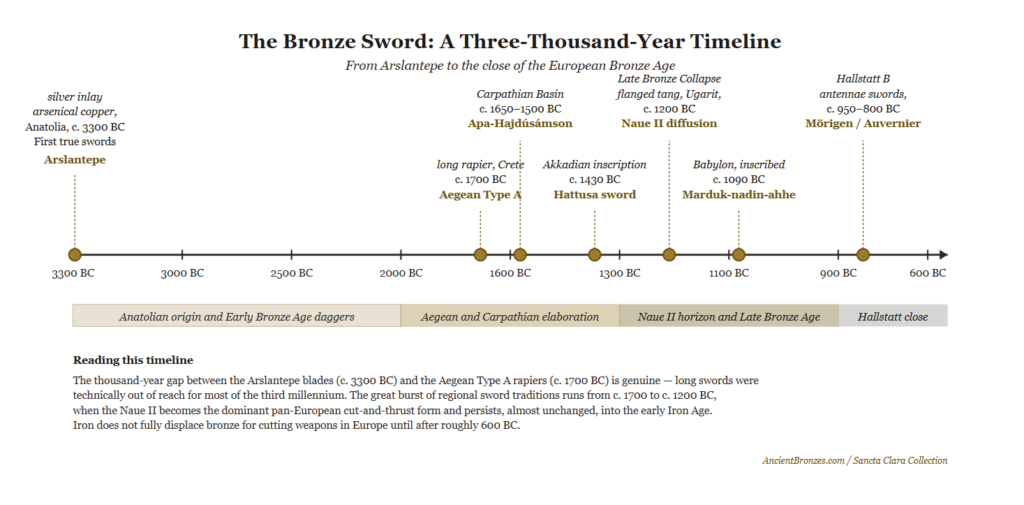
In the early 1980s, Marcella Frangipane of Sapienza University of Rome began excavating a Late Chalcolithic palace complex at Arslantepe — a mound near modern Malatya in eastern Anatolia, set above the upper Euphrates. In a single room of that complex, Period VI A, dated by calibrated radiocarbon to between roughly 3400 and 3000 BC, her team recovered a cache of nine arsenical-copper blades. Three of them — measuring between 45 and 60 cm — were unambiguously short swords. Three more were inlaid with delicate triangular patterns of silver. A slightly later context, the “Royal Tomb” of Period VI B2 (c. 2900–2750 BC), produced another sword and nine spearheads. These are not transitional objects. They are not “almost-swords” or “proto-swords.” They are swords, and they were already being decorated for prestige display by their makers. They predate the earliest Aegean rapiers by a clean thousand years.
This article is my attempt to set out, for the broader audience that reads this site, the long story of the bronze sword as I have come to understand it after years of handling these objects. It is a story that runs from that Anatolian palace at 3300 BC to the last surviving bronze swords of Mörigen and Auvernier around 800 BC and the final Hallstatt holdouts before iron took over completely. Along the way it visits Crete, the Carpathian Basin, Egypt, Babylon, Luristan, the Atlantic seaboard, Denmark, the Eurasian steppe, and as a comparative case, Shang and Zhou China. It is the broadest survey I have written for this blog, and I will admit at the outset that it is also the one I have most enjoyed researching.
What Is a Sword, Exactly?
Before we can write the history of bronze swords, we have to agree on what counts as a sword in the first place — and that turns out to be harder than it sounds. The boundary between sword and dagger is not a fact of nature. It is a convention, and different scholars have drawn it in different places.
The most widely used rule comes from British archaeology. Colin Burgess and Sabine Gerloff, in their 1981 volume The Dirks and Rapiers of Great Britain and Ireland, set the threshold at thirty centimetres of surviving blade. Above 30 cm, you have a rapier or short sword; below, you have a dirk or dagger. The follow-up volume on swords proper, by Ian Colquhoun and Burgess (1988), retained the same convention. The cut-off is acknowledged, even by its authors, to be somewhat arbitrary. The same moulds in Bronze Age workshops could cast both dirks and rapiers, and the morphological continuum is real. But the rule is useful for one important reason: it gives us a working language.
So let me adopt the convention with the modifications most contemporary specialists prefer. A dagger is roughly 30 cm or less, simple flat or shouldered heel, designed for close-quarter stabbing. A dirk or short sword runs 30 to 45 cm, often with a midrib, hilt riveted or tanged. A sword proper is 45 cm and above, with engineering — midribs, fullers, flanged or solid hilts — consistent with reach-fighting rather than knife-work. Within the sword category there are sub-types: the slender thrust-optimised rapier (Aegean Types A and B, British Group I through III), the parallel-edged secure-hilted cut-and-thrust sword (Naue II, Wilburton, Ewart Park), and the broad leaf-shaped cutting sword (late Ewart Park, Carp’s-tongue).
There is one further wrinkle that I think every collector ought to internalise, because it changes how you read a catalogue entry. When you see “blade length 39 cm” on a tang-less or rat-tail-tang specimen, that figure is just the bronze. The hilt — wood, bone, ivory, leather wrap — has long rotted away, and the original in-hand weapon was meaningfully longer.
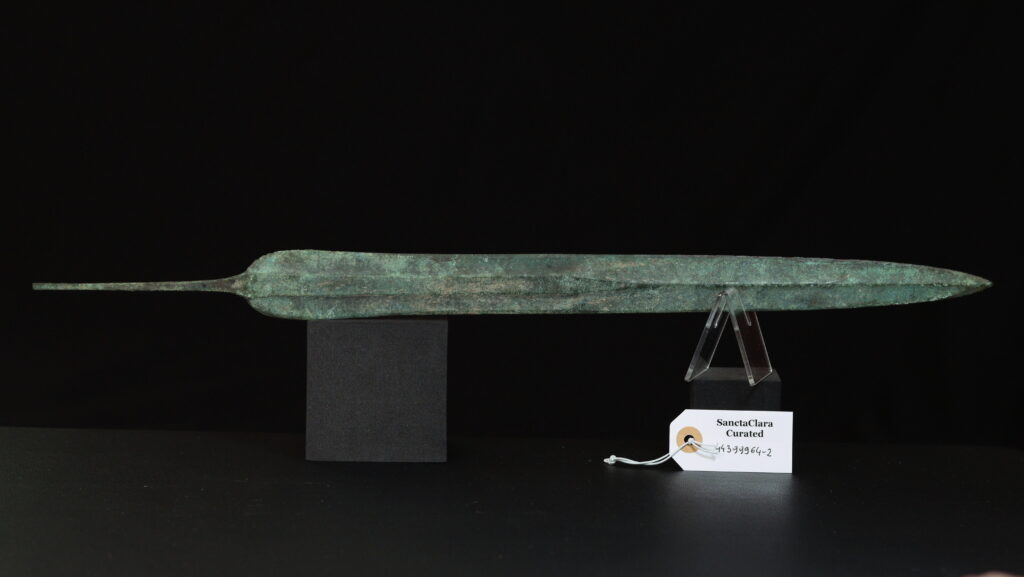
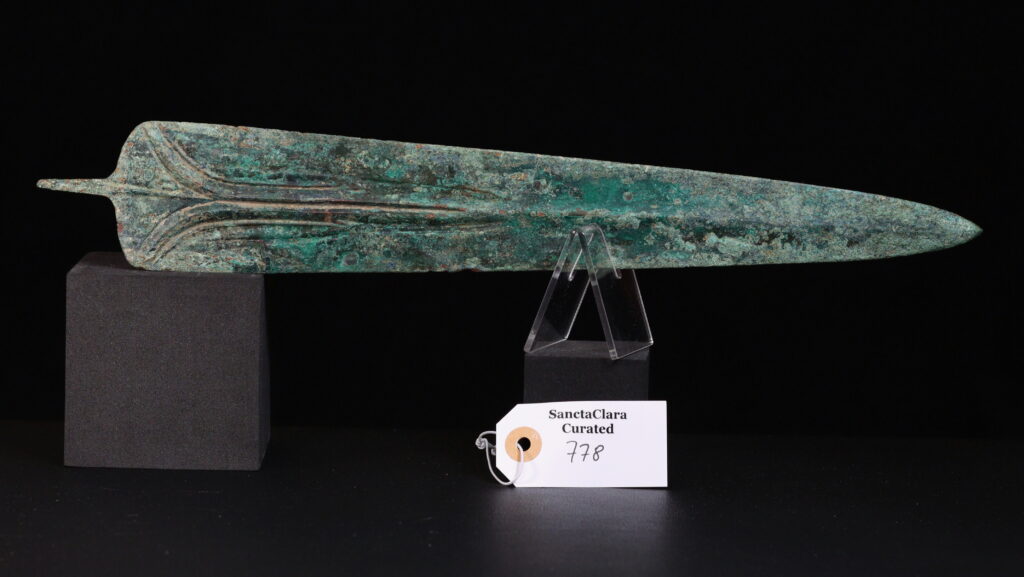
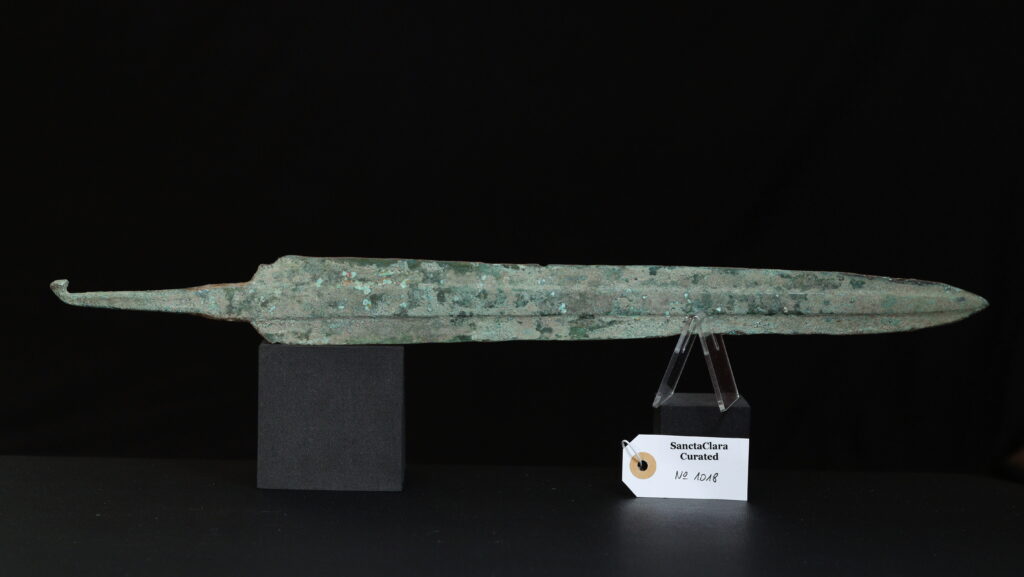
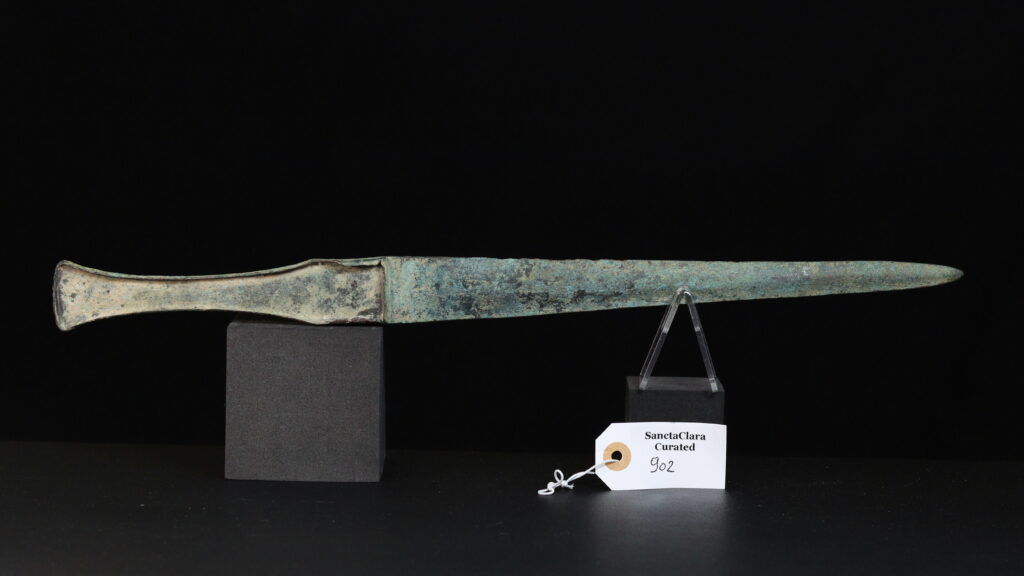
A 39 cm Mycenaean short sword like the one I keep as Sancta Clara Lot 778 was, when its grip was intact, roughly 50 cm in the hand. A 52 cm Luristan blade with a rat-tail tang like Lot 1018 was around 65 cm overall. This is not a minor detail. It is the difference between “long dagger” and “true sword,” and it is invisible from the surviving metal alone. Every length figure I cite below is the bronze length unless I say otherwise; mentally add 10–13 cm for tang-less, 8-11 cm for short-tang pieces, and very little for full-hilted Vollgriffschwerter where the bronze is the whole thing.
A Brief Digression: The Old Copper Question
Before going further east, I want to dispose of a question I am sometimes asked: did the Old Copper Complex of the Great Lakes — that remarkable cold-working copper tradition of Wisconsin, Michigan, and Minnesota that runs from roughly 6500 to 1500 BC — produce any swords? It is a fair question, because for a long time the Old Copper tradition was the oldest metal-working tradition known anywhere in the Americas, and the published date range overlaps with the Anatolian Chalcolithic. So one might reasonably wonder.
The answer is no, and the reason is worth explaining. The Milwaukee Public Museum holds the largest curated Old Copper Complex collection in the world, around 1,500 objects, and its published maxima are: knives between four and 32 cm; tanged or socketed spear points to about 25 cm; awls to 40 cm; and at the very longest, double-pointed pikes up to 75 cm — but those pikes are unedged piercing tools, not bladed weapons. The longest edged blade in the corpus is therefore around 32 cm: a long knife, below the dirk-to-rapier threshold. As Kathleen Ehrhardt summarized the repertoire in 2009, it consists of spear points, knives, awls, perforators, spuds, celts, harpoons, fish hooks, needles, and ornaments. No sword form is present.
The technological reason is more interesting than the simple absence. Old Copper smiths cold-worked native copper exclusively — they did not cast and never alloyed. Cold-worked unalloyed copper work-hardens and cracks when beaten into long thin blades. The technology ceiling was imposed by the material itself, and the makers seem to have judged that the limits of cold-worked copper were better spent on hunting and utility tools than on prestige weapons of reach. The Great Lakes copper tradition is a hunting-and-utility tradition. It is not a swordsmithing tradition, and no specimen in the published corpus meets a working definition of a sword. So when the Old World produced the first true swords at Arslantepe, the North American Great Lakes were running a different industry entirely, with different priorities and a self-imposed material ceiling. The two traditions never met.
Birth in the East: Arslantepe and the Aegean Leap
Let me return to the eastern Anatolian palace where the story really starts.
The Arslantepe blades are arsenical copper — that is, copper with a few percent natural arsenic, which hardens the metal and lowers the melting point compared to pure copper. They are not yet tin-bronze, which would emerge as the dominant alloy of the second millennium BC. They were cast in stone or clay molds, then ground and polished. Three of them carry inlaid silver triangles set into engraved channels along the blade — which makes them, incidentally, the oldest metal-on-metal inlay work in any context anywhere. The arsenic-and-nickel chemistry of the alloy points to imported polymetallic ores from the Caucasus, suggesting long-distance trade in metals was already supporting elite weapon production in the late fourth millennium.
For the next thousand years after Arslantepe, the archaeological record of swords thins out. Daggers proliferate; long blades do not. The Sumerian and Akkadian dynasties of the third millennium are well-armed cultures, but their weapon kit centres on spears, axes, maces, and daggers. The reasons are partly technological — casting reliable long blades is genuinely difficult — and partly tactical. Chariot-driven combat and massed spear-and-shield infantry do not place a premium on the sword. The dagger, the axe, and the sickle-sword cover the close-quarter need.
What changes around 1700 BC is the Aegean breakthrough. The Type A rapier — exemplified by the long blades from Mallia and Arkalochori on Crete — represents a sudden leap in capability. Nancy Sandars, in her foundational 1961 and 1963 papers on the Aegean swords, established the typology that we still use today (refined and extended in subsequent decades, most importantly by Imma Kilian-Dirlmeier in 1993 and by Barry Molloy in 2010). The Type A is a slim, tapering, single-piece blade up to a metre long, with a strong central midrib, rounded shoulders, and a narrow flat tang sheathed in an organic grip — frequently capped with a pommel of gold or ivory.
What enabled this? Two innovations working together. First, the shift from arsenical to tin-bronze gave smiths a more controllable alloy with better mechanical properties. Second, refined casting technique — more accurate stone or clay molds, better venting, control of melt temperature — allowed reliable long-blade production. And third, the engineering insight to add a strong central midrib, which dramatically stiffens a long thin blade against lateral bending without much added weight. The midrib is the single most important structural feature of any long bronze blade, and the Aegean smiths of the seventeenth century BC mastered it.
Sandars worked out an alphabetic typology, A through H, that tracks the evolution of the Aegean sword from the elegant but fragile Type A rapier through stouter intermediate types to the cut-and-thrust forms of the late Bronze Age. Type B, dating from about 1600 to 1500 BC, is shorter (around 50 cm), with squared flanged shoulders and large rivets — a half-length compromise that is easier to make reliably. Type C, the so-called “horned sword” of roughly 1450 to 1300 BC, adds hand-protection horns at the hilt junction. Type D is the cruciform sword; Type E the T-pommelled short sword; Type F the most widely distributed late form, with T-pommel, angular shoulders, and two rivet groups. Types G and H are the horned revivals of the late thirteenth and twelfth centuries, with Type H specifically associated with the Sea Peoples context.
Sancta Clara Lot 778, the Mycenaean short sword, fits most plausibly into Sandars Type B — the 39 cm length, the proportions, the rivet arrangement, and the date range (1700–1200 BC) all point that way, though smaller variants of Type E or F are also possible. With its original organic grip restored, Lot 778 would have been around 50 cm in the hand — a short sword for close work, the kind of weapon a Mycenaean warrior would draw after his spear was committed or broken.
The Carpathian Heartland
Meanwhile, in the sixteenth century BC, something equally remarkable was happening at the other end of Europe.
The Apa and Hajdúsámson hoards — the first from northwestern Romania, the second from eastern Hungary, both deposited around 1650 to 1500 BC — contain the first generation of European elite swords. Apa yielded two full-hilted swords, three axes, and a great spiral arm-ring. Hajdúsámson contained a sword and twelve battle-axes. These are objects of extraordinary technical and artistic ambition. The swords have bronze hilts cast in one piece, richly engraved with spirals and arcs, and blades that combine real mechanical capability with sustained ornamental discipline.
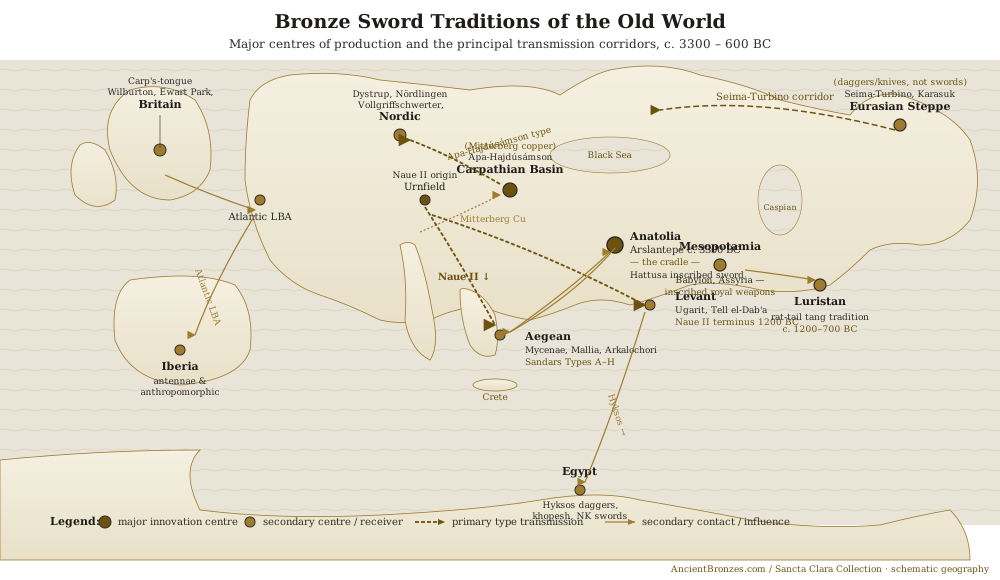
Recent isotope work has rewritten our understanding of where this metal came from. Daniel Berger and colleagues, publishing in Archaeometry in 2022, used lead-isotope and trace-element analysis to trace the copper in the Apa hoard back to the eastern Alpine Mitterberg region. The same source supplied copper to the Hajdúsámson axes and, intriguingly, to the swords associated with the famous Nebra sky disc in central Germany. The picture that emerges is of a Carpathian Basin in the sixteenth century BC functioning as the European hub of high-status sword production, drawing on Alpine copper, and transmitting both finished objects and stylistic ideas northward to Scandinavia.
This last point matters. Nils Bunnefeld, in a 2016 paper in the Praehistorische Zeitschrift, traced the northward transmission carefully. Period I of the Nordic Bronze Age — roughly 1700 to 1500 BC — initially imported Apa-Hajdúsámson swords directly. Then local smiths, working from the imported originals, began to imitate them, using traditional solid-casting technique. By Period II, the distinctive Nordic Vollgriffschwerter — full-hilted swords cast directly over the blade tang — had emerged as a regional style with its own ornamental vocabulary.
The Carpathian innovation was not just stylistic. It established the idea of the sword as a top-tier elite object in Bronze Age Europe — the kind of thing that gets buried with chieftains, deposited in bog hoards, and treated as a vehicle of ideology. That idea proved durable. It is still the basic European understanding of the sword two thousand years later, when Roman legionary swords arrive on the same landscape.
Egypt, the Levant, and the Curved Sword
Egypt’s bronze weapon tradition is, by comparison, a story of imports rather than independent invention.
Middle Kingdom Egypt (Dynasties 11 to 13, roughly 2000 to 1650 BC) produced dagger after dagger, but no swords properly so called. The typical Middle Kingdom dagger is 18 to 25 cm long, double-edged, with a low midrib and a flanged or rivet-set tang carrying an organic grip. The Metropolitan Museum holds a representative range: the ceremonial dagger of Senebtisi from Lisht (Dyn. 12, 18.9 cm), various Dyn. 12 daggers from Meir, and so on. These are all what we would now call long daggers, sometimes very fine, often ceremonial, but never approaching sword length.
Sancta Clara Lot 1202, the Egyptian ornamental bronze sword blade dated 2000–1400 BC, sits in this tradition. Its date range spans the Middle Kingdom through the early New Kingdom, and depending on its specific length and proportions it can be read either as a long ceremonial dagger or — at the upper end of the Second Intermediate Period and early Dynasty 18 — as one of the first Egyptian blades that genuinely crosses into short-sword territory. The Metropolitan’s transitional Dyn. 17–18 dagger inv. 40.2.7, at 30.8 cm and combining bronze, ivory, and silver, is the same family. These transitional pieces are quietly important: they mark the moment when Egyptian metallurgy starts producing weapons of meaningful reach, under heavy influence from the Levantine and Aegean worlds.
The big change comes with the Hyksos. The arrival of West Asian peoples in the Nile Delta during the Second Intermediate Period (roughly 1650–1550 BC) brings two transformative weapons into Egypt: the composite bow and the khopesh, the iconic curved bronze sword. The khopesh — I should say at the outset — is not a sword in the strict typological sense. It derives from the crescent battle-axe, descended from precursors like the curved-blade prototype shown on the Stele of the Vultures of Eannatum of Lagash around 2500 BC. It is sharpened on the convex curve only; the inner curve is blunt. Functionally it is a hooked slasher and chopper rather than a thrust-and-cut sword. Standard length is 50–60 cm; Tutankhamun’s tomb contained two; Ramses II’s khopesh is in the Louvre.
The published work that anchors this whole Levantine influx into Egypt is Graham Philip’s Tell el-Dab’a XV (Vienna, 2006), an illustrated catalogue of every bronze dagger, axe, spearhead, and knife from the late Middle Kingdom and Second Intermediate Period strata of the Hyksos capital. Manfred Bietak’s earlier work at the site documented a particularly striking warrior burial — a man interred with what Bietak described as “a well-preserved copper sword (the earliest of its type found in Egypt) and dagger,” accompanied by horse and sacrificial-servant burials. This is the Levantine package arriving in Egypt: warrior identity expressed in weapons, animal sacrifice, and elite display.
Mesopotamia and the Inscribed Sword
Mesopotamia is where the bronze sword first becomes a vehicle of writing. And that, I think, is where the bronze sword becomes most clearly a political object as well as a military one.
The pattern starts early — there are inscribed Sumerian daggers from the third millennium — but the iconic examples come from the second millennium. The single most famous is the Hattusa inscribed sword, found in 1991 during road repairs near the Lion Gate of the Hittite capital. It is bronze, identified as a Mycenaean Type B (though Eric Cline has cautiously suggested it might reflect Mycenaean influence on local Anatolian manufacture rather than a direct Aegean import), and it carries an Akkadian inscription declaring that “as Tudhaliya the Great King shattered the Assuwa-Country he dedicated these swords to the Storm-God, his lord.” The campaign in question is dated to roughly 1430 BC. The sword is now held at the Museum of Anatolian Civilizations in Ankara. It is, simultaneously, a piece of Mycenaean-style metalwork, a piece of Hittite royal propaganda, and a piece of Akkadian-language textual evidence — and the fact that all three can sit on the same object tells you something about how internationalised the Late Bronze Age really was.
Two centuries later we get the inscribed bronze daggers of Marduk-nadin-ahhe, the Babylonian king who reigned from roughly 1099 to 1082 BC. Four of these have been catalogued in published collections — including a specimen in the British Museum, BM 1932,0514.2, originally found in a cave near Kirmanshah in Luristan. They are bronze daggers or short swords, roughly 35–40 cm overall, with engraved cuneiform inscriptions on both faces of the blade just below the hilt junction. The formula reads, in Grant Frame’s translation: “Belonging to Marduk-nādin-aḫḫē, king of the world, king of Babylon, king of Sumer (and) Akkad.” First publication is C. J. Gadd’s 1932 note in the British Museum Quarterly; the extended discussion is Sidney Smith’s 1934 article in Iraq.
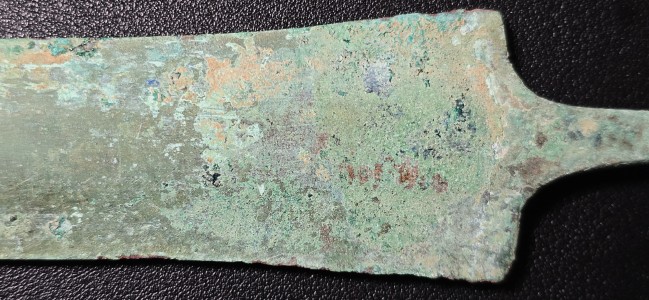
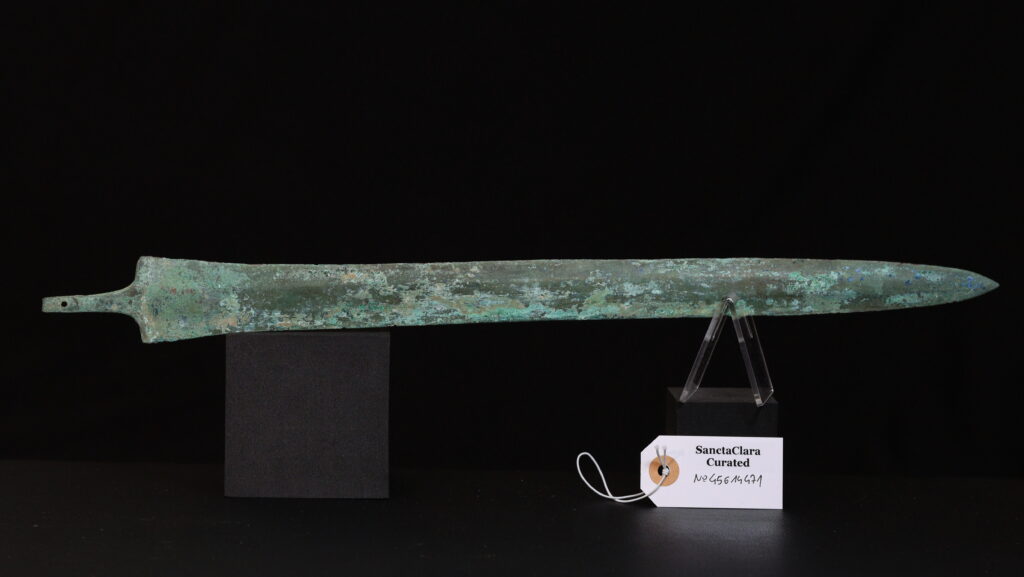
Sancta Clara Lot 902 — the Near Eastern bronze rapier-type short sword/dagger of the Marduk-nadin-ahhe period — sits in this corpus. At 49 cm it is within the inscribed comparable pieces but well within the typological family, the form, proportions, and date all point to the same Middle Babylonian elite-weapon tradition that produced the four inscribed examples. With its original grip, it would have been a serious close-quarter weapon of the Second Dynasty of Isin period, the kind of thing a Babylonian official or warrior of senior rank would have carried as a symbol of office as much as a weapon.
I should add one warning, because the secondary literature is often careless about it. The Middle Assyrian sickle sword of Adad-nirari I in the Metropolitan Museum (inv. 11.150.16, c. 1307–1275 BC, 54.3 cm long, gift of J. P. Morgan in 1911) is sometimes conflated with the Marduk-nadin-ahhe daggers in popular accounts. It is a different object: a curved Assyrian sickle sword, not a Babylonian straight dagger, separated from Marduk-nadin-ahhe’s by two centuries and several hundred kilometres. Both are inscribed bronze weapons of Mesopotamian kings; both carry royal formulas; both belong to the broader pattern of weapons-as-texts. But they are typologically and geographically distinct, and any catalogue entry that runs them together is wrong.
Luristan and the Rat-Tail Tradition
Iron Age Luristan — roughly the twelfth through eighth centuries BC, in the Zagros highlands of western Iran — produced the most distinctive single sword tradition of the ancient Near East. The Luristan bronzes have been a collecting field since the nineteenth century, and their sheer formal inventiveness has kept them interesting ever since.
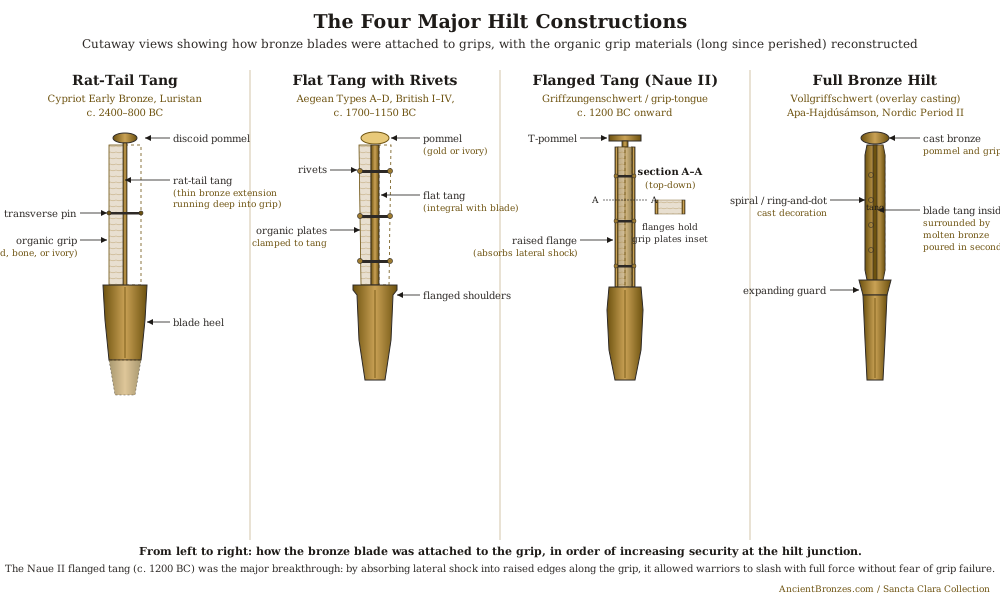
The hallmark Luristan weapon construction is the rat-tail tang: a long, thin, rectangular- or square-section extension of the blade, often bent or terminating in a discoid head, inserted into a wooden or bone or ivory grip and secured by a transverse pin — or in the most luxurious examples, completely encased in a cast bronze hilt. The blade typically has a strong central midrib and parallel fullers — narrow grooves running down the blade either side of the midrib. The fullers concentrate the blade’s mass along its spine, which gives the long thin blade the bending stiffness it needs without adding much weight. This is the same engineering principle as an I-beam, achieved with bronze and a stone mold.
The Luristan repertoire is wide. There are simple rat-tail swords and daggers; there are anthropomorphic-hilted swords with cast bronze hilts in the form of stylised human figures; there are short swords with openwork hilts and lunate or crescent pommels; there are swallowtail-base swords with winged hand-guards. The masterworks come from the Marlik finds (excavated by Ezat Negahban) and the cemeteries of the Pusht-i-Kuh.
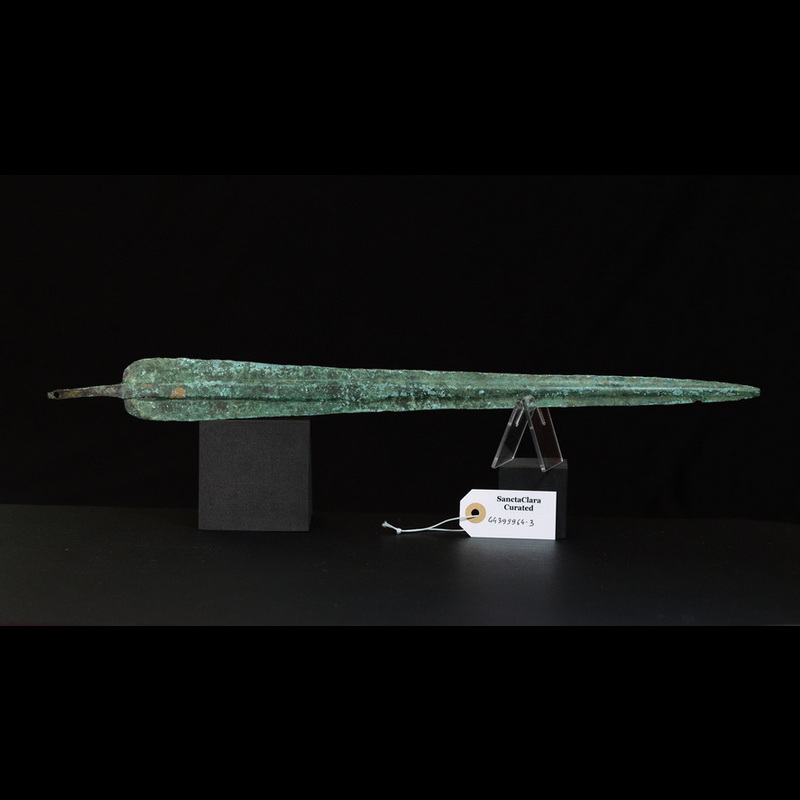
Sancta Clara Lot 1018 — a bronze sword, 52 cm of surviving blade, flat midrib, rat-tail tang — sits in the simpler end of this tradition. The flat midrib (rather than the more elaborate parallel-fuller construction) is a simpler engineering solution and may indicate either an earlier production date within the period or a regional variant outside the Marlik elite workshops. With its original organic hilt of 12–15 cm, it would have been comfortable in the hand — a real sword by any measure, and a perfectly serviceable weapon for the kind of mountain warfare that dominated Zagros geography in the early first millennium BC.
The rat-tail tang has one specific advantage worth noting: it absorbs lateral shock through the entire length of the grip rather than concentrating it at a riveted junction. For the long-blade cut-and-thrust use Luristan smiths designed for, this is a meaningful improvement over the riveted flat tang of Aegean Types A through D. The Luristan tradition is, in this respect, one of the most sophisticated engineering solutions of the entire Bronze Age sword corpus — and it is one reason these objects so often survive in much better mechanical condition than their Aegean contemporaries.
Any serious discussion of Iranian Bronze Age weapons has to acknowledge the work of Manouchehr Moshtagh Khorasani, whose *Arms and Armor from Iran: The Bronze Age to the End of the Qajar Period* (Legat Verlag, Tübingen, 2006) is the single most comprehensive published reference in the field. The book — running to nearly eight hundred pages, with several thousand colour images and illustrations of holdings from ten Iranian museums together with selected pieces from private European and American collections — was awarded the Book Prize of the Islamic Republic of Iran in 2009, and it remains the indispensable starting point for anyone working on Iranian arms. Khorasani’s particular contribution to the Bronze Age material is that he sets the weapons firmly within their cultural and historical context rather than treating them as isolated typological specimens, and that he draws extensively on Iranian-language scholarship that is rarely accessible in Western-language publications. His subsequent work — including *Lexicon of Arms and Armor from Iran: A Study of Symbols and Terminology* (2010, which won the same prize in 2012), *Persian Archery and Swordsmanship: Historical Martial Arts of Iran* (Niloufar, 2013), and a steady stream of journal articles continuing into recent years — has consolidated his standing as the central authority on the field. For the Luristan material specifically, and for the broader question of how Iranian sword design relates to and diverges from the Mesopotamian and Aegean traditions, I would direct readers to his 2006 volume as the first port of call.
The Naue II Revolution
If I had to single out one bronze sword type as the most consequential in human history, it would be the Naue II, also known as the Griffzungenschwert (“grip-tongue sword”). Named for the German archaeologist Julius Naue, who published the first systematic typology of pre-Roman swords in 1903, the Naue II emerges in northern Italy and the wider Urnfield cultural area around the thirteenth century BC and proceeds, over the next several centuries, to colonise the entire bronze-using world from Atlantic Spain to Ugarit on the Syrian coast.
The defining feature is the flanged tang, also called the grip-tongue. Instead of a flat tang held by rivets through an organic grip (the older Aegean and Carpathian solution), the Naue II tang is a flat extension of the blade with raised flanges along both edges. Organic grip plates are inset between the flanges and secured by rivets. This construction does three things at once. It dramatically increases the resistance to lateral shock at the hilt junction. It allows a warrior to slash with full force without fear of the grip working loose. And it produces a hilt assembly that is far more durable in field conditions than the older designs.
Typical Naue II blades run 50–85 cm, with most clustered around 60–70 cm. The blade cross-section may be a strong central midrib, a lenticular section, or a flat diamond. The form is optimised for cut-and-thrust use, leaning toward the slashing end of the spectrum — a meaningful change from the pure-thrust orientation of the older Aegean rapiers.
The geographic spread of the Naue II is the single most striking thing about it. Original Urnfield-region examples are followed within decades by exports and imitations across the entire Mediterranean and into the Aegean. By around 1200 BC, Naue II swords are turning up at Ugarit on the Syrian coast — just decades before the destruction of that city and the broader collapse of the Late Bronze Age palace systems.
Robert Drews, in his 1993 book The End of the Bronze Age: Changes in Warfare and the Catastrophe ca. 1200 B.C., made the case that this sword type — together with the javelin and the round shield — was a key element of a new infantry tactic that swept the Mediterranean in the late thirteenth century BC. The argument is that mass-employed infantry equipped with cut-and-thrust swords, javelins, and round shields proved decisively superior to the chariot-and-bow warfare of the late palace cultures. Drews cites, among other evidence, the Egyptian record that 9,111 swords were captured from the Libyan raid on Egypt in 1208 BC — a stunning number for the period, implying that bulk sword-armed infantry was the new military mainstream.
I will admit I find the strong version of Drews’s argument overstated. The Bronze Age collapse was multicausal, and reducing it to a single weapon shift sells short the climatic, environmental, agricultural, and political stresses that recent scholarship has emphasised. But the correlation between Naue II diffusion and the collapse is real and striking, and the Naue II clearly did represent a significant battlefield advantage. After the collapse, when the palace cultures had fallen and the so-called Dark Ages had begun, the Naue II remained the sword of choice across Europe and the Mediterranean. Its basic design persisted, with only minor refinements, for the next seven hundred years — surviving the transition from bronze to iron almost unchanged in form until the sixth century BC. This is the longest stable design horizon in the history of swordmaking.
The Atlantic Façade and the British Isles
The British and Atlantic European traditions are inseparable from the broader European Late Bronze Age, but they have their own typological vocabulary, codified by Burgess and Gerloff (1981) and Colquhoun and Burgess (1988) in the German Prähistorische Bronzefunde series.
The British dirk-and-rapier sequence runs through four numbered groups. Group I (c. 1550–1400 BC) has rounded midribs and most pieces are in the 20–30 cm dirk range; over 90 per cent of Group I finds are single watery-context deposits, indicating votive deposition rather than loss. Group II (c. 1550–1350 BC) is more numerous in Ireland. Group III (c. 1400–1250 BC) is the most elegant — triple-arris blade section, occasional lengths up to 80 cm, often deposited in rivers. Group IV (c. 1400–1150 BC) is flatter, more often in hoards, with concentrations in the Thames Valley and East Anglia.
The transition to the proper sword forms happens around 1150 BC with the Ballintober type — transitional, taking the older British rapier blade and grafting a flanged tang in the Urnfield manner. From there the sequence runs through Wilburton (c. 1150–975 BC) and into Ewart Park (c. 925–800 BC), the latter being the dominant British sword form of the very late Bronze Age, leaf-shaped, broad-bladed, and very numerous. Alongside Ewart Park, the Carp’s-tongue sword appears in the late ninth and eighth centuries BC, with a wide parallel-edged main blade and a narrow tip for thrust — a Brittany-and-southeast-England distribution, with the Isleham hoard yielding famous examples. The final Bronze Age sword type, the Gündlingen, appears in early Hallstatt C in continental Europe and crosses the Channel as a late bronze form just before iron displaces bronze entirely.
The British river deposition pattern is striking and well-documented. The Thames alone has produced enough Bronze Age swords to populate small museums. The use-wear evidence (Sue Bridgford’s work is essential here) shows that many of these swords saw real combat before deposition — they are not pristine ceremonial blades but worn fighting weapons that were then committed to the water. The interpretation everyone now favours is votive deposition: warriors or chiefs casting valued weapons into rivers, lakes, and bogs as offerings, probably at the end of a career or after a victory. The pattern is paralleled across Atlantic Europe and in Scandinavia.
The Nordic Vollgriffschwerter
Scandinavia and northern Germany produced the most spectacular full-hilted bronze swords of the entire Bronze Age. The Vollgriffschwert — literally “full-grip sword” — has its hilt cast directly over the blade tang in solid bronze, either in a single operation or by overlay casting (Überfangguss), where a pre-cast blade tang is set into a mould and molten hilt-bronze poured around it. The technique was studied in detail by Heinrich Drescher in 1958, and remains one of the most technically challenging operations in Bronze Age metallurgy.
The Nordic Period II octagonal-hilted sword family (Achtkantschwert) is the high point of the technique. The hilt is octagonal in cross-section, often elaborately decorated with ring-and-dot motifs, spirals, geometric patterns, and — as recent work has confirmed — fine inlays of drawn copper wire. A burial mound discovered in Bavaria in 2023, containing an adult man, an adult woman, and a teenager, produced an intact Achtkantschwert dated to the late fourteenth century BC, around 66 cm long, weighing roughly 2 pounds. Mathias Pfeil of the Bavarian State Office for the Preservation of Monuments described it, accurately, as “very rare.” A 2026 follow-up study at the Helmholtz-Zentrum Berlin, using 3D computed tomography by Nikolay Kardjilov and X-ray fluorescence by Martin Radtke at the BAMline, showed that the inlay on the pommel and pommel plate consisted of drawn copper wires pieced together — a technique we had not previously associated with that period.
A second northern category I want to mention is the Dystrup hoard, published by Wincentz Rasmussen and Boas in 2006. A potato harvester in northeastern Djursland (Denmark) turned up the first sword in autumn 1993; subsequent excavation produced a total of eight short bronze swords, all of the Hajdúsámson-Apa type, all locally made, all from the same workshop. Use-wear analysis showed several of them had been damaged in combat before deposition. This is the kind of find that tells us how the Carpathian sword reached the north: as imports first, then as locally imitated objects, made in series by Nordic smiths in their own workshops, drawing on the southern stylistic vocabulary.
Antennae and the Hallstatt Close
The Late Bronze Age in central Europe — Hallstatt B in the conventional German chronology, roughly the tenth through eighth centuries BC — produced one last great bronze sword family before iron took over completely. The antennae sword (Antennenschwert) takes the full-hilted Vollgriffschwert and gives it a distinctive pommel with two coiled or spiralled terminals projecting upward, like the antennae of an insect — a purely decorative flourish in a class of weapons that had long since stopped pretending not to be elite display objects.
The eponymous finds come from Lake Neuchâtel in Switzerland: the Mörigen and Auvernier types, named for the lakeshore sites where the originals were recovered. The Italian variants are Tarquinia type. Iberian Iron Age antennae and anthropomorphic-hilted swords continue the same basic concept long after central European production stopped. A representative Hallstatt B antennae sword from Bad Schussenried in southern Germany is around 67 cm long, weighs 820 g, and is cast of approximately 90 per cent copper to 10 per cent tin — the classic late Bronze Age alloy.
The succeeding Hallstatt C period (roughly eighth and seventh centuries BC) produced the Mindelheim sword, which exists in both bronze and iron variants — sometimes side by side in the same princely burial. This is the crossover period: iron is now competitive with bronze in mechanical performance, and within a few centuries it will displace it almost entirely for cutting weapons. The bronze sword, in its long European career, ends here.
The Steppe and East Asia: Parallel Worlds
I should briefly trace two parallel sword stories that run alongside the Western Old World narrative.
The first is the Seima-Turbino phenomenon of the southern Siberian forest-steppe — a remarkable burst of metallurgical innovation dated, by recent radiocarbon work (Marchenko and colleagues, 2017), to between roughly the twenty-second and twentieth centuries BC. Seima-Turbino smiths produced socketed single-hooked spearheads, socketed celts, and single-edged knives with cast figural pommels — the most famous of which is the Rostovka horse-and-skier knife, in which two separately cast parts (the blade and a handle topped by a small figure) were joined by molten-metal “soldering.” Material in this style appears as far east as Panlongcheng in the middle Yangzi by around 1400 BC, suggesting an east-west transmission corridor across the Eurasian steppe. But — and this is the point — the Seima-Turbino tradition produced daggers and knives, not swords proper. The longest knives in the corpus are around 30 cm. The sword as we have been defining it is not present.
The same is broadly true of the related Karasuk tradition of the Minusinsk Basin (c. 1500–800 BC) and the later Tagar tradition, which continued bronze edged-weapon production into the first millennium BC. Karasuk knives and daggers, often with animal-style pommels, are some of the most beautiful objects in the steppe metallurgical tradition. But they do not approach sword length until the iron akinakes of the Scythian period.
The second parallel story is China. The Erlitou culture (c. 1900–1500 BC) produced the first bronze ge — the dagger-axe, a perpendicular-bladed weapon mounted on a haft, more comparable to a halberd than to a sword. The Shang dynasty (c. 1600–1046 BC) added short bronze daggers and short swords (the proto-jian), some 30–50 cm long, occasionally with ibex- or ram-head pommels showing Seima-Turbino influence. The Western Zhou jian (c. 1046–771 BC) is a short straight double-edged sword. The Korean Liaoning-type dagger or mandolin-shaped dagger (c. 1000–400 BC) is a distinctive regional form with a lute-shaped blade and a separately mounted hilt — the National Museum of Korea holds fine examples from Hwanghae province. Yayoi Japan, from about 300 BC onward, imports the Korean tradition into northern Kyushu.
The Chinese bronze sword tradition reaches its high point during the Warring States period (fifth through third centuries BC), with high-tin bronze of 17–21 per cent tin in composite construction — softer low-tin cores with harder high-tin edges, a sophisticated metallurgical solution to the brittleness problem. The Sword of Goujian, dated to around 500 BC and 55.6 cm long, is the iconic example. But this is a parallel development with only intermittent contact with the Western tradition; the chronologies do not match, and the design solutions are different.
So my answer to the question I opened with — was the Old World really the source? — is: yes, but with two important qualifications. First, the cradle is Anatolian (Arslantepe), not Aegean. Second, East Asia developed its own bronze edged-weapon tradition essentially independently, with only occasional cross-fertilisation via the steppe. The Mediterranean–European–Near Eastern bronze sword family is one continuous story; the East Asian story is another, and the two run in parallel until iron arrives.
Why Long Bronze Swords Are Rare
There is a reason most surviving bronze swords cluster in the 50–70 cm range, and pieces over 85 cm are exceptional. The reason is metallurgy.
Tin-bronze at 9–12 per cent tin — the classic Bronze Age alloy — has a tensile strength of roughly 200 to 300 MPa. That sounds like a lot until you consider that a one-metre blade swung with vigour at an opponent’s shield experiences lateral forces that will flex the blade significantly. Long bronze blades bend; they take a permanent curve along their length; they sometimes simply fail at the hilt junction under cumulative fatigue.
The structural response is the midrib. By adding a thick rib down the centre of the blade — and, in more sophisticated cases, parallel fullers either side of that rib — the smith concentrates the blade’s mass along its spine and dramatically increases its bending stiffness without much added weight. This is the I-beam principle, applied in bronze. Aegean Type A rapiers achieve their extraordinary length (up to a metre) only because they have a very strong central midrib; Luristan blades use the parallel-fuller construction; Naue II swords use a robust midrib with a lenticular cross-section. But robust midrib adds weight.
The other constraint is casting. Bivalve molds — two-piece stone or clay molds — work very well up to a certain blade length, beyond which mold warping during the pour, porosity at the tip, and incomplete fill become serious problems. The threshold varies with mold material and operator skill, but in practice it limits most production-grade bronze swords to about 70 cm. Anything longer requires exceptionally skilled mould-making and an extended pour with careful temperature control. The Aegean Type A rapiers and the longest British Group III rapiers represent the cutting edge of what bivalve casting could achieve in their respective regions.
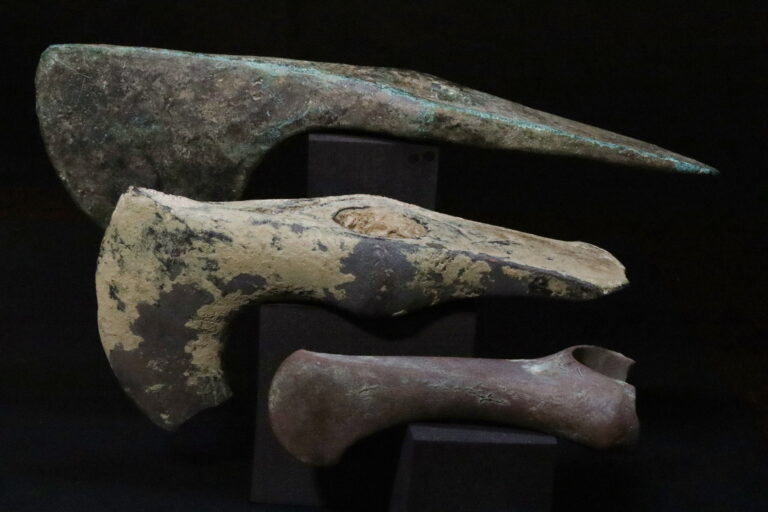
For more complex hilts — full bronze hilts in particular — smiths used cire perdue (lost wax) casting, which can produce shapes of arbitrary complexity but requires a one-time investment in a single-use wax model and clay envelope. The most elaborate Luristan hilts, the Nordic Vollgriffschwerter, the Seima-Turbino Rostovka knife pommels, and the Carpathian Apa-Hajdúsámson hilts all use this technique. Overlay casting (Überfangguss) — pouring molten bronze around a pre-cast blade tang to form a hilt — was the Nordic specialty for the octagonal full-hilted swords, and it required hot-pouring under significant thermal stress.
Once the casting was done, the edges of the blade were typically work-hardened by hammering, which refines the bronze’s grain structure and adds several HV (Vickers hardness) points to the cutting edge. Then they were ground and polished. A finished bronze sword is the product of a great deal of careful labour by a highly skilled craftsperson, working in a workshop with controlled fire conditions, mould-making expertise, and access to scarce tin. None of this came cheap, and none of this was widespread. The bronze sword was always an elite object.
How the Hilt Evolved
The history of the bronze sword is largely the history of an ongoing struggle to attach a blade to a handle securely enough to survive combat. The progression runs something like this.
The earliest swords (the Arslantepe blades, the first Cycladic and Cypriot daggers) have tang-less or rivet-attached organic handles. The entire grip is organic — wood or bone — held against the heel of the blade by transverse rivets. The construction is simple but vulnerable to rivet failure under lateral shock.
The full tang and rat-tail tang — a long thin extension of the blade running deep into a wooden or bone grip — is the Luristan and Cypriot solution. It distributes shock across the entire length of the grip. Sancta Clara Lot 1018 is built this way.
The flat tang with rivets is the Aegean and British solution from the Middle Bronze Age forward. The tang is a flat plate, the grip is two organic plates clamped against it by rivets. It is mechanically intermediate between the rat-tail and the later flanged designs. Aegean Sandars Types A through D use this construction; British Groups I through IV do as well.
The flanged tang (Griffzungenschwert) is the Naue II breakthrough. The flat tang gains raised flanges along its edges, into which grip plates are inset and riveted. The flanges absorb lateral shock that would otherwise be transmitted directly through the rivets. This is a major engineering advance and the reason the Naue II became the dominant European sword type for the better part of a millennium.
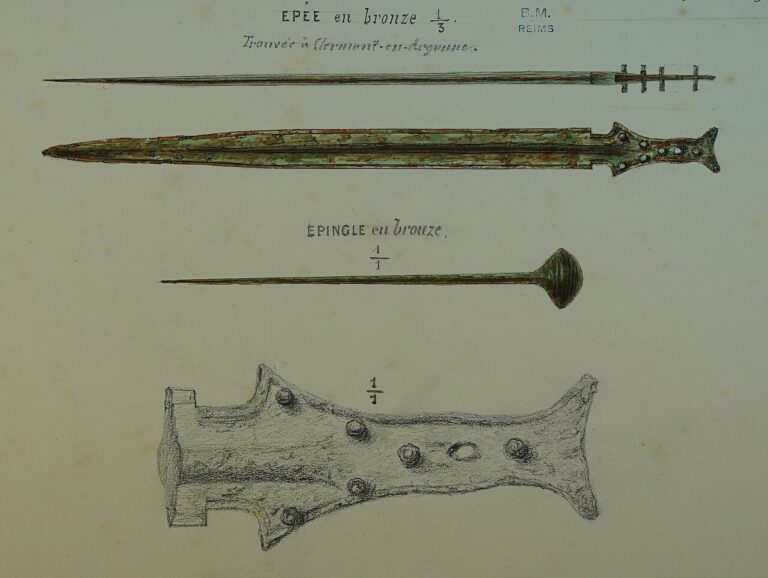
The full bronze hilt cast onto the blade (Vollgriffschwert) is the Carpathian and Nordic solution from the Middle Bronze Age onward. The hilt is solid bronze, either cast in one piece with the blade (very difficult) or cast separately and joined by overlay casting or by mechanical means. The Apa-Hajdúsámson swords, the Nordic Period II octagonal-hilted swords, and the Urnfield Riegsee, Mörigen, Auvernier, and Tachlovice types all use this construction.
The antennae hilt is a late variant of the full bronze hilt with twin spiral pommel terminals — a decorative flourish on a fundamentally sound design.
The anthropomorphic hilt is the Luristan and later Iberian solution — a cast bronze hilt formed in the shape of a stylised human figure or face. The same idea reappears in the Hallstatt anthropoid-hilted iron daggers of the Iron Age. It is a piece of design DNA that turns out to be remarkably durable.
The progression is broadly from organic-grip-with-rivets toward all-bronze construction, and from simpler hilt-to-blade junctions toward more shock-absorbent designs. But these are tendencies, not absolutes. The flanged tang of the Naue II coexists for centuries with the full bronze hilt of the Nordic Vollgriffschwert; the rat-tail tang of Luristan coexists with both. Different traditions chose different solutions, and the choices reflected local technological capability, aesthetic preference, and the specific tactical role the sword was being designed for.
Ornament, Inlay, and the Sword as Display
The bronze sword was never just a weapon. It was also, almost always, a statement.
The decorative repertoire is extraordinary in its range. Engraved blade decoration — geometric motifs, zigzags, ring-and-dot patterns — appears on Apa-Hajdúsámson swords (lavishly), on Nordic Period I and II swords (sometimes covering the entire blade), on Carp’s-tongue swords from the Vénat hoard, and on individual Mörigen examples like the famous one from the Garonne. Punched or stamped decoration appears on the Hausmoning-subtype octagonal swords held in the Metropolitan Museum, with carefully placed dots and chased crescents.
Niello inlay is the masterwork tradition. The Mycenae Shaft Grave IV lion-hunt dagger — dated to roughly 1550–1500 BC and excavated by Schliemann in 1876, now in the National Archaeological Museum in Athens — is the canonical example. Its 23.7 cm blade carries an inlaid scene of a lion hunt: hunters with shields and spears, lions in attack and flight, all rendered in gold and silver against a black niello background (sulphides of copper, silver, and lead, heated to fuse into engraved channels in the bronze). The style is Minoan; the subject is borrowed from Egyptian and Mesopotamian royal hunt iconography. A companion dagger from the same grave shows lions seizing antelopes. These objects mark the moment when bronze metallurgy crosses fully into the realm of representational art.
Silver and gold overlay is, as we have seen, even older — the Arslantepe blades of around 3300 BC carry inlaid silver triangles, making them the oldest known metal-on-metal inlay work anywhere. The 2026 study of the Nördlingen octagonal sword confirmed drawn copper wire inlay on the pommel — a technique we now know was used in the late fourteenth century BC.
Anthropomorphic and zoomorphic hilts range across the bronze world: Luristan anthropomorphic swords, Karasuk knife pommels with bears and elks, Shang dao with ibex and ram heads, the Seima-Turbino Rostovka horse-and-skier figure. The bronze hilt is a small sculpture as well as a handle.
The bigger point is that the bronze sword was always rare, always expensive, and always carried symbolic weight beyond its battlefield function. Making a serviceable bronze sword required about a kilogram of tin-bronze (perhaps 100 g of tin — a metal traded across vast distances — plus 900 g of copper), skilled casting in carefully prepared moulds, hammering and edge-grinding by an experienced smith, organic grip materials shaped to a specific blade, and a sheath. Swords were always a small fraction of any region’s warrior equipment. The spear and the axe were the everyday weapons; the sword was the marker of rank.
This is why bronze swords are found, overwhelmingly, in two contexts: in elite graves (the Mycenae shaft graves, the Apa and Hajdúsámson hoards as funerary or votive assemblages, the Hallstatt C princely burials) and in votive hoards and watery deposits (the Dystrup bog, the Tollense Valley, the Thames, the Isleham hoard of Carp’s-tongue swords, the British Group I rapiers found overwhelmingly in single watery contexts with “water patina” indicating intentional deposition rather than accidental loss).
A subset of the most ornate bronze swords were almost certainly ceremonial only — too fragile or too elaborate for combat use. Some Aegean Type A rapiers with hilts of gold and ivory have no rivets in the hilt junction at all; they would not have survived a single hard strike. Some of the Arslantepe silver-inlaid blades may belong in the same category. Some Nordic full-hilted Vollgriffschwerter are too heavy or too unwieldy for fighting use and were clearly made for display or burial.
But — and this is important — the modern use-wear scholarship (Barry Molloy’s 2010 article in the American Journal of Archaeology; Christian Horn’s work from 2013 onward; subsequent contributions by Anderson, Gentile, and others) has decisively dismantled the older view that most bronze swords were ceremonial. The use-wear evidence on the great majority of surviving bronze swords shows edge nicks, parry marks, plastic flex deformation, and the kind of cumulative damage that only real combat produces. These were weapons that were used. The ceremonial-only category is now restricted to the most ornate outliers, not the typological mainstream.
The Sword and the Inscribed Word
I want to close on the inscribed swords specifically, because I think they tell us something important about what the bronze sword was, ideologically, in the second millennium BC.
The Hattusa sword of Tudhaliya I or II (c. 1430 BC) is, simultaneously, a Mycenaean Type B in form, a Hittite royal dedication in function, and an Akkadian-language text in script. It records the king’s victory, dedicates the spoils to the Storm God, and presumably hung in a temple as a visible record of both. The Marduk-nadin-ahhe inscribed daggers of around 1090 BC are smaller objects on the same model: bronze weapons that carry royal titles, found later in Luristan caves where they had presumably been deposited as votives or trophies. The Adad-nirari I sickle sword of around 1300 BC carries the king’s full titulary along its non-cutting edge, with engraved antelopes flanking the inscription on both sides.
These objects fold together three categories that the modern museum tends to keep separate. They are weapons. They are texts. They are royal images. The bronze sword in the second millennium BC was already operating as more than a tool of war; it was operating as a vehicle of kingship and a piece of political theatre. Sancta Clara Lot 901, my Marduk-nadin-ahhe-period rapier-type short sword, may or may not bear the king’s inscription itself, but it sits in this tradition: it is the kind of object that, in the hands of a senior Babylonian official, signalled status and political loyalty quite apart from any military function it might also have carried.
When we hold one of these objects today, three thousand years after its making, we are holding an artefact that already meant several things at once when it was new. The technical achievement of the smith. The political claim of the patron. The ideological function of the gift or trophy. The aesthetic display of inlay or engraving. The deadly function of the cutting edge. All of these were present from the start.
A Short Synthesis
What I take away from all this, after years of looking at these objects in Sancta Clara collection and in museums:
The bronze sword is an Anatolian invention of the late fourth millennium BC that took a thousand years to mature into the long-blade thrusting weapon we recognise — and which then proliferated, in a great burst of regional creativity between roughly 1700 and 1200 BC, across the Aegean, the Carpathian Basin, the Levant, Egypt, Mesopotamia, the Atlantic seaboard, Scandinavia, and the Iranian highlands. The Carpathian Apa-Hajdúsámson tradition and the Aegean Sandars sequence are the two great Middle Bronze Age elaborations of the idea. The Naue II of around 1200 BC then sweeps across the entire region in a way no earlier sword type had managed, and persists, with only minor changes, until iron displaces it entirely after 600 BC.
The Old World was, in essence, a single bronze-sword culture by the Late Bronze Age, even if the specific types varied region by region. The Eurasian steppe and East Asia developed their own bronze edged-weapon traditions in parallel, with only occasional contact through the Seima-Turbino corridor. The Old Copper Complex of North America produced no swords at all, for both technological and cultural reasons. The bronze sword tradition is, in this sense, a single great phenomenon centred on Eurasia, dominated by elite display as much as battlefield function, technically demanding to produce, and culturally indispensable to its users.
This is, in my view, why these objects continue to repay close study. They are at once weapons, sculptures, texts, and political objects. They survive in considerable numbers — enough to support real comparative analysis — but each one is also a unique survival from a particular moment in a particular place. To pick one up is to put one’s hand around an idea that has been in the world for five thousand years, and that continues, in various forms, to be in the world today. There is no other class of object that does quite this work.
The Sancta Clara Collection holds a small selection of swords, daggers, and short swords spanning much of the chronology covered above, including the Mycenaean short sword Lot 778, the Marduk-nadin-ahhe-period rapier-dagger Lot 901, the Luristan rat-tail-tang sword Lot 1018, and the Egyptian ornamental blade Lot 1202. The full catalogue, with images and provenance notes, is available elsewhere on AncientBronzes.com.
Sources and Further Reading
Foundational Typologies
- Sandars, N. K. “The First Aegean Swords and Their Ancestry.” American Journal of Archaeology 65 (1961): 17–29.
- Sandars, N. K. “Later Aegean Bronze Swords.” American Journal of Archaeology 67 (1963): 117–153.
- Kilian-Dirlmeier, Imma. Die Schwerter in Griechenland (außerhalb der Peloponnes), Bulgarien und Albanien. Prähistorische Bronzefunde IV/12. Stuttgart: Steiner, 1993.
- Burgess, Colin, and Sabine Gerloff. The Dirks and Rapiers of Great Britain and Ireland. Prähistorische Bronzefunde IV/7. Munich: Beck, 1981.
- Colquhoun, Ian, and Colin Burgess. The Swords of Britain. Prähistorische Bronzefunde IV/5. Munich: Beck, 1988.
- Shalev, Sariel. Swords and Daggers in Late Bronze Age Canaan. Prähistorische Bronzefunde IV/13. Stuttgart: Steiner, 2004.
- Naue, Julius. Die vorrömischen Schwerter aus Kupfer, Bronze und Eisen. Munich, 1903.
Modern Combat and Use-Wear Studies
- Molloy, Barry. “Swords and Swordsmanship in the Aegean Bronze Age.” American Journal of Archaeology 114, no. 3 (2010): 403–428.
- Drews, Robert. The End of the Bronze Age: Changes in Warfare and the Catastrophe ca. 1200 B.C. Princeton: Princeton University Press, 1993. ISBN 9780691048118.
- Bridgford, Sue. Work on British Bronze Age rapier use-wear (multiple publications, see Proceedings of the Prehistoric Society and related journals).
Origins and Regional Studies
- Frangipane, Marcella. Multiple publications on the Arslantepe excavations, from the early 1980s onward. Overview at Arkeonews — Forged 5,000 Years Ago: The World’s Oldest Swords Discovered at Arslantepe Mound, Türkiye and Anatolian Archaeology — The World’s Oldest Swords and the Birth of Warfare at Arslantepe.
- Berger, Daniel, et al. “Identifying mixtures of metals by multi-isotope analysis: Disentangling the relationships of the Early Bronze Age swords of the Apa-Hajdúsámson type and associated objects.” Archaeometry 64 (2022). Academia.edu PDF.
- Bunnefeld, Nils. Work on the Nordic-Carpathian sword connection. Praehistorische Zeitschrift 91, no. 2 (2016): 379–430.
- Rasmussen, Wincentz, and Niels Axel Boas. “The Dystrup Swords: A Hoard with Eight Short Swords from the Early Bronze Age.” Journal of Danish Archaeology 14, no. 1 (2006): 87–108. ResearchGate.
- Stockhammer, Philipp W. Zur Chronologie, Verbreitung und Interpretation urnenfelderzeitlicher Vollgriffschwerter. Tübinger Texte 5. Rahden/Westfalen: Marie Leidorf, 2004. Academia.edu.
- Marchenko, Z. V., et al. “Radiocarbon Chronology of Complexes With Seima-Turbino Type Objects (Bronze Age) in Southwestern Siberia.” Radiocarbon (2017). Cambridge Core.
- Khayutina, Maria. “Bronze Weapons from Panlongcheng and the Seima-Turbino Cross-Cultural Phenomenon.” SSRN (2024). Paper.
Iranian Arms and Armor
- – Moshtagh Khorasani, Manouchehr. *Arms and Armor from Iran: The Bronze Age to the End of the Qajar Period*. Tübingen: Legat Verlag, 2006. ISBN 978-3-932942-22-8. 780 pages, over 2,800 colour and 600 black-and-white images. Awarded the Book Prize of the Islamic Republic of Iran, 2009. The single most comprehensive published reference on Iranian arms; the Bronze Age and Iron Age chapters are essential for Luristan and pre-Achaemenid material. Companion site at [arms-and-armor-from-iran.de](http://www.arms-and-armor-from-iran.de/).
- – Moshtagh Khorasani, Manouchehr. *Lexicon of Arms and Armor from Iran: A Study of Symbols and Terminology*. Legat Verlag, 2010. Awarded the Book Prize of the Islamic Republic of Iran, 2012.
- – Moshtagh Khorasani, Manouchehr. *Persian Archery and Swordsmanship: Historical Martial Arts of Iran*. Niloufar Books, 2013. ISBN 978-3-00-039054-8.
- – Moshtagh Khorasani, Manouchehr. “Persian Swordmakers (Armeiros Persas).” In *Rites of Power: Oriental Arms (Rituais de Poder: Armas Orientais)*. Casal de Cambra: Caleidoscópio, 2010, pp. 41–55.
- – Moshtagh Khorasani, Manouchehr, and Iván Szántó. “Straight Swords in Iran: A Continuing Tradition.” In *Persian Treasures — Hungarian Collections*. Budapest, 2012.
- – Moshtagh Khorasani, Manouchehr. “The Evolution of Curved Swords: A Comparative Study of China and Iran.” *Parseh Journal of Archaeological Studies* 9, no. 31 (2025): 33–54.
- – Author’s professional site and complete publication list: [moshtaghkhorasani.com](https://www.moshtaghkhorasani.com/books/).
- – Negahban, Ezat O. *Marlik: The Complete Excavation Report* (2 vols). University Museum, University of Pennsylvania, 1996. Foundational excavation report for the Marlik cemetery, indispensable for the elite end of the Luristan / North Iranian Bronze Age weapon corpus.
Egypt and the Levant
- Philip, Graham. Tell el-Dab’a XV: Metalwork and Metalworking Evidence of the Late Middle Kingdom and Second Intermediate Period. Vienna: Österreichische Akademie der Wissenschaften, 2006.
- Bietak, Manfred. Tell el-Dab’a V. Vienna: ÖAW, 1991 / 1996.
- Metropolitan Museum of Art collection database — Middle Kingdom and New Kingdom daggers (544283, 544281, 555724, 544821) and Assyrian sickle sword (322443).
Inscribed Swords
- Gadd, C. J. “Two Bronze Daggers.” British Museum Quarterly VII, no. 2 (1932): 44, with plate XVIII.
- Smith, Sidney. “Two Mesopotamian Daggers and Their Relatives.” Iraq 1, no. 2 (1934): 163–170. Cambridge Core abstract.
- Frame, Grant. Rulers of Babylonia: From the Second Dynasty of Isin to the End of Assyrian Domination. RIMB 2. Toronto: University of Toronto Press, 1995.
- Brinkman, J. A. A Political History of Post-Kassite Babylonia. Analecta Orientalia 43. Rome: Pontifical Biblical Institute, 1968.
- British Museum object record BM 1932,0514.2 (Marduk-nadin-ahhe inscribed sword/dagger).
- Hansen, O. “A Mycenaean Sword from Bogazköy-Hattusa.” Annual of the British School at Athens 89 (1994): 213–215.
- Cline, Eric H. Discussion of the Hattusa sword’s identification. Annual of the British School at Athens 91 (1996): 137–151.
Naue II, Sea Peoples, and Late Bronze Age Collapse
- Bronze Age Craft — extended discussion of the Naue II by Brock Hoagland, bronze-age-craft.com.
- Bryn Mawr Classical Review 1994.01.09 — review of Drews’s End of the Bronze Age, bmcr.brynmawr.edu.
- Maxwell, Joshua. “Tales of the Trojan War” (student thesis). University of Texas Libraries, PDF.
Old Copper Complex
- Ehrhardt, Kathleen. Journal of World Prehistory 22 (2009): 213–235.
- Pleger, Thomas C., and James B. Stoltman. Work on Old Copper chronology and typology (2009 and earlier).
- Bebber, Michelle R., and Metin I. Eren. “Toward a functional understanding of the North American Old Copper Culture ‘technomic devolution.'” Journal of Archaeological Science 98 (2018). ScienceDirect.
- Milwaukee Public Museum, Old Copper Culture online collection, mpm.edu.
Recent Finds and Materials Analysis
- Archaeology Magazine (Sept/Oct 2023) — Nördlingen octagonal-hilted sword, archaeology.org.
- Live Science — Octagonal sword from Bronze Age burial in Germany, livescience.com.
- Smithsonian Magazine — Bavarian Bronze Age sword, smithsonianmag.com.
- HeritageDaily — Middle Bronze Age metalworking insights, heritagedaily.com.
- Helmholtz-Zentrum Berlin — Nördlingen sword materials study, helmholtz-berlin.de.
British Isles and Atlantic
- Portable Antiquities Scheme — Rapiers and Dirks reference, finds.org.uk.
- O’Connor, Brendan. Middle Bronze Age dirks and rapiers from Scotland. Academia.edu.
- London Museum collection — Bronze Age Ewart Park sword, londonmuseum.org.uk.
- ResearchGate — Bronze Age Combat Project replica sword analysis, researchgate.net.
Aegean and Mycenaean Ornament
- Mycenae Shaft Grave IV lion-hunt dagger — National Archaeological Museum, Athens. Discussion at the University of Chicago Laboratory Schools art history reference, people.ucls.uchicago.edu.
East Asia
- National Museum of Korea — Liaoning-type Bronze Dagger collection record, museum.go.kr.
- Swordis.com — The Oldest Swords of Ancient China, swordis.com.
- Ancient War History — Chinese Dagger-Axe (Ge) and Halberd (Ji), ancientwarhistory.com.
General Reference
- Wikipedia: Bronze Age sword, Khopesh, Hyksos, Marduk-nadin-ahhe, Seima-Turbino culture, Old Copper complex. (Used as starting points for primary citations; not relied on for authoritative claims.)
- HandWiki: Bronze Age sword — extended typological discussion.
Article and accompanying diagrams © AncientBronzes.com / Sancta Clara Collection, 2026. Free to share with attribution; please do not republish in full without permission. For further references, queries, or to suggest corrections, please use the contact form.