
The Burnt City phenomenon
Beyond the well-trodden paths of Luristan and Elam, the Iranian plateau and its borderlands harboured metallurgical traditions that shaped the ancient world — yet remain almost unknown to collectors and the wider public today.
When collectors and scholars speak of ancient Iranian metalwork, the conversation gravitates predictably toward Luristan bronzes, Elamite copper, and the great empires of Mesopotamia. These traditions are well documented, frequently published, and richly represented in museum collections worldwide. But the metallurgical story of greater Iran is far broader and more complex than these familiar chapters suggest. Across the eastern deserts, within the folds of the Zagros highlands, and along the plains of Babylonia, lesser-known peoples developed their own sophisticated relationships with metal — relationships that both fed into and diverged from the mainstream traditions we know so well.
Three of these overlooked metallurgical cultures deserve particular attention: the Helmand Civilization of eastern Iran and Afghanistan, with its remarkable arsenical copper industry; the Kassites, the enigmatic mountain people who ruled Babylonia for over four centuries and presided over the Late Bronze Age’s most extensive bronze trade networks; and the Lullubi, the warlike highland tribes of the northern Zagros whose metalworking legacy is only now beginning to emerge from the archaeological record.
The Helmand Civilization: Arsenical Copper at the Edge of the Desert
The Helmand Civilization flourished between roughly 3300 and 2350 BC along the middle and lower reaches of the Helmand River, spanning what is today southeastern Iran (the Sistan region) and southwestern Afghanistan. Its two principal urban centres — Shahr-i Sokhta (the “Burnt City”) in Iranian Sistan and Mundigak near Kandahar in Afghanistan — represent some of the earliest true cities in this part of the world, predating any significant overlap with the better-known Indus Valley urban centres to the east.
What makes the Helmand Civilization particularly fascinating from a metallurgical perspective is its deep commitment to arsenical copper at a time when tin bronze was already becoming established in Mesopotamia. The smiths of Shahr-i Sokhta operated a dedicated bronze workshop in the northwestern industrial quarter of the city, where excavators recovered slags, crucible fragments, and a range of finished tools and ornaments — pins, small blades, awls, and decorative objects. Compositional analysis of these metal finds tells a consistent story: the dominant alloy was arsenical copper, produced from local ore sources in the surrounding Dasht-i Lut desert region. True tin bronzes appear only rarely and in small quantities, likely representing imports or occasional experiments rather than a local tradition.
This pattern was not unique to Shahr-i Sokhta. Across the Iranian plateau during the third millennium BC, arsenical copper dominated metallurgical production to a degree that scholars have characterised as “technologically conservative.” At Tepe Hissar in northeastern Iran, large-scale production of arsenical copper tools, weapons, and elaborate ornaments is attested by massive quantities of slag, furnace lining fragments, and stone moulds — yet true tin bronze was found only very rarely among the analysed artefacts. At Tepe Yahya to the south and at Shahdad on the edge of the Lut Desert in Kerman province, the picture is broadly similar: arsenical copper was the workhorse alloy, with tin bronze appearing as an exception rather than a rule.
The arsenical copper produced in these workshops was no crude material. The presence of arsenic — whether introduced intentionally or occurring naturally in the copper ores being smelted — significantly improved the mechanical properties of the resulting metal. Arsenic enhances copper’s hardness and casting qualities in much the same way that tin does, and the Helmand smiths clearly understood these properties well enough to produce functional tools and weapons of considerable quality. The distinction between intentionally alloyed arsenical copper and copper smelted from naturally arseniferous ores remains one of the most debated questions in archaeometallurgy, and the Helmand material sits squarely at the heart of this debate.
Shahdad deserves special mention in this context. Located at the very edge of the Lut Desert in Kerman province — one of the hottest and driest places on Earth — Shahdad was a major Bronze Age centre discovered in 1968. It is one of the very few sites on the Iranian plateau where prehistoric smelting furnaces have actually been excavated, though detailed publication of these remains has been frustratingly sparse. The site shares numerous parallels with Shahr-i Sokhta and is now understood as part of the broader network of Bronze Age centres that included the Jiroft Civilization of the Halil Rud valley. The remarkable “royal sceptre” — a large copper staff inlaid with shell mosaics of contrasting colours — recovered from the Jiroft region demonstrates a level of metallurgical sophistication and artistic ambition that rivals anything produced in contemporary Mesopotamia.
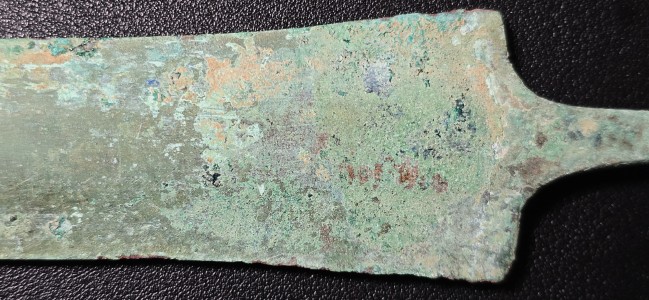
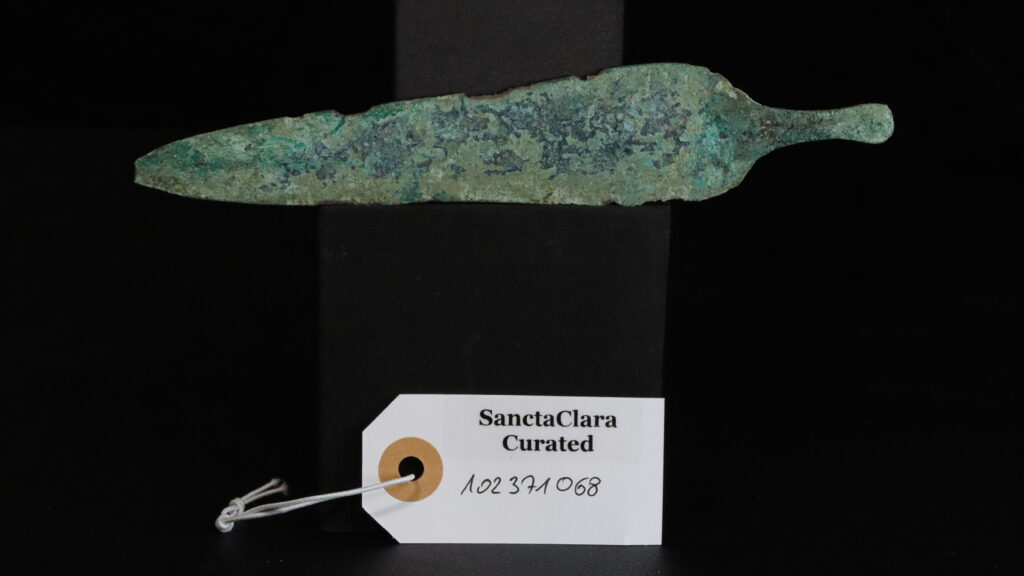
What the Helmand metallurgical tradition teaches us, when we handle artefacts from this region, is that the absence of tin does not equate to primitiveness. The arsenical coppers of eastern Iran represent a parallel technological trajectory — one that served the needs of complex urban societies with temples, palaces, and extensive trade networks reaching from Turkmenistan to the Indus Valley. I have handled copper daggers and blades in the Sancta Clara Collection — pieces like Lot 911, a Minoan bronze dagger, and Lots 912 and 913, Cypriot copper alloy daggers from the Early Bronze Age — whose ferrite copper composition and simple flat-blade morphology closely resemble the products of these eastern Iranian workshops. The pale, sometimes slightly golden colour of high-arsenic copper, the characteristic corrosion patterns, and the simple but effective forms are hallmarks of this tradition wherever it appears.
The Kassites: Mountain Lords of the Bronze Trade
The Kassites remain one of the most enigmatic peoples of the ancient Near East. Originating from somewhere in the Zagros Mountains — their precise homeland has never been identified with certainty — they first appear in Babylonian records during the eighteenth century BC as mercenaries and labourers on the fringes of the Old Babylonian kingdom. By around 1531 BC, in the chaotic aftermath of the Hittite sack of Babylon, the Kassites had seized control of the city and established a dynasty that would rule for approximately four centuries — the longest reign of any single dynasty in Babylonian history.
The Kassite contribution to metallurgy has been consistently underestimated, in part because the Kassite period remains poorly published. Of the estimated twelve thousand Kassite-period documents that have been recovered — primarily from the administrative archives at Nippur — only about ten to twenty percent have been published. Direct finds of weapons and armour from Kassite contexts are rare, though cuneiform texts mention various types of military equipment: different grades of axes (with careful linguistic distinction between military-grade weapons and utilitarian tools), spears, composite bows, and sickle-swords that continued the long Mesopotamian tradition of curved bladed weapons.
What the Kassites unquestionably did was preside over and actively facilitate the Late Bronze Age’s most sophisticated international bronze trade. The Amarna Letters — the diplomatic correspondence between the great powers of the fourteenth century BC, discovered at the Egyptian capital of Akhetaten — document the Kassites trading extensively in horses, chariots, lapis lazuli, precious stones, bronze, silver, and oil. Kassite Babylonia was a full member of what modern scholars call the “Great Powers Club,” alongside Egypt, the Hittites, Mitanni, and Assyria, and bronze was one of the commodities that lubricated these relationships.
The Kassites introduced — or at the very least, dramatically expanded — the use of the horse in Babylonia. The horse was the sacred animal of the Kassites, and their arrival transformed military technology in the region. Chariot warfare became central to Kassite military organisation, and with it came the need for an entirely new category of bronze equipment: bits, cheekpieces, yoke fittings, harness mounts, and the various small bronze components that held a chariot team together. These horse-related bronzes are a distinctively Kassite contribution to the metallurgical record, and while they are not as visually dramatic as the later horse equipment from Iron Age Luristan, they represent the foundational development from which those later traditions grew.
The Kassite capital of Dur-Kurigalzu — modern Aqar Quf, about thirty kilometres west of Baghdad — was one of the great construction projects of the Late Bronze Age. Founded by Kurigalzu I in the early fourteenth century BC, the city covered an enormous area enclosed by walls encompassing some 425 hectares. Excavations by Taha Baqir and Seton Lloyd in the 1940s recovered over one hundred cuneiform tablets, along with pottery, tools, and various artefacts. The city contained a ziggurat dedicated to Enlil, multiple palaces (evocatively named the “Palace of the Mountain Sheep” and the “Palace of the Stag”), and temples to the major Babylonian deities. The scale of construction testifies to the organizational capacity and resource command of the Kassite state — and to the centralised management of bronze production and distribution that such a state required.
The Kassite period also saw the development of the kudurru — boundary stones recording royal land grants — which represent some of the finest stone-carving of the Middle Babylonian period. While not directly metallurgical, the kudurru reliefs frequently depict weapons, divine symbols, and military equipment that provide indirect evidence for contemporary bronze forms. The low reliefs on kudurrus and cylinder seals are, in fact, among the most important artistic testimonies of the Kassite era.
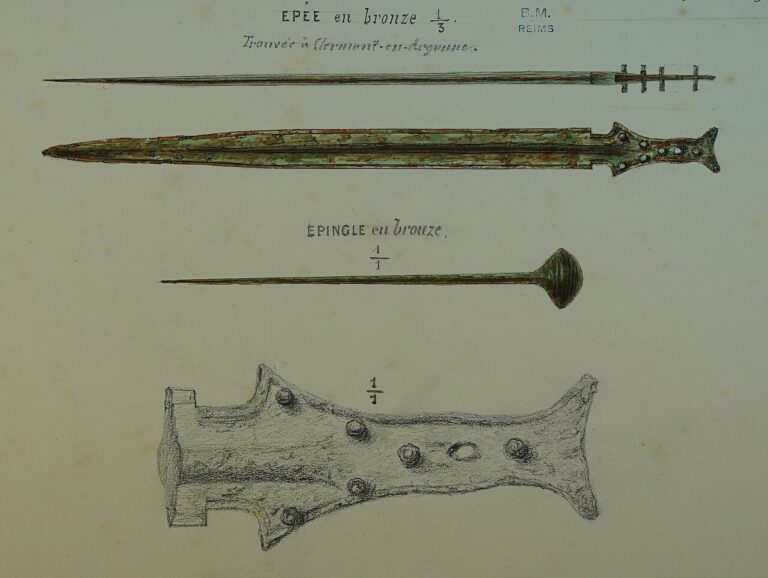
For collectors, the Kassite connection is most tangible in the bronze swords and daggers of the late second millennium BC. The British Museum holds a bronze sword or dagger attributed to the reign of Marduk-nadin-ahhe (c. 1099–1082 BC), a ruler of the Second Dynasty of Isin who succeeded the Kassites in Babylonia. In the Sancta Clara Collection, pieces like Lot 901 — a Near Eastern bronze rapier-type short sword attributed to the reign of Marduk-nadin-ahhe, 1090 BC, measuring 344 mm — and Lot 902, a Near Eastern bronze rapier-type shortsword dated to 1082 BC and measuring 480 mm, represent precisely this transitional moment between Kassite and post-Kassite metallurgical traditions. These weapons carry forward the casting techniques and alloy formulations that the Kassites had inherited and refined during their centuries of rule, even as political power passed to new dynasties.
The crescent-shaped guard dagger, a distinctively Iranian weapon form, also emerged during the mid-second millennium BC — precisely the Kassite period — at Elamite sites in the Khuzestan Plain. The type subsequently spread across a wide geographical area, from northwestern Iran to the Persian Gulf coast, before retreating again to the northwest during the early first millennium. In the Sancta Clara Collection, various Luristan daggers from the late second and early first millennia BC (such as Lot 78638597, a Luristan dagger dated c. 1000 BC) represent the downstream evolution of blade forms that were first standardised under Kassite-period metallurgical organisation.
The Lullubi: Warriors of the Northern Zagros
The Lullubi are perhaps the most elusive of the three cultures considered here. A group of Bronze Age tribes of primarily Hurrian origin, they inhabited the Sharazor Plain in the northern Zagros Mountains — the area around modern Sulaymaniyah in Iraqi Kurdistan. Their story, as it reaches us, is told almost entirely through the records of their enemies: the Akkadians, the Sumerians, and the Assyrians, all of whom regarded the Lullubi as dangerous, warlike mountain barbarians.
The most famous depiction of the Lullubi is on the Victory Stele of Naram-Sin, now in the Louvre — one of the masterpieces of Akkadian art, showing the great king trampling the defeated Lullubi beneath his feet. In these depictions, the Lullubi appear bare-chested, wearing animal skins, with short beards and long hair worn in thick braids. They carry weapons — axes and short blades — and are shown as formidable opponents despite their ultimate defeat.
The Lullubi occupied a strategically critical position. Their homeland sat astride the mountain passes connecting the Mesopotamian lowlands with the Iranian plateau — the same corridors through which copper, tin, and finished bronze goods flowed in both directions. This geography made them simultaneously middlemen and raiders, participants in and threats to the great Bronze Age trade networks. When Ashurnasirpal II suppressed a Lullubi revolt in 881 BC, he reported that they possessed nineteen walled cities and large supplies of horses, cattle, metals, textiles, and wine — hardly the inventory of primitive mountain savages.
The recent discovery of the ancient city of Kunara, near the Zagros Mountains in Iraqi Kurdistan, has begun to transform our understanding of the Lullubi. French archaeologists identified the site as likely belonging to the Lullubi people, dated to the latter part of the third millennium BC, and possibly serving as a Lullubi capital. The excavations recovered clay tablets bearing cuneiform inscriptions in which the scribes demonstrated a command of both Akkadian and Sumerian writing systems, along with evidence of large-scale agricultural storage and an independent system of measurement units distinct from the Mesopotamian gur. This is not the profile of an illiterate mountain tribe; it is the profile of an organised state with its own administrative traditions.
The metallurgical implications of the Lullubi’s geographic position are significant even where direct archaeological evidence remains sparse. The northern Zagros Mountains are rich in copper ore deposits, and the Lullubi homeland lay along the routes connecting these deposits with the copper-hungry cities of lowland Mesopotamia. The Lullubi were not merely passive intermediaries in this trade; they were active participants who controlled access to ore sources and mountain passes, and who almost certainly maintained their own smithing traditions to serve both local military needs and regional exchange.
The weapons depicted on Lullubi rock reliefs — particularly the series of carved panels at Sar-e Pol-e Zahab and the Darband-i Gawr relief near Qaradagh — show warriors equipped with axes, short swords or daggers, and bows. The Anubanini rock relief, showing the Lullubi king with the goddess Ishtar and captives in tow, depicts a ruler armed with a battle axe and a short blade — weapons consistent with the shaft-hole axes and tang daggers that circulated throughout the Zagros region during the third millennium BC.
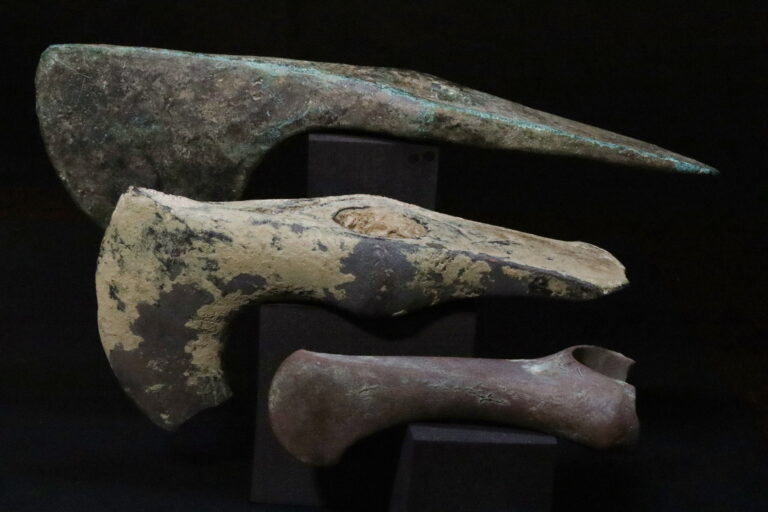
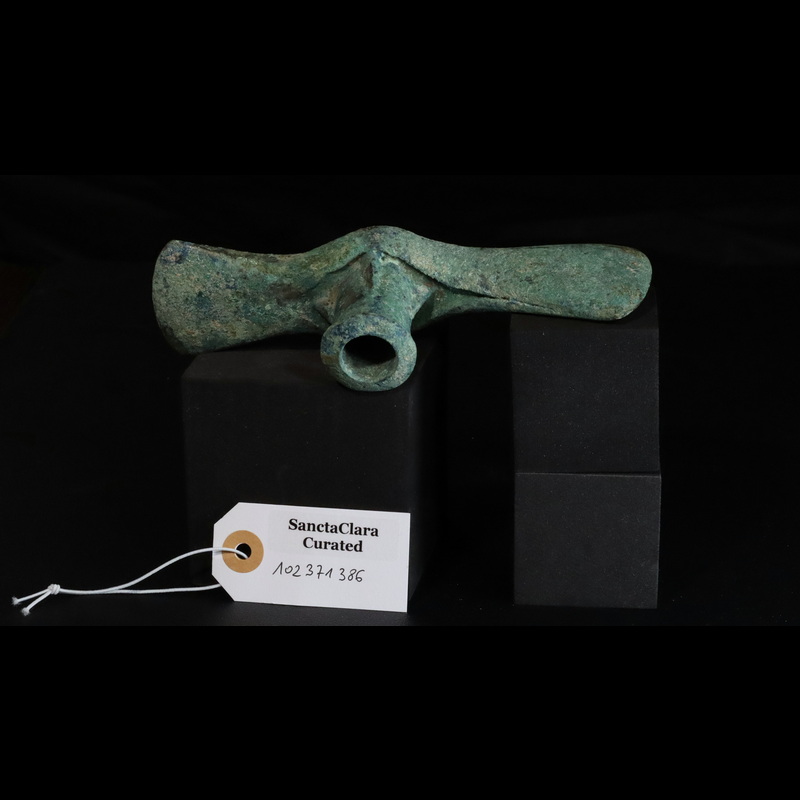
In the Sancta Clara Collection, the shaft-hole axes and copper flat axes from the third and early second millennia BC — pieces like Lot 891, an Eneolithic copper shaft-hole battle axe, and Lots 4949 and 4950, small copper flat axes — represent the types of weapons that would have been familiar in Lullubi hands. The transition from the simple flat axe to the sophisticated shaft-hole battle axe is one of the great technological narratives of early metallurgy, and the Zagros highland peoples, including the Lullubi, were at the centre of this innovation. The shaft-hole design allowed for more secure hafting and greater striking force — essential advantages for a mountain warrior culture that depended on close combat in difficult terrain.
The Lullubi’s story is ultimately one of absorption. Over the centuries, the term “Lullubi” or “Lullu” became a generic Babylonian and Assyrian word for “highlander,” losing its specific ethnic reference. The original Lullubi population likely merged with later arrivals — the Kassites among them — who descended from the same mountains to reshape the political landscape of the lowlands. The region that had been Lullubum became the Hurrian-inhabited Zamua, and the specific metallurgical traditions of the Lullubi disappeared into the broader stream of Zagros highland metalworking.
Connections and Legacies
These three traditions — the desert arsenical coppers of the Helmand, the administered bronze economy of Kassite Babylonia, and the highland metalworking of the Lullubi — represent different solutions to the same fundamental problem: how to produce, distribute, and use copper alloy tools and weapons in societies of varying complexity.
The Helmand smiths worked with locally available arseniferous copper ores and developed a sophisticated industry that served an urban civilisation without ever making the transition to tin bronze on a meaningful scale. Their conservatism was not backwardness; it was adaptation to local resources and local needs. When Shahr-i Sokhta was finally abandoned around 2350 BC — destroyed by fire for the third time — its metallurgical tradition simply ceased, leaving no clear successor.
The Kassites, by contrast, inherited the most advanced metallurgical infrastructure in the ancient world when they took control of Babylonia. They did not merely maintain it; they expanded it, integrating bronze production into the international diplomatic and trade systems of the Late Bronze Age and introducing the horse-related bronze equipment that would become ubiquitous in subsequent centuries. Their contribution was organisational as much as technical — the management of alloy supply chains across vast distances, the standardisation of military equipment, and the maintenance of skilled workshop traditions over centuries.
The Lullubi remind us that not all important metallurgical traditions leave monumental traces. Highland peoples who controlled ore sources and mountain passes played indispensable roles in the bronze economy of the ancient Near East, even when their own material culture remained modest compared to the urban civilisations they supplied and occasionally raided.
For collectors and researchers working with ancient bronzes from the Iranian sphere, these three traditions offer essential context. A copper dagger from the early third millennium might be a product of the Helmand arsenical copper industry rather than an Elamite or Mesopotamian workshop. A Late Bronze Age sword blade might carry the organisational legacy of Kassite bronze administration. A shaft-hole axe from the northern Zagros might have been forged by smiths who answered to a Lullubi chief rather than an Assyrian governor. The metal itself, in many cases, cannot tell us these stories — but understanding the full range of traditions that produced it makes us better readers of the objects that survive.
The Sancta Clara Collection includes several artefacts whose origins may connect to these lesser-known traditions. Readers interested in specific comparisons are encouraged to explore the catalogue entries for the collection’s early copper daggers and Zagros-region axes, where detailed metallurgical and typological notes are provided.