
Sharpened stick
The spear is the oldest purpose-built weapon in the human arsenal. Long before the sword, before the axe was adapted from tool to weapon, before the bow reached its mature form, the spear — a pointed object at the end of a long shaft — defined how humans hunted and how they fought. It is fitting, then, that spearheads constitute the largest single category in the Sancta Clara Collection, and that their typological range spans virtually the entire arc of ancient metallurgy: from flat hammered copper blades of the third millennium BC to massively built cast bronze socketed heads of the European Late Bronze Age, from delicate Cycladic leaf-shaped points to imposing Luristan lance heads longer than most contemporary swords.
This article examines the typology of ancient metal spearheads — how they are classified, how they evolved, and what their forms tell us about the technologies, tactics, and traditions of the peoples who made them.
The Fluid Boundaries: Spear, Javelin, Pike
Before attempting any classification, it is necessary to acknowledge a fundamental difficulty: the boundaries between a spearhead, a javelin head, and a pike head are not fixed. They are conventions imposed by modern scholars on a continuum that ancient users may not have recognised.
A spear in the strict sense is a thrusting weapon — a long shaft with a pointed head, held in one or both hands and driven into a target at close range. A javelin is a throwing weapon — a lighter shaft with a smaller head, designed to be hurled at a target from a distance. A pike is an extra-long thrusting spear, typically three to six metres, used in massed formations where reach is more important than individual agility.
The problem is that many spearheads could serve multiple purposes. A medium-weight head on a shaft of moderate length could be thrust at close quarters, thrown at short range, or used in a loose formation. Ancient warriors did not necessarily carry separate weapons for separate tactical situations; they carried versatile weapons and adapted their use to circumstances. Experimental archaeology has confirmed this versatility — Andrea Dolfini’s combat experiments with replica Bronze Age spears demonstrated that with a shorter, lighter shaft, the same spear becomes effective as a thrusting weapon, a slashing weapon, and a thrown projectile.
The typological distinction between spearhead and javelin head is therefore one of probability rather than certainty. Smaller, lighter heads are more likely javelin points. Larger, heavier heads are more likely thrusting spearheads. Very large heads on very long shafts are pikes. But the boundaries blur, and any classification must acknowledge this flexibility.
The Spearhead-or-Sword Problem
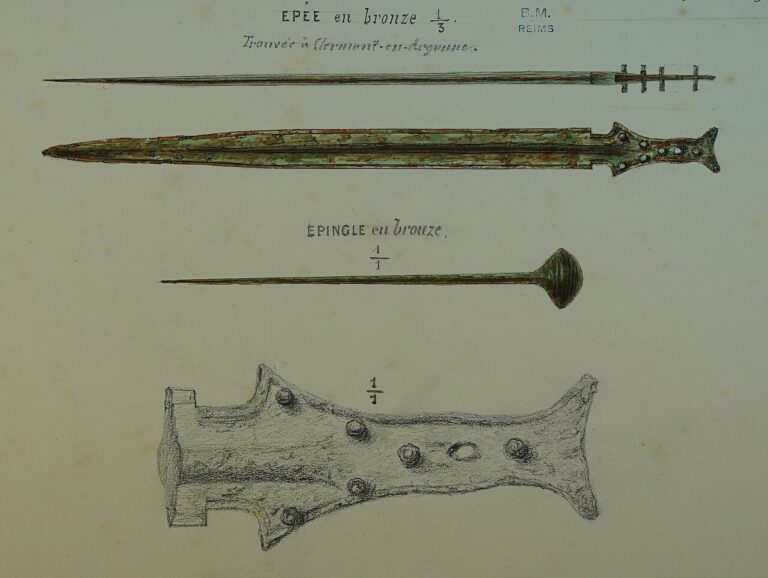
A related and perhaps even more consequential confusion exists between spearheads and the blades of early swords and daggers. This is not a minor academic quibble — it affects the classification of objects in major museum collections, including the Metropolitan Museum and the British Museum, where tanged bronze blades catalogued as spearheads are, on closer examination, almost certainly short sword or dagger blades, and vice versa.
The confusion is understandable. Early swords and daggers were primarily thrusting weapons, not slashing weapons — their tactical function overlapped directly with that of the spear, and their blade geometry reflects this shared purpose. A narrow, leaf-shaped or triangular bronze blade with a flat tang and a pronounced midrib could equally be the business end of a thrusting spear or a short stabbing sword. Without the shaft or hilt — which in nearly all cases has been lost to organic decay — the blade alone does not always declare its identity.
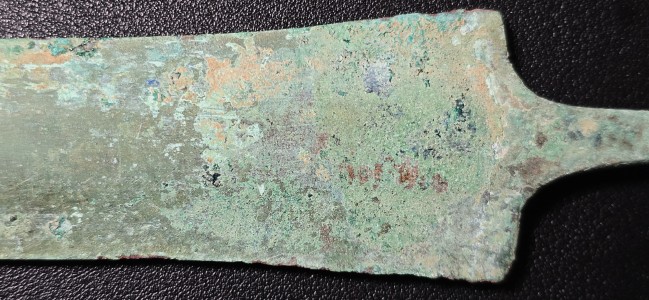
But there are diagnostic clues, and they require the kind of careful, hands-on observation that cataloguers working from photographs or brief inspection sometimes miss. The most telling evidence comes from the ghost of the organic hilt itself. Early Bronze Age swords and daggers were mounted with hilts made from bone, ivory, wood, or horn, attached to the tang and blade base using organic adhesives — typically hide glue or bone glue reinforced with binding. Over millennia of burial, the hilt material decays and vanishes, but the glue leaves its signature: a faint but distinct discolouration on the blade surface, a shadow where the adhesive altered the chemistry of the metal-soil interface and changed the way patina formed. This discolouration preserves the outline of the hilt, and — critically — it often reveals the presence of a broad, rounded hilt guard or pommel plate that extended well beyond the width of the tang.
This is the decisive clue. A spearhead mounted in a shaft shows a circular patina shadow corresponding to the diameter of the wooden shaft around the tang. A sword or dagger mounted with a broad hilt guard shows a much wider, often roughly oval or semicircular shadow at the base of the blade — the footprint of a guard designed to protect the hand, a feature that has no parallel in spear hafting. When you see this wide, rounded discolouration on a blade catalogued as a spearhead, you are almost certainly looking at a misidentified short sword.
The error persists in part because modern expectations about what a sword “should” look like — a long blade with a distinct crossguard and a shaped grip — do not map well onto the reality of early Bronze Age edged weapons. Early swords had minimal hilts: a flat tang with a few rivet holes, a thin plate of bone or horn on each side, and perhaps a small flared guard that would look negligible by medieval standards but was the defining feature that separated a hand-held thrusting weapon from a shaft-mounted one. Recognising these objects for what they are requires setting aside modern preconceptions and reading the faint physical evidence that the objects themselves preserve.
The Technological Evolution of Mounting: From Short Tang to Cast Socket
The single most important feature of any spearhead — the one that most directly reflects both the technological capabilities of its makers and the practical demands of its intended use — is how it attaches to the shaft. The history of spearhead design is, in large part, the history of increasingly sophisticated mounting solutions.
The Short Tang
The earliest metal spearheads, like the stone points they replaced, were mounted to the shaft by means of a short tang — a narrow extension at the base of the blade that was inserted into a slot cut into the end of a wooden shaft. The tang was held in place by binding — cord, sinew, or rawhide wrapped tightly around the split shaft to clamp it onto the tang.
This is the simplest possible mounting method, and it works, but its limitations are severe. The tang provides no lateral support; all resistance to bending depends on the binding. Under the stress of a thrusting impact — particularly against a hard target like bone or armour — the blade tends to lever sideways against the tang, loosening the binding and eventually working free. The short tang is adequate for light, low-impact use — hunting small game, fishing — but marginal for heavy combat.
The earliest copper spearheads from Mesopotamia, Elam, and the Levant (roughly 3500 to 2500 BC) overwhelmingly use short tangs. These hammered copper blades — flat, leaf-shaped or triangular, with minimal or no midrib — are among the most primitive metal weapon forms in the archaeological record. Many are difficult to distinguish from large knife blades or dagger points, and the classification of specific pieces as spearheads rather than daggers often depends on assumed proportions of the (missing) shaft rather than on any intrinsic feature of the blade.
The Long Tang
The obvious solution to the weakness of the short tang was to make it longer. A tang that extends ten, fifteen, or twenty centimetres into the shaft provides far greater resistance to lateral forces, distributes stress over a longer section of wood, and is much less likely to work loose under impact.
Long-tanged spearheads appear across the Near East from the late third millennium BC and become the dominant Luristan and Iranian form from roughly 2000 to 700 BC. Some Luristan lance heads in the Sancta Clara Collection — such as Lot 84058911, with its 140-millimetre tang — demonstrate the extreme to which this design was taken. The tang on these pieces is nearly as long as the blade, creating a weapon head that extends deep into the shaft and provides a remarkably secure attachment.
The long tang also enabled an important structural refinement: the transition zone between blade and tang could be shaped to provide additional support. On well-made Luristan spearheads, the blade does not simply narrow abruptly to a tang. Instead, it transitions through a tubular or rectangular-section neck — a zone of intermediate thickness that acts as a stress concentrator, absorbing the bending forces that would otherwise be transmitted directly to the tang-shaft junction.
The Tang with Stop-Ridge or Stop-Flange
A further refinement of the tang design was the addition of a stop-ridge or stop-flange — a raised collar, decorative protrusion, or widened shoulder at the junction of the blade and the tang. This feature serves two critical functions.
First, it acts as a physical stop, preventing the blade from being driven further into the shaft under the force of impact. Without a stop, repeated thrusting drives the tang deeper and deeper into the wood, eventually splitting the shaft or burying the blade base so deeply that the effective blade length is reduced.
Second, the stop-ridge provides a defined surface against which binding cord or wire can be anchored. Rather than wrapping the binding around the smooth, featureless base of the blade — where it tends to slip — the artisan wraps it against the stop-ridge, creating a far more secure lashing.
The early Greek spearhead in the collection (Lot 98946837) provides an excellent example of this design stage. Its shoulder features splayed ornamental flanges decorated with incised stripes — a stop-ridge that is simultaneously functional and decorative. The stripes are skeuomorphic references to the cord bindings that this very feature is designed to anchor: decoration imitating function imitating decoration, a feedback loop of design inheritance.
On some Luristan pieces, the stop takes the form of a hammered spherical knob or “button terminal” at the very end of the tang — a bulge that prevents the tang from pulling through the shaft under the forces of extraction (pulling the spear free from a target or from the ground).
The Hammered Split Socket
The split socket represents a conceptual revolution in spearhead design: instead of inserting the spearhead into the shaft, the shaft is inserted into the spearhead. The metal wraps around the wood, gripping it circumferentially rather than relying on a narrow tang wedged into a slot.
In the hammered split socket, a flat sheet of bronze is rolled or folded into a cone or tube, creating a hollow receptacle into which the tapered end of a wooden shaft is driven. The seam where the sheet was folded — the “split” — runs along one side of the socket and is often visible as a raised line or slight gap. The socket may be further secured by rivets, pins, or binding through holes drilled near the base.
This is a transitional technology — more secure than a tang, but less robust than a fully cast socket. The split socket is strong in compression (the shaft pushes against the socket walls) but relatively weak in tension (the socket can open along the seam if the shaft is levered sideways). It is also susceptible to longitudinal splitting if the shaft is driven in too forcefully.
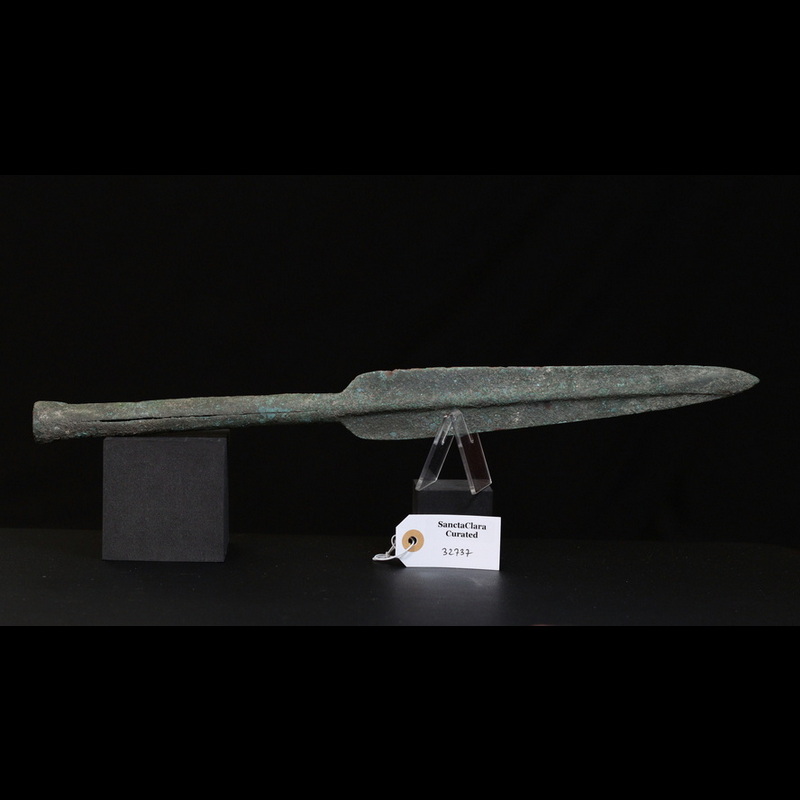
Split-socket construction is found across the Near East and the Mediterranean from the late third millennium BC. Several pieces in the Sancta Clara Collection — including the large MBA split-socket pike (Lot 32737), a massive 480-millimetre weapon — demonstrate this technology. On this piece, the folded seam is clearly visible along the socket, and the ringed, enlarged socket neck end provides additional grip on the shaft. The pronounced rounded midrib of the blade provides structural rigidity appropriate to the weapon’s considerable size and implied combat use.
The Ugarit spearhead (Lot 90939651) offers another instructive example of split-socket construction, with the seam visibly widening toward the bottom of the socket and three rivet holes positioned to secure the shaft — two large holes on either side and one smaller hole below.
The Cast Full Socket
The cast full socket represents the mature technology of Bronze Age spearhead production — the point at which metalworkers fully exploited the casting properties of bronze to create a form that was impossible in hammered copper.
In a cast socket, the entire spearhead — blade, midrib, and hollow conical socket — is produced in a single casting operation, typically using a bivalve (two-piece) mould with a clay or sand core to create the hollow interior of the socket. The result is a seamless, structurally integral unit with no split seam, no weak points, and no vulnerability to opening under stress.
The cast socket grips the wooden shaft around its entire circumference, distributing the forces of impact evenly. One or two rivet holes through the socket wall allow pins to be driven through both socket and shaft, creating a mechanical lock that prevents the head from separating under any combination of thrust, withdrawal, or lateral force. The socket walls can be made relatively thin — bronze’s ductility and toughness make thick walls unnecessary — saving weight while maintaining strength.
This technology reached its fullest expression in the great socketed spearheads of the European Late Bronze Age — the Urnfield culture, the Atlantic Bronze Age, the Nordic Bronze Age, and the British and Irish traditions. These weapons are among the most impressive products of Bronze Age metallurgy: elegantly proportioned leaf-shaped blades with pronounced midribs flowing seamlessly into robust conical sockets, the whole executed with a precision and consistency that speaks to centuries of accumulated casting expertise.
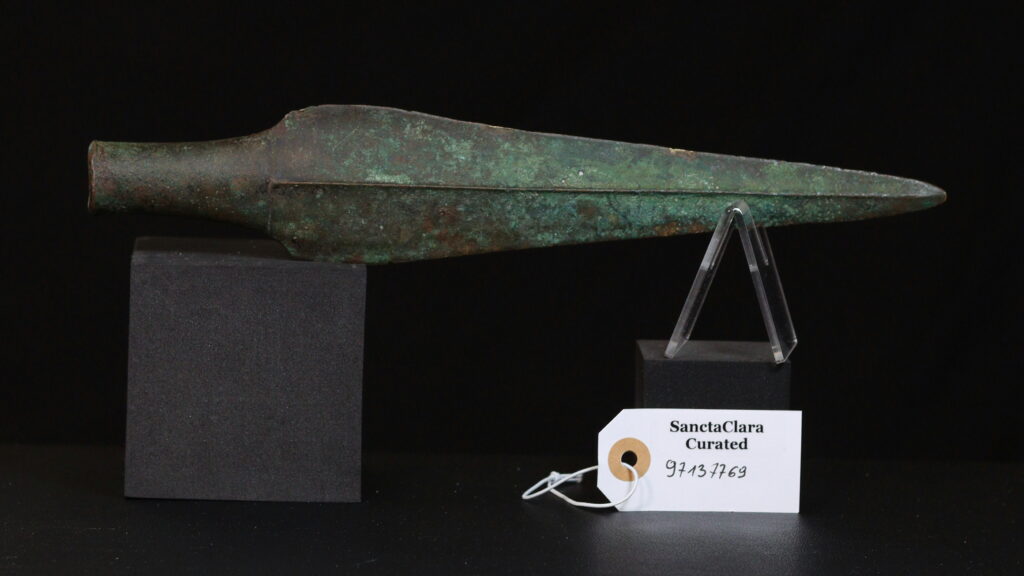
The European Late Bronze Age socketed spearheads in the Sancta Clara Collection — such as Lot 97137769, a sturdy 29.5-centimetre weapon with wide shaft socket and narrow midrib — exemplify this tradition. The build quality is remarkable: thick bronze walls, a perfectly centred socket, a joint line perpendicular to the midrib visible at the socket neck as a remnant of the bivalve mould, and a weight of 340 grams that speaks to serious functional intent.
Regional Traditions and Distinctive Forms
The Cycladic Leaf-Shaped Spearhead
Among the most distinctive and recognisable early metal spearheads are the leaf-shaped copper and arsenical bronze blades of the Cycladic islands and the Early Bronze Age Aegean (approximately 2800 to 2000 BC). These elegant, thin blades — typically flat or with a very slight midrib — feature a characteristic design element: two symmetrically placed rivet holes in the lower portion of the blade, near the junction with the tang or rudimentary socket.
These rivet holes are the hallmark of Cycladic metalwork. They served to attach the blade to a split wooden haft, with bronze rivets passing through both blade and wood to create a secure mechanical connection. The holes are carefully drilled and usually positioned with precise bilateral symmetry, reflecting a craft tradition that valued visual balance as well as functional reliability.
Several pieces in the collection (including Lot 83118347, a Cypriot/Cycladic spearhead with rat-tail tang) represent this tradition. The triangular blade with slightly raised flat central rib, the long tang with its characteristic hooked end, and the overall proportions are diagnostic of Early Bronze Age Aegean metalwork — a tradition that would evolve over the following centuries into the more elaborate Mycenaean forms.
The Metropolitan Museum holds numerous Cypriot Early Bronze Age spearheads of this type, many of which were found deliberately bent in tombs — a ritual “killing” of the weapon to ensure it could not be used after burial, a practice that tells us these objects were regarded as personally significant possessions, not merely utilitarian tools.
Luristan: The Masters of the Tang
The bronze-working traditions of Luristan (Lorestan Province, western Iran) produced some of the most technically accomplished and aesthetically striking tanged spearheads in the ancient world. Luristan spearheads are characterised by long, narrow blades with pronounced midribs, extended tangs (often as long as or longer than the blade itself), and a quality of casting and finishing that reflects a sophisticated metallurgical tradition stretching from roughly 2000 to 700 BC.
The Luristan smiths exploited the long-tang design to its fullest potential. Their spearheads feature carefully shaped transition zones between blade and tang, often with raised collars or decorative mouldings at the junction. The tangs themselves are typically rectangular in cross-section — stronger than round tangs of equivalent material — and taper gradually to a point or a hooked terminal.
The collection’s Luristan spearheads span a wide range of sizes, from compact javelin-sized heads to massive lance points exceeding 450 millimetres in total length. The largest of these — such as Lot 84068495, at 456 millimetres — are weapons of formidable proportions, longer than many contemporary swords and clearly intended for use from horseback or chariot. Their long, narrow blades with prominent midribs are optimised for deep penetration of flesh and soft armour, and the thick necks and heavy tangs are built to withstand the enormous forces generated by a mounted charge.
European Socketed Spearheads: Engineering Excellence
The socketed spearheads of the European Late Bronze Age represent perhaps the highest achievement of Bronze Age weapon technology in terms of structural engineering. These weapons — produced across a vast geographic range from Ireland and Britain through Scandinavia, Central Europe, and the Balkans — share a common design philosophy: maximum strength-to-weight ratio achieved through the integration of blade and socket in a single, optimised casting.
The typical European socketed spearhead has a willow-leaf or laurel-leaf shaped blade with a prominent midrib that extends from the tip down through the blade and into the socket, where it blends into the socket wall. The hollow of the socket continues partway up into the blade — a feature visible on X-rays and cross-sections — creating a lightweight but extremely rigid structure. Two peg-holes near the base of the socket allow the head to be pinned to the shaft.
Some of the most impressive examples come from the British Isles and Ireland, where hundreds of socketed spearheads have been recovered from river deposits, bog hoards, and burial sites. The Dowris Hoard from Ireland alone contained numerous spearheads alongside swords, axes, and other metalwork, testifying to both the scale of Late Bronze Age weapons production and the ritual significance of depositing weapons in water or earth.
The Giants: Oversized Ceremonial and Combat Spearheads
At the upper extreme of the size range, certain Bronze Age traditions produced spearheads of extraordinary dimensions — weapons so large that their practical function has been debated. Archaeological museums in Sicily, southern Italy, and the Aegean hold bronze spearheads exceeding 40 or even 50 centimetres in blade length alone, with total lengths approaching 60 centimetres or more when the socket or tang is included. Similar oversized pieces are known from Near Eastern contexts, particularly Sumerian and Elamite sites.
These massive heads may represent prestige weapons — status symbols carried by elite warriors or commanders, where size itself conveyed authority and martial prowess. They may have been pike heads, mounted on very long shafts and used in phalanx-style formations where the objective was to out-reach the enemy rather than to manoeuvre quickly. Or they may have served ceremonial or votive purposes, produced for deposition as offerings rather than for combat.
The Sancta Clara Collection includes several pieces at the upper end of the practical size range, including Lot 38071001 (450 mm) and Lot 32737 (480 mm), which occupy the grey zone between large functional weapon and oversized prestige piece. Their weight and build quality suggest genuine combat capability, but their size would have demanded exceptional physical strength and specific tactical contexts to deploy effectively.
The Spear as Hunting Weapon
It would be a mistake to discuss spearheads exclusively in military terms. For most of human history, the spear was primarily a hunting tool, and many ancient spearheads — perhaps the majority — were made for hunting rather than warfare.
The most celebrated ancient hunt — the boar hunt — was inseparable from the spear. Wild boar were among the most dangerous game animals in the ancient world: fast, aggressive, heavily muscled, equipped with razor-sharp tusks, and capable of charging a hunter with lethal force. Hunting boar with a bow was impractical (the animals’ thick skin and heavy shoulder muscles could deflect all but the best-placed arrows), and hunting them with a sword or axe required closing to a distance at which the boar’s tusks were as deadly as any weapon.
The spear solved this problem. A stout thrusting spear, braced against the ground or held firmly under the arm, could receive a charging boar and drive the point deep into the animal’s chest before the tusks reached the hunter. The spear’s length kept the hunter at a distance; its rigidity transmitted the force of the charge into penetration rather than deflection.
Boar-hunting spearheads are typically broad-bladed, leaf-shaped, and heavily built — designed for maximum tissue damage and rapid blood loss rather than for armour penetration. Some later examples feature cross-bars or “wings” below the blade to prevent the wounded animal from running up the shaft toward the hunter — a refinement first recorded by Xenophon in the fifth century BC but with antecedents in Bronze Age blade-and-collar designs.
The association between spear hunting and elite status is deeply embedded in ancient cultures. Mycenaean art depicts boar hunts as aristocratic pursuits. Roman mosaics show mounted hunters driving spears into wild boar and lions. The spear was the weapon of kings and heroes — Achilles’ ash-wood spear, Odin’s Gungnir, the Irish hero Cú Chulainn’s gáe bolga — in a way that the sword, for all its later prestige, never quite matched.
Reading the Spearhead: What Form Tells Us
Every spearhead in a collection is a compressed record of decisions — decisions made by the smith who cast or forged it, by the warrior or hunter who commissioned it, and by the culture that shaped both their expectations and their capabilities.
A short tanged, flat-bladed copper spearhead from the third millennium BC tells us about a world where metallurgy was young, where the forms of stone were still dominant in the smith’s imagination, and where the spear was a personal weapon for hunting and small-scale conflict. A massive European socketed spearhead from the twelfth century BC tells us about a world where casting technology had reached industrial maturity, where professional armies required standardised equipment, and where the spear had become the primary weapon of organised warfare. A Luristan lance head with a tang longer than its blade tells us about a culture of mounted warriors for whom deep penetration and secure hafting under the forces of a cavalry charge were paramount design concerns.
The evolution from short tang to long tang to stop-ridge to split socket to cast full socket is not merely a sequence of technical improvements. It is a record of changing demands — heavier combat, longer engagements, stronger opponents, more specialised tactical roles — and of the metallurgical innovations that made it possible to meet those demands. Each step in this evolution represents a solution to a specific problem encountered by the warriors and hunters who used these weapons, refined through generations of trial, failure, and incremental improvement.
To hold a well-made Bronze Age spearhead is to hold the distillation of that process — thousands of years of human experience compressed into a few hundred grams of copper alloy, shaped by hands that understood, as we sometimes forget, that the difference between a good weapon and a mediocre one could be the difference between life and death.
This article is part of the reference materials published by the Sancta Clara Collection at AncientBronzes.com. Content is provided for educational purposes and reflects observations drawn from direct study of the collection’s holdings and current archaeological scholarship.