
I have to begin this one with an admission. When I wrote on this site last year about the long history of the bronze sword, I treated the Arslantepe finds as a chronological footnote — the earliest known true swords, yes, but ultimately as the first generation of a developmental sequence that ran from arsenical copper through tin-bronze and onward to the long European blades of the late second millennium BC. The Arslantepe corpus, I said, was the moment when bronze metallurgy first crossed from “long knife” into “weapon of reach.” A founding event, with a slow ascent to come.
I want to walk that back. The more I have read on these objects since, the more I have come to believe that Arslantepe is not the first chapter of the bronze sword’s story. It is the only surviving chapter of an earlier story we have not yet excavated. The nine swords, twelve spearheads, two daggers, and quadruple-spiral plaque sealed in the fire that ended the Period VI A palace in roughly 3300 BC do not look like the products of an emerging technology. They look like a refined, mature production tradition operating at full capability, in significant series, under elite patronage, executing skeuomorphic design choices that only make sense if there was a long previous tradition of multi-piece composite weapons behind them. The first true swords in the archaeological record are not first-generation objects.
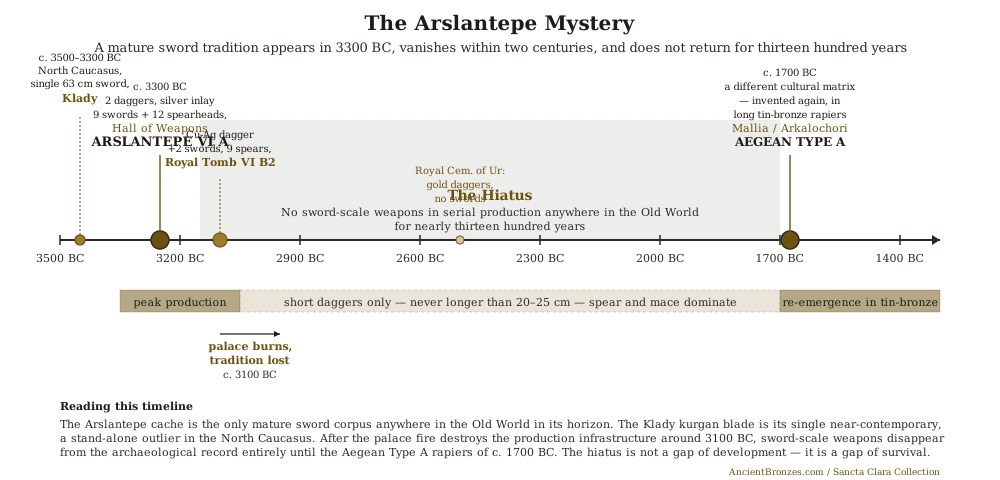
That conclusion has consequences. It changes the whole shape of the developmental story. It pushes the genuine origin of advanced bronze weapon design back into a horizon we cannot yet see, somewhere in the polymetallic ore districts of eastern Anatolia, the Pontic Black Sea coast, or the Caucasian piedmont, in workshops that have not been excavated and may never be. It makes the famous Aegean rapiers of 1700 BC — which I once treated as the first proper European swords — into a re-emergence rather than an emergence. And it means that the long thirteen-hundred-year gap between Arslantepe and the next clear sword-scale weapon corpus is not a gap of development. It is a gap of survival.
This article sets out the case. It is, I think, the most important piece I have written for this site, because it changes the framework into which everything else fits.

The Discovery and the Palace
Arslantepe is a settlement mound on the western bank of the Tohma River, a tributary of the upper Euphrates, near modern Malatya in eastern Turkey. The mound rises about thirty metres above the surrounding plain and covers about four and a half hectares. It has been excavated continuously since 1961 by the Italian Archaeological Mission of Sapienza University of Rome — first under Salvatore Puglisi and Alba Palmieri, then from the 1990s under Marcella Frangipane, and from around 2020 under Francesca Balossi Restelli. UNESCO inscribed the site on the World Heritage List on 26 July 2021, citing it as evidence of the earliest known centralised palatial complex in western Asia.
The weapon cache was recovered in the early 1980s by Palmieri’s team from a small room — designated Room A113 in the published numbering, but more commonly referred to in the site literature as the Hall of Weapons — in the southeastern wing of the Period VI A palatial complex. The room was modest, perhaps three metres on a side. The weapons appear to have been hung in two bundles on the wall, secured by cords that have left traces in the corrosion. The cache was sealed in place when the palace was destroyed by a massive conflagration at the end of Period VI A, around 3100 to 3000 BC. The collapse buried the weapons under burned mudbrick, where they remained for fifty-three centuries before Palmieri’s team uncovered them.
One detail of the find layout is worth pausing on, because it has implications for how we read the cache. The in situ photographs of the bundles, published in the 1983 Origini report and reproduced in subsequent syntheses, show that the spearheads and the swords lay together at roughly the same overall length — under sixty centimetres each. The spearheads were stored or displayed without their wooden shafts. There is simply no room in the bundles for the missing two-metre poles that would be required to make the spears into functional combat weapons. This is significant. A garrison armoury intended for rapid deployment in defence of the palace would store complete weapons, ready for issue. The Hall of Weapons cache stored heads only — the bronze components, detached from the perishable shafts that completed them as functional weapons. This is the layout of a display assemblage or a curated symbolic collection, not a tactical arsenal. The shafts may have been fitted only for ceremonial use and stored separately, or they may have been replaced with each new generation of elite while the bronze heads persisted as the durable, prestige-carrying component. Either way, the absence of the shafts in the bundle is telling. The bronze, not the polearm, was what mattered.
The palace itself was a sprawling mudbrick agglomeration: administrative storerooms, ceremonial halls, two temples (the famous Temple A with its monumental façade, and Temple B with its wall paintings and silver-copper artefacts), and an audience suite. It was the seat of an early, highly centralised proto-state administered through a system of clay sealings — cretulae — used to lock storerooms and containers and to authenticate transactions. Frangipane’s 2007 monograph Arslantepe Cretulae documents 2,145 of these sealings recovered in stratified context, making this one of the earliest administrative systems anywhere in the world, predating cuneiform writing.
The Arslantepe palace sat at a geopolitical hinge. To the south lay the Uruk-period Mesopotamian city-states with their resource hunger and their writing systems; to the north and east lay the Caucasian and Pontic highland zones with the world’s richest accessible polymetallic ore districts. The Period VI A elites synthesised the administrative apparatus of the south with the metallurgical traditions of the north, and the result was something new: an Anatolian proto-state whose visible signature is not monumental architecture or written records but weapons — produced in series, distributed within an elite, and ultimately sealed in the fire that ended their world.
The Period Sequence at a Glance
The Arslantepe stratigraphic sequence is dense and well-published, but four periods matter for our purposes here:
| Period | Date (calibrated BC) | What is happening |
|---|---|---|
| VII | c. 3900 – 3400 | Late Chalcolithic 3–4. Earliest metallurgy on the site: small awls, pins, chisels, lead and silver objects. No weapon-form precursors. Localised emerging elite. |
| VI A | c. 3400 – 3100 | Late Chalcolithic 5. Monumental mudbrick palace complex. Centralised redistributive economy run on cretulae. The “Hall of Weapons” cache: 9 swords, 12 spearheads, 2 daggers, quadruple-spiral plaque, all sealed in the destruction fire. |
| VI B1 | c. 3100 – 3000 | Early Bronze Age I. Systemic collapse of the palace economy. Ephemeral wattle-and-daub huts built directly atop the palace ruins. Mass weapon production ceases. Kura-Araxes pastoralist material culture predominates. |
| VI B2 | c. 3000 – 2900 | Early Bronze Age I/II. The “Royal Tomb” T1 — a stone cist burial of an elite adult male with 2 swords, 2 daggers (including the silver-copper alloy specimen), 9 spearheads (one with silver triangle inlay), a copper-silver diadem with Transcaucasian parallels, and four sacrificed adolescents on the slab covers. |
The recent AMS radiocarbon work by Vignola, Marzaioli, Balossi Restelli, Di Nocera, Frangipane and colleagues (2019) firms up these dates and, if anything, pushes them slightly earlier than the older beta-counting framework. There is no revisionist case for a later date. The Hall of Weapons cache is securely dated to the period 3350 to 3050 BC, with the most probable centring around 3300 to 3200 BC. The Royal Tomb is securely placed at 3085 to 2900 cal BC.
The Full Inventory
This is what Palmieri’s team excavated from Room A113, with figures drawn from the foundational Frangipane and Palmieri 1983 publication in Origini and from Di Nocera’s 2010 metallurgical reanalysis:
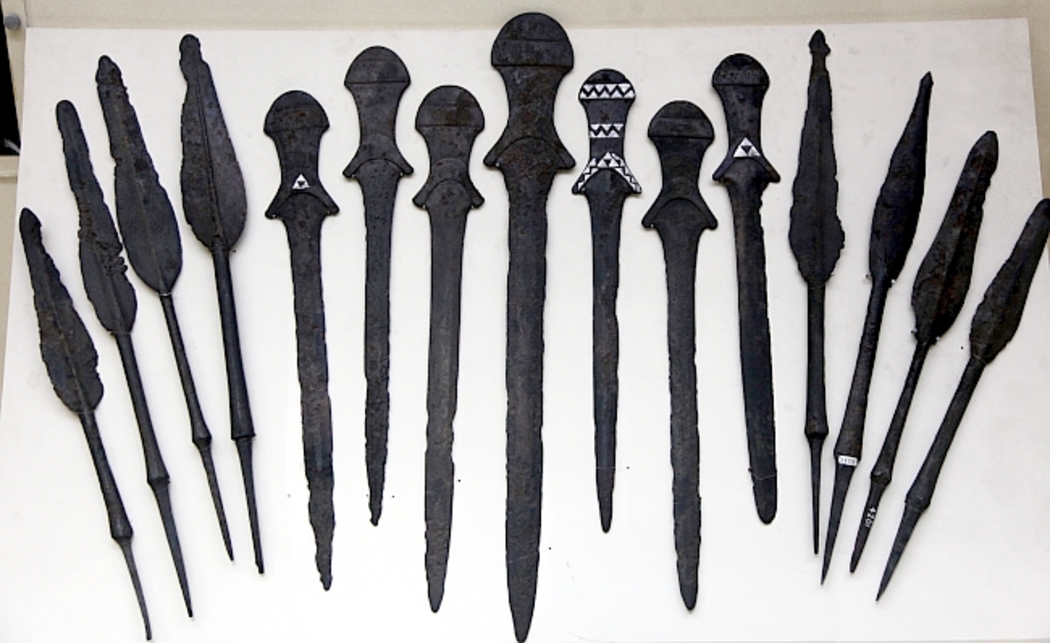
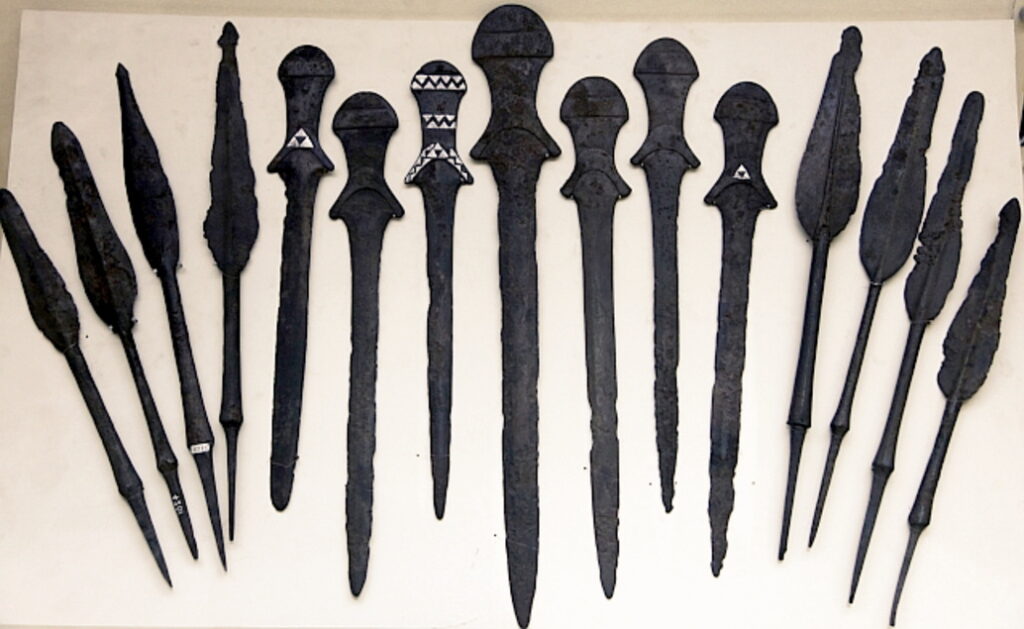
Nine swords, of arsenical copper. Average length 50 cm, average weight 521 g. Longest specimen 62 cm and 960 g; shortest 45.9 cm and 410 g. Three of the nine carry geometric silver inlay on the hilt — triangle and chevron patterns set into prepared recesses on the hilt face. All nine were cast as single integral objects: blade, guard, grip and pommel poured in one operation, then cold-hammered along the edges to harden the cutting surfaces. The blades are flat and double-edged with a thin rhomboid cross-section. The hilts are flat plates terminating in a semicircular pommel decorated with embossed horizontal banding produced by chiselling around the pommel base.
Twelve spearheads, of arsenical copper. Average length 48.5 cm, longest specimen 53.7 cm; weights from 293 g to 709 g. Cast in closed bivalve moulds in a single pour. Leaf-shaped blades with pronounced central midribs (rhomboid or lens cross-section), incuse blade panels flanking the midrib, prominent stop ridges between the tang-neck and the tang, elongated tang-necks of decagonal or biconvex section, and square-section tangs terminating in points or knobs.
Two daggers — one standard arsenical copper, one of a remarkable copper-silver alloy that we will return to below. A quadruple-spiral copper plaque, ceremonial in function, possibly a “double axe” type ornament. And from Temple B in the same complex: a gold disc, an embossed laminated-metal belt, bracelets, pins, spiral hair-rings, and silver and gold necklace beads.
From the Period VI B2 Royal Tomb, recovered nearly twenty years later by Frangipane’s team and published in extenso in 2001:
The tomb itself is worth a moment of context, because the find layout is significantly different from the Hall of Weapons cache. It is a stone cist burial — a rectangular chamber lined with limestone slabs, set in a pit cut into the southwest wall of Building 36, an earlier monumental mudbrick structure of the Period VI A palatial complex that was already in ruins and out of use when the tomb was constructed. The cist itself measured roughly 2 × 4 metres and was sealed beneath limestone covering slabs on which four sacrificed adolescents had been laid. This is not a fire-sealed deposit; this is a deliberate elite burial cut directly into the ruins of the prior regime’s palace — a fact whose significance we will return to later.
The grave goods inside the cist include two further swords, two daggers — one ordinary arsenical copper, and the second a striking copper-silver alloy at roughly 50 per cent copper to 35 per cent silver, identified by Hauptmann and colleagues as the earliest evidence of intentional metal alloying anywhere in Anatolia. Nine spearheads, mostly arsenical copper, one of them a copper-arsenic-nickel alloy with silver triangular inlay echoing the decoration of the Hall of Weapons hilt panels. A copper-silver diadem with Transcaucasian parallels. Several double-spiral pins. Carnelian, rock crystal and gold beads. Pottery combining red-black burnished ware of Kura-Araxes affinity with reserved-slip ware of upper-Mesopotamian origin — pulling in both directions, north and south, exactly as the broader cultural picture would suggest.
The two Royal Tomb swords are morphologically distinct from the Hall of Weapons specimens, in ways that turn out to matter considerably. We will work through the distinction in detail in the next section.
Beyond the controlled excavations there is one further specimen worth flagging. The Tokat Museum sword, published by Zimmermann, Dilek and Önder in Praehistorische Zeitschrift in 2011, is an Arslantepe-type sword of unknown excavation context but with portable X-ray fluorescence composition that places it firmly in the Arslantepe metallurgical signature and the Malatya regional ore field. We will come back to this object later, because the damage along its cutting edges turns out to be decisive evidence on a long-disputed question.
That is the corpus. At least twelve swords, four daggers, and twenty-one spearheads in three securely dated horizons spanning 3300 to 2900 BC. It is the densest concentration of sword-scale weapons anywhere in the fourth-millennium world. Nothing of comparable scale appears elsewhere in the Old World for the next five hundred years.
Two Traditions in One Site
Before going further it is essential to make a distinction that the older literature blurred. The Arslantepe corpus does not contain a single sword type. It contains two morphologically different sword traditions, separated by a generation or two in time but more importantly by construction technique and blade form. Failure to keep them apart has, I think, slowed the interpretation of the whole corpus.

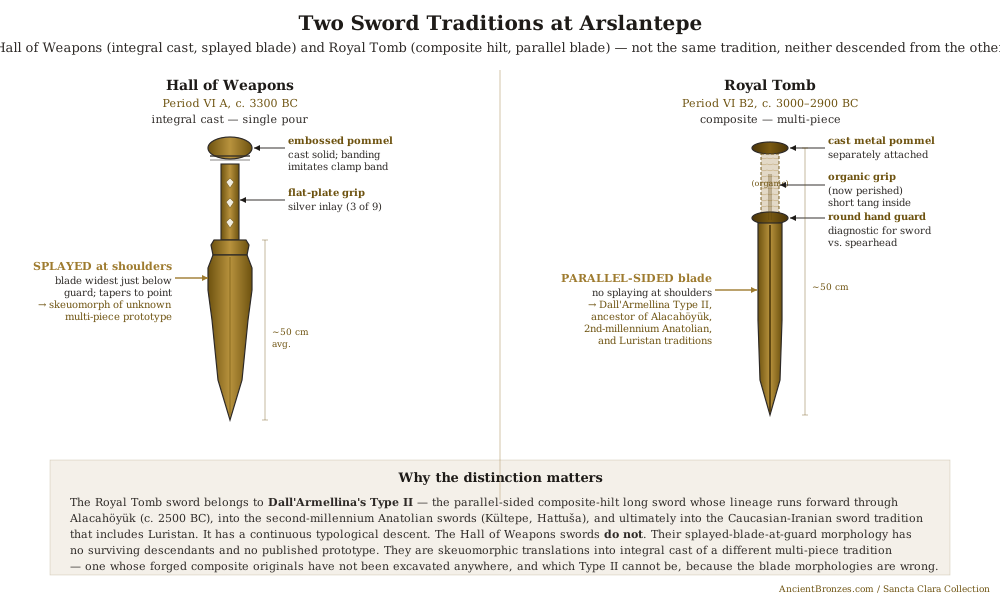
The Hall of Weapons swords (Period VI A, c. 3300 BC) are integral casts: blade, guard, grip and pommel poured in a single operation. Their blades are flat double-edged, and — this is the diagnostic feature, and the one that turns out to be decisive — the blade widens noticeably at the shoulders, splaying out into a cruciform expansion where the blade meets the cast guard. The widening is a distinctive part of the integral form’s silhouette. The pommel is hemispherical, embossed with horizontal banding. The grip is a flat plate carrying chiselled silver inlay on three of the nine specimens. The whole assembly is one casting.
The Royal Tomb sword (Period VI B2, c. 3000–2900 BC) — catalogue no. 19 in the 2001 Paléorient publication, cat. 107 in Frangipane’s 2004 monograph Arslantepe: The Hill of Lions — is morphologically a different animal. It is composite-hilted: the blade was fitted with a separately-attached organic grip, originally bound to a short tang and capped with a rounded hand guard. The blade itself is almost parallel-sided for most of its length, without the splaying widening at the shoulders that characterises the Hall of Weapons specimens. The midrib is more pronounced. The tang is short, designed to receive an organic handle rather than to be cast integrally with the rest. This is, in every respect, a different design philosophy: a multi-piece construction with components made and joined separately, not a single-pour cast.
Vittoria Dall’Armellina’s 2017 study Power of Symbols or Symbols of Power? The “Long Sword” in the Near East and the Aegean in the Second Millennium BC (Ancient Near Eastern Studies 54: 143–182) classifies the Royal Tomb sword as a Type II long sword — the precursor of what becomes the dominant Anatolian sword form at Alacahöyük around 2500 BC, and the morphological lineage that runs forward through the Anatolian second-millennium specimens (Kültepe, Hattuša, Gaziantep, Eskişehir) and ultimately, with regional refinements, into the broader Caucasian-Iranian sword tradition that includes Luristan. Dall’Armellina identifies antecedents of Type II in the late fourth millennium not only at Arslantepe but also at Tülintepe (further north in eastern Anatolia, in the Keban area) and notes the broader connection to the contemporary Klady kurgan sword in the North Caucasus that we discussed earlier. Type II is the durable tradition: it has a continuous descendant lineage running across two and a half millennia and across a wide geographic zone.
The Hall of Weapons swords are something else entirely. They have no continuous typological descent. Nothing else is made in their integral-cast, splayed-blade-at-guard, embossed-pommel-banding form anywhere afterwards. The morphology terminates with the destruction of the Period VI A palace. The smiths who knew how to make these specific objects either died, scattered, or simply stopped making this kind of sword. The integral-cast workshop tradition of the Hall of Weapons is a discontinued lineage with no surviving heirs.
This is the critical distinction. The two traditions coexist at Arslantepe within a span of perhaps a century or two, but they are not the same tradition and one is not the ancestor of the other. The Royal Tomb’s Type II form cannot be the prototype that the Hall of Weapons swords were imitating in cast bronze. The blade morphologies are wrong for that relationship: Type II has parallel-sided blades, while the Hall of Weapons casts have blades splayed at the guard. If the Hall of Weapons smiths had been translating Type II into integral cast, they would have preserved the parallel sides — the splaying at the guard would not have appeared. The fact that the splaying is present in the integral casts, and absent in the Type II composite form, tells us that they are imitating something else. Some other multi-piece composite tradition, with blades that widened at the shoulders, that we have not yet recovered anywhere in the archaeological record.
In other words: the existence of the Royal Tomb sword does not solve the missing-prior-tradition problem. It complicates it. We now have two parallel composite-hilt sword traditions visible in the late fourth-millennium Anatolian highlands. One — Type II — is documented at Tülintepe, at Klady in the North Caucasus, in the Royal Tomb itself, and continues forward in time. The other — the lost prototype with the splayed-at-guard blade — is documented only obliquely, through its skeuomorphic translation into the Hall of Weapons integral casts. Both traditions imply earlier workshops that are not yet excavated. Both point to a fourth-millennium metallurgical landscape that was richer and more typologically varied than the surviving record can show.
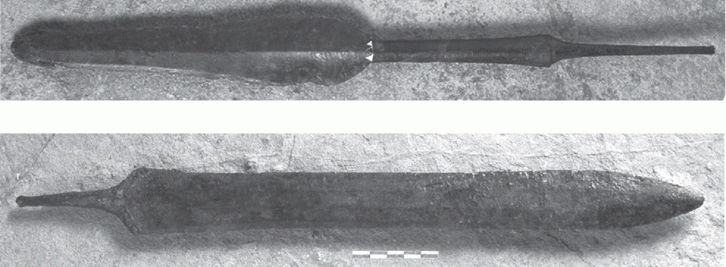
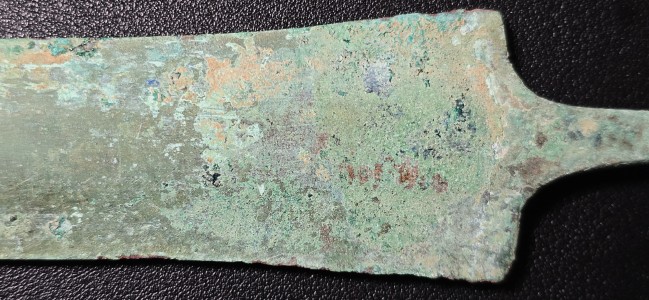
Image: Sword Type II and spear head from the Royal Tomb at Arslantepe, image source: The Role of Metallurgy in Different Types of Early Hierarchical Society in Mesopotamia and Eastern Anatolia, M. Frangipane
There is one further implication worth flagging. The Hall of Weapons swords are, in their integral-cast form, a local Arslantepe innovation. They are the response of a specific palace workshop to a specific set of patrons and aesthetic priorities. The smiths chose to cast in one pour, with imitation of multi-piece features in a particular splayed-blade form, because that suited the Period VI A elite’s display needs. The choice was apparently never repeated, apart from the outstanding and mysterious sword found at the San Lazzaro degli Armeni Monastery museum. The integral-cast tradition is not part of a broad cultural sweep; it is a focused, idiosyncratic experiment that lasted as long as its patrons did and vanished with them. This makes the Hall of Weapons cache an even more remarkable object than I previously suggested — not merely an exceptionally early example of sword production, but a unique expression of a particular palace’s aesthetic and technical ambitions, never quite reproduced before or after.
The Type II lineage that the Royal Tomb sword belongs to has its own story to tell, and we will see it surface again in the discussion of the Anatolian and Luristan spear traditions further down. But the central interpretive object of this article — the focus of the skeuomorphism argument that follows — remains the Hall of Weapons corpus and its lost composite prototype, distinct from Type II and still missing from the excavation record.
How the Metal Was Made
The technological foundation that permits a sixty-centimetre cast blade in 3300 BC is arsenical copper, and the Arslantepe smiths had it under exceptional control.
The compositional analyses published by Hauptmann, Schmitt-Strecker, Begemann and Palmieri in 2002 and reassessed in Hauptmann, Heil, Di Nocera and Stöllner in 2022 show arsenic concentrations clustered tightly around 3 to 6 per cent for the swords and 2 to 4 per cent for the spearheads. Many specimens carry significant nickel — sometimes more than 1 per cent — and trace antimony. This is not native copper hammered cold. It is the deliberate, controlled product of polymetallic ore reduction, where the smiths have selected and processed copper-arsenic-nickel-antimony ores from specific deposits, and have done so with enough consistency across the corpus that the metal must have been produced to a recipe.
The reason arsenic matters is mechanical. Pure copper at 9 per cent tin is the classic Bronze Age alloy, but tin was not available in eastern Anatolia in 3300 BC — the Cornish, Cornish-Iberian, and central Asian tin sources that supplied the second-millennium bronze world were not yet integrated into eastern Mediterranean trade. Arsenic provided an alternative. It does three things to copper. First, it acts as a deoxidiser during smelting and casting, scavenging the oxygen that would otherwise produce porosity and microvoids in the cast metal. The resulting cast is cleaner, denser, and more homogeneous — a much better starting material for a long blade. Second, arsenic at 2 to 6 per cent significantly raises the work-hardening response of the alloy. Cold hammering the edge of a freshly cast arsenical copper blade produces a hardness profile comparable to the later tin-bronzes — Vickers hardness around 120 to 180 HV at the work-hardened edge, which is more than enough to take and hold a cutting edge. Third, arsenical copper at these compositions can be cold-worked through severe deformation without intermediate annealing — without the smith needing to reheat the work to prevent brittle fracture. Experimental reproductions by the Dutch archaeometallurgist Jeroen Zuiderwijk, using a 4 per cent tin-bronze analogue to avoid the lethal arsenic fumes of the original material, have demonstrated that the edges of these blades were hammered from a cast thickness of about 3 mm down to a near-razor edge, continuously, without annealing, and without fracture.
The casting itself was a major undertaking. A 62 cm sword at 960 g requires a substantial volume of molten arsenical copper poured into a bivalve stone mould of considerable size and precision — large enough to receive the full sword form (blade, guard, grip and pommel together), accurate enough to capture the embossed pommel banding and the chiselled inlay channels. The moulds themselves have not survived, but the consistency of the casts across nine specimens implies that the workshop was operating with a small number of master moulds rather than improvising each piece. This is production engineering, not artisan experimentation.
For context: the next time anyone in the Old World produces twelve cast swords in a single workshop tradition, we are nearly a thousand years downstream. The Royal Cemetery of Ur weapons of around 2600 BC are about half a millennium later and individually less ambitious. The Aegean Type A rapiers are thirteen hundred years later. By the time the Mycenaean shaft graves are being filled, the Arslantepe smiths have been silent for forty generations.
The Skeuomorphism Argument — Why the Hilts Tell Us Something Has Been Lost
This is the central argument of the article, and I want to set it out carefully because it is the strongest single piece of evidence we have for the existence of a lost prior tradition. From here forward, when I refer to “the Arslantepe sword corpus” or “the Arslantepe swords” without qualification, I mean specifically the nine integral-cast Hall of Weapons specimens. The Royal Tomb Type II sword belongs to a different tradition, discussed above, and is not the subject of the skeuomorphism analysis that follows.
A skeuomorph is a feature on an object made in one material that imitates the form of a structurally necessary feature from an earlier object made in a different material. The classic example is the wood-grain plastic on a 1970s station-wagon dashboard: the plastic does not need to look like wood, but it does, because wood is the prestigious prior material that the plastic is replacing. The skeuomorph is psychological, not structural. It exists because the human user expects the new object to look like the old one. And the key analytical move is this: if a skeuomorph exists, the prior object must have existed too. You cannot imitate something that has never been there.
Apply that test to the Arslantepe sword hilts. They are cast as single integrated objects — blade, guard, grip, pommel all in one pour. They have no separately-attached parts. They do not need any. The integral cast is mechanically superior to a multi-piece riveted construction: there are no joints to fail, no rivets to shear, no organic grips to rot. The Arslantepe smiths chose the best possible construction. And then they covered it in features that imitate, in cast bronze, the structural elements of a multi-piece composite sword that they were no longer making.

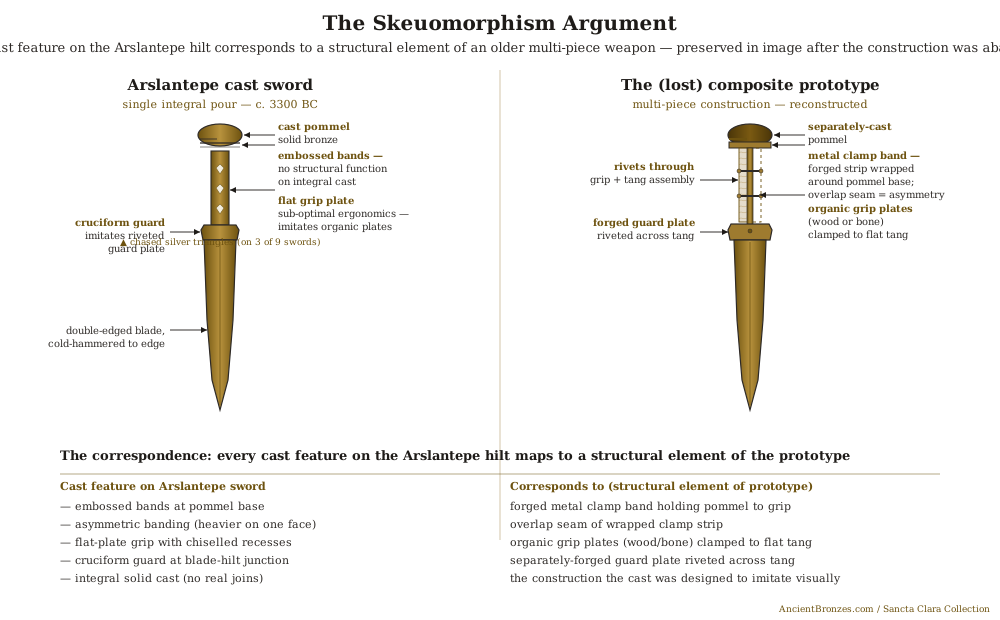
Look at the pommel. It is hemispherical, flattened, and embossed with horizontal banding produced by chiselling around the pommel base. On an integral cast hilt, those bands do nothing. They are decorative grooves on solid metal. On a multi-piece prototype with a separately-cast pommel attached to an organic-grip-and-tang assembly, however, a metal collar at the pommel base would be the structural element clamping the pommel onto the grip. The chiselled bands on the Arslantepe pommels imitate that clamp. They are the cast memory of a clamping band that the integral cast no longer needs.
On some specimens the embossing is markedly asymmetric — heavier and more deeply chiselled on one face than the other. On a cast object there is no reason for this. On an organic-handle prototype, however, the asymmetry is exactly what you would expect: the clamp band was forged from a single strip wrapped around the grip and overlapping on one face, so the wrapping seam appears as a heavier band on one side than the other. Cast symmetrically into solid bronze, that asymmetry has no function. It is preserved because the smith was working from a memory of the prior form.
Look at the guard. The Arslantepe hilts have a small symmetric or slightly asymmetric broadening at the blade-hilt junction — a cruciform or crescent-shaped expansion. On an integral cast it serves no structural purpose, because there is no joint at the blade-hilt junction to reinforce. On a multi-piece prototype, however, a separately-forged guard plate riveted across the blade tang at that exact junction is exactly what you would build: it reinforces the transition between cutting blade and grip, distributes lateral shock, and protects the user’s hand. The Arslantepe crescent expansion is the cast skeuomorph of that riveted guard.
And look at the blade itself, specifically at the shoulders just below that hand guard crescent shaped expansion. The Hall of Weapons blades splay outward at the shoulders before tapering downward to the point — they are widest at the guard-junction, not at the midpoint. This is the morphological feature that, as we saw in the previous section, distinguishes the Hall of Weapons swords from the Royal Tomb Type II form. On an integral cast it has no structural rationale; a parallel-sided or centrally-widening blade would cast just as well and would be mechanically stronger near the shoulders where lateral shock concentrates. The splayed shoulders make sense only if the prototype being imitated had a forged blade with shoulders that flared outward to seat against a separately-attached hilt and hand guard, often glued and rivetted to the blade — exactly the kind of construction in which the blade and the guard are made separately and need to mate cleanly at their junction. The blade morphology, in other words, is itself a skeuomorph. It preserves the silhouette of a composite prototype whose blade-and-guard junction required the splayed shoulders for fit and reinforcement, and that prototype is something other than the Royal Tomb Type II form. This is part of why Type II cannot be the missing prototype: Type II has parallel-sided blades, while the Hall of Weapons blades preserve the silhouette of a different multi-piece tradition with shoulder splaying built into the construction logic.
Look at the grip. The Arslantepe sword grips are flat plates, often with deliberately chiselled recesses to receive silver inlay. Mechanically they are worse than a contoured grip would be — a contoured grip with a swelling for the palm would be more secure in the hand and more comfortable under repeated use. The Arslantepe smiths could easily have cast a contoured grip; they did not. The flat-plate grip imitates the appearance of organic grip plates clamped against a flat tang — exactly the construction we know from Aegean Sandars Types A through D, 1,500 years later. The flat plate on the Arslantepe cast is a memory of an organic-grip prototype that the Arslantepe smiths were no longer making but could not bring themselves to abandon visually.
I want to dwell on this for a moment, because the argument matters. The Arslantepe smiths had the technology to cast any hilt shape they wanted. They were skilled enough to do silver inlay at 0.2 mm sheet thickness, to control the embossing of pommel bands, to cast asymmetric details deliberately. They could have made anything. They chose to make a sword that looks like a multi-piece composite weapon — a sword whose every visible feature corresponds to a structural element of a different, older construction.
That choice only makes sense if the multi-piece composite weapon was the culturally established prior form. The Arslantepe smiths were not inventing the sword. They were translating an established and visually familiar design vocabulary into the new, prestigious medium of arsenical copper. The prior form must have existed in actual physical objects, in the hands of warriors and chiefs whose successors commissioned the cast versions. Those objects have not survived — they were made of perishable organic materials over wood or bone cores, with thin metal collars and forged guard plates that would have been melted down and recycled when the objects went out of use. But they must have existed, because their image is preserved in the cast bronze of Arslantepe.
I want to be transparent that this argument — pressed this far, this systematically — is not, as far as I have been able to verify, the published consensus. Zimmermann (2011) hints at skeuomorphism in passing without naming it. Frangipane (2018) discusses the display function of the swords but does not develop the implications of the cast-imitating-composite design. The argument I am advancing here is, I believe, new in print: that the skeuomorphic features on the Arslantepe hilts are positive evidence for the prior existence of a now-invisible composite weapon tradition, and that the Arslantepe corpus is therefore not the beginning of bronze sword development but the visible apex of a sequence whose earlier members we have not yet recovered.
The Spearhead Engineering Vocabulary
If the skeuomorphism argument is the centrepiece, the spearhead engineering analysis is its strongest supporting evidence. The twelve spearheads from the Hall of Weapons are not less sophisticated than the swords; they are arguably more engineering-optimised, because the spear is a primary battlefield weapon and the engineering choices respond directly to combat use.
Consider the design problem the smith was solving. A wooden polearm thrust at force into a target — body armour of leather or linen, a wicker shield, a wooden door, eventually a human torso — experiences a violent reverse impulse along the shaft. If the spearhead is hafted with a simple flat tang inserted into a split wooden shaft and bound with sinew, several bad things can happen on impact. The tang can act as a wedge and split the shaft lengthwise, destroying the weapon in a single thrust. The tang can drive deeper into the shaft and loosen in the wood, making subsequent thrusts unreliable. Lateral shock at the moment of impact can snap the spearhead off at the join. All three failure modes are common with primitive hafting designs.
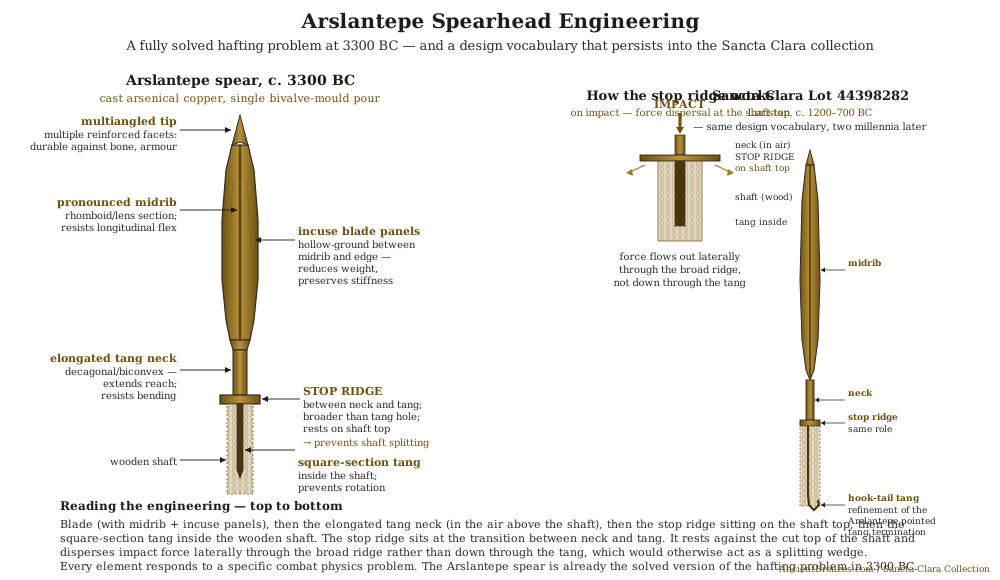
The Arslantepe smiths neutralise all three. The blade has a pronounced central midrib running its full length — rhomboid or lens-sectioned, providing the longitudinal stiffness that lets the blade transmit force without flexing or bending under load. Either side of the midrib the blade is incuse — hollow-ground, beveled away — which reduces the spearhead’s weight without sacrificing its piercing structural integrity. A lighter head means a faster thrust and better point control; a stiffer midrib means the energy of the thrust travels cleanly to the point. This is exactly the design logic of every well-engineered spearhead in the subsequent five thousand years.
At the tang-neck base, the smith forms a sharp transition into the tang assembly. First comes the stop ridge — a deliberately thickened, broadened transition cast as a flange perpendicular to the blade’s long axis. Its function is purely physical. When the spearhead strikes a target, the reverse kinetic force travels down the blade and hits the stop ridge, which sits flat against the cut top of the wooden shaft. Because the stop ridge is broader than the tang hole, the force is dispersed across the entire flat end of the shaft rather than being driven down into the wood by the tang. The tang stops acting as a wedge. The shaft does not split. This is a fully solved hafting problem.
Above the stop ridge the smith forms the tang neck — an elongated, decagonal or biconvex section several centimetres long separated by the stop-ridge from the tang proper. The neck prevents damage to the shaft from any sharp weapons. Below the neck the tang itself is square-sectioned, which prevents the head from rotating in the round-drilled tang hole.
Every element of this design responds to a specific combat physics problem. The midrib resists flex. The incuse panels reduce weight. The stop ridge prevents shaft splitting. The neck protects the shaft. The square tang prevents rotation. The whole assembly is the product of empirical iteration — many generations of smiths and warriors observing what failed in combat and modifying the design until it stopped failing. This is not a first attempt. It is the codified solution to problems that earlier, simpler hafting designs had repeatedly demonstrated.
And — this is the point that closes the argument — those earlier, simpler hafting designs are not present in the Anatolian or Mesopotamian Late Chalcolithic archaeological record either. We have small daggers from Tepe Gawra, Tell Brak, Hacınebi, Tell el-Oueili, Tepe Yahya, Susa, Ovçular Tepesi, Berikldeebi, Soyuq Bulaq. We have axes and adzes and chisels from the same horizons. We have ornaments and pins by the bucket. We do not have engineering-optimised spearheads with stop ridges and elongated necks. We have only Arslantepe — and Arslantepe is already the solved version. The trial-and-error generations that produced this solution must have existed somewhere, in some medium, but we have not found them. As with the swords, the engineering vocabulary of the spears is positive evidence for a tradition that is otherwise invisible.
The Silver Inlay
I want to take a paragraph or two on the silver inlay specifically, because the technical sophistication of this single feature is on its own enough to settle the question of whether we are looking at a mature tradition.
Three of the nine swords from the Hall of Weapons carry silver inlay on the hilt face — triangle and chevron patterns set into prepared recesses. One of the nine spearheads in the Royal Tomb carries silver triangular inlay echoing the same decorative grammar. The inlay technique works as follows. The smith first prepares the cast hilt by chasing — gouging or hammering with a hardened punch — a network of millimetre-deep channels in the predetermined geometric pattern. The silver, drawn or beaten down to a sheet thickness of around 0.2 mm, is then carefully folded and pressed into the chased channels. The surrounding arsenical copper is then cold-peened — hammered around the edges of the silver inlay — so that the copper folds over the silver and mechanically locks it in place. The whole surface is then ground and polished.
There are several technical risks at every step. The chased channels must be uniform in depth and cleanly cut, or the silver will not seat reliably. The silver sheet, at 0.2 mm, is thin enough to buckle or wrinkle during the pressing operation; it must be folded with care. The cold-peening must be applied evenly around the edge of the inlay, or the silver will pop out during subsequent hammering or polishing — copper and silver have different work-hardening responses, and the silver tends to extrude under uneven pressure. The successful execution of this process across multiple specimens, in a stable decorative grammar of triangles and chevrons, implies a workshop with dedicated specialists in silver work, and an understanding of differential metallic behaviour that anticipates the niello inlay traditions of the second-millennium Mycenaean smiths by sixteen hundred years.
The visual effect would have been striking. Polished arsenical copper has a warm reddish-bronze tone; the silver inlay would have appeared as a brilliant, near-white contrast against it. Under torchlight the inlay would have caught and reflected the light, producing a dazzling, almost otherworldly visual effect on a weapon already extraordinary by virtue of its scale and material. These are objects designed to communicate the supernatural reach of the elite who carried them.
Were They Actually Used?
For many years the dominant view in the Arslantepe literature held that the Hall of Weapons swords were primarily display objects. The argument went: they were sealed in a cache rather than in burials; their hilts are mechanically sub-optimal compared to second-millennium contoured grips; the silver inlay suggests prestige rather than function; arsenical copper at the upper end of the arsenic range (4 to 6 per cent) is hard but slightly brittle. They might have been carried in ceremony but were not real combat weapons.
That view is no longer sustainable. Two lines of evidence have settled the question.
The first is the experimental archaeology programme conducted by Jeroen Zuiderwijk, who has produced full-size reproductions of the Arslantepe swords using a 4 per cent tin-bronze analogue (necessary because casting at the original 4–6 per cent arsenic content would release lethal arsenic fumes). The reproductions weigh approximately 500 g — matching the average weight of the Arslantepe originals — and have a point of balance close to the hand, which makes them exceptionally fast and responsive. The hammer-hardened cutting edges, supported by the robust midribs, are fully capable of executing parries against heavy wooden shafts, of delivering lethal armour-piercing thrusts, and of cutting through unarmoured or lightly-armoured opponents with draw-cuts. The flat hilt is mechanically sub-optimal compared to a contoured grip, but it is not disabling. Zuiderwijk’s reproductions handle, in the hand of an experienced user, like the short swords they were designed to be.
The second line of evidence is the Tokat Museum sword. This is an Arslantepe-type sword, with the same overall morphology and the same Cu-As-Ni alloy signature, but of unknown excavation context — it came to the museum without provenance documentation. Zimmermann, Dilek and Önder published it in 2011, and the critical observation was that the Tokat sword carries patina-covered notches along its cutting edges. The notches sit beneath the corrosion layer, meaning they are ancient damage rather than recent handling. The most plausible interpretation is edge-to-edge combat damage from ancient use — the kind of nicks and dents that any cutting weapon accumulates if it is used to parry or strike against other metal weapons. The Tokat sword was used in fights.
Subsequent bioarchaeological work has corroborated the picture. Frangipane and Erdal’s 2020 study of a mass burial near the Arslantepe palace documents perimortem cranial trauma on eight of sixteen adult skulls — blunt-force injuries delivered around the time of death, consistent with organised violence in the period during which the Hall of Weapons cache was in use. The Arslantepe palace did not preside over a peaceful proto-state. It administered a community that was experiencing significant violent conflict, and its elites were equipped with weapons designed to fight that conflict.
The display function is real. The swords were prestige objects, carried by elites to project authority. But they were also fighting weapons, and they were carried by people who used them.
Where the Metal Came From
The lead-isotope provenance work by Hauptmann, Schmitt-Strecker, Begemann, Palmieri, and most recently by Hauptmann, Heil, Di Nocera and Stöllner in 2022, identifies two principal source regions for the Arslantepe copper: the Pontic / Black Sea coast to the north (specifically the Artvin–Murgul and Trabzon districts), and Ergani Maden to the south in southeastern Anatolia. Both are massive polymetallic ore deposits, both yield copper with the characteristic arsenic-nickel-antimony trace signature that the Arslantepe analyses show.
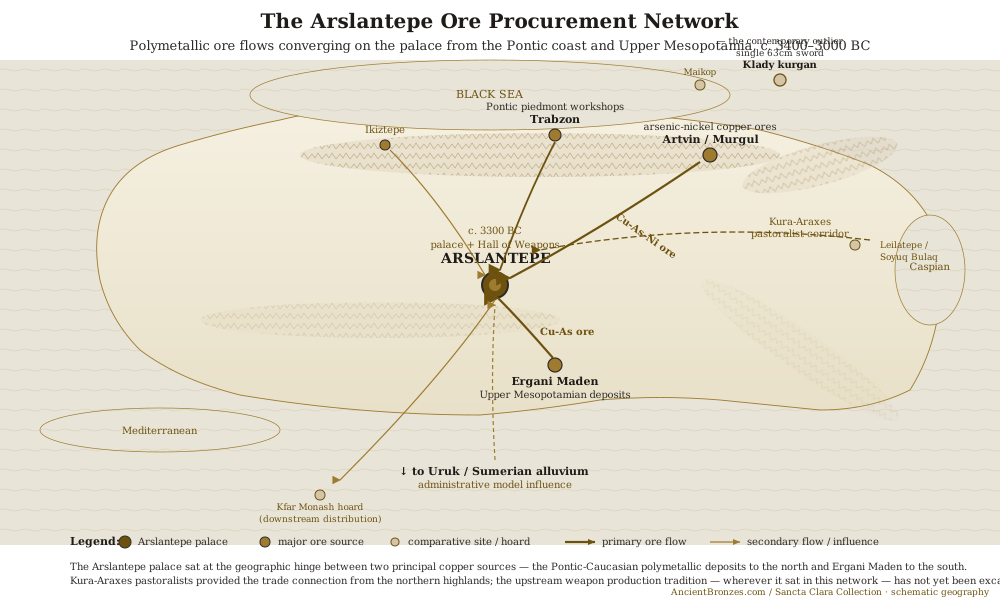
The Pontic source is the more interesting. Artvin and Murgul lie in the deep northeastern Anatolian highlands, well into the Kura-Araxes cultural sphere — a horizon of mobile pastoralist communities with seasonal transhumant migration patterns that took them through the highland valleys south of the Caucasus and across the broader Anatolian-Iranian-Mesopotamian frontier zone. The Kura-Araxes people were not state-builders in the southern Mesopotamian sense; they did not produce monumental architecture or centralised redistributive economies. But they were highly mobile and they had access to the polymetallic ore districts that the southern Mesopotamian elites desperately wanted. The lead-isotope evidence pulls the Arslantepe copper out of these northern districts and into the palace through what we can plausibly reconstruct as a long-running symbiotic exchange between the sedentary palace elite and the mobile highland pastoralists.
The southern source — Ergani Maden — is a separate channel. Ergani sits in the upper Tigris drainage, on the road south from Arslantepe to the Mesopotamian alluvium. Its arsenic-rich copper ores also show the antimony and nickel traces characteristic of the Arslantepe weapons. The Arslantepe palace appears to have been drawing from both sources, working at the geographic hinge between the two.
This double sourcing is logistically significant. A single source can be disrupted by a single political event or a single bad season; double sourcing creates resilience. It also implies that the Arslantepe administration was managing its metal supply at a level of complexity that requires either direct workshop oversight at the source (unlikely at the distance involved) or a network of intermediate trading partners who could buffer the palace against supply disruption. Either way, the metal supply was an instrument of statecraft, not a passive technical input.
The Kfar Monash hoard in Israel is a useful reference point here. This is a fourth-millennium copper hoard with the same Cu-As-Ni signature as the Arslantepe weapons — the lead-isotope evidence places its copper in the eastern Anatolian source field. A copper hoard turning up in Palestine, a thousand kilometres south of Arslantepe, with copper from the eastern Anatolian-Caucasian sources, implies a long-distance distribution system for raw material and possibly finished objects that we are only beginning to understand. The Arslantepe weapon production sat at the centre of a network whose full geographic reach we cannot yet trace.
The Missing Prior Tradition — A Systematic Survey
If the skeuomorphism argument is right, there should have been a prior tradition somewhere. Where might it have been, and what is the evidence?
I have worked through every plausible candidate region. The honest summary is that none of them, in the published record, looks like the upstream source.
Arslantepe’s own earlier periods (VII and VI B1) do not show precursor weapons. Hauptmann and colleagues in 2022 published twenty-two metal artefacts from Period VII (3900–3400 BC) — small awls, pins, chisels, lead and silver fragments, in arsenical copper and arsenic-nickel copper. The metallurgical tradition is continuous from VII to VI A on the site; the typological vocabulary is not. The leap from “small tools” to “fully-engineered long blades and engineered spearheads” is morphologically discontinuous within Arslantepe’s own sequence.
Northern Mesopotamian Late Chalcolithic sites — Tepe Gawra, Tell Brak, Hamoukar, Hacınebi — produce the right metallurgical milieu but not the right weapon forms. Tepe Gawra Levels XII to VIII contain arsenical copper objects “quite early for Mesopotamia,” but the catalogue is overwhelmingly small awls, pins, chisels, and short blades. Tell Brak has a metallurgical workshop area but no sword-scale weapons. Hacınebi produces ingots and casting evidence but again, no large-blade weapon corpus. Hamoukar yields a famous Late Chalcolithic destruction layer with mass-produced sling bullets — evidence of organised violence but not of long-blade weaponry. The northern Mesopotamian zone has the metallurgical infrastructure but not the typological output.
Late Ubaid and Halaf sites in lower Mesopotamia produce awls, pins, simple flat-axes, beads. Not precursors. Not even close.
Susa I/II in Iran has the alloying technology — a double-axe of arsenical copper of mid-fourth-millennium date is in the Louvre. Tallon and Malfoy’s 1985 compositional study of 280 Susa metal samples, reassessed by Oudbashi and others, shows that arsenical copper with up to 5 per cent As was used at Susa from the late fourth millennium. But the typology is small-tool dominated. Susa, Tepe Yahya, Tal-i Iblis and Arisman produce daggers, axes, and pins. They do not produce sword-scale blades in the Arslantepe horizon.
The Caucasian Chalcolithic — Leilatepe in western Azerbaijan, Soyuq Bulaq, Berikldeebi, Ovçular Tepesi — comes closest to a precursor milieu. Courcier and colleagues have documented the Leilatepe culture (LC 2–3, first half of the fourth millennium) as a serious metallurgical horizon with arsenical-copper daggers, a developed silver-and-gold tradition, and casting moulds. The Boyuk-Kesik dagger is published with a composition of 2.4 per cent As and 88 per cent Cu. The Soyuq Bulaq kurgan cemetery is the oldest known Transcaucasian kurgan tradition. But the Caucasian Chalcolithic still produces small daggers, axes, and ornaments — not sword-length blades. It is a plausible precursor milieu without yet being a precursor tradition.
Maikop and Novosvobodnaya in the North Caucasus, c. 3700–3000 BC, are the closest typological parallel. The Maikop kurgan itself contained an arsenical-bronze toolkit and a 47 cm blade with silver rivets, described as having sharp edges — sophisticated, but not sword-form. The genuinely important comparandum is the Klady kurgan in the Novosvobodnaya group, excavated by Aleksei Rezepkin, which produced a bronze blade 63 cm long with an 11 cm hilt, AMS-dated to 3500–3128 cal BC. This single Klady sword is the only object outside Arslantepe in the right horizon that approaches sword-scale. It is contemporary with — or slightly earlier than — the Arslantepe Hall of Weapons cache. And it stands utterly alone in the Novosvobodnaya corpus, just as the Arslantepe swords stand alone in the eastern Anatolian record. The Klady blade demonstrates that sword-scale objects could be produced in this horizon and were; it does not show that they were produced in quantity anywhere outside the Arslantepe palace. Its existence intensifies the missing-tradition problem rather than resolving it.
The polymetallic ore source regions themselves — Artvin–Murgul, Trabzon, Ergani Maden — have not produced fourth-millennium settlement sites with comparable weapon corpora. The ore districts have been surveyed, ancient workings identified, smelting evidence recovered. The upstream production site, if it exists, has not been excavated. It is possible that fourth-millennium mining settlements with weapon production capability sit in the Pontic piedmont or the eastern Anatolian highlands, undiscovered, awaiting future fieldwork.
The conclusion is bleak. There is no documented precursor tradition. The Arslantepe corpus is materially impossible to derive from any currently published earlier assemblage. Either the smiths of Arslantepe invented the entire mature engineering vocabulary in a single generation — which the skeuomorphic features make implausible — or the upstream tradition is real but invisible, lost to looting, recycling, or simple lack of excavation in the right places.
Bold Hypotheses
I want to be transparent about how I read the evidence. Here, ranked from strongest to weakest, are the hypotheses I find defensible, with the thresholds for revision.
Hypothesis 1 (strong): The upstream tradition existed in the Pontic / Caucasian polymetallic zone and is currently invisible. The lead-isotope signature points north and east. The Leilatepe–Maikop–Novosvobodnaya horizon is already metallurgically mature in alloying, casting, and silver/gold work. The Klady blade proves sword-scale production was within reach. The probability that twelve swords appear at Arslantepe with no upstream development in the same metal sources is very low. The most parsimonious explanation is that workshops in the Artvin–Murgul highlands, the Trabzon piedmont, or the Caucasian foothills were producing weapon-form objects in the late fourth millennium, and that these have not been excavated, have been melted down and recycled, or lie in still-undiscovered kurgan or hoard contexts. The Pontic piedmont in particular is very poorly explored. The revision threshold: a published fourth-millennium weapon corpus from any of these districts, with sword-scale blades, would convert “lost” to “located.”
Hypothesis 2 (strong, and this is my own argument): The skeuomorphism is itself positive evidence for the missing tradition. Cast hilts imitating riveted guards, organic grip plates clamped against flat tangs, and metal-collar-clamped pommels are not random decorative choices. They are coherent references to a multi-piece composite construction that the Arslantepe smiths chose to imitate. Such imitation requires that the prototype existed. The prototype must have existed in physical objects before the Arslantepe horizon. Where those objects are now, we do not know. But they were the design referent of the Arslantepe casts.
Hypothesis 3 (moderate): A diffusion from a now-lost Iranian centre is unlikely but not impossible. Susa I/II had the alloying technology; very early Iranian highland sites such as Tepe Sialk, Arisman, or Tepe Yahya have not been systematically searched for weapon-form precursors. The probability is low but the case is not closed.
Hypothesis 4 (rejected): Saharan or Neolithic Anatolian metallurgical diffusion. No evidence supports it. I list it only to dismiss it.
Hypothesis 5 (weaker alternative): Punctuated emergence — the Arslantepe smiths innovated rapidly, translating stone, bone, and wooden weapon vocabularies into copper, without a long prior metal tradition. The skeuomorphic features work strongly against this hypothesis. Punctuated emergence would not require imitation of multi-piece metal prototypes specifically; if the Arslantepe smiths were translating from stone and wood, the cast features would imitate stone and wood elements, not riveted metal guards and clamping bands. The metal-skeuomorphism is the falsifying observation. My honest position: punctuated emergence is implausible.
Hypothesis 6 (strong, methodological): Survival bias is severe. Arsenical copper recycles extremely well. Fourth-millennium weapons in elite ownership are exactly the objects most likely to be melted down and recast at owner-death, looted in antiquity, redeposited as votive offerings, or buried in kurgan contexts that are now plundered or destroyed by modern looting. The Arslantepe corpus survived only because the palace burned and was sealed in collapse. We are sampling the upstream tradition through a single preserved cache, and the absence of evidence elsewhere is not evidence of absence.
The Mystery of the Disappearance
The Arslantepe palace was destroyed by a massive fire around 3100 to 3000 BC. The Hall of Weapons cache was sealed in the burned debris. The administrative system collapsed; the cretulae sequence ends; the elite redistributive economy ceases to operate. In the subsequent Period VI B1, the monumental mudbrick architecture of the palace is replaced by ephemeral wattle-and-daub huts built directly atop the ruined foundations. The material culture is dominated by hand-made Red-Black burnished pottery — Kura-Araxes ware — indicating that the site was now occupied by exactly the mobile pastoralist groups that had previously served only as the trade vectors for the VI A elite. The proto-state was gone. The transhumant pastoralists were now the residents.
And the sword vanishes from the archaeological record of the Near East for nearly a thousand years.
This is the most disorienting fact about the Arslantepe corpus. A revolutionary military technology, demonstrated in serial production, deployed in actual combat (the Tokat sword’s edge damage, the Frangipane and Erdal 2020 cranial trauma evidence), capable of giving its possessors a decisive battlefield advantage — and then gone. For the next millennium, the primary bladed weapons across Anatolia, the Levant, and the Aegean are short daggers, generally under 20 cm, with heavy reliance on spears, axes and maces. The Royal Cemetery of Ur weapons of around 2600 BC are gold-hilted ceremonial daggers, not sword-scale combat weapons. The Egyptian Pre-Dynastic and Early Dynastic copper daggers are similarly short. Nothing approaching the Arslantepe sword reappears in the Near East until the Aegean Type A rapiers of around 1700 BC — thirteen hundred years later.
The standard explanation for technological loss is that the technology was never really learned in the first place — that it was a one-off, a fluke, an experiment that did not stabilise. That explanation cannot work here. The Arslantepe smiths were operating with full control of arsenical copper alloying, with established bivalve casting moulds, with codified workshop practice across twelve swords and twenty-one spearheads, with secondary specialists in silver inlay. This was not an experiment. This was a stabilised production tradition.
The honest explanation, I think, is that the tradition disappeared with the social infrastructure that sustained it, probably following a catastrophic collapse of some sort. Forging a sixty-centimetre, silver-inlaid, skeuomorphically detailed arsenical copper sword is not something a part-time smith does on the side. It requires a dedicated workshop with full-time specialists; secure long-distance supply chains to bring copper from the Pontic and southern Mesopotamian ore districts; centralised smelting infrastructure with controlled fire conditions and mould-making expertise; and — critically — a wealthy, coercive elite capable of patronising the whole apparatus. When the Arslantepe palace burned and the redistributive economy collapsed, every link in this chain failed simultaneously. The specialists scattered. The trade routes for raw material went unmaintained. The workshops went cold. The technical knowledge — held in the heads of a small number of master smiths — was lost within a generation, because the social structures that had transmitted that knowledge from master to apprentice ceased to exist.
The pastoralist Kura-Araxes communities that occupied the post-collapse site neither needed nor could support the sword. Mobile transhumant warfare in the highland zones favours the spear (for cavalry and open-ground infantry combat) and the dagger (for close personal defence in tight quarters). The sword is a weapon of settled, organised warfare — of armies that hold lines, of warriors who fight in formation, of states that can pay and equip them. When the state went, the specialized workshops went and the sword went.
The sword does not return until the second-millennium palatial economies of Mycenaean Greece, Minoan Crete, the Hittite Empire, and the Egyptian New Kingdom reconstitute the same kind of infrastructure that Arslantepe had pioneered fifteen hundred years earlier. The Aegean Type A rapiers of 1700 BC are not a first invention. They are a second invention, in a different cultural matrix, of a technology that had already existed and been lost. This is the deepest implication of the Arslantepe corpus, and the one that has most thoroughly upended my own thinking. Technological progress is not a one-way ratchet. It is contingent on the survival of the social infrastructures that sustain it. The sword can be invented twice — and apparently was.
Why This Hill?
There is one further pattern in the Arslantepe record that deserves to be named, because once you see it the coincidence becomes too improbable to be a coincidence.
The Hall of Weapons cache and the Royal Tomb are, in the broader world history of fourth-millennium metallurgy, the only two dense weapon deposits of comparable scale anywhere on the planet in their horizon. They are separated by perhaps fifty to two hundred years — almost back-to-back in archaeological terms — and they are attributed by the published literature to two materially different cultural regimes. The first belongs to the Late Uruk-oriented proto-state administration that built the Period VI A palace. The second belongs to a partly Caucasian-oriented elite that emerged after the palace fire and cut its principal burial directly into the wall of Building 36, one of the abandoned monumental structures of the prior regime. Two cultures, one century apart, depositing elite weapons at the same hill. And nowhere else in the world is doing anything like it.
The probability that this is coincidence is essentially zero. Something about this place drew successive elites to make weapon deposits here, and only here, when no comparable behaviour is recorded anywhere else in the fourth-millennium Near East. The site itself is doing something that the cultures occupying it are not, individually, sufficient to explain.
I should add an immediate caveat to soften the “two cultures” framing slightly. The Royal Tomb pottery mixes red-black burnished ware (Kura-Araxes / Caucasian) with reserved-slip ware (Mesopotamian). The metallurgical lead-isotope signatures of the Royal Tomb metal fit the same ore-source network as the Hall of Weapons metal. The Skourtanioti et al. 2020 ancient DNA from Royal Tomb individuals shows significant local-population continuity layered with Caucasian admixture, not a clean population replacement. So whoever was buried in the Royal Tomb was not a stranger arriving at a foreign place; the local population, the metallurgical infrastructure, and at least some of the cultural vocabulary continued across the cultural-political turnover. The political superstructure flipped. The underlying community substantially persisted. Whoever made the Royal Tomb sword had access to the same ore network, and probably to the same workshop tradition, as the smiths who had made the Hall of Weapons swords a century earlier.
That continuity is part of the answer. But it is not the whole answer, because it does not explain why this hill was the location of the second deposit. The new regime could have buried its leader anywhere — in the surrounding plain, on a different rise, in a kurgan-style mound newly built for him as his Caucasian cultural cousins were doing at Klady and Maikop and Soyuq Bulaq. They chose, specifically, to cut his tomb into the ruined monumental architecture of the prior elite’s palace. They were making a claim about this place — that this was where elite power deposits belonged, even (perhaps especially) when the elites in question had changed.
A place of accumulated symbolic capital
My best reading — and I want to flag clearly that we are now in speculative territory — is that Arslantepe was understood across the cultural transition as a place of accumulated ritual and symbolic memory, and that the deposits at the site are expressions of an underlying regional understanding that this hill is where the weapons of elite authority belong. Several lines of evidence converge on this reading.
First, the Hall of Weapons cache is itself increasingly read in the recent literature (Frangipane 2018, Palumbi 2012) as a display assemblage rather than a tactical stockpile. The weapons were tied in two bundles and hung on the wall of Room A113 — a display arrangement, not the layout of an armoury you intend to draw weapons from in a hurry. The spearheads were stored without their wooden shafts, as we noted earlier; the cache was the bronze component, not the functional polearm. If Frangipane’s reading is right, then the Hall of Weapons is already partly a ritual deposit rather than a pure military cache, even before the fire sealed it. The palace destruction preserved an arrangement that was meant to be seen and to communicate authority.
Second, the Royal Tomb’s deliberate placement in the wall of the abandoned monumental Building 36 is itself an act of cultural memory. The new elite chose to inscribe its principal funerary act within the physical body of the prior regime’s palace. This is the kind of move that later rulers across the ancient world will make repeatedly — Hittites building over Hattian ruins, Assyrian kings re-using Hurrian cult sites, Achaemenids inheriting the Median capital — to claim the symbolic capital of their predecessors. The new occupants of Arslantepe were doing the same thing, three thousand years earlier than the cuneiform record will document such moves elsewhere. They saw the Period VI A palace as a place worth inheriting symbolically, even though they had not built it and could not maintain it.
Third — and this is the most speculative move — the mound itself probably carried sacred significance independent of any specific elite occupation. A natural thirty-metre rise above an otherwise flat alluvial plain, situated at a major upper-Euphrates crossing, occupied continuously back to at least Period VII (3900 BC), is exactly the kind of feature that ancient cultures turned into axes mundi — sacred mountains, places where the human and divine touch. The site’s importance was probably never purely strategic and economic. It was, from very early on, sacred-strategic. Power deposited at Arslantepe was deposited with the place itself, and would have been understood that way by the elites who deposited it.
What the names tell us
The onomastic evidence supports this reading in a way I did not initially appreciate. The site has carried two parallel name traditions across at least four millennia, and both of them mark it as something other than ordinary.
The modern Turkish name Arslantepe — from arslan, “lion,” and tepe, “hill” or “mound” — was given by Turkic-speaking populations who arrived in the region after the eleventh century AD. They named it for the two monumental stone lion sculptures still visible at the Iron Age gateway: the Lion Gate of the Neo-Hittite city of Melid (Kammanu) that flourished here from roughly 1100 to 700 BC. The lions had been carved by Neo-Hittite sculptors as guardian figures at the entrance to a sacred and royal precinct, in the long Anatolian tradition of lion-gate architecture that runs from Hattuša through Carchemish to Mycenae. The Turkic name therefore preserves a memory of a memory — Turks naming the place for the visible trace of a Neo-Hittite cult of royal animality that was itself preserving an older Anatolian iconographic tradition.
The deeper name is Melid. The Hittite cuneiform attestations give us Malidiya; the Akkadian sources give Meliddu or Milidu; the Urartian texts Meliṭeia; the Greco-Roman writers, beginning with Strabo, Melitene (Μελιτηνή). The modern city a few kilometres east of the mound is still called Malatya. The name has been continuously used, across at least seven languages and four millennia, with only minor phonological drift.
The etymology is where it gets evocative. The reconstructed Proto-Indo-European root *mélit- means “honey.” It is one of the better-attested PIE roots — preserved in Hittite militt- / malitt- “honey,” Luwian mallit- “honey,” Palaic mallitanna-, Old Armenian mełr, Mycenaean Greek me-ri, Classical Greek méli, Latin mel, Gothic miliþ, and through related forms the Slavic and Baltic med / medus “honey” and Sanskrit madhu “honey, sweet.” The English word “mellifluous” descends from it, as ultimately does “mead.”
If the place-name Malidiya derives from this root — which is the consensus reading among Hittitologists, though not the only proposed etymology — then the name means something like “honey-place,” “place of honey,” or “honey-land.” The straightforward agricultural reading is well-attested: the Malatya plain produced and still produces significant honey, and remains famous today for its fruit and apricot orchards, an environment in which bees thrive. The Hittites, taking the site around 1400 BC under Suppiluliuma I, may simply have given it a descriptive name reflecting its economic character.
But honey in Anatolian and broader ancient Near Eastern religion was not merely a foodstuff. It was a ritual substance of the first rank. Hittite cultic texts use honey constantly — in purification rituals to cleanse temples and royal persons, in libations poured to the gods, in offering tables for major deities, in apotropaic ceremonies, in the “sweet substances” employed to placate chthonic powers. Honey was the substance of propitiation, the thing you offered to please a god, to cool a deity’s anger, to make the divine sweet to humans. Calling a place “Honey-Land” in Hittite was not just descriptive. It was a name with cultic resonance, and it would have been heard as such by every Hittite who used it.
There is one caveat I should flag. The Hittites arrived in Anatolia around 2000 BC. The Hall of Weapons cache dates to 3300 BC. Whatever the place was called during the Period VI A palace was not “Malidiya” — that name is roughly a thousand years too late. The Late Chalcolithic occupants spoke a pre-Indo-European Anatolian language, possibly an early form of Hattic (the substrate language that the Hittites later partly absorbed), or possibly a related but unrecorded substrate. We do not know what they called this place. The name that has come down to us is the Hittite reinterpretation — or possibly the Hittite preservation, in their own etymology, of a similar-sounding older substrate word whose original meaning is lost. The “honey” reading might be a Hittite folk-etymology overlaid on an older toponym.
What we can say is this. Both name traditions, independently, mark the place as something other than ordinary. Arslantepe says: lion-place, royal-place, guarded-place, sacred-place. Melid / Malidiya says: honey-place, sweet-place, offering-place, place where the gods are pleased. Neither name treats the location as a neutral toponym. Both mark it as a place with cultic-symbolic significance, in their respective cultural idioms. The two names are independent — they belong to entirely different language families and were given by populations separated by several millennia — yet both reach for vocabularies of sacredness and elite importance. Across at least four cultural-linguistic horizons (pre-Hittite substrate, Hittite/Luwian, Greco-Roman, Turkic), every population that has encountered Arslantepe seems to have recognised that the place was already significant, and named it accordingly.
The pattern
Put these threads together and what emerges is consistent. The site itself, the mound itself, carried symbolic weight that successive populations recognised even when they understood that weight through completely different cultural and ideological vocabularies. The Period VI A palace placed its display-cache of weapons in this place because the place was already understood as the right kind of place for elite power to be concentrated. The post-collapse Royal Tomb elite buried its leader at this place because the place was still understood as the right kind of place for elite authority to be deposited. The Hittites called the place Honey-Land, with its cultic resonance, because the place — even fifteen hundred years after the original palace burned — was still operating as a site of religious and political importance. The Neo-Hittites set up monumental lion guardians at its gate because the place was already understood as needing such protection. The Turks, finding the lions still visible on the abandoned site, named the place for them.
This is a chain of recognitions across four thousand years. The constant in the chain is not any single cultural regime — it is the place. The Arslantepe mound is one of those rare locations in the ancient world that successive cultures kept finding to be already meaningful, even when they could not read directly the meanings their predecessors had inscribed in it.
For the weapon deposit pattern specifically, the implication is the one we have been working toward. The double weapon deposit is not coincidence. It is the early, sharp expression of a continuous regional understanding — held by successive elites, attested in the persistent naming tradition — that this is where the weapons of authority belong. The two deposits are not two separate cultural acts. They are two expressions of one underlying practice that the site itself sustained. And the broader implication, again, is the one the article has been arguing throughout: the Arslantepe corpus is the visible tip of something much larger, much older, and much more layered than the surviving record can show. The lost upstream production tradition we have hypothesised is one part of what is missing. The cultic-symbolic understanding of this place is another part, glimpsed in the names and in the deliberate architectural reoccupations, but not fully recoverable from the material record alone.
I want to be transparent about how far this argument can be pushed. The place-of-memory reading is interpretive. It cannot be falsified by future excavation in the way that a missing-prototype hypothesis can. What it offers is a coherent explanation for an otherwise improbable coincidence — and a framework in which the Hall of Weapons cache, the Royal Tomb, the Hittite honey-name, the Lion Gate, and the modern Turkic Arslantepe are all reflections of a single underlying pattern. Take it as a working hypothesis, not as a proven case. But take it seriously: the alternative is to insist that two of the only major fourth-millennium weapon deposits anywhere on the planet happened to land at the same hill by chance, and that is not a position the probabilities will support.
A Note on Sancta Clara Lot 44398282
Among the spearheads in my own collection, Lot 44398282 stands out for its Arslantepe affinities. It is a Luristan-style bronze spearhead, 454 mm long, with a long narrow midrib, an elongated socket-neck, a squared shaft eye, and a back-bent rat-tail tang termination. Conventional Luristan typology dates it to the Iron Age horizon — roughly the second to first millennium BC. The piece has been studied in this context and the date seems secure.
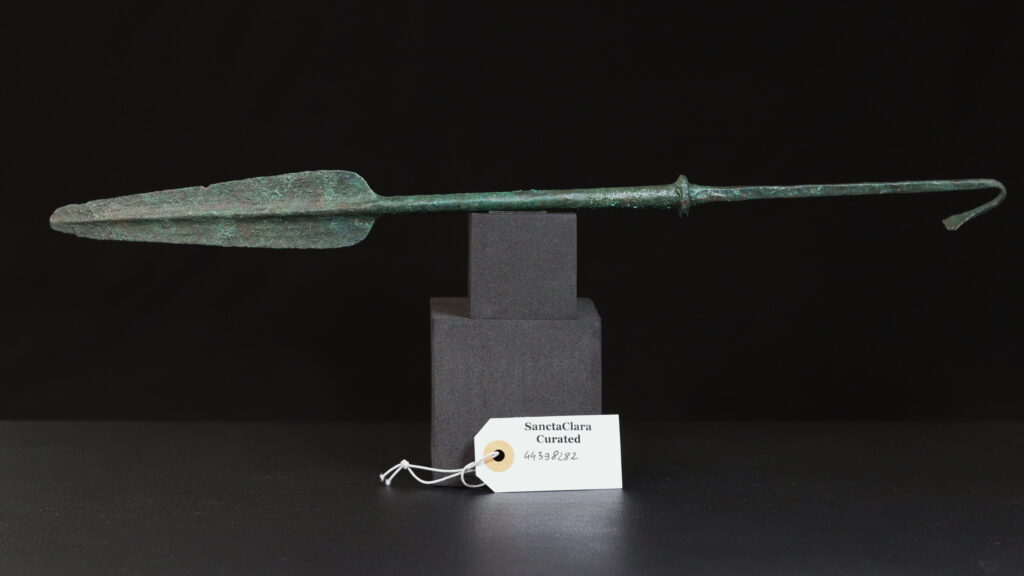
What is striking is the continuity of the engineering vocabulary between Lot 44398282 and the Arslantepe spearheads of 3300 BC, separated by some two thousand years. The pronounced midrib, the elongated tang-neck, the stop ridge transition between neck and tang, the square-sectioned tang for rotation resistance — all of these features are present in both. The principal difference is the tang termination. The Arslantepe spear tangs end in points designed for friction-fit in a deep wooden socket. The Lot 44398282 tang ends in a back-bent hook, designed to engage the inside of the wooden shaft and resist pull-out under stress.
Is there a typological lineage between these two traditions, separated by two millennia? Or are they convergent solutions to the same engineering problem? The honest answer is: partly both. The pronounced midrib plus elongated tang-neck combination is so specific that pure convergence is unlikely. The simpler explanation is that the Anatolian-Mesopotamian spear tradition of the third millennium — Hassek Höyük, Tepe Gawra V, Royal Cemetery of Ur spear types, early Susa spear types — carried the Arslantepe design vocabulary southward and eastward, where it was eventually absorbed into the workshop traditions of the Zagros and Luristan in the second and first millennia BC. The hook-tail termination is an additional refinement layered on top of the inherited base design, solving a slightly different sub-problem (pull-out resistance) that the original Arslantepe design (friction-fit) had handled differently.
This does not require unbroken workshop continuity across two thousand years. It requires only that the design vocabulary — the engineering knowledge that a spear needs a stop ridge and an elongated neck, that the tang must be square-sectioned, that the midrib must be pronounced — persisted in the metalworking community of the Zagros-Caucasus arc, the same broad metallurgical macro-region from which the Arslantepe metal originally came. The design knowledge moved with the metalworkers, even when the patronage system collapsed and the typology adapted to new tactical contexts.
So when I hold Lot 44398282, I am holding something that sits at the end of a typological chain whose first surviving link is at Arslantepe in 3300 BC. The chain is not a single workshop; it is a regional engineering tradition whose continuity is documented in the design vocabulary even where the production centres and the political patronage have changed many times over.
What This Means
Let me close by spelling out, plainly, what I take the Arslantepe corpus to mean for the broader history of bronze weaponry.
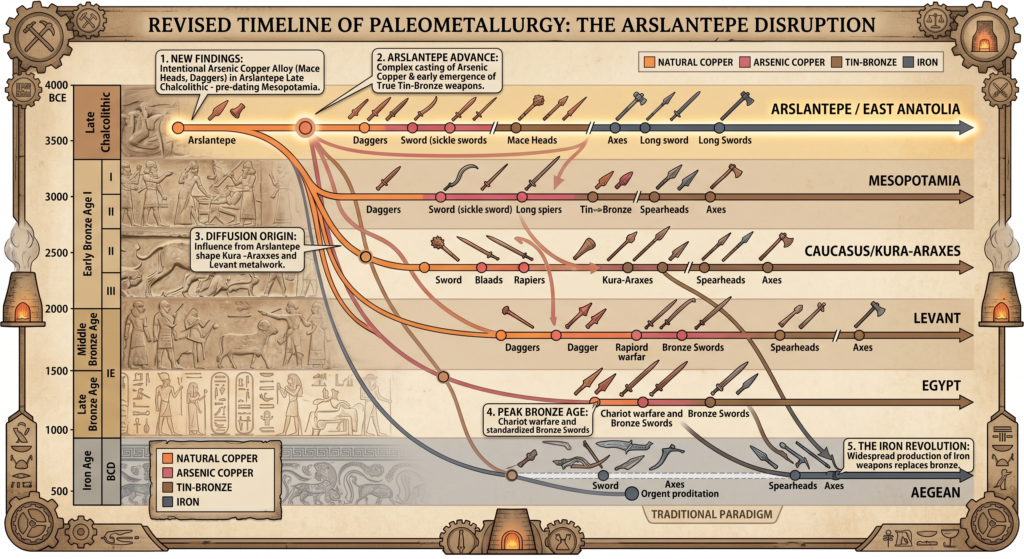
It means that the developmental timeline I had been working with — gradual emergence from small daggers in the third millennium, full sword forms in the second, refinement through the Late Bronze Age — is wrong, or at least seriously incomplete. The first true swords appear thirteen hundred years earlier than the standard chronology allows, in a mature and refined production tradition that itself implies a prior tradition we cannot yet see.
It means that bronze weapon technology was invented twice: once at Arslantepe in the late fourth millennium, in arsenical copper, in a palatial proto-state context that supported the social infrastructure required; and then again — independently, after a millennium of latency — in the Aegean and Carpathian palatial economies of the early second millennium BC, in tin-bronze, with new typological vocabulary but with many of the same engineering choices being rediscovered. The persistence of the basic design vocabulary across that gap is striking and probably reflects the underlying combat physics rather than direct cultural transmission.
It means that survival bias in the archaeological record is severe enough to mislead us in fundamental ways about technological development. We have the Arslantepe corpus only because the palace burned and sealed it. We do not have the upstream tradition because that tradition did not, by accident, burn under similarly preservation-favourable circumstances. We are inferring history from the small fraction of objects that happened not to be melted down, recycled, looted, or lost. The rule is general: where preservation is patchy and recycling is easy, the surviving record tells us about episodes of preservation as much as it tells us about technological development.
It means that the skeuomorphic features of the Arslantepe hilts are not decorative quirks; they are evidence — positive evidence — for a lost tradition of multi-piece composite weapons in the Late Chalcolithic Near East, made of organic materials over wooden cores with thin metal collars and forged guard plates. We do not have the originals, and we may never have them. But we have their image, preserved in the cast bronze that imitated them. And that lost tradition is not the Type II long-sword form that the Royal Tomb specimen represents. Type II has its own continuous descent — from Tülintepe and Klady through Alacahöyük and onward into the Anatolian and Caucasian-Iranian second-millennium swords. The Hall of Weapons swords were imitating something else, a parallel multi-piece tradition with its distinctive splayed-blade-at-guard morphology, which has not survived in any documented form. We have, in other words, fragments of two missing fourth-millennium sword traditions, not one.
It means that the place mattered. The double weapon deposit at Arslantepe — sealed-by-fire in the Hall of Weapons and deliberately-buried in the Royal Tomb, separated by perhaps a century, attributed to materially different cultural regimes — is too improbable to be coincidence. The site itself carried symbolic weight that successive elites recognised, even when they understood that weight through completely different cultural vocabularies. The Hittite name Malidiya — “honey-place,” with its cultic resonance in Anatolian religion — and the Neo-Hittite Lion Gate and the modern Turkic Arslantepe are reflections of the same underlying pattern. The mound has been recognised as significant by every population that has encountered it across at least four thousand years. The constant has been the place, not the people.
And it means, finally, that the relationship between technology and political power is more brittle than the standard developmental narratives admit. The Arslantepe sword was not a technology that outlasted its patrons. It was a technology that depended on its patrons. When the patrons burned, the technology burned with them. The thousand-year gap before the sword returns is a thousand years in which no political system in the Near East could afford to support a workshop capable of producing it. That is a sobering observation about the contingency of what we call progress.
The Arslantepe smiths were not at the beginning of a story. They were at the apex of one. We have not yet found their teachers. We may never. But the evidence they left in cast bronze — every clamping band, every cruciform guard, every embossed pommel-base — testifies that those teachers existed.
That is a finding I am not willing to leave hedged in the safe summary form the published consensus has preferred. I am writing this article because I have come to believe that the consensus has understated, for too long, just how much the Arslantepe finds change. My previous article on this site treated these objects as a footnote. They are not a footnote. They are the central piece of evidence around which the whole story of early bronze weaponry has to be rebuilt.
The Sancta Clara Collection holds Lot 44398282, the Luristan-style bronze spearhead discussed above, whose engineering vocabulary descends — across two millennia and probably with substantial workshop discontinuity — from the production tradition first visible at Arslantepe. The full catalogue, with images and provenance notes, is available elsewhere on AncientBronzes.com. I am grateful to readers who have prompted me to look harder at the Arslantepe material, and to the scholars cited below — Marcella Frangipane and the Sapienza team above all — whose decades of careful fieldwork have made this discussion possible.
Sources and Further Reading
Excavation, Stratigraphy, and Find Context
- Frangipane, Marcella. Multiple publications on the Arslantepe excavations from the 1990s onward. Key syntheses include Arslantepe: La collina dei leoni / Arslantepe: The Hill of Lions (Electa, Milan, 2004); “The 4th-millennium Arslantepe: The development of a centralised society without urbanisation,” Origini XXXIV (2012): 19–40; “Different Trajectories in State Formation in Greater Mesopotamia: A View from Arslantepe (Turkey),” Journal of Archaeological Research 26/1 (2018): 3–63.
- Frangipane, Marcella, ed. Arslantepe: Cretulae. An Early Centralised Administrative System Before Writing. Arslantepe Series V. Sapienza University of Rome, 2007. Documents the 2,145 cretulae in stratified context.
- Frangipane, Marcella, and Alba Palmieri. “Cultural Developments at Arslantepe (Malatya),” Origini XII/2 (1983): 287–668. The foundational publication of the Period VI A palace and the Hall of Weapons cache.
- Frangipane, M., G.M. Di Nocera, A. Hauptmann, P. Morbidelli, A. Palmieri, L. Sadori, M. Schultz, and T. Schmidt-Schultz. “New Symbols of a New Power in a ‘Royal’ Tomb from 3000 BC Arslantepe, Malatya (Turkey),” Paléorient 27/2 (2001): 105–139. The full publication of the VI B2 Royal Tomb.
- Frangipane, M. and Y.S. Erdal. “Ritualisation of violence and instability at Arslantepe at a time of crisis and political disruption (3300–3100 BC),” in H. Meller et al., eds., Rituelle Gewalt — Rituale der Gewalt (Landesmuseum für Vorgeschichte, Halle, 2020).
Metallurgy and Material Analysis
- Hauptmann, A., S. Schmitt-Strecker, F. Begemann, and A. Palmieri. “Chemical composition and lead isotopy of metal objects from the ‘Royal’ tomb and other related finds at Arslantepe, Eastern Anatolia,” Paléorient 28/2 (2002): 43–69. The anchor metallurgical reanalysis.
- Hauptmann, A., A. Heil, G.M. Di Nocera, and T. Stöllner. “Metallurgical processing of polymetallic ores at Arslantepe (Malatya, Turkey) in the late 4th and early 3rd Millennium BC,” Metalla 26.2 (2022): 53–90 and 87–112 (two-paper sequence). Recent reassessment with extensive new analytical data.
- Hauptmann, A., A. Heil, G.M. Di Nocera, and T. Stöllner. “The Dawn of Metallurgy at Chalcolithic Arslantepe: Metal Finds and Other Metallurgical Remains from Level VII,” Metalla 26.2 (2022). Academia.edu.
- Di Nocera, G.M. “Metals and Metallurgy. Their Place in the Arslantepe Society Between the End of the 4th and Beginning of the 3rd Millennium BC,” in M. Frangipane, ed., Economic Centralisation in Formative States. The Archaeological Reconstruction of the Economic System in 4th millennium Arslantepe (Studi di Preistoria Orientale 3, Sapienza, 2010), 255–274. Academia.edu.
- Di Nocera, G.M. “Metal Production at Arslantepe in the Late Chalcolithic and Early Bronze I,” Origini 35 (2013): 111–142.
- Palmieri, A., A. Hauptmann, and K. Hess. “Metal artefacts from Arslantepe,” XIII Arkeometri Sonuçları Toplantısı (Ankara, 1998): 115–122. The first publication of the copper-silver alloy dagger composition.
The Tokat Sword and Combat Evidence
- Zimmermann, T., N. Dilek, and S. Önder. “Ein neues Schwert vom Typus ‘Arslantepe’ — frühmetallzeitliche Waffentechnologie zwischen Repräsentation und Ritual. Mit einem archäometrischen Beitrag von Latif Özen und Abdullah Zararsiz,” Praehistorische Zeitschrift 86/1 (2011): 1–7. DOI: 10.1515/pz.2011.001. The Tokat Museum sword with its combat-damaged edges.
The Long-Sword Typology (Type II and Successors)
- Dall’Armellina, Vittoria. “Power of Symbols or Symbols of Power? The ‘Long Sword’ in the Near East and the Aegean in the Second Millennium BC,” Ancient Near Eastern Studies 54 (2017): 143–182. DOI: 10.2143/ANES.54.0.3206239. The foundational typology of Near Eastern long swords; classifies the Royal Tomb sword as Type II with antecedents at Tülintepe and the broader Caucasian-Anatolian elite-burial network. docslib.org PDF.
- Palumbi, Giulio. “The ‘Royal Tomb’ at Arslantepe and the 3rd Millennium BC in Upper Mesopotamia,” in B. Helwing et al., eds. (2021). Establishes the Royal Tomb as one example of a wider phenomenon of late fourth- and early third-millennium elite cist burials including Hassek Höyük and Bashur Höyük. uniba.it.
- Frangipane, M. Arslantepe: La collina dei leoni / Arslantepe: The Hill of Lions. Electa, Milan, 2004. Includes the Royal Tomb sword as catalogue no. 107.
Place-of-Memory and Etymology
- Kloekhorst, A. Etymological Dictionary of the Hittite Inherited Lexicon. Leiden Indo-European Etymological Dictionary Series 5. Brill, 2008. The standard reference for Hittite etymologies including militt- / malitt- “honey” and the reconstructed PIE root *mélit-.
- Beekes, R. Etymological Dictionary of Greek. Brill, 2010. For Greek méli and the broader IE cognate set.
- Bryce, T. The Kingdom of the Hittites (rev. ed., Oxford, 2005); and The World of the Neo-Hittite Kingdoms (Oxford, 2012). For the political history of Malidiya/Melid as a Hittite/Neo-Hittite political centre, and the Lion Gate iconography.
- Hawkins, J.D. Corpus of Hieroglyphic Luwian Inscriptions (de Gruyter, 2000), volume I, on the Neo-Hittite inscriptions of Melid.
- Melid / Milidu on the standard Hittite geographical references (RGTC — Répertoire géographique des textes cunéiformes, vol. 6 for the Hittite material).
Chronology
- Vignola, C., F. Marzaioli, F. Balossi Restelli, G.M. Di Nocera, M. Frangipane, A. Masi, I. Passariello, L. Sadori, and F. Terrasi. “Changes in the Near Eastern chronology between the 5th and the 3rd millennium BC: New AMS 14C dates from Arslantepe (Turkey),” Nuclear Instruments and Methods in Physics Research Section B (2019). DOI: 10.1016/j.nimb.2019.01.033. The most recent AMS radiocarbon framework.
- Manuelli, F., C. Vignola, F. Marzaioli, I. Passariello, and F. Terrasi. “The Beginning of the Iron Age at Arslantepe: A 14C Perspective,” Radiocarbon 63/3 (2021): 885ff.
Comparative Material — Caucasus and Pontic Zone
- Courcier, A., et al. Work on the Leilatepe culture and Caucasian Chalcolithic metallurgy. Multiple publications c. 2010–2015 on Soyuq Bulaq, Boyuk-Kesik, and related sites.
- Rezepkin, A.D. Novosvobodnaya Culture (on the basis of materials of the Klady burial ground). St Petersburg, 2012. The Klady Kurgan 31 bronze sword.
- Trifonov, V., et al. Recent work on Maikop chronology and Klady AMS dating, Antiquity and Russian Academy of Sciences publications.
- Ivanova, M. Aramazd: Armenian Journal of Near Eastern Studies (2008): 7–39. Historiography of the Maikop chronology debate.
- Mehofer, M., and B. Horejs. “Early Bronze Age Metal Workshops at Çukuriçi Höyük — Production of arsenical copper at the beginning of the 3rd mill. BC,” in A. Hauptmann and D. Modarressi-Tehrani, eds., Archaeometallurgy in Europe III (Der Anschnitt Beiheft 26, 2015): 165–176. ResearchGate.
Genetics
- Skourtanioti, E., Y.S. Erdal, M. Frangipane, F. Balossi Restelli, et al. “Genomic History of Neolithic to Bronze Age Anatolia, Northern Levant, and Southern Caucasus,” Cell 181/5 (28 May 2020): 1158–1175. DOI: 10.1016/j.cell.2020.04.044. Includes 22 Arslantepe individuals.
Experimental Archaeology
- Zuiderwijk, J. Replication work on the Arslantepe swords using 4 per cent tin-bronze analogue, documented in detail at the myArmoury discussion thread and in subsequent publications.
General Bronze Age Sword Context
- Bronze Age Sword, Wikipedia. en.wikipedia.org/wiki/Bronze_Age_sword. Useful chronology overview.
- Frangipane and Caneva publications on the broader Anatolian Bronze Age, Origini and Paléorient.
- Arkeonews features on Arslantepe, arkeonews.net and arkeonews.net.
- Anatolian Archaeology — The World’s Oldest Swords and the Birth of Warfare at Arslantepe.
- Early Cities of the Ancient Near East — Metal Weaponry synthesis. earlyneareasterncities.wordpress.com/material-culture-studies/metal-weaponry/.
Luristan Comparative Material (for Sancta Clara Lot 44398282)
- Moshtagh Khorasani, M. Arms and Armor from Iran: The Bronze Age to the End of the Qajar Period. Legat Verlag, Tübingen, 2006. The definitive reference for Iranian Bronze Age weapons, including Luristan spear typology.
- Moshtagh Khorasani, M. “Bronze and Iron Weapons from Luristan,” Antiguo Oriente 7 (2009): 185–217.
UNESCO
- UNESCO World Heritage Centre — Decision 44 COM 8B.22 (26 July 2021), inscribing Arslantepe Mound under criterion iii. whc.unesco.org/en/decisions/7941/.
Article and accompanying diagrams © AncientBronzes.com / Sancta Clara Collection, 2026. Free to share with attribution; please do not republish in full without permission. Several of the interpretive positions advanced here — the skeuomorphism argument as the central evidence for a lost upstream weapon tradition; the morphological distinction between the Hall of Weapons and Royal Tomb sword forms and the argument that Type II cannot be the missing prototype; the “place of memory” reading of the doubled weapon deposit; and the broader claim that the Arslantepe corpus is the visible apex rather than the beginning of an advanced weapon tradition — are positions advanced by the author. They are supported by the published evidence but are not, taken together, the established consensus of the literature. For further references, queries, or to suggest corrections, please use the contact form.