
The Five-Thousand-Year Map: A Revised Timeline of Paleometallurgy and Metal Weapons
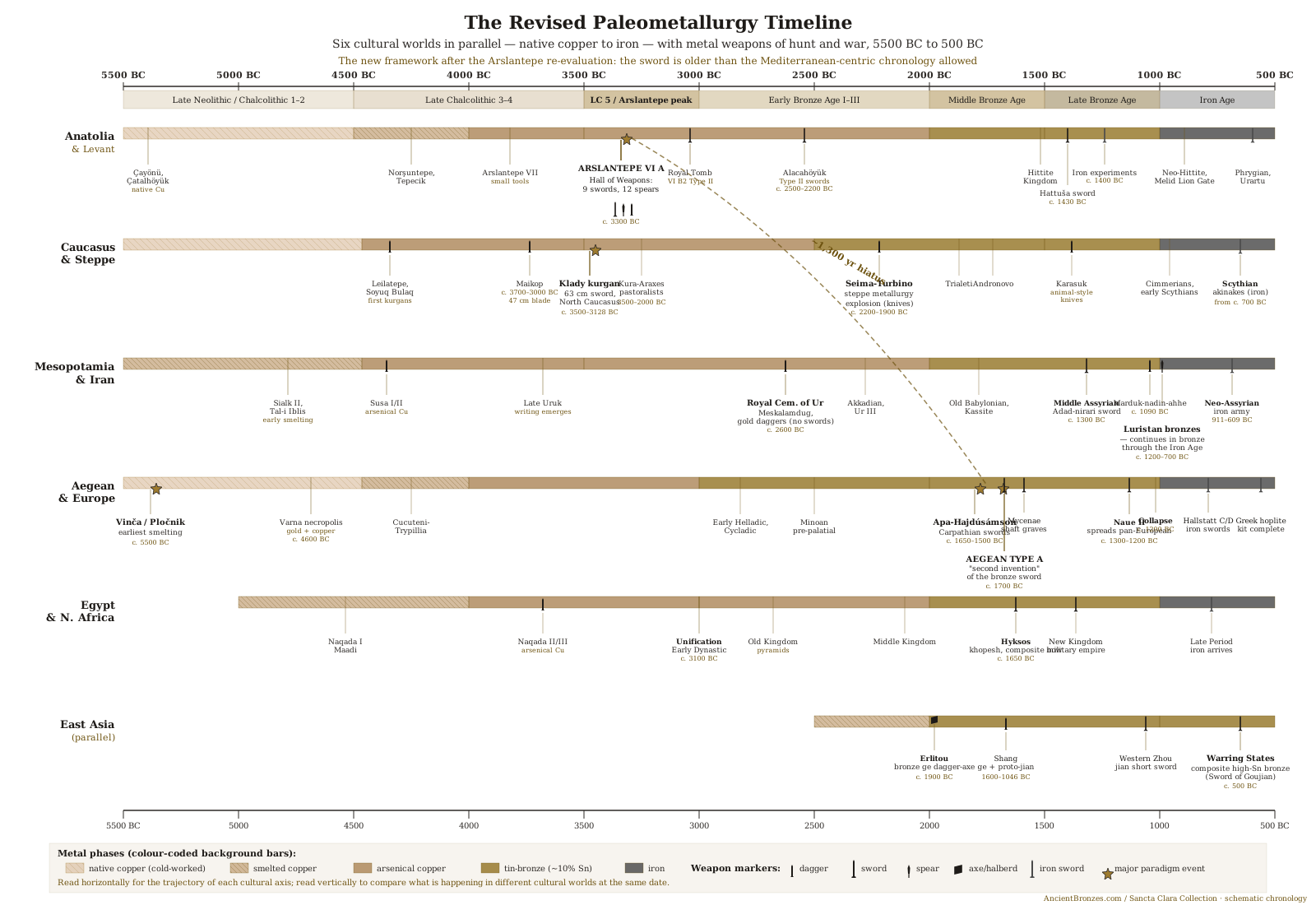
From native copper hammered cold in a Neolithic village to iron-bladed cavalry sabres on the steppe — a multi-cultural rebuild of the timeline I had been working with before Arslantepe.
After the Arslantepe research I cannot go back to teaching the developmental sequence the way I used to. The standard timeline — Neolithic copper to Chalcolithic daggers to Early Bronze Age experiments to Middle Bronze Age swords to Late Bronze Age full repertoire to Iron Age replacement — is roughly the right shape, but it is wrong about the slope, wrong about the regions, and very wrong about how technology survives or fails to survive across political collapses. The Arslantepe corpus alone pushes the first true swords back thirteen hundred years from where the Aegean-centred consensus had them. The Klady kurgan blade pushes the regional spread of long-blade production further north and earlier. The Iranian, Caucasian, and steppe traditions show that the Mediterranean was not the centre of the story. And the Old Copper Complex shows that one of the most prolific metalworking traditions in the world never developed weapons of war at all.
This article is my attempt to rebuild the timeline. It runs from roughly 7500 BC, when communities in the Anatolian and Iranian highlands began hammering cold native copper into awls and beads, through to roughly 500 BC, by which time iron has displaced bronze for cutting weapons across most of the Old World. I have organised it as a multi-axis chronology — six regional traditions running in parallel — because the Mediterranean-centric “first this happened, then that happened” sequence simply does not represent what the evidence shows. Several traditions invent the same thing independently. Some traditions never invent it at all. Some traditions invent it, lose it, and reinvent it. The timeline I had been using glossed over all of this. The new one tries to honour it.
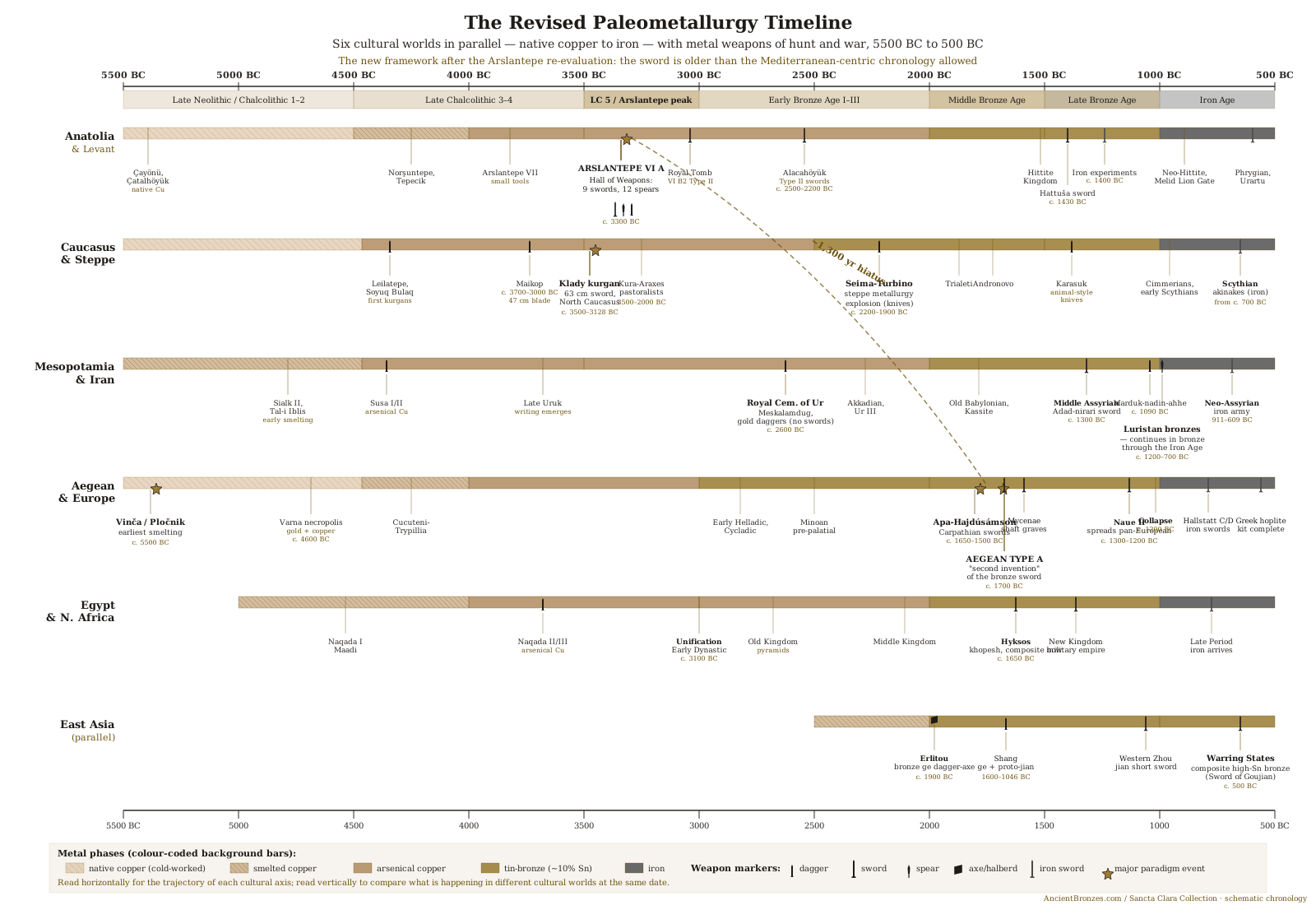
Reading This Timeline
A few principles to navigate by, before we start.
Six cultural axes run in parallel. Anatolia and the Levant. The Caucasus and the Eurasian steppe. Mesopotamia and Iran. The Aegean and Europe. Egypt and North Africa. East Asia. Some of these axes are tightly linked through trade and population movement (Anatolia–Mesopotamia, Aegean–Anatolia, Egypt–Levant, steppe–Caucasus). Others are essentially independent for long periods (East Asia, and the Old Copper Complex of North America that I will mention only to mark its absence from the weapons story). The same metallurgical step is often taken at different times in different places. The “first” of any technology that I cite below is “first within the cultural axis I am discussing, on current evidence” — not a global first unless I specifically say so.
Five metals, in rough order of mastery. Native copper, hammered cold, requires no fire technology — it is just a peculiar kind of stone-shaping. Smelted copper, reduced from ore by controlled heating, is the genuine metallurgical revolution. Arsenical copper, with two to six per cent arsenic, is harder and casts better — the workhorse alloy of the fourth and third millennia BC. Tin-bronze, around ten per cent tin, is mechanically superior to arsenical copper and not toxic to make, but tin is a scarce metal that has to be traded long distances; tin-bronze becomes dominant in the second millennium BC. Iron, the last and most demanding of the metals on this list, requires reduction temperatures and processing techniques that nobody fully masters until the late second millennium BC, but which then displace bronze for cutting weapons almost everywhere within five hundred years.
Survival bias runs through everything. Bronze and arsenical copper recycle excellently. Iron rusts away. Wood, leather, sinew, and bone — the materials that completed any metal weapon as a functional object — almost never survive at all. What we have is a tiny preserved fraction of what was made, and the preserved fraction is biased toward objects that were buried in graves, sealed in destruction layers, or dropped in waterlogged contexts where they could not be recycled. The further back we look, the smaller the fraction. Most of what I will tell you below is inference from a sample that may not be representative. Where I think the sample is misleading, I will say so.
The two inventions of the sword. The single most disorienting pattern in this timeline, and the one the Arslantepe research forced me to confront, is that the long bronze sword was invented at least twice — once in the late fourth millennium BC at Arslantepe and (probably) at workshops in the Caucasian-Pontic ore zone that we have not yet excavated, and again a millennium later in the Aegean and Carpathian palatial economies of around 1700 BC. The Mediterranean-centric standard timeline tells only the second story. The new timeline has to tell both.
With those principles in mind, here is the sequence.
Phase 1 — Native Copper, c. 7500–5500 BC
The first metal humans worked was native copper — pure copper nuggets found weathering out of ore deposits, picked up by Neolithic communities, and hammered cold into shape. This is not yet metallurgy in the strict sense. There is no fire involved beyond ordinary annealing fires. There is no chemical transformation of an ore into a metal. It is closer to stone-shaping than to anything we would recognise as a forge tradition. But it is the first step.
The earliest documented native-copper working comes from the Anatolian and Iranian highlands. At Çayönü Tepesi in southeastern Anatolia, in levels dated to roughly 7200 to 6000 BC, archaeologists have recovered cold-hammered copper awls, pins, beads, and small hooks. At Çatalhöyük, the great Neolithic site on the Konya plain, copper beads appear in burials from about 6500 BC onward; one published example contains traces consistent with very low-temperature heat treatment, hinting that fire was being used to anneal the metal between hammering passes, though the consensus remains that this is still pre-smelting native copper work. At Aşıklı Höyük, slightly older still, native copper objects appear in domestic contexts.
A parallel native-copper tradition appears in the Iranian Zagros at sites like Ali Kosh and Tepe Sialk from around 7000 BC, and in the southern Levant at Yiftah’el somewhat later. In all of these contexts the repertoire is identical and modest: awls, pins, beads, hooks, occasional small tools. Nothing weapon-like. Nothing bigger than what your thumb can pinch.
The most prolific native-copper tradition anywhere in the world develops independently across the Atlantic, in the Great Lakes region of North America. The Old Copper Complex runs from roughly 6500 BC to 1500 BC, with peak production from about 4500 to 3000 BC. Old Copper smiths produced an extraordinary range of objects — projectile points, knives, awls, harpoons, fish hooks, gouges, gorgets, ornaments — using cold hammering and selective annealing of pure native copper from the Lake Superior deposits. The Milwaukee Public Museum holds the largest curated collection in the world, around 1,500 objects, and its published maxima are: knives between 4 and 32 cm; tanged or socketed spear points to about 25 cm; awls to 40 cm; and at the very longest, double-pointed pikes up to 75 cm, though these last are unedged piercing tools rather than bladed weapons. No sword form is present. The longest edged blade in the corpus is a 32 cm knife.
The Old Copper Complex is important to mention here because it shows the technological ceiling of cold-worked native copper. Even with two and a half millennia of unbroken practice, the limits of the technique cannot be pushed past about thirty centimetres of edged blade. Cold-worked unalloyed copper work-hardens and cracks under further deformation. The metal itself imposes a ceiling that no amount of smith skill can break. Whatever was going to come next — long swords, large axes, full battle equipment — required a different metal, not just more skill with the existing one.
This is the threshold that the smelting revolution will cross.
Phase 2 — Smelting and Casting, c. 5500–4500 BC
The genuine metallurgical revolution begins when communities work out how to reduce copper ore — malachite, azurite, chalcopyrite — into metallic copper using controlled fire. This is a non-trivial chemical operation. It requires reduction temperatures around 1100 °C, controlled airflow to maintain reducing conditions, a knowledge of which rocks are ores and which are not, and the willingness to subject those rocks to an aggressive multi-stage process whose intermediate stages look like nothing but waste.
The earliest clear evidence of copper smelting comes from two regions, more or less simultaneously.
In the Balkans, the Vinča culture (5700–4500 BC) operates copper mines at Rudna Glava and Aibunar, where shafts up to twenty metres deep follow malachite veins underground. At Pločnik, a Vinča-era settlement in central Serbia, archaeologists have recovered a copper smelting site dated to about 5500 BC — the earliest in Europe and possibly the earliest anywhere. The Vinča copper objects are small: chisels, awls, simple axes. But the technology base is there, and it will spread outward across the Balkans and into central Europe over the next millennium. The famous Varna necropolis in Bulgaria (4600–4200 BC), with its gold-and-copper grave goods accumulating fabulous personal wealth around the bodies of elite men, marks the moment when this Balkan metallurgical tradition first produces objects of significant display value, even if the weapon types remain limited.
In Iran, the Sialk II and Susa I horizons produce smelted copper from roughly the same period. Tal-i Iblis in southeastern Iran has yielded crucibles and slag dated to about 4900 BC, putting the Iranian highlands on the same chronological footing as the Balkans for early smelting. The Iranian tradition is more closely tied to the Mesopotamian alluvium than the Balkan tradition is to its peripheries, and it will feed directly into the Late Uruk-period metallurgy of southern Mesopotamia.
In Anatolia, Çatalhöyük continues, and at sites like Norşuntepe and Tepecik in the Keban region the smelting tradition emerges around the same time. The Anatolian highland zone, with its rich polymetallic ore deposits, will become the metallurgical heartland of the fourth millennium.
In Egypt, copper objects appear from about 5000 BC in Predynastic contexts, mostly small tools and adornments. The Egyptian tradition is at this stage modest by comparison with Mesopotamia and Anatolia. It will grow rapidly through the fourth millennium as state formation accelerates along the Nile.
Across this entire phase the repertoire remains small. Axes, adzes, chisels, awls, pins, ornaments, occasional knives and short daggers. No swords. No long blades. The smelters have the metal but not yet the alloying chemistry, the casting precision, or — possibly more importantly — the social organisation that requires and supports large weapons.
Phase 3 — Arsenical Copper, c. 4500–3500 BC
The transition from pure copper to arsenical copper is the first deliberate alloying step in human history. Arsenic at two to six per cent dissolved in copper makes the metal harder, gives it better casting properties, and dramatically improves its work-hardening response. The cold-hammered edge of arsenical copper can reach Vickers hardness around 120 to 180 HV — fully competitive with the later tin-bronzes. And the arsenical alloy can be deformed severely without intermediate annealing, which is the property that makes long thin blades mechanically possible.
The chemistry was probably stumbled into rather than designed. Many copper ores naturally contain arsenic minerals; smelters who selected ores rich in arsenic-bearing minerals (or who deliberately added such minerals to the smelt) would have observed that the resulting metal was harder and worked better. By around 4500 BC the practice is established at several centres independently.
Susa I and II in Iran show systematic arsenical copper production from c. 4500 BC; the corpus is small tools and ornaments, plus the occasional flat axe or dagger blade. Tepe Hissar and Tepe Yahya in Iran follow. The Iranian arsenical-copper tradition feeds the Mesopotamian alluvium, where the Late Ubaid and Late Uruk periods see increasing volumes of arsenical copper in elite contexts but still no weapon forms larger than short daggers.
In Anatolia, the Arslantepe Period VII levels (3900–3400 BC) document the earliest metal at the site that would, a few centuries later, produce the Hall of Weapons cache. Twenty-two metal artefacts have been published from Period VII — small awls, pins, chisels, lead and silver fragments, in arsenical copper and arsenic-nickel copper. The metallurgical chemistry of the Arslantepe weapons is already established here. The typological vocabulary is not.
In the Caucasus, the Leilatepe culture (4350–3700 BC) in western Azerbaijan is the closest thing to a precursor milieu for the long-blade tradition. Andrey Courcier and colleagues have documented arsenical copper daggers, a developed silver-and-gold tradition, and casting moulds. The Boyuk-Kesik dagger is published with a composition of 2.4 per cent As and 88 per cent Cu. The Soyuq Bulaq kurgan cemetery in western Azerbaijan — the oldest known Transcaucasian kurgan tradition, excavated by a French-Azerbaijani team from 2006 onward — yields arsenical-copper daggers, awls, rings, and auriferous-silver alloys.
The Maikop culture of the North Caucasus (3700–3000 BC) is the most spectacular fourth-millennium metallurgical complex outside Arslantepe. The Maikop kurgan itself contained an arsenical-bronze toolkit: adze, axe-adze, two flat axes, two gouges, a small and a large dagger, a shaft-hole axe. The famous Maikop blade, 47 cm long, with silver rivets and sharp edges, is on the cusp of sword length but not quite there. Maikop metalwork shows technical mastery of casting, hammering, riveting, silver-on-copper inlay, and the gold-and-silver decoration that becomes characteristic of Caucasian elite burials. The kurgan structure itself — a chambered tumulus marking elite burial — will spread eastward across the steppe and become one of the durable forms of Eurasian elite memorialisation through to the Scythian period two thousand years later.
In Egypt, the Naqada II period (3500–3200 BC) sees arsenical copper begin to appear in elite contexts. Egyptian metallurgy of the Predynastic operates at a smaller scale than Anatolian or Iranian, and the typology remains daggers, axes, ornaments — no long blades. The Egyptian production will accelerate sharply with the unification of the country around 3100 BC.
Across this phase the dagger becomes a recognised elite weapon form. No swords are made anywhere on the current published evidence. The largest blades — Maikop’s 47 cm, individual Susa specimens — sit at the dagger-to-sword threshold without crossing it.
Phase 4 — The Arslantepe Anomaly, c. 3300–2900 BC
And then, around 3300 BC, at Arslantepe in eastern Anatolia, the threshold is crossed. The full case is set out in my recent article on this site, so I will be brief here.
The Hall of Weapons cache in Room A113 of the Period VI A palace contains nine integral-cast arsenical-copper swords (average length 50 cm, longest 62 cm), twelve cast arsenical-copper spearheads with engineering-optimised hafting features (elongated tang necks, stop ridges between neck and tang, square-section tangs for rotation resistance, multiangled points), two daggers including one of a copper-silver alloy that represents the earliest known intentional metal alloying in Anatolia, and a quadruple-spiral plaque. The cache was hung in two bundles on the wall of the chamber when the palace burned around 3100 BC, sealing the assemblage under collapsed mudbrick where it remained until the 1980s. Three of the nine swords carry silver inlay — chevron and triangle patterns chased into recessed channels in the cast hilt.
A century or so later, in the Period VI B2 Royal Tomb cut into the wall of the abandoned monumental Building 36, the elite of a different cultural regime — partly continuous with the prior population, partly Caucasian-oriented — deposit two more swords of a composite-hilt Type II form, two daggers including a remarkable copper-silver alloy specimen, nine spearheads including one with silver triangular inlay, a copper-silver diadem with Transcaucasian parallels, gold and carnelian beads, and the bodies of four sacrificed adolescents on the limestone covering slabs.
In the same horizon, in the North Caucasus, the Klady kurgan in the Novosvobodnaya group yields a 63 cm arsenical-copper sword, AMS-dated to 3500–3128 cal BC — a single object, in a kurgan burial, in a different cultural matrix from Arslantepe, but morphologically and chronologically comparable. At Tülintepe in the Keban region, further antecedents of the Type II long sword are documented in the late fourth millennium.
This is the moment when the timeline I had been working with broke. The Arslantepe-Klady-Tülintepe horizon produces full sword-scale weapons in series production a clean thirteen hundred years before the Aegean Type A rapiers that the conventional Mediterranean-centric chronology had identified as the “first” swords. Two parallel composite-hilt sword traditions are visible: one (the Royal Tomb Type II form) continues forward in time and is the ancestor of the Anatolian-Caucasian sword tradition that runs through to Luristan; the other (the Hall of Weapons integral-cast form, with its splayed-blade-at-guard morphology) has no surviving descendants and was, in its skeuomorphic features, imitating an even earlier multi-piece composite tradition we have not yet located.
The implication is profound. The sword is not a Middle Bronze Age invention. It is a Late Chalcolithic invention, in arsenical copper, at the high end of the polymetallic ore-procurement network of the Anatolian-Caucasian highland zone. The Mediterranean palatial economies will reinvent it independently a millennium later, in tin-bronze, in completely different cultural contexts. The Arslantepe corpus is the first invention.
This phase ends with the collapse of the Period VI A palatial system around 3100 BC and the subsequent Period VI B1 occupation by Kura-Araxes pastoralist communities who build wattle-and-daub huts on the ruins of the palace. The sword vanishes from the archaeological record of the Near East.
Phase 5 — The Bronze Age Begins, the Sword Vanishes, c. 3000–2000 BC
The third millennium BC is the period when tin-bronze — copper with around 10 per cent tin — becomes available and gradually displaces arsenical copper as the dominant alloy. The transition is not instantaneous and not uniform across regions, but by 2000 BC tin-bronze is the standard cutting-weapon material across Mesopotamia, Anatolia, the Aegean, Egypt, and the Iranian plateau.
Tin is the limiting reagent. Unlike copper and arsenic, which occur together in many of the same polymetallic deposits, tin is a much rarer metal that has to be procured from a small number of source regions. The principal third-millennium tin sources appear to be Anatolian (the Kestel mine in the Taurus, exploited from around 2500 BC, with associated tin-processing at Göltepe), Afghan (the Mushiston deposit), and possibly Iranian Plateau smaller sources. The Cornish, central Asian, and central European sources that would supply the Late Bronze Age are not yet integrated into eastern Mediterranean trade. Tin-bronze production is therefore patchy and dependent on long-distance trade in a way that arsenical copper had not been.
While tin-bronze is becoming established, the sword is gone. The bladed-weapon repertoire across the third-millennium Near East and Mediterranean is dominated by short daggers under twenty-five centimetres, axes (shaft-hole and socketed), and spearheads. There are some near-miss objects — the Royal Cemetery of Ur weapons of around 2600 BC include the gold-and-silver dagger of Meskalamdug, a 23 cm blade with electrum hilt and gold sheath, and similarly elaborate daggers from other royal burials. These are exquisite objects but they are daggers, not swords. Sumerian and Akkadian warfare was conducted with spears, axes, mass-archery, and the dagger as a personal sidearm. The sickle-sword that will become the iconic close-quarter Mesopotamian weapon does not appear until much later.
The conspicuous exception is Alacahöyük in central Anatolia, where the royal tombs (c. 2500–2200 BC) contain composite-hilted swords in the Type II tradition descending from the Arslantepe Royal Tomb form. The Alacahöyük weapons are the link in the chain that proves the Type II tradition did persist across the Arslantepe-collapse horizon, even though it disappears from view at the production-scale of the Hall of Weapons cache. The lineage continues — but in a quieter, more dispersed mode of production than what Arslantepe VI A had supported.
In the steppe and the eastern reaches of the metallurgical world, the Seima-Turbino phenomenon appears around 2200–1900 BC as one of the most remarkable bursts of metallurgical innovation anywhere. Sites from the Altai mountains to the Carpathians yield a distinctive metalwork tradition: socketed celts and spearheads, single-edged knives with cast figural pommels (the most famous being the Rostovka horse-and-skier knife), and a sophisticated casting tradition that includes joining separately cast components by molten-metal soldering. Seima-Turbino production reaches as far east as Panlongcheng on the middle Yangzi by around 1400 BC. But — and this is what places it in this phase rather than promoting it to “sword tradition” — the Seima-Turbino corpus is daggers and knives, not swords. The longest blades are under thirty centimetres. The technical mastery is there; the typology is not.
In Egypt, the Old Kingdom (2686–2181 BC) sees mature copper and arsenical-bronze metallurgy in service of monumental construction (copper chisels for limestone quarrying) and elite display, with daggers as the standard short-blade weapon. The First Intermediate Period and the Middle Kingdom (2055–1650 BC) follow.
In East Asia, the Erlitou culture (c. 1900–1500 BC) produces the first Chinese bronze artefacts at scale. The signature weapon form is the ge — a perpendicular-bladed dagger-axe mounted on a haft — which is functionally closer to a halberd than to a sword. The Erlitou tradition will continue and elaborate through the Shang dynasty. Chinese bronze metallurgy develops on a distinct trajectory from the West, with its own typological vocabulary and its own technical solutions.
By the end of this phase the Old World has tin-bronze, has functional state economies, has dagger-and-spear warfare at scale, has some persistent local Type II long-sword production at sites like Alacahöyük — but does not yet have the long sword in production at anything like the Arslantepe scale, anywhere. The first sword has been forgotten. The second invention is coming.
Phase 6 — The Sword Reinvented, c. 2000–1500 BC
The Middle Bronze Age sees the long bronze sword re-emerge in the Mediterranean and Carpathian palatial worlds. The form is different from the Arslantepe corpus — these are composite-hilt swords with organic grips clamped to a flat tang or set between flanges, made of tin-bronze with refined casting and edge-hardening. But the function is the same, and the social context that produces them is structurally similar to the Arslantepe palace: centralised redistributive economies with elite patronage, full-time specialist smiths, and long-distance metal-trade infrastructure.
The Aegean Type A rapier appears around 1700–1600 BC in Mycenaean shaft-grave contexts at Mycenae itself and at Mallia and Arkalochori on Crete. These are slender thrusting blades up to a metre in length, with rounded shoulders, strong central midribs, and flat tangs sheathed in organic grips often capped with gold or ivory pommels. Nancy Sandars’ 1961 and 1963 typology of the Aegean swords runs from Type A through Type H, tracking the evolution from the long thrust-rapier to the stouter cut-and-thrust forms of the late second millennium.
The Apa and Hajdúsámson hoards in the Carpathian Basin, deposited around 1650–1500 BC, contain the first European elite full-hilted swords. Apa yielded two swords with engraved bronze hilts, three axes, and a great spiral arm-ring. Hajdúsámson contained a sword and twelve battle-axes. The hilts are full bronze cast directly over the blade tang in a second pour — the technique called overlay casting. The decoration is elaborate spiral and arc engraving, of a kind that will spread northward into the Nordic Bronze Age over the next centuries.
In Egypt, the Hyksos invasion of the Nile Delta in the Second Intermediate Period (around 1650–1550 BC) brings in two transformative weapons: the composite bow and the khopesh, the iconic curved sickle-sword. The khopesh, derived from the crescent battle-axe lineage, becomes the standard Egyptian elite close-quarter weapon through the New Kingdom. Standard length 50–60 cm. Two examples were found in Tutankhamun’s tomb; Ramses II’s khopesh is in the Louvre. The Hyksos-period warrior burial at Tell el-Dab’a (Avaris) yielded what Manfred Bietak described as “a well-preserved copper sword (the earliest of its type found in Egypt) and dagger” — the moment Egyptian metallurgy crosses, under Levantine influence, into something approaching sword length.
In the Levant, the Tell el-Dab’a finds and broader Hyksos-period material show the same shift toward longer blades and the import of Aegean and Anatolian forms. Graham Philip’s 2006 catalogue of the Tell el-Dab’a metalwork documents the full range of the Second Intermediate Period weapon kit.
In the Anatolian core, the Hittites are emerging as a polity from around 1700 BC onward. The Hittite weapon repertoire of the Old Kingdom remains short-bladed for the most part, but Hittite metallurgy is by now in active contact with both Mycenaean and Mesopotamian traditions, and the famous Hattuša sword of Tudhaliya I/II (c. 1430 BC) — Mycenaean Type B in form, Hittite in function, with an Akkadian-language inscription — sits at this trilingual junction.
In Mesopotamia, the Old Babylonian period (1894–1595 BC) produces little in the way of long-blade weapons; the regional taste runs to short daggers, axes, and the sickle-sword tradition that will produce the inscribed Adad-nirari I weapon two centuries later. The famous Marduk-nadin-ahhe inscribed daggers of around 1090 BC belong in this same broad tradition — short rapier-daggers of about 35-40 cm, carrying royal cuneiform inscriptions on the blade.
In China, the Shang dynasty (1600–1046 BC) begins producing bronze in unprecedented volume and quality. The signature weapon remains the ge dagger-axe, joined now by dao straight knives and short proto-jian double-edged swords up to 50 cm. Shang bronze technology is by this point fully comparable to Mediterranean tin-bronze in alloy control and casting precision, but the typology is distinct. Some Shang dao show ibex- or ram-head pommels that hint at Seima-Turbino-style influence transmitted across the steppe.
By the end of this phase the long sword has fully re-emerged across the Mediterranean and adjoining zones — in tin-bronze, in composite-hilted construction, in the hands of palace-trained warriors of literate kingdoms. The interval between the Arslantepe corpus and this re-emergence is approximately thirteen hundred years. That gap is one of the hardest things in this whole timeline to make sense of. It is the strongest evidence for survival bias, for the contingency of technological persistence on political infrastructure, and for the fundamental observation that the bronze sword can be invented from scratch when a society needs it.
Phase 7 — Late Bronze Age Internationalism, c. 1500–1200 BC
The Late Bronze Age is the period of internationalism — the great palace civilisations of the Eastern Mediterranean (Mycenaean, Minoan, Hittite, Egyptian, Mitanni, Kassite Babylonia, Ugarit) operate as a single interconnected diplomatic and economic system, exchanging metals, finished goods, royal letters in Akkadian, and elite weapons across distances of thousands of kilometres.
The dominant sword type of this phase is the Naue II, also known as the Griffzungenschwert (“grip-tongue sword”) for its diagnostic flanged-tang hilt construction. Naue II emerges in northern Italy and the wider Urnfield cultural area around 1300 BC and proceeds over the next century and a half to colonise the entire bronze-using world from the Atlantic façade to Ugarit on the Syrian coast. The flanged-tang construction is a major engineering advance over the older flat-tang riveted-grip designs: the raised flanges along the tang absorb lateral shock at the hilt junction, allowing full-force slashing without fear of the grip working loose. Naue II blades run 50–85 cm with a typical cluster around 60–70 cm, and the form persists with only minor modifications for nearly seven hundred years.
In the Aegean, the Mycenaean palatial economy reaches its peak in this phase. The shaft-grave swords from Mycenae (the famous Lion Hunt dagger with niello inlay, the gold-hilted thrusting rapiers) are joined by the Sandars Type C “horned swords” (c. 1450–1300 BC), Type E T-pommelled short swords, and Type F angular-shouldered cut-and-thrust forms. The Mycenae shaft grave IV lion-hunt dagger (c. 1550–1500 BC, blade 23.7 cm, niello inlay) is the iconic Mycenaean prestige weapon — gold and silver figurative inlay against a niello-black background, showing hunters with shields and spears engaging lions. The technique is at the apex of Bronze Age decorative metalwork.
In the Hittite Empire, this is the period of the great kings — Suppiluliuma I, Muwatalli II, Tudhaliya IV. The Hittite military relies heavily on the chariot arm and the spear-and-shield infantry, but the Hittite kings begin to experiment with iron in this phase. The famous letter of Hattusili III to an unnamed Assyrian king mentions iron and notes that “good iron is not available in my seal-house in Kizzuwatna” — implying that iron is a known and prized material but not yet produced in routine quantities. The Hittites are widely (though not universally) credited with the first systematic smelting of iron from ore in this period. Iron weapons of the Hittite era are rare and ceremonial; iron does not yet displace bronze for routine cutting weapons.
In Mesopotamia and Assyria, the Middle Assyrian period (c. 1365–1050 BC) sees the consolidation of the Assyrian military state. The famous Adad-nirari I sickle sword (c. 1307–1275 BC, 54.3 cm long, in the Metropolitan Museum, gift of J.P. Morgan 1911) is inscribed along its non-cutting edge with the king’s titulary and depicts antelopes flanking the inscription. The sickle-sword tradition continues from earlier Mesopotamian roots and is now an instrument of imperial royalty as much as of battlefield combat.
In Egypt, the New Kingdom (1550–1077 BC) sees a fully developed military bureaucracy and standardised weapon repertoire. The khopesh remains the standard elite close-quarter weapon; bronze axes, daggers, and arrowheads are mass-produced in royal workshops. Tutankhamun’s tomb (1323 BC) preserved a particularly complete elite weapon kit, including two khopesh-style swords, multiple bronze and gold daggers, the famous iron-bladed dagger with gold hilt (probably meteoric iron, exceptional and ceremonial), and a complete bronze archery kit.
In China, the Western Zhou (1046–771 BC) succeeds the Shang. The jian straight short sword (typically 30–50 cm) is fully established as the elite close-quarter weapon. Chinese tin-bronze metallurgy at this stage is fully comparable in quality to Mediterranean traditions, with the additional development of piece-mould casting of large vessels that has no Western parallel.
This phase ends around 1200 BC with the Late Bronze Age Collapse — a multi-causal disaster involving climate stress, agricultural failure, the movement of the so-called “Sea Peoples,” and the failure of multiple major palatial states within a few decades of one another. Mycenae burns. Ugarit burns. Hattuša is abandoned. The internationalist palace system falls apart. The next phase will look very different.
Phase 8 — Bronze-to-Iron Transition, c. 1200–800 BC
The Iron Age does not begin with a single technological breakthrough. It begins with the collapse of the bronze-dependent palace economies, the disruption of the long-distance tin-trade networks they depended on, and the gradual emergence of iron as a more locally producible alternative. Iron ores are far more widely distributed than tin ores. A regional polity that cannot easily access tin-bronze can produce iron from local sources. The iron transition is therefore as much about the failure of bronze logistics as it is about the success of iron metallurgy.
In Anatolia and the Levant, iron production becomes routine through the twelfth and eleventh centuries BC. The Neo-Hittite kingdoms of the early Iron Age — including Melid at Arslantepe, Carchemish, Hamath, Sam’al — combine bronze and iron in their weapon repertoires. The famous Lion Gate at Arslantepe-Melid is set up in this period, c. 1100–700 BC, marking the visible Neo-Hittite re-occupation of the same mound that had produced the Hall of Weapons fifteen centuries earlier.
In the Aegean and Greek world, the so-called “Dark Ages” follow the Mycenaean collapse. The Submycenaean and Protogeometric periods (c. 1100–900 BC) see iron come into routine use for cutting weapons. By the Geometric period (c. 900–700 BC), iron has displaced bronze for sword blades across the Greek world. The classic Greek hoplite kit of the seventh century onward — bronze helmet, bronze cuirass, iron-bladed spear and short sword — represents the mature Iron Age weapon repertoire.
In Mesopotamia and Iran, the Neo-Assyrian empire (911–609 BC) becomes the first great Iron Age military power, equipped with mass-produced iron weapons and a professional standing army organised around iron-armed infantry, cavalry, and siege engineering. Assyrian reliefs at Nimrud and Nineveh show troops in iron mail and iron-bladed weapons; the destruction of Lachish in 701 BC, depicted in detail on the famous Sennacherib reliefs, is the iconic Iron Age siege.
In Iran, the Luristan bronze tradition of the Zagros highlands flourishes through this phase — bronze production at workshop scale, producing the extraordinary swords, daggers, spearheads, horse-bits, and ritual objects that have made the Luristan corpus a collecting field since the nineteenth century. Sancta Clara Lot 44398282, the Luristan spearhead I have discussed in the preceding article, sits in this tradition. Critically, Luristan is producing in bronze during the Iron Age — the Zagros highland economy remains tied to its bronze-working traditions even as the Mesopotamian alluvium transitions to iron. This is one of the more remarkable persistence patterns in the whole timeline.
In Europe, the Urnfield culture continues through the early Iron Age before giving way to Hallstatt C (c. 800–650 BC), the first proper Iron Age culture in central Europe. Hallstatt C swords are the Mindelheim type — found in both bronze and iron variants, sometimes side by side in the same princely burial. The transition is visible in the same grave assemblages. Within a generation or two, iron dominates.
In the steppe, the Cimmerians and emerging Scythians adopt iron weapons through the ninth and eighth centuries BC. The iconic Scythian akinakes — a short stabbing sword 30–50 cm long with a heart-shaped or T-shaped guard, in iron — appears around 700 BC and becomes the standard cavalry close-quarter weapon of the Eurasian steppe through to the Sarmatian period.
In China, the bronze tradition continues at unmatched scale through this phase. The Spring and Autumn period (770–476 BC) sees a flourishing of jian sword production, with composite high-tin bronze construction emerging: softer low-tin cores welded or cast onto harder high-tin edges, an elegant metallurgical solution to the brittleness problem of high-tin alloys. Iron is also present in China from this period onward but bronze remains dominant for prestige weapons.
In Egypt, the Third Intermediate Period (1077–664 BC) and the Late Period (664–332 BC) see iron weapons gradually displace bronze, though Egyptian iron metallurgy lags somewhat behind the Levantine and Anatolian centres. The famous iron blades from Tutankhamun’s tomb, including the gold-hilted dagger, are now understood to be meteoric iron — a special and exotic material in 1323 BC, not yet a commodity.
Phase 9 — Iron Age Maturity, c. 800–500 BC
By the close of this timeline, iron is the dominant material for cutting weapons across the Old World, with the principal exceptions being the Luristan bronze workshops of the Zagros (continuing into the seventh century) and the Chinese bronze tradition (continuing in parallel with iron through to the Han dynasty). The bronze sword — invented twice, lost once, persistent for over two and a half millennia — has reached the end of its history as the primary military weapon.
The Hallstatt D culture (c. 650–450 BC) in central Europe produces the great Iron Age princely burials, with iron swords, gold ornaments, and four-wheeled wagons. The La Tène culture (c. 450 BC onward) succeeds Hallstatt and produces the long iron swords of the Celts. By 300 BC these will be turning up across Europe as far west as Spain and as far east as the Carpathians.
The Greek hoplite kit, with its iron-bladed spear (dory) and short iron sword (xiphos or curved kopis), has reached its mature form by 600 BC. The classical world is now equipped in iron.
In the Persian Empire, founded by Cyrus around 550 BC, the standard weapon kit combines Median, Iranian, Mesopotamian, and Anatolian elements: iron akinakes short swords, iron-headed spears, composite recurve bows. The Persian army is the first proper imperial military force of the iron-using world.
In China, the Warring States period (475–221 BC) produces the iconic high-tin bronze composite-construction swords — the Sword of Goujian (c. 500 BC, 55.6 cm), with its low-tin core and high-tin edges, is the masterpiece example. These are arguably the most technically sophisticated bronze weapons ever made. Iron is increasingly present, and by the early Han dynasty (200 BC onward) will be standard, but the bronze tradition does not surrender easily.
In the steppe, the Scythians dominate from the Carpathians to the Altai through the seventh through third centuries BC. Their iron akinakes, iron arrowheads, and bronze cauldrons mark the mature steppe Iron Age. The Saka, Sarmatians, and Massagetae continue the same general tradition further east.
The bronze sword as a military reality is over. As a prestige and antiquarian object it will continue to be made for ceremonial use in some peripheries, but the iron blade is now everywhere the working weapon of war.
What the New Timeline Tells Us
A few things to take away from the rebuilding.
First — and this is the headline — the sword is older than the conventional timeline allowed. It was invented at Arslantepe around 3300 BC, in arsenical copper, under palatial patronage, with full engineering sophistication. The “first” Aegean and Carpathian swords of 1700 BC are not first; they are the second invention, in a different cultural matrix, in tin-bronze, after a thirteen-hundred-year interval. Any future synthesis of bronze weaponry has to start with this fact rather than burying it in a footnote.
Second, technology is contingent on social infrastructure. The Arslantepe corpus persisted as long as the Period VI A palace did. When the palace burned and the redistributive economy collapsed, the workshop tradition that supported it failed within a generation. The sword vanished because the social structure that required it had gone. The same pattern recurs at the end of the Late Bronze Age: when the Mycenaean and Hittite palatial systems collapse around 1200 BC, the sword does not vanish (because more dispersed production traditions sustain it), but the scale of production falls dramatically and the typological variety contracts to the Naue II form that can be made anywhere. Technology, in other words, is not a one-way ratchet. It depends on its patrons.
Third, multiple centres develop in parallel, and the Mediterranean is not central. The most spectacular fourth-millennium metallurgical complex anywhere is Arslantepe, in eastern Anatolia, at the hinge between the Caucasian and Mesopotamian ore zones. The most important third-millennium phenomenon (Seima-Turbino) is in the Eurasian steppe. The most spectacular Bronze Age sword-making horizon (Apa-Hajdúsámson) is in the Carpathian Basin. The Aegean is one important node in a much wider system, not the centre. Chinese bronze metallurgy operates on a parallel trajectory with only occasional contact with the Western tradition. The Mediterranean-centric narrative I had been working with — Aegean rapiers, Mycenaean shaft graves, then Naue II diffusion — is a small part of a much larger story.
Fourth, survival bias is severe. We have the Arslantepe corpus only because the palace burned and sealed it. We have the Klady sword only because it was deposited in a kurgan. We have the Mycenaean shaft-grave swords only because they were buried with elite warriors. We do not have the Late Chalcolithic Caucasian or Pontic workshop traditions that probably produced the prototypes the Arslantepe smiths were imitating, because those workshops were not preserved by any analogous accident. The further back we look, the smaller the surviving sample becomes, and the more confident we should be that what we have is not representative. Whole regional traditions — the upstream sources for Arslantepe, the workshop networks supplying the Maikop kurgan, the Iberian and Atlantic Late Bronze Age coast-trading communities — are barely visible in the published record and may never become fully visible.
Fifth, bronze and iron are not a simple succession. Iron displaces bronze for cutting weapons across most of the Old World between 1200 and 600 BC, but Luristan keeps making bronze weapons until the seventh century, China keeps making bronze weapons into the Han period, and the small-scale bronze tradition for prestige and ceremony continues even later. The “Bronze Age” and “Iron Age” labels are useful shorthand, but the transition is gradual, regionally variable, and never fully complete in some peripheries.
Sixth, the Americas show us what happens when the social conditions for sword production never emerge. The Old Copper Complex worked native copper at impressive scale for five thousand years and never produced a sword or a long blade of any kind. The technology ceiling was set by the choice not to smelt, alloy, and cast. That choice was, as Bebber and Eren have argued, almost certainly cultural rather than imposed by lack of opportunity — the same Lake Superior copper deposits would have supported smelting if the social pressure for it had existed. It did not. The bronze sword exists because some societies needed it badly enough to invest the social capital required. Where that pressure was absent, the metal stayed small.
The Arslantepe research that prompted me to rebuild this timeline has had effects far beyond the late fourth millennium. It has changed how I read every subsequent phase. The “rise” of the Aegean sword is no longer a rise from zero — it is a recovery, in a new medium, of something that had already existed and been forgotten. The Iron Age transition is no longer simply a technological succession — it is the failure of a specific bronze-economy political infrastructure to renew itself, and the success of a more locally producible alternative in the gap. The whole story has more contingency, more parallel innovation, more loss, and more re-invention than the linear narrative I had been working with allowed.
This is the timeline I will be using going forward. It is not the one I was taught. But it is, I think, much closer to what the evidence actually shows.
The Sancta Clara Collection holds artefacts spanning much of the chronology covered above — Luristan bronzes, Aegean and Mycenaean weapons, late Bronze Age and Iron Age material from across the Old World. The full catalogue, with images and provenance notes, is available elsewhere on AncientBronzes.com. Articles on specific traditions and individual key objects continue to appear regularly. Future planned articles include the Seima-Turbino phenomenon, the Caucasian metallurgical horizon (Leilatepe, Maikop, Klady), and the Hittite iron experiments.
Sources and Further Reading
General Surveys and Synthesis
- Yener, K.A. The Domestication of Metals: The Rise of Complex Metal Industries in Anatolia. Brill, 2000. The standard synthesis of early Anatolian metallurgy.
- Frangipane, M. “Different Trajectories in State Formation in Greater Mesopotamia: A View from Arslantepe (Turkey),” Journal of Archaeological Research 26/1 (2018): 3–63.
- Pernicka, E. “Provenance Determination of Archaeological Metal Objects,” in B.W. Roberts and C.P. Thornton, eds., Archaeometallurgy in Global Perspective (Springer, 2014).
- Roberts, B.W., and C.P. Thornton, eds. Archaeometallurgy in Global Perspective. Springer, 2014.
- Killick, D., and T. Fenn. “Archaeometallurgy: The Study of Preindustrial Mining and Metallurgy,” Annual Review of Anthropology 41 (2012): 559–575.
Native Copper and Early Smelting
- Bebber, M.R., and M.I. Eren. “Toward a functional understanding of the North American Old Copper Culture ‘technomic devolution’,” Journal of Archaeological Science 98 (2018): 34–44. The technological-ceiling argument for the Old Copper Complex.
- Ehrhardt, K.L. “Copper Working Technologies, Contexts of Use, and Social Complexity in the Eastern Woodlands of Native North America,” Journal of World Prehistory 22 (2009): 213–235.
- Maddin, R., T. Stech Wheeler, and J.D. Muhly. “Distinguishing Artifacts Made of Native Copper,” Journal of Archaeological Science 7 (1980): 211–225.
- Radivojević, M., and T. Rehren. “Tainted ores and the rise of tin bronzes in Eurasia, c. 6500 years ago,” Antiquity 87/338 (2013): 1030–1045.
- Roberts, B.W., C.P. Thornton, and V.C. Pigott. “Development of metallurgy in Eurasia,” Antiquity 83 (2009): 1012–1022.
Arsenical Copper Period (Caucasus, Anatolia, Iran)
- Courcier, A. “Ancient Metallurgy in the Caucasus from the Sixth to the Third Millennium BCE,” in Archaeometallurgy in Global Perspective (2014): 579–664.
- Hauptmann, A., S. Schmitt-Strecker, F. Begemann, and A. Palmieri. “Chemical composition and lead isotopy of metal objects from the ‘Royal’ tomb and other related finds at Arslantepe, Eastern Anatolia,” Paléorient 28/2 (2002): 43–69.
- Hauptmann, A., A. Heil, G.M. Di Nocera, and T. Stöllner. “Metallurgical processing of polymetallic ores at Arslantepe (Malatya, Turkey) in the late 4th and early 3rd Millennium BC,” Metalla 26.2 (2022): 53–112.
- Di Nocera, G.M. “Metals and Metallurgy. Their Place in the Arslantepe Society Between the End of the 4th and Beginning of the 3rd Millennium BC,” in M. Frangipane, ed., Economic Centralisation in Formative States (Sapienza, 2010): 255–274.
- Trifonov, V., et al. Work on Maikop chronology and the Klady kurgan, Antiquity and Russian Academy of Sciences publications.
- Rezepkin, A.D. Novosvobodnaya Culture (on the basis of materials of the Klady burial ground). St Petersburg, 2012.
Tin-Bronze and the Second Millennium
- Yener, K.A., et al. “Kestel: An Early Bronze Age source of tin ore in the Taurus Mountains, Turkey,” Science 244 (1989): 200–203.
- Berger, D., et al. “Identifying mixtures of metals by multi-isotope analysis: Disentangling the relationships of the Early Bronze Age swords of the Apa-Hajdúsámson type and associated objects,” Archaeometry 64 (2022).
- Sandars, N.K. “The First Aegean Swords and Their Ancestry,” American Journal of Archaeology 65 (1961): 17–29.
- Sandars, N.K. “Later Aegean Bronze Swords,” American Journal of Archaeology 67 (1963): 117–153.
- Kilian-Dirlmeier, I. Die Schwerter in Griechenland (außerhalb der Peloponnes), Bulgarien und Albanien. Prähistorische Bronzefunde IV/12. Stuttgart: Steiner, 1993.
- Dall’Armellina, V. “Power of Symbols or Symbols of Power? The ‘Long Sword’ in the Near East and the Aegean in the Second Millennium BC,” Ancient Near Eastern Studies 54 (2017): 143–182.
Seima-Turbino and the Steppe
- Marchenko, Z.V., et al. “Radiocarbon Chronology of Complexes With Seima-Turbino Type Objects (Bronze Age) in Southwestern Siberia,” Radiocarbon (2017).
- Chernykh, E.N. Ancient Metallurgy in the USSR: The Early Metal Age. Cambridge University Press, 1992. The foundational reference for Eurasian steppe metallurgy.
- Khayutina, M. “Bronze Weapons from Panlongcheng and the Seima-Turbino Cross-Cultural Phenomenon,” SSRN (2024).
Late Bronze Age and the Naue II
- Drews, R. The End of the Bronze Age: Changes in Warfare and the Catastrophe ca. 1200 B.C. Princeton University Press, 1993.
- Molloy, B. “Swords and Swordsmanship in the Aegean Bronze Age,” American Journal of Archaeology 114/3 (2010): 403–428.
- Bietak, M. Tell el-Dab’a V. Vienna: ÖAW, 1991, 1996.
- Philip, G. Tell el-Dab’a XV: Metalwork and Metalworking Evidence of the Late Middle Kingdom and Second Intermediate Period. Vienna, 2006.
Iron Age Transition
- Pleiner, R. Iron in Archaeology: The European Bloomery Smelters. Praha, 2000.
- Yalçın, Ü. “Early Iron Metallurgy in Anatolia,” Anatolian Studies 49 (1999): 177–187.
- Muhly, J.D. “How Iron Technology Changed the Ancient World,” Biblical Archaeologist 45 (1982): 40–54.
- Snodgrass, A.M. “Iron and Early Metallurgy in the Mediterranean,” in T.A. Wertime and J.D. Muhly, eds., The Coming of the Age of Iron (Yale UP, 1980).
Luristan and Iranian Late Bronze and Iron Age
- Moshtagh Khorasani, M. Arms and Armor from Iran: The Bronze Age to the End of the Qajar Period. Legat Verlag, Tübingen, 2006.
- Moshtagh Khorasani, M. “Bronze and Iron Weapons from Luristan,” Antiguo Oriente 7 (2009): 185–217.
- Negahban, E.O. Marlik: The Complete Excavation Report (2 vols). University of Pennsylvania Museum, 1996.
Chinese Bronze and Iron
- Chase, W.T. Ancient Chinese Bronze Art: Casting the Precious Sacral Vessel. China Institute Gallery, 1991.
- Bagley, R.W. Shang Ritual Bronzes in the Arthur M. Sackler Collections. Harvard University Press, 1987.
- Wagner, D.B. Iron and Steel in Ancient China. Brill, 1993.
Vinča, Varna, and the European Balkans
- Borić, D. “Absolute Dating of Metallurgical Innovations in the Vinča Culture of the Balkans,” in T.K. Kienlin, ed., Metals and Societies (2009).
- Slavchev, V. “The Varna Eneolithic Cemetery in the Context of the Late Copper Age in the East Balkans,” in D.W. Anthony, ed., The Lost World of Old Europe (Princeton UP, 2010): 192–210.
Article and timeline diagram © AncientBronzes.com / Sancta Clara Collection, 2026. Free to share with attribution; please do not republish in full without permission. The timeline as presented here reflects the author’s interpretive synthesis of the evidence, including the position — argued in detail in the preceding article on the Arslantepe corpus — that the Arslantepe weapon cache represents the first invention of the bronze sword, and that the Aegean Type A rapiers of 1700 BC are a second independent invention. These positions are supported by the published evidence but are not, taken together, the established consensus of the literature. For further references, queries, or to suggest corrections, please use the contact form.