
Document
Attachments

SCC-901-2
Metadata
Title
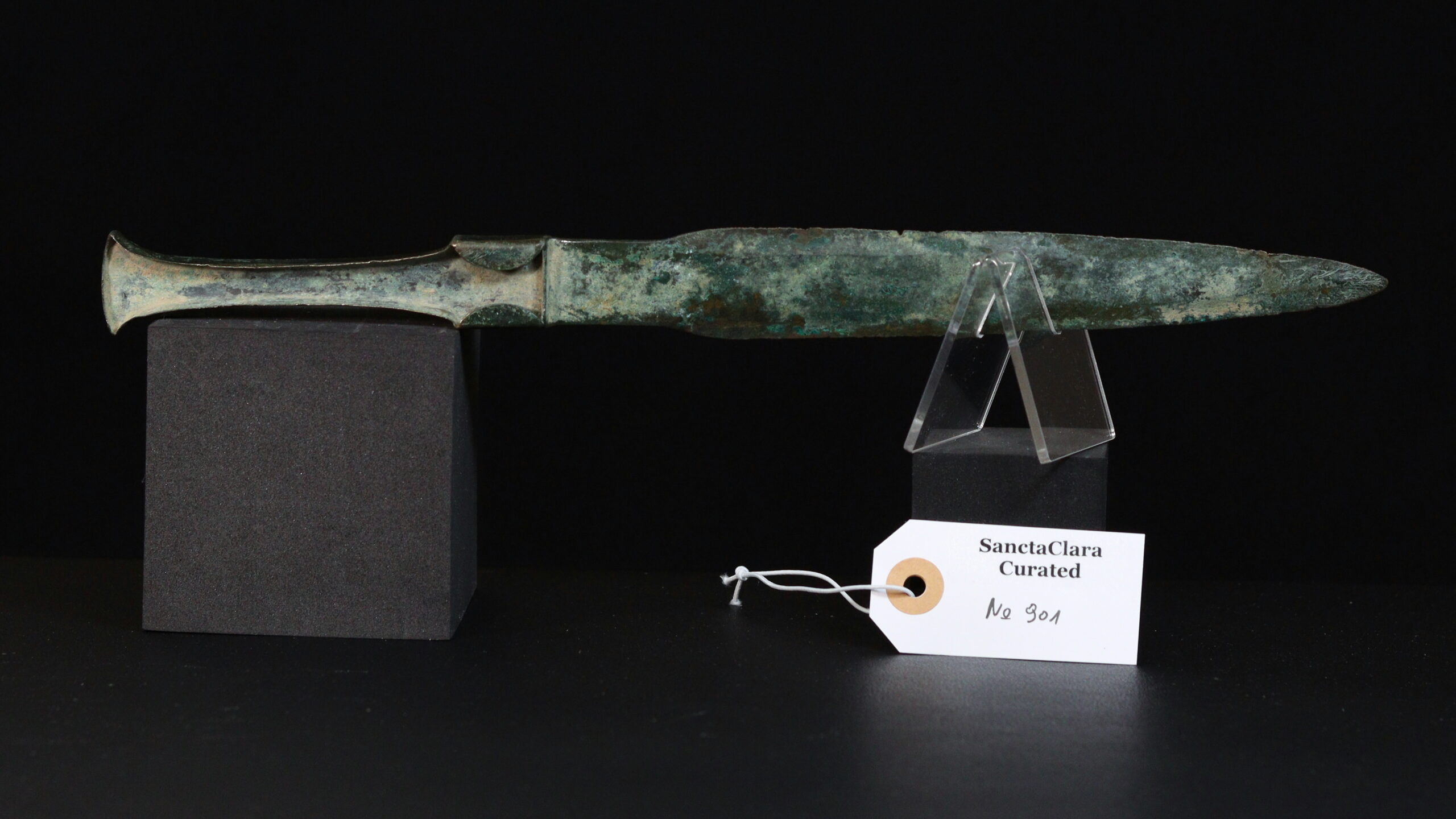
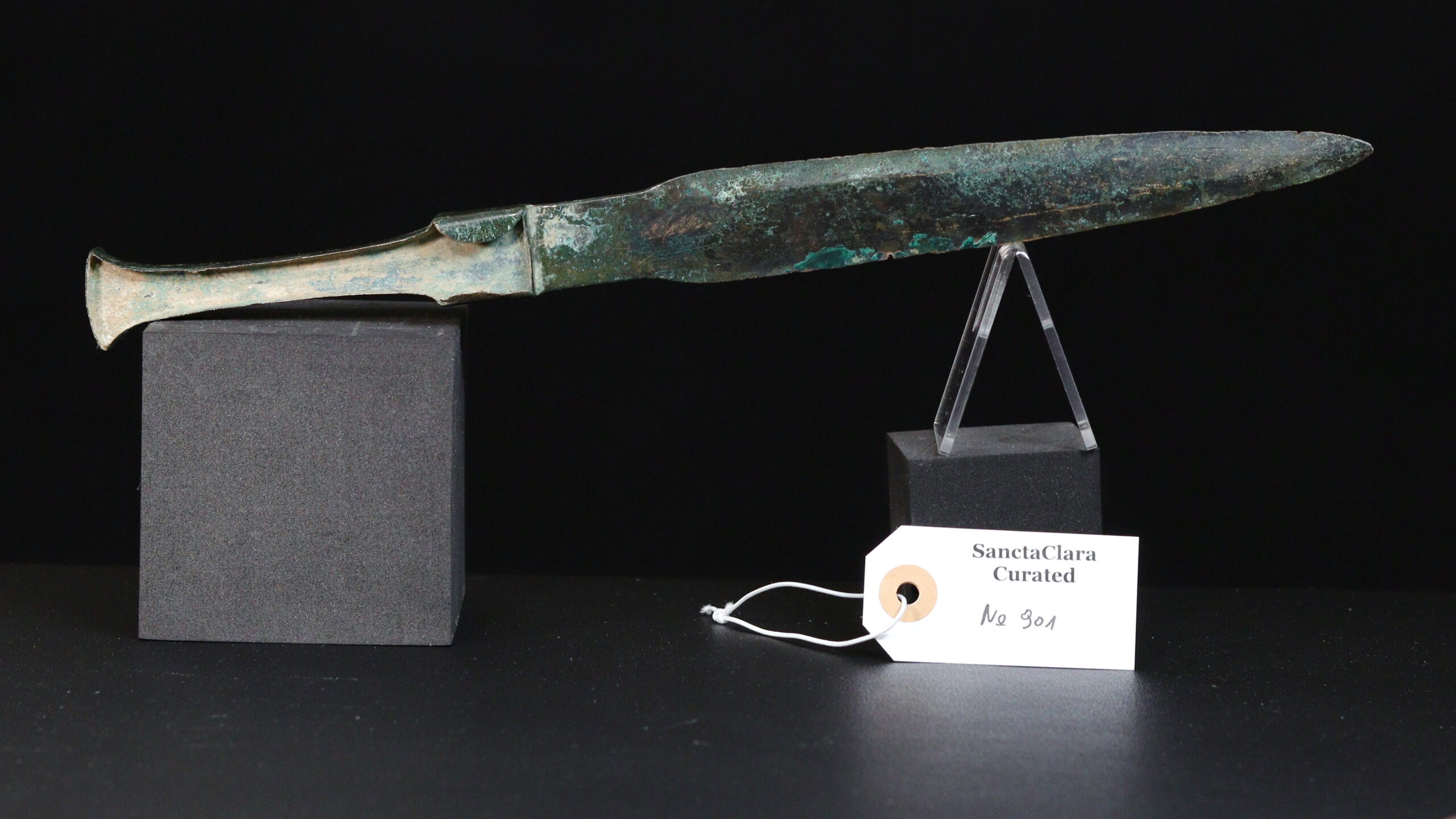
Bronze Dagger with flanged inlaid hilt
Description
A bronze dirk or short sword: The blade and hilt cast in one piece, flanged hilt with a rectangular guard and semi-circular lappets on both sides which were used to secure the inlay, which would have been of ivory or bone. Fine condition, the metal stable with an olive green patina over much of the weapon, a few light accretions in places. Length 34.4 cms (13.5 ins), 156 gr, timesancient.com](http:// Times Ancient Gallery, Invoice AI2024/01, 25.04.2024 Iron Age Near East : circa 1000-800 BC. Litehookure: Cf. Item 48, Catalogue of the Ancient Persian Bronzes in the Ashmoleon Museum: P.R.S. Moorey.
Catalogue Number
901
Category
Period
1090 BCE
Culture
Luristan, Assyrian, Babylonian, Near Eastern
Material
Bronze
Dimensions and weight
L: 34.4 cm
Reference Items
This form of sword/dagger is referred to in references as Luristan, since the daggers were found in Luristan, but probably in fact are Babylonian. Quite a few of the daggers which are in the Musée du Louvre, British Museums, Teheran Museum, and in Mrs. Christian Holmes' collection, are with inscriptions on the blades bearing the names of Babylonian kings of the Fourth Dynasty as Nebuchadnezzar I, Marduk-Nadin-Ahhe, Adad-Apal-Iddina, where according to the book by Ernest E. Herzfeld, \Iran in the Ancient East\, page 134, they belonged to Babylonian soldiers holding fiefs in Luristan. Similar daggers are published in the following references: 1\) A Survey of Persian Art: from Prehistoric Times to the Present\by Arthur Upham Pope Volume VII 2\) Iran in the Ancient East by Ernest E. Herzfeld 3\) Kostbare Blankwaffen aus dem Deutsch. Klingenmuseum Solingenby Heinz R. Uhlemann 4\) Bronzes du luristan Publisher: PARIS MUSEES (17 March 2008) 5\) Les Antiquités du Luristan: collection David-Weill by Pierre Amiet. 5\) Similar dagger WITH CUNEIFORM INSCRIPTION \'Belonging to Marduk-Nadin-Ahhe, King of Babylon, King of the Universe, King of Sumer and Akkad\', is published in Christie's catalogAntiquities6 July 2016, lot 32 6\) Cf. Khorasani, M.M., Arms and Armour from Iran - The Bronze Age to the End of the Qajar Period, Tübingen, 2006, p.381, cat.6.. 7\) National Museum Teheran pos. 17 8\) Stutzinger, 2001, pp 10-11, dates to 2000 BC 9\) Archeological Museum of Frankfurt, Grawert collection, Luristan Similar daggers are published in the following references: 10\) A Survey of Persian Art: from Prehistoric Times to the Present\by Arthur Upham Pope Volume VII 11\) Iran in the Ancient East by Ernest E. Herzfeld 12\) A Kostbare Blankwaffen aus dem Deutsch. Klingenmuseum Solingenby Heinz R. Uhlemann 13\) Bronzes du luristan Publisher: PARIS MUSEES (17 March 2008) 14\) Les Antiquités du Luristan: collection David-Weill by Pierre Amiet. To view related Babylonian swords in the Museums please see the link below: medium confidence{ USD1400 USD 3495 SOLD NOTES: hilt guard wall thickness: 0,3 -0,45 mm. Impossible to cast in bronze even in pressure chamber or centrifuge. Must have been forged and filed or grinded after initial casting, but no sigh of initial thicker cas
Historical Significance
Luristan bronzes represent one of the most distinctive metalworking traditions of the ancient Near East. The Lorestan Province of western Iran was renowned for sophisticated lost-wax casting and alloy control. The semi-nomadic peoples of the Zagros Mountains produced weapons of remarkable quality combining functional utility with artistic expression.
Curator Rating
5.0
Comparative Examples
https://www.christies.com/lot/lot-an-iranian-bronze-dagger-with-cuneiform-inscription-6009351/?https://www.christies.com/lot/lot-an-iranian-bronze-dagger-with-cuneiform-inscription-6009351/ || http://www.britishmuseum.org/research/collection_online/collection_object_details.aspx?objectId=369366&partId=1 || https://www.rom.on.ca/en/blog/weapon-wednesday-two-daggers-from-luristan-iran