
Document
Attachments
SCC 102371068 2
Metadata
Title
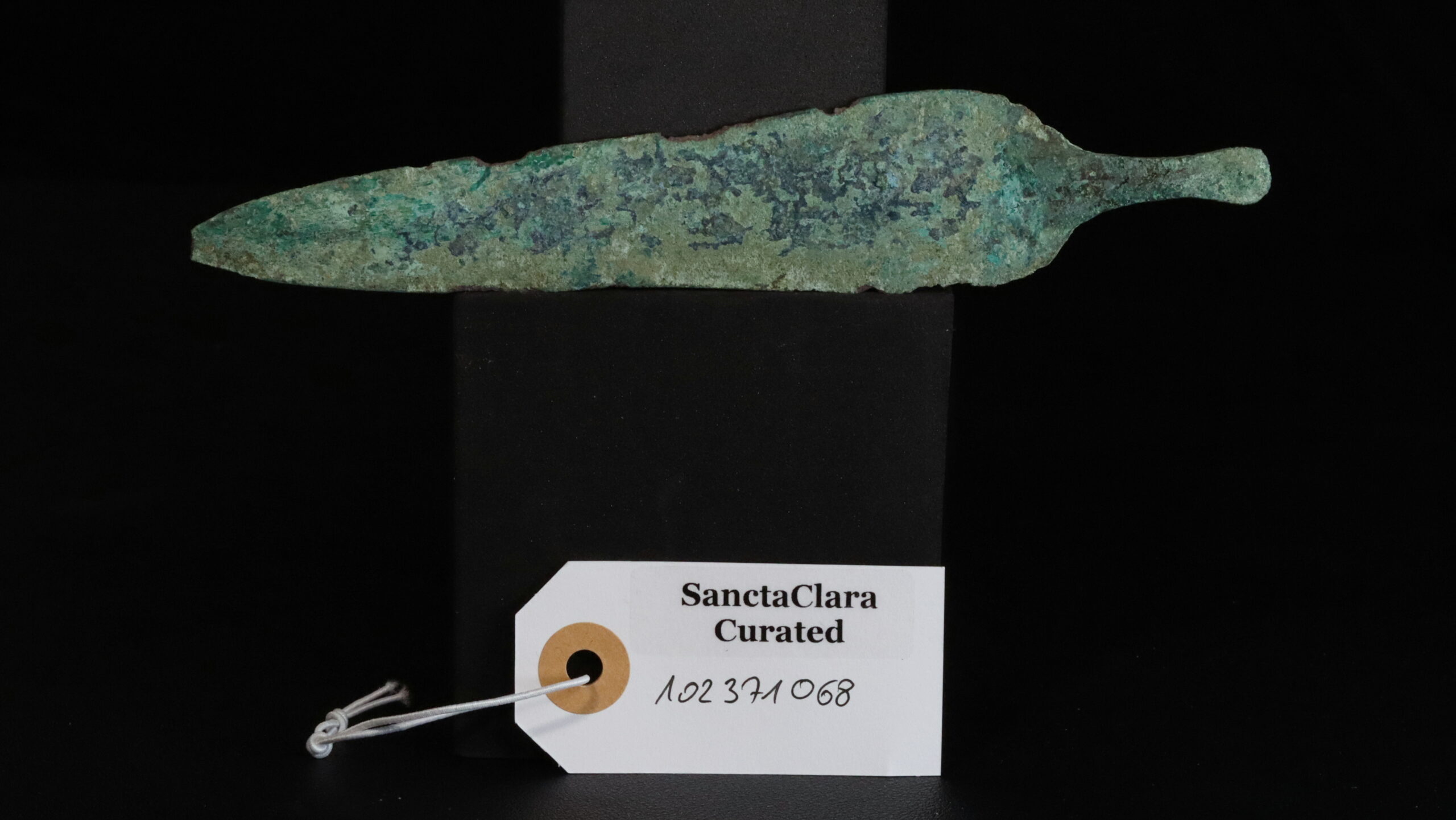
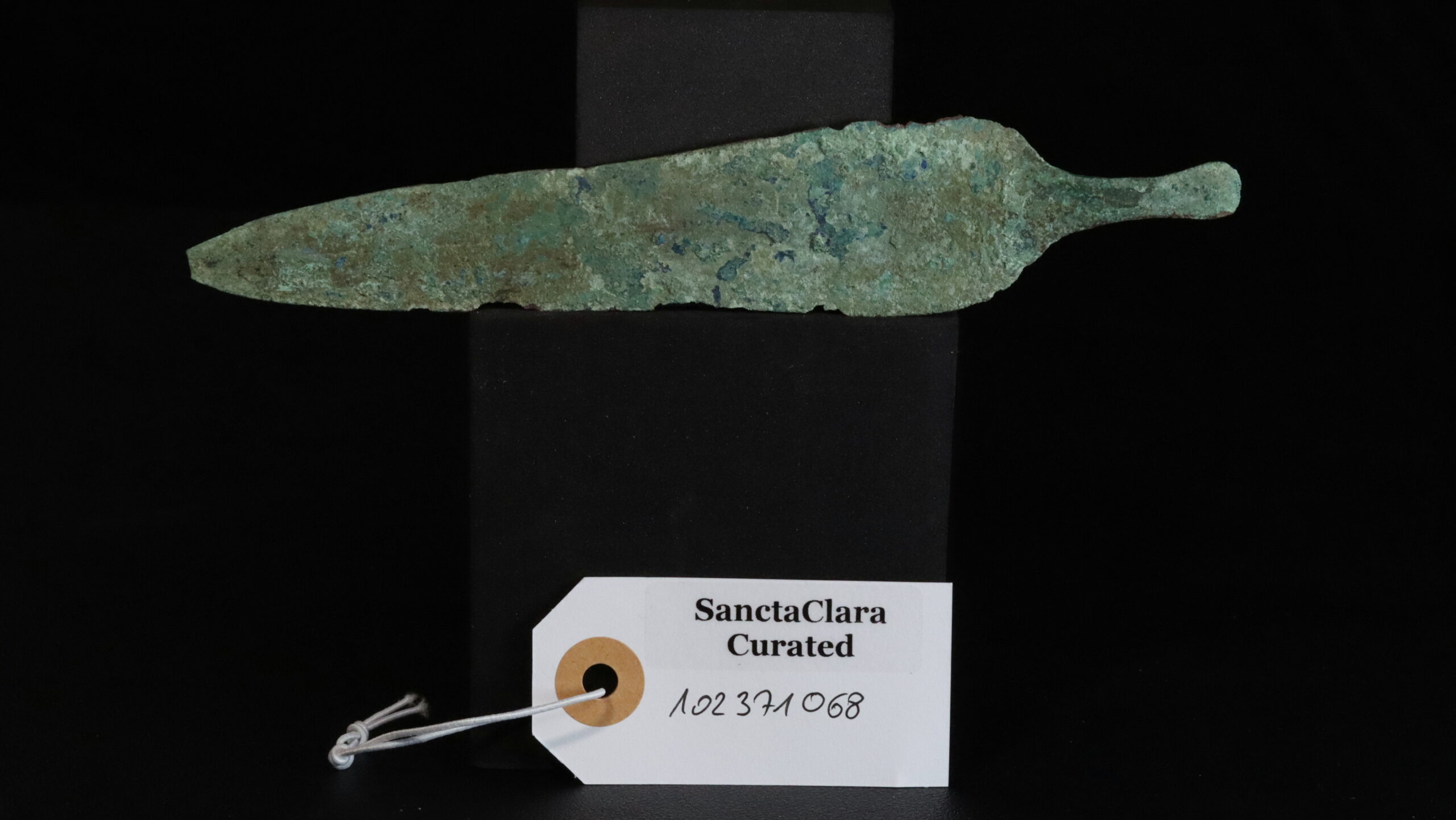
Hammered copper dagger
Description
Hammered copper dagger with flat hammered tang.
Flat-Tanged Copper Dagger or Utility Knife. This is a basal, widespread typology found across several early metallurgical centers. Strong parallels exist in the Levant/Canaan (Early Bronze Age I-II), Anatolia, the Carpathian Basin/Balkans (Late Copper Age/Chalcolithic), and western European Bell Beaker contexts.
Period: Late Chalcolithic to Early Bronze Age, approximately 3500 BCE – 2200 BCE. This dagger comes from an era before the widespread alloying of copper with tin to make true, easily castable bronze. Work-Hardening: Pure copper (or copper with natural arsenic impurities) is relatively soft. If you simply cast a copper blade and try to cut with it, the edge will roll and dull instantly. Ancient smiths discovered that cold-hammering the metal compresses its crystalline structure, making it significantly harder.
The Trapezoidal Profile: The smith likely started with a flat, simple cast blank (or a fully hammered raw copper ingot). By aggressively and repeatedly hammering just the outer edges of the blank to create the cutting bevels, the center of the blade remained thick, resulting in the distinct trapezoidal or diamond-like cross-section. This gave the blade hard, sharp edges while leaving the thicker spine softer and more flexible, preventing the whole blade from shattering on impact.
The Unperforated Tang (32x8 mm): Later Bronze Age daggers feature large handles cast in one piece with the blade, or wide tangs with multiple rivet holes to secure the handle. This blade has a simple, short, rivetless tang. How it was Handled: To haft this, an ancient craftsman would have carved a slot into a piece of dense wood, bone, or horn. The short tang would be friction-fitted into this slot and secured using a natural thermoplastic resin—most likely heated birch bark tar or bitumen. Finally, wet sinew or leather would be tightly wrapped around the shoulders of the blade and the hilt. As the sinew dried, it would shrink, creating an incredibly tight mechanical bind.
Probable Use: This was not a battlefield weapon meant to defeat armor. It was an everyday carry item—a personal utility knife for cutting meat, working leather, light carving, and personal defense. In the Chalcolithic and Early Bronze Age, owning a metal blade of any size was a profound status symbol, so it would have been worn proudly on a belt.
Flat-Tanged Copper Dagger or Utility Knife. This is a basal, widespread typology found across several early metallurgical centers. Strong parallels exist in the Levant/Canaan (Early Bronze Age I-II), Anatolia, the Carpathian Basin/Balkans (Late Copper Age/Chalcolithic), and western European Bell Beaker contexts.
Period: Late Chalcolithic to Early Bronze Age, approximately 3500 BCE – 2200 BCE. This dagger comes from an era before the widespread alloying of copper with tin to make true, easily castable bronze. Work-Hardening: Pure copper (or copper with natural arsenic impurities) is relatively soft. If you simply cast a copper blade and try to cut with it, the edge will roll and dull instantly. Ancient smiths discovered that cold-hammering the metal compresses its crystalline structure, making it significantly harder.
The Trapezoidal Profile: The smith likely started with a flat, simple cast blank (or a fully hammered raw copper ingot). By aggressively and repeatedly hammering just the outer edges of the blank to create the cutting bevels, the center of the blade remained thick, resulting in the distinct trapezoidal or diamond-like cross-section. This gave the blade hard, sharp edges while leaving the thicker spine softer and more flexible, preventing the whole blade from shattering on impact.
The Unperforated Tang (32x8 mm): Later Bronze Age daggers feature large handles cast in one piece with the blade, or wide tangs with multiple rivet holes to secure the handle. This blade has a simple, short, rivetless tang. How it was Handled: To haft this, an ancient craftsman would have carved a slot into a piece of dense wood, bone, or horn. The short tang would be friction-fitted into this slot and secured using a natural thermoplastic resin—most likely heated birch bark tar or bitumen. Finally, wet sinew or leather would be tightly wrapped around the shoulders of the blade and the hilt. As the sinew dried, it would shrink, creating an incredibly tight mechanical bind.
Probable Use: This was not a battlefield weapon meant to defeat armor. It was an everyday carry item—a personal utility knife for cutting meat, working leather, light carving, and personal defense. In the Chalcolithic and Early Bronze Age, owning a metal blade of any size was a profound status symbol, so it would have been worn proudly on a belt.
Catalogue Number
102371068
Category
Period
3500 - 2200 BCE
Culture
Wester Asiatic, Bell Beaker
Material
Copper
Dimensions and weight
L: 173 mm, W: 32 mm, Thickness: 3 mm, tang 32x8x3 mm, Weight 43 g
Curator Rating
3
Comparative Examples
Comparative Analysis Vs. Levantine/Canaanite Daggers: Excavations at Early Bronze Age sites like Jericho and Megiddo have yielded hundreds of these simple, flat-tanged, rivetless copper daggers. They are the quintessential early Near Eastern personal blade. Vs. Cypriot Daggers: Early Cypriot copper daggers often feature a distinctive "rat-tail" tang (a long, thin metal rod extending from the base) curved at the end to hook into the handle. Your flat, rectangular tang points away from Cyprus and more toward the Levantine or European mainland. Vs. Bell Beaker Copper Daggers (Western Europe): The early Beaker culture (c. 2800 BCE) is famous for very similar thin, flat-tanged copper daggers (the "tanged or tanged-and-riveted" types). Over time, Beaker smiths began adding one or two rivet holes to secure the handle, suggesting your completely unperforated piece is quite early in the typological sequence.