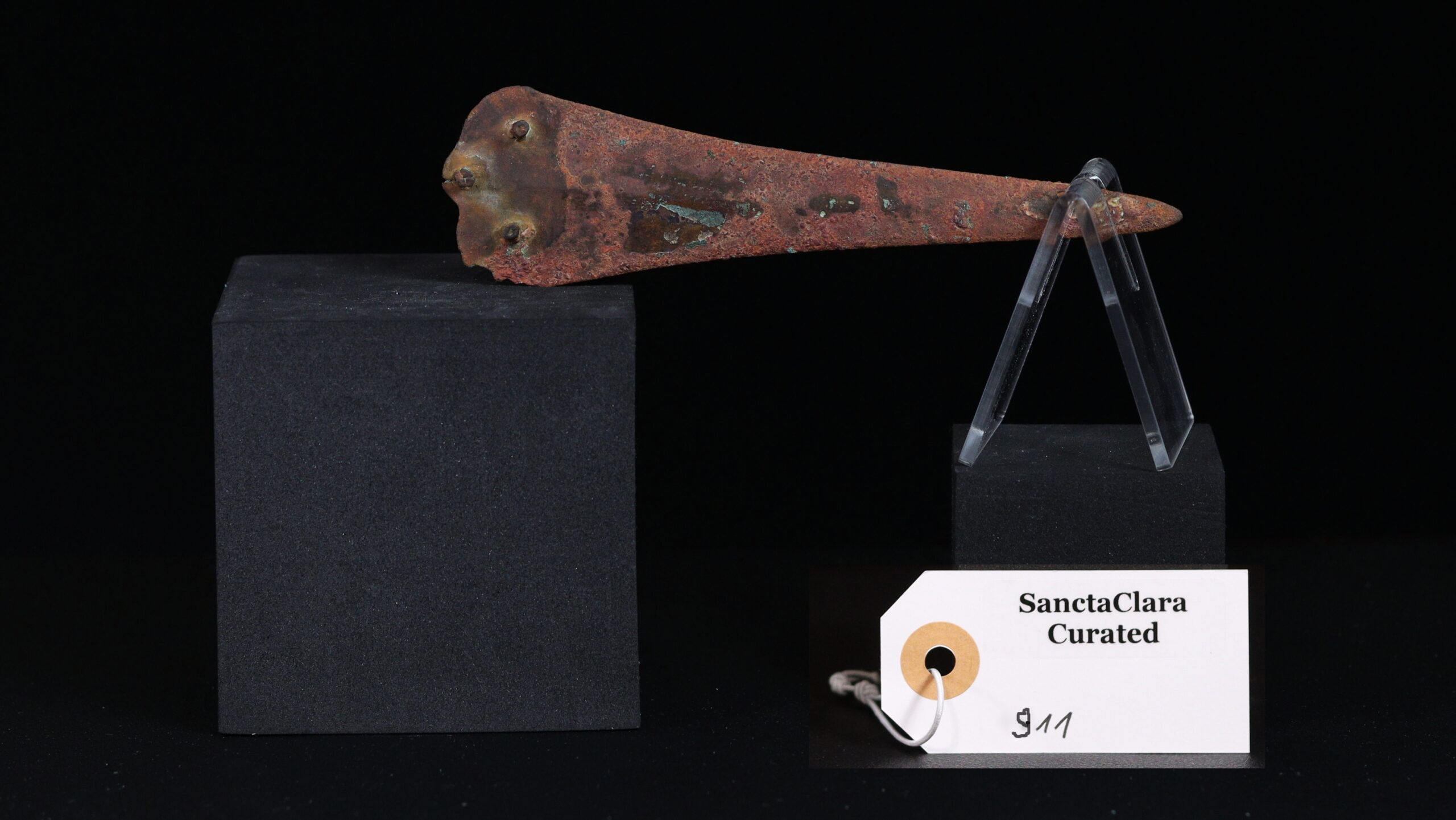
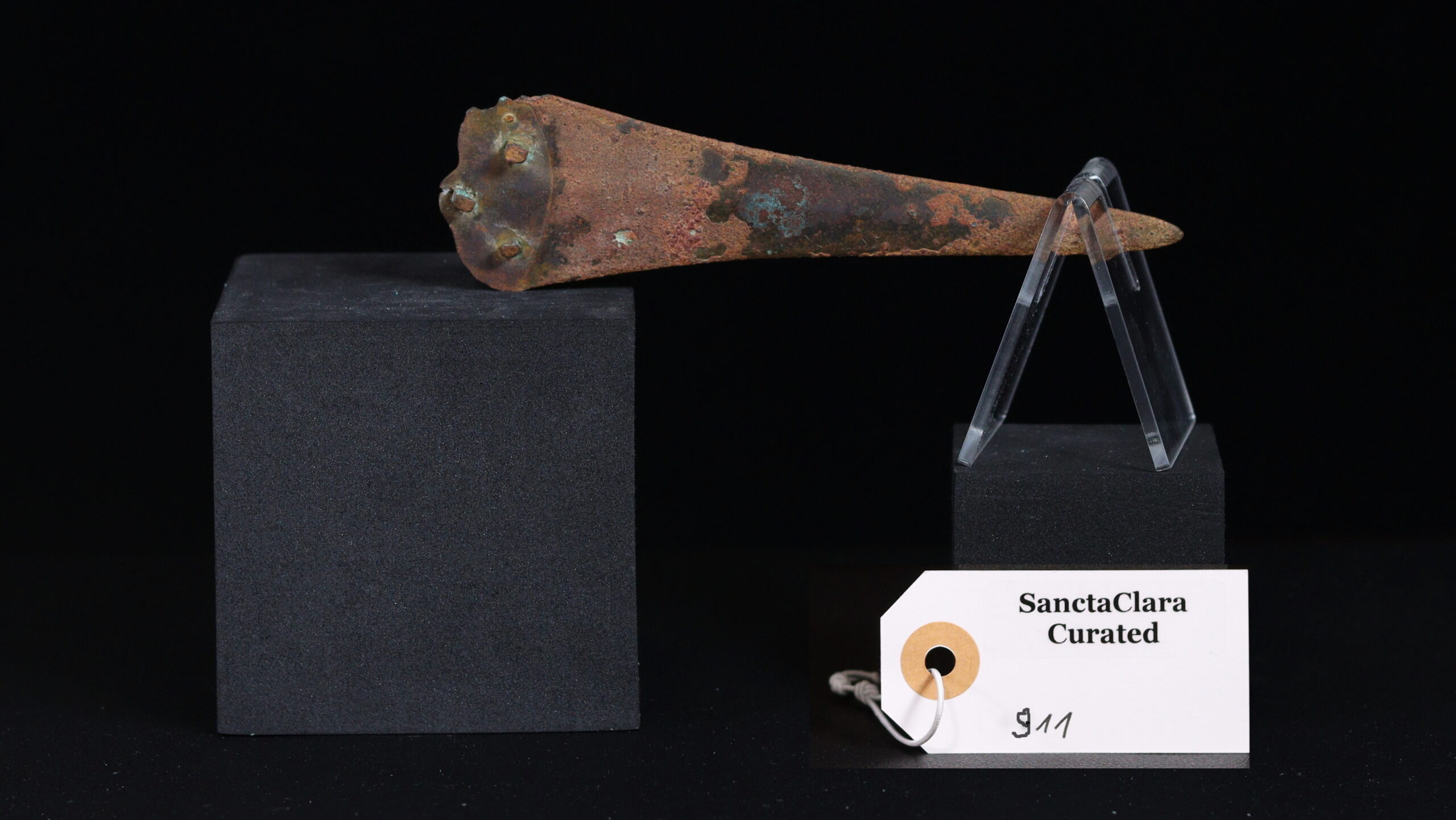
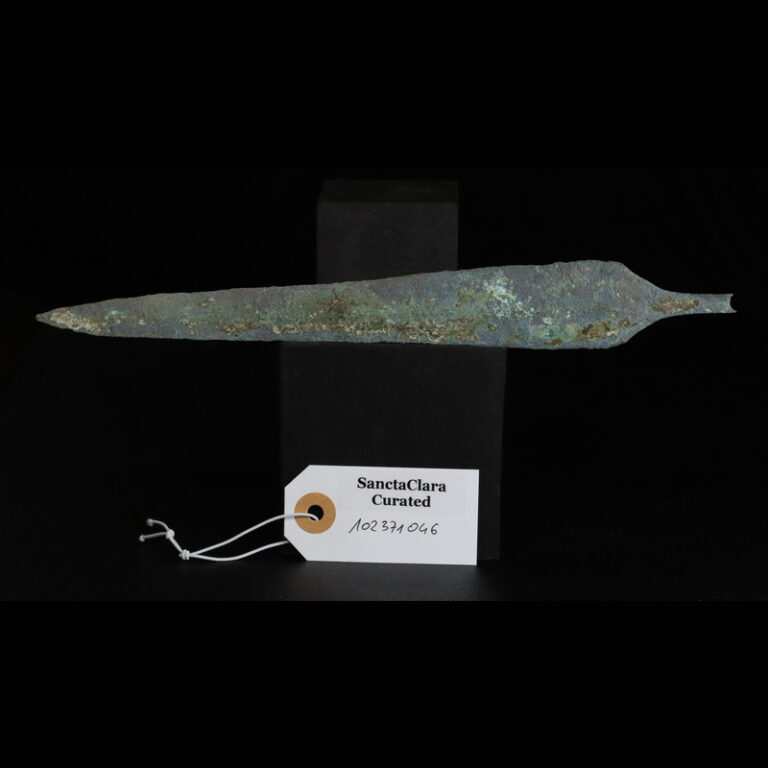
Minoan Ferrit Copper dagger with no tang and concave blade
Description
Ancient EBA ferrite copper (Black Copper) dagger, 3 rivets, round shaft hilt mark visible, rusty patina indicating iron content in copper alloy, very slightly magnetic.
For similar published archaeological examples see:
Metropolitan Museum of Arts, NY Bronze dagger, Minoan, ca. 1600--1450 BCE
Early Bronze Age bronze dagger of ogival type, Amgueddfa Cymru --- Museum Wales
Historical Significance
Ferrian Copper Production:
The ferromagnetic properties and rusty surface indicate that the dagger was not cast from a pristine oxide ore (like malachite), but rather from a complex sulfidic copper-iron ore such as chalcopyrite (CuFeS2).During the Early to Middle Bronze Age, surface-level oxide ores became depleted, forcing ancient smelters to mine deeper sulfidic ores. To extract copper from these complex ores, metallurgists developed a co-smelting or fluxing process:
The Iron Flux: Iron ores (like hematite) or iron-rich gossans were intentionally added to the smelting furnace as a flux. The iron binds with the unwanted silica in the ore to form a fluid fayalite slag, allowing the heavier copper to sink to the bottom.
The ""Accident"" of Reduction: If the charcoal-fueled furnace was run in a highly reducing atmosphere (too much carbon monoxide and too hot), some of the iron flux would reduce into metallic iron rather than entering the slag.
Microstructural Result: Because iron and copper do not mix well in a solid state, the iron separates as the metal cools, forming microscopic $\alpha$-iron dendrites (precipitates) suspended within the copper matrix. This trapped metallic iron makes the bulk object slightly ferromagnetic. As the artifact ages over millennia, these iron particles at the surface oxidize, creating a reddish-brown ""rusty"" patina rather than the typical green (malachite) or blue (azurite) carbonates.