
Document
Attachments
SCC 102371046 2
Metadata
Title
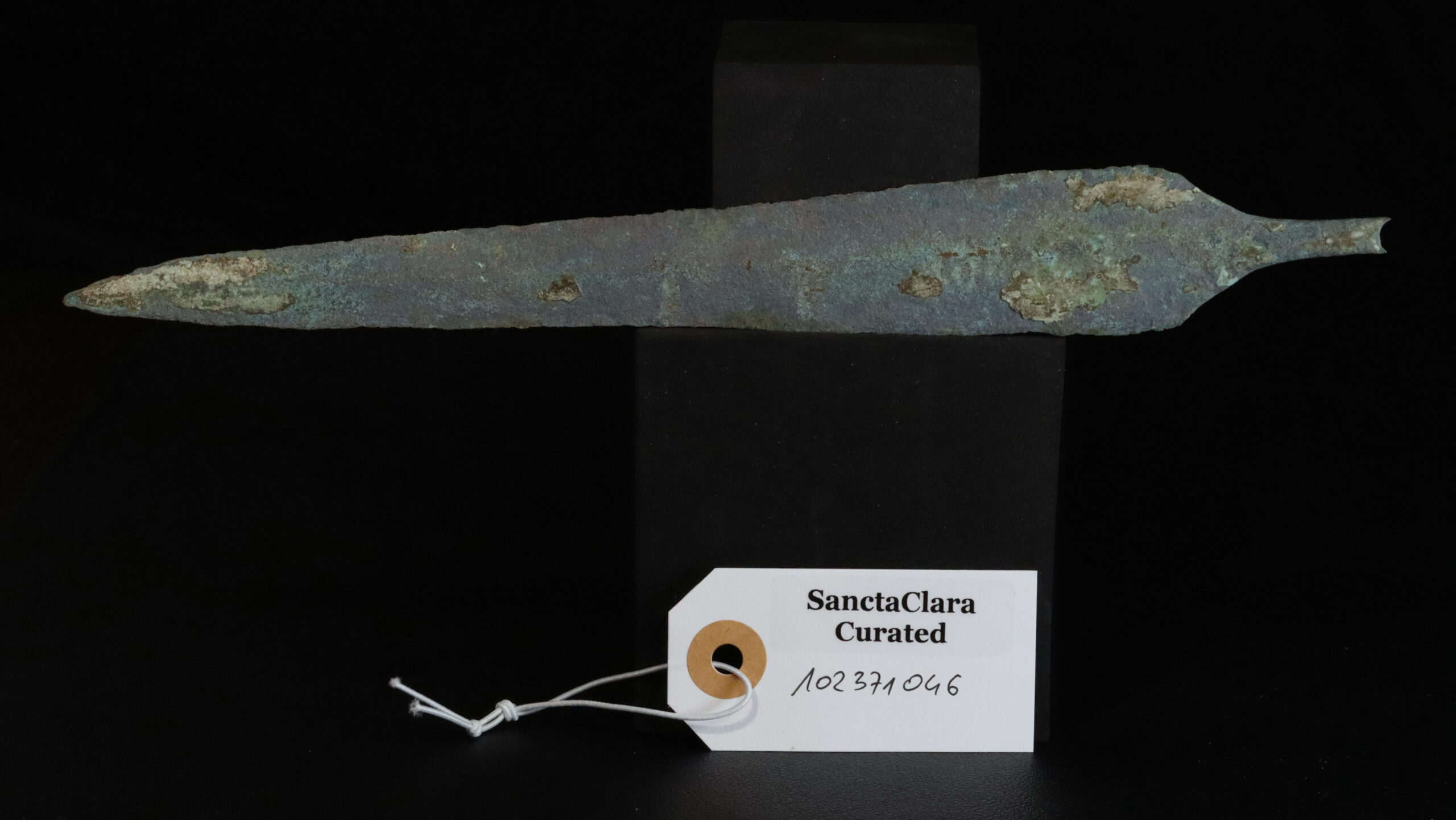
Near eastern slim bronze dagger
Description
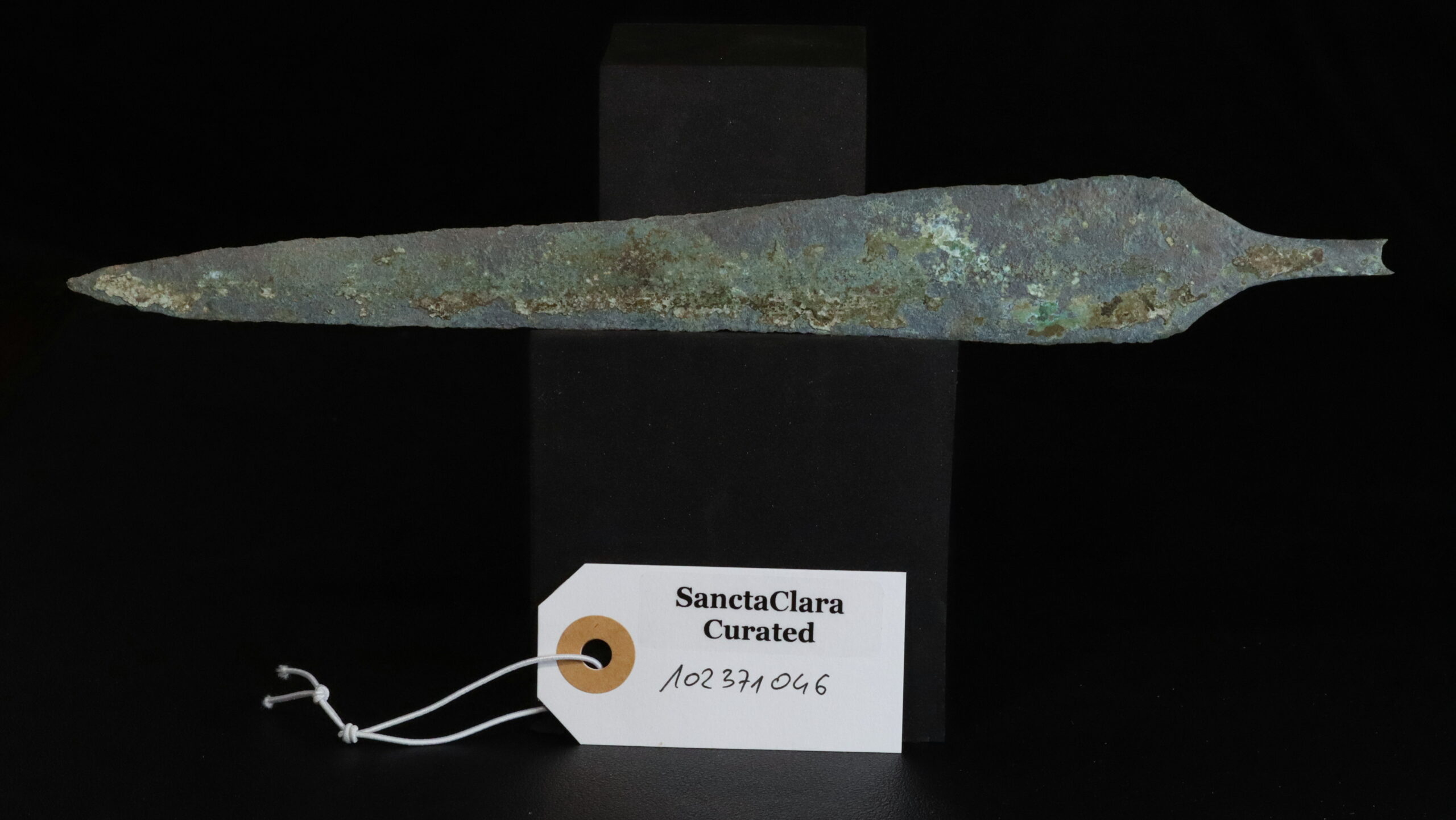
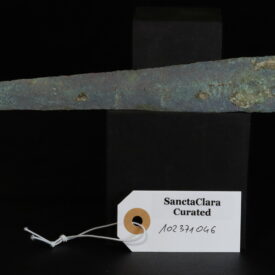
Near Eastern slim dagger. Extremely sharp. Tang with remains of 1 rivet hole, broken in antiquity.
Typological Classification and Cultural Attribution. Given its parameters (25 cm in length, trapezoidal cross-section, sloping shoulders, and a short tang with a single rivet hole), this dagger exhibits the strongest affinities with the region of the Ancient Near East and Western Asia.
In historical antiquarian collections built since the 1980s, such objects are most commonly attributed to two main horizons: Luristan Culture (Western Iran, approx. 1500–1000 BC) – Most probable: Luristan bronzesmiths were renowned for the mass production of slender, elegant thrusting weapons. The so-called "tanged daggers" from this region frequently feature the exact same short tang with a single rivet hole (or a U-shaped notch when the hole was torn out during combat, as seen in your photos). The sloping, gently rounded shoulders are practically their hallmark.
Levantine Cultures (Syria, Canaan – Middle Bronze Age, approx. 2000–1500 BC): An equally strong candidate. Early forms of utilitarian Levantine daggers could be very simple in design. They often dispensed with a pronounced, convex midrib in favor of a flat, trapezoidal, or lenticular cross-section to save metal and simplify the casting process.
A note on the European context: Although tanged daggers were also cast in Europe (e.g., in the Early Bronze Age Únětice culture or early phases of the Tumulus culture), they rarely assumed such a slender form at a length of 25 cm while simultaneously having such delicate hafting. European blades of this length typically featured a broader heel with an arched arrangement of multiple rivet holes to withstand greater stress.
Geometry and Casting Technology. Trapezoidal cross-section: This is a highly practical technological solution. The central part of the blade is flat and thickened, which stiffens the bronze and prevents the blade from bending, while the edges slope gently to form cutting planes. This is easier to achieve in rectangular or two-piece stone casting moulds than modeling a high, thin midrib. Length (25 cm): In arms and armor nomenclature, this object balances on the boundary between a dagger and a short dirk. It is not merely an everyday tool, it is a fully-fledged sidearm designed for combat.
Hilt Reconstruction and Combat Use. Looking at this short tang with a torn-out rivet, I can immediately see how this weapon was hilted: Hafting: A single small rivet on such a short tang would not support a 25 cm blade if the entire force of the impact rested upon it. This means the hilt (made of hardwood, bone, or horn) had a deep slot/cleft into which the blade was inserted right up to the shoulders. It was the rounded shoulders of the dagger that absorbed the force of the impact by resting against the hilt material. The rivet served exclusively to prevent the blade from sliding out of the grip in a straight line (e.g., when withdrawing the weapon from an opponent's body). The torn hole at the base indicates that the blade experienced a massive longitudinal strain that tore the bronze.
Combat style: The lack of a broad base precludes slashing strikes—the bronze dirk would simply snap out of the hilt. Its slenderness and lightness indicate it was a weapon intended exclusively for swift, precise, and lethal thrusts in close-quarters combat, perhaps aimed at the gaps in primitive leather or textile armors.
Typological Classification and Cultural Attribution. Given its parameters (25 cm in length, trapezoidal cross-section, sloping shoulders, and a short tang with a single rivet hole), this dagger exhibits the strongest affinities with the region of the Ancient Near East and Western Asia.
In historical antiquarian collections built since the 1980s, such objects are most commonly attributed to two main horizons: Luristan Culture (Western Iran, approx. 1500–1000 BC) – Most probable: Luristan bronzesmiths were renowned for the mass production of slender, elegant thrusting weapons. The so-called "tanged daggers" from this region frequently feature the exact same short tang with a single rivet hole (or a U-shaped notch when the hole was torn out during combat, as seen in your photos). The sloping, gently rounded shoulders are practically their hallmark.
Levantine Cultures (Syria, Canaan – Middle Bronze Age, approx. 2000–1500 BC): An equally strong candidate. Early forms of utilitarian Levantine daggers could be very simple in design. They often dispensed with a pronounced, convex midrib in favor of a flat, trapezoidal, or lenticular cross-section to save metal and simplify the casting process.
A note on the European context: Although tanged daggers were also cast in Europe (e.g., in the Early Bronze Age Únětice culture or early phases of the Tumulus culture), they rarely assumed such a slender form at a length of 25 cm while simultaneously having such delicate hafting. European blades of this length typically featured a broader heel with an arched arrangement of multiple rivet holes to withstand greater stress.
Geometry and Casting Technology. Trapezoidal cross-section: This is a highly practical technological solution. The central part of the blade is flat and thickened, which stiffens the bronze and prevents the blade from bending, while the edges slope gently to form cutting planes. This is easier to achieve in rectangular or two-piece stone casting moulds than modeling a high, thin midrib. Length (25 cm): In arms and armor nomenclature, this object balances on the boundary between a dagger and a short dirk. It is not merely an everyday tool, it is a fully-fledged sidearm designed for combat.
Hilt Reconstruction and Combat Use. Looking at this short tang with a torn-out rivet, I can immediately see how this weapon was hilted: Hafting: A single small rivet on such a short tang would not support a 25 cm blade if the entire force of the impact rested upon it. This means the hilt (made of hardwood, bone, or horn) had a deep slot/cleft into which the blade was inserted right up to the shoulders. It was the rounded shoulders of the dagger that absorbed the force of the impact by resting against the hilt material. The rivet served exclusively to prevent the blade from sliding out of the grip in a straight line (e.g., when withdrawing the weapon from an opponent's body). The torn hole at the base indicates that the blade experienced a massive longitudinal strain that tore the bronze.
Combat style: The lack of a broad base precludes slashing strikes—the bronze dirk would simply snap out of the hilt. Its slenderness and lightness indicate it was a weapon intended exclusively for swift, precise, and lethal thrusts in close-quarters combat, perhaps aimed at the gaps in primitive leather or textile armors.
Catalogue Number
102371046
Category
Culture
Near East - Canaan, Luristan
Material
Bronze
Dimensions and weight
L: 249 mm, W: 34 mm, Thickness: 4,6 mm, tang 25x7x2 mm, weight 84 g
Curator Rating
3