
Document
Attachments
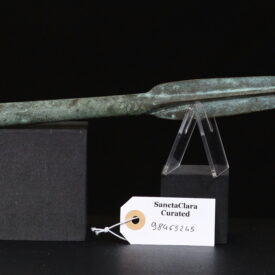
SCC-98465245-2

Metadata
Title
Bronze Age Large Socketed Spearhead or Pike
Description
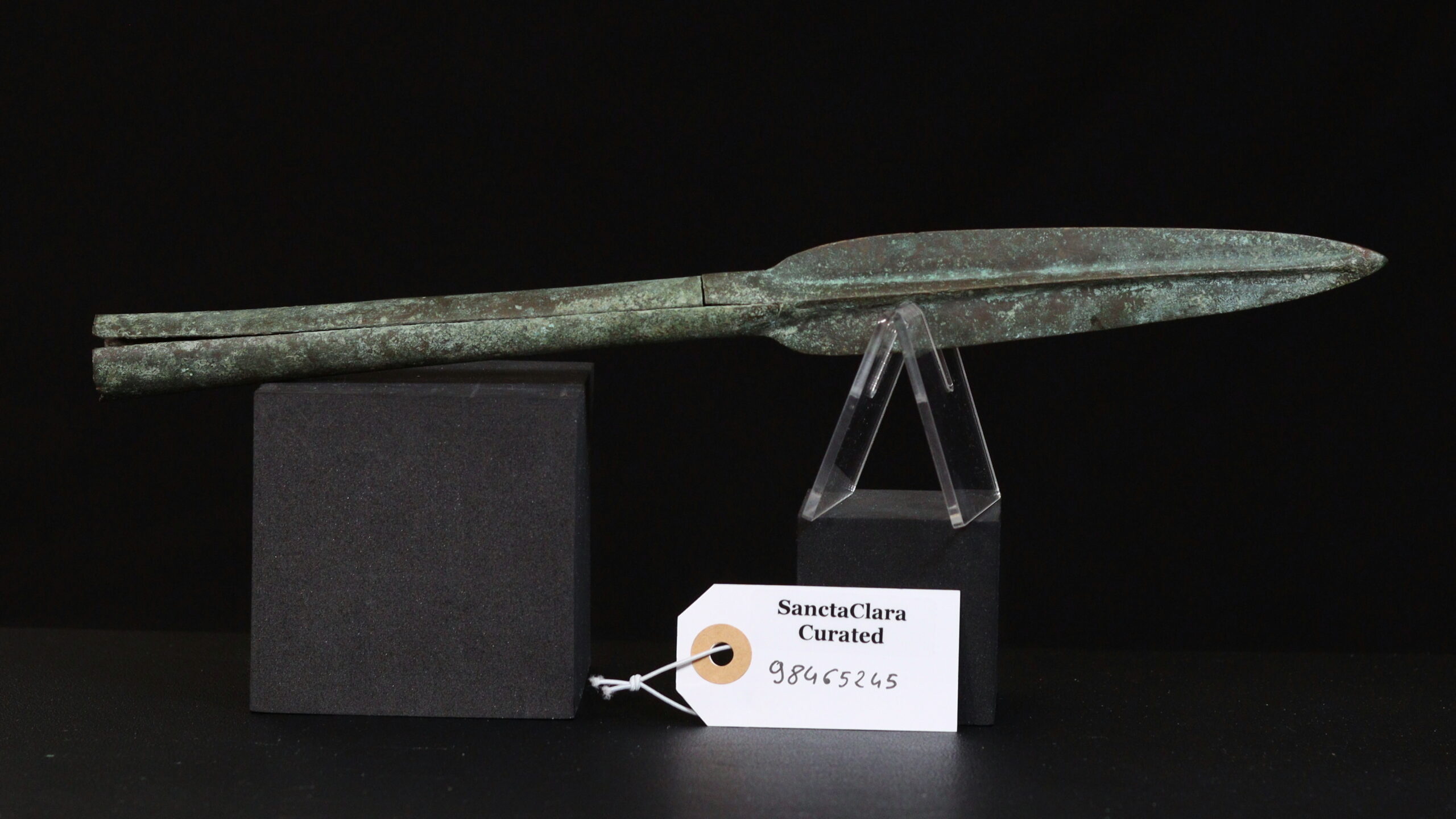
A large, massive bronze socketed spearhead with a wide central ridge.
Green patina with shades of brown and interesting crystalline formations.
This is a folded-socket (or split-socket) spearhead, and it is one of my absolute favorite typologies to study and recreate because it captures ancient smiths in the very act of problem-solving.
Culture and Period Culture: Most commonly associated with the early Levantine, Anatolian, and Mesopotamian cultures, though similar techniques appeared briefly in the Early European Bronze Age (like the Unetice culture).
Period: Early to Middle Bronze Age (roughly 2500 BCE – 1800 BCE). This weapon represents the "missing link" in spearhead evolution. It sits squarely between the era of tanged weapons (like Cypriot/Levantine examples) and the later, fully seamless core-cast socketed spears of the Late Bronze Age. The Split Socket The most diagnostic feature of this artifact is the "split and folded" socket. To understand why this is so important, we have to look at it through the eyes of an ancient bronze smith. Creating a seamless, hollow socket requires core casting—suspending a fragile clay cone perfectly in the center of a two-part stone mold so the bronze flows around it. This is highly complex. To bypass this, the smiths of this era invented the folded socket:
The Flat Cast: The smith cast the spearhead completely flat in a simple, open-face or basic bivalve mold. The blade looked normal, but the base consisted of a wide, flat rectangular or trapezoidal sheet of bronze instead of a tang. Forging the Socket: Once the bronze cooled slightly, the smith reheated the flat base (annealing it to make it workable) and carefully hammered those flat metal "wings" around a conical wooden or bronze mandrel.
The Split Line: The wings were hammered until they met in the center, forming a tube to hold the wooden shaft. Because they couldn't easily weld bronze, the seam—the "split line" at the shoulder and down the socket—remained visible, exactly as we see in your photographs.
Probable Use
At 32.2 cm long and weighing only 143 g, this is an exceptionally light and fast weapon. Agile Skirmishing: This low weight suggests it was not meant for the crushing, heavy impact of a massed infantry phalanx. Instead, it was an agile throwing javelin or a light skirmishing spear.
The Triangular Central Ridge: Because the blade lobes (the cutting edges) are described as flat and thin, the blade would be prone to bending. The triangular central ridge acts as a rigid spine, providing the structural integrity needed to penetrate a target without buckling, compensating for the thinness of the cutting edges.
Hafting: To secure this to a shaft, the wooden pole would be whittled into a cone, and the bronze socket tapped firmly over it. Often, smiths would punch a single small hole through the overlapping bronze at the base of the socket, driving a wooden peg or bronze rivet horizontally through the metal and the wood to prevent the head from flying off.
Green patina with shades of brown and interesting crystalline formations.
This is a folded-socket (or split-socket) spearhead, and it is one of my absolute favorite typologies to study and recreate because it captures ancient smiths in the very act of problem-solving.
Culture and Period Culture: Most commonly associated with the early Levantine, Anatolian, and Mesopotamian cultures, though similar techniques appeared briefly in the Early European Bronze Age (like the Unetice culture).
Period: Early to Middle Bronze Age (roughly 2500 BCE – 1800 BCE). This weapon represents the "missing link" in spearhead evolution. It sits squarely between the era of tanged weapons (like Cypriot/Levantine examples) and the later, fully seamless core-cast socketed spears of the Late Bronze Age. The Split Socket The most diagnostic feature of this artifact is the "split and folded" socket. To understand why this is so important, we have to look at it through the eyes of an ancient bronze smith. Creating a seamless, hollow socket requires core casting—suspending a fragile clay cone perfectly in the center of a two-part stone mold so the bronze flows around it. This is highly complex. To bypass this, the smiths of this era invented the folded socket:
The Flat Cast: The smith cast the spearhead completely flat in a simple, open-face or basic bivalve mold. The blade looked normal, but the base consisted of a wide, flat rectangular or trapezoidal sheet of bronze instead of a tang. Forging the Socket: Once the bronze cooled slightly, the smith reheated the flat base (annealing it to make it workable) and carefully hammered those flat metal "wings" around a conical wooden or bronze mandrel.
The Split Line: The wings were hammered until they met in the center, forming a tube to hold the wooden shaft. Because they couldn't easily weld bronze, the seam—the "split line" at the shoulder and down the socket—remained visible, exactly as we see in your photographs.
Probable Use
At 32.2 cm long and weighing only 143 g, this is an exceptionally light and fast weapon. Agile Skirmishing: This low weight suggests it was not meant for the crushing, heavy impact of a massed infantry phalanx. Instead, it was an agile throwing javelin or a light skirmishing spear.
The Triangular Central Ridge: Because the blade lobes (the cutting edges) are described as flat and thin, the blade would be prone to bending. The triangular central ridge acts as a rigid spine, providing the structural integrity needed to penetrate a target without buckling, compensating for the thinness of the cutting edges.
Hafting: To secure this to a shaft, the wooden pole would be whittled into a cone, and the bronze socket tapped firmly over it. Often, smiths would punch a single small hole through the overlapping bronze at the base of the socket, driving a wooden peg or bronze rivet horizontally through the metal and the wood to prevent the head from flying off.
Catalogue Number
98465245
Category
Period
c 1500-1100 BCE
Culture
Late Bronze Age
Material
Bronze
Dimensions and weight
L: 322 mm, weight 143 g
Reference Items
Elamite Parallels: Similar blade profiles are also seen in the armories of the neighboring Elamite empire, suggesting this highly effective design was widely traded and copied across the ancient Near East.
Historical Significance
Large socketed spearheads represent the maturation of bronze casting technology. The socket cast as an integral hollow tube allowed secure hafting without the weakness of tanged designs, one of the most consequential innovations in ancient weapon technology.
Curator Rating
5.0