

Andrzej M. Izyk, curator of the Sancta Clara Collection
Orichalcum is the metal of Atlantis. Almost everything written about it begins by overruling the one man who told us about it. Plato says, in plain words, that orichalcum was dug out of the earth. The modern consensus says it was brass: a manufactured alloy of copper and zinc that nobody ever dug out of anything. The whole problem lies between those two statements.
In this article I do something that has become unfashionable. I take Plato at his word and follow the geology wherever it leads. It leads, I will argue, to a very specific kind of ore: the gold-, silver- and copper-bearing massive sulphides that made southern Iberia the richest metal province of the ancient West. From there it leads out into the Atlantic, to the only place in that ocean where the same ore-forming engine is still running today. That place is the Mid-Atlantic Ridge, the great volcanic seam down the middle of the ocean that carries, nomen omen, Atlas’s name.
I will be equally plain about where the literal reading holds and where it strains. A theory that hides its weakest point does not deserve a hearing. One that states it openly and still stands deserves more of one than it usually gets.
What Plato actually says about orichalcum
Everything begins with two late dialogues, the Timaeus and the unfinished Critias, composed around 360 BC. The story is framed as history, not fable. The Athenian lawgiver Solon heard it from priests at Saïs in the Nile Delta. It passed down through Critias’s family, and Plato has it told as fact.
The first passage is the one that matters most. Describing the island’s natural wealth, Plato writes (in Benjamin Jowett’s 1871 translation):
“…and that which is now only a name and was then something more than a name, orichalcum, was dug out of the earth in many parts of the island, being more precious in those days than anything except gold.” (Critias 114e)
Four facts are packed into that sentence:
- Orichalcum was mined: dug out of the earth.
- It occurred in many places across the island, not in one freak deposit.
- It was valued second only to gold.
- By Plato’s day it had become “only a name”: a known word for a substance no longer available.
The second passage places orichalcum at the top of a metal hierarchy on the city walls. The outermost ring wall was sheathed in chalkos and the next in tin, while the wall around the citadel “flashed with the red light of orichalcum” (Critias 116b–c).
One translation warning is needed here, because it has misled a great many readers. Jowett renders chalkos as “brass”, in the Victorian sense of any copper alloy. The Greek word means copper or bronze. Plato’s outer wall was bronze, not brass. The next wall’s tin is the other component of bronze, and above both sat orichalcum.
The third passage makes orichalcum sacred. Inside the Temple of Poseidon the ivory roof was worked with gold, silver and orichalcum, and the walls, pillars and floor were coated with it (Critias 116d). At the heart of the sanctuary stood a pillar of orichalcum inscribed with Poseidon’s laws. Over that pillar the ten kings sacrificed a bull, let its blood run across the inscription and swore their oaths (Critias 119c–120c).
The same passages contain three more statements that are geological rather than literary, and I treat them as evidence.
- Mining. The Atlanteans “dug out of the earth whatever was to be found there, solid as well as fusile” (Critias 114e). In other words, they mined both stone and metal.
- Stone. Their building stone came from beneath the island itself, and “one kind was white, another black, and a third red” (Critias 116a).
- Water. Poseidon brought up “two springs of water from beneath the earth, one of warm water and the other of cold” (Critias 113e). The Atlanteans later built baths around both.
Mined metals, tricoloured stone, and hot springs next to cold ones. Any proposed location has to answer to all of these.
Why “orichalcum = brass” is the weakest reading
The standard identification of orichalcum with brass rests on real evidence, and I do not dismiss it. The Romans used aurichalcum for the copper-zinc alloy of their sestertii and dupondii. Brass-like ingots recovered off Gela in Sicily have been widely publicised as “Atlantis metal”. Scholars of ancient brass have built careful, well-evidenced work on that later usage.
The trouble is that the identification contradicts all three things Plato actually tells us.
First, brass is made, not mined. Ancient brass was produced by cementation. Copper was heated with a zinc ore and charcoal in a sealed crucible so that zinc vapour diffused into the metal. Nothing about that process is “dug out of the earth in many parts of the island”.
Second, brass was not extinct in Plato’s day. The Gela ingots, found in two recoveries in 2014–2016, are dated to the sixth century BC. They are a copper-zinc alloy of roughly 75–80% copper and 14–20% zinc, with traces of nickel, lead and iron. Zinc-rich alloys from Anatolia are known from the early first millennium BC. A Greek of the fourth century BC could have held brass-like metal in his hand. It was not “only a name”.
Third, brass is the wrong colour. A 15–20% zinc brass is a clean yellow-gold. Plato’s orichalcum flashes red, like fire.
Now set beside this what Pliny the Elder says in the first century AD. Listing the historic sources of copper, he notes that Cypriot ore lost its value “when a better copper was found in other countries, and especially gold-copper”. This “gold-copper” was his aurichalcum. It “long maintained an outstanding quality and popularity, but … for a long time now has not been found, the ground being exhausted” (Natural History 34.2, Rackham translation).
That is a remarkable echo of the Critias. Pliny’s aurichalcum is a mined ore of outstanding value that ran out. Pliny even spells it with aurum, gold, whether through folk etymology or through memory of what it actually contained.
A second passage in Pliny comes closer still. He describes a thin plate of Cypriot copper alloyed with gold, at six scruples of gold to the ounce. He calls it pyropus, “fire-coloured”, because it “acquires the colour of fire” (Natural History 34.94). That is a quarter gold by weight. A gold-bearing copper that glows like fire is precisely what Plato’s citadel wall was said to do.
The word is also far older than any brass-making in Greece. In the Hesiodic Shield of Heracles the hero’s greaves are of shining orichalcum (line 122). In the sixth Homeric Hymn, Aphrodite is adorned with earrings of orichalcum and gold. These are jewellery-grade, divine-grade contexts, and no one gives the goddess of beauty earrings of a base alloy. The etymology points the same way: oreichalkos, from oros (mountain) and chalkos (copper), “mountain copper”. This is a name that identifies a metal by where it comes out of the ground, not by how it is compounded in a crucible.
None of this is a new heresy. The seventh edition of the Encyclopaedia Britannica (1842) already distinguished a manufactured orichalcum, which it took to be brass, from a natural orichalcum. It suggested that copper ore intimately blended with other metallic ores might smelt into a metal resembling gold or silver. The idea was never refuted. It was simply abandoned when the brass identification became the comfortable answer.
The pattern is familiar in the history of materials. A lost natural product leaves its name behind, and the name migrates to the best manufactured imitation. When modern writers say orichalcum was brass, they are describing the heir, not the ancestor.
How a mountain yields a golden copper
There is nothing mysterious about a natural gold-bearing copper. It follows from one of the most basic facts of metallurgy: copper is a collector of gold and silver.
When a sulphide ore carrying gold and silver is smelted to copper, the precious metals go with the copper. Unless the smith deliberately separates them, a process the ancients developed late and used sparingly, the copper that comes out of the furnace is itself a gold-silver-copper alloy. If the ore is also rich in zinc and the furnace strongly reducing, some zinc stays in the metal too.
The result, depending on proportions, ranges from a warm rose-gold to a fiery red-gold. It would be valued “second only to gold” for the simplest possible reason: it contained gold. Plato’s price ranking is not poetry. It is an assay.
A furnace is not even strictly necessary. Massive sulphide deposits weather at the surface into a gossan: a rusty cap of iron oxides in which gold and silver are concentrated. Beneath the gossan, in the zone of supergene enrichment, native gold, electrum (the natural gold-silver alloy), native silver and native copper can occur. These can be worked cold with a hammer. Plato’s phrase “solid as well as fusile” fits such an ore field exactly: some metal to be hammered, some to be melted.
A gold-copper alloy also leaves a distinctive signature in the ground, one that collectors of ancient bronze should know. Burial corrosion leaches copper preferentially from the surface while the gold stays behind. Over time the object acquires a gold-enriched skin: a natural version of the depletion gilding that ancient goldsmiths produced deliberately.
I discuss that process, and its place in the dispute over Corinthian bronze, in Black Bronze: Corinthian Bronze, Hepatizon, and How the Ancients Coloured Metal. The practical consequence is the same one I stress for tin bronzes. Surface XRF on such an object would overstate its gold, exactly as XRF on uncleaned patina overstates tin. The enriched layer is not the alloy. Any claim about composition has to be made on metal beneath the corrosion. The mechanics of that layering are set out in The Language of Patina.
Southern Iberia: the ore field that fits the description
If you went looking in the ancient world for a landscape that yields gold, silver and copper from the same mountains, you would end up in the south-west of the Iberian Peninsula.
The Iberian Pyrite Belt, running roughly from Seville westward into Portugal’s Alentejo, is arguably the greatest concentration of volcanogenic massive sulphide deposits on Earth. The standard geological synthesis puts its original endowment at around 1,700 million tonnes of sulphides. Those sulphides contained some 14.6 million tonnes of copper, 13.0 million tonnes of lead, 34.9 million tonnes of zinc, 46,100 tonnes of silver and 880 tonnes of gold.
Note the balance of those figures. There is more zinc than copper, and silver and gold are present in quantity. Crush and smelt ore from such a province and your copper comes out carrying gold, silver and zinc together.
People understood this very early. Mining in the belt is documented from around 4000 BC. Since the Chalcolithic, the gossans capping the massive sulphides have been worked for copper, silver and gold. Mineralogical study of old gossan waste still finds micro-inclusions of electrum and gold. Here the metals are what the ore mineralogists report: pyrite, sphalerite, galena and chalcopyrite, with accessory tetrahedrite-tennantite, cassiterite and trace electrum.
Cassiterite is tin ore. This single ore province carries the ingredients of all three of Plato’s walls: copper for bronze, tin, and a gold-bearing copper for the citadel.
The river that drains the greatest of these deposits, the Rio Tinto, is named for its colour. Iron-rich, acidic water runs through it the red of the gossans above it. Anyone who has stood beside it understands why a metal from such country might be remembered as flashing red.
Southern Iberia has, of course, been proposed as Atlantis itself. Adolf Schulten identified Atlantis with Tartessos in the 1920s. Rainer Kühne revived the case in Antiquity in 2004, pointing to rectangular and ring-like features in satellite images of the Doñana marshes near Cádiz. I owe that tradition a real debt: it saw first that Plato’s metals look like Iberian metals.
But I part company with it on the text. Plato does not describe a coastal kingdom in a river delta. He describes an island, lying in the ocean, beyond the Pillars of Heracles, whose sinking left the sea there shoaled and impassable. Doñana is none of those things. It is also sedimentary marshland, with no quarries of white, black and red stone beneath it. Iberia gives us the model of the ore. It does not give us the island.
And there is a further, decisive fact about the Pyrite Belt. Its ores did not form on land. They formed about 350 million years ago on a submarine volcanic sea floor; host rocks from the giant Rio Tinto system date to about 349.8 million years. Hot, metal-laden fluids vented into seawater and dropped their sulphides on the ocean floor. The Iberian Pyrite Belt is a fossil black-smoker field, lifted onto a continent and then eroded down to its gossans.
The Atlantic’s working ore factory
This is where the Mid-Atlantic Ridge enters the argument. It is not there because of its name. It is there because of its chemistry.
The ridge is the boundary where the Atlantic sea floor is being pulled apart and new crust is erupted from the mantle. Along its length, seawater penetrates the hot young rock, is heated to 350°C and more, strips metals from it and vents back into the ocean through black-smoker chimneys. What it leaves behind are seafloor massive sulphides: the living equivalent of the deposits that were later mined at Rio Tinto and Tharsis.
What those deposits contain is exactly the orichalcum assemblage. Marine geologists describe the ridge’s massive sulphides as containing abundant copper, zinc, gold and silver. That is why mining companies have eyed them. The Atlantic ridge is, moreover, the gold-rich member of the family: its massive sulphides tend to carry more gold than their counterparts on the East Pacific Rise. At the Semyenov-2 field, at 13°31’N, the mean gold content of the sulphides is about 20.6 parts per million, against a ridge-wide average of about 3.2.
Some of these fields lie close to the Azores, the archipelago where the ridge breaks the surface in mid-ocean:
- Menez Gwen, near the top of a young volcano at 840–870 metres depth.
- Lucky Strike, at roughly 1,640–1,710 metres, sits in the summit basin of a large seamount. It is the first Atlantic vent field found on crust carrying the chemical signature of a mantle hot spot, the Azores hot spot.
- Rainbow, at about 2,300 metres, and Logatchev further south, which produce copper-rich sulphides from ultramafic rock.
Put the two halves of the argument together. The gold-silver-copper-zinc ores of southern Iberia are ancient ridge-type deposits. The Mid-Atlantic Ridge is the only place in the Atlantic where such deposits are forming now. An island standing on that ridge would be built, from its roots upward, by the process that makes orichalcum ore.
When I say Atlantis might have had ores “like Iberia”, this is what I mean. It is not a loose resemblance. It is the same ore type, produced by the same mechanism, in the ocean Plato named.
Where the ridge stands on dry land
The strongest single piece of evidence for this argument comes from the one stretch of the Mid-Atlantic Ridge that stands above the sea today: Iceland.
On the Reykjanes Peninsula in the south-west, the ridge comes ashore. There, a geothermal system fed not by rainwater but by seawater circulates through basalt at depths approaching three kilometres. Geochemists describe it as the subaerial equivalent of the hydrothermal systems on the mid-ocean ridge. In effect it is a black-smoker field on dry land.
When the power station’s wells draw this brine to the surface, it drops its metals in the pipes. The copper-rich scales that form there consist largely of bornite and digenite, intergrown with sphalerite and galena. They carry gold and silver at up to 590 parts per million and 2.3 per cent respectively.
Read that again with Plato beside you. Where the Mid-Atlantic Ridge rises out of the sea, its hot springs carry copper, zinc, gold and silver. That is the full orichalcum assemblage, delivered by Poseidon’s element through the island’s own hot water. The Critias gives Atlantis springs of hot and cold water side by side. A ridge island would have had them as a matter of geological course.
I will not overstate this. Most of the metal in the Reykjanes system is deposited at depth: roughly three-quarters of its metal budget precipitates in the deep reservoir or the upflow zone, not at the surface. Iceland has no Bronze Age copper mines and no great gossans. A ridge island would yield its orichalcum to hammer and furnace only if its ore bodies had been lifted and eroded so that their weathered caps lay at the surface.
We know this can happen, because it happened in the eastern Mediterranean. The Troodos massif of Cyprus is a slab of oceanic crust that formed at a spreading centre in the Cretaceous and was later heaved up onto an island. Its copper sulphides lie in pillow lavas that erupted on an ancient sea floor. Cyprus became so identified with that copper that Latin cuprum derives from aes Cyprium, “Cypriot copper”.
Cyprus is the proof of concept. Ridge-born ore, lifted onto an island, can make that island the copper source of an entire civilisation.
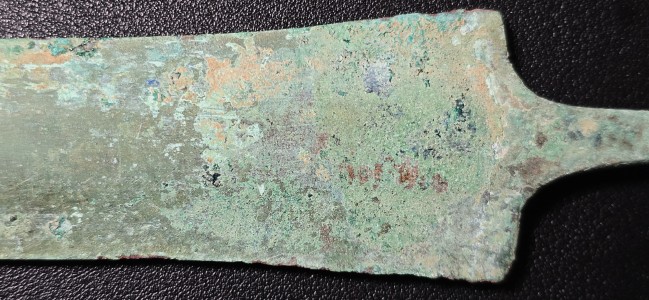
I handle that proof every time I take down the Cypriot pieces in the Sancta Clara Collection. Lot 912 is an Early Cypriot copper-alloy dagger of about 2400–2200 BC. Lot 2644 is a bronze Cypriot dagger. No. 83118347 is a rat-tail-tanged spearhead of 268 mm, which the seller listed as Luristan. I attribute it as Cypriot or Cycladic on the strength of its close parallels among Early Cypriot spearheads in the Metropolitan Museum.
If the metal of these weapons was smelted from Troodos ore, then what I hold is quite literally copper from a mid-ocean ridge. Nothing in their appearance can establish that. Only lead-isotope analysis on clean metal from the core can tie an object to an ore field. I state the attribution as typological, and the ore source as a question the objects could one day answer.
Testing Plato’s island against the ridge
If the ore argument puts Atlantis on the ridge, the rest of Plato’s physical description should at least be compatible with that setting. For the most part it is.
White, black and red stone. Volcanic islands produce exactly this palette: black basalt, red oxidised scoria and pale trachyte or pumice. The Azores show all three. I should be honest that this detail does not single the ridge out. Thera (Santorini) shows the same three colours, and it is one reason Spyridon Marinatos and later Angelos Galanopoulos argued for a Minoan Atlantis destroyed by the Bronze Age eruption. What the detail does is rule out the non-volcanic candidates, including the sedimentary marshes of Doñana.
Hot and cold springs together. These are routine on active volcanic islands on the ridge. The Furnas valley on São Miguel in the Azores has both side by side to this day.
Islands that appear and vanish. The Azores preserve documented cases on a small scale. In 1720 an eruption built an island on the Dom João de Castro bank between Terceira and São Miguel, and within about two years the sea had taken it back. In 1811 the island of Sabrina rose off São Miguel. A British captain landed and claimed it for the Crown, and it was gone within months. These were small islands, but they show that land on the ridge can be born and lost within a human lifetime.
A sea made impassable. Plato’s account of the aftermath is precise: “the sea in those parts is impassable and impenetrable, because there is a shoal of mud in the way; and this was caused by the subsidence of the island” (Timaeus 25d). Large submarine and island eruptions produce floating pumice rafts that can cover hundreds of square kilometres and foul navigation for months. To a sailor in a small ship, a sea choked with pumice and ash would be exactly a shoal of mud where no shoal should be.
Lower seas. At the Last Glacial Maximum, about 21,000 years ago, global sea level stood roughly 120 metres below today’s. On the Canary Islands, reconstructions show that the emerged land grew by around 45 per cent, to some 11,150 square kilometres against about 7,450 today. The Azorean platforms and shallow banks would likewise have stood as more and larger islands.
There are two older pieces of evidence I will not lean on, although they appear in most books on an Atlantic Atlantis.
Termier’s tachylyte. In 1898 a telegraph cable was being recovered some 500 miles north of the Azores, from a depth of around 3,000 metres. The grapnels brought up fragments of tachylyte, a glassy basalt. In his 1912 lecture to the Oceanographic Institute in Paris, the eminent French geologist Pierre Termier argued that such glass could only have solidified in open air. He concluded that it was the surface of a sunken land. We now know that basaltic glass forms readily under water: the quenched rinds of pillow lavas all over the ocean floor are made of it. Rebuttals appeared as early as 1917. The tachylyte proves nothing about dry land.
Kolbe’s diatoms. In 1957 the Swedish diatomist R. W. Kolbe reported abundant freshwater diatoms and grass phytoliths in deep-sea cores from the 1947–48 Albatross expedition. René Malaise took them as remains of sunken lakes. The cores in question come from the equatorial Atlantic off West Africa, however. Modern sediment-trap studies show that the dominant freshwater genus, Melosira, is carried out to sea today by winter winds from the southern Sahara and the Sahel. Kolbe himself weighed wind transport as an explanation. The diatoms are Saharan dust, not Atlantean lakes.
That leaves one more objection I need to address: size.
Plato says the island was “larger than Libya and Asia put together” (Timaeus 24e). In his day those names meant the known lands of North Africa and Anatolia rather than modern continents, but they were vast all the same. The Azores today total about 2,300 square kilometres. The Azores Plateau around them is broad but lies mostly between one and two kilometres deep, and it is generally held to be far beyond the reach of any glacial lowering of the sea. I do not believe that is the whole story.
The ridge has shown that it can carry a large island. Iceland, at about 103,000 square kilometres, exists precisely where the ridge meets a mantle hot spot, and the Azores stand at another such meeting point. No survey has yet found evidence that an island of the size Plato describes subsided at the Azores within the span of human history. Academic geophysics offers no mechanism for kilometre-scale sinking in “a single day and night”. I believe the answer lies in the isostatic mechanics of the Atlantic floor at the close of the Younger Dryas. As the continents were relieved of the weight of their ice sheets, they rose. Meltwater Pulse 1B followed, together with a dramatic isostatic subsidence of the ocean floor. If that mechanism operated as I think it did, it would account for a large landmass sinking in a very short time.
Nine thousand years, or nine thousand months?
The date raises the same question in sharper form. Plato puts the war with Atlantis nine thousand years before Solon, around 9600 BC.
Read literally in solar years, that date has one striking feature: it falls close to the end of the Younger Dryas cold snap, when meltwater was flooding the world’s coastlines. On the current academic view, it also has one serious problem, and it is a metallurgical one. People of that age could at most have hammered native gold, electrum and copper out of a gossan. Walls sheathed in bronze and tin require smelting and tin alloying, and no one anywhere is securely known to have smelted copper before the sixth or fifth millennium BC. Plato’s ladder of bronze, then tin, then orichalcum is a Bronze Age scale of values.
There is a way to take the text literally and still fit the metals into the currently accepted chronology. The figure came, the dialogue insists, from Egyptian priests. Diodorus Siculus records the tradition that the earliest Egyptian year was reckoned by the moon, so that what the old records called a “year” was a month. If the priests’ nine thousand “years” were nine thousand lunar months, the interval is about 730 years. Counted back from Solon’s visit in the early sixth century, that lands close to 1300 BC, squarely in the Late Bronze Age: the age of bronze-sheathed palaces, long-distance tin, and gold as the currency of kings.
Supporters of this reading can point to one detail in its favour. Plato’s primeval Athens has a spring on the Acropolis “which was choked by the earthquake” (Critias 112d). Excavations on the north slope in the 1930s found a deep Mycenaean fountain shaft of the late thirteenth century BC, used for a generation and then abandoned.
I do not accept that reading, however. I see enough compelling evidence to believe that the accepted timeline of early metallurgy is seriously wrong, and on the date I stand with Plato.
Why orichalcum became “only a name”
If orichalcum was the metal of an island’s ore bodies, Plato’s melancholy phrase explains itself. When the island went, the ore went with it.
The same thing happened, more slowly, on land. In the Iberian Pyrite Belt, millennia of working since the Chalcolithic have left almost all the outcropping and near-surface deposits exhausted, so that prospecting today must target deeper orebodies. The rich, gold-bearing gossans were the first thing taken and the first thing to run out. Pliny’s verdict on his gold-copper, “the ground being exhausted”, is the geologist’s verdict on every such field.
What survived was the word, carrying its prestige: a golden, fire-bright metal worth nearly its weight in gold. That prestige was too valuable to leave idle. When metalworkers learned to make a copper that looked golden by cementing it with zinc ore, they gave it the old name. Hence the Gela ingots, hence Augustus’s aurichalcum sestertii, and hence the modern equation of orichalcum with brass.
The imitation inherited the name, as imitations always do. Corinthian bronze went through the same process of legend, loss and imitation, as I show in the hepatizon article linked above.
The metal of law and oath
It is worth ending the textual argument where Plato ends his description. Orichalcum was not merely precious in Atlantis; it was sacred and legal. Poseidon’s laws were cut into an orichalcum pillar, and the kings bound themselves to those laws with a blood oath sworn over it. The metal of the innermost wall was also the metal of the constitution.
That fits a pattern I trace throughout the Bronze Age: the most prestigious metal is the one that carries the oath. Plato frames the whole story in terms that belong to the oldest layer of Mediterranean religion. “In the days of old,” the Critias begins its history, “the gods had the whole earth distributed among them by allotment” (109b). Poseidon’s lot was Atlantis. That idea of a divine council apportioning the lands and peoples of the earth, and of human lineages descended from the gods whose “divine portion began to fade away” (121a), is the subject of my book Abandoned Children of the Gods: Still Waiting for the Return.
The dialogue itself breaks off at the moment of judgement. “Zeus, the god of gods, who rules according to law,” gathers the gods in his most holy dwelling at the centre of the world. He begins to speak, and Plato’s text stops mid-sentence.
Who that lawgiving sky god was before he was Zeus is the question I pursue in The Sky Father: The Lost Bronze Age God Behind Zeus, Jupiter, Tyr and Deus, and in summary in The Lost Bronze Age God: The Sky Father. It is fitting that the last word on Atlantis, left unspoken, belongs to the god of the oath.
What the objects in my hands can and cannot say
A collection is a discipline against wishful thinking, and orichalcum invites a great deal of it.
Lot 38071001. This is a long socketed spearhead from north-western Iran, 448 mm as it survives, of the late third to early second millennium BC. Where the patina has been breached, it shows bright yellow metal beneath. It is tempting to call that golden, and wrong to conclude anything from it. The colour of freshly exposed copper alloy depends on its tin, arsenic and zinc content, and on which corrosion layer is being viewed. Without analysis on clean metal it is a tin bronze until shown otherwise.

Lot 1516. This Early Cycladic copper spear point, possibly from Amorgos, belongs to an Aegean world whose metal came from polymetallic sources. Plato’s own Athens sat beside Laurion, whose silver-lead-zinc ores had been worked since the Bronze Age. His first readers did not need to be told that a mountain can yield several metals at once.
The Cypriot pieces discussed above carry, if their metal is local, the signature of ocean-ridge ore.
What would a genuine piece of natural orichalcum look like on the analyst’s bench? Not like brass. Copper smelted from ordinary ores carries gold at the level of a few parts per million. A metal won from a gold-silver-rich polymetallic ore would carry gold and silver at levels a thousand times higher, from tenths of a per cent up to several per cent, together with zinc and perhaps tin.
Those readings would have to be taken on the core, not on a gold-enriched corrosion skin. Lead isotopes would then have to match them to a massive-sulphide source. The test is well defined. As far as I know, no one has yet looked for such a signature among early copper-alloy objects in a systematic way, because no one has been looking for natural orichalcum at all.
Conclusion
Taken at his word, Plato describes orichalcum as a metal dug from the earth in many places, second in value only to gold, fiery red in colour and lost by his own day. Brass meets none of those conditions. A natural gold-silver-copper alloy, won from polymetallic massive sulphide ores, meets all of them. It is backed by Pliny’s mined and exhausted “gold-copper”, by his fire-coloured pyropus, and by the plain chemistry of copper as a collector of precious metals.
Southern Iberia shows us that ore in its fossil form. The Mid-Atlantic Ridge shows it forming now, and at Reykjanes it shows the ridge’s hot springs carrying copper, zinc, gold and silver on dry land. An island on that ridge, with hot and cold springs, white, black and red stone, and a catastrophic end that left the sea choked, fits Plato’s description better than any rival location I know of.
On everything that can be tested against metal and rock, the literal reading of the Critias holds up remarkably well.
Frequently asked questions
What is orichalcum? Orichalcum (Greek oreichalkos, “mountain copper”) is a precious metal named in early Greek poetry and, most famously, in Plato’s Critias as the metal of Atlantis. Plato describes it as dug from the earth, valued second only to gold, and flashing red. Later Romans applied the name (aurichalcum) to brass. I argue that the original orichalcum was a natural gold-silver-copper alloy won from polymetallic ores.
Was orichalcum real? The word was real and in use for centuries, and the Romans certainly minted coins in a metal they called aurichalcum. Whether Plato’s orichalcum was a real natural metal is the question this article addresses. Pliny the Elder describes a mined “gold-copper” that had been exhausted by his day, which strongly suggests it was.
Is orichalcum the same as brass? Not in Plato. Brass is a manufactured copper-zinc alloy, was known in the Mediterranean before Plato’s time, and is yellow rather than red. Plato’s orichalcum was mined, extinct by his day and fiery red. The brass identification describes the later imitation, not the original.
Why is orichalcum called the Atlantis metal? Because in the Critias it sheathes the innermost wall of the Atlantean capital, coats the Temple of Poseidon, and forms the pillar on which Poseidon’s laws were inscribed and over which the kings swore their oaths.
Where did Plato place Atlantis? On an island in the ocean “in front of” the Pillars of Heracles, the Strait of Gibraltar, from which other islands and “the opposite continent” could be reached. I argue that the Mid-Atlantic Ridge is the most coherent setting, because it is the only place in the Atlantic producing the gold-silver-copper ores that fit Plato’s description.
Could orichalcum-type ore be found today? The ore type certainly exists. It was mined for millennia in the Iberian Pyrite Belt and is forming now on the Mid-Atlantic Ridge, where massive sulphides rich in copper, zinc, gold and silver lie on the sea floor. A worked natural orichalcum would be identified by gold and silver at percent-level concentrations in the core metal, matched by lead isotopes to such a source.
About the author
Andrzej M. Izyk is the author of The Sky Father: The Lost Bronze Age God Behind Zeus, Jupiter, Tyr and Deus and Abandoned Children of the Gods: Still Waiting for the Return. He is an independent researcher of ancient history, archaeometallurgy and ancient belief systems, and the curator of the Sancta Clara Collection of ancient copper-alloy artefacts, catalogued publicly at AncientBronzes.com.
This article was prepared for AncientBronzes.com and the Sancta Clara Collection. © Sancta Clara Collection, 2026.