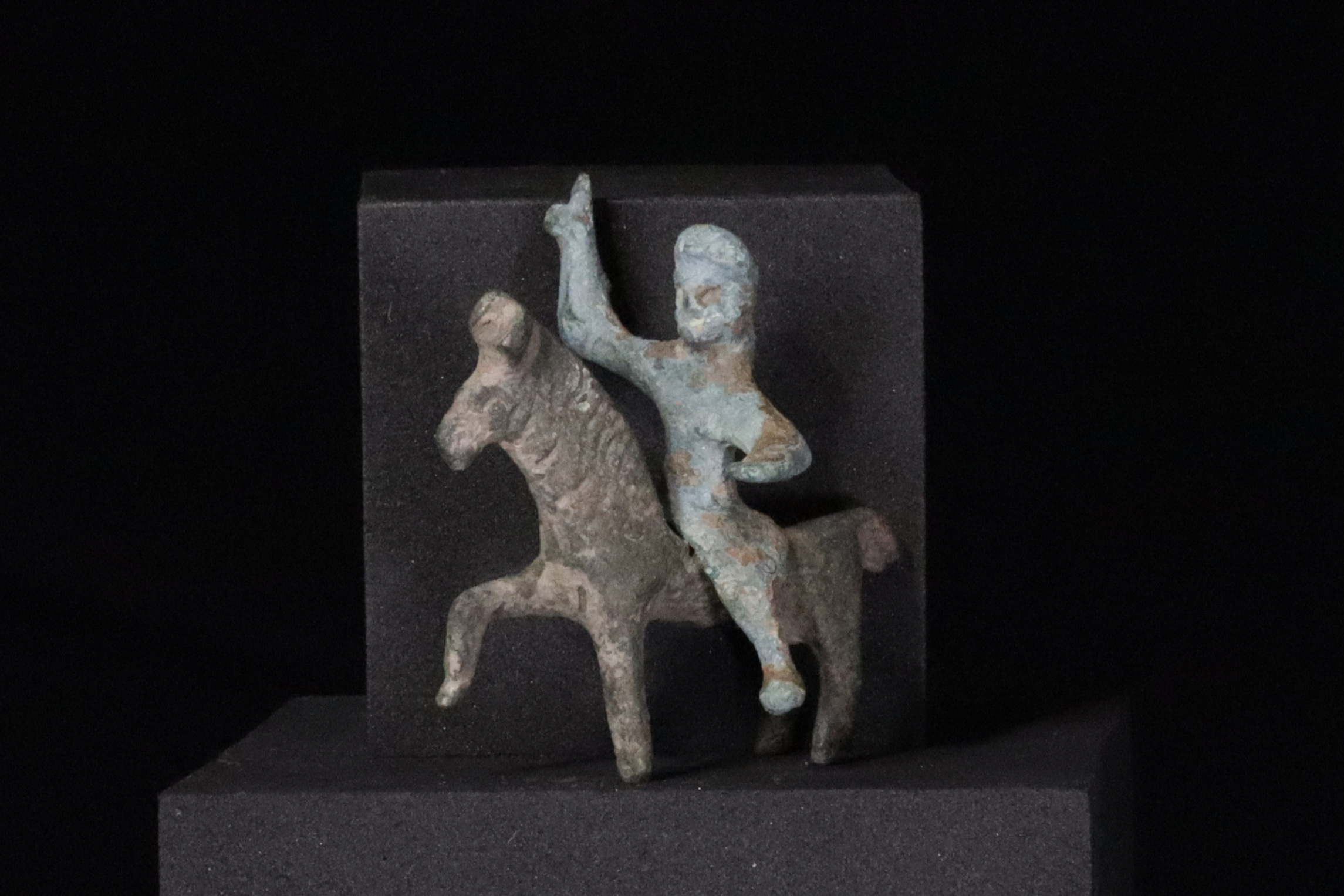

The Sworn Blade: The Sky Father and the Weapons of the Oath
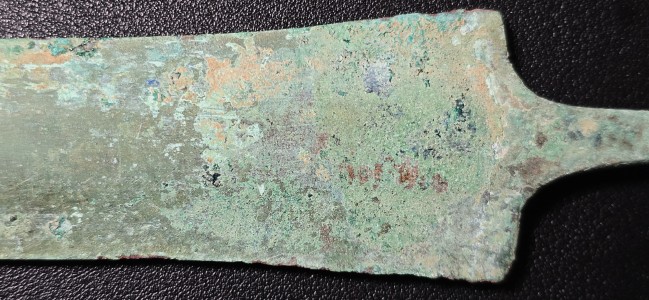
There is a particular kind of object in this collection that I have never been able to file away as merely a weapon. A sword such as Lot 1018 — fifty-two centimetres of Western Asiatic bronze, the flat midrib running clean to the point, the rat-tail tang that once ran down into a grip long since lost to the ground — is, of course, a thing made to kill. But it is also a thing made to be sworn upon, to be carried by a man whose standing in his community rested not on paper, of which there was none, but on the binding force of his given word. Hold such a blade in the hand for any length of time and the two functions begin to feel inseparable. The sword is the argument of last resort behind the oath, and the oath is the thing that made the sword something more than a tool for murder.
I have spent a great many hours with the small cast objects of the vanished Bronze Age world, and the longer I spend the more I have come to believe that we have lost the god who stood behind them. Not lost as an inscription is lost, buried and unread. Lost in a stranger way: papered over, walked past, and forgotten, while his name went on living in the most ordinary words we own. This article is about that god, and about why the daggers and spearheads in these pages are, in a sense I will try to make good, his surviving relics.
A god hiding in plain sight
Say the word day aloud. Now say deity. Now say Jupiter. Underneath the spelling, all three open with the same gesture of the mouth — a d or j sound that, slowed right down, is little more than a d followed by a y-glide. Add the Spanish Dios, the French Dieu, the Italian Dio, and the pattern sharpens rather than dissolves.
This is not my discovery, and I want to be exact about that from the start. For two centuries the discipline of historical linguistics has reconstructed a vanished parent tongue, Proto-Indo-European, spoken perhaps six thousand years ago on the steppe north of the Black Sea, from which descend English and Latin, Greek and Sanskrit, the Celtic, Slavic, Iranian and Germanic languages — very nearly half the tongues spoken on earth today. And at the centre of that lost language stood a god whose reconstructed name the textbooks write as *Dyḗws Ph₂tḗr: the Sky Father. The asterisk marks only that no one ever wrote the name down, because writing did not yet exist when he was first worshipped.
His descendants are not confined to dusty grammars. The Roman Iūpiter is simply Dyēu-pater worn smooth — Sky-Father, the d-y- softened to j- over centuries. The Greek Zeús hides the same opening, and his old vocative gives him away: Zeû páter, “O Father Sky,” the very phrase Homer’s heroes cry. The Vedic priest’s Dyáuṣ Pitṛ́, the Roman senator’s Iūpiter, and the Greek hero’s Zeû páter are, etymologically, the same two words spoken in three rooms of the same enormous house. The same root sank into the ordinary vocabulary of daylight and divinity: Latin dies “day” and deus “god”; Sanskrit dyaus; the Polish dzień, the Russian день. When the Norsemen wanted a plain word for “the gods” they said tívar — and that, too, is his name, worn down into a common noun the way thermos slips loose from its origin.
That much is settled philology, and the reader can verify it in any standard reference. What I have spent years pursuing is the next question, the one the specialists are professionally reluctant to ask: what kind of god was he, and what happened to him?
Which sciences are doing the work
It is worth pausing to name the disciplines this enquiry draws upon, because keeping them distinct is the whole methodological backbone of the argument. The firm ground is comparative historical linguistics, and within it the specialised field of Indo-European studies — the reconstruction of Proto-Indo-European and its daughter tongues. This is what licenses the descent of *Dyḗws Ph₂tḗr into Jupiter, Zeus, and Týr, worked out by the comparative method, by etymology, and by the regular sound-laws (Grimm’s Law chief among them) that allow one to trace a single word across three thousand years. Its sub-branches of onomastics — the study of names — supply the rest: theonymy for the names of gods, toponymy for the names of places that still carry the god’s mark, such as the Swedish forest Tiveden, “Tyr’s wood.”The second discipline is comparative mythology, with its parent field the history of religions. Where linguistics traces the god’s name, comparative mythology reconstructs his role — the witness of oaths, the inaugurator of kings, the warrior of witnessed combat — and compares that role across traditions. The great practitioner here was Georges Dumézil, whose model of sovereignty (the Mitra–Varuna pairing, mirrored in Norse by Týr and Odin) the argument leans on directly. Around both sit the supporting fields that furnish the primary evidence: archaeology, Assyriology, Classics, Egyptology, and Near Eastern studies.The distinction between the first two is not pedantry; it is the discipline of the whole book in a sentence. Same name, same god is what linguistics proves — Týr, the Luwian Tiwad, the Etruscan Tinia, and Roman Iuppiter, all worn down from one word. Different name, same god is what comparative mythology proves — the Vedic Mitra, who is no relative of Tyr’s name but a twin of his function. To confuse a genuine cognate with a chance look-alike is the cardinal sin, and the testing of every connection against that standard is what separates a method from a fishing expedition.
The god of the sworn word
To answer that, one has to repair a piece of furniture the modern mind has quietly thrown out. We must remember what an oath actually was.
Picture a world without writing — which is to say, most of human history. There is no registry of deeds, no signed contract in a drawer, no court record, no written law to consult. When two families agree on the boundary between their fields, no document fixes it; there is only the oath they swore, before witnesses, under the open sky. When one clan promises peace to another, when a trader promises to return in spring with the goods he was paid for, when a chief promises to defend those who follow him — in every case the only thing that makes the agreement real is the sworn word, witnessed and remembered. The oath is not a quaint ceremony decorating an agreement that exists on its own. The oath is the agreement. It is the entire technology of trust, the load-bearing wall beneath boundaries, alliances, commerce, marriage, and rule alike. Pull it out and everything collapses into the war of all against all.
A god who guaranteed the oath, therefore, was not one god among many. He was the keystone of the arch. And it is no accident that this duty fell to the god of the bright daytime sky. An oath must be unhidden — if oaths could be secretly broken they could not bind communities — and the daylight is precisely the domain in which nothing can be concealed. To swear before the sky-father was to place your word in the keeping of the one presence from which nothing is hidden.
The traces are everywhere once you look. Roman treaties were sworn by Iuppiter Lapis, the god by whose stone the fetial priests cut a flint and called down destruction on Rome should she break faith. Beside Jupiter stood the archaic oath-god Dius Fidius — Dius, the heavenly one, from the same bright-sky root, joined to fides, good faith — whose oath could be sworn only beneath the open sky, so that his temple was built with a hole in its roof. Greek Zeus is Horkios, “the oath-keeper,” and Pistios, “the faithful.” And the Norse Tyr survives as the god of oaths and of the Thing, the public legal assembly held under the open sky. A Roman frontier altar at Housesteads on Hadrian’s Wall, raised around 200 CE, calls him Mars Thingsus — Mars of the legal assembly. The function was so essential it survived, cut in stone, for two thousand years.
The rune on the blade
Here the collection and the argument meet, and meet on the edge of a sword.
In the Elder Futhark, the runic alphabet of the Germanic peoples, one letter was named after the god himself: the rune ᛏ, Tiwaz, later Týr. Its shape is an upward-pointing arrow, a vertical stem with two flanges angled toward the sky. The Anglo-Saxon Rune Poem says of it, Tir biþ tacna sum — healdeð trywa wel: “Tir is a sign; he holds faith well.” And this rune was carved on weapons — on sword-blades, on hilts, on spear-shafts — as an invocation of the god’s favour, the deity’s signature etched into the metal and pointed at the heavens.
Consider what that means for the objects in these pages. The bronze and iron points gathered here — the leaf-shaped spearheads of Luristan with their raised midribs, the rapier-type short-swords of the Near East such as Lot 902, the Mycenaean short sword Lot 778 with its long reach and its evident history of use — belong to the same long technological and religious continuum that, by the Iron Age, would see a warrior scratch the sky-god’s mark on his blade before battle. The impulse is older than the rune that records it. A weapon was not only a means of killing; it was a sworn instrument, bound up with the warrior’s standing, his loyalty, his given word. The duel under daylight — single combat fought before witnesses, where the outcome was read as a verdict rather than a brawl — was the sky-father’s own institution. Tyr, whom Tacitus’s Romans matched to Mars, was in his oldest stratum not the chaos-god of mass slaughter but the guardian of legitimate, witnessed combat. The blade and the oath were forged in the same fire.
So when I turn a Bronze Age sword over in my hands and feel the casting seam, the wear, the deliberate weight of the thing, I am not only handling a piece of metallurgy — a subject I have written about at length elsewhere, in the language of patina and in the survey of ancient bronze swords. I am handling the material residue of a world whose entire order was held together by sworn truth, and whose highest god was the witness of that truth.
The hand in the wolf’s jaws
The deepest image of this god survives in the North, and it is worth telling in full, because once seen it is not forgotten.
The gods have learned that the monstrous wolf Fenrir will one day bring the cosmic order to ruin. They cannot kill him; they cannot let him run free. They resolve to bind him with a magical fetter, light as a silk ribbon and unbreakable. But the wolf is no fool. He will consent to be bound only if one of the gods places a hand between his jaws as a pledge of good faith — so that if the fetter is a trick, the hand is forfeit. The whole circle of gods holds back. They want the binding and they want to keep their hands; they want the outcome at no cost, and at that price the outcome cannot be had.
Only Tyr steps forward. He lays his right hand in the wolf’s mouth. The fetter holds; the wolf is bound; and Fenrir, understanding he has been tricked, bites down. Tyr loses his hand.
That is the story, and its core never changes. Tyr offers his hand knowing it will be lost, and he loses it. What makes the gesture extraordinary is what it is not. It is not a battle — he never draws a weapon, never strikes at the wolf, never tries to win. And it is not a trade. He gains nothing: no knowledge, no power, not even honour, for the wolf does not thank him and the other gods would not do what he did. He pays a price no one else would pay, knowing in advance he would pay it, because the binding of chaos required someone to make the pledge real. Other gods sacrifice to gain — Odin trades an eye for wisdom. Tyr’s sacrifice is of another kind entirely: a pledge that seeks no return, an oath made flesh in his own body. He does not master chaos by defeating it, because chaos cannot be defeated; he holds it, for a time, at a cost he accepts with open eyes. Do your worst. The order will hold. I have decided.
I do not know a braver stance in all of mythology, and I do not think it an accident that it belongs to the god whose other name is simply the bright sky, the god of the sworn and the true. This is what sworn truth looks like when it is asked for everything. It looks like an open hand in the mouth of the wolf.
What was overthrown
And then, across almost every culture that had worshipped him, he was overthrown. Somewhere in the long centuries of the war-chariot and the warrior aristocracy, a younger and more violent god rose up and took the throne: Indra over Dyaus in India, Marduk over the older sky-god An in Babylon, Baal and then Yahweh over El in the Levant, Odin and Thor over Tyr in the North.
What changed was not merely the name at the top of the pantheon. It was a whole way of imagining how the world holds together. The old god was the witness of the sworn word, the guarantor that a promise made under the open sky was a real and binding thing. The gods who replaced him were of another kind: gods of the storm and the thunderbolt, who took their thrones by slaying dragons, whose authority rested on victory — might, demonstrated, becoming right. One might call the difference the creed of keeping faith against the creed of taking: the guardian who holds his place honourably within an order larger than himself, against the conqueror who expands without limit because he can. We are the heirs, all of us, of the second kind of god, and we have lived inside the victor’s story so long that we can barely remember the first was ever thinkable.
That, finally, is why these objects move me as they do. A collection like this one is a field of fragments from precisely the world that was overwritten — the world before the storm-gods won, when a blade and an oath were the same kind of thing. To recover the Sky Father is to recover the memory that the conqueror’s creed was never the only one.
The book
It is, I wrote once, like finding one perfect hand of a shattered bronze in the dark of a storeroom — and I have held such fragments — and knowing, from the surety of that one hand, how great the whole figure must have been, and that the rest is gone past recovering. The Sky Father reaches us exactly so: a name worn into half the world’s words, a rune on an Iron Age blade, a hand in a wolf’s jaws, and the silence where the rest of a god should be.
I have spent several years following that figure across languages, across the ethics of the oath, and into the stones of some of the most extraordinary ruins on earth. The result is a book, The Sky Father: The Lost Bronze Age God Behind Zeus, Jupiter, Tyr, and Deus, now available on Amazon.
I should say plainly what it is and is not. I am not an archaeologist or a philologist by training; where the book rests on the work of those who are — and in its firmest chapters it rests on them almost entirely — I have tried to represent their findings faithfully and to mark clearly the line where their conclusions end and my own speculation begins. When I cross that line, I say so; the reader never has to guess. What I bring instead is a particular angle of vision — a background in international law and the theory of war, which is to say in treaties, sworn oaths, and the hard question of what makes authority legitimate rather than merely victorious — and the conviction of a lifelong collector that the truth which most interests me tends to fall in the gaps between the disciplines, where no single specialist feels authorised to look. It is offered in the one spirit I trust: preferring the truth to the consensus, wherever the two come apart.
If the weapons in this collection have ever made you wonder about the world that made them — the world of the sworn word, the witnessed duel, the rune cut into the blade — then this is the larger story those objects belong to.
The Sky Father: The Lost Bronze Age God Behind Zeus, Jupiter, Tyr, and Deus by Andrzej M. Izyk is available now on Amazon: https://a.co/d/0f2zGYUU
*This article is part of the editorial library of AncientBronzes.com, companion to the Sancta Clara Collection. Lot references throughout link to catalogue entries within the collection. The linguistic descent of **Dyḗws Ph₂tḗr* and the documented oath-functions of Jupiter, Zeus, and Tyr summarised here reflect established scholarship in comparative Indo-European studies; the broader interpretive argument — the reading of the Bronze Age weapon as a “sworn instrument,” and the framing of the storm-god revolution as the overthrow of a “creed of keeping faith” — is the author’s own, developed at length, with its evidence laid open to challenge, in_ The Sky Father. © AncientBronzes.com.*