
The Steppe Archers: Scythian Bronze Arrowheads and the Technology of Mounted Warfare
There is a particular kind of object in this collection that I find myself returning to far more often than its modest size would seem to justify. It fits in the palm of the hand, weighs a few grams, and was made by the hundreds of thousands. It is the socketed bronze arrowhead of the Eurasian steppe — and to my mind it is one of the most quietly revolutionary artefacts in the entire ancient armoury. Where a Luristan spearhead is a statement and a Mycenaean dirk a treasure, the Scythian trilobate arrowhead is something stranger and more modern: a piece of standardised, mass-produced munition, cast in two-piece moulds by the bushel, interchangeable from one battle to the next, and engineered around a single, ruthlessly effective military doctrine. To hold one is to hold the ammunition of the first great cavalry archers of history.
This article is the next in my series of named-culture deep dives, following the work I have already done on the metalworkers of the Zagros. But where “Luristan” is a label I have argued is a market-driven oversimplification, “Scythian” presents a different and equally instructive problem: it is a name that the ancient world itself stretched, borrowed, and misapplied across a thousand years and five thousand kilometres. Before we can talk about the bronzes, we have to talk about the word.
What the Name Means, and How to Say It
In English we say Scythian, and we say it with a soft initial sound — most dictionaries give /ˈsɪθiən/ or /ˈsɪðiən/, “SITH-ee-un” — though you will hear careful classicists harden it toward “SKITH-ee-un” in deference to the Greek. That Greek form is the root of our word: Skýthēs (Σκύθης), plural Skýthai (Σκύθαι), which passed through Latin Scythae to give us the modern term. The soft “s” of our pronunciation is an accident of how Greek theta and Latin transmission landed in English; the original sound was harder.
The more interesting story is what the people called themselves. The reconstructed endonym is Skuδa (or Skuda), built on the Proto-Indo-European root skewd-, meaning “to shoot, to propel” — the same root, by a satisfying coincidence, that very probably gives us the English verb to shoot. The Scythians, in their own language, were quite simply the Shooters: the Archers. There is no more honest self-description in all of ancient ethnography. A people named themselves after the weapon, and the weapon is what fills the trays of this collection.
The endonym fractured as it travelled. By the time of the Persian invasions, a sound change within the Scythian language itself had turned the /d/ into an /l/, so that Herodotus could record the self-designation Skolotoi (Σκώλοτοι) alongside the Greek Skythai. The Persians called them Saka; the Assyrians, encountering them in the Near East, wrote Aškuza or Iškuza; and through a scribal slip in Hebrew, that same Aškuz was miscopied as Aškenaz — which is how a steppe archer people lurk, etymologically, behind the medieval term for Rhineland Jewry. The Chinese, meeting their eastern cousins, wrote Sai. One root, Skuda, refracted through every literate civilisation that the nomads ever frightened.
A word of caution that runs through everything below: “Scythian” in modern usage covers a spectrum. In the strict sense it names the Pontic tribes north of the Black Sea described by Herodotus. In the loose sense — the sense that auction catalogues and even some scholarship use freely — it stands in for the whole “Scytho-Siberian” cultural continuum stretching from Ukraine to Mongolia, embracing the eastern Saka, the Altai cultures, and others. Some specialists, Di Cosmo among them, would prefer we drop the blanket term entirely and speak of “Early Nomadic” cultures. I keep the word because it is useful and universally understood, but the reader should treat it as a family name, not a passport.
Sarmatians and Parthians: The Wider Family
The Scythians did not exist in isolation, and two neighbouring peoples are worth fixing in mind before we go further, because their names recur constantly in any discussion of steppe bronzes.
The Sarmatians were the Scythians’ close kin and ultimate successors. An Iranian-speaking nomadic people from the east, they pressed westward across the Pontic steppe and, from roughly the first century AD, absorbed and replaced the Scythians proper; the archaeological record shows the Late Scythians of the Crimea being substantially assimilated by Sarmatian populations across the first and second centuries CE. Herodotus, tellingly, recorded a tradition that the Sarmatians themselves were born of a union between Scythian men and Amazon women — a detail I will return to. For our purposes the key point is continuity: the Sarmatians inherited the same animal-style art, the same mounted-archery doctrine, and broadly the same arrowhead types, so that a great deal of material sold as “Scythian” is, strictly, Scytho-Sarmatian.
The Parthians belong to a related but distinct story. Also of Iranian nomadic origin — descended from the Parni, a Saka-related people — they settled and founded a great sedentary empire in Iran and Mesopotamia (c. 247 BC – 224 AD) that rivalled Rome. The Parthians were no longer steppe nomads, but they preserved the steppe inheritance in their devastating horse archery; the famous “Parthian shot,” loosed backwards from a galloping horse in feigned retreat, is the steppe tactic perfected and made proverbial. This collection holds Parthian socketed trilobate arrowheads (Lot 1822, and the group of three in Lot 1069) that are recognisably the same technological family as the earlier Scythian pieces — the doctrine outlived the people who invented it.
Conquest, Migration, and the Reach of the Steppe
The Scythians enter recorded history not as a curiosity on the margin but as a power that shook the Near East. In the seventh century BC they swept down through the Caucasus and campaigned across Assyria, Media, and the Levant, reaching the borders of Egypt, where the pharaoh Psammetichus is said to have bought them off rather than face them. For a generation they were, by Herodotus’ account, overlords of much of western Asia. This is not a peripheral people; this is a cavalry power operating at continental scale, and it did so on the strength of the composite bow and the mass-produced arrow.
The Scythian world was a migratory and absorptive one. The “original” Scythians, pushed west out of Central Asia, became the ruling stratum over countless subject peoples who adopted their masters’ lifestyle, equipment, and even their name. This is precisely why the arrowhead types spread so far and so uniformly: a successful military technology, carried by a mobile and dominant elite, propagates across the entire steppe corridor. By the time the culture’s eastern and western wings are compared — the Altai kurgans of Pazyryk against the Pontic mounds of Ukraine — they share a recognisably common toolkit despite the vast distance between them. The collection’s Altai trilobate (Lot 11481) and its Pontic-zone Scythian pieces (Lots 11482, 11486, 11487) are separated by thousands of kilometres and yet belong unmistakably to one tradition.
Their end was the common fate of steppe powers: absorbed from within and overrun from without. The Sarmatians displaced them on the western steppe; the Goths overwhelmed the last Pontic remnants by the third century AD; and thereafter, for more than a thousand years, “Scythian” became a lazy literary label that medieval and early-modern writers slapped onto any northern nomad they did not understand — Huns, Goths, even Slavs. The word outlived the people by a millennium and a half.
The Women of the Steppe, and the Amazons
Few claims in ancient history have been so thoroughly vindicated by the spade as Herodotus’ insistence that steppe women fought. For most of the twentieth century, archaeologists excavating Scythian and Sarmatian kurgans assumed, by reflex, that any skeleton buried with weapons was male. The advent of osteology and ancient-DNA analysis demolished that assumption. Across the steppe, somewhere between a fifth and a third of weapon-bearing nomadic graves have turned out to hold women — women buried with bows, quivers, daggers, axes, and horse-harness, many bearing the bowed leg bones and muscular signatures of a lifetime in the saddle, and a striking number showing healed combat trauma: arrowheads embedded in bone, blade cuts, crushing injuries.
The cases are vivid. At Devitsa in western Russia, two women were excavated with horse-harness and some thirty arrowheads between them. In a Tuvan burial, remains long assumed to be a “prepubescent boy warrior,” interred with a birchwood bow and a quiver of ten wood-, bone-, and bronze-tipped arrows, were revealed by genome sequencing to be a girl of no more than thirteen. The excavator’s own reaction — that the find “returns us to the myth of the Amazons” — is the one every archaeologist seems to reach for, and with reason.
This is where the Amazon question becomes serious rather than romantic. The Greek legend of a nation of warrior women on the steppe margins, fighting on horseback with the bow, was long dismissed as pure fantasy or as Greek anxiety about female power projected onto the barbarian east. The bioarchaeology suggests something more interesting: that the Amazons of myth are a Greek refraction of a real and observed phenomenon — the armed women of Scythia and Sarmatia. Herodotus’ own aetiology, that the Sarmatians descended from Scythian men marrying Amazons and that Sarmatian women rode, hunted, and fought, reads now less like folklore and more like reportage filtered through legend. I would not go so far as to say “the Amazons were Scythians” — the myth has older and more tangled roots than that — but I am comfortable stating, as my own position, that the steppe warrior woman is the historical bedrock beneath the Greek story, and that the small bronze arrowheads in this collection were as likely to have been loosed by a woman as a man. That is not a fashionable flourish; it is what the graves say.
Beyond the Arrowhead: The Other Scythian Bronzes
If the arrowhead is the ammunition of the steppe, it is far from the only bronze the culture left us. The Scythians are conventionally defined by a “triad” — weapons, horse-harness, and animal-style art — and bronze is the connective tissue of all three. Gold gets the museum headlines, but as the literature is at pains to point out, the predominant working material for the mass of Scythian objects was bronze; gold was the prerogative of the ruling elite, bronze the medium of the warrior class at large.
The other weapon that defines the culture is the akinakes, the short iron or bronze sword or long dagger carried at the hip, often with a bronze hilt even when the blade is iron, and frequently with a zoomorphic pommel. Alongside it goes the gorytos — the distinctive combined bow-and-arrow case slung at the waist, the very container these arrowheads would have filled — whose metal and gold-sheet fittings survive from the richest graves at Solokha and Chertomlyk.
Then there is the animal style itself, the glory of Scythian art and overwhelmingly a bronze art in its everyday form. Stylised stags, coiled felines, raptors, griffins, and writhing combats of beast against beast were cast as plaques, belt-fittings, harness ornaments, sword-scabbard mounts, and clothing appliqués. These were not mere decoration: sewn onto stiff leather jerkins, the bronze plaques doubled as a primitive armour, and the animal forms were understood to lend the wearer the prowess of the beast depicted. Recent securely-dated work from the Tunnug 1 kurgan in Siberia (around 800 BC, among the earliest Scythian material we have) suggests the animal style began precisely on such functional objects — harness and tools — before it ever became free-standing art.
To this we can add the great cast-bronze cauldrons, used for communal feasting and ritual; bronze mirrors, a recurring grave-good especially in female burials (one was found in the Amazon-type burial at Mamai Hill in Ukraine); horse-bits and bridle ornaments in profusion; and, at the cultural fringes, the extraordinary Permian bronze casts of the northern forests, whose three-tiered cosmological plaques and mother-goddess imagery show the Scytho-Sarmatian animal style radiating far beyond the steppe proper. The Scythians, being nomads, made portable art almost exclusively — everything was meant to ride — and bronze, durable and recastable, was the ideal medium for a people who carried their wealth on horseback. Readers interested in the votive and sacred dimension of small cast bronzes will find the broader argument in my article on ancient bronze figurines, votives, and the personal sacred.
The Arrowhead Itself: An Industrial Object
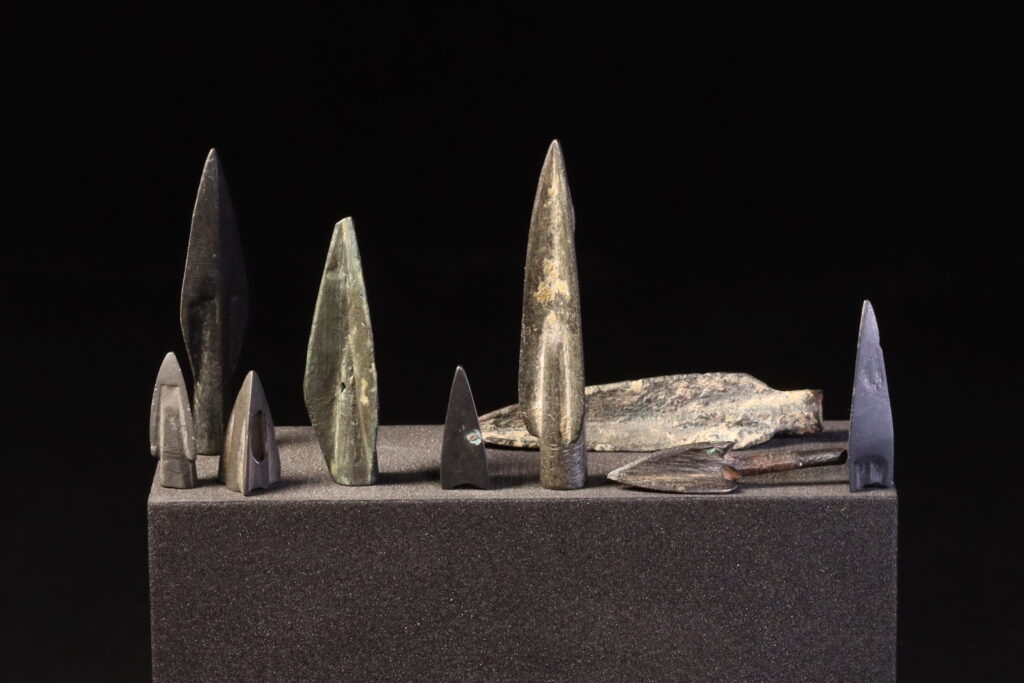
Now to the heart of the matter, and to the pieces themselves. The Scythian socketed arrowhead is, I will argue, the first genuinely industrial munition in the Western record — and the catalogue lets us watch its logic unfold.
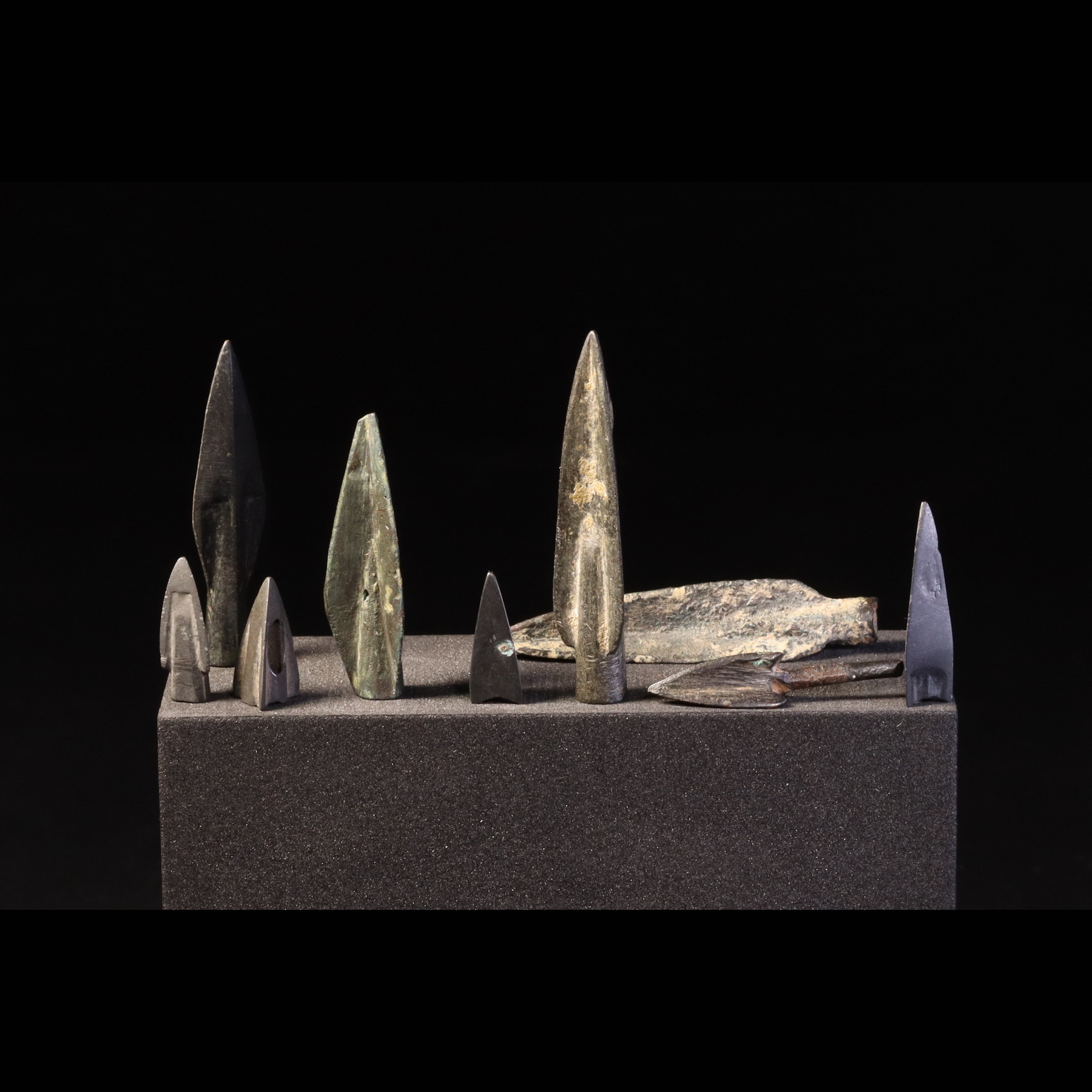
The defining technical leap is the cast socket. Earlier arrowheads across the Bronze Age were overwhelmingly tanged: a spike at the base was driven into a split shaft and bound. The bilobate (two-bladed) tanged forms in this collection — the Scythian piece at Lot 11494, the spurred Graeco-Scythian example at Lot 722 — sit at the older end of this story. The steppe revolution was to cast the head around a socket, hollow, so the shaft slips inside rather than the head slipping into the shaft. A socketed head self-centres on the shaft, sits perfectly true, and can be mass-produced in a reusable two-piece mould to identical specification, batch after batch. This is the precondition for industrialised archery: ammunition that is interchangeable, quick to fit, and uniform in flight.
The second leap is the trilobate (three-bladed) head. Where the bilobate form is a flat blade with two cutting edges, the trilobate is three vanes radiating at 120 degrees around the central socket. The geometry is not decorative. Three vanes give a wound channel that does not close, superior penetration of leather and quilted-textile armour, aerodynamic stability in flight without fletching doing all the work, and — crucially — a shape that casts cleanly and symmetrically in a mould. It is the optimal marriage of terminal ballistics and mass-manufacture. The collection’s trilobates show the type at its mature best: the barbed Scythian examples at Lots 11482 and 11486, the cleaner trilobate at Lot 11487, the Altai piece at Lot 11481, and the Scythian-or-Babylonian pieces at Lots 11489 and 11492 that sit on the cultural boundary where steppe and Near Eastern traditions met and traded forms.
This sequence — tanged bilobate giving way to socketed bilobate giving way to socketed trilobate — is the technological spine of the article, and I want to be candid that it is a tendency rather than a clean linear march. The forms overlap in time and space; a conservative region kept casting bilobates while its neighbour adopted trilobates; and the “Scythian or Babylonian” attributions in the catalogue are honest admissions that, at the meeting-points of cultures, the typology blurs. But the direction of travel is unmistakable, and it tracks a military doctrine. Mass mounted archery — clouds of arrows loosed at the gallop by a mobile cavalry that never closes to contact unless it chooses to — demands ammunition in industrial quantity, of uniform quality, fitted fast. The trilobate socketed arrowhead is the physical expression of that demand. It is, in the most literal sense, the bullet of its age.
A Note on Attribution and Method
In keeping with the practice across this library, I want to separate what is settled from what is my own reading.
Settled, or close to it: the etymology of the name from Skuda, “archer”; the existence and scale of armed women in steppe society; the technological superiority and mass-production of the socketed trilobate; the relationship of Sarmatians and Parthians to the Scythian core. These rest on solid published consensus.
My own positions, offered as argument rather than fact: that the trilobate socketed arrowhead deserves to be understood specifically as an industrial object and the first true standardised munition in the Western record — a framing that goes beyond how most catalogues present these pieces; and that the steppe warrior woman should be regarded as the historical bedrock of the Amazon myth rather than a coincidental parallel to it. I hold both views firmly, but I flag them as interpretation.
And a word the careful collector will want said plainly: the precise tribal label attached to any individual arrowhead — “Scythian” versus “Saka” versus “Sarmatian” versus “Babylonian” — is very often a probability, not a certainty. These objects travelled, were traded, were copied, and outlived their makers. Where the catalogue says “Scythian or Babylonian,” it is being honest about a genuine ambiguity, and that honesty is worth more than a confident label that the evidence cannot bear. As with my argument about “Luristan,” the tidy market name conceals a messier and more interesting reality.
Sources and Further Reading
A. Mayor, The Amazons: Lives and Legends of Warrior Women across the Ancient World (Princeton, 2014); J. Davis-Kimball, Warrior Women: An Archaeologist’s Search for History’s Hidden Heroines (New York, 2002); Herodotus, Histories, Book IV; the entry “Scythians” in the Encyclopaedia Iranica (Ivantchik); O. Szemerényi on the reconstruction of the endonym Skuda; T. Sadykov et al. on the Tunnug 1 animal-style material (Antiquity, 2025); Kilunovskaya et al. on the Tuva “Amazon” burial (Stratum Plus, 2020); B. Cunliffe, The Scythians: Nomad Warriors of the Steppe (Oxford, 2019); and the Hermitage and Metropolitan Museum collections of Scytho-Siberian metalwork.
This article is part of the named-culture series at AncientBronzes.com, the public reference catalogue of the Sancta Clara Collection. Lot numbers cited throughout refer to catalogued items in the collection. © AncientBronzes.com.