
We have to begin by unlearning a word. When we look at a small ancient bronze of a woman, a bird, an ibex, or a seated god, the modern eye reaches instinctively for the category “art” — a thing made to be admired, displayed, contemplated for its beauty. This is almost certainly wrong, and the wrongness matters, because it stands between us and what these objects actually were. The people who cast them were not making art in our sense. They were making tools — instruments for doing something in the world. The thing in your hand was not meant to be beautiful. It was meant to work.
What it was meant to do was establish a connection. A bronze figurine was a point of contact between a single human being and a force — a god, a spirit, an ancestor, a power of fertility or protection or fortune — that could influence the course of a life. It was a device for negotiating with destiny. To call it art is to mistake the residue for the purpose, rather as a future archaeologist might admire the elegant typography of a prayer book while missing entirely that people once knelt to it. This article is about that purpose: the forgotten function of the small sacred object, and the deep, strange, only half-understood human impulses it served.
The economy of the sacred
The governing logic of the ancient figurine was the votive transaction, and it is best summed up in a Latin phrase that long postdates the practice but captures it exactly: do ut des — “I give so that you may give.” The relationship between a person and the powers that governed their world was not one of pure submission or pure faith. It was, at bottom, reciprocal. You gave the god something — an offering, an image, a token of devotion — and in return you expected, or at least hoped for, the god’s favour: a healthy child, a good harvest, safe passage, victory, recovery from sickness, protection from the malign forces that pressed in everywhere on ancient life.
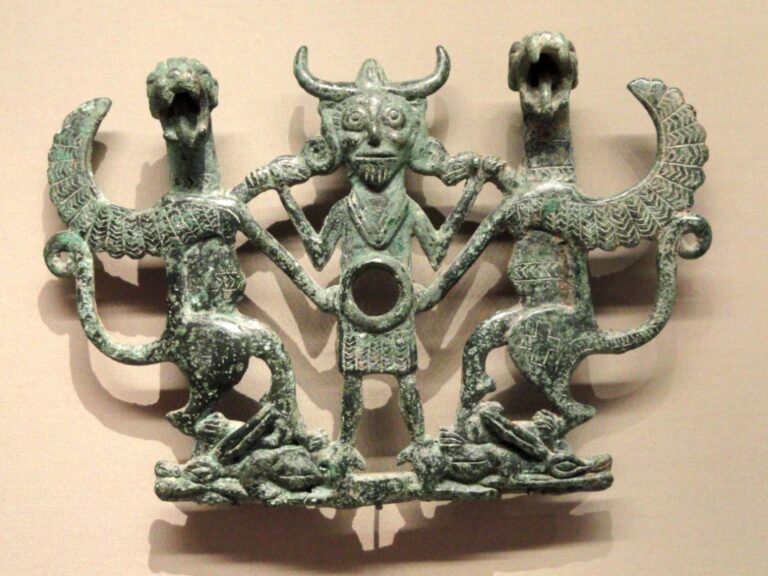
The figurine was the physical instrument of that exchange. Sometimes it was the offering — a small bronze image left at a shrine, deposited in a sacred spring, buried in a sanctuary, given over permanently to the divine as a tangible prayer made metal. The great Zagros sanctuary of Surkh Dum, which I discussed in Luristan Bronzes: The Metalworkers of the Zagros, was exactly such a place: generation upon generation of mountain people climbed to it and left their bronzes, until the floor of the shrine was a sediment of accumulated devotion. Each object represents a single human transaction with the unseen — a deal struck, a hope deposited.
At other times the figurine was not given away but kept — carried, worn, set in a household niche — as the durable anchor of an ongoing relationship. Here the object functioned less like a one-time payment and more like a permanent line of communication: a household god who lived with the family, a protective image worn against the body, a small deity who could be addressed daily. Either way, the figurine was working machinery in the spiritual economy. It was how an ordinary person reached the powers that mattered.
This is why bronze, specifically, was so apt a material. A votive offering should endure — a prayer in clay can crumble, but a prayer in bronze persists, gleaming, incorruptible in a way that flesh and grain and timber are not. The metal’s permanence was itself a kind of theological statement: the offering, and the relationship it embodied, was meant to last. The same corrosion processes that we now read to authenticate these pieces, set out in The Language of Patina, are simply the slow record of how long that bronze prayer has lain undisturbed.
The meaning of smallness
There is a clue to the nature of these objects that is so obvious we tend to overlook it: they are small. A votive bronze figurine sits in the palm. It can be closed in a fist, hung from a cord, carried in a pouch, tucked into a niche beside the hearth. This is not an accident of preservation or a limitation of technique — these same cultures could and did raise monumental images. The smallness is the meaning.
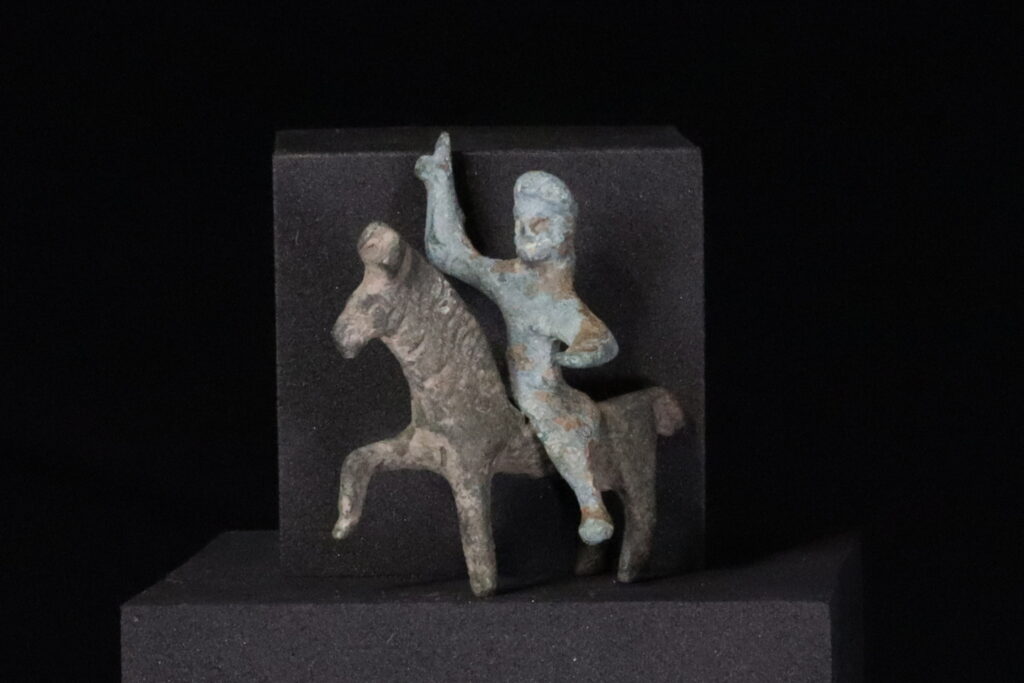
A great cult statue in a temple, or a colossus at a city gate, expresses a public relationship with the divine: the god of the whole people, mediated by priesthoods, approached on festival days, belonging to everyone and therefore to no one in particular. The small bronze expresses something entirely different and, I would argue, far more intimate. It is the personal sacred — the god you could hold, the power you had a private arrangement with, the divine presence scaled to the individual life rather than the civic monument. The smallness tells us that for most people, most of the time, religion was not the great procession through the temple gates. It was the daily, domestic, hand-sized negotiation with a force you kept close.
This personal scale is, I think, the most human thing about these objects, and the thing the museum vitrine most effectively destroys. Behind glass, lit and labelled, a bronze figurine becomes a specimen. In the hand, it becomes what it was: a person’s private means of reaching for help, for luck, for protection, for connection with something larger than a precarious mortal life. The smallness is the fingerprint of that intimacy.
The Mother: humanity’s oldest image
If you ask which figure recurs most insistently across the deep history of the small sacred image, the answer is not in doubt. It is the female form — and behind it, in some guise we still cannot fully define, the archetype we clumsily call the Mother.
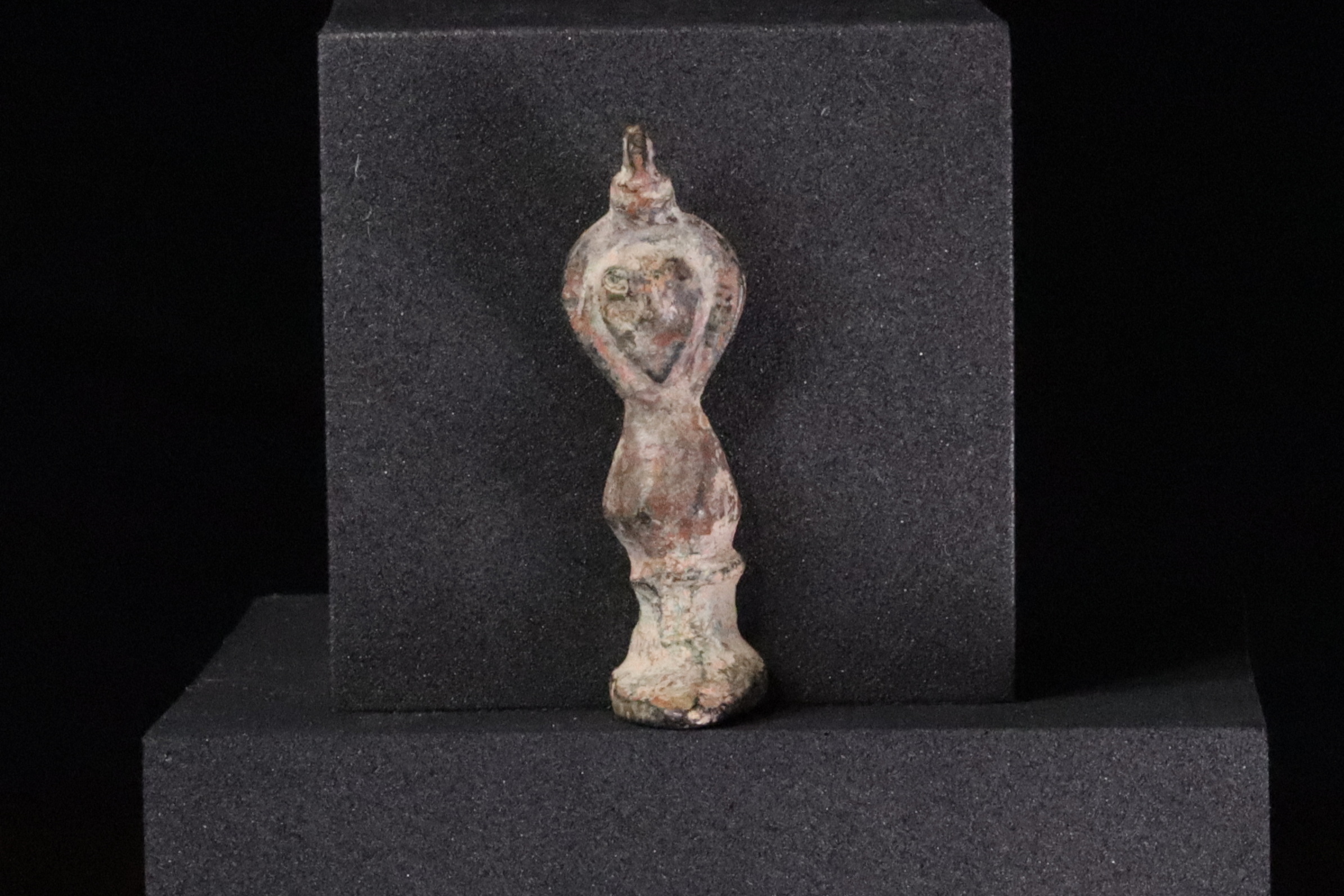
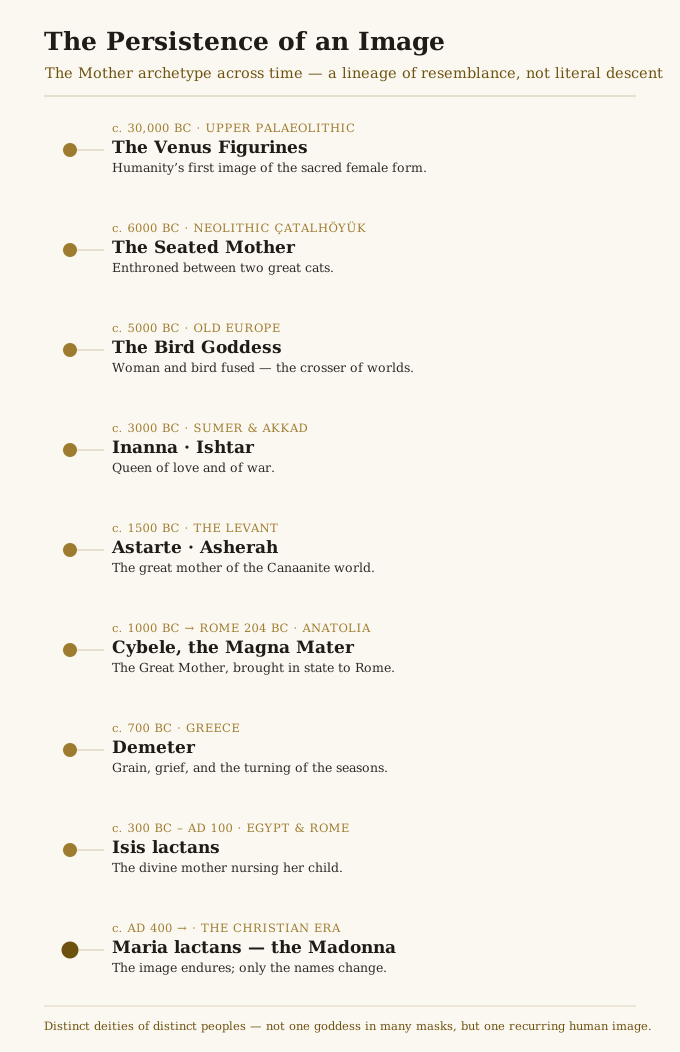
She is older than metal, older than farming, older than the city. The so-called Venus figurines of the Upper Palaeolithic — Willendorf, Dolní Věstonice, Hohle Fels, and dozens more — carry her back tens of thousands of years, to the very dawn of representational image-making. These are among the first things human beings ever made that depict a human being, and overwhelmingly they depict a woman, often with the generative aspects of the body emphasised to the point of abstraction. Then, with the Neolithic and the coming of agriculture, the female figurine explodes in frequency: the seated woman of Çatalhöyük flanked by her great cats; the countless figures of Old Europe and the Near East; and on into the Bronze Age, where the mould-made “goddess” plaques of the Levant and the cast bronze female figures of the wider Near East continue the line. The goddess figures in this Collection — the bronze figures catalogued under Lots 499, 368, and 2287 — belong to the late chapters of a story that is, almost literally, as old as art itself.
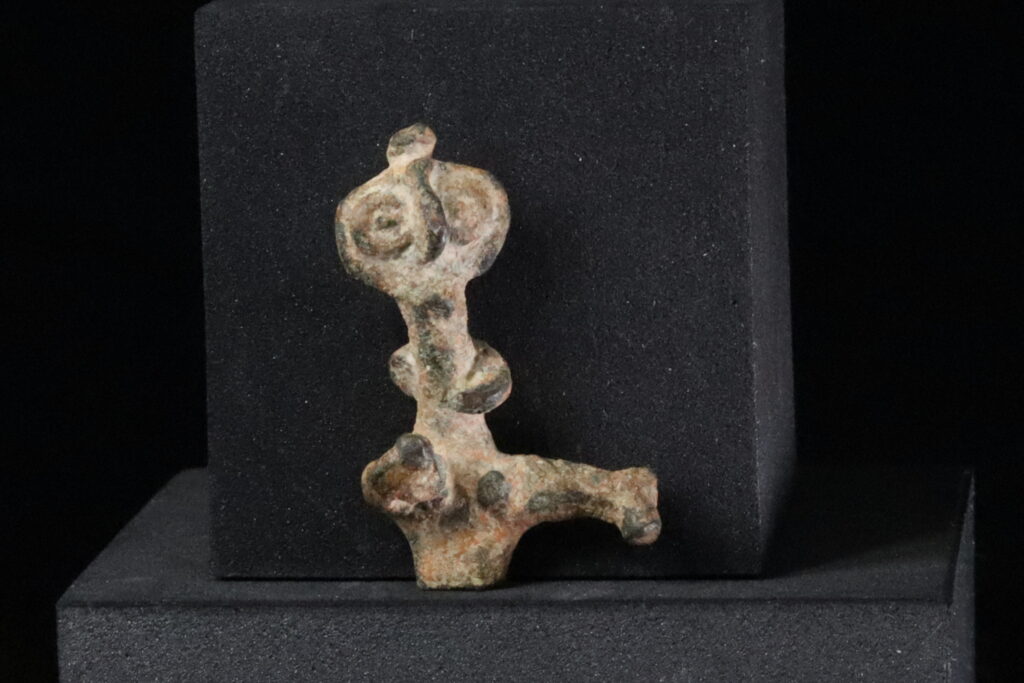
What does she mean? Here we must be honest, and the honesty is the point. We do not know. The temptation — and it is an old and powerful one — is to read this vast scatter of female images as evidence of a single, universal religion: a primordial cult of the Great Mother, the Earth Goddess, worshipped continuously from the Ice Age to the coming of the patriarchal sky-gods. This is the thesis most famously associated with the archaeologist Marija Gimbutas, who saw in the figurines of “Old Europe” the traces of a peaceful, matrifocal, goddess-centred civilization later overrun by warlike Indo-European horsemen from the steppe.
I want to be careful and fair here, because Gimbutas’s legacy is genuinely double. Her Kurgan hypothesis — the idea that Indo-European languages and peoples spread westward from the Pontic-Caspian steppe — has been strikingly vindicated, confirmed in our own time by ancient DNA. But her grand synthesis of a unified prehistoric Goddess religion, with its confident decoding of every chevron and spiral as sacred symbol, is regarded by most archaeologists today as going far beyond what the evidence can bear. The figurines are real and they are abundant; the single coherent theology she built from them is, in the sober view, a beautiful and influential hypothesis rather than an established fact.
The truthful position is more uncomfortable and more interesting than either the romantic Great Goddess or its dismissal. We have thousands of female figurines across tens of millennia and half a world. They clearly meant something profound and recurrent to the people who made them. But whether they represent goddesses, ancestors, fertility charms, didactic objects, portraits, or things for which we have no category at all — and whether the resemblance across cultures reflects a shared inheritance or merely the independent human preoccupation with birth, the body, and survival — we cannot say with confidence. The word “goddess” on a catalogue card is very often a placeholder for our ignorance dressed as knowledge. I prefer to leave the mystery standing, because it is real.
The Bird Goddess: the strangest archetype
Within this vast Mother-imagery there is a subset stranger than the rest, and it deserves its own attention because it appears so often and is understood so poorly: the figures that blend the human, usually female, with the bird.
These are the images Gimbutas christened the Bird Goddess — Neolithic and later figures with beaked or pinched faces, columnar bird-like bodies, sometimes wings or tail, frequently incised with the chevrons, meanders, and zigzags she read as the sign of water and flowing life. They turn up across Old Europe and beyond in great numbers, and their hybrid form is genuinely arresting: not quite woman, not quite bird, something deliberately between. The bird-woman is one of the most persistent and least explained figures in the whole prehistoric repertoire.
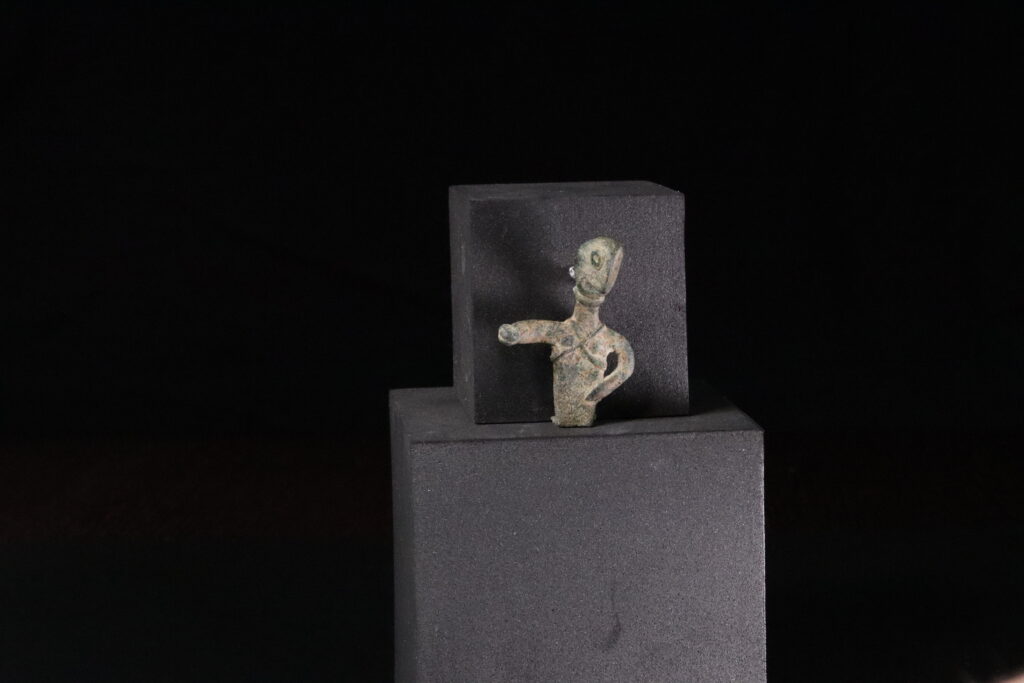
Why a bird? We can only reason toward it. The bird impersonated the magical ability to fly, so here is one for the Paleo Astronauts theory. The water-bird belongs to all three realms — it walks the earth, swims the water, and flies the sky — and a creature that crosses all boundaries is a natural emblem of a power that does the same: a deity who mediates between worlds, between the living and the dead, between the seen and the unseen. Birds migrate and return, vanishing and reappearing with the seasons, an obvious image for death and rebirth. Birds lay eggs, the most economical symbol of generative potential there is. The marriage of bird and mother may fuse the idea of the life-giver with the idea of the boundary-crosser — the power that both brings life and carries the soul across. But I stress that this is interpretation reaching toward a meaning the makers never wrote down. The bird-woman keeps her secret. She is a reminder that the ancient sacred imagination did not confine itself to the shapes we find comfortable, and that some of its most common figures are precisely the ones we understand least.
The long road to Isis — and beyond
Andre put a sharp question to me in commissioning this piece: was the Mother a kind of Proto-Isis? It is worth taking seriously, because it points at something real, provided we are careful about what we are claiming.
There is no straight genealogical line — no single ancestral Great Goddess who “becomes” Isis the way a daughter descends from a mother. That tidy family tree is part of the romantic synthesis the evidence does not support. But there is something subtler and, to my mind, more remarkable: the persistence of an image. Across the ancient Near East and Mediterranean, the figure of the great female power recurs under name after name — Sumerian Inanna and Akkadian Ishtar, queen of love and war; Levantine Astarte and Asherah; Anatolian Cybele, the Magna Mater, the Great Mother brought in state to Rome itself; and Egyptian Isis, who by the Roman period had swelled from a national goddess into a deity worshipped from the Nile to the walls of Britain. These were not the same goddess wearing different masks — they were distinct deities of distinct peoples. But they occupied the same archetypal space, and the imagery flowed between them with remarkable ease.
And one image in particular travelled an extraordinary distance through time. Isis was shown seated, nursing the infant Horus at her breast — the form Egyptologists call Isis lactans, Isis the nurturer. When the cult of Isis spread across the Roman world and was at last displaced by Christianity, that exact compositional image — the divine mother seated with the holy child at her breast — reappears, almost unchanged in its essentials, as the Maria lactans, the nursing Madonna of Christian art. Art historians have long noted the continuity, and it is one of the most haunting facts in the history of images: a way of picturing the sacred mother that runs, by whatever winding route of influence and reinvention, from the temples of Egypt into the cathedrals of Europe.
So was the bronze Mother a Proto-Isis? Not as a literal ancestor. But as the earliest expression of an archetype that Isis would later carry, and that would outlive Isis herself — yes, in that sense the small female figures pressed into a worshipper’s hand four thousand years ago belong to the same immense and unbroken human conversation that produced both the goddess of Egypt and the Madonna of the church. The figurine is a single word in a sentence we are still speaking.
The divine in animal form
The sacred did not always wear a human face. A great many votive bronzes take the form of animals, and these are not “nature studies” any more than the goddess figures are portraits. The animal was a vehicle of divine power, an attribute of a god, a totem of a people, or an offering standing in for the living beast.
The ibex and the wild goat, so central to the Zagros imagination, recur as votives — the Collection’s Luristan ibex of Lot 2248 is one such figure, the mountain animal rendered in metal as an emblem of the highland world and very probably as an offering in its own right. Cattle, the measure of wealth and the great sacrificial animal across the ancient world, appear as small bronzes — a function the Collection’s Roman bronze cow, Lot 2253, sits within: the bull and the cow carried profound religious weight from Apis in Egypt to the bull-cults of the Mediterranean. Birds, as we have seen, slip between the animal and the divine. Each small bronze beast was a way of holding a particular sacred power in concentrated form — the strength of the bull, the agility of the goat, the boundary-crossing freedom of the bird — and offering or keeping it as the situation demanded.
Bells, and the joy of life
It would leave a false impression to end on solemnity, because the sacred in the ancient world was not only fear and supplication. It was also celebration, presence, and sheer noise — and here the small bronze bell deserves its place.
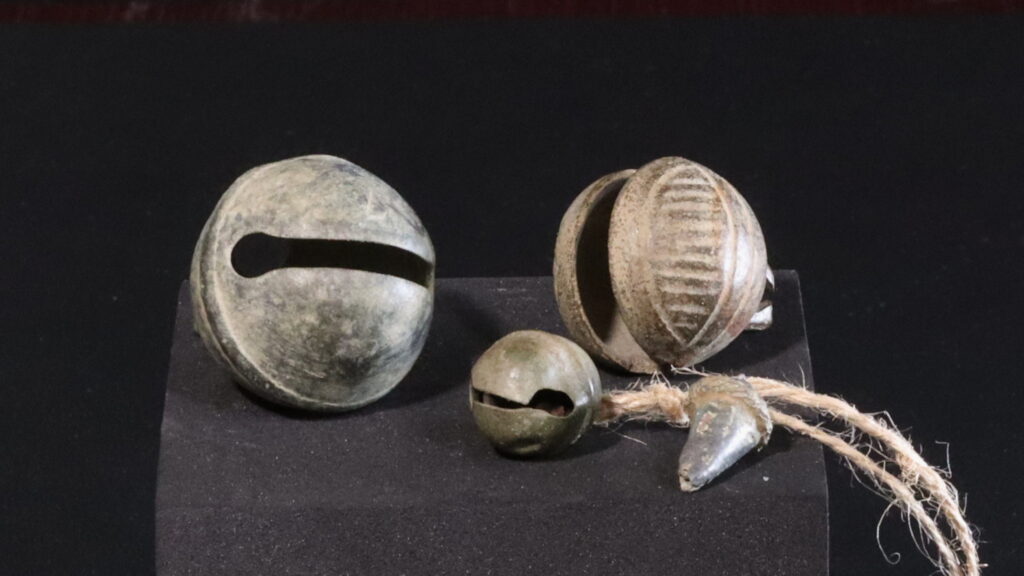
Bronze bells and jingling pellet-bells, the little “tinker bells” of the ancient world, ring through antiquity in a register quite different from the votive figurine’s hush. Their function was partly protective in the most cheerful possible way: across an astonishing range of cultures, sound itself — bright, sudden, metallic sound — was believed to scatter malign spirits. To hang a bell was to build a small perpetual ward against the unseen, a defence that announced itself not in dread but in music. The Romans hung bronze bells, often in clusters, as apotropaic charms about the house, the threshold, the body, and the necks of animals.
But there is more to a bell than fear-management, and Andre is right to call it an expression of the joy of life. A bell makes the invisible audible. It marks presence, announces arrival, calls a gathering, keeps a rhythm, turns the passage of an animal or a person or an hour into something heard. It is, almost uniquely among ancient bronzes, an object whose whole purpose is to produce a moment of bright sensation in the air — a deliberate, repeatable spark of liveliness. Where the votive figurine reaches toward the powers above in hope or supplication, the bell rings out at the level of daily living, warding off the dark with a sound that is indistinguishable from delight. The same culture that buried its prayers in bronze also hung bronze from its doorways to jingle in the wind, and we should hold both gestures together. The ancient relationship with the sacred ran the full span from terror to joy, and bronze served it at every point along the way.
The interpreter’s humility — and the collector’s caution
Two cautions must close any honest account of these objects.
The first is interpretive. More than any other class of ancient bronze, the figurine resists our certainty. A spearhead is unambiguously a spearhead; its function is written in its form. But is this small female figure a goddess, a votary, an ancestor, a charm, or a toy? Is this bird-woman a deity or a decoration? We label them confidently in our catalogues — “goddess,” “idol,” “votive” — and we should remember that these labels are frequently educated guesses, the projection of our categories onto a vanished mental world that did not share them. The intellectual integrity of the subject lies in holding that uncertainty open rather than papering it over.
The second caution is practical, and it follows from the first. Precisely because small figural bronzes are so charged with meaning, so portable, and so saleable, they are among the most heavily forged categories in the entire antiquities market. “Goddess figurines,” “Luristan idols,” and small deity and animal bronzes are forger’s favourites, because an evocative little figure commands a price out of all proportion to the metal in it, and because their very ambiguity makes invented types hard to challenge. The collector of figurines must therefore be doubly disciplined — reading the casting, the corrosion, the wear, and the typology with full scepticism, as I set out in The Collector’s Eye: Identifying Modern Forgeries in Ancient Bronze Markets, and weighing provenance with the care urged in Collecting with Conscience. The fine lost-wax casting that produced the best figural bronzes is itself a diagnostic field, treated in Paleo-Metallurgical Techniques and Their Signatures on Ancient Bronzes. With figurines above all, the appealing object demands the coldest eye.
What you hold
Strip away the modern word “art,” and the small bronze figure becomes something more moving than a decorative antiquity. It becomes the surviving instrument of a relationship — the means by which a particular human being, dead for two or three or four thousand years, reached out toward the forces they believed governed their fate, and asked for help, for protection, for fertility, for fortune, for connection with a power greater than themselves. It is a prayer you can hold in your hand, a negotiation made metal, the most personal religious technology the ancient world possessed.
The Mother in her thousand forms, the inexplicable Bird Goddess, the sacred beast, the bright apotropaic bell — these are not the ancient world’s ornaments. They are the tools it used to live with the unseen, scaled to the size of a single life and a single hand. To hold one is to hold the other end of a gesture of hope made by someone who needed exactly what we still need, and who left, in a small piece of enduring bronze, the evidence that they reached for it.
This article is part of the scholarly reference library of the Sancta Clara Collection. Interpretations of prehistoric religion are offered in the spirit of honest inquiry; where the evidence is contested, I have tried to say so. © AncientBronzes.com — a scholarly reference for ancient bronze and copper alloy antiquities.