
The Horned Warriors of Two Seas: The Nuragic Bronzetti and the Veksø Horned Helmet Connection
Everyone knows the Vikings wore horned helmets. Everyone is wrong. No horned helmet has ever been found in a Viking grave; the image was invented in the nineteenth century, largely by a costume designer for a Wagner opera, and it has clung to the popular imagination ever since. The irony is that horned helmets genuinely existed in Europe — but two thousand years before the first Viking longship, in the Bronze Age, and in two places separated by the entire length of the continent: the Mediterranean island of Sardinia and the bogs of southern Scandinavia. That coincidence, real and strange, is the starting point for one of the most tantalising puzzles in European prehistory, and it is the subject of this article.
I want to lay out the parallels honestly, because they are genuinely striking and deserve to be taken seriously. I also want to test them just as honestly against the hard evidence — the radiocarbon dates, the metal itself, the ancient DNA, the language — because the most seductive explanation is not always the one the evidence supports, and a collection that prizes accuracy owes its readers the difference between what we can see and what we would like to believe. What emerges is not a simple story, but it is a remarkable one: a Bronze Age world far more connected than the old picture of isolated tribes ever allowed.
Two helmets in a Danish bog
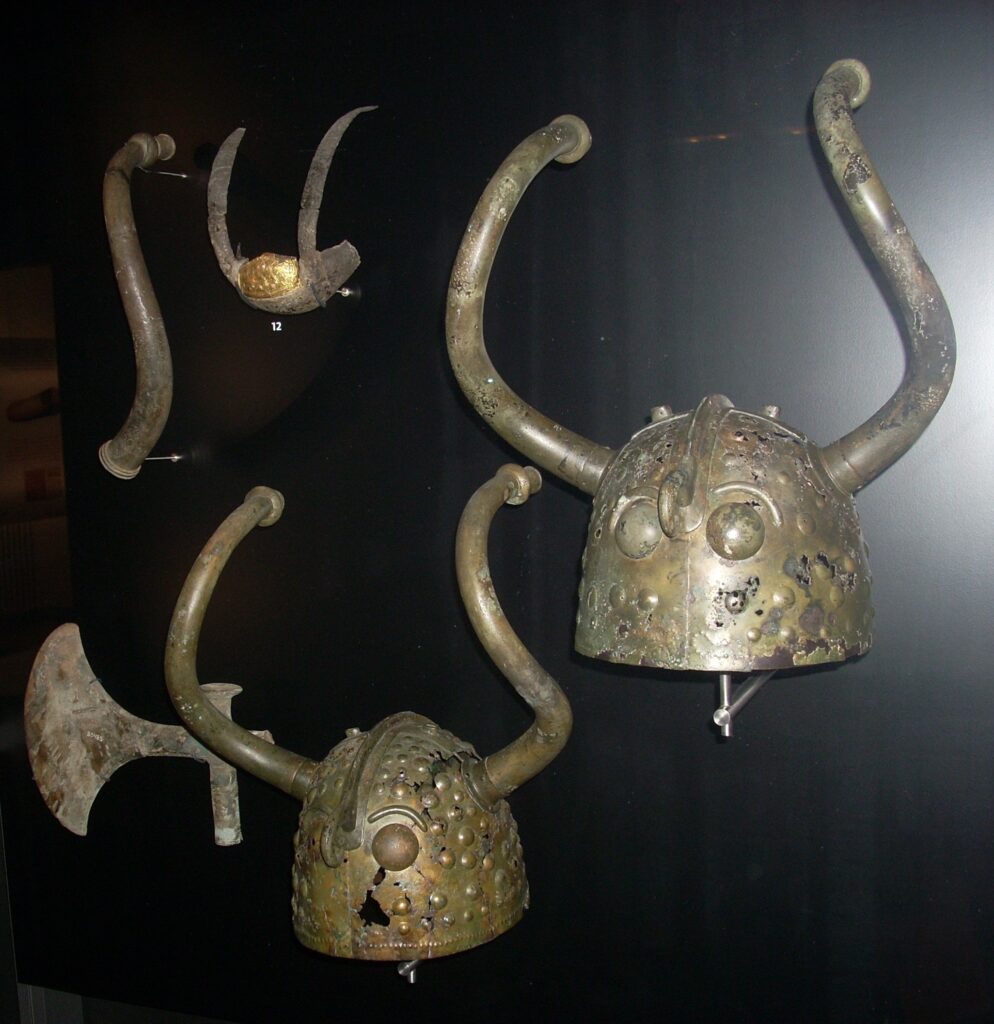
Image: Bronze Age horned helmets from Brøns Mose at Viksø (Veksø) on Zealand, Denmark. Now in the Nationalmuseet (National Museum of Denmark) in Copenhagen, Source Author Simon Burchell, @Wikimedia Commons
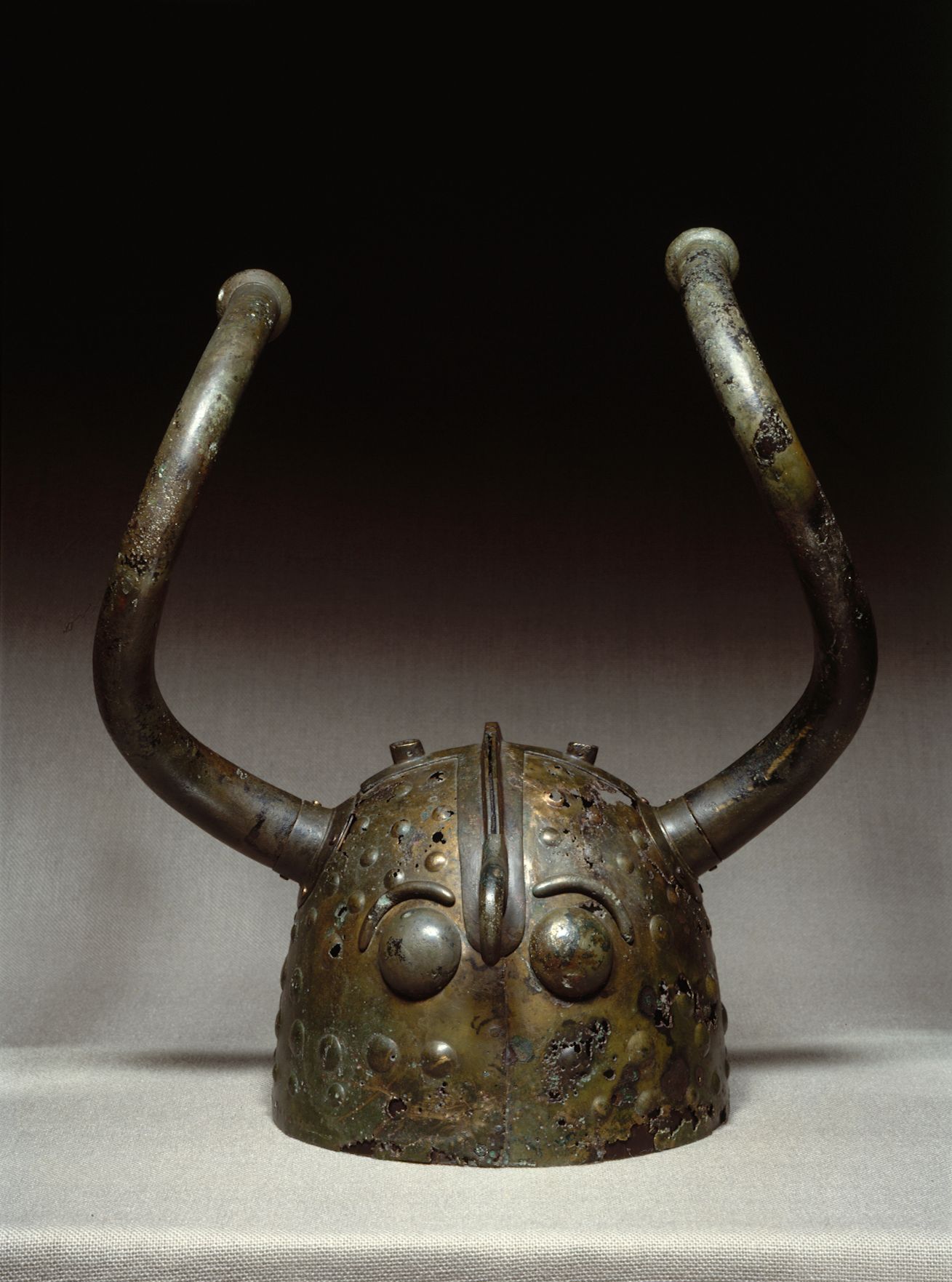
In 1942 a peat-cutter near Viksø (Veksø) in Denmark struck metal. What emerged, eventually, was a matched pair of bronze helmets, each crowned with a great curving pair of bull’s horns, fitted with the beak and staring eyes of a bird of prey, and originally dressed with feathers and perhaps a mane of horsehair. For decades they were vaguely assumed to be Iron Age or even, in the popular mind, Viking. Then, in 2021, a team led by Helle Vandkilde of Aarhus University radiocarbon-dated organic material — birch tar, used as an adhesive to fix the plumage inside the hollow horns — preserved deep in one of them. The result was unambiguous: the helmets were deposited around 900 BC, in the heart of the Nordic Bronze Age, nearly two millennia before the Viking era could begin.
These are masterworks of the bronze-sheet worker’s craft, raised and beaten from thin metal with a skill that still impresses. The horns are modelled on the aurochs, the great wild cattle of prehistoric Europe; the bird’s beak and eyes sit at the front; a crest and a front-to-back groove were made to carry feathers and a horsehair mane. The result is a deliberate piling-up of animal power — bull, bird, and horse fused into a single object — and it reads less as battlefield equipment than as the regalia of a ruler or a priest. Tellingly, the Viksø helmets are not unique within Scandinavia. The same horned image recurs on small contemporary bronzes — the Grevensvænge figurines from Denmark, and finds from Fogdarp and Kallerup — which show men, kneeling or standing, in horned helmets. A small but very particular detail links these figures to artefacts far to the south: little spherical knobs set on the tips of the horns. That idiosyncratic flourish becomes important later, so it is worth holding in mind.
The 2021 study did something more provocative than simply re-date the helmets. It set them beside the warrior imagery of Bronze Age Sardinia and south-western Iberia and argued that the resemblance was too close to be accidental. In Sardinia, the horned warrior is everywhere: cast into the small bronze votive figures called bronzetti, and carved at colossal scale into the limestone giants of Mont’e Prama — the warriors among them wearing a distinctive crested-and-horned helmet — fixed as a defining attribute of the island’s martial iconography. In Scandinavia, horned warriors stride across the rock carvings of Tanum in Sweden and appear on bronze figurines. The horned head, the bird symbolism, the round shield, even the animal-headed ships — the motifs rhyme across two thousand kilometres of sea.
The Sardinian warriors and their welcoming hands
The bronzetti are the heart of the Sardinian side of the story, and they repay close attention. These are small lost-wax cast figures, most between a few centimetres and around forty centimetres tall, produced as votive offerings and deposited in sanctuaries across the island — at Abini, Santa Vittoria di Serri, Su Tempiesu, and many more. They depict a whole society in miniature: chieftains with staffs and cloaks, mothers, wrestlers, animals, model ships. But the warriors dominate, and they are rendered with real specificity of dress and equipment.
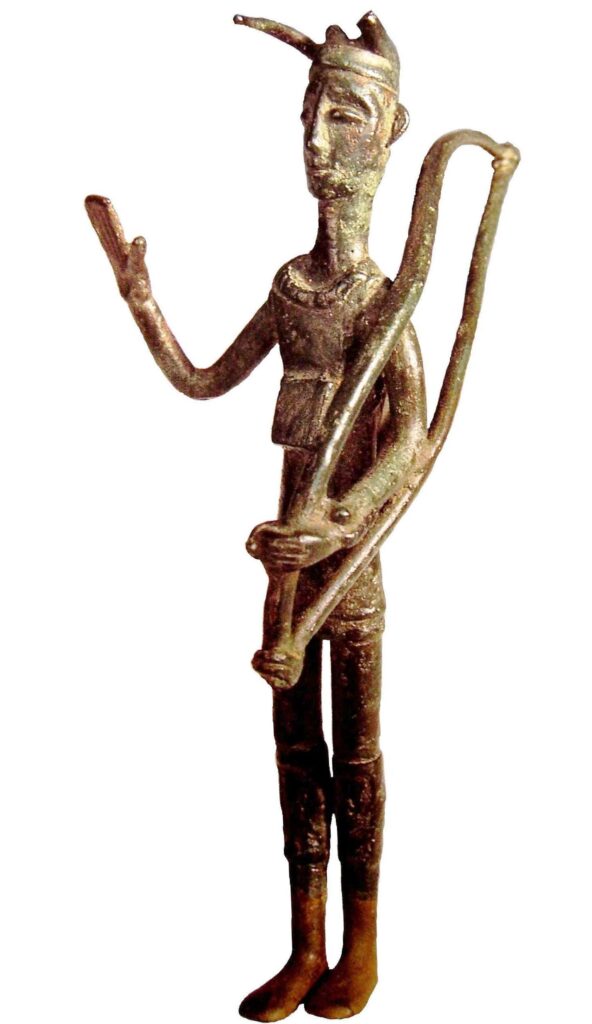
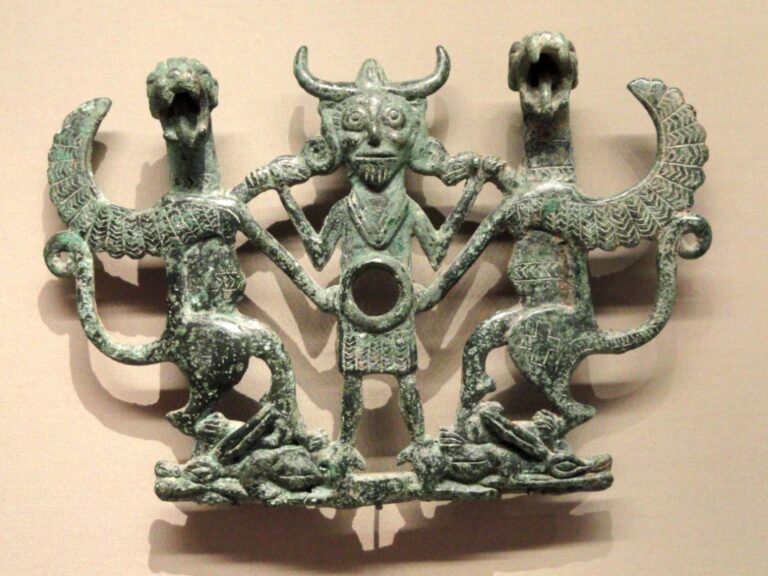
Image: Sardinian bronzetto figure. Sardinia Italy (Cagliari Museo Nazionale), Bronzetto sardo; Author:-Shardan, 2006, @Wikimedia Commons
Scholars usually sort the bronzetti into two broad groups in sequence: an earlier Uta-Abini group, roughly 1200–950 BC, and a later “Mediterraneanising” (Mediterraneizzante) group, around 950–750 BC. The earlier group is especially preoccupied with heavily armoured warriors — and it is here that the parallel with the north grows uncomfortably specific, because many of these Sardinian helmets carry the very same spherical horn-knobs and short forward-pointing horns seen on the Grevensvænge figurines from Denmark. Sardinia shows by far the wider range of horn styles, with long horns angled in every direction, yet that shared structural detail keeps surfacing.
The dress is equally precise. The scholarship recognises distinct warrior types distinguished by weapon and clothing: archers, sword-bearing figures, and figures often read as boxers. Archers wear a short tunic, sometimes a long robe combined with a skirt, with a square fringed breastplate, greaves over the shins, and a high-horned helmet; many carry a quiver and a sword slung across the back. Chieftain figures wear a double tunic and a cloak, carry a sword and a gamma-hilted dagger on the chest, and lean on a knotted staff of office. The horned headdress is the single most common attribute across the whole corpus, and the votive sword and round shield recur constantly.
It is the posture of many of these figures that catches the eye, and that has fed the most romantic readings. A great number of the warriors stand with the weapon at rest — the bow shouldered or grounded, the sword sheathed or slung — and the right hand raised, palm open and turned outward toward the viewer. It is tempting to read this as a gesture of peaceful greeting: we come armed, but our arms are lowered; our hands are open. I felt the pull of that reading myself. But honesty requires noting that the specialists who have studied the corpus most closely interpret the raised open palm not as a diplomatic greeting to other humans but as a devotional gesture — an act of reverence or prayer directed at the deity whose sanctuary received the offering. The same raised-arm “salute” recurs on the monumental Mont’e Prama archers, in an unmistakably funerary and sacred setting, which reinforces the religious reading. The open hand is most likely raised to a god, not extended to a stranger. That is a quieter interpretation than the one the imagination reaches for, and probably the truer one. It also tells us something important: these were militaristic figures operating inside a deeply religious frame, where warfare and divine sanction were inseparable.
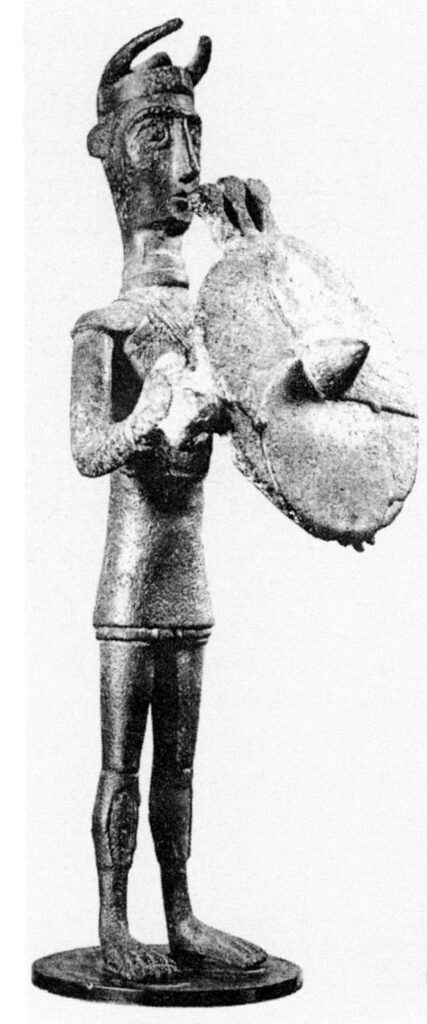
Image: Giovanni Pinza, Monumenti primitivi della Sardegna. Roma, 1901 (Monumenti Antichi dei Lincei, XI). @Wikimedia Commons
The giants and the granite: monumental warriors
That fusion of the martial and the sacred reached its monumental peak at the necropolis of Mont’e Prama in western Sardinia, where the Nuragic people carved warriors not in miniature bronze but in limestone over two metres tall. Discovered in thousands of fragments from 1974 onward and painstakingly reassembled — some twenty-eight figures so far, alongside stone models of the nuraghe towers themselves — the “Giants” faithfully reproduce the iconography of the bronzetti at colossal scale. They are currently dated to roughly 900–750 BC, almost exactly the moment the Viksø helmets were laid in their bog.
The Giants fall into three types. The boxers stand bare-chested in a triangular loincloth, a spiked glove on one hand and a curved rectangular shield raised over the head — perhaps lightly armed close-combat fighters, perhaps athletes in sacred funeral games, their legs and chests sometimes still bearing traces of red paint over carved wounds. The archers wear the short tunic and horned helmet, the bow resting on the shoulder and the right arm raised in salute, the left hand gloved and guarded. The warriors, more poorly preserved, wear segmented breastplates and a calotte-shaped helmet bearing a central crest and two forward-bending horns — some of the reassembled horns ending, once again, in small spheres at their tips. The Giants are unique: no other large stone statuary survives from the Nuragic world. That the islanders chose to translate the horned warrior from portable bronze into eternal stone tells us how much social weight the image carried — petrified guardians set over the elite dead.
In Scandinavia the warrior was monumentalised in a different medium: the granite bedrock itself. The horned warrior dominates the rock art of the Nordic Bronze Age, above all in the Bohuslän region of Sweden and at the World Heritage site of Tanum. Here oversized, anthropomorphic figures in horned helmets stride across the rock, brandishing spears and axes, dancing in what look like rituals, or standing aboard heavily crewed ships. The carvings are fluid and active where the Sardinian figures are static and frontal. Some panels, at Lövåsen and Tegneby, show “bird-masked” figures whose horned heads merge with avian features, knotting the martial and the mythological together exactly as the bronzetti’s praying warriors do. Two regions, two materials — beaten bronze and incised stone — reaching for the same figure.
Following the metal
Before weighing what the resemblance means, it helps to follow the substance that made all of it possible: the metal. The Bronze Age ran on copper and tin, and those ores are scattered very unevenly across Europe. Southern Scandinavia, rich in farmland and fish, had effectively none of them. Every gram of bronze in those prolific northern workshops had to be imported from far away, which means the Nordic Bronze Age was, by necessity, plugged into long-distance trade from the start. The question is: trade with whom?
For a long time the assumed answer was Central Europe and the Alps. Recent work has complicated that comfortably, and the technique behind it is worth understanding because we have met it before on this site. Researchers — notably those connected with the “Metals and Giants” project, working through the Curt-Engelhorn Centre for Archaeometry in Mannheim — have moved beyond the traditional reliance on lead isotopes alone to a multi-proxy method that reads copper, tin, lead, and the very rare element osmium together. Osmium is the prize ingredient here: it survives the smelting process locked in the metal and keeps the geochemical signature of the original ore body, which lets it separate, say, a Mediterranean source from an Eastern Levantine one where lead isotopes alone might blur the line. (Readers of the piece on Nuragic figurine provenance will recognise the approach; this is the same family of analysis applied to the wider trade map.)
Applied to the bronzetti, the multi-proxy data describe a sophisticated and strikingly self-sufficient Sardinian metal industry. The main copper is local Sardinian ore — the island was a serious producer in its own right — but it was repeatedly and apparently deliberately mixed with copper imported from the Iberian Peninsula, a blending that looks engineered, perhaps to tune the working properties or the colour of the finished cast. Notably, the osmium signatures argue against any Levantine copper — nothing from the great eastern mines at Timna or Faynan — in the figurines studied. If that holds, Sardinia was no passive outpost of an east-led trade system but an independent hub running its own networks westward toward the Atlantic. And since the island has no workable tin of its own, the tin to make the bronze had to be shipped in, again largely from Iberia, binding the whole western Mediterranean circuit tightly together.
The northern end of the story is the provocative part. Isotopic studies of Scandinavian metalwork, especially from Period IV (around 1100–900 BC), point to copper arriving in the far north from Sardinian and Iberian sources: the composition of a number of Nordic socketed axes is reported to align with Nuragic copper, and contemporary flange-hilted swords with ores from southern Spain. The timing is suggestive — a shift in supply around 1000 BC that lines up with the broader reshuffling of Mediterranean trade as Phoenician shipping expanded in the east and the western and Atlantic sea routes grew busier. The picture this paints is of a metal corridor running up the Atlantic façade and into the Danish straits and the Baltic, carrying not only raw copper and tin but, plausibly, the images and ideas that travelled with them.
A necessary caution: provenance by isotopes is powerful but probabilistic, it works by overlapping ranges rather than fingerprints in the forensic sense, and “matches Iberian ore” is not quite the same as “was mined in Iberia.” The direction of the argument is well supported and genuinely reshapes the old map; the certainty with which any single axe can be sourced is more modest than a confident summary makes it sound. With that said, the broad conclusion — that northern bronze was substantially subsidised by western Mediterranean metal — is on firm ground.
The shields: a prestige canvas that crossed a continent
If metal supply is the skeleton of the connection, the bronze shield is one of its most eloquent surfaces — and a second specific link between the two ends of Europe. Over the Late Bronze Age, defensive gear shifted from organic materials (leather, wicker, wood) to sheet bronze, and the metal shield became a supreme prestige object: it swallowed enormous quantities of imported metal and demanded rare skill to make.
The making is itself remarkable. Experimental reconstructions show a shield was raised from a single small tin-bronze blank, perhaps fifteen to twenty centimetres across, then expanded through endless patient cycles of hammering and annealing into a sheet fifty to seventy centimetres wide and astonishingly thin — often well under a millimetre. To keep so thin a disc from buckling, the rim was usually rolled over, sometimes around a bronze wire, giving a thickened edge with some chance of turning a sword-cut. Archaeologists sort the surviving shields into a family of types by their proportions, boss shape, and the layout of their concentric decoration. The principal Bronze Age shield typologies recorded across Europe are summarised below.
| Shield typology | Recorded finds | Average diameter | Average sheet thickness | Average weight | Primary distribution |
|---|---|---|---|---|---|
| Lommelev-Nyírtura | 6 | 67 cm | 0.9–1.0 mm | 2.2 kg | Central / Northern Europe |
| Nipperwiese | 8 | 38–44 cm | 1.0–1.3 mm | 1.5–2.2 kg | Western / Central Europe |
| Harlech | 6 | 50–69 cm | 0.1–1.0 mm | 1.0–2.75 kg | British Isles |
| Coveney | 2 | 46–53 cm | 0.3–0.5 mm | 0.9–1.2 kg | British Isles |
| Athenry-Eynsham | 6 | 23–35 cm | 0.3–1.2 mm | 0.9–1.2 kg | British Isles |
| Yetholm | 25 | 55–70 cm | 0.4–0.7 mm | 1.2–2.6 kg | British Isles, Denmark |
| Herzsprung | 22 | 67–71 cm | 0.4–0.5 mm | 1.4–1.5 kg | Scandinavia, Ireland, Iberia |
Figures synthesised from Bronze Age shield typological and archaeometallurgical surveys; find-counts and ranges vary between studies.
The type that matters most for our story is the Herzsprung shield, because its distribution traces the very maritime routes the metal data imply. The Herzsprung is round to slightly oval, with a shallow central boss and an unmistakable signature: a set of wide plain ribs running concentrically around the boss, the inner rib interrupted by a gap and the outer ribs carrying a distinctive U- or V-shaped notch, the outer field filled with rows of small bosses. Its epicentre is the Fröslunda hoard in Sweden, found in a dried-up bay of Lake Vänern, which yielded eighteen of them in one spectacular deposit — and the copper in the Fröslunda shields has been reported to match ores from the Ossa-Morena massif of south-western Iberia. A Swedish hoard forged, it seems, substantially from Spanish metal.
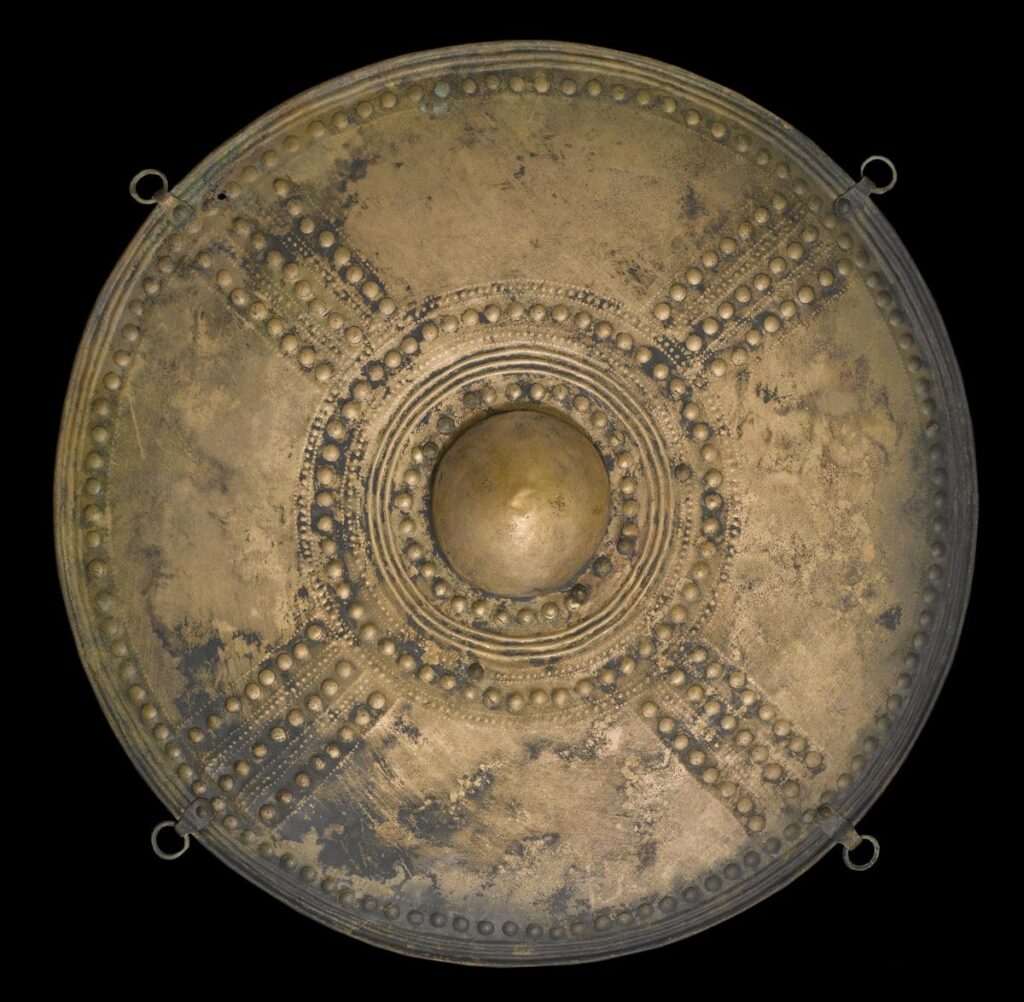
Image: The bronze shield from Sørup Bog, Denmark, Now in the Nationalmuseet (National Museum of Denmark) in Copenhagen Source: https://en.natmus.dk/
The iconography backs up the physical link. In south-western Iberia the elites did not bury bronze figurines; they raised carved stone stelae over their warriors, and on those stelae are engraved exactly these V- and U-notched Herzsprung shields, alongside chariots and horned helmets. Sardinia, for its part, has yielded few surviving metal shields, but the round, concentrically decorated “Sardinian type” shield — long recognised as close kin to the Herzsprung design — is everywhere on the bronzetti and the Mont’e Prama Giants. And organic versions of the same form survive too: the leather Clonbrin shield from an Irish bog shows the design spanning the whole Atlantic-Nordic corridor. One shield-idea, recurring from Iberia to Ireland to Sweden to Sardinia.
What were these beautiful things actually for? Probably not, in the main, for fighting. A body of sheet bronze under half a millimetre thick would be punched straight through by a determined spear-thrust, and the evidence leans heavily toward ceremony, display, and ritual deposition rather than the front line. Scandinavian rock art reinforces this: at Svenneby and Hede, figures hold large round objects that double as shields and sun-discs, and panels show dancers and priests leaping with the discs held aloft, echoing later accounts of ritual shield-dances. The eighteen pristine shields sunk together at Fröslunda read unmistakably as a deliberate sacrifice of wealth to the waters — a gift to whatever powers lived at the boundary between land and lake.
The swords: lethal technology and sacred deposit
The shield was the warrior’s canvas; the sword was his cutting edge, in every sense. The Late Bronze Age sees the warrior emerge as a professional class and interpersonal violence organised on a new scale, and both Sardinia and Scandinavia are saturated with the sword as a symbol of power both worldly and divine.
The technological turning point was the Naue II sword — the flange-hilted type — which appeared in Central Europe or northern Italy around 1400 BC and spread with remarkable speed. Earlier Bronze Age rapiers were thrusting weapons, narrow and rather brittle; the Naue II had a robust leaf-shaped blade and a heavy flanged hilt that made it a true cut-and-thrust weapon, good for hacking as well as stabbing. It moved along the same trade arteries as the metal, displacing local designs as it went. Scandinavian elites imported blades and then cast their own versions using imported western metal; the same weapon flooded the Mediterranean.
Sardinia offers a perfect snapshot of this networked weaponry in the Monte Sa Idda hoard, found at Decimoputzu in 1921: over three hundred fragmentary pieces, prominently including “Sa Idda” type swords whose closest cousins are Iberian. Lead isotope analysis of the swords and ingots in the hoard reported a striking split — several pieces carrying signatures matching distinct Iberian copper sources, others matching local Sardinian ores. That is a reciprocal trade laid bare in a single deposit: Iberian metal and finished weapons moving east into Sardinian sanctuaries, even as Iberian and Sardinian metal moved north to Scandinavia.
Sardinia also did something singular with swords. At sacred water-sites across the island — Su Tempiesu, Su Mulinu, Sa Sedda ‘e Sos Carros, Abini — archaeologists have found long, slender bronze swords fixed into stone or cached in numbers. These are votive, not martial: too long, too soft, too brittle in their alloy to survive real combat, they were set at the apex of shrines as visible tokens of divine alliance, of treaties between chiefs, of sworn oaths. Sardinia’s “swords in the stones” are a deep cultural statement about the weapon as a conduit to the sacred — a striking thing to find at the southern end of a network whose northern god, as we will see, was himself a god of oaths.
And the violence was real, not merely symbolic. The rock art of southern Scandinavia preserves it vividly. In the Medbo valley near Brastad in Sweden, recent fieldwork has recorded no fewer than twenty-four sword-wielders across nine adjacent panels — not abstract emblems but figures with swords raised, actively fighting. One scene shows a warrior striking down at an opponent armed only with a bludgeon, clearly overmatched by the prestige bronze blade; others show sheathed-sword figures stepping in to parry spear-thrusts. Imported bronze swords were tokens of wealth, yes, but they were also used to kill, and the carvings show it.
The archers
Between the close work of the sword and the defensive wall of the shield stood a third discipline, prestigious in its own right: archery. Both regions treat the archer as a high-status specialist rather than a lowly skirmisher.
In Sardinia the archer is among the most detailed and common of the bronzetti — standing frontally, an oversized bow running from ground to shoulder, dressed in a short tunic and a square fringed breastplate, greaves on the shins, a quiver and a back-slung sword completing the kit, and the high-horned helmet on the head. This is heavy, regimented equipment: archers here were armoured elites. The Mont’e Prama Giants magnify the point — the archer Prexiau wears the same tunic and rectangular breastplate, the heavy double-curved bow resting on his shoulder, his left arm guarded and gloved. The precision of the gear implies a specialised, organised class of bowmen within the Nuragic military order.
Scandinavian rock art mirrors the emphasis. In the violent Medbo panels, scenes show two archers deliberately aiming at one another — formal duels, or organised ranged combat. At the Tegneby panel in Tanum, bird-masked warriors wield axes, spears, and bows against horsemen carrying square shields. The bow, in both the miniature Sardinian bronzes and the monumental Nordic stone, was a weapon worth commemorating, fully woven into the panoply of the horned warrior.
Ships, the Sherden, and the reach of a Sardinian fleet
None of this — the metal, the shields, the swords — crosses two thousand kilometres without ships, and both cultures were profoundly maritime, a fact written all over their art. In Scandinavia the ship is the single commonest motif in all of rock art, with well over ten thousand depictions, the vessels often crewed by six to thirteen figures and their prows carved into animal heads, frequently birds or horses. The Nuragic people cast votive bronze ships, the navicelle or nacelle, deposited in sanctuaries beside the bronzetti, their prows mounted with the heads of deer, rams, antelopes, or oxen — probably religious vessels, perhaps ferrying the dead, certainly celebrating the island’s command of the sea.
That command of the sea opens onto one of the great enigmas of the period: the “Sea Peoples.” In the late second millennium BC the established empires of the eastern Mediterranean buckled under waves of mysterious maritime raiders, and Egyptian records — from the Amarna letters to the reign of Ramesses III — name among them a group written ŠRDN, the Sherden or Shardana. The great reliefs at Medinet Habu show them fighting the pharaoh’s forces, and the way they are carved is hard to ignore: long straight dirks or Naue II-style swords, perfectly round shields, and horned helmets with a disc or knob set exactly at the crest between the horns — sailing, moreover, in ships with animal figureheads on the prow. The resemblance to the Nuragic warriors, down to the disc-between-the-horns and the animal-prowed ships, is inescapable.
The temptation is to close the loop: ŠRDN sounds like “Sardinia,” the iconography aligns, therefore the Nuragic Sardinians were the Sherden. I would urge a step short of that. The name-resemblance is real and much discussed, and there is genuine material support for a Sardinian presence in the east — locally made Nuragic pottery, the crude everyday kind that travels with people rather than as luxury trade, has turned up at Pyla-Kokkinokremos on Cyprus, at Cannatello in Sicily, and at Lipari, which does suggest Sardinian traders, mercenaries, or migrants actually living abroad. But the equation of Sherden with Sardinians remains debated, the direction of the name (did the people give it to the island, or the island to the people?) is unresolved, and ancient ethnonyms are slippery things. What the evidence comfortably supports is the larger claim: the Nuragic maritime network was vast, reaching east toward the Levant and, as the metal data suggest, north toward the Baltic. That alone is extraordinary enough without forcing the identification.
The case for a connection — and the case against migration
So the parallels are real, and they are not vague: shared horned helmets with shared spherical horn-knobs, shared Herzsprung shields traced by their very metal to Iberian ore, the shared Naue II sword, shared armoured archers, shared animal-prowed ships. What explains a package this specific? Several hypotheses are on the table, and they are worth setting out plainly and in order of ambition.
The boldest is migration: that a northern people carried the horned-warrior identity south to Sardinia, or a Sardinian people north, physically bringing the helmet culture with them, and that the bronzetti might even record such an arrival. It is a thrilling idea — the welcoming gesture of the figures almost seems to narrate it — and it deserves a fair hearing. But it runs hard against the genetic evidence, which modern work has made decisive. Ancient-DNA studies show Bronze Age Sardinia characterised by remarkable genetic continuity, its population descending overwhelmingly from the island’s own Neolithic farmers. Crucially, Nuragic Sardinia lacks the “Steppe” ancestry that swept across most of Bronze Age Europe — the very ancestry that carried Indo-European peoples, languages, and gods into the continent, Scandinavia included. The modest external admixture that appears on the island traces to the eastern and northern Mediterranean and to periods largely later than the Nuragic floruit, not to Scandinavia. A northern tribe settling on Sardinia in any demographically real way would have left a genetic signature, and it is not there. On the evidence as it stands, the migration reading — however attractive — is the least likely of the explanations.
A second position, associated with Nicola Ialongo, is independent convergence: that two heavily militarised Bronze Age societies simply invented the horned helmet on their own, as a natural symbol of bovine strength and aggression, with no contact at all. Ialongo’s supporting objection is genuinely sharp and has to be answered: if a busy route really linked Sardinia and Scandinavia, why is horned-warrior imagery so scarce in the lands between — Britain, France, the Low Countries? A shared symbol with a hole in the middle of its map is a puzzle. Yet pure convergence struggles with the specificity we have just catalogued. A bull-horned helmet might be invented twice; the spherical knobs on the horn-tips, the exact Herzsprung notch, the matching combination of shield-plus-sword-plus-bow, the disc between the horns — that degree of idiosyncratic agreement is a great deal to ask of coincidence.
The interpretation that carries the most support is the middle one: shared iconography travelling along the metal-trade networks. The routes that carried copper and tin carried images, ideas, and prestige with them, and the horned warrior was adopted by newly consolidating elites at both ends because it offered an internationally legible vocabulary of power — authority underwritten by control of exotic imported metal and association with distant, almost mythical lands. The warriors of Sardinia, Scandinavia, and Iberia were not one people; they were different peoples reaching for the same potent symbol, its ultimate roots reaching back further still to the horned divine imagery of the ancient Near East. This reading has the great virtue of fitting both the genetic evidence (no shared population) and the archaeometallurgical evidence (a real physical conduit of metal), while accommodating Ialongo’s gap as a matter of which elites chose to adopt the package and which did not.
The seduction of the sky-god: a linguistic caution
There is one more thread worth pulling, precisely because it shows how a true connection can be mistaken for a false one. Might the religions of these horned warriors share a god? Might the Scandinavian sky-and-war god Týr, in particular — and recall those Sardinian swords driven into stone as oaths — have a counterpart in Bronze Age Sardinia?
Here the linguistics offers something real, and then takes most of it back. Týr is indeed an ancient god by descent — though the line of descent is worth getting exactly right, because the tidy version one usually meets is wrong. Týr’s name does not come straight down from *Dyḗws, the Proto-Indo-European name of the daylight-sky father that produced Greek Zeus, Roman Jupiter, and Vedic Dyaus. It comes from that name’s sibling: the word *deywós, “a god, a shining one” — the same word that became Latin deus — which Grimm’s Law and its successors ground down, step by regular step, into Proto-Germanic *Tīwaz and finally Norse Týr. Týr and Zeus are therefore cousins, not parent and child: two children of the one bright-sky root *dyew-, “to shine.” The same root, in its Anatolian branch, gave the Luwian sun-god Tiwad, who is attested in Bronze Age cuneiform as a witness of treaties and oaths — a role Týr also came to hold — a parallel that can make the hair stand up, especially alongside those Sardinian oath-swords. So Týr and Tiwad are genuine cognates: linguistic cousins descended from a common ancestor.
But — and this is the essential point — that cousinship is one of deep time, not of Bronze Age contact. Týr and Tiwad are related the way English and Hindi are related: through an ancestor thousands of years upstream, not through any meeting of their speakers. And when we turn to Sardinia, the linguistic bridge collapses, because there is nothing to connect to. The Nuragic language — Paleo-Sardinian — is essentially undeciphered: there are no readable connected texts and no recovered theonyms, and the substrate is generally held to be largely non-Indo-European. We cannot read a single Nuragic god’s name, let alone identify a sky-god cognate with Týr. There is no attested “Tiwad cult” in Sardinia; on the linguistic evidence alone, the idea has nothing on the ground to rest on. The one named ancient Sardinian deity, Sardus Pater, belongs to the later Punic and Roman island, not to the Bronze Age, and carries North African and Phoenician associations rather than Indo-European ones. The genetic evidence sharpens the picture in one specific way: a people without Steppe ancestry is a people the Indo-European sky-god’s speakers never settled among in any demographically real number. What the genes cannot rule on is whether the god himself — as a cult, an idea, a way of building — ever made the crossing by other means; gods, as this whole article has shown of images, do not need migrations to travel. But that is a question the silence of the Nuragic language cannot answer either way, and I will return to it in the postscript below.
The linguistic thread is therefore a cautionary tale rather than a supporting one. The Týr–Tiwad link is real and marvellous, but it is a story about the deep unity of the Indo-European world, not about ships passing between Sardinia and the north. To press the etymology into service as evidence of Bronze Age contact would be to mistake a shared ancestor for a handshake — the very error this whole article is built to avoid. If a case for the sky-father on Sardinia can be made at all, it must be made on different ground entirely. I believe it can — and I will declare it openly as my own speculation, below, after the mainstream account has been given its full and final word.
What remains
Strip away the migration that the DNA forbids and the shared god that the language cannot deliver, and something genuinely remarkable is still standing — more, in fact, than we began with. Across two thousand kilometres of Bronze Age sea, two cultures that we cannot show to have shared blood or speech were nonetheless joined by a real river of metal, and they reached for the same cluster of images: the horned warrior, weapon at rest in a gesture of prayer; the round notched shield that doubled as a sun-disc; the leaf-bladed sword that was at once a killing tool and a sacred offering; the animal-prowed ship. The bronzetti raise their open hands to their gods at one end of the continent; the Viksø helmets were laid with care in their bog at the other. We do not need to invent a migration, or a borrowed god, to find that astonishing. The Bronze Age was simply far more connected — by trade, by violence, by shared devotion — than the old picture of isolated tribes ever allowed, and the horned warrior is the face it wore at both ends of Europe.
Postscript: the towers in the middle of his sea
Everything above is the article I set out to write, and it stands on its own. What follows is something different in kind, and I mark the boundary deliberately: this is where I leave the consensus and tell you where my own thinking has gone. It is the thesis I argue at full length in my book The Sky Father, and the reader is entitled to know that it is mine, that it is heterodox, and that it does not command mainstream assent.
Here is the thing the mainstream account leaves unexplained, sitting in plain sight. The Greeks called the Etruscans Tyrrhēnoi — a name bound up with the substrate word týrsis, “tower” — and they named the whole basin after them: Mare Tyrrhenum, the Tyrrhenian Sea. And in the exact centre of that sea, on its largest island, stands the densest concentration of megalithic tower architecture anywhere on the face of the Earth: above seven thousand nuraghi, raised between roughly 1900 and 730 BC — truncated cones of massive unmortared basalt, corbelled chambers, spiral stairs inside the walls — together with sacred wells of breathtaking ashlar precision, some aligned so that at certain moments of the year the sun or moon falls straight down the shaft onto the water. The sea of the tower-people, ringed and centred by the greatest tower-building culture that ever lived, in the very chronological window when the bright-sky god’s name was being spoken from Anatolia (Tiwad) to Etruria (Tinia) to Latium (Iuppiter). In the book I argue that this is not decoration: that the Tyrrhenian basin was, for a thousand years, a single coherent religious-architectural province of the old sky-father’s cult, and that the towers were its temples.
Notice what this argument does not claim, because the distinction is everything. It does not claim the Nuragic people spoke an Indo-European language — the substrate evidence is against it. It does not claim a migration — the DNA forbids it, as we have seen. It claims that a religion travelled the same roads this entire article has shown the images travelling: with the ships, with the metal, with the prestige vocabulary of power that newly consolidating elites at every node of the network were so visibly eager to adopt. If the horned helmet, the Herzsprung shield, and the bird-prowed ship could cross those waters without a single migrating population behind them, then so could a cult — and the cult of the bright daytime sky is precisely the kind that travels, because it asks nothing local: no sacred grove you must inherit, no ancestral spring. It asks only height, light, and the open sky, and a tower gives all three.
And there is one more rhyme, the one this article has already laid on the table without naming it. Everywhere the sky-father is securely attested, he is above all the god of the oath: Luwian Tiwad, the standing treaty-witness of the Hittite state archives; Roman Jupiter as Iuppiter Lapis, by whose stone treaties were sworn, beside the archaic Dius Fidius, whose oath could only be sworn under the open sky; Norse Týr, god of the Thing, the legal assembly held in the open air. Now look again at what the Nuragic people did at their sanctuaries: long votive swords — too long, too soft, too brittle for war — driven into stone and set at the apex of shrines, read by the archaeology as tokens of oaths, of treaties, of sworn alliance. Swords in stones, at sacred wells, on the island at the centre of the sea named for towers. I cannot prove that the god those swords invoked was a reflex or a cousin of the sky-father, and I will not pretend otherwise: no theonym survives, and the four-test linguistic discipline I hold myself to in the book cannot even be attempted on Sardinian soil. The mainstream reading of the nuraghi themselves, I should add, is defensive and residential — fortified seats of chiefly power — not temples, though the sacred wells are unambiguously religious and the line between fortress and sanctuary in the Nuragic world is genuinely blurred. So hold this postscript exactly as I offer it: not as a finding, but as a pattern — towers, oaths, open sky, and a sea that remembers a name — that I find too coherent to leave unrecorded, and that the book sets inside a much larger architecture of evidence running from Tiryns to Anatolia to the western Mediterranean.
If the body of this article was about resisting the seductive explanation, the postscript is about the obligation that comes after resistance: to say plainly what you suspect, label it as suspicion, and let the reader weigh it. Preferring the truth to the consensus where the two diverge does not mean abandoning the consensus lightly; it means earning the divergence in the open.
Further reading
The full argument — the sky-father’s name traced step by step through half the world’s languages, his cult of the oath reconstructed, the case for his architecture from Tiryns to the Sardinian nuraghi to Baalbek, and the story of his displacement by the storm-gods — is in my book:
Andrzej M. Izyk, The Sky Father: The Lost Bronze Age God Behind Zeus, Jupiter, Tyr, and Deus — available on Amazon: https://a.co/0cLxOoVe
The book keeps the same discipline as this article: mainstream scholarship and the author’s speculation are always separated, and every derivation is shown in full so the reader can check each link in the chain.
Author’s note on interpretation and consensus. The Bronze Age date of the Viksø helmets (deposited c. 900 BC), the existence of horned-warrior iconography in Bronze Age Sardinia, Scandinavia, and Iberia, the Mont’e Prama Giants (c. 900–750 BC), the Herzsprung shields and the Fröslunda hoard, the Naue II sword and the Monte Sa Idda hoard, and the Medinet Habu reliefs of the Sherden are all established archaeological facts. The multi-proxy isotopic provenance work (copper, tin, lead, and osmium), associated with the Curt-Engelhorn Centre and the “Metals and Giants” project, genuinely reshapes the trade map and is the basis for the Sardinia–Iberia–Scandinavia metal corridor described here; I have flagged in the text that isotopic provenance is probabilistic and that individual-object sourcing is less certain than summary statements imply. The interpretation of the iconographic parallels as evidence of contact through trade-borne shared imagery follows Helle Vandkilde and colleagues and is the best-supported reading, though it is contested — notably by Nicola Ialongo on grounds of the gaps in the distribution — and independent convergence cannot be wholly excluded. The reading of the bronzetti’s raised open palm as a devotional rather than a diplomatic gesture reflects the mainstream interpretation of the corpus. The genetic continuity of Bronze Age Sardinia and its lack of Steppe ancestry are well supported by multiple ancient-DNA studies; on this basis the migration hypothesis — including the idea that the bronzetti record the peaceful arrival of a northern people — is, in my assessment, not supported by current evidence and is presented as a hypothesis to be tested and, on balance, set aside. The identification of the Sherden with the Nuragic Sardinians is plausible and supported by Nuragic pottery found at eastern Mediterranean sites, but it remains genuinely debated and is presented here as a strong possibility rather than a settled fact. The cognate relationship between Týr, Proto-Germanic *Tīwaz, Latin deus (all via PIE *deywós, “a god”), Luwian Tiwad, and the wider family of the root *dyew- — with Greek Zeus, Jupiter, and Vedic Dyaus descending from the sibling name *Dyḗws — is established historical linguistics; the absence of any attested Nuragic theonym is the current state of knowledge, and the linguistic parallel should not be read as evidence of Bronze Age contact. The postscript stands apart from all of the above: the reading of the Tyrrhenian basin as a religious-architectural province of the *Dyḗws cult, and of the nuraghi as its tower-temples, is my own thesis, argued in The Sky Father; it is heterodox, it is not the mainstream interpretation of the Nuragic world (which reads the towers as fortified elite residences), and it is presented here, as there, explicitly as speculation built on architectural, toponymic, and functional pattern rather than on texts — of which Bronze Age Sardinia has left none. Readers should treat the horned-warrior connection as a real and open question, the trade-and-iconography reading as the best-supported interpretation, and the migration, shared-theonym, and tower-temple ideas as evocative but presently unsupported by direct evidence.
Image attributions: 1. Title image: Dansk: Hjelm af bronze fra Veksø, Brønsmose. Votiv/depot, yngre bronzealder. Viksø sogn, Ølstykke Herred Frederiksborg Amt
Date 1984, Source http://samlinger.natmus.dk/DO/907, https://natmus.dk/museer-og-slotte/ Author Lennart Larsen, Nationalmuseet. In-text images attributed accordingly
This article was prepared for AncientBronzes.com and the Sancta Clara Collection. ©Sancta Clara Collection.