
The paradox of a metalworking civilisation
There is a paradox at the heart of Egyptian metallurgy, and it is worth stating plainly at the outset, because everything else in this article hangs from it. No ancient culture worked precious metal more beautifully than Egypt. The goldsmiths of the Nile produced granulation, cloisonné, and inlay of a delicacy that the modern eye still struggles to believe was made by hand, without magnification, three and a half thousand years ago. And yet this same civilisation came late and reluctantly to tin bronze, persisted with arsenical copper long after its neighbours had moved on, and did not work iron in earnest until the first millennium BC — by which time the Hittites and the peoples of Anatolia had been smelting it for centuries.
How can a culture be so advanced in one branch of metalwork and so conservative in another? That is the question I want to pursue here. It is, I think, the most interesting way into Egyptian metallurgy, far more so than a flat chronological recital of who cast what and when. The answer turns out to involve geology, trade, fuel, religion, and a particular Egyptian relationship to material that valued colour and permanence over hardness. I will take the strands in turn — copper and its sources, the slow arrival of tin bronze, the goldsmith’s separate and dazzling tradition, the casting of statuary, and finally iron, the metal that came from the sky before it ever came from the ground. Throughout, I have tried to separate what is securely established from what remains genuinely contested, and I have flagged the live debates rather than smoothing them into false certainty, in the same spirit as my notes on Corinthian bronze.
Copper from the desert and the mountain
Egypt’s metal story begins, as everyone’s does, with copper, and copper in Egypt begins in two places: the Eastern Desert between the Nile and the Red Sea, and the Sinai peninsula. The Egyptians most likely took their first supplies as native metal and then as the abundant green malachite of the southern Sinai, learning step by step to reduce the ore to metal.
The headline site is Serabit el-Khadim, in the south-west of the peninsula. By around 3000 BC the Egyptians had become masters of the Sinai mines and had set up a large and systematic operation there. It is worth being careful about Serabit, though, because it wears two hats: it is best known as a turquoise-mining centre, with an Egyptian temple to Hathor founded on its rocky terrace in the Twelfth Dynasty and used into the New Kingdom, and the copper and turquoise workings sit close together in the same wadis — Wadi Maghara, Wadi Nasb, Wadi Kharig. The scale of copper production was substantial: one estimate puts output across roughly 150 years of the New Kingdom at around a thousand tons from the region. These were not casual scratchings in the rock but a state enterprise, complete with administrative buildings, watchpoints, garrisoned ports, and royal inscriptions — Amenemhat III left his name on the pass above Bir Nasb — recording the expeditions that the crown despatched to win the metal.
The archaeology of how the Egyptians actually smelted that ore has improved markedly in recent years, and this is one of the places where the article can stand on fresh ground rather than received wisdom. Excavation in the Sinai has recovered vitrified and slagged furnace fragments, made of sandstone, that may well be the remains of wind-powered furnaces — installations sited and built to draw a draught from the prevailing wind rather than relying solely on lung-power or bellows. And in 2025, Egyptian authorities announced a Bronze Age copper-smelting workshop at Wadi al-Nasb in South Sinai, complete with smelting furnaces, ore-preparation tools, ceramic crucibles, ingots, charcoal from local trees, and the purified clay used to fashion tuyère heads — the nozzles through which air was forced into the furnace. It is a rare thing to be handed so complete a picture of an ancient industrial process, and it confirms in physical detail what the tomb reliefs had long hinted at.
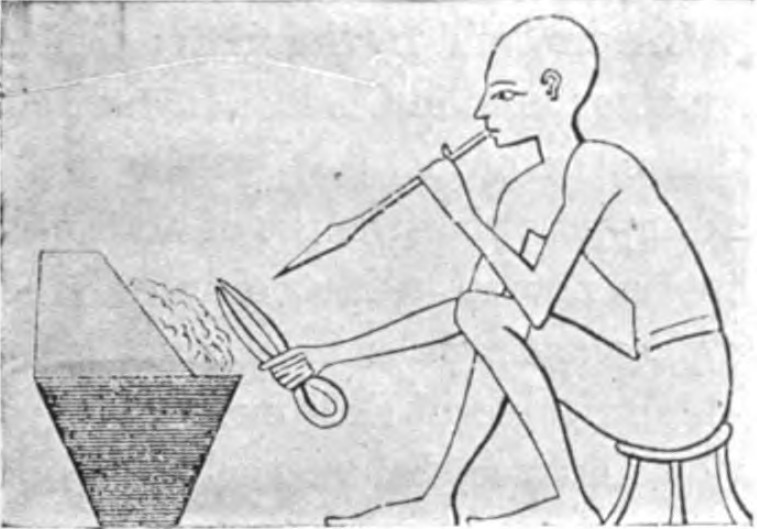
Those reliefs are themselves a precious source. Scenes near the pyramids show Egyptians gathered around a fire, smelting copper by blowing down long tubes tipped with bulbous ends — the blowpipe, the simplest and oldest way to force a charcoal fire to the temperature copper demands. In time the blowpipe was supplemented, though never wholly replaced, by the foot-operated bellows depicted in later workshop scenes. The essential method, however, was ancient and stable: malachite and charcoal, heat and air, and the patient reduction of green stone into red metal.
Arsenical copper, and why Egypt was in no hurry to leave it
For most of its early history, Egyptian “copper” was not pure copper and not yet tin bronze, but arsenical copper — copper carrying a few per cent of arsenic, which hardens the metal and improves its casting. Its use is confirmed in Egypt from the second phase of the Naqada culture in the Predynastic period, and it remained the workhorse alloy through the Old and Middle Kingdoms, only giving way at the threshold of the New Kingdom.
For a long time it was assumed that this arsenic was simply an accident — a natural contaminant of certain copper ores, present without the smiths intending or controlling it. That assumption has now been overturned, and this is the single most important recent development in the field. Analysis of metallurgical debris from a Twelfth-Dynasty context at Elephantine identified fragments of speiss — an arsenic-rich intermetallic — of deliberate metallurgical origin, showing that Egyptian smiths were alloying copper with arsenic in ceramic crucibles through a controlled cementation process. This is the earliest documented case of deliberate, controlled arsenic alloying in Egyptian metallurgy. The Middle Kingdom metalworker, far from blundering into a hard alloy, was reaching for the speiss and adjusting his metal on purpose. There is a sting in the tail for the rest of us, however: that same speiss introduced not only arsenic but trace antimony and lead into the metal, which disturbs the isotopic signatures modern researchers rely on to trace where ancient copper came from. The Egyptians, in improving their bronze, inadvertently complicated our provenance studies by three thousand years.
The deeper question is why Egypt clung to arsenical copper for so long when tin bronze was available. It is tempting to reach for the old answer — that arsenic poisoned the smiths and was abandoned on health grounds — but that explanation is now regarded as weak. The better account is metallurgical and practical. Tin bronze offered few decisive advantages in strength over a good arsenical copper; what it offered was control. Tin could be added directly to the melt in a measured, repeatable quantity, whereas the amount of arsenic that survived smelting was hard to judge and harder still to reproduce, since arsenic vaporises out of the melt at modest temperatures. Tin bronze, in other words, won not because it was dramatically better but because it was reliable — the same dull, decisive virtue by which standardised technologies usually displace temperamental ones. Egypt, with a deeply conservative craft tradition and a perfectly serviceable arsenical copper, simply had less reason to hurry than cultures with readier access to tin.
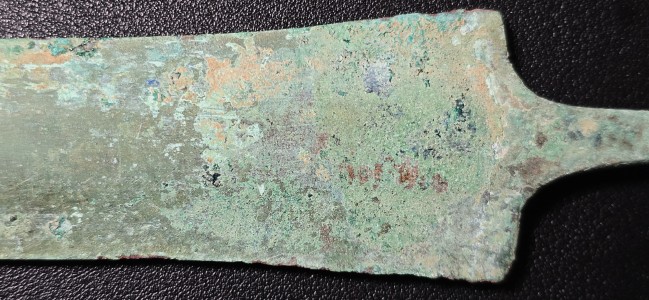
When the change did come, it came slowly and unevenly. There are sites where tin-bronze objects sit alongside arsenical-copper ones, the two technologies overlapping for generations. Only from the New Kingdom and its Eighteenth Dynasty, in the fourteenth century BC, do we have definitive evidence of tin bronze in large-scale use. Thereafter the sequence completes itself: tin bronze becomes standard, leaded tin bronze makes its appearance in the late New Kingdom, and that leaded alloy remains dominant through the Late, Ptolemaic, and Roman periods, when casting figurines for temple offerings became something close to mass production.
The Old Kingdom toolkit shows the early state of things with unusual clarity. The metal recovered from the settlement of the workers who built the pyramids of Khufu and Khafra at Giza, around 2500 BC, is arsenical copper and copper with impurities — and no tin bronze at all. The functional, full-size tools among them, a chisel and two axe blades, were arsenical copper. The metal that raised the pyramids was the older alloy; tin bronze, when it came, came for finer and later things.
The goldsmith’s separate genius
If Egyptian base-metal work was conservative, Egyptian goldwork was the opposite: precocious, virtuosic, and largely without rival. The two traditions ran side by side for millennia, and the contrast between them is itself part of the answer to our opening paradox. Gold was not a structural metal. It was the metal of the gods — the very flesh of the gods, in Egyptian thought — and it was worked not for hardness but for colour, light, and permanence. There the Egyptian craftsman had no peer.
The cultural weight of gold is written into the script itself: the hieroglyph for gold, drawn as a broad collar, appears at the very beginning of Dynasty 1, around 3100 BC, signalling that gold sat at the centre of Egyptian value from the dawn of the historical record. The raw material came overwhelmingly from the Eastern Desert and from Nubia to the south, a region so bound up with the metal that Egypt’s prosperity and Nubian gold became almost synonymous. The intensity of exploitation was remarkable: in the relatively short span between Thutmose III and Amenhotep IV, roughly 1480 to 1340 BC, very nearly all the important gold-mining sites of the Eastern and Nubian deserts were located and worked, with around 250 production sites now recorded across that vast and forbidding terrain.
There is a beautiful economic wrinkle here that most accounts miss, and it rewards attention. Gold, for all its prestige, was relatively cheap in Egypt while Nubia was under Egyptian control, because the supply was so abundant. The gold-to-silver value ratio in Egypt before about 1100 BC was strikingly low by the standards of Mesopotamia, where gold was far scarcer and dearer. Then, after 1100 BC, Egypt lost its grip on Nubia, the gold supply contracted, and by around 960 BC the ratio had climbed steeply, until gold in Egypt was as expensive as it had always been in gold-poor Mesopotamia. The value of the metal, in other words, tracked imperial control of its source — a reminder that even the flesh of the gods obeyed the arithmetic of supply.
The techniques the goldsmiths brought to that metal are where the real wonder lies. Granulation — the fixing of minute gold spheres to a surface to build pattern and relief — was achieved by a method known as colloidal hard soldering: a finely ground copper-mineral powder, applied to the join, chemically reduces on heating and locally lowers the melting point of the adjacent gold, so that gold and copper atoms diffuse across the contact and bond the granule to its base without ever flooding the delicate detail with solder. It is an exquisitely controlled piece of chemistry, and the Egyptians were doing it on cylinder amulets in the Middle Kingdom. Wire, the other foundation of the jeweller’s art, was made by twisting tightly wound metal strips or by hammering square-section rods to roundness, and was then twisted, braided, or woven into chains, or laid down in conjunction with granulation as surface ornament. To these the goldsmith added cloisonné — thin strips of gold soldered on edge to form cells, then filled with faience, coloured glass, or semi-precious stones — and the whole repertoire of casting, hammering, and gilding, worked over charcoal furnaces with foot-bellows and the ever-present blowpipe for fine, local heat.
One last point on gold belongs here, because it shows how early the Egyptian instinct for purity and control ran. The Nubian gold often arrived as electrum, the natural pale alloy of gold and silver. The desire to part the silver from the gold drove some of the earliest assaying in history: by adding salt to the melt, early metallurgists could bind the silver and drive it off, leaving the gold purer behind. The goldsmith, it turns out, was also Egypt’s first analytical chemist.
Casting the gods: lost-wax and the rise of the bronze statuette
The technique that most fully married Egyptian metallurgical skill to Egyptian religion was lost-wax casting — cire perdue — and its trajectory tracks the wider story closely. The first bronze and copper statuettes made by the lost-wax method appear in Egypt by the end of the Old Kingdom, around the twenty-third or twenty-second century BC. But it was the New Kingdom that saw the decisive leap, in the perfection of hollow lost-wax casting.
The principle is elegant. Rather than hammering or solid-casting, the artisan modelled a detailed figure over a clay core, coated it in a skin of wax that carried all the fine surface detail, and encased the whole in an outer clay mould. Fired, the wax ran out, leaving a narrow cavity between core and mould into which molten bronze was poured. The result was a statuette that was light, economical of metal, and capable of dynamic poses and intricate surface work that heavy stone could never achieve. This is why the temples filled, over time, with bronze gods and priestesses in attitudes of movement and prayer.
The sequence of surviving hollow castings traces the technique’s maturing hand: the kneeling figure of Thutmose IV and the head fragment of Ramesses V stand near the beginning, the castings grow more detailed through the Eighteenth Dynasty — the black bronze kneeling Tutankhamun is a celebrated example — and by the Late and Graeco-Roman periods the lost-wax process had become a vehicle for genuine mass production, turning out votive deity figures for personal devotion and temple offering by the thousand.
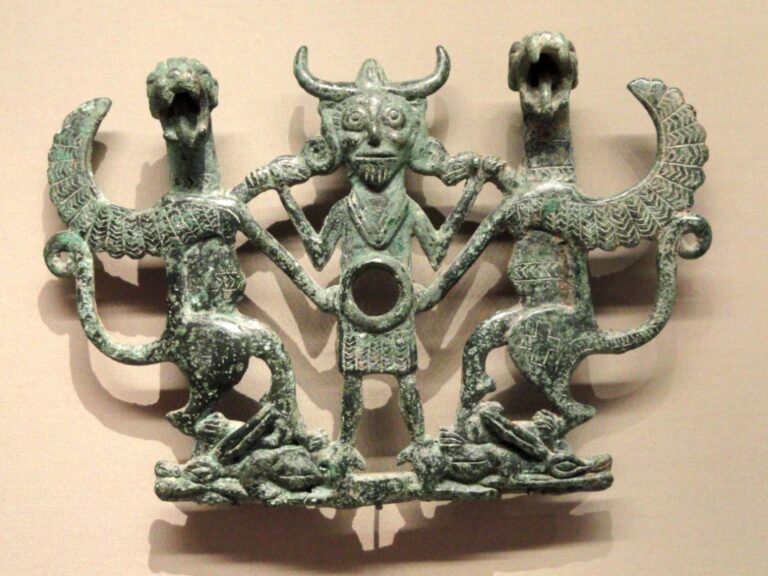
The masterpiece around which any discussion of Egyptian bronze statuary tends to orbit is the statue of Karomama, Divine Adoratrice of Amun, of the Twenty-second Dynasty, now in the Louvre. Cast by the lost-wax process, she carries inlays of several different copper alloys together with gold and silver, deployed to create a polychrome surface of extraordinary subtlety — and, as we shall see, some of those dark inlays connect directly to the black-bronze tradition I have written about elsewhere. It is worth saying that the precise casting methods behind such pieces are still debated: scholars continue to argue over the use of the indirect lost-wax method, in which a master mould allows multiple wax copies and hence repeated castings, and over how far Late Period figurine production should be understood as true serial manufacture. The workshop remains recovered at Qubbet el-Hawa near Aswan, a rare survival of an actual Egyptian casting establishment, are among the materials now being used to settle those questions.
The black inlays and the long shadow of Corinthian bronze
I cannot leave the statuary without addressing the dark, gold-flecked inlays that appear on the finest pieces, because they belong to a debate I have set out at length in my discussion of Corinthian bronze and hepatizon, and the Egyptian evidence is in fact the oldest thread in that whole story.
The Egyptian term at issue is hsmn-km, or in another reading hmty-km — “black bronze” or “black copper.” The reading goes back to John Cooney in 1966, who interpreted a particular hieroglyphic phrase as the name of a class of object inlaid with gold or electrum against a deliberately darkened background, the darkness chosen to throw the bright inlay into relief. He guessed, without analysis, that the blackening was a kind of niello. Later work by Paul Craddock and Alessandra Giumlia-Mair gave the idea analytical teeth, identifying a coherent family of these materials — copper alloys carrying small, deliberate additions of gold and silver, chemically surface-treated to a stable dark patina — and linking the Egyptian hsmn-km to Roman Corinthium aes and onward to Japanese shakudō. Recent analyses confirm that late-Middle-Kingdom Egyptians already knew this distinctive black copper: a copper base with small amounts of gold, silver, and often arsenic, taking a black patina after chemical treatment, and frequently misidentified by earlier scholars as niello.
I will not rehearse the whole argument again here, but the essential caution carries over: direct evidence for intentional patination is genuinely hard to establish, the field remains contested, and only a small number of objects have been positively identified as artificially patinated. The dispute over whether the black layer on such pieces is true niello or an intentional metal patina is not a quibble but a real and unresolved technical disagreement — one analytical study of related Mycenaean black inlay, for instance, found no reason to suppose sulphur was present in the black layer and no evidence to support its being niello at all. What matters for the Egyptian story is simply this: the deliberate colouring of metal by surface chemistry, which the Romans practised and the Greeks practised, has its deepest documented roots in the Egyptian workshops of the second millennium BC. Karomama and her kind are the ancestors of the whole tradition.
Iron from the sky
Iron is where the Egyptian paradox shows its sharpest edge, and it makes a fitting place to close. The civilisation that worked gold like no other was, by the standards of its neighbours, remarkably slow to take up iron — and when iron does appear in early Egypt, it comes not from the ground but from the heavens.
The oldest Egyptian iron we know of is a set of nine small beads from a tomb at Gerzeh, dated to around 3200 BC, carefully hammered into thin sheets from meteoritic iron. The most famous example is far later and far grander: the iron dagger of Tutankhamun, whose blade — iron with about eleven per cent nickel and around half a per cent cobalt — has a composition that places it squarely among iron meteorites, putting its meteoritic origin effectively beyond doubt. The Egyptians and their neighbours had a name that tells us they understood, at some level, exactly what this material was: they called it, in so many words, “iron of the sky.”
That phrase is the key to the whole puzzle. For most of the Bronze Age, the iron available to Egypt was meteoritic — rare, prestigious, and reserved for fine ceremonial and ornamental objects rather than tools or weapons of war. Smelted iron, where it existed at all in this period, was scarce and of poor quality. The utilitarian use of iron in the Nile Valley — common tools, common weapons — did not arrive until the first millennium BC, with iron weapons and tools becoming general only somewhere around 700 to 800 BC, and iron agricultural implements coming into wide use later still, in the Ptolemaic period. This was centuries after Egypt’s neighbours to the north and east had made the transition.
Why so late? The usual explanation is geological and ecological rather than a failure of skill. Egypt, despite holding iron ores, lacked both the incentive and the means: it had no shortage of excellent copper and bronze, and — crucially — it lacked the vast quantities of timber that iron-smelting devours for charcoal. A civilisation strung out along a desert river simply did not have the forests to fuel a wholesale shift to iron, and had little reason to attempt one while bronze served. Iron’s late triumph in Egypt was less a matter of learning the trick than of running out of reasons not to.
The Tutankhamun dagger also carries one of the field’s livelier debates, and it is worth flagging in the article’s own spirit of honesty. Because the other blades in the tomb are comparatively crude, while the meteoritic dagger is finely made, a number of scholars hold that the dagger was not made in Egypt at all but imported — quite possibly a royal diplomatic gift from a neighbouring power. The Amarna letters record gifts of iron sent to the pharaohs before Tutankhamun’s reign, and one recent study has argued specifically for a Mitanni origin for the blade. The point is not settled. More broadly, the whole question of how iron technology was invented and spread across the ancient Near East remains genuinely contested, compromised by gaps in the analytical record — and that uncertainty is itself part of the honest picture.
What the paradox finally tells us
Set the strands side by side and the apparent contradiction dissolves into something coherent. Egypt was not a backward metalworking culture that happened to be good at gold; it was a culture whose metallurgical priorities were simply not the ones we, looking back through the lens of tools and weapons, expect. Egypt optimised for colour, permanence, and symbolic value, and in those things — gold, electrum, polychrome inlay, the deliberate chemistry of dark patina — it led the ancient world. In the things that mattered less to it, or for which its geology and its forests left it ill-supplied — tin for bronze, timber for iron — it lagged, and felt no urgency to do otherwise while its own copper and its own gold sufficed.
The metal that came from the sky captures the whole of it. A civilisation that could leach silver from electrum with salt, force a stable black skin onto a gold-bearing bronze, and granulate gold spheres onto an amulet with sub-millimetre precision, nonetheless waited the better part of two thousand years to forge a working iron blade — and treated the meteoritic iron it did possess as a heavenly marvel rather than a material to be smelted and swung. Egyptian metallurgy is not the story of a slow learner. It is the story of a culture that knew exactly what it valued in metal, and pursued that with a brilliance the rest of the ancient world could only imitate.
Author’s note on interpretation and consensus. The broad periodisation set out here — arsenical copper dominant from the Predynastic through the Middle Kingdom, tin bronze arriving slowly and reaching large-scale use only from the Eighteenth Dynasty, leaded tin bronze dominant from the late New Kingdom onward, and iron entering common use only in the first millennium BC — is well established in the analytical literature and not in dispute. The meteoritic origin of the Gerzeh beads and of Tutankhamun’s dagger blade is secured by compositional analysis and is likewise not seriously contested. Several matters in this article are, however, genuinely open. The deliberate (rather than accidental) alloying of arsenic in the Middle Kingdom rests on the recent Elephantine speiss study and reframes a long-held assumption; it is new enough that its full implications are still being absorbed. The identification of Egyptian hsmn-km with the wider “black bronze” tradition, and the question of whether the dark layers on such objects are intentional metal patina or niello, remain contested, as I have discussed at greater length in the companion article on Corinthian bronze; the position I take there is an argued one. The foreign manufacture of Tutankhamun’s dagger — and specifically a Mitanni origin — is a serious hypothesis advanced by reputable scholars but is not established fact, and the broader history of the invention and diffusion of iron metallurgy is acknowledged in the literature itself to be unsettled. The economic interpretation of Egypt’s gold-to-silver ratio, and its link to the loss of Nubia, follows the published modelling but should be read as a reasoned reconstruction rather than a precise measurement. Where I have characterised Egyptian “priorities” and motivations, I am offering an interpretation of the material record, not a documented intention of the ancient smiths themselves.
This article was prepared for AncientBronzes.com and the Sancta Clara Collection. © Sancta Clara Collection.