
The Black Gold of the Alchemists: Corinthian Bronze, Hepatizon, and the Art of Intentional Patina
Epistemic key used throughout this article: ✅ established scholarship · ⚠️ argued inference or actively contested · ◆ the author’s own framework
There is a particular romance to a lost recipe. Pliny the Elder, writing in the first century AD, confessed that the formula for the most celebrated metal of the ancient world had vanished before his own lifetime — and that confession has tantalised metallurgists, antiquaries, and alchemists ever since. The metal was Corinthium aes, Corinthian bronze, and the Romans valued it, in Pliny’s own phrasing, before silver and almost before gold.
What follows is an attempt to set out, as honestly as the evidence allows, what this material probably was, how its darker cousin hepatizon was made, why the whole subject sits at the strange and beautiful intersection of chemistry, art, and alchemy — and why, in my own view, the ancient practice of colouring metal by chemical attack is the most plausible origin of the belief that base metal could be transmuted into gold. I will also address two questions closer to home: how a collector or curator can tell a genuine ancient black patina from a modern one, and whether the striking black glassy surfaces seen on certain pieces in this collection have anything at all to do with these legendary alloys. They almost certainly do not — but the reason why is worth understanding, because it reveals two utterly different roads to the same dark lustre.
A metal worth more than silver
✅ The prestige of Corinthian bronze in antiquity is hard to overstate. Cicero, in 80 BC, could lambast the corrupt governor Verres for stripping precious Corinthian vessels from temples, confident that his audience grasped the magnitude of the theft. Roman collectors paid fortunes for it, and the market it generated had all the features we would recognise today — including connoisseurship of dubious reliability. Petronius mocked the experts of his own day who claimed they could identify the true material on sight, a detail I find quietly reassuring: the problem of authentication is not a modern affliction, and neither is the confident fool.
The legend held that the alloy was created by accident in the fire that destroyed Corinth in 146 BC, when the molten gold, silver, and bronze of the city’s treasures supposedly ran together — a charming story that cannot be true, since the material is referred to before that date, and Pliny himself dismissed it on the sensible ground that the great makers of Corinthian work had lived long before the second century BC. Pausanias offers something more technically interesting than the legend: a tradition that the metal owed its character to heating and quenching in the waters at Corinth. That is not a fable. Heating and quenching are real steps in the chemical treatment of a metal surface, and a garbled memory of a genuine process is exactly what one would expect to find surviving in a periegetic guidebook three centuries after the workshops had closed.
✅ Pliny distinguished three varieties: a white kind, pale and silvery; a yellow kind, with the warm tone of gold; and a third in which the precious metals were held in balance. Set against these noble forms stood a humbler relation, hepatizon — from the Greek for “liver” — whose dark, purplish, liver-coloured surface gave it its name. Hepatizon was the poor relation of the family, yet it was prized for casting statuary and temple fittings precisely because of its sombre colour. Roman satirists, tellingly, mocked it for a lingering smell, a throwaway detail that turns out to be a genuine chemical clue, since sulphur treatments leave exactly such a residue.
The gate of the Temple: Corinthian bronze in the historical record
If you want a single object that conveys what this material meant to the people who used it, it is not a statue or a vessel. It is a door.
✅ Josephus, describing the Second Temple in Jerusalem shortly before its destruction, records that of the gates giving onto the inner courts, nine were completely overlaid with gold and silver, along with their door-posts and lintels — but that one gate, standing outside the sanctuary, was made of Corinthian bronze, and far exceeded in value those that were merely plated with silver and gold (Jewish War 5.201). He returns to the same gate elsewhere in the narrative and notes its extraordinary weight: it took twenty men to move it.
Read that comparison slowly, because it is the most valuable sentence in the entire ancient record on this subject. A first-century writer, addressing an audience that included Roman readers who knew perfectly well what gold plating cost, states as an uncontroversial fact that a bronze door was worth more than gilded ones. No modern estimate of ancient metal prices can do what that single comparative does.
⚠️ The gate in question is generally identified with the Nicanor Gate of the Mishnah and, in most reconstructions, with the Beautiful Gate of Acts 3 — where the lame man sat and was healed. The identification of the Corinthian Gate of Josephus with the Nicanor Gate is broadly accepted; the precise position of that gate within the Temple complex, and whether it stood at the eastern entrance to the Court of the Women or on the step dividing that court from the Court of Israel, remains genuinely disputed and turns on the reading of a single difficult passage. Readers should treat the location as open. What is not open is the material and the valuation.
There is a further detail that bears on the question of where this metal was actually made. Nicanor, the donor of the doors, was an Alexandrian — his ossuary, found on the Mount of Olives, carries a Greek inscription recording the bones of Nicanor the Alexandrian, who made the doors. ⚠️ That points to Egypt as a production centre for the material, which matters enormously for the argument I will develop below, because Egypt is also, by long tradition, the cradle of alchemy. The doors of the Jerusalem Temple, the black bronzes of the Nile workshops, and the earliest recipes for transmuting metals may all belong to one technological world.
What the metal actually was — and a dispute worth preserving
Here I must depart from the way this subject is usually popularised, because the popular account flattens a real and unresolved scholarly disagreement into a tidy certainty, and that does the reader a disservice.
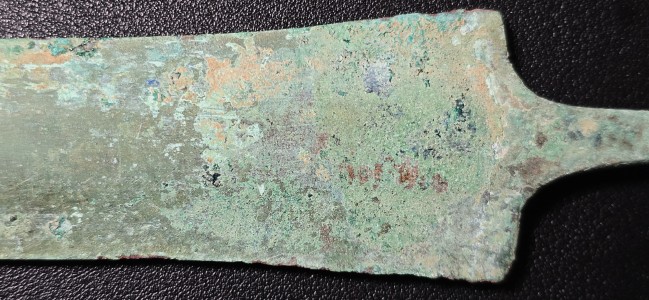
✅ The modern revival of interest in Corinthian bronze owes most to the work of Alessandra Giumlia-Mair and Paul Craddock, who in the early 1990s identified a coherent family of ancient “black bronzes”: copper alloys carrying small, deliberate additions of gold and silver, their surfaces intentionally darkened by chemical treatment. Their key papers — Corinthium Aes: Das schwarze Gold der Alchimisten in Antike Welt (1993) and the fuller technical treatment in La Niece and Craddock’s Metal Plating and Patination (1993) — linked these to the Egyptian hsmn-km (“black copper”), to the dark inlays on the Mycenaean shaft-grave daggers, to Roman Corinthium aes, and onward to the East Asian traditions of Japanese shakudō and Chinese wu tong. On this reading, all are members of one technological lineage: a low percentage of precious metal in a copper base, surface-treated to yield a dark, even purplish, patina.
⚠️ This identification, however, has been challenged on a point that is not a quibble. As David Jacobson and Michael Weitzman argued — first in the American Journal of Archaeology in 1992, then in a sharper note in the Classical Quarterly — the ancient sources are emphatic that Corinthian bronze was prized for resembling gold or silver: bright and lustrous, not dark. A genuinely golden depletion-gilded surface, where acid leaching strips copper from the surface to leave a skin enriched in gold, is only achieved with relative ease when the gold content is fairly high, well above ten per cent of the alloy. The dark “black bronzes” identified by Giumlia-Mair and Craddock contain far less gold than that.
The conclusion Jacobson draws is that those black alloys are best matched not to the noble, golden Corinthian bronze of the literary sources, but to Pliny’s dark hepatizon — and that true Corinthian bronze, the kind valued before silver, was a richer, brighter, higher-gold material that may simply have been melted down for its precious-metal content and so survives barely at all.
◆ I find this distinction persuasive and worth holding onto, and it is more interesting than the flattened version. There may have been two related but genuinely different materials: a high-gold alloy treated to look like gold (Corinthian bronze proper, now almost vanished), and a low-gold alloy treated to look dark and liverish (hepatizon, of which several plausible examples survive). The blurring of the two began in antiquity itself, as later texts already confused them.
⚠️ Giumlia-Mair, for her part, has noted that high-gold tumbaga-style alloys have not actually been identified among the many thousands of analysed Roman objects, whereas black patinated pieces demonstrably exist — which she takes as an argument for the black-bronze identification. That is a serious objection and I do not think Jacobson has fully answered it: an argument from the absence of surviving examples is only as strong as the recycling hypothesis that explains the absence. The matter is not settled, and a good article should say so rather than pretend otherwise.
The word itself: burnished bronze, chalkolibanon, and the Syriac evidence
One line of evidence rarely brought into these discussions is philological, and it is worth setting out because it independently supports the “bright, gold-like” reading of Corinthian bronze.
✅ In the Syriac Peshitta translation of 1 Kings, the Hebrew phrase conventionally rendered “burnished bronze” is translated as Corinthian bronze. A translator working in a Semitic language, with no stake in Roman art-market connoisseurship, reached for Corinthian bronze as the natural equivalent of a bright, polished, high-value copper alloy. The tenth-century Syriac lexicographer Bar Bahlul agrees with Pliny that the material is part silver, part gold and part copper — and adds, strikingly, that it is “bronze from which one makes gold and silver.” Hold on to that phrase; I return to it below.
⚠️ There is a related and much-searched puzzle in the Greek of Revelation, where the risen Christ’s feet are described as χαλκολίβανον, chalkolibanon (Revelation 1:15, and again at 2:18) — a word that appears nowhere else in surviving Greek literature and whose meaning was already obscure to ancient lexicographers. It is conventionally rendered “burnished bronze” or “fine brass,” and the standard lexica gloss it as a copper alloy, possibly containing gold or silver, of brilliant lustre. Some commentators have connected it directly to Corinthian bronze.
◆ I would put this cautiously. The etymology is genuinely uncertain — the second element may relate to frankincense, with an implied sense of whiteness or brilliance, or may be something else entirely — and a word attested twice in one apocalyptic text cannot bear much analytical weight. What I do think is defensible is the negative point: the writer of Revelation reached for a rare compound word to describe a metal of extraordinary brightness, glowing as if in a furnace. Whatever chalkolibanon was, nobody was straining to describe something dark. Taken with the Peshitta rendering, the philological evidence leans towards the bright, gold-lustred reading of Corinthian bronze and away from identifying it with the black patinated alloys. That is a modest argument, but it points the same way as Jacobson’s.
The chemistry of a deliberate darkness
Whatever name we attach to it, the process behind these intentionally dark surfaces is real, repeatable, and remarkable.
✅ It is a form of what metallurgists call depletion gilding, run in reverse of the goldsmith’s usual intent: instead of leaving a bright gold skin, the treatment produces a stable, dark, adherent layer. The principle rests on a single fact of chemistry: gold resists almost every common corrosive agent, while copper and silver do not.
An object is cast from a copper base carrying small amounts of gold and silver. Its surface is then attacked — historically with hot aqueous solutions, the alchemical recipes preserved in sources such as the Leiden and Stockholm papyri and the writings attributed to Zosimos of Panopolis describing baths of vinegar, alum, sulphur, salts, and metallic sulphates. The treatment selectively removes copper from the outermost layer and, in the presence of those trace noble metals, drives the growth of a microscopically thin, stable, coloured film. Treatments dominated by sulphur and alum yield the matte, sombre, liver-toned surface of hepatizon — and leave the sulphurous smell the Roman satirists ridiculed.
✅ The crucial point, confirmed by modern experimental reproduction, is that this stable dark film depends on the presence of those trace amounts of gold and silver. It does not form the same way on an ordinary tin-bronze that lacks them. More recently, X-ray diffraction and microdiffraction work on Egyptian and Roman objects in the Louvre has gone further and found evidence, within genuine black-bronze patinas, of metallic gold and silver present in the surface layer — most plausibly as nanoparticles. That is the mechanism laid bare: the noble metal is not merely a passive survivor of the leaching process but is redistributed into the film that gives the surface its colour and its stability.
The ancient smiths were, in effect, performing controlled surface chemistry at a scale of a few atomic layers, centuries before anyone could possibly have understood why it worked. Anyone who has spent time reading the signatures that casting and finishing leave on ancient metal will recognise the pattern: empirical mastery running centuries ahead of theory.
✅ That this was discovered independently more than once is part of its fascination. The Japanese shakudō, a copper alloy with a small percentage of gold, was boiled in a solution called rokushō to produce its celebrated blue-black patina; the Chinese wu tong belongs to the same family; and across the Atlantic, entirely unconnected, the metalworkers of the pre-Columbian Americas used depletion gilding on their copper-gold tumbaga. Human ingenuity converged on the same trick from opposite ends of the earth — a convergence of the same order as the one I have traced in the design of the flanged sword hilt, and for the same underlying reason: shared constraints produce rhyming solutions among people who never met.
What Nolan got right — and what he got wrong
The black bronzes have had an unexpected second life since July 2026, because Christopher Nolan reached for them to defend the most criticised design choice in The Odyssey. Pressed on Agamemnon’s black armour, he pointed to the blackened Mycenaean daggers and gave a description of the process — bronze, with gold and silver added, treated with sulphur — that is, to my considerable surprise, essentially correct. Directors are not usually right about metallurgy. He is.
He is wrong about what it was for, and the distinction matters more than the chemistry.
Intentional black patination in the Aegean Bronze Age is an inlay technique. It appears as the dark ground against which the gold and silver figures of the shaft-grave daggers are set — the lion hunt, the marine scenes — on objects the size of a forearm, made for display and burial. There is no evidence whatever for black-patinated body armour, and two good reasons to think it never existed. The first is cost: a material Josephus could describe as worth more than gilding, spread across a full panoply, would represent a sum no Bronze Age ruler would sink into something a spear point could ruin. The second is physics. A depletion-gilded surface is a film a few microns thick. It survives on a dagger kept in a scabbard and buried in a tomb; it would not survive a season of campaigning, and any smith who had made one would know that within a week.
So the honest verdict is narrow: the technology Nolan cites was real, and the object he cites it from is real, but the application is invented. He has taken a jeweller’s finish and scaled it to a suit of armour.
Which is, in fairness, the least of the film’s departures. The armour objection that most exercised specialists was never about colour but about the absence of the Dendra panoply and the boar’s-tusk helmet — the genuinely astonishing kit the period actually produced. Odysseus’s ship is a full-scale Viking longship reconstruction, the Draken Harald Hårfagre, which is a magnificent vessel roughly two millennia out of place. One reviewer put the film’s relationship to the archaeological record on a level with The Lord of the Rings, and that is not unfair.
I have set out what the Late Bronze Age warrior actually carried, and where Homer himself is describing kit from three different centuries at once, in The Arms of Odysseus. The short version is that Homer was already an unreliable narrator of his own subject — composing around 700 BC about events four centuries earlier, mixing Bronze Age heirlooms with Iron Age gear. Nolan is doing to Homer roughly what Homer did to Mycenae. It is a bad documentary and an old tradition.
Why the alchemists believed: depletion gilding and the birth of transmutation
Now to what I regard as the most important idea in this whole subject, and the one the popular accounts almost entirely miss.
We tend to treat alchemy as a delusion — a pre-scientific error, the belief that lead could be turned into gold, embarrassing in retrospect. ◆ I think that framing is not merely uncharitable but historically backwards. Consider what a craftsman in an Alexandrian workshop could actually observe with his own eyes.
He takes an ingot of copper alloy. It looks like copper: reddish, base, ordinary, worth little. He works it, then immerses it in a hot bath of vinegar, alum and salts — substances any kitchen or dyer’s shop could supply. He removes it. The surface is now gold. Not gold-coloured in the sense of a paint or a foil that will flake: the metal itself, in its own substance, presents a golden face that can be burnished, that resists corrosion, that will not come off. He has not applied gold to the object. He has, so far as any available theory could tell him, turned the surface of a base metal into a noble one.
⚠️ This is the argument advanced by Jacobson: that the concept of transmutation of base metals into gold arose from the depletion-gilding process itself, and that the earliest alchemical texts should be read as the technical literature of a real craft rather than as mystical speculation that happened to use metallurgical vocabulary. The recipes in the Leiden papyrus are not incantations. They are workshop instructions, and they work.
Recall Bar Bahlul’s definition, quoted above: Corinthian bronze is “bronze from which one makes gold and silver.” Read as mysticism, that is nonsense. Read as a description of depletion gilding, it is an accurate technical summary written by someone who had either seen the process or read a good account of it.
◆ My own position, which I hold with some conviction but present as interpretation rather than fact: the alchemists were not fantasists who failed. They were surface chemists who succeeded — spectacularly, repeatably, commercially — at something genuinely astonishing, and who then drew from that success a theoretical inference that turned out to be wrong. The inference was that if the surface could be transmuted, the bulk could be too. That was an error, but it was an empirical error, reasoned from real evidence, and the same intellectual move underlies a great deal of early natural philosophy. The gold that came out of the alum bath was real. Only the theory was mistaken.
There is a consequence for how we read the sources. If depletion gilding was the technical core of early alchemy, then the obscurity and secrecy of the alchemical corpus is not evidence of mumbo-jumbo — it is trade protection. A workshop that could sell a copper object as a golden one had every reason to encrypt its recipes. And Pliny’s report that the formula was lost begins to look less like the fading of a mystery and more like the ordinary commercial death of a guild secret whose holders were dispersed.
What survives, and where the evidence actually is
A reasonable question at this point: if any of this is true, what can one go and look at?
✅ Rather more than the “no certain examples survive” formula suggests — provided we are careful about which material we mean.
For the black patinated alloys, there is a substantial and growing analytical corpus. Eleven Egyptian statuettes in the Louvre have been examined by optical microscopy, scanning electron microscopy, X-ray fluorescence and Raman spectroscopy, producing evidence for deliberate polychrome finishes; a separate study group of twenty-three objects drawn from the Egyptian Museum in Cairo and the Faculty of Archaeology Museum has been analysed for black patination. Giumlia-Mair has argued for the existence of a highly specialised workshop in the Romano-Egyptian world producing extraordinary inlaid artefacts, with black, red, orange and yellow patinated surfaces on the same objects — and, for the first time, alloys resembling not only shakudō but other Japanese irogane metals such as sentoku and akagane. That is a striking claim of parallelism across a millennium and half a world, and it rests on composition rather than resemblance.
✅ For the Aegean, the black inlaid metalware in the National Archaeological Museum in Athens — including the celebrated shaft-grave daggers with their inlaid hunting and marine scenes — has been given a full technical examination, and the black backgrounds against which those figures are set belong to this same technological family. Anyone who has stood in front of the Lion Hunt dagger has seen ancient intentional patination; most visitors simply do not know that is what they are looking at. It is worth adding this to the mental furniture when reading about the material culture of the period — I discuss the wider armoury of that world in The Arms of Odysseus, and the Egyptian side of the story in Egyptian Metallurgy.
⚠️ For high-gold Corinthian bronze proper — the bright, gold-lustred material of Pliny and Josephus — the position is genuinely different, and this is where the “no certain examples” formula does apply. No object has been securely identified as Corinthium aes of the noble kind. Whether that reflects total recycling for precious-metal content, misidentification of surviving pieces, or the possibility that the noble variety was never a distinct alloy at all is exactly the question Jacobson and Giumlia-Mair disagree about.
The forger’s tell: selenium and the modern black patina
Here is a practical matter that ought to interest anyone who buys, sells, or conserves ancient metal, and which has not, to my knowledge, made its way into the collecting literature at all.
✅ Recent elemental and molecular analysis of black bronzes across cultures and periods has repeatedly turned up selenium-based patinas, identified as copper selenite dihydrate. Selenium patination is a modern technology. It had been assumed to be a nineteenth-century European response to the arrival of Japanese shakudō and shibuichi after the Meiji restoration — but a study of English, German and French patination literature of the nineteenth and early twentieth centuries found that the Japanese metals, though greatly admired, were not in fact the impetus for the Western adoption of selenium. The origin of the practice remains obscure. What is not obscure is the chronology: selenium-based black patination belongs to the modern era, not to antiquity.
◆ The implication for the collector seems to me direct, and I state it as my own inference rather than as an established authentication protocol. A black patina on a purportedly ancient bronze that yields selenium on analysis did not acquire that surface in antiquity. It acquired it in a restorer’s workshop, a dealer’s back room, or a forger’s studio. The finding does not by itself condemn the object — a genuine ancient bronze may have been “improved” with a modern patina to make it more saleable, which is a very common form of enhancement — but it does condemn the surface, and it should prompt hard questions about everything else.
This belongs alongside the other diagnostics I have set out in The Collector’s Eye, and it is the sort of test worth requesting before committing serious money to a black-surfaced piece offered as an ancient patinated alloy. Non-destructive XRF will detect selenium readily. There is no good reason for it to be there.
The honest caveat: the black surfaces in this collection are probably a different thing
I want to address directly something a careful viewer of this collection will have noticed. A number of pieces here — most strikingly several of the Scythian arrowheads — carry a distinctive black, almost glassy, vitreous surface. It is tempting to wonder whether these are humble cousins of the black bronzes, little steppe fragments of hepatizon.
◆ I do not believe they are, and the distinction is precisely the lesson of this article.
✅ The black glassy skin on a buried high-tin bronze is, in the overwhelming majority of cases, a product of natural corrosion, not of intentional treatment. Over long burial, bronze undergoes decuprification: copper is selectively leached out of the surface, leaving the tin behind to oxidise into cassiterite — tin dioxide — which builds up as a smooth, hard, often glossy dark layer that faithfully preserves the original contours of the object. On a high-tin alloy this tin-oxide enrichment can be dramatic, producing exactly the dark, lustrous, “glazed” appearance these arrowheads show. It is a corrosion product, formed slowly and unbidden in the soil, and it is governed by the metal’s tin content and its burial chemistry, not by any ancient recipe. I set out the full corrosion sequence in The Language of Patina.
That is the essential difference. Corinthian bronze and hepatizon are copper-gold-silver alloys deliberately surface-treated to achieve colour; the black cassiterite patina on these arrowheads is a high-tin bronze passively transformed by centuries underground. The two arrive at a dark surface by opposite roads — one by the intentional addition of precious metals and the hand of a chemist, the other by the slow subtraction of copper at the hand of time. To call the Scythian pieces “black bronze” in the Corinthian sense would be a category error, however seductive the resemblance.
Note that the distinction is testable, and cheaply. Intentional black bronze carries gold and silver in the alloy and, in the patina itself, evidence of those noble metals in the surface film. Cassiterite patination carries neither: it is tin oxide over a tin bronze, with no precious-metal signature at all. A non-destructive XRF reading distinguishes the two in minutes — with the standing caveat, which applies to every compositional claim made about an uncleaned artefact, that handheld XRF on an intact patina reads the enrichment layer rather than the underlying metal and will systematically misrepresent bulk tin content. For the specific question at issue here that limitation matters less than usual, because the presence or absence of gold and silver is diagnostic either way.
A telling group: three fates of ancient metal
A single group from the collection brings the whole argument of this article into one frame. Laid out together are arrowheads of broadly comparable type but strikingly different surfaces, and the contrast is the lesson.
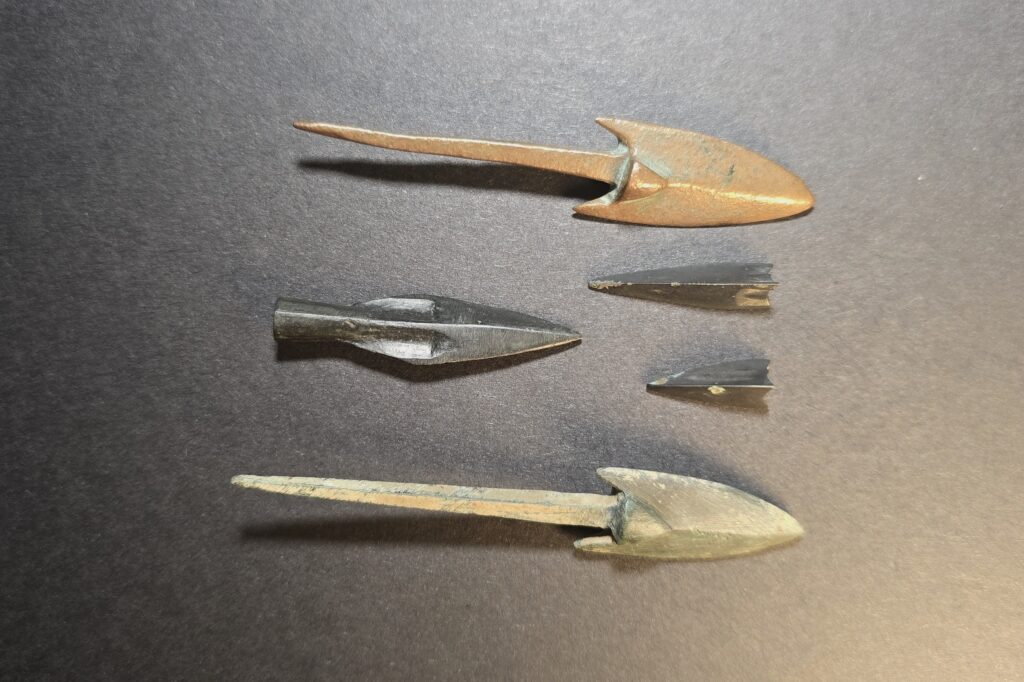
There is a tanged, barbed point carrying the dark grey-green surface of an ordinary patinated bronze — the expected outcome of long burial, copper and tin alike weathering into stable corrosion products. Beside it sits a barbed, tanged Greek arrowhead of a familiar form that is the wrong colour entirely: a warm, reddish-gold metallic piece that reads as a copper-coloured alloy rather than a tin bronze, set next to a corroded specimen of the very same shape so that the divergence is plain — two arrowheads, one typology, two different fates. That specimen is of unusually high density, above bronze and equal to pure copper: 8.96 g/cm³.
And then there are three small Scythian points with the dark, lustrous, almost glassy black surface that prompted this discussion in the first place.
⚠️ It is those three black Scythian arrowheads that I want to be careful about, because they are the ones most likely to be mistaken for fragments of the legendary black bronzes. They are probably not. Their glossy dark skin is, in all probability, the cassiterite-rich surface described above: a high-tin bronze that has undergone decuprification in the soil, copper leaching away and tin oxidising into a smooth, hard, vitreous black layer that faithfully preserves the contours of the point. It is a corrosion product, formed slowly and unbidden, and it owes nothing to the intentional copper-gold-silver chemistry of Corinthian bronze or hepatizon. The resemblance is real and the kinship is illusory — which is precisely why the group is worth showing.
The copper-coloured piece deserves a word of its own, because it is the genuine anomaly of the group. ◆ I make no firm claim as to its alloy. A density at 8.96 g/cm³ is consistent with substantially unalloyed copper, and an un-patinated metallic surface on a piece of this age is unusual enough to warrant explanation rather than admiration. The possibilities include a high-copper alloy that has resisted corrosion in a favourable burial environment, a cleaned and repolished surface, or a modern object. I hold the question open. It would be settled by a non-destructive XRF reading, which I would rather obtain than speculate about — and the broader typological context for the group is set out in The Anatomy of Ancient Arrowheads and, for the steppe material specifically, in Scythian Bronze Arrowheads.
Set side by side, the ordinary green patina, the unexpected copper-coloured alloy, and the three black lustrous Scythian points illustrate that what an ancient surface becomes is governed by what the metal is made of and where it lay, not by any single recipe. The black bronzes of the Corinthian workshops achieved their darkness by design; these little steppe arrows arrived at theirs by chemistry and time. To read the one as the other would be the very category error this article exists to prevent.
There is a humbling symmetry in all this. The ancient smiths laboured with acids and sulphur and minute additions of gold to force a dark, stable, lustrous surface onto their metal; and the same dark lustre arrives, given enough time and the right tin content, entirely on its own. The alchemist’s triumph and the soil’s slow chemistry are, in the end, two answers to the same question — how copper learns to wear black.
Frequently asked questions
Does Corinthian bronze still exist? It depends which material is meant. Objects with intentional black patination of the kind associated with hepatizon survive in reasonable numbers and have been analysed in the Louvre, in Cairo, and in Athens. High-gold Corinthian bronze of the noble, gold-lustred kind described by Pliny and Josephus has never been securely identified in a surviving object. Whether that is because it was recycled for its precious-metal content, because surviving examples are misidentified, or because the noble variety was not a distinct alloy at all, remains an open scholarly question.
What was Corinthian bronze made of? On the mainstream reconstruction, a copper base carrying small deliberate additions of gold and silver, chemically surface-treated to produce colour. The disagreement is over how much gold: a high-gold alloy would depletion-gild to a golden lustre, matching the literary descriptions, while the surviving black-patinated objects contain far less gold and match Pliny’s dark hepatizon instead.
Is shakudō the same thing as Corinthian bronze? Technologically they belong to the same family — a copper alloy with a small percentage of gold, chemically patinated to a dark surface. They are not historically connected. The Japanese tradition developed independently, as did the Chinese wu tong and the pre-Columbian tumbaga work in the Americas. The convergence is a case of separate invention under shared chemical constraints.
How was black bronze made? By casting an alloy of copper with small amounts of gold and often silver, then attacking the surface with a hot aqueous solution — vinegar, alum, salts, sulphur compounds and metallic sulphates figure in the surviving recipes. The treatment leaches copper from the outermost layer and grows a thin, stable, dark film whose formation depends on the presence of the trace noble metals. Analysis of genuine examples has found metallic gold and silver within the patina itself, probably as nanoparticles.
How can I tell an intentional black patina from natural corrosion? Composition. Intentional black bronze carries gold and silver, both in the alloy and in the surface film. The glossy black surface produced by burial on a high-tin bronze is cassiterite — tin dioxide — with no precious-metal signature. Non-destructive XRF distinguishes them. If the analysis instead returns selenium, the patina is modern regardless of how old the object beneath it may be.
Was Corinthian bronze mentioned in the Bible? Not by that name in the Greek or Hebrew texts, but the connections are real and worth stating precisely. Josephus describes the Corinthian-bronze gate of the Second Temple, generally identified with the Nicanor Gate and, in most reconstructions, with the Beautiful Gate of Acts 3. The Syriac Peshitta renders the “burnished bronze” of 1 Kings as Corinthian bronze. And the rare Greek word chalkolibanon at Revelation 1:15 and 2:18, conventionally translated “burnished bronze,” has been connected by some commentators to the same material — though the etymology is uncertain and the identification should be treated as speculative.
Transparency footer: consensus, argument, and open questions
In keeping with the standards of this site, I separate here what is established scholarly consensus from what is my own argued position or hypothesis, and I name every contested claim.
✅ Established scholarly consensus:
- The high prestige of Corinthian bronze in antiquity, Pliny’s report that its recipe was lost, his three-fold classification, and the dark liver-coloured character of hepatizon are all well attested in the ancient sources and not in dispute.
- Josephus records that one gate of the Second Temple was of Corinthian bronze and exceeded in value the gates plated with silver and gold (Jewish War 5.201). The identification of that gate with the Nicanor Gate of the Mishnah is broadly accepted.
- The chemistry of depletion gilding, and the demonstrated dependence of the stable dark film on trace gold and silver, are established by modern experimental and analytical work — principally that associated with Giumlia-Mair, Craddock, and colleagues (Craddock 1982; Giumlia-Mair & Craddock, Antike Welt 1993; Craddock & Giumlia-Mair in La Niece & Craddock, Metal Plating and Patination, 1993).
- X-ray diffraction work on Egyptian and Roman objects in the Louvre has found evidence of metallic gold and/or silver within genuine black-bronze patinas, presumably as nanoparticles.
- Black-patinated copper alloys form a technological family spanning the Egyptian hsmn-km, the Mycenaean shaft-grave dagger inlays, Roman material, Chinese wu tong and Japanese shakudō, with analytical corpora published from the Louvre, Cairo museums, and the National Archaeological Museum in Athens.
- Selenium-based black patination is a modern technology, identified in analysed black bronzes as copper selenite dihydrate; it is not an ancient practice.
- The Syriac Peshitta renders the “burnished bronze” of 1 Kings as Corinthian bronze; Bar Bahlul describes the material as part silver, part gold and part copper.
◆ My own argued positions and hypotheses (contestable):
- That the alchemical belief in transmutation most plausibly originated in the direct workshop experience of depletion gilding — that alchemy began as a real and successful craft from which a mistaken theoretical generalisation was drawn. This follows and extends Jacobson’s argument; the framing of alchemists as successful surface chemists rather than failed transmuters is my own, and is an interpretation of motive that the sources do not state outright.
- That the secrecy of the alchemical corpus is better read as commercial trade protection than as mysticism. My inference.
- That the presence of selenium in a black patina should be treated by collectors as disqualifying for the surface, though not necessarily for the object. This is my practical inference from the published chronology of selenium patination; it is not an established authentication protocol, and I am not aware of it having been formalised as one.
- That the philological evidence — the Peshitta rendering and the brightness implied by chalkolibanon — leans against identifying Corinthian bronze proper with the dark patinated alloys. A modest supporting argument, not a decisive one.
- That the black glassy surfaces on this collection’s Scythian arrowheads are natural cassiterite-rich corrosion through decuprification rather than intentional patination. This is my assessment based on the well-documented corrosion behaviour of high-tin bronzes in burial; absent analysis of the individual pieces, it remains an informed interpretation rather than a laboratory finding.
⚠️ Contested or open questions, stated as such:
- The identity of Corinthium aes is unresolved. Jacobson’s position — that surviving black bronzes correspond to hepatizon while true high-gold Corinthian bronze barely survives because it was recycled — is presented here as serious and, in my view, persuasive. It is not universally accepted. Giumlia-Mair’s objection, that high-gold alloys of the expected kind have not been found among thousands of analysed Roman objects while black patinated pieces demonstrably exist, is a real difficulty for the recycling hypothesis and has not been fully answered.
- The precise location of the Corinthian/Nicanor Gate within the Temple complex is disputed and turns on the reading of a single passage in Josephus.
- The identification of chalkolibanon with Corinthian bronze is speculative; the word is attested only twice and its etymology is uncertain.
- The alloy of the copper-coloured Greek arrowhead in the group described above is not established. It is described here only by appearance and by its anomalous density of 8.96 g/cm³. Elemental analysis — a non-destructive XRF reading would suffice — would settle it.
- Any compositional claim derived from handheld XRF on an uncleaned patina should be treated with caution: the enrichment layer systematically misrepresents bulk tin content.
This article was prepared for AncientBronzes.com and the Sancta Clara Collection. © Sancta Clara Collection, 2026.