
The Clasp of Civilisation: A Field Guide to Ancient Fibulae and Garment Hooks
For the better part of three thousand years, the peoples of Europe and the Near East did not wear clothing in the sense we understand today. They wore cloth. A cloak was a rectangle of woven wool; a tunic or a peplos was little more than a folded sheet, gathered at the shoulder and held in place by tension and ingenuity rather than by a tailored seam. The garment did not fit the body — the body, and the fastener, made the garment fit. That fastener, in its developed metal form, is the fibula, and its long evolution is one of the most useful chronological tools we possess. A fibula can rarely be mistaken for anything else, it survives burial well, and its mechanism changed in ways that are tightly datable. For the collector and the field-finder alike, learning to read a brooch is learning to read time itself.
I want to set out here, as plainly as I can, how these objects work, how they evolved, and how to tell them apart — including the awkward but important fact that not everything pin-shaped and looped is a brooch at all. Several pieces that pass through collections under the comfortable label of “brooch” are in truth belt and garment hooks, a related but distinct family. I will return to that problem, because it matters.
The problem the fibula solved
Before metal fasteners, draped cloth was pinned with a simple straight pin of bone, thorn, or bronze. Anyone who has used a straight pin knows its single fatal flaw: it works its way loose and falls out, and a lost pin in a woollen cloak means a cloak on the floor. The genius of the fibula — and it is genius, however humble the object — was to bend that single pin back on itself so that the sharp point was captured and held under tension. The result is, in mechanical principle, identical to the modern safety pin, which is simply the fibula’s direct descendant after a two-thousand-year detour through the button.
This is the first thing to understand about every brooch in this family: it is a spring-loaded trap for its own pin. A length of metal is worked so that one end is a sharp pin, the other end forms a catch or catch-plate that receives and grips the point, and somewhere in between the metal is coiled or hinged so that the pin is forced shut. Everything else — the decoration, the shape of the bow, the size of the spring — is variation on that single idea.
The vocabulary is worth fixing early, because the literature uses it without apology. The bow is the arched body that spans the gathered cloth. The pin (or needle) pierces the fabric. The spring or hinge is the joint that provides tension. The catch-plate (or foot) is the hooked or troughed terminal that holds the pin’s point. The chord is the short length of wire, on a coiled spring, that connects the two halves of the coil and runs either over or under the bow — a detail that looks trivial and is in fact one of the most diagnostic features on the whole object.
A short history of status worn at the shoulder
The earliest true fibulae appear at the close of the Bronze Age, around the fourteenth century BC, in the Mycenaean world of the Greek Peloponnese. These first brooches are the so-called violin-bow type: a low, flat arch running nearly parallel to the pin, so that the profile resembles the bow of a stringed instrument. From Mycenae the form travelled quickly along Bronze Age trade routes to Crete, Cyprus, and the Mycenaean trading posts of Sicily and southern Italy, where a closely related early form appears at Peschiera. Whether the idea was invented once and exported, or arose in more than one place, is still argued; what is not in doubt is that the violin-bow brooch is the ancestor of the entire European tradition.
From the very beginning the fibula carried meaning beyond function. A straight pin holds cloth; a fibula holds cloth and announces who you are. Because it sat at the shoulder or breast — the most visible point of the body — and because it could be enlarged, gilded, hung with amber beads, or cast into elaborate shapes, the brooch became one of the principal ways a person displayed wealth, rank, ethnicity, and allegiance. A bronze brooch worn by a labourer and a gold one worn by a chieftain performed the same mechanical task, but they were not the same object in any sense that mattered to the people wearing them. To possess an ornate fibula was to possess metal that had been spent on display rather than on tools or weapons, and in societies where metal was scarce that was a statement in itself. By the Roman period, certain brooch forms had become near-uniform military issue, and the great crossbow brooches of late antiquity were effectively badges of imperial office. The humble safety-pin had become insignia.
The heart of the matter: reading the spring
If you learn to read one thing on a brooch, read the joint where the pin meets the bow. The evolution of that joint is the backbone of fibula chronology, and it proceeds in a clear sequence from the simple to the elaborate and then, finally, back to the simple again.
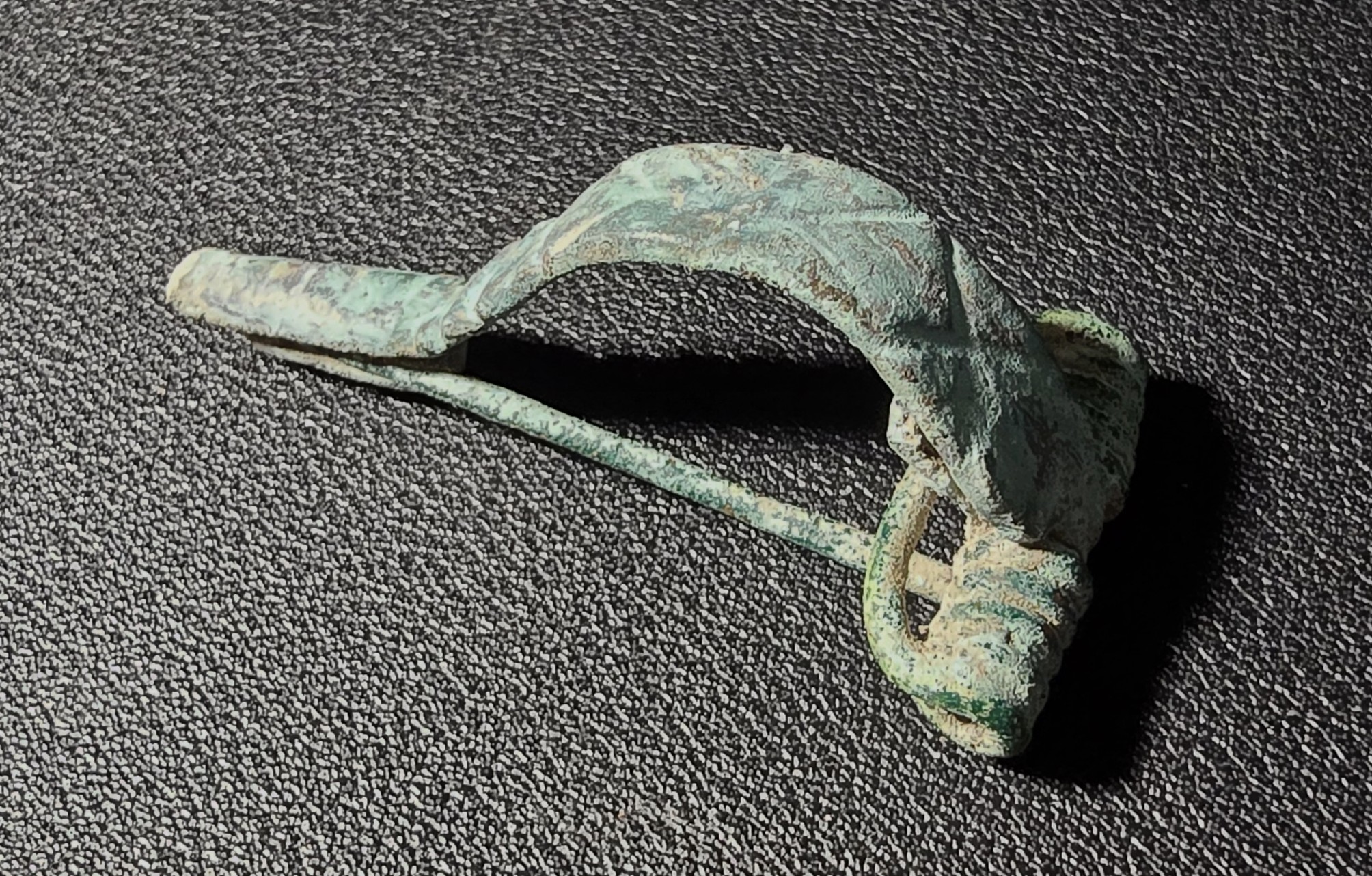
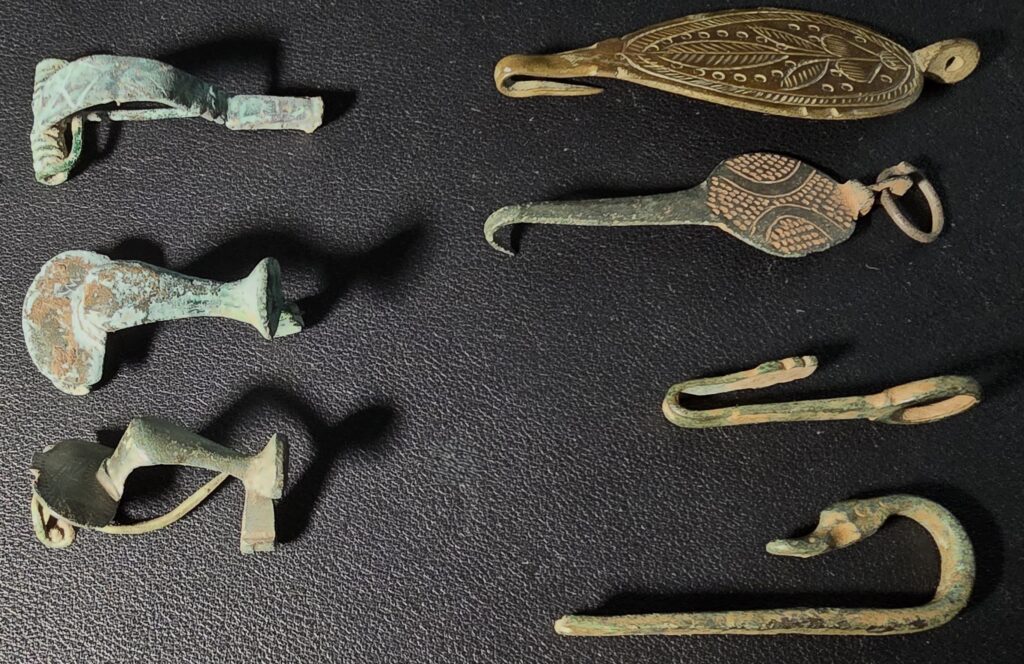
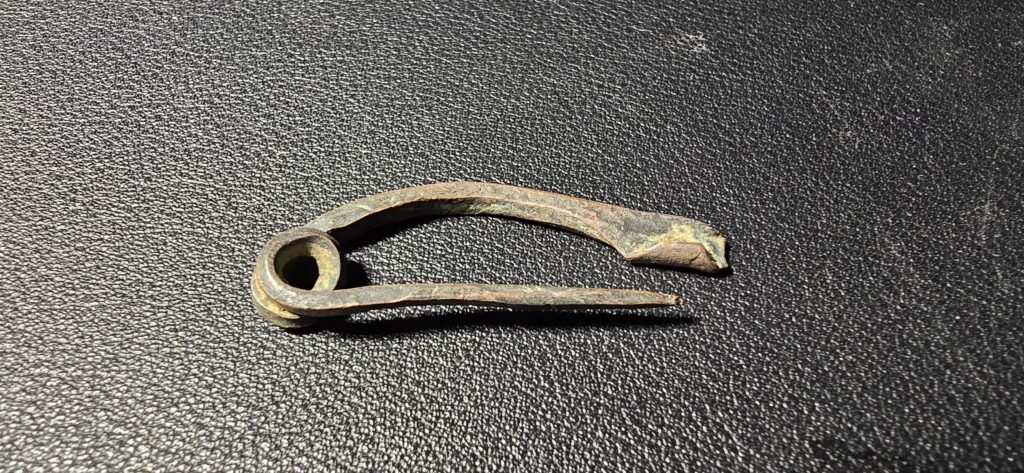
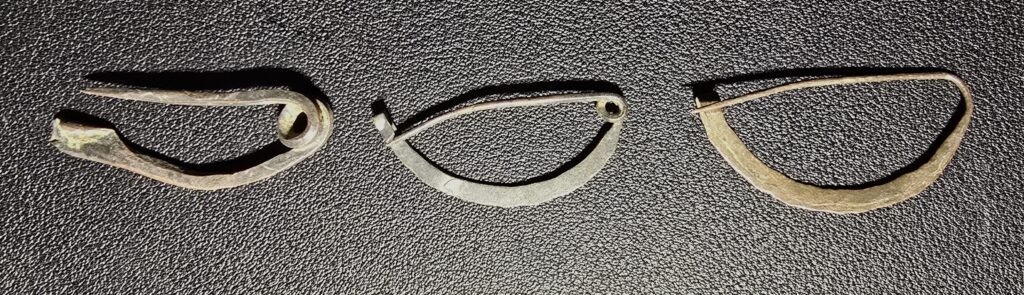
Stage one: the simple coil (unilateral spring). The earliest brooches solved the tension problem with a single twist. The wire is wound once or a few times into a coil on one side of the bow only, and the natural springiness of the worked bronze drives the pin downward into the catch. This is the unilateral spring, and it is the mechanism of the violin-bow and the early arched brooches. It is beautifully economical — the entire object, pin, spring, bow, and catch, is forged and bent from a single unbroken piece of metal. Three of the pieces illustrated here belong to this earliest conceptual world: simple bows of hammered copper and bronze wire, their tension supplied by a single looped coil at the head. In one of the three the spiral is clearly visible, wound tight where the pin springs away from the bow; in the others the wire is barely thickened into a loop. These are the most ancient mechanical idea in the collection, and the least changed from the original fourteenth-century invention.
Stage two: the bow rises and the coil multiplies (bilateral spring). Two developments transformed the simple brooch. First, the flat violin bow gave way to a high, rounded arch, lifting the body of the brooch clear of the gathered fabric — easier to use, and presenting a far larger surface for decoration. Second, around the sixth century BC, the single coil was replaced by the bilateral spring: the wire now winds into several loops on one side of the pin, crosses the head of the bow as the chord, and continues into matching loops on the other side. This is a more powerful and more reliable spring, and it is the dominant mechanism of the Iron Age across Hallstatt and La Tène Europe, the Italic peninsula, and the Greek world.
Here the diagnostic detail I mentioned earlier comes into play. On a bilateral spring the chord must pass either in front of the bow head (an external chord) or behind it (an internal chord), and the choice is regionally and chronologically patterned. Internal chords tend to be earlier and are common on certain Central European groups; external chords, sometimes secured by a small cast hook on the bow, characterise other regions and the early Roman provincial series. The number of coils is equally informative: most springs have two to four turns per side, but some Germanic and provincial types run to ten or more turns on each side, producing a spring several centimetres wide. Such broad springs cannot hold their own shape under their own tension, and the smiths solved this by running an iron axis-pin through the coil — often capped at each end with a decorative knob to stop the spring sliding off. This is the world of the knee fibula, two examples of which are illustrated here: compact, sharply bent brooches whose profile turns at a near right-angle like a flexed leg, with a substantial transverse spring at the head. The knee brooch is overwhelmingly a thing of the second and earlier third centuries AD, worn across the Roman provinces and especially associated with the military and with the frontier zones of free Germania. Where one finds a knee brooch, one is usually looking at the high imperial period.
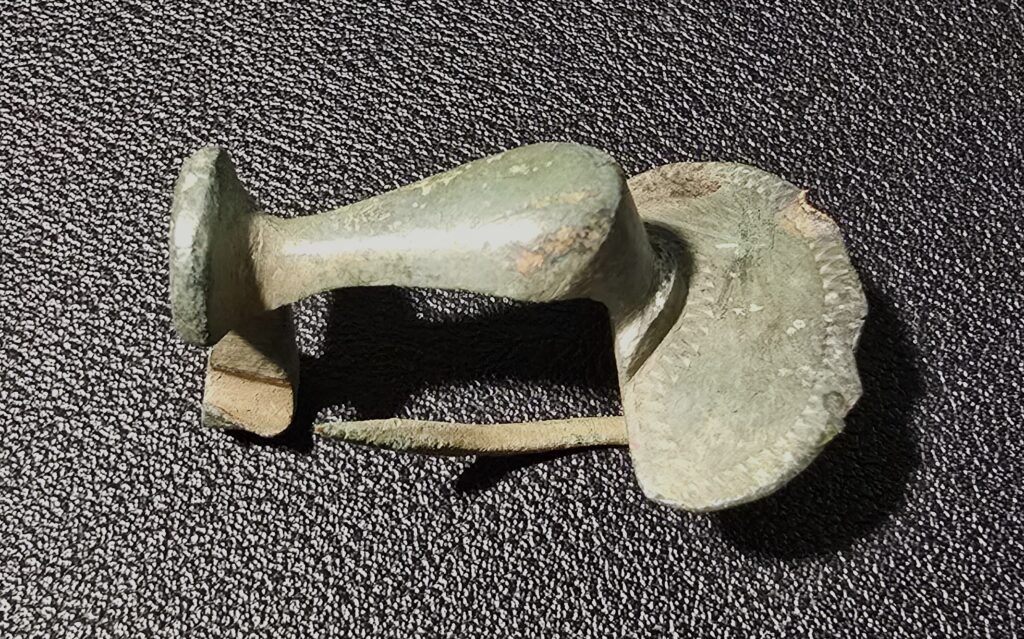
Stage three: the spring is hidden, then abandoned (the hinge). The bilateral spring, for all its power, had two weaknesses: it was fiddly to make in one piece, and its delicate coil was vulnerable to dirt and breakage. The Roman response was twofold. First, in the first century AD, some smiths concealed the spring inside a tubular sleeve cast as an extension of the bow — the spring is still there, but protected and hidden, giving a cleaner silhouette. Second, and far more consequentially, in the late first century BC or early first century AD the spring was abandoned altogether in favour of a hinge. The head of the bow was hammered flat and rolled over to form a small tube, a separate pin was seated on an axle inside it, and the tension that a coil once provided was now supplied by a deeper, longer catch-plate gripping the pin by friction. By the later second century AD the hinge tube was being cast solid rather than folded by hand, allowing the heavy, architectural cross-arms of the great crossbow brooches — the onion-knobbed insignia of the late Roman state.
This sequence — single coil, bilateral spring, hidden spring, hinge — is not a perfect ladder, and regional traditions overlap and persist. The northern European world, notably, favoured a genuinely two-piece construction (a separate bow and a separate pin) from early on, where the Mediterranean world preferred the one-piece sprung form. But as a first approximation for dating an unfamiliar brooch, the joint tells you more than anything else on the object.
A practical classification
It helps to hold the family in mind as a small number of clear groups rather than as the hundreds of named types the specialist literature recognises. The table below is deliberately simplified; it is a way in, not the last word.
By mechanism (the most diagnostic axis):
- Unilateral spring — a single coil on one side; one-piece construction; earliest, c. 14th–6th century BC. The violin-bow and early arched brooches.
- Bilateral spring — multiple coils both sides linked by a chord (internal or external); the Iron Age and earlier Roman workhorse, c. 6th century BC onward.
- Sleeve-hidden spring — a bilateral spring concealed in a cast tube; 1st century AD.
- Hinge — a pivot pin in a folded or cast tube, no spring; late 1st century BC onward, dominant in the Roman world and the basis of the crossbow brooch.
By form (the most visible axis):
- Violin-bow — low flat arch parallel to the pin; Late Bronze Age.
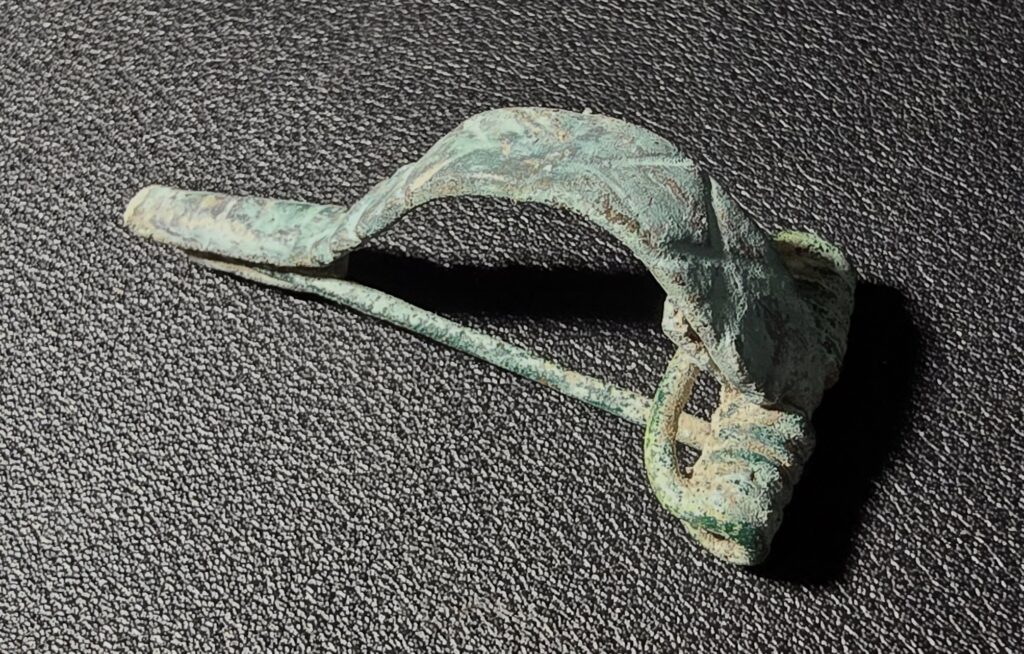
- Arched (or “arch/harp”) bow — high rounded single arch; the long-lived basic form. One such piece is illustrated here, its tall thin arch springing from a visible coil.
- Knee — sharply angled compact bow with a broad transverse spring; Roman, 2nd–early 3rd century AD.
- Plate and disc — a flat decorated plate, often enamelled, with the pin mechanism hidden behind; Roman.
- Crossbow — heavy hinged cross-arm with terminal knobs; late Roman official wear.
The complication: brooches that are not brooches
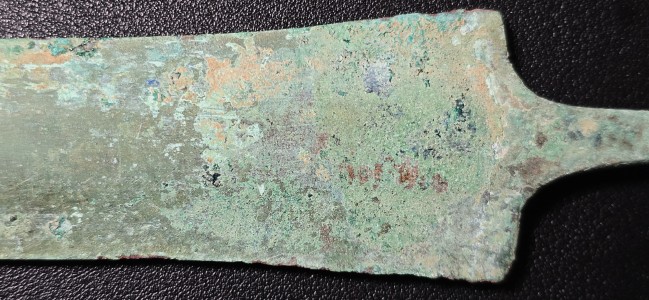
Now to the difficulty I flagged at the outset. Among the pieces presented here as “brooches” are several flat, elegant objects — one a fine leaf-shaped plate incised with a feather-and-dot pattern, terminating at one end in a rolled loop and at the other in a returned hook; another similar but with a separate ring still attached; and two simpler hooked wire pieces. These are tempting to call fibulae. They are, I think, mostly garment and belt hooks, and the distinction is worth defending carefully because it is so often blurred in the trade.
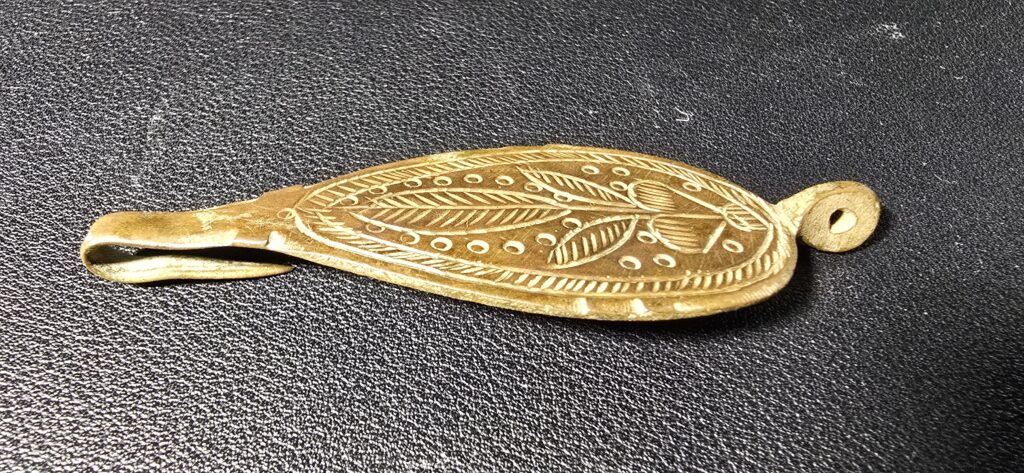
The test is mechanical, and it is decisive. A fibula is a sprung trap: it has a pin that is held shut against a catch-plate by stored tension, and you fasten it by piercing the cloth and snapping the point home. A belt or garment hook has no spring, no captured pin, and no catch-plate. It works instead as one half of a hook-and-eye: a hook at one end engages a loop, a ring, or a corresponding eye on the opposing end of a belt or on the other edge of a garment, and it is held by the simple tension of the wearer’s body and the gathered cloth, not by a spring. Where you see a flat plate with a loop at one end and a hook at the other, and no trace of a coil or a pin-rest, you are almost certainly holding a hook rather than a brooch.
The confusion is ancient and genuine, not merely a modern cataloguing slip. Hook-and-eye closures and spring brooches did the same cultural job — fastening dress and displaying status — and they were often made by the same hands in the same workshops, decorated in the same idioms. The hooked fastener has an enormously long history of its own: hooks of this general kind appear across the Iron Age Celtic world, where decorated belt hooks were both practical and prestigious, and an even older and quite separate tradition of garment and belt hooks runs through the bronze-working cultures of the Iranian plateau and the Eurasian steppe. The decorated leaf-shaped piece illustrated here, with its disciplined incised foliage and dotted border, sits comfortably in that broad hook tradition rather than in the sprung-brooch tradition; its rolled terminal is an attachment loop, not a spring.
Cultural markers: what a brooch tells you besides its date
A brooch is rarely culturally silent. Beyond the mechanism, which gives a date, a number of features point to where and among whom a piece was worn.
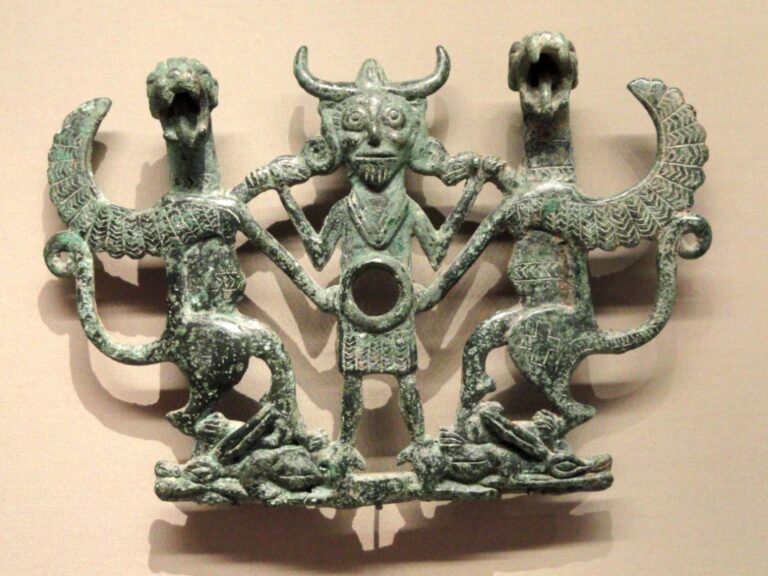
Decoration follows ethnicity and period. The disciplined vegetal-and-dot ornament on the leaf-shaped hook belongs to a different decorative grammar than the plain functional bronze of a frontier knee brooch. Enamelled and millefiori plate brooches are a Romano-provincial signature; tightly geometric incision and applied granulation point to the Iron Age Mediterranean and Etruscan worlds; openwork zoomorphic forms — birds, horses, beasts — are at home in the La Tène and steppe traditions.
The spring betrays the region. As noted, internal versus external chords, and the width of the bilateral spring, are not random. Very broad springs with knobbed axis-pins are a Germanic and frontier trait; the hidden sleeve-spring is a particular Gaulish and Rhenish solution; the hinge is the diagnostic Roman innovation, and its spread across Europe is in effect a map of Roman material influence.
Form can equal office. By the late Empire, wearing the right brooch was not a matter of taste but of standing. The crossbow brooch in gold or gilt bronze was effectively a uniform fitting of the late Roman administration and army, and its presence in a grave says something specific about the status of the person buried.
Pairs and singletons matter. How a brooch was worn — singly at one shoulder, or in pairs linked by a chain across the breast — varied by culture and by sex, and where brooches survive in pairs in a burial they carry information about dress and gender that a single stray find cannot.
To hold an ancient brooch, then, is to hold a remarkably dense piece of evidence. Its joint dates it; its decoration places it; its form may even rank its owner. And — if one is honest about the mechanics — its very identity as a brooch rather than a hook is itself a small act of interpretation, one that rewards looking closely at how the thing actually worked.
Author’s note on interpretation and consensus. The chronological framework set out here — the unilateral spring from roughly the fourteenth century BC, the bilateral spring from roughly the sixth, the sleeve-hidden spring and then the hinge across the turn of the era, and the crossbow brooch in late antiquity — reflects the broad and settled consensus of fibula scholarship, and the Mycenaean origin of the violin-bow form is likewise widely held (though the question of whether the type was invented once and exported or arose independently in more than one region remains genuinely open). The identification of specific illustrated pieces as belt or garment hooks rather than spring brooches is my own reading of their visible mechanics, advanced as the most probable interpretation rather than as certainty; it could be revised by direct examination of the reverse faces, the surviving springs or catch-plates, and the weight and section of each object. Readers should treat the attribution of individual pieces as a working hypothesis, and the general typological sequence as established.
This article was prepared for AncientBronzes.com and the Sancta Clara Collection. © Sancta Clara Collection.