
9 parts copper 1 part tin
Bronze has a secret, and the secret is tin. Copper is everywhere — it outcrops on five continents, and almost every early complex society had a usable source within reach. But bronze, the alloy that gave an entire age its name, is mostly copper with roughly a tenth part tin, and tin is one of the most geographically perverse commodities in the ancient world. It is rare, it is unevenly distributed, and the great majority of the people who needed it had none of it within hundreds or even thousands of kilometres. To make bronze, then, you had to trade — and not locally, but across continents. The result is one of the most remarkable facts of antiquity: the Bronze Age was, of necessity, the first age of long-distance interdependence. No palace, however rich, was self-sufficient in the metal that defined its power.
This article is about the tin roads — where the metal came from, how it moved, how modern science is finally tracing those movements atom by atom, and how the whole fragile system rose and, in the end, helped bring itself down. It is a story that runs from the cliffs of Cornwall to the oases of Uzbekistan, and it is, at the moment, one of the most actively contested questions in all of archaeometallurgy.
Why tin, and why so little of it
To understand the trade you must first understand the problem it existed to solve. Pure copper is soft and casts poorly; it slumps, it traps gas, it will not hold a fine edge. Alloy it with about ten per cent tin and everything changes. The melting point drops, the molten metal flows cleanly into the mould, the cast cools harder and tougher, and the finished edge can be worked to keenness and will keep it. Tin-bronze is, quite simply, a superior material in every way that mattered to a smith — and I have traced what that transformation meant for weapons and tools in From Stone to Iron: The Material Revolutions That Shaped the Ancient World.
The earliest “bronzes” cheated the problem. Before true tin-bronze, smiths used arsenical copper — copper smelted from ores that happened to carry arsenic, producing a harder metal almost by accident. It worked, but arsenic is treacherous: it fumes poisonously over the furnace, and its content cannot be controlled. Tin is stable, measurable, and addable in known proportion. By the later third millennium BC, wherever it could be got, tin-bronze had begun to displace the arsenical alloys, and the search for tin became one of the organising pressures of the ancient economy.
Here is the geological cruelty at the heart of it. Tin occurs almost entirely as cassiterite — tin dioxide, SnO₂ — concentrated by very specific granite-related processes into a narrow set of provinces. Most of the great Bronze Age consuming centres sat nowhere near one. Egypt had none. Mesopotamia had none. The Aegean palaces had none. Cyprus, drowning in copper, had no tin at all. The metal had to come from the geological margins of the known world to its political centre, and that single fact wrote the map of Bronze Age trade.
A global inventory of ancient tin
Let me lay out the sources continent by continent, because the geography is the argument. But one scholarly caution must come first: geological abundance is not the same as ancient exploitation. Some of the world’s richest tin provinces were never touched by Bronze Age hands, while a few modest deposits fed half a civilization. The Old World Bronze Age system, for all its reach, drew on a surprisingly short list of actually-worked sources.
Europe
Cornwall and Devon (south-west Britain). The Cornubian granites hold the most famous tin in the world, and they are now at the centre of the provenance debate. The tin here is alluvial as well as lodebearing — streamable from riverbeds without deep mining — which made it accessible to prehistoric communities. Recent isotope and trace-element work, of which more below, has made a serious case that Cornish and Devon tin reached the eastern Mediterranean by around 1300 BC, which would make these windswept peninsulas one of the supply hubs of the entire Bronze Age world.
The Erzgebirge (the Ore Mountains, on the Saxon–Bohemian border). Long suspected as a major Central European source, the Erzgebirge poses an archaeological problem: its tin, too, was won from placers, and fluvial working erases its own evidence, so direct proof of Bronze Age mining is frustratingly thin. The isotopic case for its exploitation is strong even where the diggings themselves are gone.
The Iberian Peninsula. North-western Iberia — Galicia and northern Portugal — and pockets of the south-west carried workable tin, and Iberia held the double distinction of being both a tin source and a copper source (the great silver-and-copper district of the Río Tinto lies here). Iberia was also the indispensable hinge of the Atlantic route, the place where northern tin met the Mediterranean.
Brittany (Armorica). The Breton tin fields formed part of the Atlantic network that linked Britain to Iberia, a string of metal-bearing coasts down the western edge of Europe.
Tuscany (Italy). The deposits around Campiglia Marittima offered a minor Italian source whose Bronze Age use remains debated — real geology, uncertain antiquity.
The Near East and Anatolia
Kestel, in the Taurus Mountains of southern Turkey. This is the source that rewrote the textbooks. When tin was identified at the Kestel mine, with its associated processing settlement at Göltepe, it overturned the old assumption that Anatolia had no tin of its own. The deposit is low-grade and was worked early, in the third millennium, and it has become one of the two leading candidates for the Anatolian tin that supplied the Hittite world and, by some readings, the Uluburun ship.
Central Asia and Iran
Mušiston (Tajikistan) and the Zeravshan valley mines of Uzbekistan — Karnab, Sichkonchi, Changali. These Central Asian deposits, worked by communities tied to the Andronovo and Bactrian cultural worlds, are now firmly established as Bronze Age tin sources. They sit at the eastern end of a corridor that, on one major interpretation, fed tin westward across Iran to Mesopotamia and beyond.
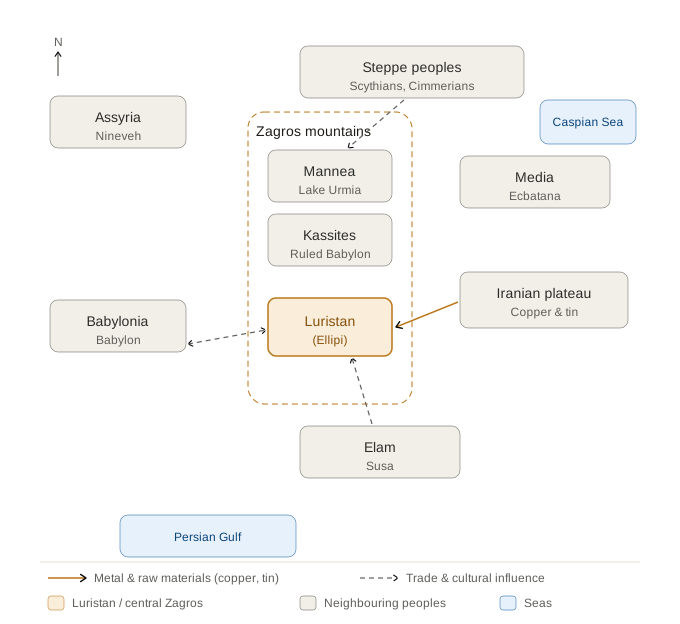
Deh Hosein (western Iran). A polymetallic tin-and-copper source in the Iranian highlands, plausibly within reach of the Zagros metalworking world I described in Luristan Bronzes: The Metalworkers of the Zagros.
Afghanistan. The classical literary tradition of “tin from the east” has long pointed toward Afghan sources, and the trade entrepôt of Shortugai on the Oxus shows the Indus civilization reaching deep into this zone. Direct evidence of large-scale Bronze Age mining remains thinner here than the historical argument would like, but the region clearly lay on the eastern tin road.
East and South-East Asia
Yunnan and the Chinese sources. Chinese bronze civilization — Erlitou, then the staggering ritual bronzes of the Shang — drew on tin from the south, above all the great deposits of Yunnan around Gejiu, among the richest on earth. This was a wholly separate metallurgical universe from the West, developing its own piece-mould casting tradition, but it ran on the same two metals.
The South-East Asian tin belt. Running down through Myanmar, Thailand, Malaysia, and the Indonesian islands of Bangka and Belitung lies one of the largest tin provinces on the planet. It supplied the Bronze Age cultures of mainland South-East Asia, and it is the metallurgical backdrop to the Dong Son world of Vietnam and Cambodia — the tradition that produced the great bronze drums and the decorated axe represented in this Collection by the Dong Son axe of Lot 98277415.
Africa, the Americas, and Australia
For completeness, and to make the scholarly point sharply: tin exists on every inhabited continent, yet most of it lay entirely outside the Old World Bronze Age system.
Africa carries tin on the Jos Plateau of Nigeria and at Rooiberg in South Africa, but sub-Saharan Africa largely moved from stone to iron without a true tin-bronze age, and these deposits were worked late, if at all in antiquity. The Americas hold the magnificent tin province of highland Bolivia, around Potosí and Llallagua, which did feed a genuine tin-bronze tradition — but among the Andean cultures of Tiwanaku and later the Inca, a thousand years and more after the Old World Bronze Age and entirely independent of it. Australia, rich in Tasmanian and New South Wales tin in modern terms, had no Bronze Age at all; its peoples did not practise metallurgy before European contact.
The lesson of the inventory is plain. The Old World Bronze Age, for all its hunger, was fed by a handful of provinces — south-west Britain, Central Europe, Iberia, the Taurus, Central Asia — and the trade existed precisely because so few places had what everyone needed.
How the metal moved: the tin roads
Tin moved along two great systems, one western and largely seaborne-and-riverine, one eastern and largely overland, meeting in the middle at the consuming heart of the eastern Mediterranean.
The western, Atlantic system ran down the ocean edge of Europe: tin from Cornwall and Devon, gathered with Breton tin, carried south along the Iberian coast to the great metal markets of the south-west, then through the Strait of Gibraltar and along the Mediterranean shore eastward. A parallel Central European overland route carried Erzgebirge tin south toward the head of the Adriatic and the north Italian plain, feeding the Alpine copper districts and the trans-Mediterranean shipping that distributed metal to the Aegean. These are the networks behind the European Bronze Age weapons in this Collection — the Atlantic and Urnfield-tradition spearheads such as Lots 97137769 and 97806108, cast where northern tin met Central European copper.
The eastern system carried Central Asian tin westward across Iran along the routes that also moved lapis and other highland goods, into Mesopotamia, and from there to the Levantine coast. The Old Assyrian merchant archives of the early second millennium — the letters of the Assyrian trading colony at Kanesh in Anatolia — record tin moving in donkey caravans by the tonne, bought in Ashur and sold into Anatolia at a handsome markup. This is documentary proof, in cuneiform, of an organised long-distance tin trade centuries before the famous shipwrecks.
And then there is the single greatest snapshot of the whole system: the Uluburun shipwreck, which went down off the southern Turkish coast around 1320 BC carrying about ten tonnes of Cypriot copper in oxhide ingots and a full tonne of tin — the largest assemblage of Bronze Age raw metal ever recovered. One ship, sunk on a single voyage, held the copper of one island and the tin of somewhere far away, bound together for some Aegean or Levantine palace. It is the physical embodiment of bronze’s central truth: two metals, two geographies, one cargo. The Aegean swords of the Mycenaean world, such as the Mycenaean short sword of Lot 778, were the end product of exactly such voyages — Cypriot copper and imported tin, alloyed in a Greek workshop.
Reading the metal: how science traces a source
How can we possibly know that a scrap of corroded bronze, or a tin ingot from a wreck, came from one mine rather than another? This is where archaeometallurgy has been transformed in a generation, and it is worth understanding the tools — and their genuine limits. The principles connect directly to the diagnostic reading of metal I set out in Paleo-Metallurgical Techniques and Their Signatures on Ancient Bronzes.
Lead isotope analysis was the first powerful method and remains a workhorse. Ores incorporate lead whose isotopic ratios were fixed by the radioactive decay of uranium and thorium over geological time, so the ratio acts as a fingerprint of the ore body’s age and origin. Match the lead isotopes in an artifact to those of a candidate ore field and you have a provenance argument. The catch, for bronze specifically, is profound: the lead signature of a finished bronze is dominated by its copper, because copper is the overwhelming bulk of the alloy. Lead isotopes are superb for sourcing the copper; they tell you little, on their own, about where the tin came from.
Tin isotope analysis is the newer and more directly relevant tool. Tin has ten stable isotopes, and their ratios vary subtly between ore deposits. Measuring them — by the demanding technique of multi-collector mass spectrometry — offers a route to the tin itself rather than its copper partner. The method is real and improving, but it carries a serious complication: smelting itself can shift the isotope ratios through fractionation, as lighter tin is preferentially lost during the reduction of the ore, so the analyst must correct for the very process that made the metal. Tin isotope ranges from different provinces also overlap, so the signal is rarely a clean fingerprint on its own.
Trace element geochemistry supplies the third leg. Tin ores carry minute, source-characteristic quantities of other elements — tellurium, indium, and others — that can sharpen an attribution where isotopes alone are ambiguous. It was elevated indium, alongside isotope ratios and a predicted geological formation age, that anchored the recent argument for a Cornish source of certain Mediterranean ingots.
The honest state of the art is that no single method settles a tin provenance. The strongest claims now combine all three — lead isotopes, tin isotopes, and trace elements — read against an ever-growing reference library of analysed ore samples. And that reference library is itself the limiting factor: you can only match an artifact to deposits that someone has already sampled and characterised. The same disciplined scepticism applies here as in authentication generally; an analytical result is an argument, not an oracle.
The great tin controversy
All of this comes to a head over the Uluburun tin, and the dispute is genuinely unresolved — which is precisely why it is worth airing rather than papering over.
On one side, a 2022 study led by Wayne Powell and Michael Frachetti, published in Science Advances, used combined lead, tin, and trace-element analysis on the wreck’s tin ingots and concluded that roughly two-thirds derived from the Taurus sources of Anatolia and the remaining third from the Central Asian deposits of Tajikistan and Uzbekistan — Mušiston above all. On this reading, tin travelled some three thousand kilometres from the oasis mines of Central Asia, through networks of mobile pastoralists and small villages, to reach a ship on the Mediterranean coast. It is a vision of a Bronze Age world knit together across the whole breadth of Asia.
On the other side, Daniel Berger and Ernst Pernicka and their colleagues have contested the Central Asian attribution directly, arguing that the data do not compel that conclusion, and that the isotopic and chemical signatures fit European sources at least as well — with Cornwall a leading candidate, and the Erzgebirge or Iberia also possible. Their case draws strength from a striking parallel: Bronze Age tin ingots recovered off the coast of Israel and from Mediterranean wreck sites appear to match the tin of Cornwall and Devon.
That western argument gained major ground in 2025 with the Antiquity study evocatively titled “From Land’s End to the Levant.” Combining trace elements with lead and tin isotopes on tin from south-west Britain and from Mediterranean find-spots, its authors argued that Cornish and Devon tin was reaching the eastern Mediterranean by around 1300 BC — that small farming communities on the Atlantic fringe of Europe were, in effect, suppliers to the palatial civilizations of the Levant. If they are right, the humble streamworks of Cornwall helped fuel the bronze economy of the pharaohs and the Hittite kings.
I will not pretend to adjudicate between teams of specialists wielding mass spectrometers. What I will say is that the very existence of this debate is the most important point for a collector to absorb. It tells us that the tin trade was vast, multi-stranded, and very far from fully mapped; that a single cargo might blend metal from opposite ends of a continent; and that the confident source-attributions of older catalogues should be read with caution. The science is converging, but it has not yet arrived.
Tin and the rise — and fall — of the Bronze Age
Step back from the analytical detail and a larger pattern emerges, one that I find the most compelling thing about the whole subject: tin both built the Bronze Age and helped destroy it.
It built it because scarcity forces connection. A world that needed bronze but lacked local tin had no choice but to reach outward — to negotiate, to ally, to establish trading colonies, to send caravans across deserts and ships across seas. The dense, cosmopolitan, palace-to-palace world of the Late Bronze Age eastern Mediterranean — the world of diplomatic letters between great kings, of standardised oxhide ingots, of the Uluburun cargo — was in large part a machine for moving copper and tin. The interdependence was not incidental to Bronze Age civilization; it was structural. The metal that armed the elite could only be had through long-distance exchange, and so the trade and the civilization grew up entangled, each sustaining the other. This is the connective tissue running through the global picture I sketched in The World in Bronze: A Global Survey of Ancient Metallurgical Cultures.
And that same dependence was the system’s fatal weakness. A supply chain stretched across continents is only as strong as its weakest link. Around 1200 BC the eastern Mediterranean world convulsed in the cascade of disasters we call the Late Bronze Age Collapse — palaces burned, kingdoms fell, the Mycenaean and Hittite states vanished, and the dense trade networks that had carried metal for centuries came apart. Whatever its tangle of causes — climate stress, internal upheaval, the movements of displaced peoples — one of its consequences was the disruption of the long-distance metal trade. And a civilization whose premier material could only be sourced by reaching across a continent is acutely vulnerable when the reaching stops.
Here, I think, lies the deepest reason iron triumphed. Iron is harder to smelt and to work than bronze, and early iron was often inferior to good bronze. But iron ore is everywhere. It does not require a tin road running back to Cornwall or Mušiston. In a fractured world where the great trade networks had failed, the decisive advantage of iron was not metallurgical but geographical: it freed metalworking from the tin lifeline. A people cut off from tin could not make bronze, but they could nearly always find iron under their own feet. The shift from bronze to iron, which I treated at length in From Stone to Iron, was driven as much by the collapse of supply chains as by any advance in furnace technology. Bronze fell, in part, because it was too dependent on a metal too few places possessed.
What this means for the collector
When you hold a Bronze Age weapon, you are holding the end point of a journey most of us never imagine. The copper may have come from a Cypriot or Alpine mine; the tin, on current evidence, from somewhere between the Atlantic coast of Britain and the oases of Uzbekistan. Two metals from two ends of the world, smelted, alloyed, and cast into a single object by a smith who almost certainly never saw the mines that fed his crucible. Every tin-bronze artifact is, in this sense, a fossil of trade — material proof of a connected ancient world.
It also means that the casual provenance label on an old bronze deserves a measure of humility. We are only now, with isotopes and trace elements and slowly accumulating reference libraries, beginning to read the true geography written into the metal — and the experts are still arguing about what it says. That uncertainty is not a flaw in the subject; it is the frontier of it. The tin roads ran further, and tied the ancient world together more tightly, than the people who walked them could ever have known — and we are still mapping where they led.
This article is part of the scholarly reference library of the Sancta Clara Collection. Artifact references are drawn from the Collection’s own holdings; scientific findings reflect the published archaeometallurgical literature current to 2026. © AncientBronzes.com — a scholarly reference for ancient bronze and copper alloy antiquities.