
The real Bronze Age ran on networks, not empires. The textbooks are 70 years behind.
8 lis 2026 · @Andrzej M Izyk
The ladder that never existed
The Bronze Age was not a world of isolated tribes waiting for kings to civilise them. It was a connected, mobile, industrial world — and the evidence has been lying in Russian, Kazakh and Chinese excavation reports for decades.
Yet the textbook model survives almost untouched. Hunter-gatherers become farmers, farmers become villages, villages become states, and only states produce writing, temples and “civilisation.” Mesopotamia and Egypt sit at the top of the ladder. Everyone else is scenery.
This is not a conclusion drawn from evidence. It is a template into which evidence is poured, and whatever does not fit is labelled “periphery,” “nomadic” or “barbarian.” The steppe, from the Urals to the Altai, has carried all three labels at once.
Look at what that steppe actually did, and the ladder collapses.
Where the ladder came from
The ladder has a pedigree, and it is Victorian. In 1877 Lewis Henry Morgan sorted humanity into “savagery,” “barbarism” and “civilisation,” each defined by a technology: pottery, herding, writing. The scheme flattered its authors, who naturally stood at the top.
In 1950 V. Gordon Childe refined it into the “Urban Revolution” and listed ten criteria for civilisation: large cities, full-time specialists, surplus taxed by a ruler, monumental public buildings, a ruling class, writing, exact sciences, representational art, long-distance trade, and a state based on residence rather than kinship. In the 1960s Elman Service gave it the neat sequence band, tribe, chiefdom, state, still taught in introductory courses.
Notice what these criteria measure. Almost every one of them is something that survives well in the ground or that a king commissions. Cities of stone, inscriptions, temples, palaces. The criteria do not ask how many people a society fed, how far its goods travelled, how long it lasted without collapse, or how free its people were. A society that chose mobility, consensus and timber over stone fails the test by design.
The exceptions that are not exceptions
The counter-examples are now too many to file as anomalies:
- Göbekli Tepe in southeast Turkey raised monumental carved pillars around 9500 BC, before farming, pottery or any state. Monuments came first; the “revolution” came later.
- The Indus civilisation built planned cities with drains, standard bricks and standard weights for centuries, with no securely identified palace, royal tomb or depiction of a king.
- The Trypillia megasites of Ukraine, discussed below, housed populations comparable to early Uruk with no visible ruler at all.
- The Eurasian steppe ran mining districts and continental exchange networks, the subject of this article, without a single city in Childe’s sense.
If four of the most impressive achievements of prehistory fail the definition of civilisation, the problem is the definition.
Kargaly: a mining district the size of a small country
In the southern Urals, near Orenburg, lies the Kargaly ore field: roughly 500 square kilometres of copper workings. Mining began in the Early Bronze Age, with Pit-Grave (Yamnaya) communities, and peaked in the Late Bronze Age Srubnaya horizon, around the 17th–15th centuries BC.
The settlement of Gorny sits inside this ore field. Its excavators, led by Evgeny Chernykh, recovered about 2.3 million animal bones from roughly 1,000 square metres. Some 99.8% came from domestic animals, and about 80% were cattle.
Read that again. A mining camp with almost no hunting and no visible farming, eating beef on an industrial scale. That is a provisioning system. Specialist miners and smelters were fed by herding societies that moved livestock to the mines as deliberately as a modern supply chain moves fuel.
The “primitive nomad” of the textbook did not run a meat logistics network for a copper district. Somebody did.
Reading the bones
The Russian–Spanish expedition at Kargaly, working through the 1990s and 2000s, mapped tens of thousands of surface traces of mining: shafts, galleries, spoil heaps and collapsed adits. Miners at Gorny lived in pit-houses dug partly into the ground, and smelted and cast on site. This was not a seasonal scratching of outcrops. It was a district worked for centuries.
The bone count deserves arithmetic. Even spread over two or three centuries of occupation, 2.3 million bones from one excavated hectare mean thousands of cattle slaughtered and eaten on a small patch of ground. Cattle are not wild game. Every one was bred, grazed, protected and driven to the site. The bones are a ledger of a pastoral economy producing surplus on purpose and moving it to a non-farming workforce.
That is the definition of a specialised economy: some people produce food, others produce metal, and an exchange system links them. Childe’s “full-time specialists fed by surplus” are standing right there — without a city, a king or a tax collector.
Three ways to read Gorny
- Pastoral clans mining in their own territory (about 45%). The herders and the miners were the same communities, rotating labour between herds and shafts. Chernykh himself stressed that steppe metallurgy grew out of pastoral societies, not against them.
- A specialist mining community fed by exchange (about 35%). Miners formed a distinct group, trading copper and ore to surrounding herders for meat. This is the more “industrial” reading.
- Large-scale feasting and ritual deposits inflating the count (about 20%). Some of the bone mass may come from communal feasts or ritual deposits rather than daily diet. Even then, the feasts presuppose the same surplus and the same organisation.
Every option ends at the same place. A stateless society mobilised labour and food on a scale the ladder reserves for states.
The first heavy industry — and its first ecological crisis
Kargaly was not alone. For the Kenkazgan workings in the Dzhezkazgan district of central Kazakhstan, published estimates run to 30,000–50,000 tonnes of smelted copper in the Late Bronze Age. Treat the figure as an order of magnitude, not a ledger. Even its lower bound is an industry, not a cottage craft.
Industry has a price. Smelting copper needs charcoal, and charcoal needs forest. Chernykh’s team argued that the woodland around Kargaly was exhausted by roughly 1400 BC, and that this, not barbarian collapse, ended the Late Bronze Age mining cycle there.
Roasting sulphide ores releases sulphur dioxide and metal-laden dust. Across the ancient mining world, the same pattern recurs: local fuel runs out, ore is carried away to be smelted elsewhere, landscapes degrade. The Bronze Age met the problems we call “modern” three and a half thousand years early.
Sintashta: fortified towns of smiths
East of Kargaly, in the southern Trans-Urals, the Sintashta culture (about 2100–1800 BC) built some twenty fortified settlements, Arkaim the best known. They were circular or oval, ringed by walls and ditches, with houses arranged radially around a central space.
At Arkaim and its neighbours, many houses had their own well, furnace and metallurgical debris. Copper was smelted household by household, inside the walls. Sintashta graves contain the earliest securely dated spoked-wheel chariots, horse sacrifices and heavy weaponry.
That combination is extraordinary. Dense, planned, fortified communities with metallurgy as a domestic industry, elite warfare on chariots, and no palace. Sintashta and its successor Andronovo horizon carried this package across the steppe to the borders of China and India. Here is a whole developmental path that never passes through the state.
The pollution record
The environmental cost is not speculation. At Wadi Faynan in southern Jordan, copper mining from the Bronze Age onwards left heavy metals in soils, plants and animals that remain toxic today. Studies of ancient skeletons from the region found elevated copper and lead. Peat bogs and lake sediments in Europe record atmospheric metal pollution rising with prehistoric mining, long before Rome.
Kargaly’s deforestation fits the same pattern. Smelting one kilogram of copper took very roughly tens of kilograms of charcoal, and charcoal at roughly five to seven kilograms of wood per kilogram. Scale that to thousands of tonnes and whole forests disappear. When fuel ran out, the smelting moved, the miners moved, or the cycle ended.
The point is not that ancient people were “eco-villains.” It is that they operated at a scale where they could exhaust a landscape. Only industries do that.
Tin: the cradle of civilisation had none
Copper alone makes soft tools. Tin bronze — roughly nine parts copper to one part tin — makes weapons that hold an edge. And tin is one of the rarest useful metals on Earth, with deposits scattered and small.
Mesopotamia, celebrated as the cradle of bronze working, had no tin at all. Central Asia did. Bronze Age tin workings are documented in the Zeravshan valley, at Karnab in Uzbekistan and Mushiston in Tajikistan. Afghanistan supplied lapis lazuli from Badakhshan and likely tin as well.
The Bactria–Margiana Archaeological Complex (BMAC) sat across these routes, trading tin, gold, lapis and finished goods south to the river-valley states.
So who depended on whom? The “centre” could not make its signature alloy without the “periphery.” A civilisation that cannot cast a sword without imported metal from the steppe and the mountains is not the top of a ladder. It is a node in someone else’s network.
Follow the tin
The written record confirms the dependence. Around 1950–1750 BC, merchants of the city of Assur ran caravans of donkeys to Kanesh in central Anatolia. Their thousands of surviving letters show tin and textiles going west, silver and gold coming back. Estimates of the tin shipped run to dozens of tonnes over a few decades. Assur did not mine tin. It bought it from the east, through Iran, and resold it at a profit.
The sea tells the same story. The Uluburun shipwreck off southern Turkey, around 1300 BC, carried about ten tonnes of copper ingots and roughly one tonne of tin — the ten-to-one ratio of a bronze foundry’s order. Isotope analysis by Daniel Berger and colleagues, published in 2019, matched part of that tin to Central Asian ores at Mushiston in Tajikistan. Tin mined in the Pamirs was sinking off the coast of Anatolia.
Who sat at the centre?
Map the flows instead of the monuments and the picture inverts:
- Raw materials — tin, copper, gold, lapis, turquoise, horses — originate largely in the mountains and steppes of Central Asia, Iran and Anatolia.
- Transport and know-how — caravan routes, steppe mobility, casting techniques — are run by mobile and semi-mobile societies.
- Consumption and display — temples, palace workshops, royal tombs — concentrate in the river valleys.
The river-valley states were where metal ended up, not where the system was driven. Calling them the “centre” is like calling a jewellery shop the centre of the mining industry.
There are other tin sources: Cornwall, the Erzgebirge, Iberia and contested Anatolian deposits such as Kestel. That only strengthens the case. Bronze everywhere depended on long-distance connections, and those connections ran through people the textbooks still call peripheral.
Seima-Turbino: the network nobody can fit into a box
Around 2200–1900 BC, something appears across northern Eurasia that archaeology still struggles to name. It is called the Seima-Turbino “phenomenon” precisely because it refuses to behave like a “culture”: no homeland of villages, no pottery tradition, mostly cemeteries and hoards full of superb metal.
Its signature objects are technically ahead of their time. Socketed spearheads were cast hollow around a core, in one piece, many with a single side hook. Knives carry pommels of horses, and at Rostovka near Omsk a figure of a man on skis being pulled by a horse — miniature sculpture cast by lost wax.
The distribution is the scandal. Seima-Turbino-type metal runs from the Baltic basin and the Borodino hoard region in the west to the Yellow River basin in the east. Seima-type spearheads turn up in northwest China, in the Qijia and Siba horizons around 2100–1900 BC, and their echoes continue into early Shang-period metalwork.
What travelled was not only objects. It was method: core casting, multi-part moulds, alloy recipes, the know-how that let local smiths reproduce the type. That requires people moving fast, over thousands of kilometres, and teaching. It is the opposite of isolation.
Where did it start? The honest answer is still open:
- Altai / Sayan origin, spreading west — Chernykh’s classic model, supported by the eastern concentration of early types. Confidence: moderate, about 50%.
- Polycentric network with no single homeland — fits the fast spread and mixed local contexts. Confidence: moderate, about 35%.
- Western (Urals / Volga) origin, spreading east — a minority position. Confidence: low, about 15%.
None of these options is the ladder model. Every one of them describes mobile elites of warrior-metallurgists running a network across a continent.
The speed problem
Radiocarbon dating changed the story. A 2017 study by Zhanna Marchenko and colleagues compressed the Seima-Turbino horizon into roughly 2150–1900 BC — a couple of centuries, perhaps less. The network spread across some 6,000 kilometres of forest-steppe and taiga within a handful of generations.
Slow diffusion, village to village, cannot do that. Something moved fast and on purpose: mounted or boat-borne groups travelling along the great Siberian and Ural rivers, carrying moulds, metal and specialists. The rivers of northern Eurasia run north–south, but their tributaries interlock east–west, forming a natural highway that the textbooks of Mediterranean archaeology barely mention.
Who were they?
The cemeteries — Seima on the Oka, Turbino near Perm, Rostovka near Omsk, Satyga in western Siberia — hold weapons, tools and ornaments but few ordinary settlements. The objects suggest a warrior and craft elite, small in number, moving through and among local populations rather than replacing them.
Genetics adds a striking possibility. A 2018 study led by Thiseas Lamnidis traced an East Siberian ancestry component into Fennoscandia and the Baltic region during the Bronze Age. The authors suggested it may connect with the spread of Uralic languages, and proposed Seima-Turbino as one possible vehicle. If that holds, these metallurgists did not just move objects — they helped shape the language map of northern Europe, from Finnish and Estonian to the Sámi languages.
Other scholars link Seima-Turbino to early Indo-Iranian or Tocharian movements, or to neither. The honest position is that the network’s ethnic and linguistic identity is unresolved. What is not unresolved is its reach.
What China took
In China the evidence is concrete. Seima-type socketed spearheads with a side hook have been found in Qinghai, Gansu and Henan. Several are early local copies, cast by smiths who had learned the technique. Many specialists now accept that steppe contacts contributed to the start of Chinese metallurgy, before the Shang states developed their own monumental bronze casting.
The implication is uncomfortable for both Western and Chinese national narratives. One of the great bronze traditions of the world may owe part of its spark to unnamed, stateless travellers from the northern forests.
The cities that burned themselves down
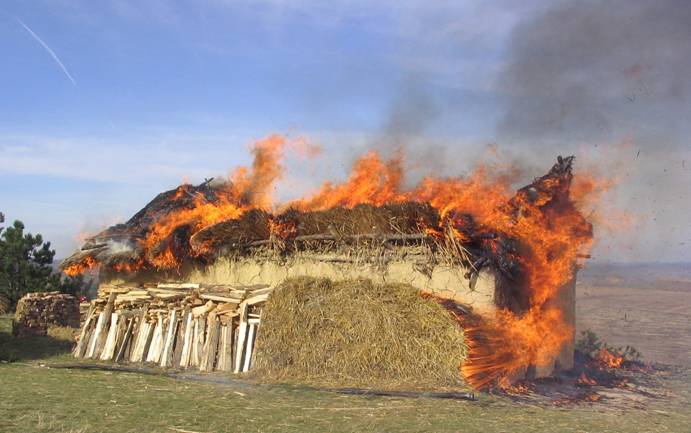
Long before Kargaly, Europe’s largest settlements were set on fire — repeatedly, and apparently on purpose. Archaeologists call it the Burned House Horizon. It runs through the Vinča culture of the Balkans and the Cucuteni-Trypillia culture of Romania, Moldova and Ukraine, roughly 5000–3500 BC.
The Trypillia megasites of the 4th millennium BC are the scandal. Talianki covered about 300 hectares; Maidanetske held some 3,000 houses in concentric oval rings. Population estimates run from about 10,000 to well over 20,000 people per site — larger than the earliest Mesopotamian cities. Yet they show no palace, no royal tomb, no fortress, no temple district.
Many of their houses ended the same way: burned so hot that the clay walls fired into brick-like rubble. Experimental burns by Mirjana Stevanović and Ruth Tringham showed that a wattle-and-daub house does not reach that state by accident. It needs extra fuel, deliberately stacked. Megasites also seem to have been abandoned and relocated every few generations, often estimated at 60–80 years.
Why would a society burn its own homes? The options, with my rough confidence:
- Ritual ending of a household’s life (about 50%). The house was “killed” with its owner or lineage, like a burial. Recent work at Maidanetske suggests houses burned one by one over time, not in a single catastrophe, which fits this reading.
- A social reset against accumulation (about 20%). Periodic burning and relocation wiped out stored wealth and inherited property, keeping a huge population from sliding into hierarchy. This matches the argument of David Graeber and David Wengrow that some societies consciously refused the state.
- Raids and warfare (about 15%). The weakness: burned layers rarely hold weapons, unburied bodies or signs of massacre.
- Hygiene, pests or accidental spread (about 15% combined). None of these explains why burning was so systematic and so thorough.
Whichever answer is right, the consequence for archaeology is the same. The fire baked the house plans into durable clay but destroyed or scattered the household goods. The richest record of how a stateless mass society lived was erased by that society’s own rituals. The archive was burned by its authors, and the academy read the silence as poverty.
How a city without rulers was organised
Geophysical surveys since the 2000s have mapped the megasites almost house by house. The houses sit in concentric rings, grouped into neighbourhoods. Each neighbourhood had a larger building, and the biggest sites had one or more “mega-structures” — large public buildings with little domestic debris.
The researchers at Maidanetske, led by teams from Kiel and Kyiv, read these as assembly houses. Decisions seem to have been taken at several levels: household, neighbourhood, whole settlement. That is a layered, consensus-based governance, not a pyramid. It worked for centuries, for populations in the tens of thousands.
The megasites dissolved around 3600 BC. The excavators link the decline to a drift toward centralisation: assembly buildings fell out of use as the site shrank. In other words, the system weakened when it began to look more like a state, not less. That is the exact reverse of the ladder.
The scholar they laughed at
Marija Gimbutas called this world “Old Europe”: peaceful, settled, rich in female figurines and lacking fortified elites. She argued it was disrupted from about 4000 BC by mobile herders from the Pontic–Caspian steppe — the “Kurgan” people.
For decades she was mocked. Her migration model was dismissed as outdated and her reading of the figurines as romantic. Then, in 2015, genome-wide studies led by David Reich’s laboratory and Eske Willerslev’s group showed a massive inflow of steppe ancestry into Europe in the 3rd millennium BC, linked to the Yamnaya.
Gimbutas was not right about everything. Her goddess theology remains contested, and the timing and violence of the transition are still debated. But on the central question — large-scale steppe migration into Old Europe — the outsider beat the consensus, posthumously. Keep that in mind when you read the next section.
Why the academy kept looking the other way
Here is the uncomfortable part. Most of the facts above were dug up by professional archaeologists. The failure is not in the trench. It is in the machine that turns trenches into textbooks.
Stone bias. Empires build in stone and write on clay. Mobile societies build in felt, wood and hide, and burn or reuse their metal. Taphonomy — what survives in the ground — favours palaces over pastures. A discipline that counts ruins will always crown the people who left ruins.
Language walls. Kargaly and Seima-Turbino were published mainly in Russian, behind the Iron Curtain. For decades, Western synthesis simply did not read them. A continent of evidence was invisible because it lacked an English abstract.
The peer-review ratchet. Peer review was meant to catch errors. In practice it rewards papers that support the status quo or at best extend the existing frame by one careful step. Reviewers are the people whose careers and funding rest on that frame. A manuscript that says “the frame is wrong” is judged by the frame — and loses.
Grant cycles and safe questions. Funding goes to projects that can promise publishable results in three years. Re-dating one site is fundable. Rebuilding the model of Eurasian prehistory is not. So the details sharpen while the big picture stays frozen.
The result is paralysis that looks like rigour. Each paper is careful; the edifice they hold up is decades out of date. Archaeogenetics, isotope analysis and lead-isotope provenancing are now forcing the doors open — often from outside the old departments, and often against them.
A pattern, not an accident
Gimbutas is not a lone case. The history of archaeology and geology is a list of correct ideas that waited decades for permission:
- Clovis First. For most of the 20th century, American archaeology held that the Clovis people, about 13,000 years ago, were the first humans in the Americas. Older sites were rejected as contaminated or misdated. Tom Dillehay’s Monte Verde in Chile, dated earlier, was fought for some twenty years before a 1997 site visit by sceptics accepted it. Today pre-Clovis occupation is mainstream.
- The Missoula floods. In 1923 geologist J Harlen Bretz argued that the Channeled Scablands of eastern Washington were carved by a single catastrophic flood. The geological establishment, committed to slow, gradual change, ridiculed him; at a 1927 meeting in Washington, D.C., his critics lined up to dismiss the idea. Joseph Pardee then identified the water source: Glacial Lake Missoula, repeatedly dammed and released by an ice sheet at the end of the last Ice Age. Aerial photography and the discovery of giant current ripples confirmed it. By the 1960s the floods were textbook geology, and in 1979, aged 96, Bretz received the Penrose Medal, American geology’s highest honour, about half a century after he was laughed at.
- Steppe migration. Dismissed as “pots, not people” thinking from the 1960s onward, then confirmed by ancient DNA in 2015.
- Göbekli Tepe. A surface survey in the 1960s recorded the site and wrote it off as a medieval cemetery. Klaus Schmidt recognised what it was in 1994.
- Russian and Soviet scholarship. Chernykh’s metallurgical provinces and the Sintashta excavations were known for decades before they entered Western textbooks.
In each case the evidence existed. The delay was social.
Science advances one funeral at a time
Max Planck said a new scientific truth wins not by convincing its opponents but because they eventually die. In 2019 Pierre Azoulay and colleagues tested this. They studied what happened in life-science fields after the sudden death of an eminent scientist. Papers by outsiders to the field rose sharply, and those papers were disproportionately highly cited.
That is the clearest available evidence that established networks suppress new entrants, not by fraud, but by controlling reviewing, funding and hiring. When the gatekeeper is gone, the gate opens.
Peer review itself performs worse than its reputation. In controlled experiments at medical journals, reviewers given papers with deliberately inserted errors caught only a minority of them. Reviewers agree with each other only modestly better than chance. Yet the system is very good at one thing: spotting work that departs from the reviewer’s own framework.
The defence of peer review is that it filters out nonsense, and it does filter some. But a filter that blocks both nonsense and the next paradigm, at similar rates, cannot claim to be the engine of discovery. In archaeology, the engine has repeatedly been the outsider, the foreign-language publication and the new laboratory method that the reviewers did not control.
What the bronzes in this collection testify
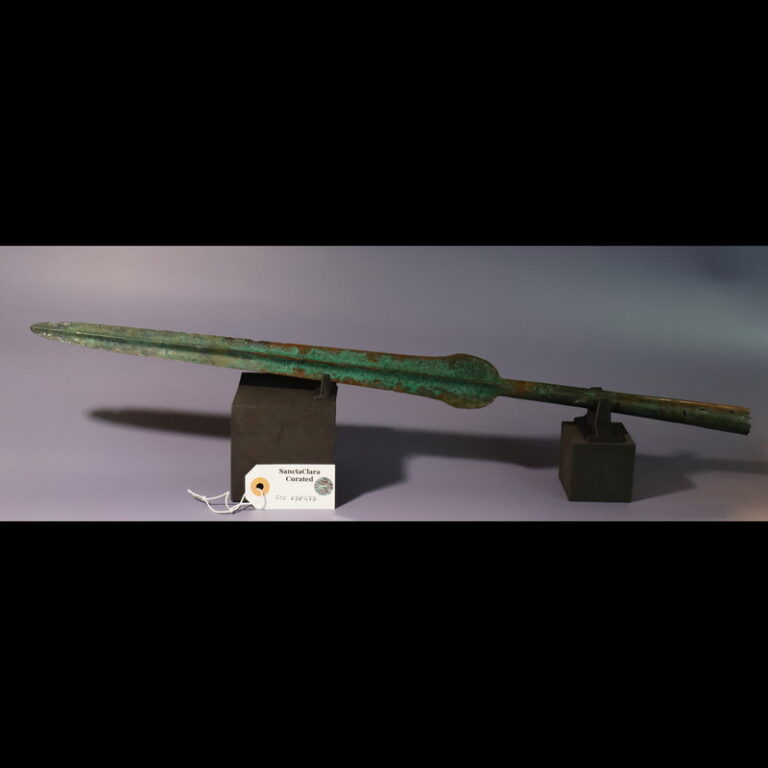
A spearhead is a technology record you can hold. The pieces in the Sancta Clara Collection trace the same story of transfer that the textbooks underplay.
- Tanged blades — the Cypriot / Cycladic rat-tail spearhead (No. 83118347) and the copper spear point of Lot 1516 show the older solution: a flat blade with a tang driven into the shaft and bound.
- Hammered split sockets — the copper pike-adze of Lot 5111 and the 48 cm Middle Bronze Age pike of Lot 32737 show the transitional step: metal curled around the shaft by hand.
- Cast sockets — the 29.5 cm socketed spearhead of Lot 97137769 still carries the seam of its two-piece mould. Casting a hollow socket in one pour is exactly the skill Seima-Turbino smiths spread across Eurasia.
- Use, not display — the Luristan leaf-shaped spearhead (Lot 84058911) bears ancient strike marks along one edge. These were tools of real conflict, made by people who traded metal across thousands of kilometres.
None of these objects is Seima-Turbino. All of them belong to the same connected world of ore, alloy and know-how that the old model insists was not there.
Reading a spearhead as a document
Every feature of a bronze weapon records a decision and a skill.
The hafting. A tang is cheap to make: hammer or cast a flat strip and drive it into the wood. But under a hard thrust the shaft splits, and a twisting blow rotates the head. The hooked or “rat-tail” end on the Cypriot and Luristan pieces is a patch for that weakness: it bends over and locks into the wood. The socket solves the problem outright, because the shaft goes inside the metal.
The split socket. Item 678477, item 5111 and Item 32737 show the socket achieved by hand: a sheet hammered thin and curled into a cone. It works, but the seam is a weak line and the metal must be soft enough to bend. It is a smith’s answer, not a founder’s.
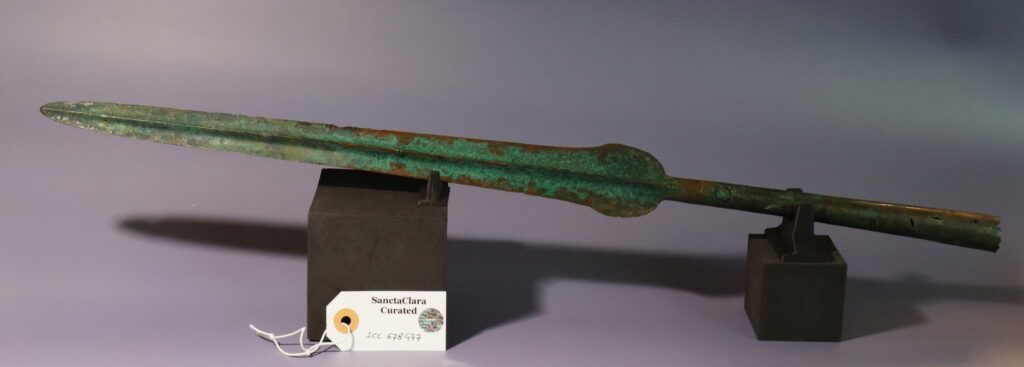
image: the 59 cm long spearhead No 678477 exhibits cold hammered split socket (shaft) walls and blade that are less than 0,4 mm thick
The cast socket. Lot 97137769 shows the founder’s answer. A clay core was suspended between two mould halves, and molten bronze filled the gap in one pour. The joint line still visible at its neck is the trace of that bivalve mould. Getting this right means controlling alloy, temperature, venting and core position at once. Fail any one, and the socket is porous or off-centre. This is precisely the technology that Seima-Turbino founders mastered early and spread east.
The midrib. A strong midrib, rounded or flat, stiffens a long blade against bending. The 45–48 cm pieces in this collection — Lot 32737, No. 38071001, the Luristan long spearheads — are long enough that without it they would flex. Their makers understood beam stiffness empirically, millennia before anyone wrote an equation for it.
The wear. Strike marks, re-sharpened edges and bent tips are the last chapter. They show that these were used, repaired and kept. A weapon re-sharpened several times had a long working life, which implies its metal was too valuable to waste.
Put side by side, these pieces read as a timeline of problem-solving, carried out across Cyprus, the Levant, Iran, the Caucasus and Europe by smiths who were clearly in contact with each other’s solutions.
Stop climbing the ladder
The Bronze Age steppe ran mines, fed them with cattle, exhausted its forests, traded tin to the so-called cradles of civilisation and spread casting technology from the Baltic to China within a few generations. None of that needed a pharaoh.
The lesson is not that states were unimportant. It is that the state was one option among several, and for long stretches not the most successful one. Mobile, networked societies without palaces moved more metal, more ideas and more people than the textbooks allow.
The evidence is already published. What is missing is the nerve to say what it means. Independent researchers, collectors and readers do not need permission from a review panel to look at a socketed spearhead and ask who taught its maker.
A different map of the past
Replace the ladder with a map of networks, and prehistory reorganises itself:
- Many paths, not one. Trypillia’s assemblies, Sintashta’s fortified smithing towns, the pastoral mining economy of Kargaly, the mobile Seima-Turbino elite and the temple states of Mesopotamia were parallel experiments, not rungs on one ladder.
- Connection before the state. Long-distance exchange of metal, technique and probably language was running across Eurasia before most states existed, and largely outside them.
- Choice, not backwardness. Mobility, periodic abandonment and consensus government look like deliberate strategies. Some of them lasted longer than the empires that are supposed to have been superior.
- Silence is not absence. Burned houses, recycled metal and timber architecture leave thin records. A thin record is a property of the evidence, not a measure of the people.
This is not a fringe position. Every step in it rests on published fieldwork, radiocarbon dates and DNA. What is missing is a synthesis bold enough to say it plainly, because the institutions that could write it are rewarded for footnotes, not for overturning foundations.
Those same steppe networks carried more than metal. They carried gods. The sky deity worshipped by the peoples who drove these routes — the common ancestor of Zeus, Jupiter, Tyr and the Latin deus — is the subject of my book The Sky Father: The Lost Bronze Age God Behind Zeus, Jupiter, Tyr and Deus, which follows him from the Bronze Age into the pantheons that inherited him.
Andrzej M Izyk is the curator of the Sancta Clara Collection at AncientBronzes.com and the author of The Sky Father and Abandoned Children of the Gods: Still Waiting for the Return.