
28 paź 2026 · @Andrzej M Izyk
A perfect blade on a haft that would snap
Some Bronze Age weapons were never meant to strike anything. They were made to be seen, carried, given, buried or offered to a god.
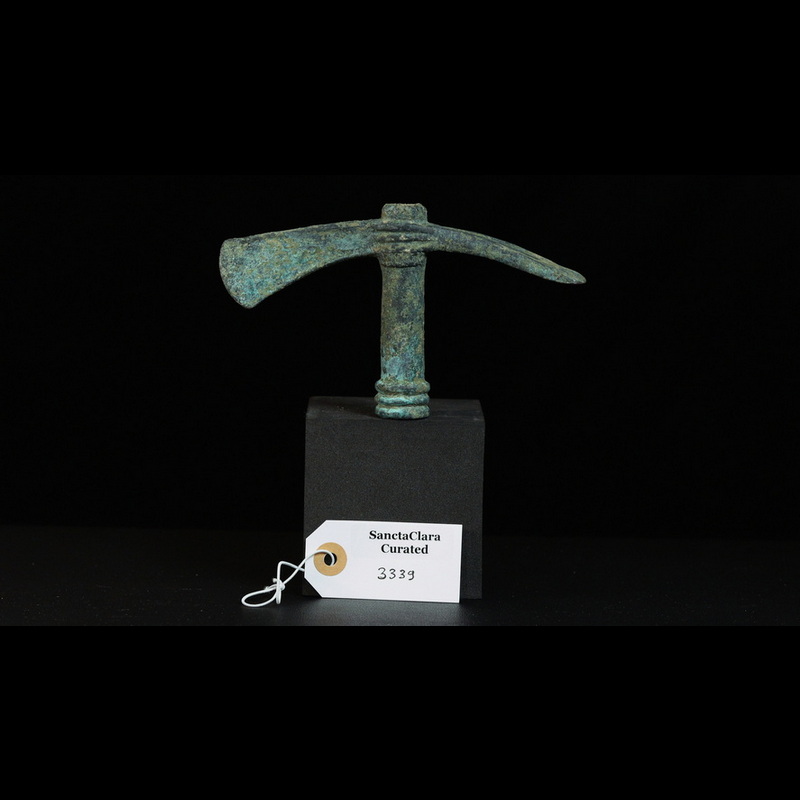
Two axes in the Sancta Clara Collection make the point in the hand. Lot 3339 is a decorated bronze shaft-hole axe-adze, 166 mm long and 293 g, with well-formed blades at both ends. Its shaft hole tapers from 15 to 13 mm. The Koban or Colchian ornamented axe head SCC 102371465 goes further: 112 mm long and 80 g, with a shaft hole of 10 mm at the top and 9 mm at the bottom.
Both look like weapons. Neither could carry a haft strong enough to fell a tree or break a shield. A wooden shaft that thin would bend, crack or tear out of the eye on the first full-power swing.
This article asks a simple question with no simple answer: how do we tell a working weapon from one made for power, ritual or the grave? The answer lies in measurable features, in use-wear science, in the places these objects were found, and in the gods whose weapons they imitated.
The short version: no single feature proves a ceremonial purpose. The case is built from several pieces of evidence pointing the same way. The shaft hole is one of the most objective of them, because a collector can measure it with calipers.
How do we know a weapon was not meant for battle?
Archaeologists identify ceremonial weapons by converging evidence, never by one trait. A beautiful weapon can still be a working one, and a plain one can be a votive copy. The table below sets out the main criteria, how strong each is, and a well-known example.
| Criterion | What to look for | Strength of evidence | Key example |
|---|---|---|---|
| Undersized shaft hole or no hafting provision | An eye under about 15 mm on a full-size blade; dirks without rivet holes | Strong when the blade is full-size | Oxborough dirk (no rivet holes); Lot 3339 (13–15 mm); Koban SCC 102371465 (9–10 mm) |
| Unsharpened or as-cast edges | Casting seams left on, no hammered bevel | Strong, though unfinished trade stock looks the same | Oxborough dirk, edges deliberately blunt |
| No use-wear | No notches, nicks, edge damage or resharpening | Strong only if the surface survives; corrosion can erase wear | Molloy’s Irish study of 130 swords and 138 spearheads |
| Impractical size or thinness | Oversized, paper-thin or clay-cored pieces | Strong | Oxborough dirk, 70.9 cm and 2.37 kg; Nordic clay-core axes |
| Precious metals or inlay | Gold, silver, electrum, gold foil, stone inlay | Strong for display or gift use | Ahmose axe; BMAC silver-gilt axe (Met 1982.5) |
| Inscriptions | Royal names, owner names, dedications | Points to gift, ownership or dedication, not necessarily to non-use | Marduk-nadin-ahhe daggers; El-Khadr arrowheads |
| Miniaturisation | Scaled-down copies of real weapons | Very strong | Arkalochori gold double axe, 4.93 cm wide, 11.2 g |
| Deliberate destruction | Bending, folding, burning, breaking | Moderate; combat damage, scrapping and burial with the fallen can look the same | Bent Thames sword; Duddingston Loch hoard |
| Decoration that weakens the piece | Openwork, perforations, figural blades | Moderate | Shang yue axes; Dong Son openwork axes |
| Soft or unusual alloy | Very high lead, pure copper, silver alloys | Moderate; needs bulk analysis, as surface XRF misleads | Untash-Napirisha silver and electrum axe |
Two cautions apply to every piece in a private collection. First, provenance without a findspot removes the strongest evidence of all: the context of burial or deposition. Second, function and ceremony form a spectrum. Many prestige weapons were fully usable and were still carried as badges of rank.
Narrow holes are not automatically ritual either. Studies of Early Bronze Age shaft-hole axes from the north-eastern Balkans report holes of 1–2 cm, irregular and blocked with casting scrap. Those are attributed to inexperienced mould-making, not to ritual intent. A competent, decorated casting with a clean but narrow eye is a different matter.
The science: use-wear and haft engineering
Two lines of evidence carry the most weight: the marks left by use, and the mechanics of the haft. The first tells us what a weapon did. The second tells us what it could have done.
What use-wear can and cannot prove
Experimental archaeology has changed how Bronze Age weapons are read. Barry Molloy (University College Dublin) recorded use-wear on 130 swords and 138 spearheads from Bronze Age Ireland, plus more than fifty axes. He tested replicas against straw mats, carcasses, armour and shields. His conclusion was that many weapons were genuinely fought with.
The Bronze Age Combat Project at Newcastle University went further. Hermann, Dolfini, Crellin, Wang and Uckelmann staged controlled fights with replica swords. They used the resulting marks to interpret more than 2,500 traces on 110 Middle and Late Bronze Age swords from Britain and Italy (Journal of Archaeological Method and Theory, 2020). Gentile and van Gijn built a parallel experimental framework for sword notches and tested it on the Leiden collection (Journal of Archaeological Science, 2019).
These studies also set a limit. Horn and Holstein (2017) showed that fighters avoided blade-on-blade contact, so not every combat leaves visible damage. Mödlinger showed that many swords from wetlands carry unrepaired combat damage, consistent with weapons consecrated straight after use. An unworn edge on a corroded antiquity is therefore weak evidence. A hafting provision that physically cannot carry a working haft is strong evidence.
The haft is the weak point a ceremonial maker can skimp on
A blade can look lethal while the eye behind it is too small for any serious shaft. This is the one feature a collector can measure objectively with calipers.
Working shaft-hole axes cluster at roughly 18–33 mm internal diameter. Latvian Bronze Age work axes mostly fall between 21 and 25 mm. The Nagļi axe from eastern Latvia, found with oak haft remains still in the eye, measures 21.0–23.7 mm. Near Eastern, Luristan and BMAC working adzes run about 19–23 mm. The 2023 axe-efficiency experiment in the Journal of Archaeological Science used replica hafts averaging 35–37 mm.
The mechanics are simple. A round wooden haft’s resistance to bending, its section modulus, grows with the cube of its diameter:
S₁ / S₂ = (d₁ / d₂)³So halving the diameter does not halve the strength. It cuts it to one-eighth. Stiffness falls even faster, with the fourth power of the diameter, so a thin haft also whips and wastes the blow.
| Haft diameter | Bending strength vs. 22 mm working haft | Bending strength vs. 35 mm experimental haft |
|---|---|---|
| 35 mm (modern felling axe, experiments) | about 4× | 100% |
| 22 mm (typical Bronze Age working axe) | 100% | about 25% |
| 13–15 mm (Lot 3339) | about 21–32% | about 5–8% |
| 9–10 mm (Koban SCC 102371465) | about 7–9% | about 2% |
A haft sized to Lot 3339 has between a fifth and a third of the strength of an ordinary Bronze Age working haft. A haft for the Koban axe has under a tenth. That is about the thickness of a pencil, not of a weapon shaft.
Case study: two axes in the Sancta Clara Collection
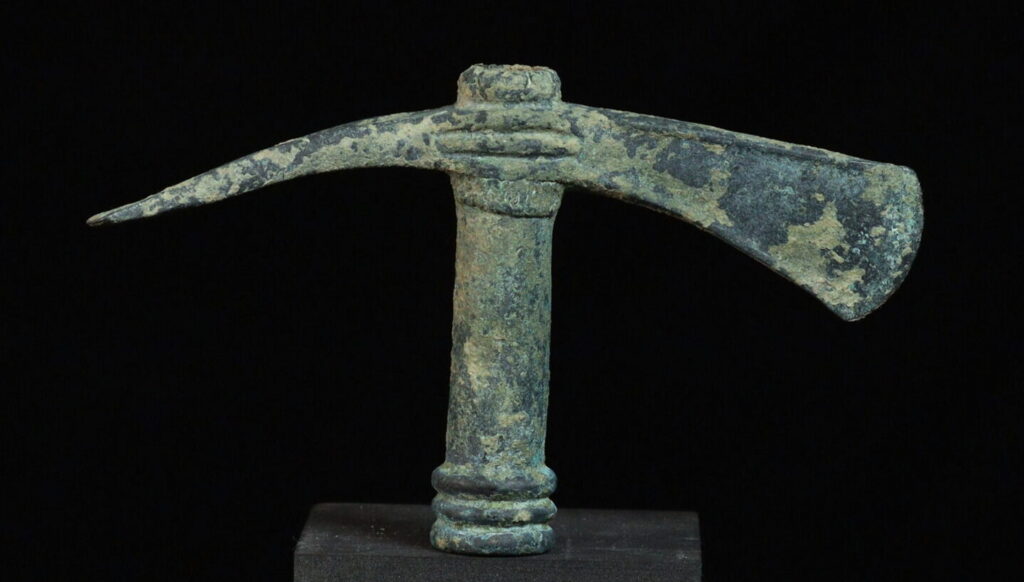
Image: Ornamented Axe – adze 3339
Lot 3339 and the Koban axe SCC 102371465 are the clearest ceremonial candidates in the Collection. Both have competent, decorated castings with blade forms that would work. Both have shaft holes that would not.
Lot 3339: the decorated axe-adze
Lot 3339 is a decorated bronze shaft-hole axe-adze: an axe blade on one side, an adze blade on the other. As a form it is a working carpenter’s and warrior’s tool, found from the Balkans to Bactria. It measures 166 mm long and 95 mm high and weighs 293 g. That is a full working weight, and the blades are properly shaped and would cut.
The problem is the eye. It tapers from 15 mm to 13 mm. The taper itself is normal practice, since a conical hole lets the haft be wedged tight. The absolute size is what is wrong: it sits below the 18–25 mm range of preserved working axes.
A haft that fits it would have between a fifth and a third of the bending strength of an ordinary working haft. The head’s weight makes this worse. Swinging 293 g on a 13–15 mm shaft puts the momentum of a working axe on a haft built for a light tool. An axe-adze also takes levering loads in use, which makes a thin haft fail faster still.
The socket carries raised ribs at its top and bottom, with a decorative band in the centre. This is a classic skeuomorph: a feature of an older technology copied in a new material. The ribs most likely reproduce the leather thongs or cord lashings that once bound stone or simple metal heads to their shafts. In bronze, the lashings become reinforcing hoops around the socket.
Here lies the paradox of the piece. The maker reinforced the socket yet kept the hole too narrow for a working haft. Ornament that recalls how weapons used to be hafted, on a weapon that could not be hafted for work, marks an object meant to be seen. The most likely reading is a status emblem carried on a slender staff, rather like a sceptre.
Koban SCC 102371465: the extreme case
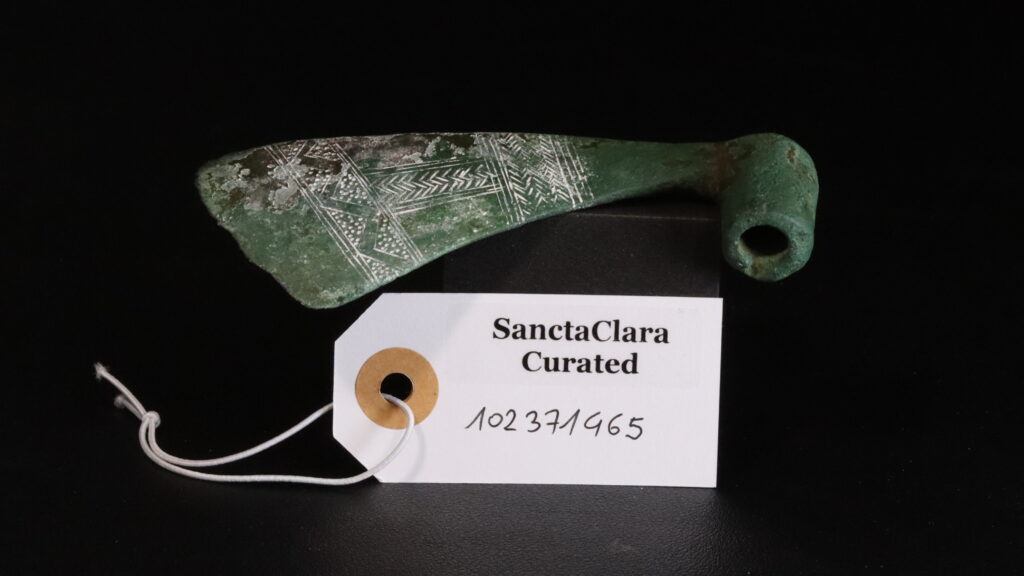
Image: Koban axe SCC 102371465
The Koban culture (c. 1100–400 BC) of the North and Central Caucasus produced some of the finest decorated axes of the ancient world. It is named after the village of Koban in North Ossetia, where battle-axes, daggers and ornaments were found in burials in 1869. Full-size Koban axes run to about 17–18 cm, with oval shaft holes reinforced by hatched ribs and blades engraved with stags, hounds and snakes.
Those full-size pieces sit in a grey zone. Their makers clearly expected them to be used, yet they are found in graves as emblems of rank. George Ortiz’s catalogue states it well: such axes were used in combat, had cult significance and were probably also emblems of power.
SCC 102371465 is a Koban or Colchian ornamented axe head, dated 1100–650 BCE. It is 112 mm long and 44 mm wide and weighs 80 g. The shaft tunnel measures 44 by 17 mm, but the hole through it is only 10 mm at the top and 9 mm at the bottom.
The decoration was chased and engraved after casting and polishing, using hardened bronze or early iron tools. Three motifs dominate:
- Chevron and herringbone bands. Interlocking V-shapes fill the central vertical and horizontal bands, a hallmark of Koban design. They are often read as skeuomorphs of woven textile or basketry, or as stylised snake scales, a creature of mythological weight in the Caucasus.
- Stippled triangles. Nested triangles filled with punched dots are perhaps the most diagnostic feature of the region’s metalwork. They occur almost only on high-status Koban and Colchian bronzes.
- Framing lines. Deep parallel borders follow the drooping curve of the blade, so the ornament was designed around this axe’s own shape.
The Koban and Colchian smiths treated bronze as a canvas for highly standardised geometric art. The hours of labour in this engraving alone rule out an everyday tool.
The blade could take and hold a lethal edge. The haft could not. A 9–10 mm shaft would have under a tenth of the strength of a working haft. The long 44 mm tunnel is telling: the maker gave the head a deep, secure seating, suited to a slender staff that had to hold the head firmly in procession, not under impact.
At about two-thirds the length of full-size Koban axes and a fraction of their weight, it reads as a reduced-scale prestige emblem for a chieftain or elite warrior. Weapons of this quality were paraded in ceremony and finally laid in burial mounds, kurgans and stone cists, to accompany their owners into the afterlife.
Interpretive options
| Interpretation | Lot 3339 | Koban SCC 102371465 | Reasoning |
|---|---|---|---|
| Status emblem on a slender staff or sceptre-like shaft | Medium–high | Medium | Full blade form, decoration and an undersized eye; Near Eastern and Egyptian art shows axes carried as marks of rank |
| Votive offering or grave good | Medium | High | Koban axes are typically burial finds; this piece is reduced in scale, weight and eye |
| Amulet or pendant worn on the body | Low | Low–medium | Plausible only for very small pieces; check the eye for cord wear |
| Light precision tool (fine carving, leatherwork) | Low–medium | Low | Possible only if the edge shows working wear and resharpening |
| Casting accident (core too narrow) | Low | Low | Unlikely in a competent decorated casting; check for casting scrap in the hole |
How to strengthen the case
Three simple checks would move both readings from likely to well-founded. First, measure the bore at both ends after gentle cleaning, since corrosion can narrow the true opening. Second, inspect the edges under magnification for hammered bevels, nicks or resharpening. Third, record weight, wall thickness and the depth of the eye (the bearing length), which together show how much load the socket was built to take.
Giants and ghosts: the Oxborough dirk and its siblings
The clearest European examples of weapons made not to be used are the giant ceremonial dirks of the Plougrescant-Ommerschans type, c. 1500–1300 BC. Only six are known: Oxborough and East Rudham in Norfolk, Plougrescant in Brittany, Beaune in Burgundy, and Jutphaas and Ommerschans in the Netherlands.
The Oxborough dirk in the British Museum is 70.9 cm long and weighs 2.37 kg. Its edges were left deliberately blunt, and there are no rivet holes at the butt to fix a handle. It was found standing upright in peat, tip down, as if planted in the ground.
Everything about it says display. The form is a dirk, a stabbing weapon. Yet it is too heavy to wield, cannot be hafted, and cannot cut. It is the dirk idea enlarged into a monument.
The six dirks are so alike that they are thought to come from a single workshop tradition. A 2024 study of the East Rudham dirk by Stuart Needham and colleagues supports a closely related production group on typological and chemical grounds. Dr Tess Machling goes further and argues that they were all made by the same hand (plausible, medium confidence). Either way, they show elites across the Channel and the North Sea sharing one prestige object, made to the same pattern, centuries before Rome.
The Collection’s large spearheads invite comparison. The Luristan long spearheads (Lots 84068495 and 44398282, about 455 mm) and the Middle Bronze Age split-socket pike (Lot 32737, 480 mm) are impressive in size. Size alone does not prove ceremony, however. They remain prestige candidates until socket diameter and edge wear are checked.
Axes of the gods
The axe is the weapon most often held by gods. Across the Bronze Age world, the ceremonial axe of a king or priest mirrored the weapon of the storm god or sky father.
The double axe in Crete: votive by the hundred
The Arkalochori cave in central Crete is the richest votive weapon deposit in the Aegean. Hatzidakis recovered 53 hiltless sword blades and 19 double axes in 1912. Marinatos and Platon found hundreds more in 1934–35, including 25 gold and 7 silver double axes and the longest Bronze Age sword known from Greece, about 1.05 m.
The Heraklion Museum states that some objects bear traces of use, but many were made as votives. The swords have no hilts and thin blades, so they could not be used. One gold double axe is 4.93 cm wide and weighs 11.2 g, with a loop for hanging. The inscribed Arkalochori Axe, by contrast, is 241 mm across and once had sharp edges.
The deposit has three competing readings:
- An offering place of a war or storm deity, as Marinatos proposed (medium confidence).
- A store of metal capital held for recycling, an alternative the museum itself notes (medium).
- The original Labyrinth, the “place of the labrys”, proposed by Gareth Owens (speculative, low).
From the labrys to the thunderbolt
In Crete the double axe often accompanies goddesses and priestesses. In Anatolia and Syria it belongs to the storm god. Both readings are well founded, and the best explanation is regional reinterpretation of one powerful symbol.
The Anatolian evidence is direct. Zeus Labraundos at Labraunda in Caria holds a double axe. So does the Hurrian sky and storm god Teshub. In Roman times Jupiter Dolichenus, from Doliche in Commagene and probably a local Baal, still carries the double axe beside the thunderbolt. The modern Greek word for lightning, astropeleki, means “star-axe”. The link between axe and lightning survived three thousand years in everyday speech.
In Mesopotamia, the storm god Adad shares a written sign with Teshub. Axes are reported from the foundations of Adad’s temple at Assur (secondary source; to be verified).
Twin axes in the North
In Scandinavia, Kristiansen and Larsson link pairs of axe-bearing figures in rock art and twin ceremonial axes to an institution of twin rulers from about 1700 BC. They connect it to a bronze Levantine storm-god figurine found at Schernen in Poland. That is a tangible object joining the smiting gods of the Near East to the axe cults of the North (medium confidence on the interpretation).
The Nordic clay-core axes, cast in thin bronze over a clay core around 900 BC, could never have been used. They appear in bogs and lakes and on the rock carvings at Fossum in Bohuslän. Egebak cult axes from Denmark weigh over 7 kg and, according to the National Museum of Denmark, could only have served cult purposes.
Oscar Montelius argued in 1910 that the Anatolian double axe of the sun or sky god became Thor’s hammer in the North. The Baltic Perkūnas belongs to the same family of thunder-weapon gods. Montelius’s lineage is dated and debated, but the family resemblance is hard to dismiss.
The axe as kingship in China
The same logic appears at the other end of Asia. Lady Fu Hao, a Shang queen and general buried at Anyang about 1200 BC, was given four large bronze yue axes, two inscribed with her name. One reportedly weighs about 9 kg (encyclopaedic source). These were symbols of delegated military command, not field weapons. The Chinese character for “king”, wang, is often argued to derive from an axe pictograph.
The sky father’s weapon
These threads converge on one idea, explored at length in the author’s book The Sky Father: The Lost Bronze Age God Behind Zeus, Jupiter, Tyr and Deus. In much of the Bronze Age record, the storm and sky god’s weapon is an axe long before it becomes the classical thunderbolt. When a Bronze Age ruler raised a ceremonial axe that could never strike, he was not holding a weapon. He was holding the god’s weapon, and claiming the god’s authority.
Kings’ names on bronze
A weapon carrying a king’s name is primarily a document: of ownership, of gift, or of dedication to a god. Many such pieces are fully functional in form. Their value lay in who owned them and who gave them.
Babylonian daggers found in Luristan
The British Museum holds a bronze dagger of Marduk-nadin-ahhe, king of Babylon about 1099–1082 BC (BM 1932,0514.2). Its hilt was once inlaid, and a cuneiform inscription runs on both sides of the blade just below the hilt. The standard formula reads, in translation: “Property of Marduk-nadin-ahhe, king of the world, son of Ninurta-nadin-shumi, king of Babylon.”
Four such daggers name this king, and similar blades name Nebuchadnezzar I and Enlil-nadin-apli. Most were found in Luristan, far from Babylon. They most likely travelled as royal gifts to mountain chiefs, as dedications at sanctuaries, or as trophies. The Collection’s Near Eastern rapier-type short swords, Lots 901 and 902, belong to this type. Unless an inscription is confirmed, they are best described as “of the inscribed royal type” rather than as royal property.
Elam: the axe of Untash-Napirisha
The Louvre axe Sb 3973, about 1300 BC, came from the temple of the goddess Kiririsha at Chogha Zanbil in Elam. It is made of silver and electrum. A boar stands on the heel, the blade issues from a lion’s mouth, and the inscription names “I, King Untash-Napirisha”. Elamite ceremonial weapons served as royal gifts to favoured subjects or as offerings to the gods.
Egypt: the axe of Ahmose
The ceremonial axe of Ahmose I, founder of the New Kingdom, was found in the burial of Queen Ahhotep at Dra Abu el-Naga (Luxor Museum JE 4673). It is 47.5 cm long, with a cedar haft sheathed in gold. The copper-alloy blade is inlaid with Ahmose smiting an enemy and a griffin of the war god Montu. It was a funerary object, never used in life. A companion dagger is gold-inlaid in an Aegean technique.
The Collection’s ornamental Egyptian bronze sword blade (Lot 1202, 2000–1400 BC) belongs in this conversation, though its date range should be confirmed: Egyptian swords before the New Kingdom are rare.
Names on arrowheads
Even arrows carried names. The El-Khadr hoard near Bethlehem, found in 1953, held 26 arrowheads, three of them inscribed; two more from the same find were published in 1980. They read “arrowhead of ʿAbdlabiʾt” and date to about 1100 BC. Golub (2021) counts 110 personal names on 63 inscribed bronze arrowheads. Palimpsest examples carry successive owners’ names, which shows that the name marks ownership.
There is a caution here: all but one of the 63 come from the antiquities market. The Collection’s inscribed arrowheads (Lots 769, 763 and 1110) need an epigrapher’s reading before any inscription is published.
Weapons as gifts of the gods
In the Ugaritic Baal Cycle, the craftsman god Kothar-wa-Khasis forges the two clubs with which Baal defeats the sea. The divine smith makes the weapon, and the god gives power to the king who holds its earthly copy. Royal weapons thus stood at the meeting point of human and divine authority. This theme of divine gifts and divine kingship runs through the author’s book Abandoned Children of the Gods: Still Waiting for the Return.
Small things for great powers: miniatures and votives
Miniature weapons are the least ambiguous ceremonial objects of all. No one fights with a 5 cm axe. Yet miniatures appear in sanctuaries, graves and hoards for more than two thousand years, from the Copper Age to the Roman Empire.
The miniature reproduces the meaning of the weapon without its function. A small gold double axe hung in a Cretan cave carries the full authority of the labrys. A tiny stone axe from Ķivutkalns in Latvia, 5 cm long with a 9 mm shaft hole, repeats the form of a working axe at toy scale. Its eye matches the Koban axe SCC 102371465 almost exactly.
The Sancta Clara Collection holds a sequence of such pieces:
- Lot 4944, small copper double axe head. About 99.6 g with a 15 mm socket. It sits at the border between a small working tool and a symbolic double axe, and the labrys parallel makes the symbolic reading attractive.
- Lots 4950 and 4949, small copper flat axes. These are genuinely ambiguous: miniatures, ingot-like units of value, or small functional tools.
- Lot 4952, miniature iron axe-adze or votive dolabra. With a socket of about 7 mm, it is a pure votive. Being iron, it is later, La Tène or Roman, and shows that the tradition outlived the Bronze Age.
Weight tells part of the story, but not all of it. The Collection’s Luristan adze-axe (Lot 84338037) is 193 mm long and 672 g, a working tool. Lot 3339, at 293 g, has a full working weight on an undersized eye. The Koban axe, at 80 g, carries about an eighth of the Luristan mass, and true miniatures cluster lower still.
Killed and drowned: weapons for the grave and the water
Some weapons became ceremonial only at the end of their lives. They were bent, broken, burnt or thrown into rivers and bogs, taking them permanently out of human use.
“Killed” weapons
A Late Bronze Age sword of Ewart Park type from the Thames, 925–800 BC, now in the London Museum, was deliberately damaged before it went into the river. The Duddingston Loch hoard in Edinburgh held swords and spearheads that had been broken, bent, burnt and partly melted. In the Early Iron Age Aegean, swords folded double are a familiar grave find.
Why kill a weapon? The main explanations, with an assessment of each:
| Explanation | Confidence | Reasoning |
|---|---|---|
| Ritual “death” so the weapon follows its owner | Low–medium | Popular and intuitive, but Lloyd cautions there is no evidence swords were treated as persons in Iron Age Greece |
| Removing prestige goods from circulation | Medium–high | Destroying wealth publicly is a display of status, and it stops heirs or robbers reusing the piece |
| Preventing grave robbery | Medium | A bent sword is worth little except as scrap |
| Marking the end of a warrior’s or a lineage’s identity | Medium | Fits weapons that are personal, decorated or inscribed |
Not every broken or bent weapon in a grave was ritually killed, however. Warriors’ weapons were often laid to rest with the fallen in the state the battle left them. A sword notched, bent or snapped in its owner’s last fight went into the grave as it was.
The two practices also met. Deliberate destruction was sometimes part of the funeral rite of a fallen warrior: his weapon was bent or broken at the graveside, as part of the ceremony, before being laid beside him. A weapon in a warrior’s grave may therefore carry battle damage, ritual damage, or both.
Combat damage, later scrapping and even the weight and movement of a burial over centuries can all resemble deliberate destruction. Combat leaves edge notches, bends near the point and breaks at stress points such as the hilt junction (see Why Bronze Age Swords Broke at the Hilt). Deliberate killing tends to show controlled folding, repeated bending or bends made after heating, which no fight produces. Without such evidence, a damaged weapon in a grave is best read as the warrior’s own weapon, buried with him as it came from battle. Where the evidence is present, the damage most likely belongs to his funeral rite.
Rivers, bogs and caves
Water was the favoured destination for weapons in Bronze Age Europe. Many river swords carry unrepaired battle damage, suggesting they were dedicated soon after use. The giant dirks were placed upright in peat. The Nordic clay-core axes went into bogs and lakes. The Cretan cave deposits gathered hundreds of axes and blades at sacred places.
Hoards are harder to read. Some were offerings; others were scrap metal, smiths’ stock or wealth hidden in danger. The Collection’s Urnfield socketed axe from the Podkonice Hoard in Slovakia (Lot 97524689) sits at the centre of this debate, and its hoard provenance makes it unusually valuable as evidence.
Warrior burials
In graves, weapons announced who the dead had been. The Levantine “warrior burials” of the Middle Bronze Age, the Shaft Graves at Mycenae and the Trialeti kurgans of Georgia all placed weapons beside precious vessels. The largest Trialeti mound, the Zurtaketi kurgan, measured about 100 m across and 8 m high. Koban axes themselves were first recognised among burial goods at Koban in 1869. The weapon in the grave was a statement of rank, carried into the next world.
Collection spotlight
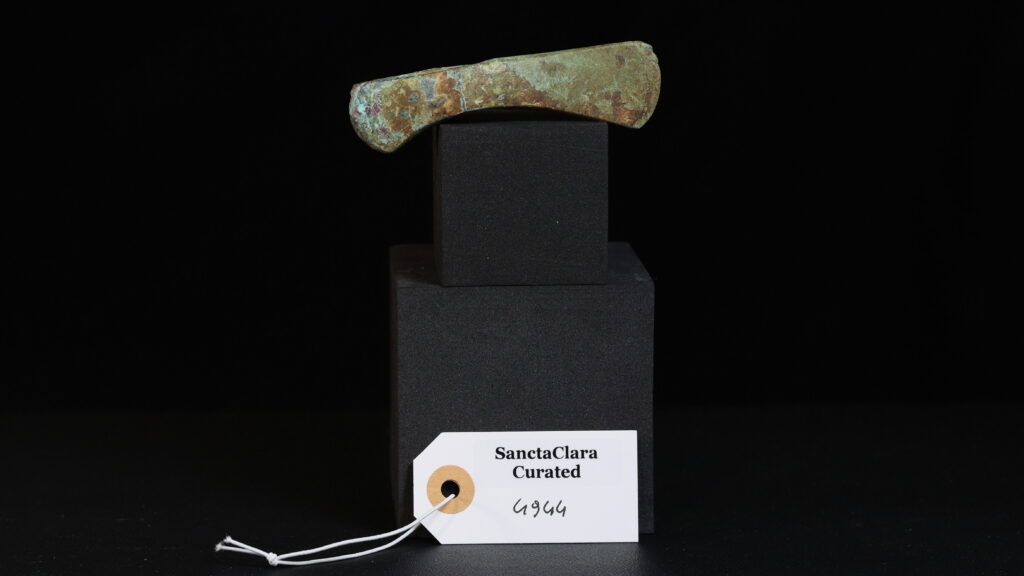
Image: miniature copper alloy double axe 4944
The table rates how well each Sancta Clara piece illustrates the ceremonial, prestige or funerary theme, strongest first.
| Lot | Object | Fit | Comment |
|---|---|---|---|
| SCC 102371465 | Koban or Colchian ornamented axe head, 1100–650 BCE, 112 mm, eye 9–10 mm, 80 g | Very strong | Full Koban ornament at a scale no one could fight with; reduced-scale prestige or funerary emblem |
| 3339 | Decorated bronze shaft-hole axe-adze with skeuomorphic socket ribs, 166 mm, 293 g, eye 13–15 mm | Very strong | Working weight and blade on a haft with a fifth to a third of normal strength; likely status emblem |
| 4952 | Miniature iron axe-adze, votive dolabra, socket about 7 mm | Very strong | Pure votive; later (La Tène or Roman), showing the tradition’s long life |
| 901, 902 | Near Eastern rapier-type short swords, Marduk-nadin-ahhe type, c. 1090 BC | Strong | Comparativa inscribed royal type; describe as royal only if an inscription is confirmed |
| 97524689 | Urnfield socketed axe, Podkonice Hoard | Strong | Hoard provenance; offering versus scrap debate |
| 4944 | Small copper double axe head, 96 mm long, 15 mm socket, 99.6 g | Good | Symbolic double axe or small tool; pairs with the labrys |
| 2578 | Ancient bronze shaft-hole axe, 150 mm, 194 g | Good | Catalogued as ornamental and ceremonial |
| 97814529 | Urnfield large decorated axe head | Good | Prestige and hoarding |
| 98277415 | Dong Son bronze axe | Good | Compare with Dong Son and Indonesian ceremonial axes |
| 98946837 | Early Greek spearhead with decorated shoulder flanges | Good | Decoration as a status statement |
| 1202 | Ornamental Egyptian sword blade, 2000–1400 BC | Good | Compare with the Ahmose axe; confirm the date |
| 84068495, 44398282 | Luristan long spearheads, about 455 mm | Candidate | Size suggests prestige; check socket and wear |
| 32737 | Middle Bronze Age split-socket pike, 480 mm | Candidate | Trialeti or Levantine attribution is tentative |
| 769, 763, 1110 | Inscribed bronze arrowheads | Use with caution | Need an epigrapher’s reading first |
| 4950, 4949 | Small copper flat axes | Ambiguous | Miniatures, value units or small tools |
| 738 | Celtic sword belt | Peripheral | Display of warrior identity |
| 84338037 | Luristan adze-axe, 193 mm, 672 g | Working comparator | The functional baseline against which the ceremonial pieces are measured |
| 1829 | Greek arrowhead mould | Contrast | Mass production versus the unique prestige object |
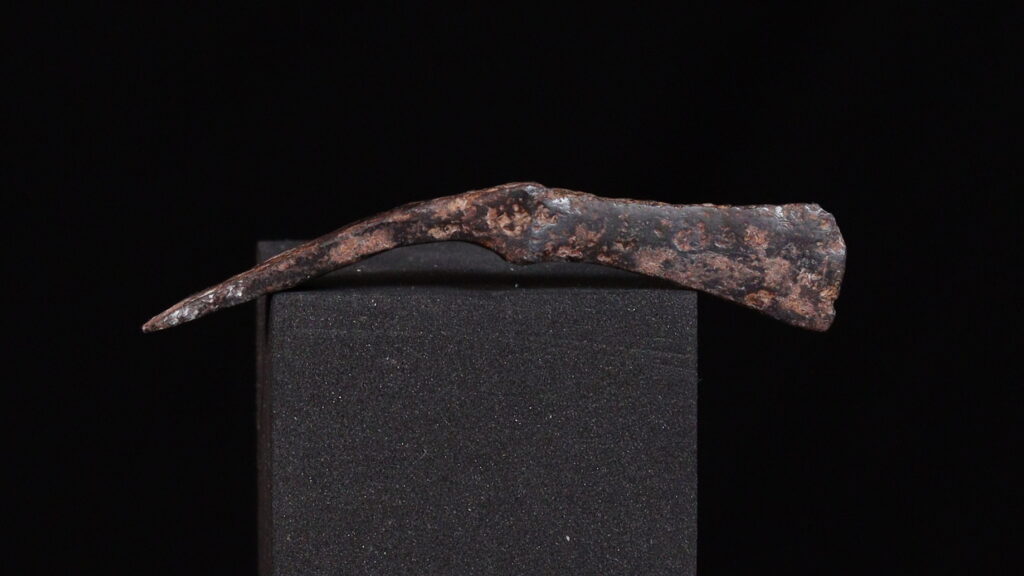
Image: Miniature iron axe-adze, votive dolabra 4952, Weight 20,70 g, Length: 85 mm Width: 14 mm, socket diameter 7 mm
Collector’s checklist: spotting a ceremonial weapon
No single answer settles the question. Three or more positive answers make a ceremonial or prestige reading likely.
- Measure the shaft hole or socket. Under about 15 mm on a full-size blade is a strong signal. Measure both ends, after gentle cleaning of corrosion. Treat 15 mm as a working rule of thumb, not a law: the published dataset is small.
- Weigh the piece. Compare it with working examples of the same type. A head far lighter than its form suggests may be a miniature.
- Check the hafting provision. Rivet holes, tangs and sockets should be strong enough to hold. Their absence on a dagger or dirk is telling.
- Look at the edges under magnification. Hammered bevels, nicks and resharpening show use. As-cast edges with seams still on suggest the piece was never prepared for use.
- Assess the decoration. Ornament that weakens the blade, or figural work on a working surface, points to display.
- Look for inscriptions. Have them read by a specialist before publishing any name.
- Note signs of deliberate damage. Bending, folding or breaking in antiquity points to ritual deposition.
- Record the provenance. A known hoard, grave or sanctuary findspot is the strongest evidence of all.
- Be wary of forgeries. Ceremonial and inscribed weapons command high prices, which makes them a favourite of pastiche makers, especially among unprovenanced Luristan and inscribed pieces.
Conclusion and further reading
The ceremonial weapon is a Bronze Age invention as important as the sword itself. It turned a tool of violence into a sign of rank, a gift between kings, an offering to a god and a companion in the grave. The shaft hole of an axe, measured in millimetres, is one of the most honest witnesses to that change: Lot 3339 at 13–15 mm and the Koban axe at 9–10 mm were made for power, not battle.
Books by the author
- The Sky Father: The Lost Bronze Age God Behind Zeus, Jupiter, Tyr and Deus (ASIN B0H47D4J1B): the sky and storm god whose weapon ceremonial axes imitated.
- Abandoned Children of the Gods: Still Waiting for the Return (ASIN B0HBW8LBN8): divine gifts and divine kingship.
Sources
- British Museum, bronze dagger of Marduk-nadin-ahhe, 1932,0514.2
- ORACC, Royal Inscriptions of Babylonia online, Marduk-nadin-ahhe
- Heraklion Archaeological Museum, bronze swords, daggers and axes and gold double axe X-Α599
- Metropolitan Museum of Art, BMAC shaft-hole axe head, 1982.5; boot-shaped hafted axe; ceremonial object in the shape of an axe
- London Museum, Late Bronze Age sword from the Thames
- George Ortiz Collection, Koban axe-head no. 211
- Molloy, B. Hunting Warriors: weapons, combat practices and society in Bronze Age Ireland, European Journal of Archaeology
- Hermann, R. et al. 2020, Bronze Age Swordsmanship: New Insights from Experiments and Wear Analysis
- Gentile, V. and van Gijn, A. 2019, Anatomy of a notch, Journal of Archaeological Science
- Testing the efficiency of Bronze Age axes: an interdisciplinary experiment, Journal of Archaeological Science, 2023
- Vasks, A. 2019, Simple stone work axes in Latvia
- Late Bronze Age stone axe with a wooden haft from Nagļi, Estonian Journal of Archaeology, 2024
- Golub, M. 2021, Personal names on Iron Age I bronze arrowheads, Jerusalem Journal of Archaeology
- Elayi, J., Four new inscribed Phoenician arrowheads
- Kristiansen, K. and Larsson, T. B. 2005, The Rise of Bronze Age Society
- Montelius, O. 1910, The Sun-God’s Axe and Thor’s Hammer, Folk-Lore 21
- Lloyd, M., Bending in the grave: killing weapons in the Early Iron Age Aegean, Ancient World Magazine
- Scandinavian Society for Prehistoric Art, weapons in rock art
Figures marked as secondary or to be verified (the Fu Hao axe weights and the axes in the foundations of Adad’s temple) should be checked before publication.