
What Trypillia and Harappa Knew About Satisfaction That the Consumer Economy Forgot
There is a claim so deeply embedded in modern life that it is rarely stated aloud, because stating it aloud invites the question of whether it is true. The claim is this: that human beings are acquisitive by nature; that the pursuit of more — more goods, more income, more status — is simply what we are; and that any society which fails to organise itself around that pursuit is denying human nature and will stagnate.
I want to put that claim under two kinds of pressure it does not usually meet in the same room. The first is psychological: what the study of human satisfaction has actually found, as opposed to what the advertising industry needs it to have found. The second is archaeological: the material record of large, sophisticated societies that were not organised around accumulation at all — and that appear, by the measures available to us, to have held together for centuries on a different principle.
The two bodies of evidence converge on the same uncomfortable conclusion. The growth-and-status model is not the default setting of a functioning society. It is one arrangement among several that humans have tried, and by the criteria that matter most to the people living inside it, not obviously the best one.
This is a companion piece to my article on the definitional problem — how “civilisation” came to be defined as the presence of a surplus-extracting elite [TODO: confirm slug — The Category Error at the Heart of Civilisation]. That article was about how we measure societies. This one is about how societies make people feel.
I. The Treadmill, Measured
Begin with the best-documented finding in the psychology of wellbeing, because everything else follows from it: human beings adapt to states and do not adapt to processes.
Acquire something — a larger house, a promotion, the object you wanted — and satisfaction rises, then decays back towards your personal baseline, typically within months. Psychologists call this hedonic adaptation, and the baseline it returns to the set point. The finding is old, robust, and quietly devastating for an economy premised on the idea that the next purchase will be the one that lasts.
At the level of whole societies the same pattern appears as the Easterlin paradox: decades of rising national income accompanied by essentially flat reported life satisfaction. The relationship between money and wellbeing is real but has a shape — Daniel Kahneman and Angus Deaton found day-to-day emotional wellbeing plateauing beyond a moderate income threshold; Matthew Killingsworth’s later data showed continued gains; and their 2023 adversarial collaboration reconciled the two, finding that additional income keeps helping most people modestly while doing nothing for an unhappy minority whose troubles are not financial. I cite the dispute rather than either side of it, because the honest summary is that money matters most at the bottom, modestly in the middle, and marginally at the top — which is precisely not the shape a growth economy requires you to believe in.
What rises reliably with income is something else: relative position. And here the economist Fred Hirsch, in Social Limits to Growth (1976), identified the engine of the whole machine. A large and growing share of what a wealthy economy produces consists of positional goods — goods whose value lies not in their use but in having more of them than other people. The prestigious address, the credential in a saturated market, the brand whose entire function is to be recognised as expensive. Positional goods are zero-sum by construction. When everyone runs faster, the race’s finishing order is unchanged; the effort simply cancels out in aggregate. Robert Frank has spent a career documenting the resulting arms races. An economy weighted towards positional consumption generates enormous activity, enormous resource throughput, and no net gain in satisfaction — which is a fair description of the consumer economy’s last half-century, stated without a single word of moralising.
So the treadmill is not a metaphor. It is two measured mechanisms — adaptation and positionality — operating together. The first guarantees that acquisition does not satisfy for long; the second guarantees that status expenditure does not satisfy at all, in aggregate, ever.
Now ask the question that is almost never asked: what kind of economic system would you build if your objective were to exploit both mechanisms at maximum efficiency?
You would build ours. You would need dissatisfaction as a raw material, and you would manufacture it industrially — an advertising sector whose entire function is to create wants that did not previously exist, and to attach status meaning to objects that previously had none. You would engineer goods to expire, so that adaptation is pre-empted by replacement. You would make status ever more legible and rankable — visible brands, visible metrics, and finally platforms that assign every human being a public numerical score of attention received. A follower count is a positional good in its chemically pure form: it is nothing but rank. That such platforms are among the most profitable enterprises ever created, and that their measured effects on the wellbeing of the young are what they are, is not a paradox. It is the business model working.
This is what I mean by decadence, and I intend the word precisely, not as a sermon. Decadence is not pleasure — the ancient world understood pleasure perfectly well, and made superb objects in its service. Decadence is the substitution of purchase for practice: an arrangement in which the capacity to do things is progressively replaced by the capacity to buy things, and in which the resulting hollow is treated as a marketing opportunity rather than a warning.
II. What People Never Get Used To
The adaptation literature has a second finding, less quoted and more useful. There are conditions to which people do not adapt — harms that never fade into background.
The landmark work is Richard Lucas and colleagues’ longitudinal studies, following thousands of individuals in German panel data across many years. Unemployment produced the expected collapse in life satisfaction; re-employment produced the expected recovery — but not a full one. Years later, back in work, people remained measurably below their pre-loss baseline. Losing one’s work leaves a permanent dent that regaining it does not fully repair. Something in the experience — the loss of standing, of being needed, of the assumption of safety — does not heal on the ordinary schedule.
The same resistance to adaptation appears for chronic pain, chronic noise, long daily commuting, loneliness, and sustained insecurity — the condition of not knowing whether you will be all right. These grind continuously. They do not become wallpaper.
Notice the asymmetry this creates, because it inverts the entire policy logic of the growth model. Adding goods produces gains that expire. Removing the specific harms people cannot habituate to produces gains that last. A society genuinely optimising for the durable wellbeing of its members would therefore concentrate not on raising average consumption — a target the psychology says is largely futile — but on guaranteeing the floor: security of livelihood, freedom from chronic environmental assault, the preservation of human connection.
And now observe, with some discomfort, what the modern arrangement actually does. It overproduces exactly the category of good that habituation neutralises, while systematically generating the harms that habituation never touches: precarious employment as a labour-market feature, commutes lengthened by housing markets, loneliness at levels that governments have begun appointing ministers for, and a pervasive background insecurity that is, for the positional economy, not a defect but a motivator. We have built a machine that is efficient in precisely the wrong direction.
III. What Hierarchy Costs, in Years
One more body of evidence belongs here, because it measures something this site’s readers will recognise from the archaeological argument: the price of the ladder itself, paid by the people standing on its lower rungs.
The Whitehall studies, led by Michael Marmot, followed tens of thousands of British civil servants across decades. Every subject was employed, housed, and covered by the same health system — this was not a study of poverty. What it found was a steep, continuous gradient in health and mortality by employment grade: each step down the hierarchy meant worse health and earlier death, even after controlling for the obvious behavioural factors. And the mechanism, teased out in the second study, was substantially job control — the degree of say a person had over their own work. Not income. Not absolute deprivation. Being told what to do, without discretion in how, was the exposure; the dose-response ran all the way up the building.
Hold that finding for a moment, because it converts the political question into a physiological one. Hierarchy is not merely an arrangement some find distasteful. Position within a steep hierarchy, and specifically the loss of autonomy that low position entails, is a measurable health exposure, paid in years of life, by people who are by any global standard comfortable. When my previous article argued that archaeology built the ruling class into its definition of advancement, this is what the definition quietly priced in.
IV. The Other Engine: Work That Regenerates
Against the treadmill, psychology offers exactly one well-supported alternative engine of satisfaction, and it happens to be the one the ancient material culture in this collection embodies.
Self-determination theory — Edward Deci and Richard Ryan’s framework, developed over four decades — identifies three conditions under which human beings flourish: autonomy (acting by one’s own volition), competence (exercising and extending skill), and relatedness (mattering to people who matter to you). Wealth is not on the list. Rank is not on the list. And the experimental tradition behind the theory produced one of social psychology’s more subversive findings: Deci’s early studies showed that paying people to do something they already found interesting could reduce their subsequent engagement with it. External reward, applied to intrinsically motivated activity, tends to crowd the intrinsic motivation out. The effect has survived meta-analysis, though it is narrower than the slogan version — it applies chiefly to tasks already interesting, under rewards experienced as controlling — and I state it at that width and no wider.
Mihaly Csikszentmihalyi’s work on flow locates the satisfying state with precision: a task at the edge of one’s competence, with clear goals and immediate feedback, absorbing enough that self-consciousness disappears. His experience-sampling studies found people reporting flow more often at work than at leisure — while wishing they were elsewhere. The activity satisfied; the compulsion surrounding it did not. Which is Whitehall again, from the inside.
Assemble the pieces and something important comes into focus. Satisfaction that lasts is not stored; it is regenerated — by skilled activity, freely undertaken, at the edge of ability, before people capable of judging it. And this engine has two properties the acquisitive engine lacks. It does not habituate, because as skill rises the challenge rises with it; the gap that produces flow never closes, which is why a craftsman forty years into a trade is not bored of it. And it is non-positional: my competence at a thing is not diminished when yours grows. Mastery is the rare good that is both inexhaustible and non-zero-sum.
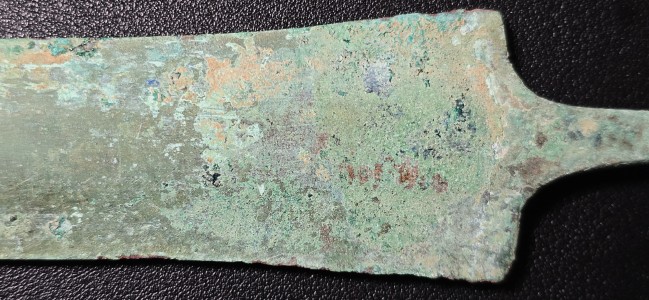
I handle the residue of exactly this engine every week. The collection holds a Greek bronze arrowhead mould — Lot 1829, a form-cast for producing three heads at a time — and I know of no object that states the argument more compactly. A mould is not a possession in any display sense; it is pure capacity, the crystallised competence of a maker, valuable only in use and only to someone with the skill to use it. The copper axe-adze catalogued as Lot 43951422, from the Old European horizon around 4300 BC, carries the same message at a larger scale: shaft-hole casting of that quality, at that date, is not the product of a society that despised work. It is the product of one that organised itself around skill — and, on the evidence of the Varna cemetery, may have granted its highest standing to those who possessed it, a possibility I examined in the previous article and hold, with the published scepticism duly noted, as a live inference rather than a fact.
The consumer economy’s relationship to this engine is parasitic and corrosive at once. It sells the image of mastery — the professional-grade equipment, the artisanal branding — while structuring actual work, for most people, as the opposite of flow: fragmented, surveilled, metric-driven, and stripped of discretion. The capacity it cultivates in its customers is choosing between products, which is the one activity in this entire literature reliably associated with no lasting satisfaction whatsoever.
V. Trypillia: A Large Society That Held the Ladder Down
Now to the ground, and to the reason this argument belongs on an archaeology site rather than in a psychology journal.
Between roughly 4100 and 3400 BC, the forest-steppe between the Southern Bug and Dnieper rivers held the largest settlements then existing anywhere: the Cucuteni–Trypillia mega-sites, with Taljanky at some 320 hectares, Nebelivka around 238, Maidanetske about 200. Their populations are genuinely disputed — the Kiel school’s estimates for Maidanetske run into the tens of thousands, while the Anglo-Ukrainian project argues for far smaller, possibly seasonal occupation, and I decline to pick a number where the specialists cannot. What is not disputed is the plan: houses of broadly uniform standard arranged in vast concentric circuits around an open interior, punctuated by larger assembly structures — and no palace, no citadel, no central storehouse, no fortress, anywhere, in any of them.
In 2024 the question of equality at these sites moved from impression to measurement. Robert Hofmann, Nils Müller-Scheeßel and Johannes Müller, publishing in Antiquity (98:398, pp. 380–400), computed Gini coefficients — the standard statistical measure of inequality, here proxied by house floor-area, on the well-tested assumption that wealthier households build larger houses — from roughly 7,000 structures across 38 sites. Their result: inequality was measurably reduced at the mega-sites relative to the smaller settlements before and after them. The largest aggregations of population in the Neolithic world were also, by this measure, the most equal — the precise opposite of what the standard model predicts scale should do. Differentiation crept back only after several generations, plausibly in connection with the sites’ abandonment; the authors’ conclusion is that growing social complexity need not bring growing vertical differentiation, and that large populations can, for a time, find mechanisms to hold inequality down.
For a time. The proxy has limits — portable wealth, livestock and labour claims would not show in floor plans, and Trypillia’s near-total absence of burials removes the usual cross-check. I state those limits because they are real, not because they blunt the point. Something at these sites was actively suppressing the accumulation that “naturally” attends scale, across generations, without any visible apparatus of enforcement.
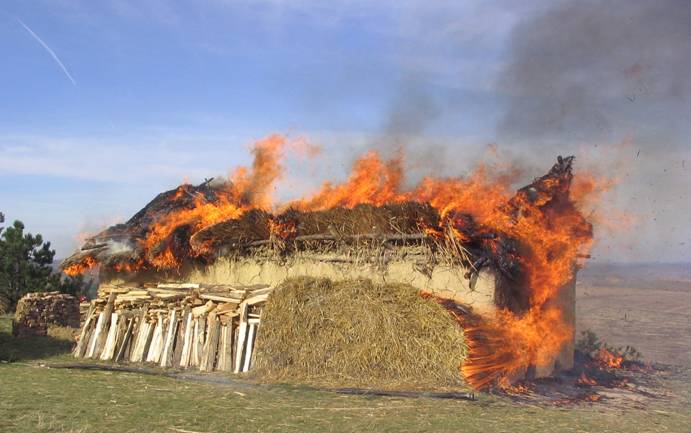
What was it? Here I offer my own reading, plainly labelled as such. The Trypillian settlements practised deliberate, systematic house-burning: dwellings were fired — experimental work suggests with added fuel, at temperatures accident does not easily explain — on something like a generational rhythm, and rebuilt. The literature debates the meaning: ritual closure at the death of a household, purification, practical response to decayed structures. All are live. But notice the mechanism’s side-effect, whatever its intention: accumulation was periodically zeroed. No lineage compounds a material advantage across generations when the material substrate is destroyed on a schedule. It is a levelling device requiring no leveller — embedded in ritual rather than imposed by an authority — which is exactly the kind of institution a society without coercive apparatus would need, and the best candidate I know for how the measured equality was maintained as long as it was. The deep antiquity of institutionalised reset has parallels the historical record makes explicit later: Mesopotamian debt cancellations, the seisachtheia at Athens, the jubilee tradition. Societies older and, in this respect, wiser than ours understood that compounding advantage, left alone, eats the community that hosts it — and built the antidote into the calendar.
There is a second lesson folded inside the first, and it bears directly on the psychology of Part I. A society that burns and rebuilds on a cycle lives in cyclical time: success is recurrence — the harvest returns, the house rises again — not increase. The modern arrangement lives in linear time, where each year is a failure unless it exceeds the last; dissatisfaction is thereby built into the reference frame itself, before a single advertisement is shown. The Trypillian calendar, whatever its makers thought it meant, is the architecture of enough: a structure in which sufficiency is an achievement that repeats, rather than a target that recedes.
VI. Harappa: Amenity Without a Palace
The Indus cities, c. 2600–1900 BC, supply the complementary case: not a mechanism of levelling but a pattern of provision.
Across a territory larger than Egypt and Mesopotamia combined, the Harappan settlements standardised their weights and their brick ratios, planned their streets, and — the detail I keep returning to — ran their drainage, wells and sanitation through the general housing stock. Amenity was distributed, not concentrated in an elite quarter, because after a century of excavation no elite quarter has been found: no palace, no royal tomb, no throne room, no ruler on a monument. Adam Green’s 2020 synthesis in the Journal of Archaeological Research draws the conclusion at full strength — a managerial ruling class has simply failed to appear in the evidence, and a ruling class is not, on this record, a prerequisite for social complexity.
And the craft. Harappan carnelian bead-work — stones drilled with constricted cylindrical borings over lengths that modern experimenters struggle to reproduce, individual long beads representing days or weeks of skilled labour — travelled to Mesopotamian royal graves as treasure. Here is excellence of an extraordinary order produced without royal patronage, workshop provision distributed through the cities in the same pattern as the drains. The standard model holds that high craft requires a court to commission it. The Indus record answers that skill, given a society organised to sustain it, commissions itself.
I will not romanticise, because the same record forbids it. Gwen Robbins Schug’s palaeopathology at Harappa found interpersonal violence structured along lines of gender and community, rising sharply in the troubled late phase — a society without kings was not therefore a society without cruelty, and any account that needs it to be one is advocacy, not archaeology. The claim the evidence supports is narrower and, for present purposes, sufficient: for some seven centuries, the largest urban civilisation of its age ran on distributed provision and distributed competence, with no detectable class living from the labour of the rest.
VII. Many Ladders, or None
One further design feature links the archaeology to the psychology, and it is the one modern life most conspicuously lacks.
The treadmill of Part I turns on status being legible — a single visible scale on which everyone can be ranked. Carole Crumley’s concept of heterarchy, which I discussed in the previous article, describes the alternative: societies in which elements are unranked, or rankable in several different ways at once, no single ordering dominating. Read that as a psychological design rather than a taxonomic nicety and its force becomes obvious. A community with a finest smith, a finest potter, a finest midwife, a finest storyteller and a finest grower has distributed esteem across incommensurable domains; there is no common currency in which the smith outranks the midwife, and therefore no single ladder whose lower rungs — Whitehall tells us — cost years of life. Esteem of that kind is earned in the way mastery is earned, and shares its properties: it does not habituate, and it is not zero-sum.
The consumer economy’s innovation was to solve heterarchy — to dissolve every local, plural, skill-grounded form of standing into one universal solvent, money, and then to build instruments that display the resulting rank in real time. It is the most efficient status-legibility machine ever constructed. The psychological literature predicts precisely what such a machine should produce: an arms race of positional expenditure, chronic comparison, and a gnawing insufficiency immune to any absolute level of comfort. One need only look up from the literature to confirm the prediction.
VIII. What I Am Not Claiming
The counterarguments deserve their space, stated at full strength.
These societies did not last indefinitely: the mega-sites were abandoned, the Indus cities emptied, and if a critic argues that non-hierarchical arrangements fail to scale across time, the abandonment record is their evidence — the honest answer being that we do not yet know whether governance, climate, disease or something else was the cause. Equality of houses is not proof of equality of lives, and neither site guarantees the absence of domination by age, gender or ritual standing; small communities enforce conformity by means — gossip, ostracism, sanction — that can be suffocating, and the burning of one’s house on schedule, whatever else it was, was likely not experienced as a gentle institution. Roughly half the variance in temperamental wellbeing appears heritable, so no arrangement will make everyone content; the achievable object is the removal of structural misery, not the delivery of happiness. And the deepest objection I take the most seriously: the restlessness that drives the growth spiral is the same trait that produced the objects this collection exists to preserve. Somebody was dissatisfied enough with existing axes to work out shaft-hole casting. A society that wholly cured its restlessness might also stop making anything worth digging up.
But that last objection, followed carefully, is not an objection at all. It is the thesis. The choice was never between striving and stagnation. It is between striving at things and striving for rank — between the smith perfecting the casting and the purchaser accumulating the castings of others. The first engine runs forever on its own output and diminishes no one. The second consumes its host. The archaeological record contains societies that ran, for centuries, on the first — and the psychological record, assembled with no reference to archaeology whatsoever, has independently concluded that the first is where durable human satisfaction actually lives.
IX. Enough, as an Achievement
So: security as a floor, because insecurity is the harm no one habituates to. Work structured around deepening skill rather than expanding output, because process regenerates what states cannot hold. Esteem plural and incommensurable, so that no single ladder exists to price human beings against each other. And sufficiency built into the calendar — renewal, recurrence, reset — rather than the linear demand that every year exceed the last.
None of this is a blueprint, and the ancient cases are not templates; five and a half thousand years separate us from Taljanky, and no serious person proposes the wattle-and-daub commute. What the cases establish is smaller and more important: that these principles are not utopian speculation. They are the reconstructed operating logic of the largest settlements of their age, held together for centuries, measurable in their floor plans and legible in their drains — and they align, point for point, with what the modern study of satisfaction found when it finally thought to ask what actually works.
The consumer economy answers the question of the good life with an axiom: more. The psychology says the axiom is false, and the archaeology says it was never necessary. Between them stands the possibility this site exists to keep visible — that enough is not a resignation but a design, one that human beings have built before, at scale, and left in the ground for us to find.
Cross-references
- The Category Error at the Heart of Civilisation: What Cucuteni–Trypillia, Varna and the Indus Valley Reveal About Cities Without Kings
- The Language of Patina: Understanding Corrosion Layers on Ancient Bronze and Copper Alloy Artifacts
Andrzej M. Izyk is the curator of the Sancta Clara Collection and the author of The Sky Father: The Lost Bronze Age God Behind Zeus, Jupiter, Tyr, and Deus and Abandoned Children of the Gods: Still Waiting for the Return.
© AncientBronzes.com — Sancta Clara Collection.