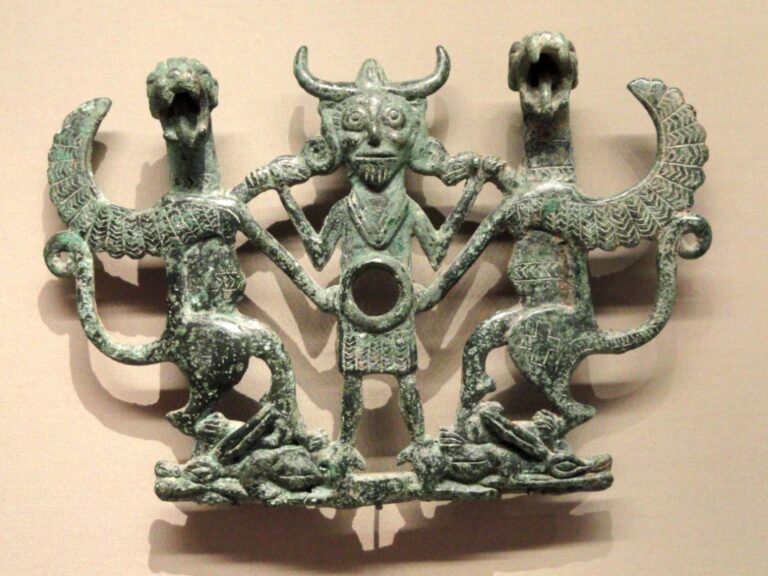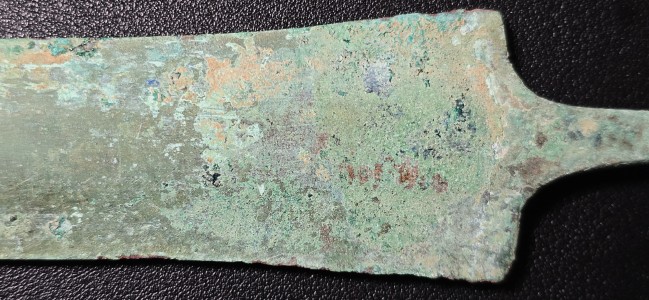
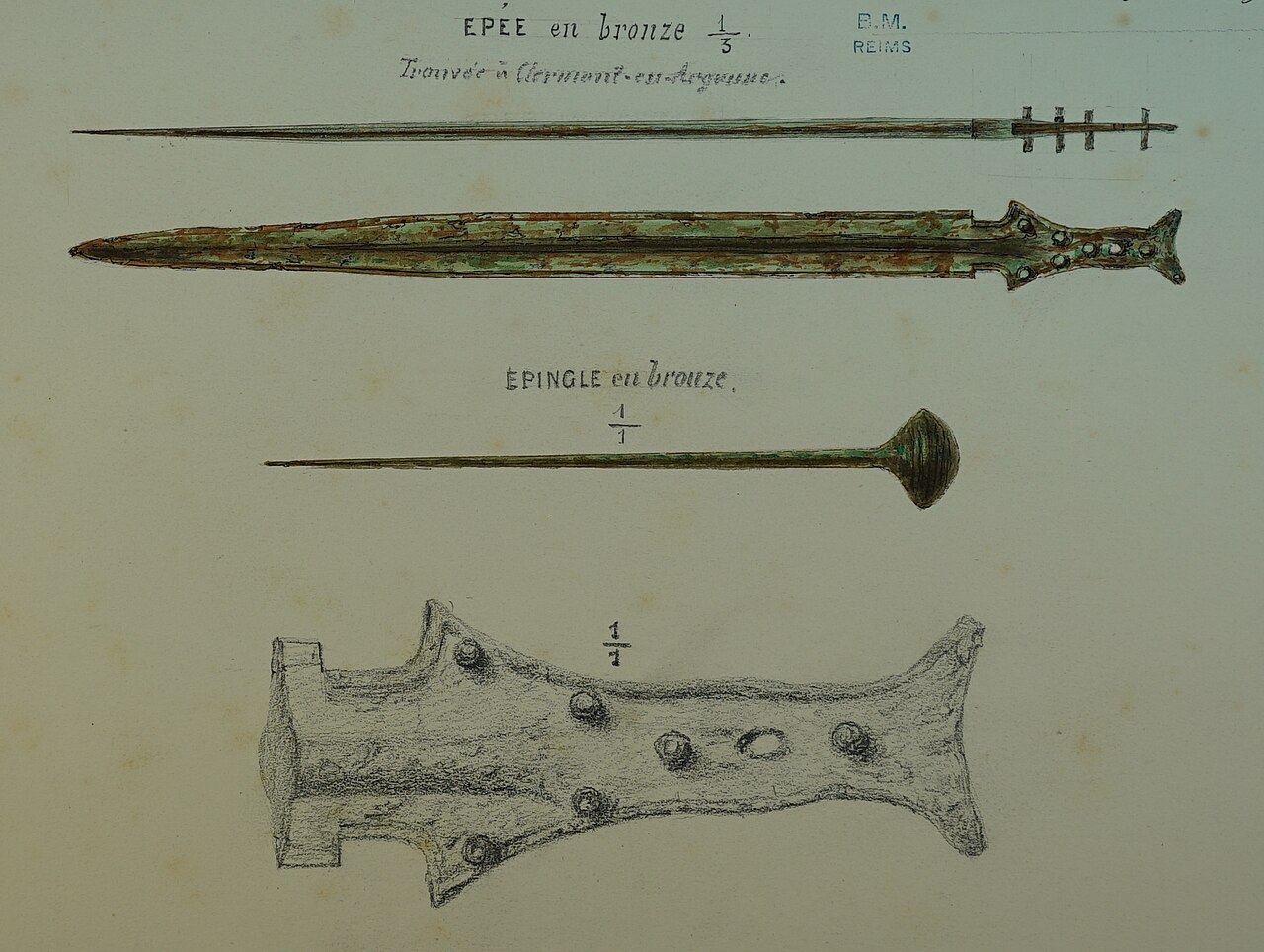

The Flanged Hilt: How Bronze Age Smiths Solved the Sword’s Weakest Point — from the Zagros to the Baltic: How Bronze Age smiths from the Zagros to the Baltic independently solved the sword’s weakest point — the blade-to-hilt junction — with the flanged hilt. Featuring the Sancta Clara Lot 902 dirk, the Naue II grip-tongue sword, and the 2026 Gdańsk forest find.
By Andrzej M. Izyk — Sancta Clara Collection, AncientBronzes.com
Every sword has a point where it is most likely to fail, and for most of the Bronze Age that point was not the edge, not the tip, but the join between the blade and the thing you hold. I have handled enough of these weapons to have developed a feel for where the metal is anxious, and it is almost always at the shoulders — the narrow neck where a cast blade tapers into a tang, or where a riveted hilt-plate is pinned to the heel. Strike a hard target with the edge, or catch another blade and lever it sideways, and that junction takes a load it was never engineered for. The whole history of the second-millennium-BC sword can be read as a long argument about how to fix that one problem.
This essay traces one family of answers. Across metallurgical provinces that had little or nothing to do with one another — the Zagros highlands of western Iran, the workshops of the central Mediterranean and the Carpathian Basin, the lakeside foundries of the Alpine foreland, and finally the sandy pine forests of the southern Baltic littoral — smiths converged on the same broad solution: stop making the hilt a separate thing bolted onto the blade, and instead cast blade and hilt as a single continuous piece of bronze, using raised flanges to grip the organic scales or inlay that gave the weapon its working surface. I want to follow that convergence honestly, which means insisting at the outset on a distinction the popular retellings blur: convergence is not descent. The Near Eastern flanged dirk and the European grip-tongue sword are not the same weapon, and neither is the ancestor of the other. They are two independent solutions to one shared engineering problem, and that — not some imagined single lineage — is the genuinely interesting story.
I will anchor the argument in three objects: a Near Eastern flanged-hilt dirk in my own care, the great European Naue II grip-tongue sword, and a Baltic sword pulled vertically out of a forest floor near Gdańsk in June 2026 that the world’s press has, I will argue, misnamed.
The weak point, stated plainly
Bronze is a wonderful casting metal and a mediocre structural one. It is soft, it fatigues, and it bends rather than springs. The tin content of Bronze Age sword blades is not a single recipe but a working range: the time-of-flight neutron-diffraction study of eight Austrian Bronze Age swords by Marianne Mödlinger and colleagues (Journal of Archaeological Science: Reports, 2020) found blades containing between 7 and 13 wt% tin, and — crucially — showed that forging a 12% tin bronze raises its hardness to around 220 HV against only about 70 HV for the same alloy left as-cast. That single fact governs everything that follows: the metal is only as good as the smith’s cold-working of it, and the hilt junction is where cold-working is hardest to apply. The earliest true swords — the Aegean Type A rapiers of around 1700 BC from Mallia and Arkalochori on Crete, those metre-long slivers of thrust-optimised bronze — solved the blade problem brilliantly with a strong central midrib that stiffens a long thin section against lateral bending. What they did not solve was the hilt problem. The Type A rapier carried its organic grip on a flat, narrow tang held by a handful of rivets through rounded shoulders. Thrust straight down the axis and the weapon is superb. Give it any lateral or percussive load and the rivets tear out, the shoulders crack, and the blade parts company with the hand. I discuss the deeper history of these Aegean rapiers, and of the far older Anatolian swords from Arslantepe that predate them by a clean thousand years, in my Arslantepe essay and in the Bronze Age Swords knowledge base; here I want to stay narrowly on the junction.
Nancy Sandars’ alphabetic typology of Aegean swords, A through H, is in effect a century-long record of smiths worrying at this joint. Type A (c. 1700 BC) is the fragile long rapier. Type B (c. 1600–1500 BC) is shorter, around 50 cm, with squared, flanged shoulders and larger rivets — a deliberate half-length compromise that trades reach for a hilt junction that will actually survive. Types C and D of the fifteenth century — the “horned” sword with hand-protecting projections at the hilt, and the cruciform sword — add protection and shoulder strength. Types E and F bring the T-shaped pommel and angular shoulders with two rivet groups, and Types G and H are the horned revivals of the late thirteenth and twelfth centuries, with Type H specifically bound up with the Sea Peoples horizon. The Mycenaean short sword I keep as Sancta Clara Lot 778, which sits most plausibly in Sandars Type B, is a perfect physical statement of the compromise: at 390 mm of surviving bronze, roughly 50 cm once its organic grip is mentally restored, it is a weapon that has given up reach to keep its hilt attached. That is the trade-off the whole period is trying to escape.
There were two clean ways out. One was to make the entire hilt of solid bronze and cast it as one with the blade — the Vollgriffschwert or full-hilted sword, the Carpathian and Nordic solution from the sixteenth century BC onward, seen in the Apa and Hajdúsámson hoards and in the Nordic Period II octagonal-hilted swords. That is elegant but expensive, metal-hungry, and it makes the grip a rigid casting rather than a forgiving organic surface. The other way — the one this essay follows — was to keep an organic grip but stop trusting it to rivets alone. Cast the hilt-structure integrally with the blade, and raise flanges along it: walls of bronze that physically cage the organic plates or inlay and take the lateral load the rivets used to carry alone. That single idea appears, independently, in the Zagros and in temperate Europe within roughly the same two or three centuries. Let us take the eastern case first.
The Near Eastern solution: Lot 902 and the Medvedskaya dirk
Sancta Clara Lot 902 is a bronze dirk or short sword of 48 cm, cast — blade and hilt together — in a single pour. The hilt is flanged: raised bronze walls run along the grip to receive an inlay of wood or bone, now perished, and a rectangular guard with shortened lappets on each side clamps that inlay at the base. The metal carries a stable green patination with light accretions, and the lappet edges are a little nibbled — honest wear, not damage. On the collection catalogue I have dated it to circa 1100–800 BC and attributed it, with appropriate caution, to the horizon of the Babylonian king Marduk-nadin-ahhe. It belongs to Type I in the classification of I. N. Medvedskaya.
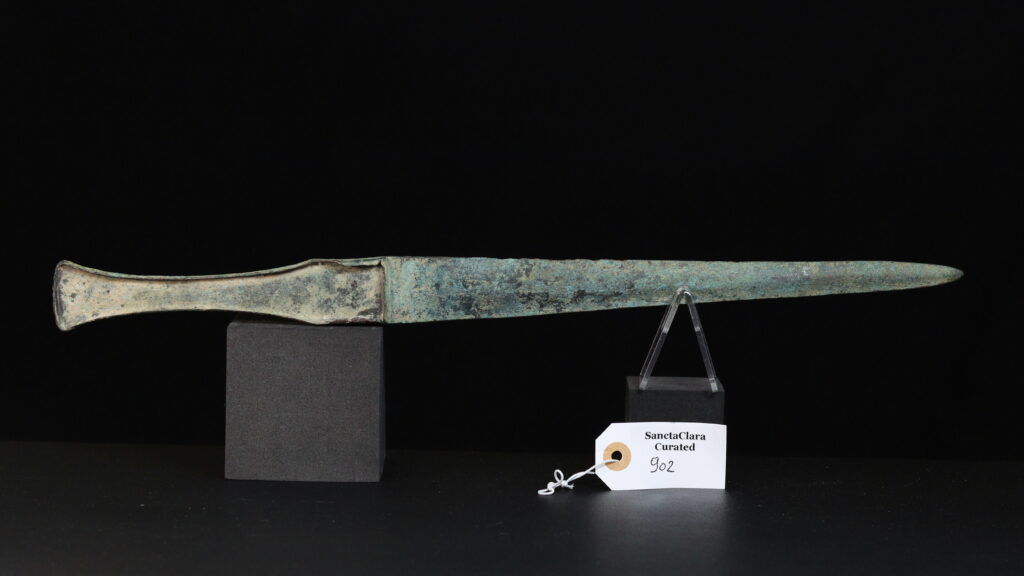
That classification deserves a proper account, because it is the scholarly spine of the whole eastern half of this argument. Irina Nikolaevna Medvedskaya, a Russian specialist in the Iranian Iron Age, published the reference study in English as “The Iranian Daggers of the Second and Early First Millennia B.C.” in Iranica Antiqua volume 24 (1989), building on her 1982 book Iran: Iron Age I. Her scheme sorts these flanged bladed weapons by the form of the hilt, and it is on that basis that she distinguishes types originating in different regions of Iran. I should be candid about the state of the evidence: Medvedskaya’s own texts are not available in open access, and the working definition of Type I has to be reconstructed from scholars who apply her scheme — principally Manouchehr Moshtagh Khorasani in Arms and Armour from Iran (2006) and in his 2009 study of Luristan weapons, and a detailed 2025 catalogue in the journal Historia i Świat. What emerges consistently is this: Medvedskaya’s earliest group, Type I (with a sub-variant IA), comprises daggers and dirks in which the flanged hilt and the blade are cast in one piece, carrying flanges along the grip to hold an inlay of wood, bone, or metal; the pommel is characteristically lunate or “ear-shaped,” and the guard is marked by sharp-angled indentations or protrusions on each side that helped lock the inlay in place. The Historia i Świat catalogue dates Type IA specifically to the twelfth–eleventh centuries BC; the broader one-piece-cast flanged group is generally placed from the thirteenth into the ninth century BC. Everything in that description matches Lot 902: the one-piece casting, the inlay-holding flanges, the lappeted guard. The attribution is sound.
Now the inscribed daggers, because this is where romance and evidence have to be separated carefully. A small number of these Luristan flanged dirks carry short cuneiform inscriptions engraved on both faces of the blade just below the hilt, giving the names of late-second-millennium Babylonian kings — Nebuchadnezzar I, Marduk-nadin-ahhe, Adad-apla-iddina and others of the Second Dynasty of Isin. The best-published is in the British Museum (BM 123061; registration 1932,0514.2). Its inscription reads, in the Museum’s translation, “Property of Marduk-nādin-aḫḫē, king of the world, king of Babylon, king of Sumer and Akkad” — the sixth king of the Second Dynasty of Isin, who reigned c. 1099–1082 BC (some current king-lists give c. 1095–1078 BC). The piece is 37 cm overall with a 23.4 cm blade, and it was reportedly “found near Kermanshah, it is said in a cave” in Luristan, together with a second inscribed dagger (BM 123060) naming Shamash-killani, “an officer of the king,” and a Middle Babylonian bronze bowl.
Here the honest historian must slow down. First, none of these inscribed weapons comes from a controlled excavation; all reached scholarship through the Iranian art market of the early twentieth century, and the dealer reports that they came “from widely scattered sources in various parts of the district” are, as the British Museum’s own catalogue drily notes, “hardly to be relied upon.” Second, there is a live scholarly disagreement about what the inscriptions mean. Ernst Herzfeld proposed that the weapons came from the graves of Assyrian soldiers garrisoned in Luristan — a hypothesis I cite on the Lot 902 catalogue page and which is now regarded as, at best, one option among several and probably too specific. The British Museum entry lays out the alternatives soberly: the most likely scenario is that the swords were found in graves and represent ancient booty carried east from Babylonia; Peter Calmeyer suggested instead that they may have been dedicated at local sanctuaries or given to men who had served as mercenaries in Babylonian armies. Third — and this is a point I want to make plainly rather than bury — the Near Eastern flanged swords are, in Paulina Suchowska-Ducke’s synthesis, “later” than the European ones and “date mainly to the 12th–10th centuries BC” on typological and relative-chronology grounds; most examples are plain, and only a small number from the art market carry royal inscriptions. That distribution should make any collector cautious: a genuine ancient blade of this common type can carry an inscription that is itself ancient, but the inscription is exactly the feature a later hand — ancient or modern — would have the strongest motive to add. I am satisfied that Lot 902 is a genuine ancient dirk of Medvedskaya Type I; I make no claim that it ever bore a royal name, and I would treat any uninscribed piece attributed to “Marduk-nadin-ahhe” as attributed to his period, not his ownership.
That leaves the technical claim I have made about Lot 902, which I want to submit to scrutiny rather than assert. I have recorded that the hilt-guard wall is 0.6 mm thick, and argued that such a wall is “impossible to cast in bronze even in a pressure chamber” and must therefore have been forged and ground down after an initial casting — while noting, honestly, that there is no visible sign of an originally thicker wall. I no longer think the strong form of that claim is defensible, and I would rather correct myself in public than defend it. A 0.6 mm section is, in fact, at the very floor of what modern investment (lost-wax) casting shops quote as a minimum wall thickness for bronze — commercial guidance repeatedly cites 0.6 mm as the natural-finish minimum for small bronze work, though heavier structural investment casting is more comfortable at 1.5 mm and above. Ancient smiths did not have vacuum-assisted pouring, so a reliably cast 0.6 mm wall across a broad guard would indeed have been near the edge of the achievable — but “near the edge of the achievable” is not “impossible,” and the British Museum’s own technical examination of the comparable inscribed dagger gives the likely answer directly: these weapons were made “by first casting the blade and tang, trimming, hammering and polishing the cast, and then pouring hot metal into a mould added around the tang and upper blade,” after which “the handle would then be trimmed and polished.” In other words, the hilt structure was routinely finished by hammering and grinding after casting. That is precisely the post-casting working I inferred from the thin wall — so my observation stands, but my inference that it proves the impossible does not. The thin, crisp guard wall is good evidence of skilled cold-finishing of a casting; it is not evidence that the casting itself was impossible. I should never have written “impossible,” and I withdraw it.
Lot 902 does not stand alone in the collection. Its close sibling, Lot 901, is a Near Eastern rapier-type short sword or dagger of 344 mm from the same Babylonian horizon; Lot 1018 is a 52 cm bronze sword with a flat midrib and a rat-tail tang — a reminder that the rat-tail solution, a long thin spike running up into an organic grip, is the opposite engineering philosophy to the flanged hilt, trading a caged grip for simplicity and paying for it in exactly the junction weakness this essay is about. A 52 cm rat-tail blade like Lot 1018 was perhaps 65 cm in the hand; a tang-less Western Asiatic blade such as those I catalogue under Lot 44399964-1 (1300–900 BC), and the large blade fragment Lot 44399964-3, tell us their length only in bronze, with the organic hilt to be imagined back on. These are the workaday relatives of the inscribed showpieces, and they matter because they show the flanged hilt was a production solution, not a one-off royal conceit.
The European solution: the Naue II grip-tongue sword
Now cross the continent, and change almost everything except the underlying idea.
The European answer to the junction problem is the sword Julius Naue described for the Munich Anthropological Society in 1884 and which bears his name: the Naue II, or in German the Griffzungenschwert, the “grip-tongue sword.” Naue was a painter and illustrator turned self-taught archaeologist, and his 1884 presentation on prehistoric swords gave the type its enduring label. The construction is the crucial thing. Instead of a separately cast hilt riveted to the blade’s shoulders — the very join that failed — the Naue II extends the blade metal itself upward into a flat “tongue,” and raises flanges along the edges of that tongue. The organic grip-plates then sit inside those flanges and are riveted to a continuous, unbroken piece of metal that runs from pommel to point. Flanges and rivets together hold the grip; the load path never passes through a glued or pinned seam. To this the type adds a blade with long, near-parallel cutting edges and a thickened cross-section — sometimes a broad midrib, sometimes a lens or diamond section — that resists bending and puts real mass behind a cut. In the words of Anthony Snodgrass — quoted so often because it is exactly right — this was the first true “cut-and-thrust” sword: introduced to the Aegean from Central Europe late in the thirteenth century BC, and typically 50 to 70 cm in length.
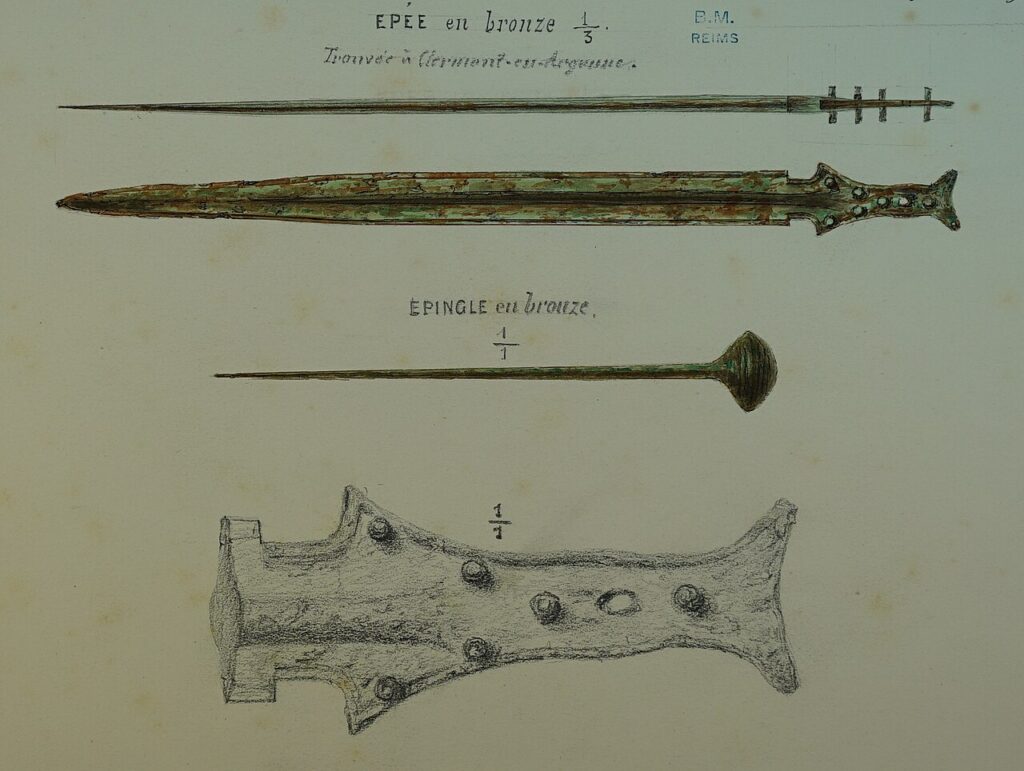
Where did it come from? The mainstream reconstruction places its emergence in a general Urnfield background of the thirteenth century BC — most probably among the Urnfield cultures of the eastern Alps and the Carpathian Basin, with a strong claim also entered for northern Italy. From that heartland it spread with astonishing reach: north and west into central Europe, Scandinavia and the British Isles, and — from about 1200 BC, in the decades just before the Late Bronze Age palatial collapse — south and east into the Aegean, Cyprus and the Levant. In Paulina Suchowska-Ducke’s dissemination study, more than 1,100 specimens of this artefact class are known from across Europe and the eastern Mediterranean, with some 933 finds of the popular grip-tongue group recorded across temperate Europe and the Mediterranean Basin. It outlived bronze itself: the design survived the changeover to iron essentially unaltered and persisted, with only minor modification, until iron swords of other forms displaced it after about 600 BC. Imagine a single basic weapon design lasting seven centuries across a change of working metal, and you have the measure of how well it solved the problem.
The type’s arrival in the east has become one of the sharpest debates in Bronze Age archaeology, and it bears directly on my convergence argument, so I will set it out with its uncertainty intact. The key case study is a Naue II sword found at Ugarit on the Syrian coast, published by Reinhard Jung and Mathias Mehofer in Aegean Archaeology 8 (2008/2009, pp. 111–136). Their argument, based on the sword’s features and on comparanda from the Aegean and Cyprus, is that these weapons “arrived together with their users and producers from the central Mediterranean and cannot be seen as a result of goods exchange” — that is, that people carrying and making Italian-type weapons physically moved east, rather than the swords travelling alone as traded objects. That is a strong claim about mobility, and it is contested; it is not the same thing as saying the objects prove an invasion. What the distribution does show, and here the evidence is firmer, is a striking pattern within the Aegean itself. As Thanasis Giannopoulos and others have emphasised, the greatest concentration of Naue II swords in the Aegean is not in the old palatial heartlands but in the twelfth-century-BC warrior burials of the north-western Peloponnese, and especially Achaia — at cemeteries such as Voudeni, Klauss and Portes. These new weapons have been linked, in the wider literature, both to the Sea Peoples and to foreign mercenaries in palatial service. I want to be careful here: that linkage is an interpretation, not a demonstrated fact. The swords are real and their concentration in Achaean warrior graves is real; the identification of the men who carried them with any named group in the Egyptian texts is an inference layered on top, and a fragile one. The most one can responsibly say is that a new, more effective cutting sword entered the Aegean from a central-European/Italian technical world at the very moment the palatial system was failing, and that it clusters with a new kind of warrior self-presentation in burial. Cause, symptom and coincidence are genuinely hard to separate.
For the reader who wants to know what the Naue II replaced, the preceding Aegean sequence is the Sandars series already sketched: the Type A and B rapiers and their stouter Type C–F descendants, thrust-first weapons with vulnerable riveted hilts, giving way — via the horned Types G and H of the collapse horizon — to a cutting weapon whose hilt did not fail. That is the whole point. The Mycenaean world had been refining the blade for five centuries; the Naue II fixed the hilt, and in doing so changed how a sword could be used, from a duel of points to a mêlée of edges. The collection’s Mycenaean pieces — Lot 778 itself, the Mycenaean dagger Lot 82723193 (1600–1200 BC, 217 mm), and blade fragments such as Lot 84122607 (1200–1000 BC) and Lot 83346847 (1400–1000 BC) — all belong to that older, thrust-first world the grip-tongue sword superseded.
The Baltic descendant: the Gdańsk forest sword of June 2026
The European lineage has a long tail, and it reaches the southern Baltic. On Sunday 14 June 2026, during legal, permitted metal-detecting in the Nadleśnictwo Gdańsk — the Gdańsk Forest District, in Pomerania in northern Poland — the detectorist Marcin Wiśniewski found a bronze sword standing vertically in sandy soil, “sitting rigid” in the ground. What he did next is worth recording as a model of practice: he stopped, left the object in situ rather than wrenching it out, back-filled and camouflaged the hole with branches and stumps, and even left a discarded can on top to suggest to any passer-by that the spot held nothing but modern rubbish. He then notified the Pomeranian Voivodeship Conservator of Monuments (Pomorski Wojewódzki Konserwator Zabytków), whose office is headed by Dariusz Chmielewski and whose spokesman is Marcin Tymiński, and the Forest District. Staff of the conservator’s archaeological department then lifted the sword using proper archaeological method, working alongside the finder, in heavy rain, cutting a small sondage to record the stratigraphy — which yielded no accompanying objects. The provisional date is Period V of the Nordic/Central European Bronze Age scheme, c. 900–700 BC. The same finder had previously recovered an early Iron Age assemblage — neckrings, anklets or greaves, and bracelets — in the same forests.
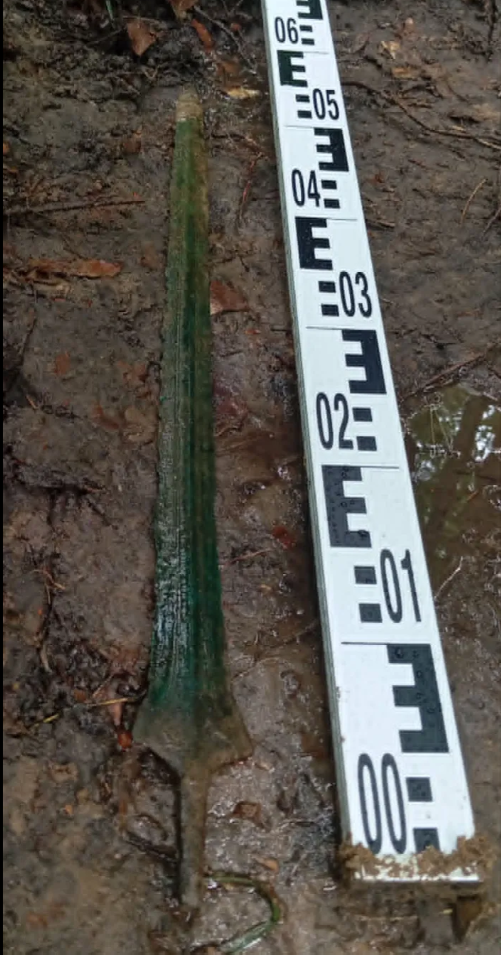
Image: Spectacular bronze sword excavated in northern Poland in 2026 by Marcin Wisniewski and Dr Radoslaw Biel
The press, Polish and international alike, has overwhelmingly called this a “miecz antenowy,” an “antennae sword.” I need to say clearly, as the point on which I most directly correct the reporting, that this designation is almost certainly wrong, and that it matters. An antennae sword (Antennenschwert) is defined by its pommel: a full metal hilt terminating in two coiled, spiral, upward-curling terminals resembling an insect’s antennae. It is a sub-type of the full-hilted Vollgriffschwert, in which the entire grip is cast bronze. The Gdańsk sword has no hilt at all. On the evidence — including the detailed field description by Dr Radosław Biel in Archeologia Żywa, working from the finder’s and conservator’s own photographs — the surviving object is a little over 60 cm long, of which only about 6 cm is a narrow tang (a kolec do rękojeści, a grip-spike) onto which an organic grip of wood, bone or antler was once fitted and has long since rotted away. There is no antenna pommel present because there is no metal pommel present at all. To call it an “antennae sword” is to name it after a feature it demonstrably lacks.
The collection’s own reading — and the correction I want to put on record — sharpens this further. The surviving bronze is best understood as approximately 54 cm of blade-and-tang, with the complete original weapon, hilt restored, standing somewhat over 60 cm in the hand. The blade splays noticeably wider close to the hilt end, then holds a nearly constant width for much of its length before tapering to the point, and it is decorated with grooves — fullers or ornamental blade-grooves — running on both faces alongside the mid-ridge, with rows of engraved arcs and short transverse strokes. Crucially, no hilt survives: there is only the short tang tongue. What can we honestly infer from that combination — short grip-spike, splayed blade shoulders, grooved faces?
Here the diagnostic criteria matter, and I will lay out the options rather than force one. The Polish specialists have already done the sober thing: Biel’s account assigns the piece, following Jerzy Fogel’s 1979 corpus of Lusatian-culture weaponry from the Oder and Vistula basins, to Fogel’s Type XVII, a grip-spike (Griffangel) sword form dated mainly to Periods IV and V. That is a grip-tongue/grip-spike weapon — the northern, late descendant of the Naue II construction principle, not a full-hilted antennae sword. A near-identical Pomeranian comparandum, published by Jarosław Rola in 1992, was found near Szczecinek: 71.5 cm long, slender-bladed, ornamented at the base of the blade, likewise dated to Period V, and at the time the nineteenth known example of its type from Middle Pomerania. (That 71.5 cm sword is a comparandum and must not be confused with the new Gdańsk find, which is shorter.) So the responsible determination, on present evidence, runs: this is most consistent with a grip-tongue/grip-spike sword of the broad Naue II descent as localised in Period V Pomerania — Fogel Type XVII — and not with a Vollgriff antennae sword. Three possibilities remain formally open until conservation and X-ray are done: (1) a grip-spike Griffangelschwert as Biel proposes, which I regard as much the most likely; (2) a Griffzungenschwert proper, with a flat flanged tongue rather than a spike, if cleaning reveals flanges on the tang; or (3), far less likely, the blade of a full-hilted sword whose separately made metal hilt has been lost — but a lost Vollgriff would not leave a neat organic-grip spike, so this can be all but excluded. What can be excluded outright is the “antennae” label, which presupposes a spiral pommel that is simply not there.
The regional context is the Lusatian culture, the great Urnfield-related complex that covered much of the lower Vistula and Oder basins from roughly 1300 to 500 BC, its Pomeranian branch drawing bronze-working ideas from both the Nordic circle to the north and the Urnfield world to the south. The lower Vistula was itself a metallurgical centre — Ernst Sprockhoff long ago identified original local forms being produced there even while under Nordic influence. In this world the sword was a supreme prestige object; the Polish reporting’s estimate that such a weapon was worth “an entire herd of cattle” is folk-arithmetic, but the underlying point is sound — a sword represented a large quantity of imported metal and a great deal of skilled labour, and its owner belonged to a warrior elite or a local leadership. The collection’s Central-European material speaks to the same world: the Urnfield socketed axe from the Podkonice Hoard (Lot 97524689) and the large decorated Urnfield axe-head (Lot 97814529), and the European spearheads Lot 97137769 and Lot 97806108, are the tool-and-weapon repertoire within which a Period V Pomeranian sword belongs.
Ritual deposition: a sword planted in the ground
The most evocative fact about the Gdańsk sword is its posture. It was not lying flat, as a lost or discarded weapon tends to end up; it was driven point-down, vertically, into the earth, and left. As Dr Dawid Sych of the University of Leicester observed to Archeologia Żywa, such vertically deposited swords are known both from what is now Poland and from elsewhere in Europe — he cites the Isle of Shuna in Scotland — but they are genuinely rare, and outside controlled excavation we almost never get to see how an object was placed in the ground. A vertical sword is very hard to explain as accidental loss. The natural reading is deliberate deposition: a votive act, a weapon “given” to the earth, to a deity, or to the ancestors — perhaps in thanks for a victory, perhaps to retire a dangerous object’s power so that no one else could wield it.
This is not special pleading. Deliberate deposition of Bronze Age weapons in the ground and in water is one of the best-attested phenomena of the European later Bronze Age. The forms are various: single votive swords, great weapon-hoards, river finds, and the deliberate “killing” of objects — bending, breaking, or defacing them — before they were committed to bog, lake or marsh. Marianne Mödlinger and others have shown that many swords recovered from wetlands carry unrepaired combat damage, consistent with weapons taken out of use immediately after a fight and consecrated rather than mended — the deep prehistoric root of the war-booty offering later documented in Iron Age Gaulish sanctuaries and Greek temples. The Gdańsk forest itself has form: in the 1920s, two bronze swords the older literature does call “antennae swords” were recovered from the Rynarzewo peat bog, by the Rynarzewo forester’s lodge within today’s Gdańsk Forest District, and passed to the Provincial Museum in Gdańsk (the Museum Provinzial) before being lost in the Second World War. A wetland pair then; a vertically planted blade now — the same landscape receiving weapons across centuries.
A near-contemporary parallel from just south underlines how careful the interpretation of “ritual” has become. In roughly May–August 2026, during the Brno–Přerov railway modernisation near Kojetín in Moravia, the Olomouc Archaeological Centre recovered an Urnfield-culture bronze fragment hoard from a former wetland: eight bent sickles, one complete sickle, part of a sword blade, ornament fragments, three ingots and two unfinished objects. The excavators’ argument that this was deliberate placement rather than a cache for later recovery rests not on romance but on use-wear traceology: the traceologist Michael Kamarád found that the sword blade had been severed by a single heavy blow of chisel or axe and several sickles deliberately bent, damage inflicted “not during work” but “related to their storage” — that is, immediately before deposition, in a waterlogged place from which no one intended to retrieve them. That is how you argue ritual deposition responsibly: from damage patterns and depositional context, not from atmosphere.
Which brings me to the nicks on the Gdańsk blade, and a caution. The finder and the reporting note visible notches or poszczerbienia on the edges, and one commentator suggested these might indicate the sword’s użytkowy, its working, combat character. Perhaps. But I would not overclaim. Edge notches on a bronze sword can record genuine blade-on-blade or blade-on-shield contact; they can equally result from post-depositional damage, from the plough, from root and stone pressure over 2,700 years in the ground, or from the mechanics of recovery. Only microscopic use-wear analysis of the kind applied at Kojetín, and to the well-studied Górzyca sword from the middle Oder, can tell combat damage from taphonomic damage, and that work has not yet been done on the Gdańsk blade. Until it is, “decorated, patinated, with edge notches” is an accurate description and “a battle-scarred warrior’s blade” is a story. The green patina, incidentally, should not be cleaned by any hand but a conservator’s — it is not dirt but the artefact’s present state of preservation, and I have written elsewhere about reading corrosion layers on ancient bronze.
The convergence argument, stated carefully
Now I can draw the three threads together, and I want to do it without the sleight of hand that this kind of essay invites.
Set Lot 902 beside a Naue II. Both are one-piece bronze castings that integrate hilt-structure and blade. Both use raised flanges to retain an organic grip surface. Both belong, broadly, to the same half-millennium — the mature life of the European type running from the thirteenth century, that of the Near Eastern group mainly the twelfth to tenth. A careless writer would call that a lineage. It is not, and the differences are exactly where the honesty lives. Lot 902 has a discrete, cast, rectangular guard with lappets — a distinct cross-piece at the base of the grip — which the Naue II simply does not have; the Naue II’s grip-tongue runs straight into the blade shoulders with no cast guard. And the flanges do different jobs: on Lot 902 they are hilt-walls caging an inlay set into a grip-frame, on the Naue II they are the raised edges of a flat tongue onto which scales are riveted. One is a framed-and-inlaid grip; the other is a plated tongue. They look like relatives in a photograph and behave like strangers in the hand.
Is there any scholarly case for contact or diffusion between the Iranian flanged-hilt tradition and the European Griffzungenschwert? Honestly, no serious one — and the best authorities on the European side actively argue against any such derivation. J. D. Cowen, whose 1966 paper in the Proceedings of the Prehistoric Society remains the foundational study of the type, set out deliberately “the case for an independent and wholly indigenous development of the flange-hilted sword of bronze in extra-Aegean Europe.” Cowen’s own words frame the methodological point better than I can: he noted that flanged hilts were not new — the Mycenaeans had them on their rapiers, and Anatolia had substantial-tanged swords by the end of the third millennium — and that the argument is therefore “for independent invention of the same device in more than one period and place — a concept which some prehistorians seem to find unpalatable to the point of disbelief, however simple and natural the device.” That last clause is the heart of the matter. A flange to cage a grip is not a rare stroke of genius that has to be invented once and then transmitted; it is an obvious, natural response to an obvious, shared problem, and obvious responses get invented repeatedly by people who never met.
Could a Levantine or Anatolian intermediary — Ugarit, Cyprus, the Hittite sphere — have carried the idea between the two provinces? The chronology does not forbid contact at the right moment: the Naue II reaches Ugarit around 1200 BC, exactly when the inscribed Luristan flanged dirks were current a few hundred kilometres to the east. So one could imagine a transmission corridor. But imagining a corridor is not evidence that anything travelled down it, and here the physical differences are decisive: if the European grip-tongue sword had been derived from the Iranian framed-and-inlaid dirk, we should expect the intermediate Levantine examples to show the hybrid features — a cast lappeted guard on a grip-tongue, say — and they do not. The Ugarit Naue II is a straightforwardly European-type weapon, not a blend. The transmission route exists on the map and vanishes in the metal. I therefore come down, with Cowen and with the mainstream of the field, firmly on the side of independent invention: the flanged hilt is a convergent solution, arrived at separately in the Zagros and in temperate Europe because both faced the identical structural failure and bronze offered both the identical repertoire of fixes.
That conclusion is, to my mind, more interesting than a spurious single lineage would have been. It tells us something true about technology in the second millennium BC: that a well-connected Old World was, in effect, running the same experiment in many laboratories at once, and that when the constraints are shared — a soft cast metal, an organic grip, a junction that fails under lateral load — the answers rhyme even where the smiths never spoke. The Sancta Clara Lot 902 dirk from the Zagros and the sword pulled vertically from a Pomeranian forest in 2026 are not cousins. They are strangers who solved the same problem the same way, and that is the deeper unity this collection exists to show.
Established scholarly consensus:
- The junction between blade and hilt was the principal structural weakness of early Bronze Age swords, and both the Vollgriffschwert (full cast hilt) and the flanged grip-tongue construction were responses to it. (General consensus; Sandars, Cowen, Kilian-Dirlmeier, Molloy.)
- The Naue II / Griffzungenschwert emerged in a thirteenth-century-BC Urnfield background (eastern Alps / Carpathian Basin, with a north-Italian claim), spread across Europe and to the Aegean, Cyprus and the Levant from c. 1200 BC, and survived the transition from bronze to iron until c. 600 BC. (Naue 1884; Cowen 1966; Jung & Mehofer 2008; Suchowska-Ducke 2015, who counts more than 1,100 specimens.)
- Snodgrass’s characterisation of the Naue II as the first true “cut-and-thrust” sword is standard.
- The greatest Aegean concentration of Naue II swords is in twelfth-century-BC warrior burials of the north-western Peloponnese and Achaia, not the palatial heartlands. (Giannopoulos; Papadopoulos; Moschos.)
- Bronze Age sword blades were cast from copper-tin alloy across a range of roughly 7–13% tin, with forging dramatically raising hardness (c. 220 HV forged versus c. 70 HV as-cast at 12% Sn). (Mödlinger et al. 2020, J. Archaeol. Sci.: Reports.)
- The Marduk-nadin-ahhe inscribed daggers are genuine ancient objects; the British Museum example (BM 123061) is inscribed for that king (reigned c. 1099–1082 BC, sixth king of the Second Dynasty of Isin) and was reportedly found in Luristan with a second dagger naming an officer, Shamash-killani. None comes from a controlled excavation. (British Museum; Gadd 1932; Brinkman 1962.)
- Medvedskaya’s typology of Iranian daggers (1982; 1989) is the standard reference, sorting flanged bladed weapons by hilt form; her Type I/IA is a one-piece-cast, flanged, inlay-holding form with lunate pommel, dated (IA) to the twelfth–eleventh centuries BC.
- Deliberate deposition of Bronze Age weapons in ground and water — including vertically placed swords, wetland/bog and river finds, and the “killing” of objects — is a well-attested phenomenon. (Mödlinger; and, freshly, the Kojetín hoard 2026.)
- The Gdańsk 2026 sword is a Period V (c. 900–700 BC) tang/grip-spike sword, provisionally assigned by Polish specialists to Fogel’s Type XVII, found standing vertically in the Gdańsk Forest District by Marcin Wiśniewski. (Pomeranian Voivodeship Conservator; Biel 2026 in Archeologia Żywa, after Fogel 1979.)
Copyright: AncientBronzes.com, 2026