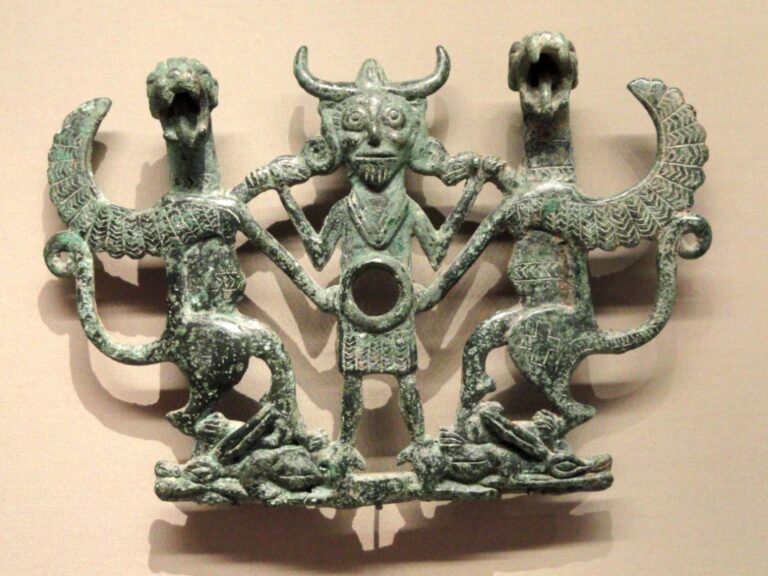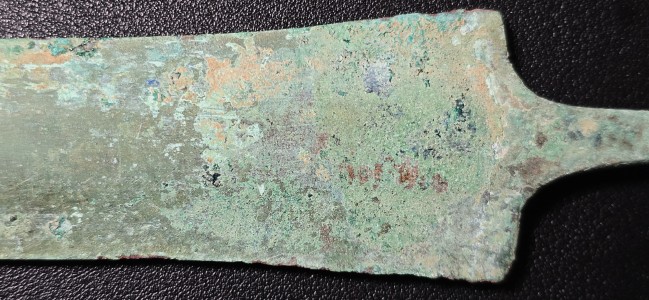
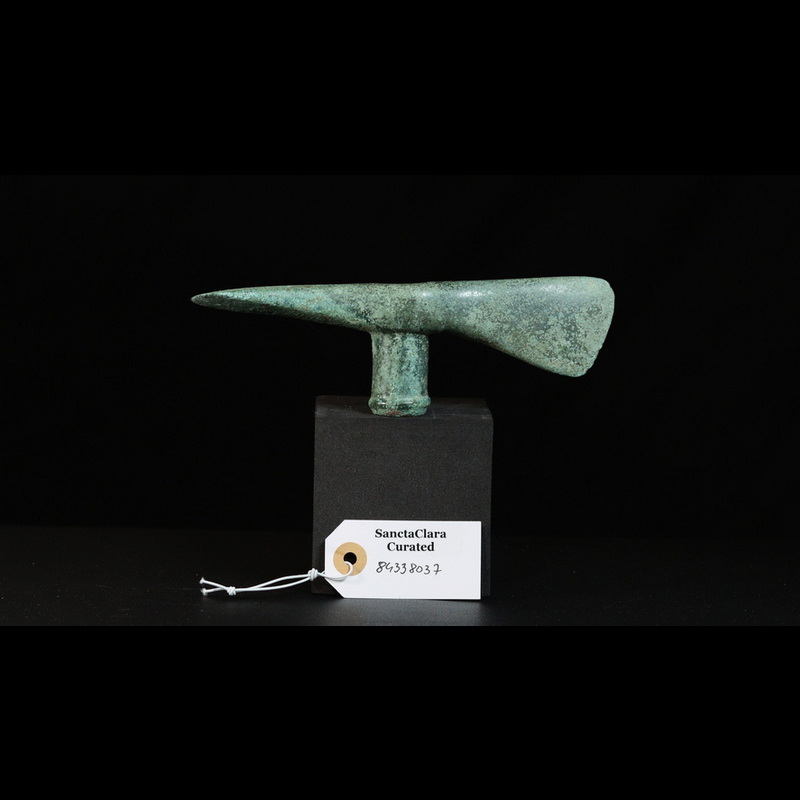

Unifying R. Maxwell-Hyslop, Western Asiatic Shaft-Hole Axes, Iraq 11 (1949), 90–129/130, pls. XXXIII–XXXIX, and J. Deshayes, Les outils de bronze, de l’Indus au Danube (IVe au IIe millénaire), BAH LXXI, 2 vols. (Paris, 1960).
0. Read this first: the status of what follows
Neither work is available in full text online. What is set out below is built from three things, and they are not of equal reliability:
- Verified — statements traceable to a specific citation of the original (page, plate, or type designation) found in published secondary literature or museum records. These are marked ✅ and carry their source anchor.
- Structural inference — how the two schemes are organised, reconstructed from consistent patterns across many independent citations. Marked ⚠️.
- Framework — the unified rows themselves, which are a working instrument built for our purposes, not a reproduction of either author’s table. Both authors’ cells are filled only where anchored.
Before publishing anything on the strength of this document, the specific type assignments must be checked against the originals. The unified table is a triage tool: it gets an object to the right page of the right book quickly. It does not replace the page.
1. What each work is, and how it thinks
1.1 Maxwell-Hyslop 1949
✅ A direct continuation of her Daggers and Swords in Western Asia (Iraq 8, 1946), funded by a Central Research Fund grant that let her handle material in the Louvre, the Musées Royaux (Brussels), the British Museum, the Ashmolean, the Museum of Archaeology and Ethnology (Cambridge), and the Institute of Archaeology, London.
✅ In her own words in the opening paragraph, the scheme is offered as an outline only, to be modified and developed once more stratified material became available. This is not false modesty — it is the correct way to use her: as a first-pass vocabulary, not as a fixed authority. Her 1946 dagger paper had classified 56 types on hafting method, blade shape and shoulder form; the axe paper applies the same instincts.
Organising logic. ⚠️ Two parallel notations appear in the citation record, which is best explained by the paper running in two sections:
- Numbered Types (1–12+) for the socketed/shaft-hole series proper, running east–west from Iran and Mesopotamia. ✅ She herself refers back to “the introduction to Types 11 and 12” for Iranian axes with heavy moulding round the shaft-hole edge (Iraq XI pt. 1, pl. XXXVIII:3), noting that Luristan examples carry only a swelling or boss behind the socket (Maxwell-Hyslop, “Note on Two Western Asiatic Bronze Axeheads,” Iraq 14 (1952), 118–119).
- Lettered types (B1–B4) for the Syro-Levantine series, hafted without a cast socket. ✅ B1 = crescentic axe (pp. 116–118); ✅ B3 and B4 = the broad fenestrated and “duckbill” fenestrated axes respectively (pp. 119–121, pl. 37:6–7).
Character. Weapon-oriented, narrative, regionally argued. Her types are named, recognisable gestalts — you match a silhouette. Fast, but blunt on undecorated or atypical pieces.
1.2 Deshayes 1960
✅ Two volumes covering the whole bronze toolkit from the Indus to the Danube, 4th–2nd millennium, with a continuously numbered catalogue (entries run past no. 2098) keyed to plates.
Organising logic. First by tool class, then within each class a three-tier alphanumeric code: CAPITAL + numeral + lowercase, in which ✅ the capital letter = Type, the numeral = Subtype, the lowercase letter = Variant.
- The capital letter (Type) encodes the position of the collet (collar) relative to the blade. ✅ A = collet non décalé — collar not offset. ✅ B = collet dépassant le bord supérieur de la lame — collar carried beyond the upper edge of the blade.
⚠️ Read décalé as “offset / shifted”, not “projecting”. The capital letter is not measuring how far the socket tube protrudes. Sleeve projection is described by a separate word — manchon (manchon tubulaire, manchon court, manchon brisé) — and is coded in the numeral or variant tier, not the capital.
On this reading: A is the symmetrical case, socket centred on the blade’s line, blade springing from mid-socket, and the tube free to project both above and below. B is the asymmetrical case, collar riding up past the blade’s upper edge.
Unresolved: a socket projecting only downward is not covered by either definition as recorded. It may fall under A (not offset upward), be handled in the numeral tier, or require a capital beyond A and B. Do not force such a piece into B — downward projection is not what B describes.
- The numeral (Subtype) and lowercase letter (Variant) subdivide on blade geometry and sleeve form.
✅ Worked examples, from Louvre records citing Deshayes directly — these are the anchor points for the whole A/B system:
| Code | Object | Description | Deshayes | Date |
|---|---|---|---|---|
| A1a | Susa, SB 10474 / SB 10479 | Irano-Mesopotamian axe; tubular sleeve; non-offset collar; blade with straight parallel sides | no. 1267 | — |
| A1a | Susa, Ilishmani blade (Louvre cl010120414) — inscribed in Akkadian, “Ilishmani, scribe and shakkanakku of Elam” | As above; blade only survives, carrying the inscription | — | Susa IVB, 2340–2100 BC |
| B3c | Susa, Atta-Hushu axe (Louvre cl010120454) — Akkadian dedication, syllabic cuneiform | hache à collet with collar projecting above the blade’s upper edge | pl. XX:8, no. 1407 | Susa V, Shimashki / Sukkalmah era |
| B2a (herminette) | Susa, “Vase à la cachette” adze | Short sleeve; blunted edge | no. 1851 | Susa IVA, c. 2450 BC |
The two inscribed pieces are the most valuable entries here: they tie a Deshayes code to a named individual and a dated horizon, which is exactly what a bare type code normally cannot give you.
✅ Tool classes present in the work (from the volume’s own index): haches plates, haches à rebords, haches à collet, haches à moignons, haches à douille, haches-marteaux, haches-herminettes, herminettes, houes, ciseaux, bédanes, gouges, marteaux, couteaux, faucilles, doubles haches.
Character. Attribute-based, hierarchical, and much finer than Maxwell-Hyslop. The real working currency is the catalogue number, not the type code — museums cite “Deshayes no. 1267” far more often than “type A1a.”
1.3 The practical difference
| Maxwell-Hyslop 1949 | Deshayes 1960 | |
|---|---|---|
| Scope | Shaft-hole axes, Western Asia | All bronze tools, Indus→Danube |
| Basis | Museum corpora + excavation reports | Same, far larger |
| Primary cut | Region + recognisable form | Tool function, then collar/hafting geometry |
| Notation | Types 1–12+ ; B1–B4 | A/B + numeral + letter; catalogue nos. |
| Strength | Fast identification, chronological argument | Precision on plain and atypical pieces |
| Weakness | Coarse; explicitly provisional | Language barrier; code opaque without the plates |
Neither is current. Both have been substantially refined. For anything going into writing, the modern instruments are: Erkanal 1977 and 1997 (Anatolia, PBF 9.8); Miron 1992 (Axes and Adzes from Canaan, PBF 9.19); Philip 1989 (Metal Weapons of the Early and Middle Bronze Ages in Syria-Palestine, BAR IS 526); Gernez 2007 (H-series typology); Tubb 1982 (crescentic axes, Iraq 44, 1–12); Curtis 1983 (Chagar Bazar and Nimrud axe-heads, Iraq 45, 73–81); Moorey 1971 (Ashmolean Persian bronzes); Haerinck & Overlaet, Bani Surmah and the Pusht-i Kuh series.
1a. Glossary
English throughout. Where a French term is the only precise one available, it is given in brackets for tracing citations, but is not used in the body of this guide.
| Term | Definition | Notes and traps |
|---|---|---|
| Shaft-hole | The transverse perforation through the body that receives the haft [trou d’emmanchement] | Prefer this to “socket.” A socketed axe is a different hafting system — a tube at the butt into which the haft’s end is inserted, haft running parallel to the blade (row U15) |
| Sleeve | The tubular part of the casting carrying the shaft-hole, including any length projecting above or below the blade [manchon] | Qualified by length and condition: long, short, broken. Sleeve projection is an independent variable from collar offset |
| Collar | The mounting element as a whole — the thickened junction where haft meets blade [collet] | ⚠️ Unverified reading. Deshayes’ class name is hache à collet, so it cannot mean merely an applied ring, or plain examples would fall outside the class. Its position relative to the blade edges is the A/B criterion. Do not use “collar” for the rings described below |
| Rim lip | The raised, rounded, encircling bead at the mouth of the sleeve, at one or both ends [bourrelet] | Often flared; the two ends may differ in angle or profile, which is itself diagnostic. Count them — one or two |
| Sleeve ring | A raised encircling moulding around the sleeve, set back from the mouth, not at the rim [moulure circulaire] | Runs transversely, around the sleeve. Deliberately avoids “rib,” which in this literature runs longitudinally along the blade (midrib, edge ribs, relief ribs) |
| Rim lip vs. sleeve ring | Position, not size, separates them | Rim lip = terminal, at the mouth. Sleeve ring = set back along the sleeve. On a downward-projecting sleeve, sleeve rings sit between the blade root and the lower rim lip |
| Butt / talon | The mass behind the shaft-hole | A distinct classificatory feature. Carries the boss in M-H Types 11–12 and the spikes in U11 |
| Boss | A rounded swelling on the butt, without a hook | Distinguishes U9 from U10 |
| Hook | A definite rearward projection behind the socket, for binding | U10 only |
| Neck | The narrowed zone between collar and blade expansion | Length and minimum width are recordable and diagnostic |
| Side loop | A cast lateral loop for suspension or securing [anneau] | ⚠️ False friend. Anneau means this loop, not a ring moulding. A sleeve ring is not an anneau |
A caution on “reinforcement”
Avoid calling sleeve rings “reinforcement rings.” Function is contested and the name should not decide it: the Atlantic socketed-axe literature treats mouldings set below the mouth bead as decorative, discussing them alongside horizontal bars and chevrons, whereas Maxwell-Hyslop reads socket mouldings on Iranian axes as structural. Both may hold for different corpora. “Sleeve ring” is neutral; “reinforcement ring” is not.
2. The unified classification table
Rows are ordered by hafting principle first, because that is the one attribute that survives breakage, corrosion and cleaning. Codes prefixed U- are ours.
| Code | Form | Hafting / socket | Blade | Maxwell-Hyslop | Deshayes | Region & date | Conf. |
|---|---|---|---|---|---|---|---|
| U1 | Flat axe | None cast; lashed/split haft | Plain wedge, expanded edge | — (out of scope) | haches plates | Pan-regional, Chalco.–EBA | ⚠️ |
| U2 | Flanged axe | Raised side flanges grip haft | Wedge, flanged sides | — | haches à rebords | Anatolia, Aegean, Danubian; EBA–MBA | ⚠️ |
| U3 | Trunnion axe | Lateral lugs/stops | Elongate, parallel-sided | — | haches à moignons | Syria–Anatolia, later 3rd–2nd mill. | ⚠️ |
| U4 | Crescentic (lunate) axe | Tangs cut from crescent horns at a steeper angle, no socket | Lunate, splayed edge | B1 ✅ (pp. 116–118) = Philip type 1 ✅ | — | Levant / N. Mesopotamia, EB II–III. Grouped with epsilon axes; Sargonic Maništušu axehead attributed to Susiana | ✅ |
| U5 | Broad fenestrated (“eye”) axe | Tang + perforations, lashed | Broad, two openings | B3 ✅ (pp. 119–121, pl. 37:6) = Philip type 2 ⚠️ | — | Levant, later 3rd–2nd mill. Soapstone moulds, Ebla Tomb D.3721, 1800–1600 BC ✅ | ✅ |
| U6 | Duckbill fenestrated axe | As U5, slender | Long slender, carination between perforations to edge | B4 ✅ (pp. 119–121, pl. 37:7) | — | Syria & Lebanon, c. 1900–1700 BC | ✅ |
| U7 | Shaft-hole axe, collar not offset | Transverse bore; collar centred on blade line. Sleeve may project above and below | Often straight, parallel-sided | Numbered-type series ⚠️ | A-series ✅ — A1a = tubular sleeve, parallel-sided blade (no. 1267; Ilishmani blade) | Iran / Mesopotamia. Dated anchor: Susa IVB, 2340–2100 BC ✅ | ✅ |
| U7b | Shaft-hole axe, sleeve projecting below only | Tube extends past the lower edge; collar not carried above | Varies | — | Unresolved ⚠️ — probably within A, but not verified | Common form; needs checking against the originals | ⚠️ |
| U8 | Shaft-hole axe, collar offset upward | Collar carried beyond blade’s upper edge | Varies; B3c subgroup has a curved, asymmetrical blade | Numbered-type series ⚠️ | B-series ✅ — B3c, pl. XX:8, no. 1407 (Atta-Hushu axe) | Susa, early 2nd mill., Shimashki/Sukkalmah ✅. Corpus near-exclusive to Susa | ✅ |
| U9 | Shaft-hole axe, heavy rim lips + butt boss | Heavy rim lips round the shaft-hole; boss (no hook) behind the sleeve | Narrow neck, broad convex edge; blade ribs may strengthen the upper edge | Types 11 & 12 ✅ (pl. XXXVIII:3) | cf. p. 158, pl. XVIII ✅ | Luristan / W. Iran, mid–late 3rd mill. | ✅ |
| U10 | Shaft-hole axe, hooked socket | Moulded rim plus a definite rearward hook for binding | As U9 | Discussed p. 103 ✅; Iraq 14 (1952) 118–119 | — | Chagar Bazar; BM 26948; IM 11494 (Rīm-Sîn inscr.) | ✅ |
| U11 | Spiked-butt axe | Socket with 3–4 conical spikes projecting rearward, joined by strut | Downturned, near-flat edge; relief ribs, arrow motif common | cited in this connection ⚠️ | pp. 181–82, pl. XXI, nos. 4–6, 9 ✅ | Luristan (Bard-i Bal, Kutal-i Gulgul); avg. c. 20 cm | ✅ |
| U12 | Axe-adze | Single shaft-hole, two opposed working ends at 90° | Axe blade splayed; adze end narrow, parallel-sided, straight edge | — | haches-herminettes ✅ | Iran / Mesopotamia / Aegean | ✅ |
| U13 | Adze | Collar/sleeve; edge perpendicular to haft | Narrow, parallel-sided | — | herminettes; B2a = short sleeve ✅ (no. 1851, Susa IVA c. 2450) | Susa, Mesopotamia, Iran | ✅ |
| U14 | Axe-pick / hammer-axe | Shaft-hole; blade one side, pick or hammer poll the other | Blade + tapering pick | pp. 97f, 104f; pl. XXXV:15, pl. XXXVIII:5, 10 ✅ | haches-marteaux, pp. 264–65, pl. XXXVI:5, LX:10 (no. 2098) ✅ | E. Iran / Makran (Khurab), Susa | ✅ |
| U15 | Socketed axe (shaft parallel to blade axis) | Cast tubular socket at butt, haft parallel | Splayed edge | — | haches à douille | Aegean, Danubian, Caucasian | ⚠️ |
| U16 | Double axe | Central shaft-hole, two opposed blades | Symmetrical | — | doubles haches | Aegean, Anatolia, Levant | ⚠️ |
Reading the table
- U4–U6 are the Syro-Levantine, non-socketed series — Maxwell-Hyslop’s territory, and where her lettered types are the standard shorthand still cited today.
- U7–U11 are the socketed series — Deshayes’ A/B collar distinction is the more precise instrument here, with Maxwell-Hyslop’s numbered types supplying the regional labels.
- U12–U14 are the compound/tool forms, where Deshayes is effectively the only game in town among these two.
2a. Cultural and chronological anchors
Type codes float free unless pinned to dated contexts. These are the fixed points worth memorising — all verified.
| Anchor | Class | Date | Why it matters |
|---|---|---|---|
| Vase à la cachette adze, Susa (Acropole, de Morgan 1907) | herminette B2a | Susa IVA, c. 2450 BC | Earliest firm date in the A/B collar system; short-sleeve adze |
| Ilishmani blade, Susa — “scribe and shakkanakku of Elam” | Axe A1a | Susa IVB, 2340–2100 BC | Dates the flush-collar, parallel-sided class |
| Maništušu axehead, Susiana | Epsilon / crescentic (U4) | Sargonic, 23rd c. BC | Dedicated by a charioteer; ties crescentic forms to Akkadian military elite |
| Atta-Hushu axe, Susa | Axe B3c | Shimashki / Sukkalmah, early 2nd mill. | Dates the projecting-collar class; corpus near-exclusive to Susa |
| Ebla Tomb D.3721 soapstone moulds | Fenestrated (U5) | 1800–1600 BC | Direct evidence of production method for fenestrated axes |
| Rīm-Sîn axe, IM 11494 (said to be Khafajah) | Hooked socket (U10) | Larsa period | Inscribed; paired with BM 26948 |
| Chagar Bazar axe (Mallowan) | Hooked socket (U10) | — | Engraved scroll round socket and hook |
The “Atta-hushu axe” caution
The label is contested. Wicks & Dadfar, “An axe to grind? Another look at the so-called ‘Atta-hushu’ axes” (2020), examine the corpus — collared axes with a curved, asymmetrical blade, found almost exclusively in early 2nd-millennium burials at Susa — and question whether the personal attribution is legitimate. They also note the axes were made in both functional and non-functional forms, which matters for any use-wear argument: absence of use damage on this class is not by itself evidence of modern manufacture.
Elamite / Susa sequence, for reference
Susa IVA (c. 2450) → Susa IVB (2340–2100, Akkadian/Sargonic contact) → Susa V (Shimashki and Sukkalmah dynasties, “neo-Sumerian” horizon in Louvre labelling, early 2nd millennium). Louvre gallery labels use these phase names, so they are the fastest route into their catalogue.
3. Decision key
Work down. Stop at the first match.
1. Transverse perforation through the body for the haft?
- No → go to 2
- Yes → go to 5
2. Cast tubular socket at the butt, haft parallel to blade axis? → U15 (hache à douille)
3. Perforations/fenestrations through the blade, with tangs?
- Broad blade, two openings → U5 (M-H B3)
- Slender blade, carination running between the openings to the cutting edge → U6 (M-H B4, “duckbill”)
4. Lunate blade, horns cut back to form tangs → U4 (M-H B1, crescentic). Otherwise: flanges → U2; lateral lugs → U3; plain wedge → U1.
5. Two working ends?
- Blade + pick/hammer poll → U14
- Blade + adze at 90° → U12
- Two opposed symmetrical blades → U16
- One working end → go to 6
6. Edge perpendicular to the haft (adze geometry) → U13. Edge parallel to the haft (axe geometry) → go to 7.
7. Conical spikes projecting from the butt → U11. Otherwise → go to 8.
8. Socket rim heavily moulded?
- Yes, with a definite rearward hook → U10
- Yes, with a swelling or boss only → U9
- No moulding → go to 9
9. Is the collar carried above the blade’s upper edge?
- Yes → U8 (Deshayes B-series)
- No, collar centred on the blade line → U7 (Deshayes A-series)
- Sleeve projects below only → U7b — record it and flag it; the assignment is not resolvable from what is verified here
Do not use overall protrusion as the test. A socket tube can project a long way above and below and still be A, provided the collar is not offset upward. Measure the collar’s position relative to the two blade edges separately; a single “does the socket stick out?” observation will not decide it.
The critical test at step 6. Rotate the object 90°. If the blade collapses to a narrow wedge in the rotated view, the bore axis lies in the plane of the first view and the edge runs parallel to the haft — axe. If the blade stays broad in the rotated view, it is an adze. This single check resolves most “axe or adze?” ambiguity and should be done before anything else in steps 5–6.
4. Recording protocol
Both schemes discriminate on measurements that are routinely omitted from dealer listings. Record all of these before attempting an assignment:
Mandatory
- Overall length, and length of the surviving fragment if broken
- Blade edge width (chord, and arc if curved)
- Socket bore diameter — top and bottom separately (conical bores are diagnostic)
- Socket wall thickness at the thinnest point
- Collar position, measured against each blade edge separately: how many mm does the socket extend above the upper edge? How many below the lower edge? (The upper figure is what sets Deshayes A vs. B. Record the lower figure too — it is a different variable and one this guide cannot yet resolve.)
- Weight
- Blade section (lentoid / rhomboid / plano-convex) at midpoint and at the neck
Strongly advised 8. Neck length and minimum neck width 9. Whether the edge is bevelled symmetrically or asymmetrically — asymmetry indicates adze use even where the geometry says axe 10. Rim lips: count (one or two), position (upper, lower, or both), profile, and whether the two differ in flare or angle 10a. Sleeve rings: count, and the distance of each from the nearest rim lip. Note whether any continue onto the blade — if so it is a blade rib, not a sleeve ring 10b. Blade ribs (longitudinal): count, position, and whether they run onto the blade from the sleeve or spikes 11. Bore section: circular / oval / conical, and any cast-in internal features 12. Casting seams and their position
Views to photograph Face; reverse; both 90° rotations; straight down the bore; straight onto the cutting edge; any break surface at raking light.
5. Applying this to the Catawiki axe (13.7 cm, broken at socket)
Running it through the key: perforation present (5) → one working end (6) → rotation test collapses the blade to a wedge, so edge parallel to haft, axe geometry (7) → no butt spikes (8) → no heavy rim lips, no hook, only a slight cast rim lip (9) → collar not carried above the blade’s upper edge.
→ U7 / Deshayes A-series. Within Maxwell-Hyslop, it sits in the Iranian numbered-type range but lacks the mouldings and butt boss that define her Types 11–12, so it should not be labelled Luristan on typological grounds alone.
What the new anchor adds. The A-series now has a dated context: the Ilishmani blade, catalogued A1a, is Susa IVB, 2340–2100 BC. If the Catawiki axe does prove to be A1a — flush collar, tubular sleeve, parallel-sided blade — the later 3rd millennium is the horizon to argue from, not the Iron Age. Two cautions before leaning on that:
- Its blade is not straight-sided and parallel; it waists and then splays to a shallow crescentic edge with a drooping heel. That may push it out of
A1into another subtype whose definition I do not have. - One dated example dates that example, not the whole subtype. A1a plainly persisted; the bracket is a starting point, not a terminus.
It is also worth noting what the axe is not: the collar does not project above the blade’s upper edge, which excludes the entire B-series and with it the Atta-Hushu group, despite a superficial similarity in overall silhouette.
Outstanding measurements needed to go further: bore diameter (top and bottom), wall thickness at the break, edge chord, weight, and neck minimum width. Those five figures are what separate the A-series subtypes in Deshayes.
6. Known gaps in this document
- The full run of Maxwell-Hyslop’s numbered Types 1–10 is not reconstructed here. Only Types 11 and 12 are anchored. This is the largest gap.
- Maxwell-Hyslop’s B2 is unlocated. B1, B3 and B4 are anchored; B2 presumably sits between the crescentic and fenestrated forms, but this is unverified.
- The relationship between her numbered and lettered notations is inferred, not confirmed. It is possible the paper uses a single continuous scheme that secondary authors have cited inconsistently.
- A socket projecting only below the blade’s lower edge is unaccounted for. A is defined negatively (non décalé), B positively and only with reference to the upper edge. Downward-only projection falls between them. It may sit within A, be handled in the numeral tier, or need a capital beyond A and B — I have found no evidence that Deshayes’ capitals stop at B. This is a live question, not a settled one.
- ~~Deshayes’ numeral and lowercase tiers are inferred.~~ Closed: the hierarchy is Type (capital) → Subtype (numeral) → Variant (lowercase). What the individual numerals and letters mean within each class is still unanchored beyond the four worked examples in §1.2.
- Plate concordance is partial. Where a plate is cited above it is verified; absence of a plate reference means none was found, not that none exists.
Filling the first two gaps requires the Iraq 11 offprint itself. It is on JSTOR (DOI 10.2307/4241690) and Cambridge Core; a library copy of the Deshayes volumes would close the rest.
7. Rejected claims log
Assertions encountered in secondary summaries and not carried into this guide. Logged so they are not quietly reintroduced later.
| Claim | Status | Reason |
|---|---|---|
| M-H Type 12 = narrow axes of the Levant and Anatolia | Rejected | Contradicts Maxwell-Hyslop’s own 1952 note, where the introduction to Types 11–12 covers Iranian axes with heavy socket-rim moulding, Luristan examples carrying a butt boss |
| Crescentic axes = “Type I, Type 11, Type B1” | Rejected | Three notations for one form in a single sentence. Only B1 is anchored |
| M-H Type 22 = central Anatolia and Syria, excavated near Erzurum | Rejected | Internally contradictory (Erzurum is eastern Anatolia); type number exceeds the range the paper appears to use |
| Spiked-butt axes with up to nine spikes | Rejected | Published examples of this class typically carry four |
| 4.3% arsenical copper in fenestrated axes from Fasuta and Gesher | Unverified — do not cite | Sites are real; the figure is untraceable |
| Ivory talisman from Ebla as evidence for fenestrated axes | Replaced | Use the soapstone moulds from Ebla Tomb D.3721 instead — securely published, and better evidence for the same argument |
| Deshayes axe-adze Types A, B, C, D | Unverified | A and B are anchored for haches à collet and herminettes; C and D are not attested in any record consulted |
| Deshayes A5c = M-H Type 9 | Unverified | Code format is plausible; the equivalence is uncheckable without both originals |
Copyright: AncientBronzes.com