

The Alloy and the Altar: how copper and tin interconnected trade network distributed the Neolithic and Bronze Age beliefs and now seemingly forgotten gods that still influence us from behind the veil of repressed memories.
There is one fact about bronze that I keep coming back to, and it is the reason this website exists.
You cannot make bronze at home.
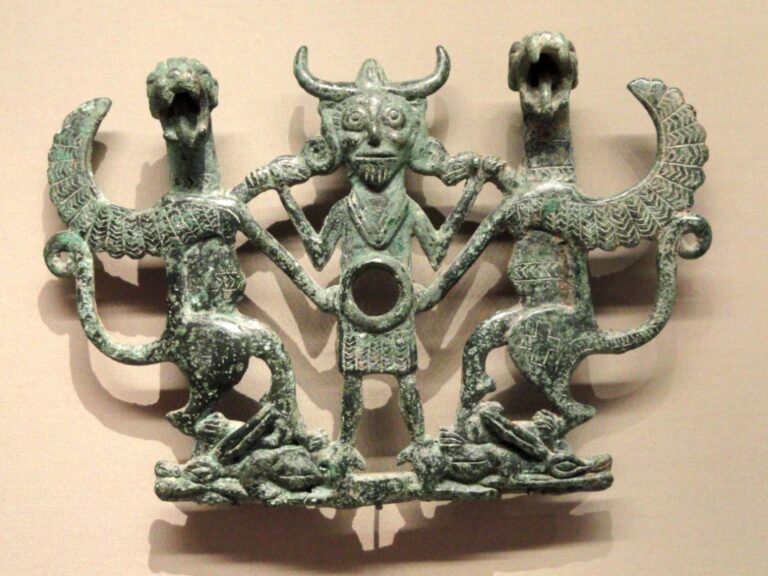
Copper you might find locally. Tin you almost certainly will not. The tin that hardened the copper of the eastern Mediterranean came from mountains thousands of kilometres away — Central Asia, Anatolia, eventually Cornwall. To hold a Bronze Age blade, mirror or votive figure is to hold the end product of a supply chain that crossed empires, deserts and seas, in an age with no maps as we understand them and no way to enforce a contract at distance.
So bronze was never only a metal. Bronze was an agreement. Routes had to be negotiated. Escorts had to be paid. Weights had to be standardised. Debts had to be recorded. And promises made between men who would never meet again had to be secured by something stronger than goodwill, which meant they were sworn before witnesses who were not human.
Here is the thing I want to put in front of you, and then spend the rest of this article earning.
The same centuries that assembled the first international system to move metal also assembled the religious architecture that most of the living human race still occupies. Not the metaphors – the architecture, the very structure. The council in heaven. The nations divided among patrons. The covenant with its clauses and its curses. The temple as a house with a resident who must be fed. The oath sworn on a standard that binds even the powers above you. The expectation, held now on every continent, that someone who left is coming back.
Every one of those was fully operational in the Bronze Age. Most of them were already old.
First, the settled ground: what the Bronze Age actually was
Let me lay out the uncontroversial frame before I argue anything, because the argument later in this piece is mine and I want the join to be visible.
In the ancient Near East, the Bronze Age runs roughly from 3300 BC to about 1200 BC. Within it, the Late Bronze Age — very roughly 1550 to 1200 BC — is the period historians sometimes call the first genuine international system. Great kingdoms sat around one table: Egypt, Hatti (the Hittite empire in Anatolia), Assyria, Babylonia, Mitanni, and the trading city-states of the Levantine coast.
We are not guessing about this. We have their mail.
The Amarna letters, a cache of clay tablets from the Egyptian capital of Akhenaten, preserve the correspondence of that system: kings addressing each other as brothers, haggling over gold, complaining about delayed gifts, arranging marriages, demanding troops. At Ugarit — a Syrian port city rediscovered in 1929 at Ras Shamra, and one of the most important archaeological finds ever made for the history of religion — excavators recovered an entire literature in a local alphabetic script, including the cycle of texts about the storm-god Baal and the aged high god El.
Then, around 1200 BC, that system came apart. Palace after palace burned across the eastern Mediterranean within a few decades. Hatti disappeared. Mycenaean Greece collapsed and lost its writing. Ugarit was destroyed and never reoccupied. Egypt survived, diminished, and never again ruled as it had.
That much is standard history. Now look at what the religious record of those same centuries actually contains.
The world that era built: a religion of offices, not of feelings
Read Bronze Age religious texts side by side and the first surprise is how little they resemble what a modern reader means by religion. There is very little about inner states. There is a great deal about procedure.
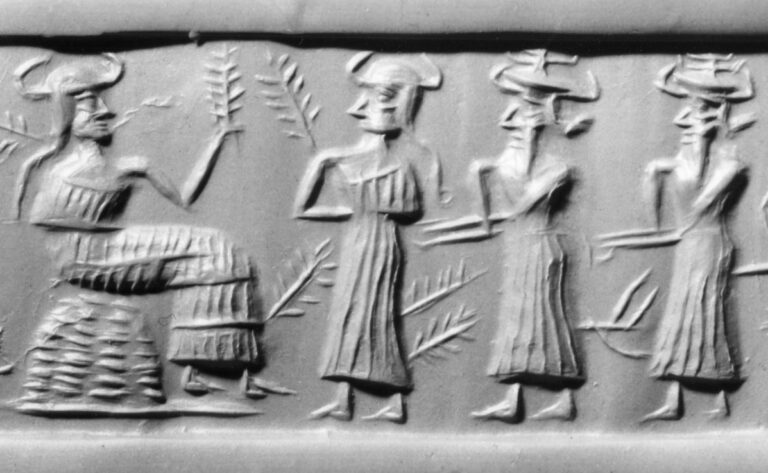
Mesopotamia gives us an assembly that deliberates. In the Enuma Elish, the Babylonian creation epic, authority is conferred on Marduk by a council that debates the terms first. In Atrahasis, the labour grade of the gods goes on strike — tools burned, the manager’s house surrounded — and the response is an administrative solution to a workforce problem. These are minutes, not hymns.
Ugarit gives us the household at the top. El is the aged presiding father, seated at the source of the waters, with a consort and a large family of sons. Baal is the active young executive who needs a house built and permission to build it. When scholars first read these tablets, the shock was how much of the vocabulary was already familiar from the Hebrew Bible: the divine assembly, the sons of El, the titles, the poetic formulas.
Egypt gives us the temple as a literal residence. The daily ritual was the care of a resident: the shrine opened at dawn, the image washed, clothed, anointed, fed, the shrine sealed at night. Not symbolism in its own terms — service.
Hatti gives us the legal form. Hittite scribes produced the classic vassal treaty, and its shape is fixed: who I am, what I have already done for you, what you must now do, who witnesses this, what blessings follow obedience and what curses follow breach.
India gives us, in the oldest layer of the Rigveda, a sky-father, a warrior storm-god, a chariot-borne aristocracy and a sacrificial economy of exact reciprocity.
Greece gives us, on the Linear B tablets of the Mycenaean palaces, the names of Zeus, Hera, Poseidon and Dionysus already on the ration lists — centuries before Homer, listed as recipients of deliveries.
And Israel’s oldest strata sit squarely inside this world. Deuteronomy 32:8–9, in the reading preserved at Qumran and reflected in the Septuagint, describes the Most High dividing the nations and assigning them according to the number of the sons of the powerful ones — with one portion falling to Yahweh. Psalm 82 opens with a session of that same assembly, in which the members are indicted for failure of justice and sentenced to die like men.
That is not a stray verse. That is a court transcript in a genre the Bronze Age used constantly.
Five Bronze Age structures still running today
Now the part that matters for anyone alive in 2026.
1. Plural heaven. Strict monotheism did not abolish the council; it reclassified it. Angels, archangels, saints, devas, jinn — every major tradition retains a populated middle tier of mighty creatures who are not the Creator. The furniture stayed. The label on it changed.
2. The allotment. The idea that peoples and lands are assigned — that a nation stands in a special relationship to a particular power — is Bronze Age administrative logic. It survives in chosenness, in national patron saints, in the whole emotional grammar of sacred homeland.
3. The covenant. Compare the Hittite vassal treaty to the structure of Deuteronomy: preamble, historical prologue, stipulations, witnesses, blessings and curses, deposit of the text in the sanctuary, periodic public reading. The correspondence has been a mainstay of biblical scholarship since the 1950s. What it means is that the central religious relationship of the West was drafted in the international legal boilerplate of the Late Bronze Age. When a believer today speaks of a covenant, they are using a term sheet.
4. The house and the offering. Consecrated space, a threshold, degrees of access, a served interior, smoke rising, a maintained calendar of appearances. Walk into a cathedral, a mandir, or a Shinto shrine and you are inside a structure whose logic was standardised before iron was common.
5. The standard above the ruler. This is the one I find most moving, and it is the subject of my earlier book. The Bronze Age produced not only kings but the idea of an oath binding kings — a law that the powers themselves are subject to. Greek tradition preserved the sharpest formulation of it in a single line of Pindar, quoted by both Herodotus and Plato: Law, king of all, of mortals and immortals alike. Read the second half slowly. The standard binds the immortals too.
Take that seriously and you are looking at the deepest root of constitutional thinking. Not “the ruler is good,” but “the ruler is bound.”
The hinge: what happened when the era ended
Here is where I move from settled ground onto my own reading, and I will say so at every step.
Something changes in the religious record after the Bronze Age, and it changes everywhere. Before: the powers are present. They are seen, heard, housed, quoted, quarrelled with, obeyed and disobeyed in the plain narrative past tense. After: they are absent, and the texts know it.
The prophets argue about a silence. The Egyptian priests, according to Herodotus, showed visitors a gallery of 341 statues and told them no god had appeared in human form for that entire span of generations. Greek tradition, in Hesiod, already taught that the ages ran downhill and that the last divine presences had covered their faces and gone. Across the world, comparative religion has a standard name for the high god who is honoured, remembered, and no longer invoked for anything operational: deus otiosus, the idle god.
And the whole religious project of our species then does something I think we have never properly stared at.
It changes its objective.
The living religions of the Bronze Age were service institutions. Feed the resident. Keep his protocols. Maintain his house. Ask what he wants. The religions that came out the other side are return institutions. Purity campaigns to make the house fit for his arrival. Penitential systems to remove the cause of his leaving. Prophetic schools to watch for the signs. Calendars with windows held open.
And then the named expectations, which now organise the faith of most living human beings: the Second Coming, the Mahdi, Maitreya, Kalki, the returning Pahana of the Hopi with his matching half of a broken tablet, the returning Quetzalcoatl whose date the Mexica kept.
One doctrine, in local dress, on every continent: they left; they promised; they will return; be ready.
That is not a mood. It is an institutional objective. Most of the human race belongs, whether it uses the word or not, to a reception committee.
Which raises the uncomfortable question
If a departure produces all of that — the doctrine, the self-blame, the ritual apparatus, the named returning figure, the vigil kept for centuries — then the obvious question is what kind of departure does it.
We happen to have a control case, and it was filmed.
Melanesia in the 1940s. Powerful strangers arrived in ships and aircraft, carrying cargo beyond local manufacture. They gave, they taught, they demanded, they built. Then the war ended and they left. Within one observed generation, anthropologists watched the full structure assemble itself: the doctrine of the departed benefactors, the self-examination, the ritual replication of the apparatus — swept airstrips, bamboo control towers, headphones carved from coconut shell — a named figure who would return, and a vigil kept on the horizon for decades.
Everything took thirty years. Under observation. The mechanism is real, it is fast, and it is not a primitive mechanism. It is a human one. Those islanders were simply the people who happened to be photographed operating it.
My book Abandoned Children of the Gods — Still Waiting for the Return is a long, careful argument that we have been running the same machinery for thousands of years, and that our oldest texts are not the mythology of the departure but the records of it.
Abandoned Children of the Gods — available on Amazon
The reading it works from — engaging most closely with the work of Mauro Biglino and Paul Wallis, within a wider tradition of named interpreters — takes the oldest layer of the texts at its word. Elohim is a plural: the powerful ones. The beings the record describes are many. They hold allotted territory like governors. They travel in equipment that must be approached with precautions. They age. They can be defeated. In Psalm 82 they are sentenced to die like men.
I should say plainly what that does and does not touch, because I hold this line hard throughout the book. Beings that are plural, physical, territorial and mortal fail every classical criterion of divinity — and the more orthodox your theology, the more firmly your own tradition obliges you to agree. Maimonides would sign that sentence. Nothing in my work is about God. It is about a category every religion already possesses: mighty creatures who are not the Creator. The study of angels never threatened the study of God, and neither does this.
What the book traces instead is a gradient. Capability runs backward through the corpora: most advanced in the earliest material, crudest in the latest. Full-spectrum warfare in the oldest epic layer. Infrastructure and biotechnology in the reconstruction texts. And at the end, in the Iron Age Levant, a single aging vehicle maintained by a human ground crew, a communications channel that degrades from direct speech to dreams to nothing, and a last recorded live event on Mount Carmel around 850 BC.
Then a priest named Ezekiel logs a detailed sighting by a canal in Babylonia. Then a Roman general forces an empty room in Jerusalem in 70 AD and finds nothing inside. Then the file closes.
The Bronze Age, on this reading, is not the age of the gods. It is the garrison age — the long, declining occupation at the end, when the machines were old, no new ones were built, and the province was quietly going dark.
Why any of this still decides things
Because the Waiting is not a historical topic. It is the operating system.
- The shape of hope. Vast populations organise their moral lives around an arrival. That expectation sets electoral behaviour, foreign policy sympathies, attitudes toward ecological catastrophe, and the willingness to accept present suffering as a phase before a rescue.
- The politics of blame. When the expected does not arrive, the machinery asks a question that has been asked for three thousand years: what did we do wrong? That question has produced penitential religion, purity campaigns, and in some provinces, atrocities. Same question, different answers.
- Sacred territory. Allotment language remains flammable. I will be blunt about my own scope here, as I am in the book: a record of who administered a district three thousand years ago establishes nothing whatever about who should administer it today. My file closes in 70 AD and does not reopen. Anyone citing my work in a contemporary territorial argument, in any direction, is using it for something it was never built to carry.
- Law above the ruler. The Bronze Age idea that even the highest power is subject to the standard is, in my view, the single most valuable thing the era gave us. It is also the one currently under the most strain.
- The secular versions. Drop the religious vocabulary and the structure persists: the technological rescue, the arriving intelligence that will solve what we cannot, the golden age that will be restored. The porch light is still on. We have only changed who we say we left it on for.
Deeper, and further back: The Sky Father
Abandoned Children of the Gods starts in the ruins of a settlement. My previous book goes underneath it, and considerably further back.
The Sky Father reconstructs a single office across five language families with no relationship to each other: Indo-European Dyēus Ph₂tēr, the sky-father who becomes Zeus and Jupiter; Sumerian An, whose name is the sky and whose sign is the mark of divinity itself; Egyptian Ra-Horus, legitimator of every pharaoh; Canaanite El, the aged father with seventy sons; and Turkic Tengri, whose mandate makes the khan.
No name connects these figures, and I refuse to pretend one does. What connects them is the job, and the job description is identical in all five: senior of a plurality, source of legitimate rule, witness of the sworn word. Together with the standard that bound the holder — Pindar’s line about the law that rules mortals and immortals alike.
If this article’s argument interests you, that book is where the foundations are.
The Sky Father — available on Amazon
How to read claims like these
One last thing, because I would rather lose a reader than mislead one.
Everything above falls into three kinds, and I keep them separate in both books:
Settled ground. The Amarna correspondence, the Ugaritic tablets, the Hittite treaty form, the Qumran reading of Deuteronomy 32:8, the Theban statue count reported by Herodotus, the Late Bronze Age collapse, the Melanesian cargo movements. Texts and artefacts, accepted by mainstream scholarship. Anyone can check them.
Prior interpreters. The Elohim read as a plural class of physical beings; the interlinear method; the comparative civiliser pattern. These are documented arguments by named authors — principally Mauro Biglino and Paul Wallis — and I attribute them where they do work.
My own steps. The two-collapse architecture, the devolution gradient, the garrison age, the conversion of service religions into return institutions. That synthesis is mine, and I mark it as mine. Some of those steps will not hold. I say so each time my footing gives way, which turns out to be one of the more interesting parts of the job.
Hold the object
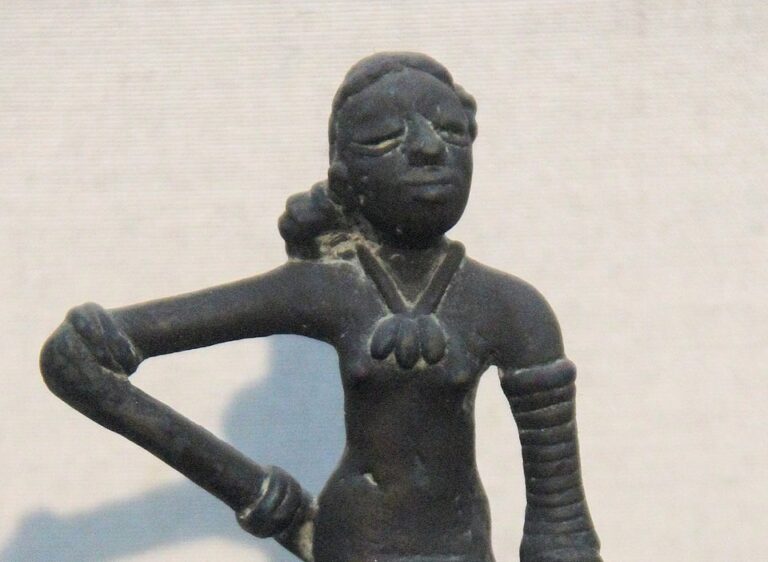
If you have ever held a Bronze Age votive figure, you know the strange weight of it — heavier than it looks, cool for longer than you expect.
Remember what it was. Not decoration. Not folk art. A working part of a service institution, cast by people who believed they were maintaining a relationship with someone who was actually there, who could be pleased and displeased, and whose absence would be catastrophic.
They were right about the absence.
That figure is a component from the last centuries before the lights went out. And the institution it belonged to did not end. It changed its objective, and it is still running, and most of the people reading this sentence are inside it.
Andrzej M. Izyk is an international manager and business negotiator with a legal background, writing on ancient contact traditions, treaty structures and the history of belief.
Read the argument in full: