
Bronze Age Cultures of the Ancient World: BMAC, Andronovo, Luristan, Shang China and the Forgotten Civilisations of Metal
From the copper mines of the Balkans to the ritual vessels of Shang China, bronze metallurgy arose independently — and sometimes interdependently — across an astonishing range of civilizations. This article surveys the full scope of that transformation, well beyond the familiar centers of Mesopotamia and Egypt, into regions rarely given their due in popular accounts of the ancient world.
Bronze Metallurgy as Cultural Engine
From the copper mines of the Balkans to the ritual vessels of Shang China, bronze metallurgy arose independently — and sometimes interdependently — across an astonishing range of civilisations. This article surveys the full scope of that transformation, well beyond the familiar centres of Mesopotamia and Egypt, into regions rarely given their due in popular accounts of the ancient world: the Oxus civilisation of Central Asia, the chariot-builders of Sintashta, the tin miners of the Zeravshan valley, and the enigmatic Yaz culture that buried no dead.
When we speak of “the Bronze Age,” the phrase itself is a convenient fiction — a single label stretched across a tapestry of cultures separated by thousands of kilometres and, in some cases, thousands of years. The term descends from Christian Jürgensen Thomsen’s three-age system, devised in the 1820s to organise the collections of the Danish National Museum, and it has never sat entirely comfortably on the archaeological record. The alloy we call bronze (typically copper with 8–12% tin, though arsenic, lead, antimony and other metals were also used, deliberately or otherwise) was not discovered once and then transmitted outward from a single origin. It was independently developed, redeveloped, borrowed, adapted, and perfected by societies as different from one another as the Shang court at Anyang and the copper-working communities along the shores of Lake Superior. In some regions the “Bronze Age” lasted two thousand years; in others it was compressed into a few centuries, or skipped entirely in favour of a direct leap to iron.
Having spent years handling hundreds of ancient copper alloy artifacts — from the massive 480 mm split-socket pike in the Sancta Clara Collection (Lot 32737, a Transcaucasian or Levantine type from the Middle Bronze Age) to diminutive Scythian trilobate arrowheads weighing barely a few grams — I can say that no single typological framework captures the ingenuity of these cultures. Each region left its signature in the metal: in the way a socket was formed, a midrib raised, a blade hardened by hammering, or a surface decorated. A spearhead is never merely a spearhead. It is a frozen decision tree — ore source, alloy recipe, mould technology, hafting philosophy, tactical doctrine — and learning to read those decisions is the central pleasure of this field. What follows is an attempt to trace those signatures across the globe, with particular attention to the Central Asian cultures — the BMAC, Sintashta, Andronovo, Seima-Turbino, and Yaz — that recent scholarship has moved from the footnotes to the centre of the story.
The Usual Suspects: A Brief Reorientation
Before venturing into less-discussed territory, it is worth sketching the five cultures that dominate most introductory accounts, if only to establish a baseline against which the others can be measured.
Mesopotamia (c. 3300–1200 BC) gave us the earliest large-scale bronze production in the Near East. Sumerian and later Akkadian metalworkers were casting sophisticated weapons, tools, and votive figures by the mid-third millennium BC. The famous “Standard of Ur” era graves at the Royal Cemetery (c. 2600 BC) contained electrum daggers, copper-alloy helmets, and socketed axes of remarkable refinement. Tin was imported over vast distances — from Afghanistan, from the Zeravshan valley, possibly from the Taurus Mountains and even, at the system’s furthest reach, from Cornwall — feeding an alloy economy that underwrote urban civilisation. Cuneiform archives from Kültepe (ancient Kanesh) in Anatolia document Assyrian merchants moving annaku (tin) by donkey caravan in quantities of tonnes per year during the nineteenth century BC, with prices, interest rates, and smuggling routes all recorded in clay. No other Bronze Age culture left us its commercial paperwork. The Sancta Clara Collection’s Elamite copper arrowheads (such as Lot 117, a massive 142 mm bilobate point dating to 3000–1600 BC) belong to this broader Mesopotamian metallurgical sphere, though Elam itself maintained a fiercely independent tradition, to which I return below.
Egypt developed bronze metallurgy somewhat later than Mesopotamia — arsenical copper dominated through the Old and Middle Kingdoms, with tin-bronze becoming standard only in the Second Intermediate Period and New Kingdom — but applied it with extraordinary refinement. Egyptian arrowhead design is well represented in the Collection: the inscribed arrowheads of Lots 763 and 769, for instance, bear marks that may tie them to specific military units or temple arsenals of the New Kingdom. The bilobate leaf-shaped arrowhead with knob (Lot 11491, 18th Dynasty, 1550–1292 BC) exemplifies the Egyptian preference for elegant, aerodynamic forms optimised for chariot warfare — itself a technology imported from the Asiatic Hyksos, who had imported it, ultimately, from the steppe cultures discussed at length below. The threads of this story cross and recross.
The Aegean World — Minoan Crete and Mycenaean Greece — represents the European Bronze Age at its most dramatic. Mycenaean swordsmiths produced blades of startling quality: the Sancta Clara Collection’s Mycenaean short sword (Lot 778, 1700–1200 BC, 390 mm) is a case study in functional design, with its flanged tang and carefully balanced blade. The Type A rapiers from the Shaft Graves of Mycenae, some approaching a metre in length, pushed thrusting-blade technology to its physical limits — and their structural weaknesses (tang failure above all) drove the iterative redesigns that culminated in the Naue II cut-and-thrust sword, arguably the most successful weapon design of the ancient world. These cultures imported tin from the west and east alike and copper above all from Cyprus, establishing maritime networks that linked the eastern Mediterranean from end to end.
The Indus Valley Civilisation (c. 3300–1300 BC) at Harappa and Mohenjo-daro produced a distinctive suite of copper and bronze objects — flat axes, chisels, knives, fish-hooks, and the famous “dancing girl” figurine, a lost-wax casting of c. 2300–1750 BC that remains one of the most technically assured bronzes of the third millennium. Yet weapons are notably rare in the Harappan archaeological record, a fact that continues to puzzle scholars: a civilisation of perhaps a million people, with standardised weights, planned cities, and long-distance trade, apparently felt little need for swords. The Harappans also maintained a trading outpost at Shortugai on the Amu Darya in northern Afghanistan — nearly a thousand kilometres from the Indus heartland — positioned to control the lapis lazuli of Badakhshan and, very plausibly, the tin of the western Hindu Kush. Shortugai is a thread that will lead us directly into the BMAC.
China’s Shang Dynasty (c. 1600–1046 BC) achieved what many regard as the apex of ancient bronze casting. But the Shang did not emerge from a vacuum, and the story of Chinese metallurgy begins much earlier — and, perhaps, much further west. We will return to China in detail below.
These five are important, but they are the overture, not the opera. Let us turn now to the cultures that seldom appear in popular surveys, beginning at the very root of the technology.
Before Bronze: The Deep Chalcolithic
Anatolia and the First Metal
The human relationship with copper is far older than smelting. At Çayönü Tepesi in south-eastern Anatolia, beads and small tools of hammered native copper date to the ninth millennium BC — fully four thousand years before anyone extracted metal from ore. Native copper, found as metallic nuggets in the oxidation zones of ore bodies, could be treated as a strange, malleable stone: hammered, cut, ground, and annealed. Çatalhöyük, Aşıklı Höyük, and other Anatolian Neolithic sites continue this tradition through the eighth and seventh millennia.
The conceptual leap — understanding that certain green and blue stones (malachite, azurite) could be transformed by fire into metal — is the true beginning of metallurgy, and for decades scholars assumed it happened first in the Near East and diffused outward. The evidence now suggests a more interesting picture.
The Balkans: Vinča, Belovode, and the World’s Oldest Smelting
Long before the conventional Bronze Age begins, south-eastern Europe was already transforming the human relationship with metal. The Vinča culture (c. 5400–4500 BC), centred in modern Serbia and extending across much of the central Balkans, is now the holder of the earliest secure evidence for copper smelting anywhere in the world. Excavations at Belovode, a Vinča settlement in eastern Serbia, recovered copper slag, droplets, and minerals in stratified contexts dated to c. 5000 BC — and crucially, the chemical and microstructural analyses published by Miljana Radivojević and colleagues in 2010 demonstrated that this was true smelting of ore, not merely the melting of native copper. The neighbouring site of Pločnik has yielded heavy copper hammer-axes and chisels from the same horizon.
This was not an isolated experiment. The copper mine at Rudna Glava in Serbia, with its vertical shafts following malachite veins into the hillside, and the even larger mining complex at Ai Bunar in Bulgaria, attest to organised extraction on a scale that implies specialist labour, seasonal scheduling, and distribution networks. Tens of thousands of Chalcolithic copper objects are known from the Balkans — more, by weight, than from contemporary Mesopotamia.
The nearby Varna culture (c. 4600–4200 BC) on the Black Sea coast of modern Bulgaria is best known for the spectacular gold of the Varna Necropolis, discovered in 1972 — Grave 43 alone, the so-called “chieftain’s grave,” contained more worked gold than has been recovered from the entire rest of the world for that period. But the copper objects from Varna are equally significant for the history of metallurgy. The Varna smiths were working with high-purity smelted copper, casting heavy shaft-hole axes and adze-axes in open and bivalve moulds — forms that anticipate types which would not become widespread in the Near East for another millennium. The social message is as important as the technology: Varna’s graves document, for the first time in human history, extreme inequality materialised in metal. Some individuals were buried with kilograms of gold and copper; most with nothing. Metal had become not just a material but a language of power, and it would never stop being one.
These “Old European” copper cultures did not, strictly speaking, produce true bronze — their metal was typically high-purity smelted copper, sometimes with arsenic, silver, lead or zinc present from the ore. But they established the smelting techniques, the social structures around specialist craft production, and the long-distance exchange networks (for malachite, obsidian, and Spondylus shell) that later Bronze Age cultures in Europe would inherit. The Sancta Clara Collection’s Eneolithic shaft-hole battle axe (Lot 891, of the Epirus/Kurgan/Veselinovo type) is a direct descendant of this tradition — a weapon form that originated in the Chalcolithic Balkans and spread across a vast territory from the Adriatic to the Pontic steppe. The “Old Europe” copper axe-adze (Lot 43951422), dated to approximately 4300 BC, is one of the Collection’s oldest artifacts and a tangible link to this formative chapter: its flat blade and simple shaft-hole represent a technological solution that remained in use, with refinements, for three thousand years. The Collection’s small copper flat axes (Lots 4949 and 4950) and the diminutive double axe head (Lot 4944) document the humbler end of the same spectrum — the everyday tools through which most ancient people actually encountered metal.
The end of Old Europe around 4200–4000 BC — settlement abandonment, the collapse of the Varna network, the apparent cessation of large-scale mining at Ai Bunar — remains one of prehistory’s unsolved problems. Climate deterioration, soil exhaustion, internal social crisis, and incursions from the steppe have all been proposed, singly and in combination. What is certain is that when intensive metallurgy re-emerges in the region, its centre of gravity has shifted, and its products increasingly follow the fashions of the steppe and the Caucasus.
The Levantine Chalcolithic and the Nahal Mishmar Hoard
No account of pre-Bronze Age metallurgy can omit the single most astonishing metal assemblage of the entire Chalcolithic: the Nahal Mishmar hoard. Discovered in 1961 in a cave high above the Dead Sea — wrapped in a reed mat and hidden, perhaps hastily, around 3700–3500 BC — the hoard comprises 429 objects, of which over 400 are copper: crowns, sceptres, mace-heads, “standards” with spiral and animal ornament, and vessels of bewildering elaboration.
Two things make Nahal Mishmar extraordinary. First, the technique: most of the prestige objects were cast by the lost-wax (cire perdue) process, making this the earliest large-scale application of the most sophisticated casting method humanity has devised — a thousand years before lost-wax becomes common in Mesopotamia. Second, the metal: the elaborate objects are not pure copper but arsenical copper rich in antimony and nickel, almost certainly imported from distant ore sources (the Caucasus and Anatolia have both been proposed), while the simple tools in the same hoard are local, pure copper. Already in the fifth millennium BC, then, we find a two-tier metal economy: utilitarian metal from nearby sources, exotic alloyed metal for objects of power. The probable association of the hoard with the nearby temple at Ein Gedi suggests the entire assemblage was cultic treasure, spirited away in a moment of danger and never retrieved.
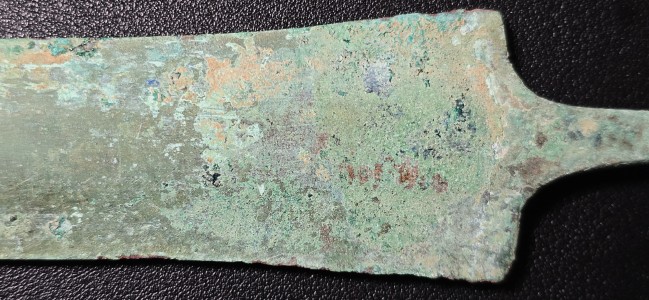
The Collection’s Chalcolithic copper dagger (Lot 1111, c. 2100 BC, 152 mm) and the early copper blades of Lots 83518421 and 83518467 (third millennium BC) belong to the long aftermath of this first florescence — simple, riveted or tanged flat blades whose typology changes with glacial slowness precisely because the design had already been perfected within the limits of unalloyed copper.
The Caucasus: The Forge Between Two Seas
The Caucasus region — the mountainous isthmus between the Black Sea and the Caspian — deserves extended treatment in any survey of bronze metallurgy, because the evidence increasingly suggests that it was here, rather than in Mesopotamia proper, that some of the earliest systematic arsenical bronze production took place, and because the Caucasus is the hinge connecting the Near Eastern, Anatolian, and steppe worlds.
Maykop: Royal Tombs Before the Pyramids
The Maykop culture (c. 3700–3000 BC) of the north-western Caucasus announced itself to scholarship in 1897, when Nikolai Veselovsky excavated an enormous kurgan at Maykop in the Kuban region and found beneath it a tripartite timber chamber containing a single principal burial accompanied by gold and silver vessels, gold bull figurines mounted on silver staves, hundreds of gold ornaments, and a suite of arsenical copper tools and weapons — axes, daggers, chisels — of remarkable quality. This is, by most reckonings, the oldest “royal” burial assemblage in the world, predating the Royal Cemetery of Ur by some seven centuries.
Maykop metallurgy is precocious in several respects. The arsenical copper is deliberately alloyed — arsenic contents cluster in ranges that cannot be explained by ore chemistry alone. Some Maykop blades show evidence of controlled cold-working of the cutting edge over a cast core, the basic recipe for all subsequent blade production. And Maykop sits at the head of a contact network that ran south into Mesopotamia (the famous parallels between Maykop and Uruk-period iconography) and north into the steppe, where Maykop metal and metalworking knowledge seeded the Yamnaya world. When the steppe cultures discussed below begin producing metal, their earliest products are recognisably Caucasian in inspiration.
Kura-Araxes: The First Transcaucasian Koine
The Kura-Araxes culture (c. 3400–2000 BC) of the South Caucasus produced a distinctive package of black-burnished pottery, rectangular and round houses with fixed hearths, and arsenical copper metallurgy that spread — apparently by migration as much as by trade — from eastern Anatolia and the Armenian highlands into north-western Iran and down the Levantine corridor as far as the Jordan valley, where archaeologists know it as Khirbet Kerak ware. This is one of the great unexplained dispersals of prehistory: a coherent cultural package travelling fifteen hundred kilometres while maintaining its identity.
For the metallurgist, Kura-Araxes matters because its communities sat directly on the polymetallic ores of the Lesser Caucasus and the Armenian highlands and worked them intensively. The region is a serious candidate source for the arsenical copper that appears across the third-millennium Near East, and recent survey work in the Zangezur and Alaverdi districts has documented ancient workings of impressive scale. Readers of my article on Arslantepe will recall that the famous swords from that site — among the earliest swords in the world, c. 3300–3000 BC — are of arsenical copper consistent with Transcaucasian metal, found at a site deeply entangled with Kura-Araxes communities. The sword, as a category of object, may well be a Caucasian invention.
Trialeti and the Middle Bronze Age Florescence
By the time of the Trialeti culture (c. 2200–1500 BC) in modern Georgia, Caucasian metalworkers were producing bronze weapons and vessels of extraordinary quality — massive shaft-hole axes, finely proportioned spearheads, and the gold and silver goblets from the Trialeti kurgans, with their granulation, filigree, and figural friezes, which rank among the finest metalwork of the ancient world. Trialeti society was mobile, pastoral, and spectacularly stratified: enormous barrows containing wheeled vehicles, sacrificed animals, and concentrated treasure, in a landscape nearly empty of permanent settlements.
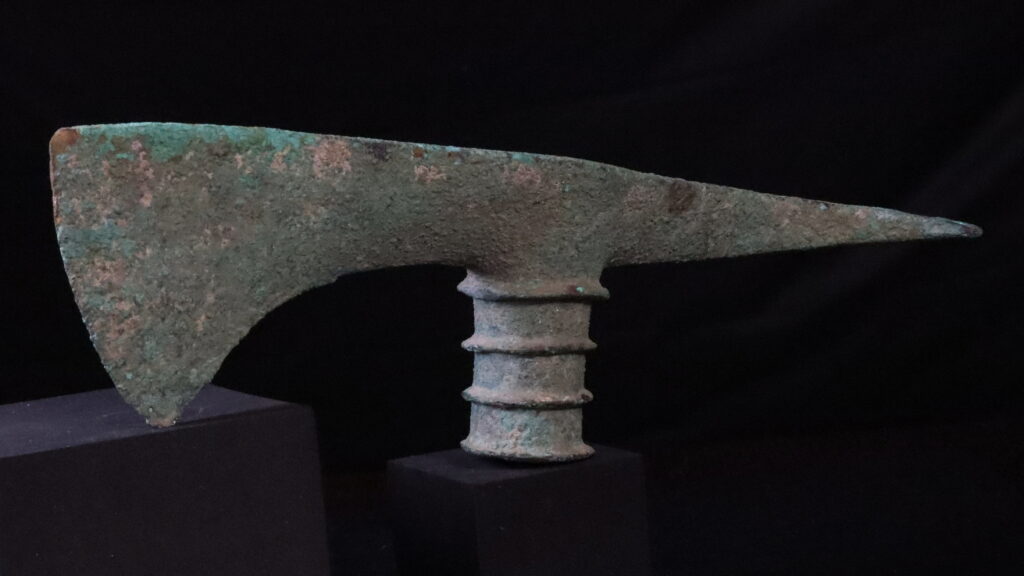
The large MBA split-socket pike in the Sancta Clara Collection (Lot 32737, 480 mm, 451 g) is attributed in part to this Transcaucasian/Trialeti tradition. Its robust proportions, rounded midrib, and ringed socket neck are consistent with a Caucasian origin, though the type also appears in the Levant (the Ugarit/Byblos series), underscoring the interconnections between these metallurgical zones. The split socket itself — sheet metal hammered and curled around the shaft rather than cast as a closed tube — is a diagnostic of this transitional era, before closed-socket casting in two-part moulds became universal. The Collection’s small copper pike-adze (Lot 5111, 135 mm, hammered with a split socket and quadrangular point) preserves the same technology at tool scale, and I regard the pair as a useful object lesson in how a single hafting concept was executed across the weight spectrum.
The Caucasus was also, in all likelihood, a tin and antimony source of regional importance — ancient workings are known in the Racha district of Georgia — and the region’s role as a metallurgical crossroads, linking steppe, Anatolian, Iranian and Mesopotamian traditions, can hardly be overstated. Every overland route between the steppe world and the urban Near East passed within sight of its peaks.
The Iranian Plateau and Elam: An Independent Power
Between Mesopotamia and Central Asia stretches the Iranian plateau, and it is a persistent distortion of the textbook narrative that the plateau appears only as a transit corridor. It was, in fact, one of the earliest and most productive metallurgical landscapes on earth.
Copper smelting at Tal-i Iblis in Kerman province and at Tepe Ghabristan reaches back into the fifth millennium BC. By the fourth millennium, the industrial complex at Arisman, on the edge of the central desert near Kashan, was smelting copper ore in quantity — the slag heaps at Arisman run to thousands of tonnes, the residue of what can only be called proto-industrial production serving the urban networks of the proto-Elamite world. The plateau’s polymetallic ores (copper frequently co-occurring with arsenic, antimony, and silver-bearing lead) made it a natural laboratory for alloying, and Iranian arsenical coppers of the fourth and third millennia are consistently among the best-performing metals of their era.
Elam — the civilisation of south-western Iran, with its twin poles at Susa in the lowlands and Anshan on the plateau — maintained a metallurgical tradition as old as Mesopotamia’s and never subordinate to it. Elamite smiths were casting large statuary by the second millennium (the life-size copper statue of Queen Napir-Asu, c. 1340 BC, weighs 1,750 kg and was cast around a bronze core — a technical feat without parallel until much later), and Elamite weapon types maintain their own typological logic. The Collection holds a focused group of Elamite projectile points: the great 142 mm bilobate arrowhead of Lot 117 (3000–1600 BC), the Copper Age arrowhead of Lot 83351729 (130 mm), the archaic copper javelin head of Lot 83518675 (120 mm), and the later bronze javelin head of Lot 1062 (1200–800 BC, 115 mm). Set side by side, they document a continuous tradition of long, tanged, midribbed points — designed for thrusting javelins and powerful bows — that changes alloy (copper, then arsenical copper, then tin-bronze) while conserving form across nearly two millennia. The Elamite copper alloy knife blade of Lot 101315690 extends the same conservatism to edged tools.
North-eastern Iran tells a parallel story. The great mounds of Tepe Hissar (near Damghan) and Tureng Tepe (in Gorgan) were metallurgical centres from the fourth millennium onward, and the cemetery of Marlik (c. 1400–1100 BC) in Gilan yielded weapons and gold vessels of superb quality. The Collection’s large spearhead of Lot 38071001 (448 mm, c. 2000 BC) belongs precisely to this north-west Iranian horizon — its elongated lanceolate blade and long angular tang find their parallels, as the accompanying expertise notes, at Tepe Hissar, Tureng Tepe, and Marlik. These north Iranian sites are also, not incidentally, the south-western neighbours of the BMAC, and the resemblances between their metalwork are not coincidence.
Luristan: The Master Bronzesmiths of Western Iran
No survey of Bronze Age metallurgy would be complete without extended attention to Luristan, and for the Sancta Clara Collection this tradition is central. The Lorestan Province of western Iran — a vertical landscape of parallel ridges and high pastures in the central Zagros — produced a body of bronze work spanning roughly 2600 to 600 BC that is unmatched in its combination of technical virtuosity and aesthetic ambition.
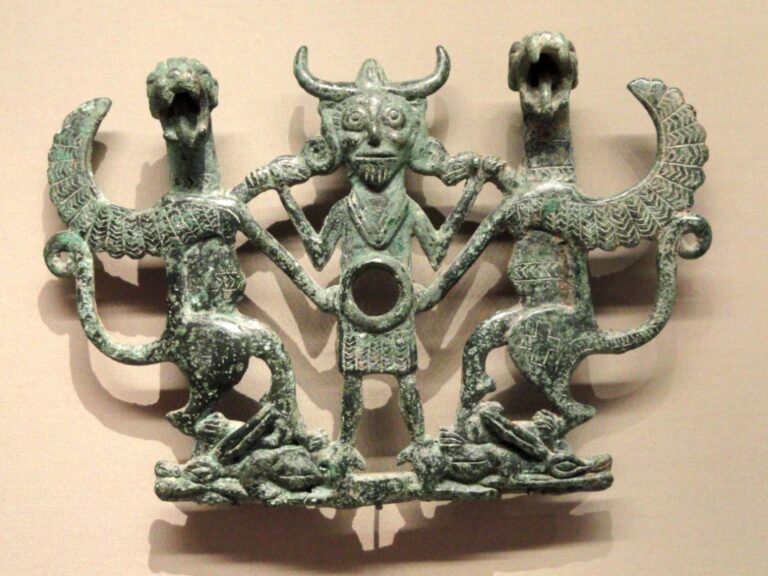
It is important to distinguish the two phases that the art market tends to blur. The earlier phase (c. 2600–1500 BC) is a weapons tradition: flat riveted daggers, tanged blades, and shaft-hole axes that participate in the broader Mesopotamian-Elamite typological world. The Collection’s Luristan copper and Bronze Age dagger group (Lot 84375835, 2750–2250 BC) belongs here — early blades whose simple, powerful forms would not look out of place at Susa or Ur. The later, “classic” phase (c. 1250–600 BC, the Iron Age in local terms despite the material) is the era of the canonical Luristan bronzes: the standard finials with their “Master of Animals” compositions, the zoomorphic horse-bits, the spike-butted axes, the whetstone handles, the heraldic ibex (as in the Collection’s Luristan ibex figurine, Lot 2248). These were the products of communities that buried their dead in stone-built cist graves in their thousands — Bani Surmah, War Kabud, Kalleh Nisar — and apparently lavished their finest metal on the grave and the sanctuary.
The weapons of the classic phase are superbly represented in the Collection: the long spearhead of Lot 84068495 at 456 mm, the huge spearhead of Lot 44398282 at 454 mm, the leaf-shaped rat-tail-tang spearhead of Lot 84058911 at 437 mm (its blade carrying multiple ancient strike marks — a weapon that saw genuine combat), the javelin heads of Lots 84026513 and 83518649, and the daggers of Lots 78638597 and 97583774. The rat-tail tang deserves a note: this long, round-sectioned tang, curved or flared at its tip, was driven through a wooden or composite shaft and bent over to lock the head in place — a hafting solution distinct from both the socket and the flat riveted tang, and one with a long pedigree in Iran and Mesopotamia. Early models of spearheads were designed as flat dagger-like blades with a thin tang tied to the shaft; later designs evolved increasingly secure mechanical attachments, and the typological sequence from tied tang to rat-tail to closed socket is one of the cleanest evolutionary series in ancient weapon design.
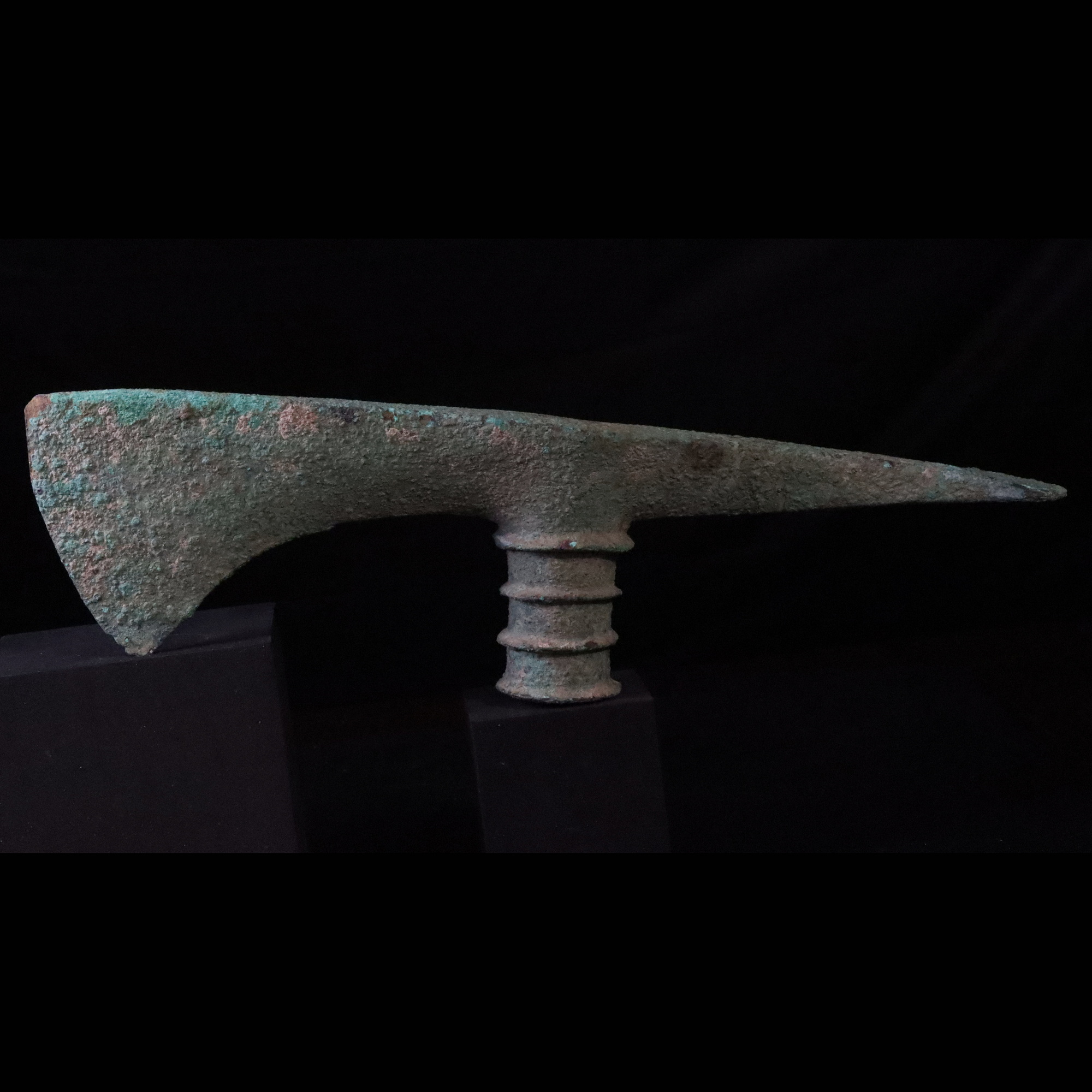
What distinguishes Luristan metalwork from that of neighbouring Mesopotamia or Elam is its exuberant decorative vocabulary and its sheer casting ambition — lost-wax openwork of a complexity that few ancient traditions attempted, applied not to temple treasure but to horse gear and personal weapons. The technical range is equally impressive: lost-wax casting for complex three-dimensional forms, bivalve mould casting for weapons and tools, casting-on (joining a new pour to an existing component — many Luristan iron-bladed, bronze-hilted daggers are made this way), and extensive cold-working and annealing. The adze-axe head of Lot 84338037, with its decorated socket, represents the high-water mark of Luristan tool production — simultaneously weapon, tool, and prestige object.
The provenance challenges surrounding Luristan bronzes are well known. The vast majority entered the art market through uncontrolled excavation following the chance discoveries at Harsin in 1928, and establishing specific findspots is usually impossible; the controlled excavations of the Belgian mission under Louis Vanden Berghe in the 1960s–70s remain the indispensable scientific anchor for the whole corpus. Nevertheless, the typological coherence of the material — and its distinctiveness from Mesopotamian, Elamite, and Central Asian metalwork — is beyond question.
The Carpathian Basin: Únětice, Otomani, and the Industrialisation of the Craft
The Carpathian Basin — roughly modern Hungary, Slovakia, western Romania, and parts of Austria — was one of the richest metallurgical zones in prehistoric Europe. Copper and gold deposits in the Apuseni Mountains of Transylvania and the Slovak Ore Mountains (Slovenské rudohorie) fuelled a succession of cultures that produced increasingly sophisticated bronze artifacts, and did so on a scale that justifies the word industry.
The Únětice culture (c. 2300–1600 BC) of Central Europe is best known to the public for the Nebra Sky Disc — that astonishing bronze-and-gold representation of the cosmos, its copper traceable to the Mitterberg mines of the Austrian Alps and its gold and tin to Cornwall — but its contribution to bronze typology is equally remarkable. Únětice metalworkers developed the flanged axe, the early halberd (a dagger blade mounted at right angles to its shaft — a weapon whose practical use remains debated, since many show no impact damage and may have been parade equipment), the solid-hilted dagger, and the ingot torc: rings of standardised weight, found in hoards of dozens or hundreds, that functioned as a kind of proto-currency. Hoards such as Dieskau in Saxony-Anhalt, with hundreds of axes and torcs, reveal an economy in which metal had become wealth in the abstract — stockpiled, counted, and presumably exchanged by weight.
The Otomani–Füzesabony complex (c. 2100–1400 BC), overlapping geographically with eastern Únětice, produced a denser and more martial material culture: heavy shaft-hole battle axes of the Apa–Hajdúsámson type with their incised spiral ornament, daggers with multiple rivets, disc-butted axes, and the first long swords of temperate Europe. The Apa hoard from Romania and the Hajdúsámson hoard from Hungary define the style — weapons of such confident design and decoration that they were clearly the regalia of a warrior aristocracy. The fortified tell settlements of this complex (Otomani, Spišský Štvrtok, Békés) with their bronze workshops inside the ramparts show metallurgy moving to the centre of political life.
The transition from arsenical copper (where arsenic acts as a natural hardening agent absorbed from the ore) to deliberate tin-bronze alloying can be traced through Carpathian assemblages with particular clarity, and by the Middle Bronze Age the regional smiths were running what can only be called serial production. Mould hoards — caches of stone and clay bivalve moulds — have been found across the region, and the standardisation of products is striking: socketed axes, sickles, and spearheads replicated in hundreds of nearly identical examples from the Danube to the Rhine. The “Podkonice Hoard” socketed axe in the Sancta Clara Collection (Lot 97524689, Urnfield culture) comes from exactly this tradition of serial production in the Slovak ore zone, and I discuss its hoard context further in my article on ancient axes.
The Pontic Steppe: Yamnaya, Catacomb, and Srubnaya
The vast grasslands stretching from the lower Danube to the Ural Mountains were home to a succession of pastoralist cultures whose relationship with bronze was shaped by mobility. These steppe peoples did not build cities, but their metalwork — compact, portable, and ruthlessly functional — spread across an enormous geographic range, and their genetic and linguistic legacy (the Yamnaya expansion is now the leading candidate vector for the dispersal of Indo-European languages) makes them central actors in Eurasian prehistory.
The Yamnaya horizon (c. 3300–2600 BC) drew its earliest metallurgical knowledge from the Maykop culture to its south and from the remnants of the Balkan Chalcolithic to its west. Yamnaya communities used arsenical copper for tanged daggers, awls, and flat axes — a modest inventory, but one carried in wagons across thousands of kilometres. Their real metallurgical legacy lies in the networks they established: the Circumpontic Metallurgical Province, as Evgeny Chernykh termed it, a zone of shared alloy preferences and artifact types ringing the Black Sea, within which metal and metallurgical fashion circulated for a millennium.
The Catacomb culture (c. 2800–2200 BC) that succeeded Yamnaya east of the Don refined the kit — its smiths produced shaft-hole axes of elegant waisted profile and experimented with moulds of increasing complexity. With the Srubnaya or “Timber-Grave” culture (c. 1900–1200 BC), steppe metallurgy becomes genuinely large-scale: Srubnaya communities mined the Kargaly copper field on the southern Urals steppe — one of the largest ancient mining landscapes anywhere, with thousands of surface workings and an estimated output, over its lifetime, of tens of thousands of tonnes of smelted copper. Srubnaya bronzework is characterised by socketed celts, curved-backed knives, sickles in enormous numbers, and hook-tanged spearheads.
The steppe connection runs directly into the Collection. The Scythians (c. 900–200 BC) were the cultural heirs of these earlier steppe traditions, and the trilobate socketed arrowhead — mass-produced in multi-cavity moulds and carried by mounted archers from the Danube to the Altai — represents the endpoint of two thousand years of steppe ballistic refinement. Lots 11482, 11486, 11487, and the Altai tanged trilobate of Lot 11481 document the formal variety within this seemingly simple weapon type; my dedicated article on Scythian arrowheads treats the typology in full. But between Srubnaya and the Scythians stand two phenomena that deserve their own chapters, because they transformed not just the steppe but the whole of Eurasia: Sintashta and Andronovo.
Sintashta: Chariots, Fortresses, and Smiths
In the 1970s and 1980s, Soviet archaeologists working in the Trans-Ural steppe — the grassland east of the southern Ural Mountains — uncovered something that should not, by the standards of the time, have existed: a dense cluster of fortified, planned settlements dating to c. 2100–1800 BC, each a closed ring or rectangle of conjoined houses behind timber-and-earth ramparts, each house equipped with a well, a hearth, and — this is the extraordinary part — metallurgical installations. Slag, ore, crucibles, and casting debris occur in virtually every excavated house at Sintashta, Arkaim, and the twenty-odd related sites of the so-called “Country of Towns.” These were not villages with attached smithies; they were communities organised around metal production, sitting deliberately on the copper ores of the eastern Ural slope.
The Sintashta culture’s cemeteries delivered the second shock. Burials at Sintashta, Krivoe Ozero, and related sites contained the remains of light, two-wheeled vehicles with spoked wheels set in slots in the grave floor — the earliest true chariots known anywhere, radiocarbon-dated to c. 2000 BC, complete with paired horse sacrifices and distinctive disc-shaped antler cheekpieces. Whether the chariot was invented here or merely first preserved here is debated, but the steppe dates are earlier than any Near Eastern depiction, and the case for a steppe origin of the chariot — subsequently transmitted southward to enter Near Eastern warfare in the seventeenth century BC and Chinese warfare by the thirteenth — is strong.
Sintashta metallurgy itself is transitional: arsenical copper still dominates, but tin-bronze appears, and the weapon kit (socketed spearheads, shaft-hole axes, tanged daggers) sets the pattern for the next half-millennium of steppe production. The intensity of production far exceeded local need, implying export — and the obvious customers lay to the south, in the urban world of Central Asia. Many researchers connect the Sintashta phenomenon, with its chariots, horse sacrifice, and fire-centred ritual, to the community that composed the earliest Indo-Iranian poetry; the parallels between Sintashta funerary ritual and the rites described in the Rigveda are suggestive, though I would stress that the equation of archaeological cultures with language communities is always a hypothesis, never an observation.
Andronovo: The Bronze That Built a Continent
Out of the Sintashta core there expanded, from roughly 1900 BC, the largest cultural horizon of the Bronze Age world: the Andronovo complex (c. 1900–1100 BC, with late phases to c. 900 BC), named after a village cemetery near Achinsk in Siberia. At its greatest extent Andronovo material culture — distinctive incised pottery, timber-and-stone funerary architecture, and above all a standardised bronze inventory — stretched from the Ural River to the Yenisei and the Tien Shan, an east–west span of well over three thousand kilometres. This was not an empire; it was something stranger and more durable: a continental network of related pastoral communities sharing technology, style, and probably language (the majority view sees Andronovo as broadly Indo-Iranian-speaking, with all the caveats already noted).
Archaeologists conventionally divide the horizon into the Alakul variant (west and central, c. 1900–1500 BC) and the Fedorovo variant (east and later, c. 1750–1300 BC, with cremation burial and its own ornament style), shading into the Final Bronze cultures (Sargary, Begazy-Dandybai in central Kazakhstan — the latter with megalithic mausolea implying concentrated power) that bridge toward the Iron Age and, ultimately, the historical Saka and Scythians.
For the history of metallurgy, Andronovo matters for three reasons.
First, copper at scale. Andronovo communities operated some of the great mining landscapes of antiquity: Kenkazgan and Dzhezkazgan in central Kazakhstan, the Kalbin and Narym ranges in the east. Estimates for ancient extraction at the Dzhezkazgan field run to the order of a million tonnes of ore. Settlements such as Atasu and Myrzhik in central Kazakhstan were specialised smelting sites, their economy visibly oriented to metal export.
Second — and this is the point on which the whole Bronze Age economy turns — tin. The great unsolved problem of Near Eastern archaeology has always been the source of the tin that made the Bronze Age possible, since Mesopotamia, Anatolia, Egypt and the Aegean are all essentially tin-less. The Zeravshan valley and adjacent ranges of modern Uzbekistan and Tajikistan hold genuine tin deposits, and excavation has demonstrated Bronze Age mining at Karnab (Uzbekistan) and at Mushiston (Tajikistan), where the ore is stannite and cassiterite of high quality. The miners’ material culture at both sites is Andronovo. Here, for the first time, we can put a face on the people who actually dug the Bronze Age’s rarest strategic commodity: mobile steppe pastoralists, working seasonal mines in the mountains above the Zeravshan, feeding tin southward into the urban networks of Central Asia and beyond. Recent lead- and tin-isotope work has even traced tin ingots from the Uluburun shipwreck off the Turkish coast (c. 1320 BC) — the single richest Bronze Age cargo ever found — to Central Asian sources including Mushiston, alongside Anatolian ore. The result is debated, as all isotopic provenance claims are, and I treat the controversy at length in my article on the Bronze Age tin trade; but if it holds, it means metal mined by Andronovo hands in the Pamir foothills was being shipped past Rhodes a century before the Trojan War. The Bronze Age was global before globalisation.
Third, transmission eastward. Andronovo (Fedorovo) communities reached the Tien Shan, the Dzungarian Gate, and the oases of Xinjiang, where their metallurgy met westward-looking communities of the Chinese sphere. The appearance in second-millennium Gansu and Xinjiang of socketed celts, curved knives, and certain mirror types of steppe character — and conversely the appearance of Chinese-style artifacts on the steppe — marks the opening of the corridor that would one day be the Silk Road. The question of what else moved along it (the chariot certainly; the words for “horse” and “wheel” possibly; metallurgical technique itself, contentiously) is among the liveliest debates in Eurasian archaeology, and I return to it under China below.
The Collection’s Altai trilobate tanged arrowhead (Lot 11481) sits at the far chronological end of this world — a product of the mounted-archer cultures that inherited the Andronovo lands — but the deeper point is worth making explicitly: when one handles a Scythian arrowhead, one is handling the final, perfected output of a metallurgical economy whose foundations were laid by Sintashta fortress-smiths and Andronovo tin miners a thousand years earlier.
The Seima-Turbino Phenomenon: A Technology Moving at the Speed of Horses
One of the most extraordinary episodes in the history of metallurgy is the Seima-Turbino phenomenon (c. 2200–1900 BC by current dating, thus overlapping Sintashta), named after the cemetery sites of Seima and Turbino in the Volga-Kama region of Russia. These are cemeteries without settlements — burial grounds, often at river confluences, containing weapons of a sophistication that nothing in their surroundings predicts: single-piece cast socketed spearheads with forked midribs, socketed celts cast in closed moulds, and curved knives with pommels sculpted as horses, rams, and — in the famous Rostovka example — a skier being towed by a horse.
Three things astonish. The metal: high-tin bronze in a region with no tin, the alloy pointing to Altai sources thousands of kilometres east. The technique: thin-walled closed-socket casting around a suspended clay core, a method demanding extreme skill, which Near Eastern smiths of the same date had not mastered — the closed-cast socketed spearhead appears at Seima-Turbino sites before it appears in the Near East, one of several cases where the supposed periphery outran the supposed centre. And the distribution: essentially identical objects from Finland and the Borodino hoard in Moldova to the Altai and into Xinjiang and Gansu, deposited within at most a few generations.
The excavators of the type-sites, Chernykh and Kuzminykh, proposed that Seima-Turbino represents not a culture but a movement: small, mobile, possibly mounted groups of warrior-metallurgists originating in the Altai forest-steppe, travelling the river systems westward, intermarrying or trading with local communities, and burying their dead with the tools of a craft that was itself their power and their identity. Others prefer a cascade of emulation along existing exchange chains. Whatever the mechanism, the phenomenon demonstrates that two thousand years before the Silk Road, the forest-steppe corridor could move a complex technology across the breadth of a continent within a human lifetime — and it is very probably the Seima-Turbino current that delivered the socketed celt and advanced casting know-how to the doorstep of early China.
The BMAC: The Oxus Civilisation in Full
The Bactria-Margiana Archaeological Complex (BMAC, c. 2300–1450 BC in the currently favoured chronology; also called the Oxus civilisation), centred on the Murghab delta of Turkmenistan and the Amu Darya (Oxus) basin of Uzbekistan, Tajikistan and northern Afghanistan, is the most important Bronze Age civilisation that most educated readers have never heard of. Its obscurity is an accident of twentieth-century politics: its heartland lay inside the Soviet Union, its principal excavator published in Russian, and its Afghan component reached the world chiefly through the antiquities market rather than the excavation report.
Discovery and Shape
The civilisation was given its name and its outline by Viktor Sarianidi, who from the 1970s until his death in 2013 excavated the colossal site of Gonur Depe in the Murghab delta — a walled palace-temple complex covering some 25 hectares at its core, with monumental gates, water basins, and a royal necropolis containing chamber tombs with mosaic-decorated walls, wheeled vehicles, and sacrificed animals including horses and camels. Around Gonur spread hundreds of smaller fortified settlements — Togolok, Kelleli, Adji Kui in Margiana; Dashly and Sapalli, Djarkutan and Farkhor in Bactria — each built to a strikingly geometric plan: square or rectangular enclosures with round corner towers, a fortress-architecture so regular that Sarianidi compared the BMAC landscape to a country of kremlins.
This was a fully urban, irrigation-based civilisation — wheat, barley, and the qanat-like management of the Murghab’s waters — with social stratification written plainly in its graves, administrative technology in the form of seals, and craft specialisation of a very high order. What it lacked, so far as we know, is writing; a handful of enigmatic signs (the “Anau seal”) have not yielded a script. The BMAC must therefore be read entirely through its objects, and its objects are eloquent.
The Metalwork
BMAC bronzesmiths worked in arsenical copper and increasingly in tin-bronze — unsurprising, given that the Zeravshan tin mines lay within their commercial reach and that Andronovo herders camped, quite literally, at the gates of BMAC towns (steppe ceramics occur in and around several BMAC sites; the relationship appears to have been symbiotic rather than hostile, ore and animals moving south, grain and finished goods moving north).
The repertoire is highly distinctive. Compartmented stamp seals — openwork copper-alloy seals cast by lost wax, bearing eagles, snakes, scorpions, crosses, and winged deities — are the signature BMAC object, and their distribution (Iran, the Indus, the Gulf) maps the civilisation’s reach. Cosmetic flacons, mirrors, and elaborately handled “wands” attest a developed culture of personal adornment. Shaft-hole axes with sculptural animal terminals — ibex, boars, dragonsnakes — blur the line between weapon and emblem, and stand in obvious aesthetic kinship with the later Luristan tradition to the south-west, a kinship whose mechanism (shared Iranian-plateau inheritance? actual contact?) remains an open question I would not presume to close. The famous “Bactrian princesses” — composite statuettes of seated women in kaunakes garments, carved in chlorite and limestone — are not metalwork, but they travelled with it, and their serene, heavy-lidded faces have become the visual shorthand for the civilisation.
For the weapons specialist, BMAC arsenals are notable for long tanged daggers and short swords with raised midribs, trunnion axes, and spearheads of the same broad family as the north-east Iranian series from Tepe Hissar and Tureng Tepe mentioned above — which is to say, the family to which the Collection’s Lot 38071001 belongs. The typological continuum across the Kopet Dagh, from Gorgan to the Murghab, is real and visible at the bench.
Religion, Fire, and the Zoroastrian Question
Sarianidi held, with increasing conviction, that the BMAC temples — with their fire installations, their white-ash-filled rooms, and the residues in their ceremonial vessels which he identified as ephedra, poppy and cannabis — were the cradle of proto-Zoroastrianism, the fire religion of the Iranian world, and that the haoma/soma cult of the Avesta and Rigveda was being celebrated at Gonur and Togolok a millennium before Zoroaster. The botanical identifications have been seriously contested (independent re-analyses of the Togolok material failed to confirm ephedra), and most scholars regard the proto-Zoroastrian claim as unproven, though the fire-centred ritual architecture is not in doubt. I flag the dispute deliberately: it is a model case of a brilliant excavator’s grand hypothesis outrunning verifiable evidence, and the honest position is that the religious identity of the BMAC remains unknown.
Trade: The Entrepôt Hypothesis
What is not seriously disputed is the BMAC’s commercial centrality. Harappan seals and ivory at Gonur; the Harappan colony at Shortugai upstream on the Oxus, beside the Badakhshan lapis sources; BMAC seals and “princesses” in south-eastern Iran and on the Iranian plateau; Mesopotamian texts of the late third millennium speaking of tin arriving from the east through Elamite middlemen; BMAC-type objects in graves on the Gulf island of Bahrain (ancient Dilmun). Assemble these dots and the line that connects them is the tin route: Zeravshan cassiterite, mined by Andronovo labour, alloyed or traded raw through BMAC towns, moving south-west via Elam and Susa into the bronze workshops of Sumer and Akkad. The BMAC, on this reading, grew rich precisely where the steppe’s metal met the south’s grain and cities — the first Central Asian middleman civilisation, ancestor in function if not in blood to Sogdian Samarkand and the caravan cities of the Silk Road.
Collapse and Afterlife
Around 1700 BC the great centres contract sharply; by c. 1450 BC the civilisation as an urban phenomenon is over. Shifts in the Murghab’s channels, soil salinisation, the southward pulse of steppe populations, and the breakdown of the long-distance exchange system have all been proposed, and as with most Bronze Age collapses the truthful answer is probably “several of the above, compounding.” What followed is in some ways the most intriguing chapter of all.
Yaz: The Culture That Buried No Dead
Across the former BMAC lands and the piedmont of the Kopet Dagh there emerges, around 1500 BC, the Yaz culture (named for Yaz Depe in the Murghab delta; conventionally Yaz I, c. 1500–1100 BC; Yaz II, c. 1100–700 BC; Yaz III, c. 700–330 BC, running up to Alexander’s arrival). Yaz I communities lived in modest mudbrick villages, often clustered around a citadel on a high platform; their pottery is handmade and painted with simple geometric motifs, a sharp break from the wheel-made plainwares of the BMAC; their economy remained agricultural and irrigation-based.
Two features make Yaz indispensable to this survey. The first is metallurgical: Yaz is the local hinge between bronze and iron. Yaz I metalwork is still bronze — trilobed and leaf-shaped arrowheads, knives, simple ornaments, in forms that converse with both the steppe and the Iranian plateau — while in Yaz II iron appears and progressively takes over edged tools and weapons, with bronze retreating to arrowheads (the trilobate socketed type above all, standard equipment across the Achaemenid world) and ornament. Anyone who studies the bronze-to-iron transition in the Collection’s material — the Hallstatt iron axe of Lot 98948114, the Lydian iron arrowhead of Lot 1825, the Greek hoplite encheiridion of Lot 98732499 standing beside their bronze counterparts — is watching, in the west, the same substitution that Yaz II documents in Central Asia. The transition was not an event but a long negotiation, conducted independently in each region, and bronze arrowheads outlived bronze swords everywhere by centuries, for the simple reasons that arrowheads are cast (iron cannot be cast with ancient technology) and are expendable (standardised mass production matters more than edge hardness).
The second feature is the famous negative: across the entire Yaz I–III sequence, regular burials are almost completely absent. A culture that built citadels and farmed for a thousand years left essentially no graves. The standard explanation — advanced cautiously by the excavators and adopted with enthusiasm by historians of religion — is exposure of the dead: the defleshing of corpses by birds and elements, as prescribed in the Avesta and practised by Zoroastrians into modern times. If correct, the Yaz culture is our best archaeological candidate for the society of the Avestan texts themselves — the world of pastoral-agricultural oasis communities, fire veneration, and excarnation in which the Zoroastrian tradition took shape. I find the convergence genuinely impressive, while noting its logical structure: it is an argument from absence, and arguments from absence are the archaeologist’s most treacherous friends. (Burial in perishable contexts, or off-site disposal, would produce the same archaeological silence.) The hypothesis deserves its prominence; it has not been proved.
Yaz III ends with the region incorporated into the Achaemenid satrapies of Margiana and Bactria — at which point Central Asia re-enters written history, and the trilobate bronze arrowheads of the Persian armies (the Collection’s Lot 1814 among their close kin) carry the steppe’s metallurgical signature into the battle lines of Marathon and Gaugamela.
China: From Majiayao to the Ritual Bronzes of Shang and Zhou
The Chinese bronze tradition is in many ways the most technically accomplished in the ancient world, and it followed a trajectory entirely distinct from the Western Asian pattern — though its opening chapter now appears to have a Central Asian prologue.
The earliest bronze object yet found in China is a knife from Linjia, a Majiayao culture site in Gansu (c. 3000–2700 BC) — a cast tin-bronze blade, isolated and precocious. The Qijia culture (c. 2200–1600 BC), likewise of the Gansu corridor — the natural funnel between the steppe world and the Yellow River — produced China’s first consistent series of copper and bronze objects: knives, awls, rings, and the earliest Chinese mirrors. The geography is suggestive, and the chronology more so: Qijia metal appears precisely when Seima-Turbino and early Andronovo material reaches Xinjiang and the Hexi corridor, and several Qijia types (the curved-backed knife above all) have steppe cousins. The question of whether Chinese metallurgy was independently invented or steppe-transmitted has been debated for a century, often with more nationalism than rigour on both sides; the position I find most defensible is the moderate one — the idea of metallurgy and certain specific forms (socketed celts, knives) plausibly arrived via the steppe corridor, but what Chinese founders then did with the technology owes nothing to anyone.
For what happened next has no parallel. The Erlitou culture (c. 1900–1500 BC) on the middle Yellow River — identified by many, though not all, scholars with the Xia dynasty of the histories — redirected bronze away from the blade and toward the vessel, casting the first ritual jue and ding by a method unique to East Asia: the piece-mould technique, in which a clay model is enclosed in a segmented ceramic mould, the segments carved and keyed, the model shaved down to become the core, and the bronze poured into the resulting gap. Where the lost-wax method (universal from Nahal Mishmar to Luristan to Benin) destroys its mould and makes each casting unique, the piece-mould is an architecture — and it shaped Chinese bronze aesthetics profoundly, since decoration was carved into mould segments and the vessel’s form had to respect the mould’s divisions, producing the flanges and registered friezes that define the style.
The Shang dynasty (c. 1600–1046 BC) industrialised this craft. The foundry quarter at Anyang covered hectares; single castings such as the Houmuwu fangding weigh over 830 kg, demanding the synchronised pour of multiple crucible teams; and the consumption was staggering — the tomb of Fu Hao alone (c. 1200 BC), one royal consort, and not the most senior, contained some 1.6 tonnes of bronze in over 460 objects. In the Near East, bronze was primarily the material of the weapon and the tool; in Shang China the most ambitious casting served the ritual vessel, because ancestral sacrifice — the feeding of the royal dead — was the foundation of political legitimacy. He who held the vessels held the Mandate. The tin came from deposits in the Yangtze region and perhaps beyond; the copper from Tongling and other Yangtze-valley mines; and the logistics of supplying Anyang were as remarkable as the casting. The recently understood sacrificial pits at Sanxingdui in Sichuan — with their colossal bronze heads, masks, and trees, contemporary with late Shang but utterly alien to its style — are a salutary reminder that “Chinese Bronze Age” was itself plural.
The Zhou dynasty (1046–256 BC) inherited, transformed, and textualised the tradition — long dedicatory inscriptions cast into vessel interiors turn late Zhou bronzes into historical documents — and eventually carried bronze into a new world-historical role: cast coinage, the spades, knives and round cash of the Warring States, which made bronze the money of East Asia for two thousand years.
Southeast Asia: Ban Chiang, Dong Son, and the Southern Bronze
Southeast Asia’s bronze traditions have been the subject of fierce scholarly debate since the late 1960s, when excavations at Non Nok Tha and then Ban Chiang in northeastern Thailand yielded bronze artifacts with early dates that, if accurate, would have made the region’s metallurgy contemporaneous with or older than the earliest Near Eastern bronze — newspaper headlines of the 1970s announced the Bronze Age had begun in Thailand. The claims rested on problematic associations between dated material and metal finds in heavily disturbed, repeatedly re-dug cemetery soils, and the subsequent re-dating controversy ran for decades: Joyce White’s team defended a “long chronology” with bronze by c. 2000 BC, while Charles Higham’s AMS-dating programme on bone and rice from the burials themselves yielded a “short chronology” placing the first bronze at Ban Chiang nearer 1100–1000 BC. The short chronology currently commands the majority, but the dispute is a textbook lesson in how much archaeological interpretation hangs on the integrity of stratigraphy — and either way, the deeper conclusion stands: Southeast Asian metallurgy derives not from the West but from the north, arriving via Yunnan and Lingnan from the Chinese sphere, and was then developed along thoroughly local lines. Village-scale, kin-organised, without palaces or armies, sites like Ban Non Wat and the copper-mining complex in the Khao Wong Prachan valley show a Bronze Age without the state — a standing refutation of the old assumption that bronze and political centralisation necessarily travel together.
The Dong Son culture (c. 1000 BC – 100 AD), centred on the Red River delta of northern Vietnam and radiating into southern China, Cambodia, Thailand, and the Indonesian archipelago, produced the most spectacular bronzes of the region. The great Dong Son drums — massive cast kettle drums, the largest over 70 kg, their tympana decorated with concentric registers of boats, plumed warriors, dancers, deer, and rayed stars — are among the most iconic objects of Asian antiquity, and their distribution, from Yunnan to New Guinea and Bali, maps a maritime exchange network of remarkable reach. The casting is piece-mould work of high sophistication (with lost-wax used for ornaments and figurines), and analysis of the drums shows leaded bronze recipes adjusted for large thin-walled castings — recipe engineering, not happenstance. The Sancta Clara Collection includes a Dong Son bronze axe (Lot 98277415), a characteristic product of this culture: the asymmetric “boot-shaped” and splayed-blade axes of Dong Son are socketed, frequently decorated, and were as much insignia as implements.
The Great Lakes Old Copper Complex: A Metallurgy Without Smelting
The copper-working cultures of the Great Lakes region of North America (beginning by c. 7500 BC on recent dating — among the oldest metalworking traditions on earth — and continuing to c. 1000 BC and beyond) represent one of the most instructive episodes in the global story. The native copper deposits of Michigan’s Keweenaw Peninsula and Isle Royale provided metal of exceptional purity in masses ranging from pebbles to multi-tonne boulders, and the peoples of the Old Copper Complex produced a sophisticated range of objects: socketed and tanged projectile points, crescent knives, gaffs, awls, fishhooks, beads, and bracelets, with thousands of ancient mining pits still visible along the copper range.
What makes this tradition anomalous is that it remained, for its entire multi-millennial duration, a cold-working and annealing technology. Despite an intimacy with copper as deep as any society’s, the Great Lakes metalworkers never developed smelting, never alloyed, and never cast. Every object was hammered from native metal, with periodic annealing to relieve work-hardening. This is not a failure of ingenuity — the socketed points are formed with real virtuosity — but a ceiling imposed by circumstance: with native copper abundant beyond any conceivable need, there was no pressure to extract metal from ore; without smelting, no liquid metal; without liquid metal, no casting and no alloys; and without tin within reach, no bronze in any case. Intriguingly, utilitarian copper use actually declines in the region after c. 1500 BC, copper shifting to ornamental and status roles — a reminder that technological trajectories can reverse when the social calculus changes.
The Old Copper Complex matters because it demonstrates that the sequence we treat as natural — native copper, then smelting, then arsenical copper, then tin-bronze — was a contingent historical achievement, not a predetermined staircase. Remove any precondition (ore-poor abundance of native metal, long-distance exchange, urban demand for harder alloys) and the progression halts, without any deficiency of skill or intelligence. “The Bronze Age” was made, not awaited.
The European Atlantic and Urnfield Traditions
Western and Central Europe developed vigorous and ultimately interlinked bronze traditions during the second and first millennia BC, connected to the wider world chiefly through the tin of Cornwall and Brittany and the copper of the Alps, Wales and Iberia.
The Atlantic Bronze Age (c. 1300–700 BC), stretching from Iberia through western France, the British Isles, and into Scandinavia, is characterised by leaf-shaped slashing swords, palstaves and socketed axes, flesh-hooks and cauldrons, circulated by maritime exchange along the seaboard — the Langdon Bay cargo of scrap bronze from the seabed off Dover and the great Huelva deposit from a Spanish estuary are snapshots of this sea-borne metal economy in motion. Mining reached industrial scale where the geology allowed: the Great Orme mine in north Wales descends through kilometres of Bronze Age galleries, some so narrow they can only have been worked by children, and its output in the centuries around 1500 BC was sufficient to supply much of Britain.
The Urnfield culture (c. 1300–750 BC) of Central Europe, named for its cremation-in-urn burial rite, represents the culmination of European Bronze Age metallurgy and its near-total social penetration: by this period bronze is no longer aristocratic monopoly but everyday equipment — sickles, knives, razors, pins by the tens of thousands. Urnfield smiths produced the first true slashing swords in quantity (the Naue II type, which spread from the Urnfield/north Italian zone into the Aegean and the Levant during the very crisis decades around 1200 BC — one of the rare cases of a European weapon conquering the Near East), standardised socketed axes, sheet-bronze cuirasses, greaves, and vessels raised and riveted from hammered sheet. The large socketed spearhead of Lot 97137769 in the Sancta Clara Collection — 29.5 cm, 340 g, with a pronounced midrib and its bivalve-mould casting seam still visible at the socket neck — is a classic product of this world, as are the winged (flanged) axe of Lot 792 (c. 1100 BC), whose flanges grip the knee-shaft against the torque of the blow, and the decorated axe head of Lot 97814529. Readers wishing to follow the hafting logic of flanged, winged, palstave and socketed forms — one of the most satisfying engineering sequences in all of ancient technology — will find it traced step by step in my article on ancient axes.
The Urnfield period is also the great age of the hoard: deliberate deposits of bronze, from a handful of axes to assemblages of hundreds of kilograms, buried in pits, bogs and rivers across the continent. Founders’ stock awaiting recasting, merchants’ caches, emergency burials in troubled times, and votive surrender of wealth to the gods have all been argued, and the categories surely overlap; what the hoards collectively prove is the sheer volume of metal in circulation, and the existence of a recycling economy in which most bronze objects ended not in the ground but in the crucible. Every surviving artifact is, statistically, an escapee.
The Levant, Ugarit and Cyprus: Where the Routes Converged
The eastern Mediterranean coast — modern Syria, Lebanon, Israel and Jordan — was the great crossroads of Bronze Age metallurgy, where Egyptian, Mesopotamian, Anatolian, Aegean and Cypriot traditions met and hybridised.
The port city of Ugarit (Ras Shamra, flourishing c. 1450–1185 BC) was the paradigm of the cosmopolitan Late Bronze Age emporium: its archives were kept in four scripts and eight languages, and its smiths worked for a market that stretched from the Nile to the Aegean. The “poche aux bronzes” — the cache of bronze weapons and tools published by Claude Schaeffer, the site’s excavator — included socketed spearheads combining Near Eastern socket construction with Aegean blade morphology. The Sancta Clara Collection’s socketed spearhead from the Ugarit milieu (Lot 90939651) belongs to this Levantine coastal tradition: its leaf-shaped blade, folded-sheet socket with visible seam, and triple-rivet attachment are textbook features, and the folded rather than cast socket is itself a chronological and regional marker. Ugarit’s destruction around 1185 BC, in the systemic collapse that ended the Late Bronze Age — its last clay tablets, never fired, speak of enemy ships sighted offshore — closes the era this article describes; the Collection’s Egyptian ornamental sword blade (Lot 1202) and the great series of Bronze Age sword blades (Lots 83346847, 83845543, 84122607) belong to the centuries of armament that preceded that storm, and my article on bronze swords treats their typology in detail.
Cyprus, the copper island (the word “copper” descends from Latin cuprum, from Kyprios, “Cypriot”), was the indispensable raw-material engine of the eastern Mediterranean. From the sulphide ore bodies of the Troodos foothills, Cypriot smelters produced the oxhide ingot — the standardised four-handled copper slab of c. 25–30 kg that is the emblem of Late Bronze Age trade, found from Sardinia to the Euphrates and stacked, three hundred and fifty strong, in the hold of the Uluburun ship alongside a tonne of tin ingots, Baltic amber, African ebony and hippopotamus ivory, Mycenaean pottery and a gold scarab of Nefertiti: the entire Bronze Age world economy compressed into one fourteenth-century cargo. The Collection’s Cypriot material reaches back far earlier, to the island’s first metallurgical maturity: the Early Bronze Age spearhead with rat-tail hooked tang (Lot 83118347, c. 2400–2100 BC, with close parallels in the Metropolitan Museum), the EBA dagger of Lot 912 (2400–2200 BC), the dagger of Lot 2644, and the broadly Cycladic-Cypriot copper spearpoint of Lot 1516 (c. 2700–2300 BC, possibly Amorgos) — this last a representative of the Aegean’s own copper-using horizon, when Cycladic islanders were already casting and hammering blades centuries before the palaces.
Sub-Saharan Africa: Independent Invention and the Iron Leap
Sub-Saharan Africa’s metallurgical history breaks the conventional sequence entirely. Across much of the continent, copper and iron smelting appear nearly simultaneously — and in some regions iron precedes copper, an inversion impossible under diffusionist assumptions of a fixed technological ladder. The Nok culture of central Nigeria was smelting iron by at least 900–500 BC in furnaces of local design; copper smelting at Agadez in the Aïr Massif of Niger reaches back to the second millennium BC; and the forest kingdoms of West Africa later developed lost-wax casting traditions — the Igbo-Ukwu bronzes of ninth-century AD Nigeria, technically among the most virtuosic castings ever made anywhere, and the later Ife and Benin corpora — that owe nothing to Mediterranean tutelage. The copper crosses of the Katanga Copperbelt circulated as currency for a thousand years. Africa’s record is the strongest single corrective to the old diffusionist reflex: metallurgy is not one river with one source, but a watershed.
The Japanese Archipelago: Yayoi and the Bronze Bells
Japan compresses into a few centuries what took Western Eurasia three millennia. Bronze and iron arrived together, via the Korean peninsula, in the Yayoi period (c. 900/800 BC – 300 AD), packaged with wet-rice agriculture. Freed by iron from utilitarian duty, Japanese bronze went almost directly to ritual: the dōtaku — thin-walled cast bells, growing over time ever larger, more elaborate, and less functional, their surfaces carrying some of the earliest Japanese pictorial art (dragonflies, deer, hunters, raised-floor granaries) — were buried, singly or in caches, on hillsides away from settlements, for purposes that remain genuinely unknown. Korean-derived bronze swords and halberds underwent the same drift from weapon to broad, blunt ceremonial emblem. Japan is the limit case of a theme running through this whole survey: a society adopting bronze not for what it does, but for what it means.
The Tin Problem: A Synthesis
Step back from the regional narratives and a single structural fact organises the entire Bronze Age: copper is common, tin is rare. Workable tin deposits relevant to the ancient world cluster in a few places — Cornwall and Devon, Brittany, north-west Iberia, the Erzgebirge on the German-Czech border, possibly the Taurus (the disputed mine at Kestel/Göltepe), and the Central Asian belt from the Zeravshan (Karnab, Mushiston) through Afghanistan. Virtually none lies near the urban cores that consumed bronze most voraciously. Every tin-bronze sword, therefore, is the terminus of a supply chain hundreds or thousands of kilometres long, and the Bronze Age world system — Cornish streamers, Erzgebirge washers, Andronovo miners, BMAC middlemen, Assyrian caravan financiers, Ugaritic shippers — existed substantially to move perhaps a few tens of tonnes of this grey metal each year. The new isotope and trace-element provenance methods are at last putting sources to artifacts (Cornish tin at Nebra and in Israeli shipwreck ingots; Central Asian and Anatolian tin at Uluburun), though the science is young, the databases incomplete, and the debates correspondingly sharp. When the supply chains snapped in the twelfth-century BC collapse, the experiments with the inferior but ubiquitous metal — iron — that had been ticking over for centuries suddenly became economics rather than curiosity. Bronze did not lose to iron on quality; good tin-bronze outperforms early iron. Bronze lost on logistics.
Conclusion: Bronze as a Mirror of Civilisation
What strikes me most, after years of studying and handling artifacts from these disparate traditions, is how powerfully a bronze object encodes the society that made it. A Luristan spearhead and an Urnfield socketed axe are both “bronzes,” but they belong to utterly different worlds — different ores, different alloy recipes, different casting technologies, different conceptions of what a weapon should be and do. The Dong Son drum and the Shang ding are both masterpieces of piece-mould casting in service of entirely different cosmologies. The Sintashta fortress-foundries, the Andronovo tin mines above the Zeravshan, the seal-stamped warehouses of Gonur Depe, and the silent, graveless villages of the Yaz culture are successive acts of a single Central Asian drama that the textbooks are only now learning to tell.
The Sancta Clara Collection, though centred on the ancient Near East and the Mediterranean, contains echoes of a remarkable number of these traditions — from the Chalcolithic Balkans (the Old Europe axe-adze of Lot 43951422 and the battle axe of Lot 891) through the Caucasian-Levantine pike of Lot 32737, the Elamite points of Lots 117 and 83351729, the north Iranian spearhead of Lot 38071001 with its Tepe Hissar kinships, the full sweep of Luristan, the early Cypriot and Cycladic copper of Lots 83118347, 912 and 1516, the Urnfield products of Lots 97137769 and 97524689, the steppe-descended Scythian and Altai arrowheads of the Lot 11481–11496 series, to the Dong Son axe of Lot 98277415. Each artifact is a point on a network that, at its greatest extent, linked the tin streams of Cornwall to the copper mines of the Yangtze across half the circumference of the earth.
That network, fragile and contingent as it was, made the Bronze Age the first truly interconnected era of human history. Iron would eventually replace bronze — made from ores available nearly everywhere, and cheaper precisely because it asked nothing of the long roads — but the world that bronze created, a world of long-distance trade, specialist craft production, and complex political organisation, did not disappear. It merely changed its material foundation. The bronze endures — green with age (on the chemistry of that green, see my study of patina: The Language of Patina), heavy in the hand, still carrying the mark of the smith who cast it three or four or five thousand years ago.
Sources and Further Reading
- Chernykh, E. N., Ancient Metallurgy in the USSR: The Early Metal Age (Cambridge University Press, 1992)
- Chernykh, E. N. & Kuzminykh, S. V., Drevnyaya metallurgiya Severnoi Evrazii (seiminsko-turbinskii fenomen) (Nauka, 1989)
- Radivojević, M. et al., “On the origins of extractive metallurgy: new evidence from Europe,” Journal of Archaeological Science 37 (2010)
- Anthony, D. W., The Horse, the Wheel, and Language (Princeton University Press, 2007)
- Sarianidi, V. I., Margush: Ancient Oriental Kingdom in the Old Delta of the Murghab River (Ashgabat, 2002)
- Hiebert, F. T., Origins of the Bronze Age Oasis Civilization in Central Asia (Peabody Museum, 1994)
- Lyonnet, B. & Dubova, N. (eds.), The World of the Oxus Civilization (Routledge, 2021)
- Cattani, M. et al. on the Murghab surveys; Lhuillier, J., on the Yaz I culture, Les cultures à céramique modelée peinte en Asie centrale méridionale (De Boccard, 2013)
- Moorey, P. R. S., Ancient Mesopotamian Materials and Industries (Oxford, 1994); Catalogue of the Ancient Persian Bronzes in the Ashmolean Museum (1971)
- Vanden Berghe, L., excavation reports from Pusht-i Kuh, Luristan (1965–1979)
- Higham, C., Early Mainland Southeast Asia: From First Humans to Angkor (River Books, 2014)
- Bagley, R., “Shang Archaeology,” in The Cambridge History of Ancient China (1999)
- Schaeffer, C. F.-A., Ugaritica IV (1962)
- Pulak, C., “The Uluburun Shipwreck: An Overview,” International Journal of Nautical Archaeology 27 (1998)
- Powell, W. et al., “Tin from Uluburun shipwreck shows small-scale commodity exchange fueled continental tin supply across Late Bronze Age Eurasia,” Science Advances 8 (2022)
- Martin, S. R., Wonderful Power: The Story of Ancient Copper Working in the Lake Superior Basin (Wayne State University Press, 1999)
- Pernicka, E., Nessel, B. et al., papers on tin isotope provenance, PLoS ONE and Archaeological and Anthropological Sciences (2016–2023)
A note on settled knowledge and the author’s own positions. Most of what is presented above reflects mainstream archaeological consensus. The reader should however know where I have taken sides in live debates or advanced interpretations of my own: the steppe-transmission reading of earliest Chinese metallurgy is a majority but contested view; the identification of the Yaz culture’s missing burials with Avestan-style excarnation, and of the BMAC temples with proto-Zoroastrian ritual, are attractive hypotheses that remain unproven (Sarianidi’s botanical identifications in particular have failed independent verification); the Central Asian provenance of part of the Uluburun tin rests on recent isotope work that is still being tested; the Sintashta origin of the chariot, while well supported, is not universally accepted; and the framing of the BMAC as a tin-trade entrepôt, together with my reading of the Collection’s Lot 32737 as Transcaucasian/Trialeti and the pairing of Lots 32737 and 5111 as a single hafting concept at two scales, are the author’s argued positions rather than settled fact.
Written by Andrzej M Izyk for AncientBronzes.com. All referenced artifacts (cited by lot number) belong to the Sancta Clara Collection (Prague), a private reference collection of ancient bronze and copper alloy artifacts. © AncientBronzes.com — Sancta Clara Collection.