
Forging the Edge: The Long Evolution of the Ancient Axe
The axe is the oldest tool we still recognise as our own. Long before the sword, before the spear was hafted with any sophistication, before the very idea of a dedicated weapon had separated itself from the idea of a dedicated tool, there was the axe: a heavy, edged mass swung on the end of a lever. I have come to think of it as the most honest object in the whole of the ancient material record. A blade can flatter its owner; a votive figurine can lie about a belief; but an axe either bites the wood or it does not, and three thousand years of metallurgical experiment were spent, edge by edge and haft by haft, learning how to make it bite harder and for longer.
This article replaces and greatly expands an earlier piece I wrote on axe morphology. The Sancta Clara Collection now holds nineteen examples in the Axes, Adzes & Maces category, and that group has turned out to be unusually well suited to telling the whole story — from a knapped Neolithic flint through the great experimental phase of copper and bronze and out the far side into carburised iron. Rather than treat morphology as an abstract typology, I want to walk the actual objects, because the objects are where the argument lives.
A note before we begin, because it matters to how the rest reads: the conventional account of axe evolution is told as a clean ladder — stone, then copper, then bronze, then iron; flat, then flanged, then palstave, then socketed. That ladder is real, but it is also a convenience of hindsight. On the ground the forms overlapped for centuries, regional schools went their own way, and “improvements” were frequently rejected by communities who had no need of them. The axe-adze, supposedly an early form, was still being cast in sophisticated collared versions in the Near East long after Europe had moved to the socket. Keep the ladder in mind, but do not trust it too far.
I. The Alchemy of the Edge: How Material Set the Limits
Everything an axe can do is constrained by what its edge is made of. The entire developmental arc is, at bottom, a search for a cutting edge that is simultaneously hard enough to hold its geometry and tough enough not to shatter when it meets a knot in oak. Those two properties — hardness and toughness — pull against each other in almost every material available to the ancient world, and the history of the axe is largely the history of managing that trade-off.
Stone: brittle sharpness and patient grinding
The collection’s Neolithic polished stone axe (Lot 97808350) is the right place to start, because it shows both halves of the stone problem at once. It is a semi-ground flint piece with a chalky white patina and minor iron staining, an elongated trapezoidal body with a biconvex section, the convex cutting edge now rounded from hafting and the butt pecked into shape. It was never fully ground — a working rough-out rather than a finished prestige piece — and that is exactly what makes it instructive.
Flint takes an astonishingly keen edge. The same conchoidal fracture that lets a knapper detach a razor-thin flake is, however, the material’s undoing under heavy percussion: flint is brittle, and a hard blow against timber transmits a shock the stone cannot absorb, so the edge chips and the body can split outright. The Neolithic answer was twofold. For fine work, knap and accept the fragility. For the heavy labour of forest clearance, abandon flint for tough igneous and metamorphic rocks — dolerite, jadeite, hornfels — and grind rather than flake them. Grinding is brutally slow, but it produces a blunt, durable, shock-tolerant edge that will fell a tree without disintegrating. The trapezoidal ground axe was the chainsaw of the early Holocene, and the deforestation of temperate Europe was carried out very largely with it.
Native and arsenical copper: soft metal, clever smiths
Metal did not, at first, solve the problem so much as relocate it. The earliest metal axes were of native copper or smelted high-purity copper, and copper is soft — a freshly cast copper edge rolls and dents under exactly the loads that shattered flint. What copper offered was not initial hardness but recoverability: a rolled edge can be hammered straight and re-sharpened indefinitely, where a chipped flint is simply gone. And copper can be cast to shape, opening morphological possibilities that subtractive stone-working could never reach.
The decisive discovery was that copper is not all the same copper. Ores carrying arsenic produced a natural alloy — arsenical copper, sometimes loosely called arsenical bronze — that is markedly harder than pure copper and, critically, work-hardens well: hammer the cutting edge cold and it stiffens without cracking. Several of the collection’s most important early pieces sit in exactly this arsenical-copper horizon.
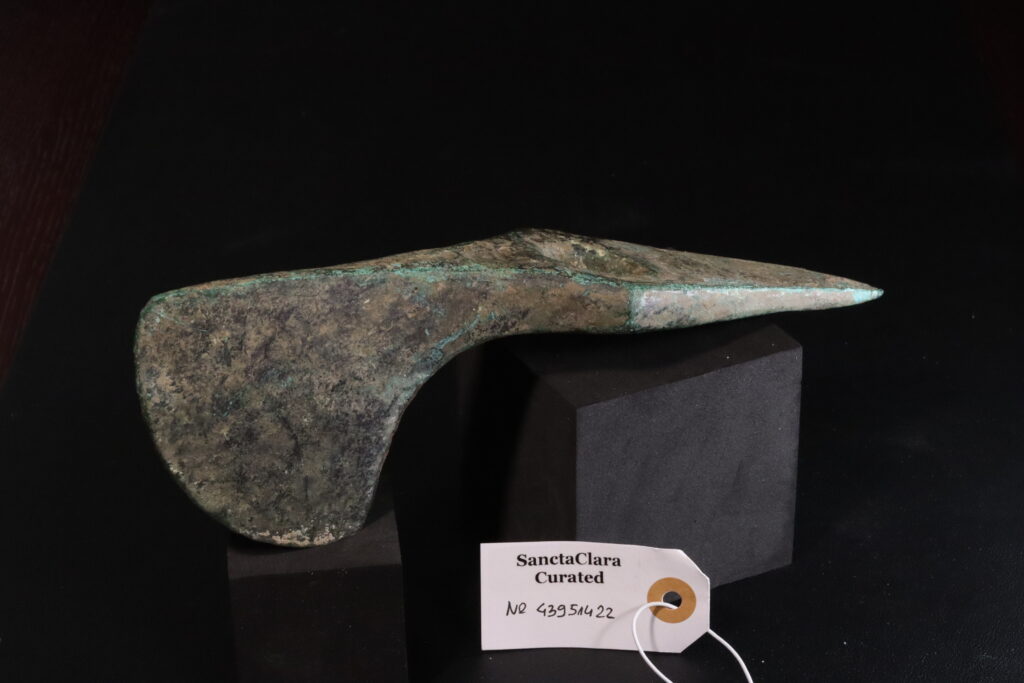
The Copper “Old Europe” Axe-Adze Sagaris (Lot 43951422) is the standout. This is a Chalcolithic piece of real consequence — a spike-butted axe-adze of the Mugeni or Siria type, within the Plocnik/Vidra family of South-East European copper metallurgy classified by Schubert. Axes of this class are not casual tools. They are concentrations of wealth, prestige and long-distance ore exchange, the products of the “Old Europe” Copper Age that flourished in the Balkans and Carpathian Basin in the fifth and fourth millennia BC — a metallurgical tradition that was, for a time, the most advanced on earth. To hold one is to hold a statement about the social complexity that copper made possible.
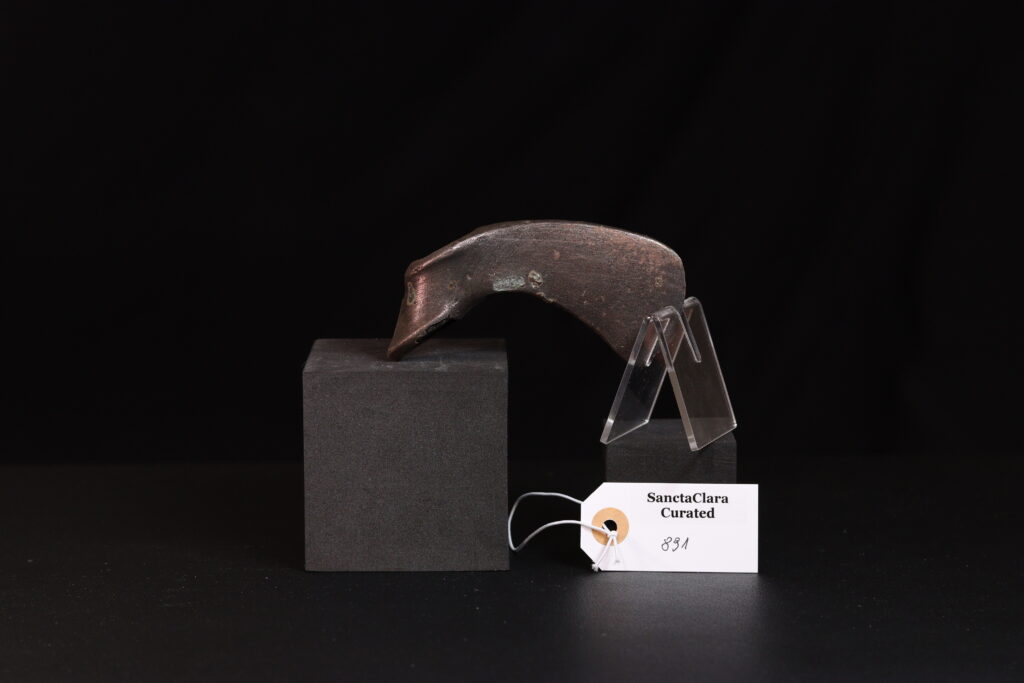
The Eneolithic Copper Shaft-Hole Battle Axe (Lot 891) belongs to the same broad Circumpontic metallurgical sphere, in its lightweight variant. I have catalogued it as a Late Chalcolithic to Early Bronze Age battle-axe, with an origin somewhere along the arc running from western Georgia (Colchis) to northern Greece and Macedonia — the Epirus/Kurgan/Veselinovo cluster of types. The very existence of a dedicated battle-axe at this date is significant: it tells us that by the late fourth and early third millennia, metal was being committed not only to felling trees but to felling people, and that a weapon distinct from a tool had begun to crystallise.
Three further pieces extend the copper story eastward and show how far the axe-adze idea travelled. The Giant Oxus copper axe-adze (Lot 102371201) is an enormous flat-topped shaft-hole axe-adze with four round collars ringing the shaft tunnel, which I attribute to the Bactria-Margiana Archaeological Complex — the Oxus Civilisation of Central Asia — or to the greater Iranian plateau in the early Elamite orbit. The Danubian collared shaft-hole axe-adze (Lot 102371386), with its structural buttresses and fullers, sits at the western end of the same morphological conversation, in the Carpathian Basin or the wider Balkan-Danubian and Pontic-Caspian world. And the L-shaped shaft-hole bronze adze (Lot 102371261), an unornamented socketed transverse blade curving smoothly downward, is the plainest expression of Near Eastern utilitarian metalwork — function with the decoration stripped away. Set side by side, these three make a point I find genuinely striking: the collared, buttressed, shaft-hole axe-adze was a pan-Eurasian solution, arrived at from Hungary to the Hindu Kush, because the engineering it embodied simply worked.
Tin bronze: the predictable alloy
The true working optimum arrived with tin bronze — copper alloyed deliberately with roughly ten to twelve per cent tin. Tin bronze is the material the Bronze Age is named for, and with good reason. Compared with arsenical copper it is less hazardous to the smith (arsenic vapour is a slow poison, and the lamed smith-god of so many mythologies may be a cultural memory of chronic arsenicism), it flows more cleanly into the mould, and above all it is predictable: a given recipe yields a given hardness, batch after batch, allowing edge geometry and casting design to be standardised. The price was tin, a rare metal sourced from a handful of distant deposits, and the long fragile supply lines that carried it underwrite much of the period’s history — a subject I have treated at length elsewhere in the library, in The Tin Roads.
Iron: the reluctant successor
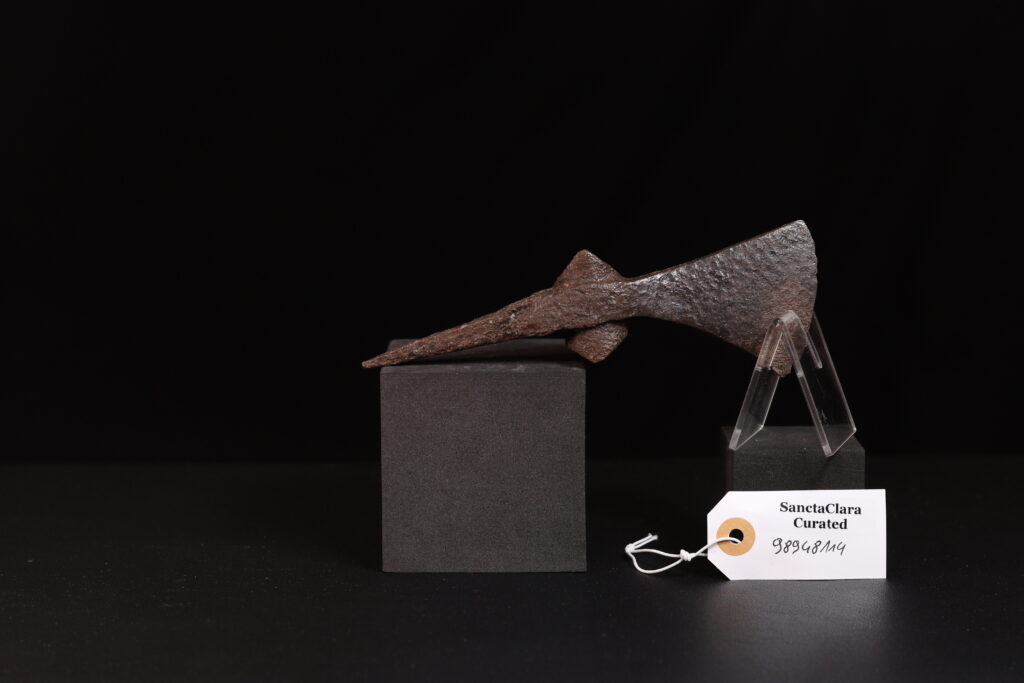
Iron did not win on merit. Plain wrought iron is softer and less satisfactory than good tin bronze, and the early Iron Age adopted it less because it was better than because bronze had become impossible — the Late Bronze Age collapse around 1200 BC tore apart the trade networks that carried tin, and iron ore, unlike tin, is almost everywhere. Necessity drove the switch; metallurgy justified it only later. Once smiths learned carburisation — working carbon into the surface to make steel — and then quenching and tempering to control hardness, iron and steel finally surpassed bronze decisively. The collection’s Hallstatt iron pick-axe (Lot 98948114) captures the transitional moment: an iron axe-adze head of Sagaris type, a broad flaring axe blade on one face, the other arm drawn out into a long straight-backed pick, a thick central body with an oval hafting eye and paired lugs above and below. It is recognisably the heir of the copper sagaris we began with — the same idea, two and a half thousand years on, rendered in the new metal.
II. Engineering the Strike: The Long War Against the Haft
If material decided what an axe’s edge could do, hafting decided whether the axe survived doing it. This is the part of the story that is most often underplayed, and yet to my mind it is the more interesting half, because it is pure mechanical problem-solving carried out by people who had no equations, only failures to learn from.
The problem is simple to state. When the edge strikes, the head wants to keep moving — driving backward relative to the handle, and twisting around it. A head that is merely wedged into split wood will, blow by blow, force that split wider until the haft fails; a head that is merely tied on will work loose and rotate. Every major morphological stage in the metal axe is, fundamentally, another move in a centuries-long campaign to lock the metal to the wood.
The flat axe and the knee-haft
The opening position is the flat axe: a simple wedge of metal, descended directly from the ground stone celt, set into a cleft in an L-shaped or naturally elbowed wooden handle — the “knee-haft”. It works, but it carries the seed of its own destruction, because the wedge that holds it also splits its host: every heavy blow drives the metal a little deeper, like a chisel, and the cleft creeps open. The collection’s two small copper flat axes (Lots 4950 and 4949) preserve this earliest and most vulnerable design in miniature.
Flanges: stopping the wobble
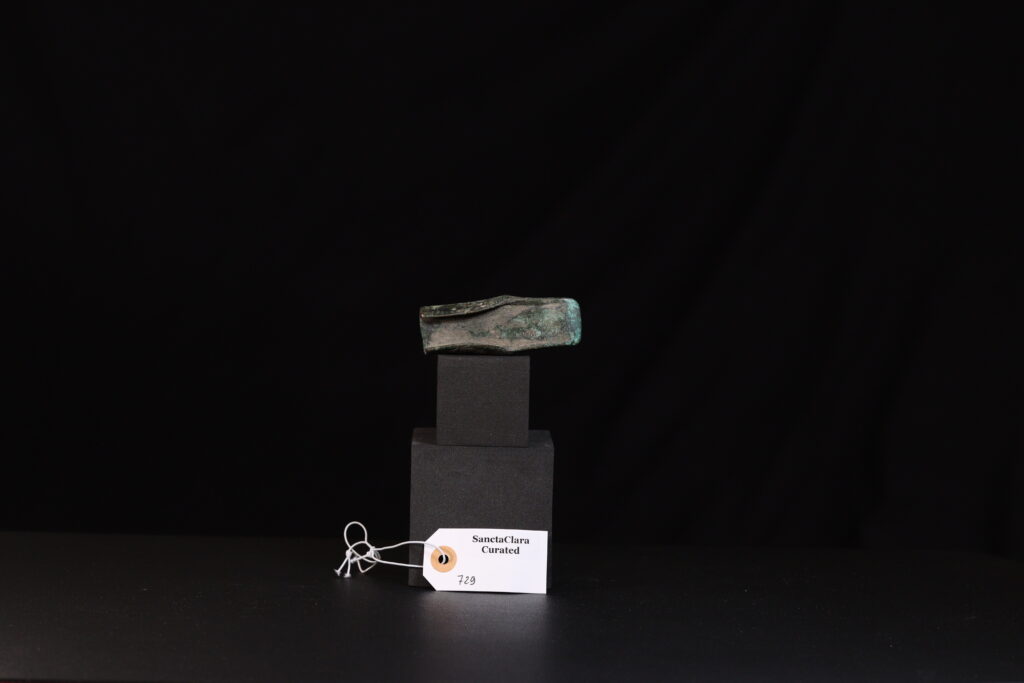
The first real improvement attacked side-to-side movement. Early Bronze Age smiths raised lips — flanges — along the long edges of the flat axe, so the wood seated between the flanges rather than merely against a flat face. This braced the head laterally and resisted twist. The Ancient Bronze Winged Axe, or flanged axe (Lot 729), is the collection’s representative of the principle. I follow the collection of H.A. (Germany) in associating winged axes of this kind with the Appenine and Sub-Appenine cultures of peninsular Italy, including Etruria, in the Middle and Late Bronze Age — though the flanged and winged idea was pan-European, and “winged” specifically describes the later stage in which the flanges were hammered up and over into curling wings that gripped the haft from both sides.
The palstave and the stop-ridge
The Middle Bronze Age produced the cleverest purely-mechanical answer of all: the stop-ridge. In the palstave, a transverse bar of metal runs across the blade. The split wooden haft wraps the upper half of the head as before, but now the stop-ridge physically arrests the wedge — the head can be driven back only as far as the ridge and no further. At a stroke this addressed the flat axe’s fatal flaw, and palstaves became one of the great workhorses of Bronze Age Europe. (The collection does not at present hold a classic palstave; it is the one obvious gap in an otherwise complete sequence, and one I would like to fill.)
The socket: turning the problem inside out
The decisive conceptual leap was to stop wrapping wood around metal and instead wrap metal around wood. The socketed axe is cast hollow at the top, using a clay core to leave a void; the elbowed wooden haft is inserted directly into that socket. Now the percussive force seats the head more firmly rather than splitting its handle, and a cast side-loop lets the head be lashed tight as insurance. This is the culmination of Bronze Age founding technology, and the collection is rich in it.
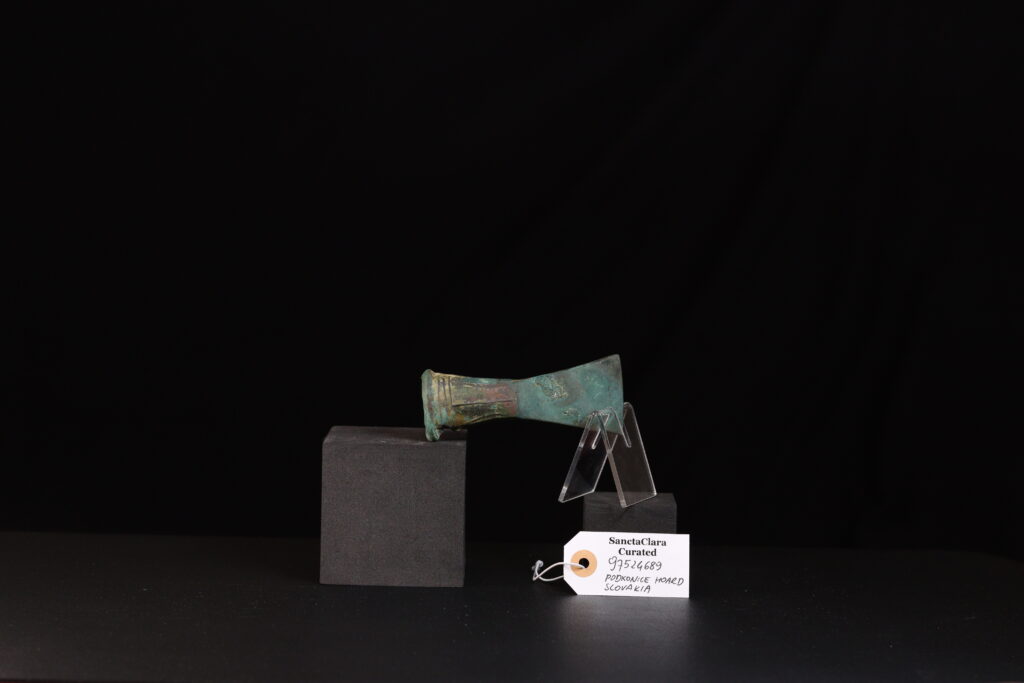
The Bronze Age Urnfield-culture large decorated socketed axe head with loop (Lot 97814529) is a superb example — a collared, decorated socket with an intact mounting loop, very precisely cast, and (revealingly) showing no signs of use, which raises the perennial question of whether the finest socketed axes were working tools or wealth made portable. Its near-twin, the Urnfield socketed axe from the Podkonice Hoard in Slovakia (Lot 97524689), tells the opposite tale through a manufacturing accident: its eyelet failed to cast, leaving the loop incomplete, and it carries a distinctly set-off thin cutting edge meant to be attached below the body. Hoards like Podkonice — deposits of dozens or hundreds of axes, many unused or deliberately broken — are among the great puzzles of the European Bronze Age, hovering between scrap-metal banking and ritual offering.
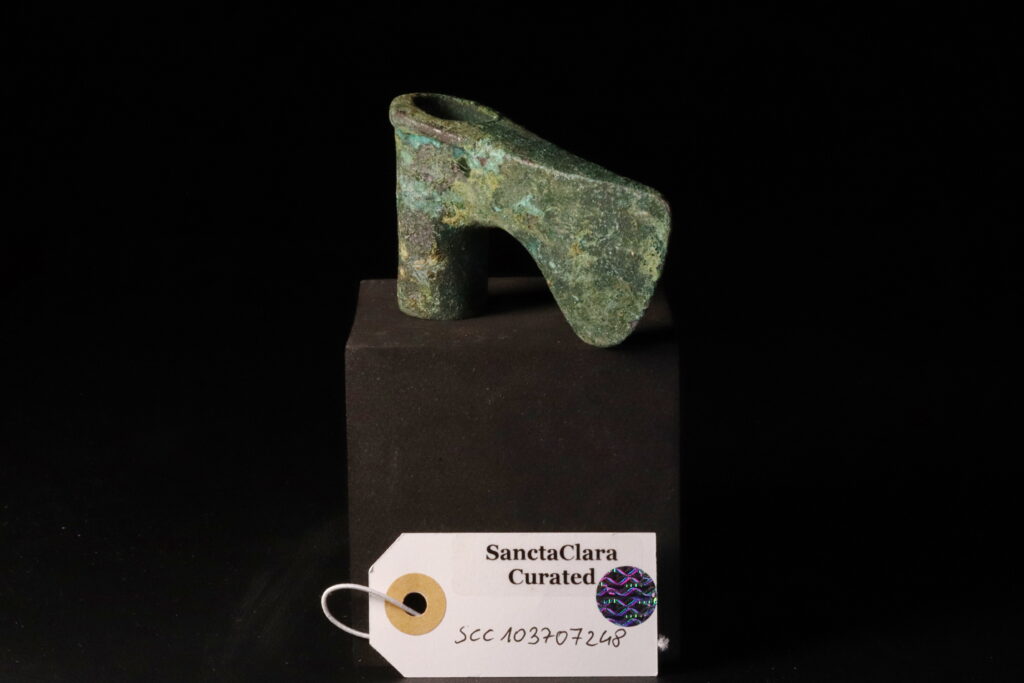
Two further socketed pieces widen the geography. The small socketed copper-alloy axe head (Lot 103707248) is a sturdy, heavy little thing with a collared socket and a slightly drooping, barbed, full-bodied blade that broadens to a curved edge. And the Dong Son bronze axe (Lot 98277415) carries the socket principle all the way to South-East Asia: a magnificent asymmetric blade from the Red River Valley tradition of Bronze Age Vietnam and Cambodia, precisely cast, and preserving the genuine rarity of actual wood remains from its handle still lodged in the socket — a direct physical trace of the hafting we otherwise only infer.
The shaft-hole: the modern axe arrives
Running alongside the European socket tradition, and in many regions preceding it, is the shaft-hole solution: a hole driven straight through the heavy head so a one-piece handle passes clean through it. To modern eyes this looks like the “obvious” design — it is, after all, how an axe is made today — but casting a clean transverse void through a solid head is metallurgically demanding, and the shaft-hole axe is best understood not as the simple starting point but as a parallel, sophisticated tradition with deep roots in the Near East and the Caucasus.
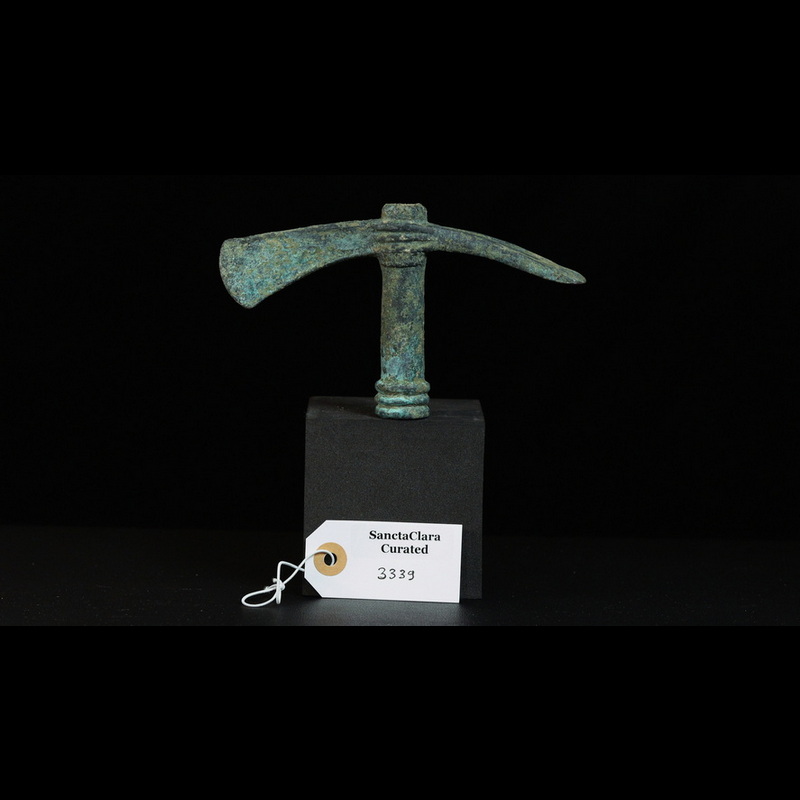
The collection’s shaft-hole holdings are among its strongest. The Bronze Decorated Shaft-Hole Axe-Adze (Lot 3339) shows raised ribs or rings at the top and bottom of the socket and a decorative central band — a textbook case of skeuomorphism, the new material (bronze) faithfully reproducing structural features that had been functionally necessary in an older one (the bindings and collars of composite hafts), now retained purely as ornament because the eye expected them. The Ancient Bronze Shaft-Hole Axe (Lot 2578) I read as ceremonial, a Western Asiatic piece from the Elam/Luristan/western Iran orbit. The Luristan Bronze Adze-Axe head (Lot 84338037) — a cylindrical shaft-hole, a flattened top, a vertical blade broadening to a convex edge and a horizontal adze blade to the rear, with a ring at the base of the socket — is a classic of that prolific Zagros workshop tradition, its inclined convex blade suggesting a martial rather than a carpentry role. On the wider problem of how much the “Luristan” label actually explains, I have set out my reservations in Luristan Bronzes, and they apply here too: the name is a market convenience laid over what were almost certainly several distinct peoples and centuries.
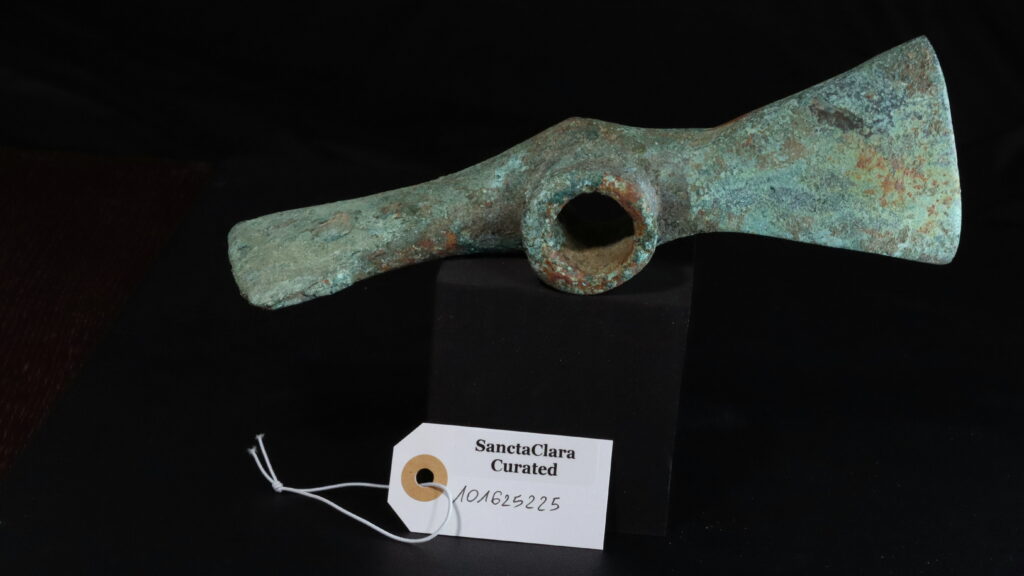
The Copper axe-adze with collar socket mount (Lot 101625225) — a dolabra with two perpendicular wide blades, a 67 mm axe edge and an 82 mm adze edge, shoulders widened at the socket and an additional lower collar — sits in the Carpathian, Transylvanian and Middle Danubian tradition, and bridges neatly to the small copper double axe head (Lot 4944), whose round socket and lozenge-shaped expansion deliberately echo the drilled stone boat-axes and battle-axes that preceded it: another skeuomorph, metal remembering stone.
III. Form Follows Function: Reading the Blade
With material and hafting understood, the shape of the working end can finally be read for what it tells us about purpose. As founding technique matured, the blade diverged into specialised forms, and learning to read those divergences is most of the practical skill in handling this category.
The single blade is the baseline — the felling and carpentry edge, which over time migrated from a narrow chisel-like profile toward the broad, flared, crescentic edge that maximises the cut. The plain socketed and shaft-hole working axes above are its expression.
The axe-adze is the ancient world’s great multi-tool: a vertical axe blade on one side of the shaft and a horizontal adze blade on the other, the axe for cross-grain felling and the adze for dressing the felled timber into planks, beams and dugout hulls. It is the single most strongly represented form in the collection — the Old Europe sagaris, the Giant Oxus, the Danubian collared piece, the L-shaped adze, the Bronze Decorated example, the Luristan head, the collar-mount dolabra and the Hallstatt iron pick all belong to its extended family — and that prominence is not an accident of collecting. The axe-adze was genuinely ubiquitous across Chalcolithic and Bronze Age Eurasia precisely because it folded two essential operations into one casting.
The axe-pike, or pick-axe, turns the rear arm into a long narrow spike for punching through the leather, felt and quilted-textile armour that wide blades only bruised. As organised warfare intensified through the Middle and Late Bronze Age the form proliferated, and the Hallstatt iron piece (Lot 98948114) carries it into the Iron Age with its drawn-out straight-backed pick opposite a broad blade.
The double axe, the labrys, sets two opposed vertical blades across a central shaft-hole. Plain versions let a woodsman turn to a fresh edge when one dulled, but the form is famous for its other life — the oversized, ultra-thin, gorgeously decorated ceremonial labrys of Minoan Crete and the wider Aegean, cast far too delicate to cut anything and intended only to be carried, displayed and dedicated. The collection’s small copper double axe head (Lot 4944) is the workaday cousin of those celebrated ritual giants.
A category worth isolating on its own is the votive and the ornamented, where the axe stops being a tool at all and becomes a carrier of meaning. The Miniature iron axe-adze, the Votive Dolabra (Lot 4952), is the clearest case: an Iron Age to Roman miniature of the kind a retiring soldier might dedicate to Mars or Minerva in thanks for survival, or a farmer to the agricultural powers — too small to use, made expressly to be given. The Koban ornamented axe (Lot 102371465), with its zig-zag, chevron and stippled motifs, belongs to the Koban culture of the northern and central Caucasus, closely entwined with neighbouring Colchis, in the Late Bronze to Early Iron Age of roughly the eleventh to seventh centuries BC; here the decoration carries identity, the surface as eloquent as the edge. With these the axe completes its journey — from a thing that does work, to a thing that says something.
Coda: The Whole Sequence in One Drawer
What makes this group of objects worth an article rather than a list is that, laid out together, they reconstruct the entire developmental logic of the ancient axe almost without gaps. The ground flint celt and the search for a shock-tolerant edge; the arsenical-copper prestige axe-adzes of Old Europe and the Circumpontic sphere; the eastward reach to the Oxus and the Iranian plateau; the predictable working bronzes of the Urnfield and Atlantic worlds; the socketed and shaft-hole solutions to the eternal problem of the haft; the skeuomorphs in which bronze politely remembers the stone and the bindings it replaced; the specialised pike for war and the labrys for the gods; and finally the carburised iron that inherited the lot. Hold them in sequence and you are holding three thousand years of people refusing to accept that their axe was as good as an axe could get.
A note on attribution and interpretation
Readers familiar with my approach will know I prefer to commit to an attribution and then say plainly where the commitment is provisional. Several positions taken above go a little beyond settled consensus and are mine to defend. The reading of the Hallstatt pick as a direct typological descendant of the copper sagaris is an interpretive line, not a documented lineage; morphological echo is not the same as continuous transmission. My insistence that the shaft-hole axe is a parallel sophisticated tradition rather than a “primitive” starting point runs against the older evolutionary-ladder textbooks, though it is now widely shared among specialists. The cultural attributions of the unprovenanced pieces — the Oxus, Koban, Danubian and Luristan examples in particular — rest on morphology and decoration rather than excavation context, and morphology can mislead; treat them as strong hypotheses, not certainties. And on “Luristan” specifically, I maintain, as I do throughout this site, that the term flattens several distinct peoples and centuries into a single saleable label, and I have used it here only as shorthand for a regional workshop tradition, not as an ethnic fact.
Sources and further reading
Schubert’s typology of South-East European copper axes (1965) underlies the Old Europe and Mugeni/Siria attributions. For the Circumpontic and Caucasian material I have drawn on the standard literature of the Maikop and Koban cultures and the metallurgy of Colchis. The Bactria-Margiana attributions follow the now-extensive BMAC excavation literature. For tin supply and the Late Bronze Age collapse, see the companion article on the tin trade in this library; for the Zagros material, the Luristan article and Manouchehr Moshtagh Khorasani’s Arms and Armor from Iran (Legat Verlag, 2006). The Robbiola framework informs the patina assessments in the individual catalogue entries.
AncientBronzes.com / The Sancta Clara Collection. All catalogued pieces (lot numbers as cited) are in the collection’s Axes, Adzes & Maces category. Images and full technical entries for each item are available in the catalogue.