
Bronze Age warfare on the river the Slavs would later call Dołęża
When a volunteer archaeologist named Ronald Borgwardt found a human upper-arm bone with a flint arrowhead still driven into it, eroding out of a riverbank in Mecklenburg-Vorpommern in 1996, nobody yet understood that the Tollense Valley would overturn a century of comfortable assumptions about the European Bronze Age. The old picture was of a quiet north: thinly settled farming communities, three to five souls per square kilometre, capable at most of cattle raids and the occasional ritual duel between a handful of chieftains’ men. What the Tollense has yielded instead — more than 12,000 fragments of human bone, the remains of at least 140 individuals, and a weapons assemblage unmatched anywhere in northern Europe — is the earliest direct evidence we possess of organised mass violence on the continent. This was a battle, fought around 1250 BC, in which thousands of men met on the boggy margins of a slow northern river, and several hundred of them died there.
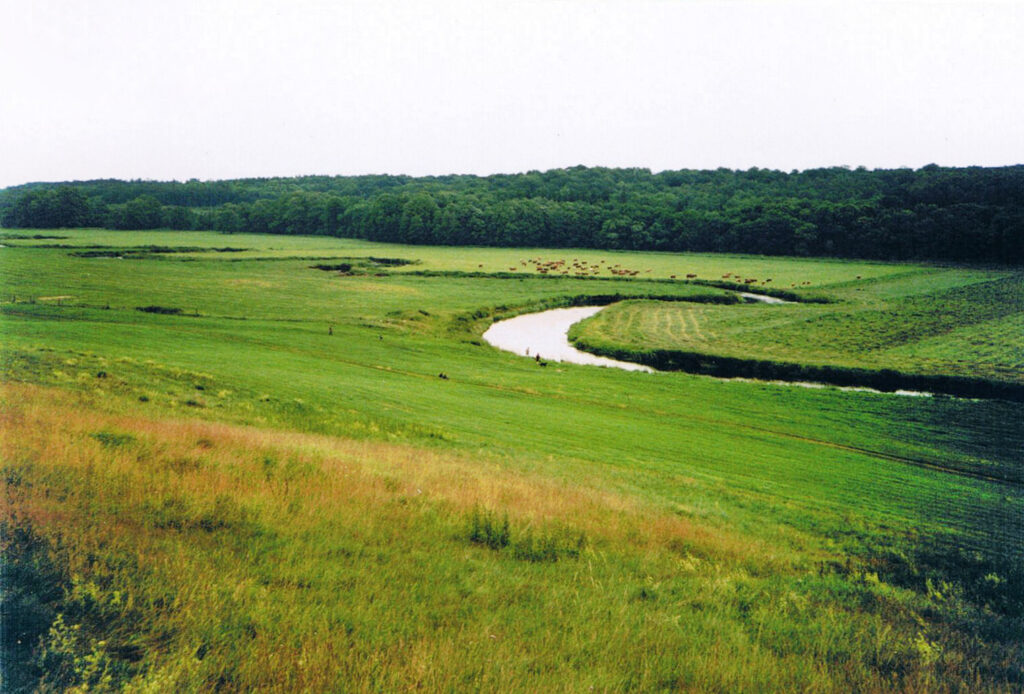
Image: Tollense Valley, by Botaurus stellaris ©Wikimedia Commons
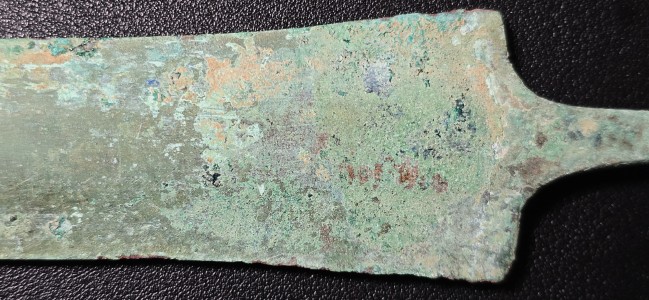
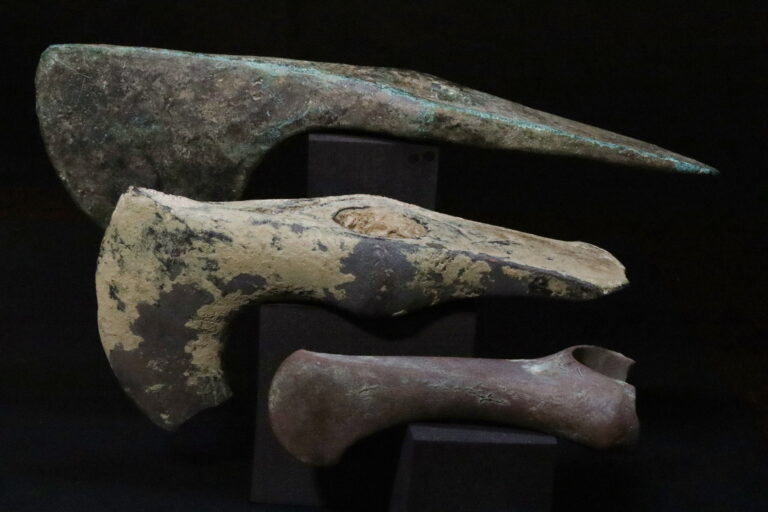
I have spent years handling the small bronze weapons of exactly this horizon — the socketed arrowheads, the leaf-shaped spear points, the daggers that blur into short swords — and the Tollense corpus speaks a language I recognise from the cataloguing table. This is not the language of ceremony and burial. It is the language of use, loss, and the brutal economy of a metal that had to be carried a thousand miles before it could be driven into a man’s skull. What follows is an attempt to read that language carefully: the weapons, the wounds, and the trade route whose disruption may help explain why the killing happened where and when it did.
The valley carries a name worth recording at the outset, because it matters both to the history and to anyone trying to find this material. The German Tollense preserves an older Slavic root; the medieval West Slavic Tollensians who later lived here were the Dolenćane, and the Polish form of the valley is Dolina Dołęży — from dolina, “valley,” the same root that gives the river its name. The Bronze Age dead pre-date the Slavs by two millennia, but the toponym has carried the sense of “the low valley” down an extraordinary span of time.
A river as a trap
The dead of the Tollense were not buried. Their bones are overwhelmingly disarticulated — pulled out of anatomical order — scattered and folded into the river’s peat and marl over a stretch of nearly three kilometres. That distribution is itself a piece of evidence. It is not what a cemetery looks like. It is what a rout looks like.
In the Bronze Age the valley floor was open, very wet, grown over with alder and birch, while the higher ground carried oak, lime and ash. Geophysical and excavation work has revealed, in the upper (southern) reach of the investigated area, a substantial piece of engineering: a causeway built of sand, peat and timber, reinforced at the flanks with stones and driven piles. It was first raised around 1900 BC and was still being maintained and used at the time of the battle — one of the very few dry crossings through the mire, a genuine chokepoint in the landscape.
Everything points to the fighting having begun as a contest for that crossing. The concentration of remains downstream of it, spread across the marshy meadows and the river itself, suggests that once the defence at the causeway broke, the killing became a pursuit. Men died on the bog, their bodies thrown into or falling into the water, where the current dismembered them before the anaerobic peat sealed what was left. The river was both the prize and the grave.
The arrow storm: why bows mattered most
If one category of find defines the Tollense, it is arrowheads. The quantity recovered exceeds anything else known from the Nordic Bronze Age and places this site, by a wide margin, at the front of the research field. The detailed 2024 study published in Antiquity — “Warriors from the south?” — catalogued and geographically analysed the bronze points, and its conclusions reshape how we should think about the battle.
From the central investigated zone came 54 bronze arrowheads and 10 of flint; dredged sediments above and below the main reach yielded a further 8 bronze and 14 flint, for an unprecedented total of 62 bronze and 24 flint points. Fragments of the wooden shafts survive too — ash and dogwood, including one 240 mm length from Weltzin 28. This is, before anything else, evidence that archery was not a skirmisher’s afterthought here. It was a primary instrument of the battle, used at a scale northern Europe had never been shown to reach.
The typology of the bronze points is where the argument turns. They are not a uniform set. Several distinct forms are present, and they map onto geography in a way that strongly implies two differently equipped populations:
- Types 5A and 5B dominate the assemblage and cluster downstream, in the pursuit zone (Weltzin 20, 32). These are northern forms, at home in the Nordic Bronze Age. Type 5B, the narrow-leaved variant, is widely read as a recycled, repaired derivative of 5A — frugal husbanding of scarce metal, exactly what you would expect on the metal-poor north.
- Type 4A appears across the whole field and is known from eastern Germany and Bavaria through to Slovakia, turning up occasionally in the north as well — a form both sides could plausibly have carried.
- Types 4B1 and 4B2, found in the upper and middle reaches, are extremely rare in the north but common from southern Brandenburg and Bavaria through Saxony to Silesia and Moravia.
- Type 4C, the barbed form, is the clincher. It occurs only in the upper reach near the causeway, and it is wholly foreign to the northern lowlands, clustering instead in Hesse, northern Austria and Moravia. Its presence is among the strongest signs that a force came from the south.
- A single Type 2A (globular-tang) point, a rarity tied to southern Germany, completes the picture.
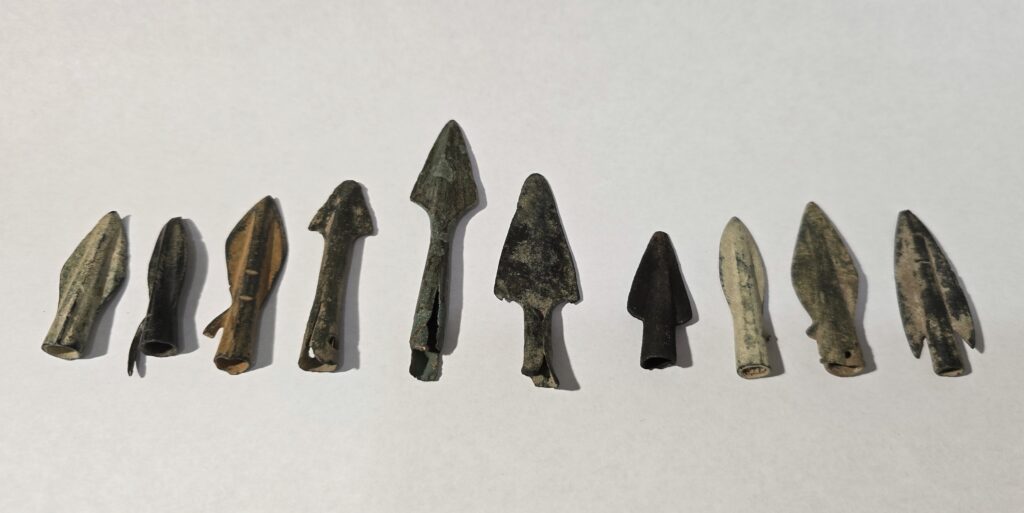
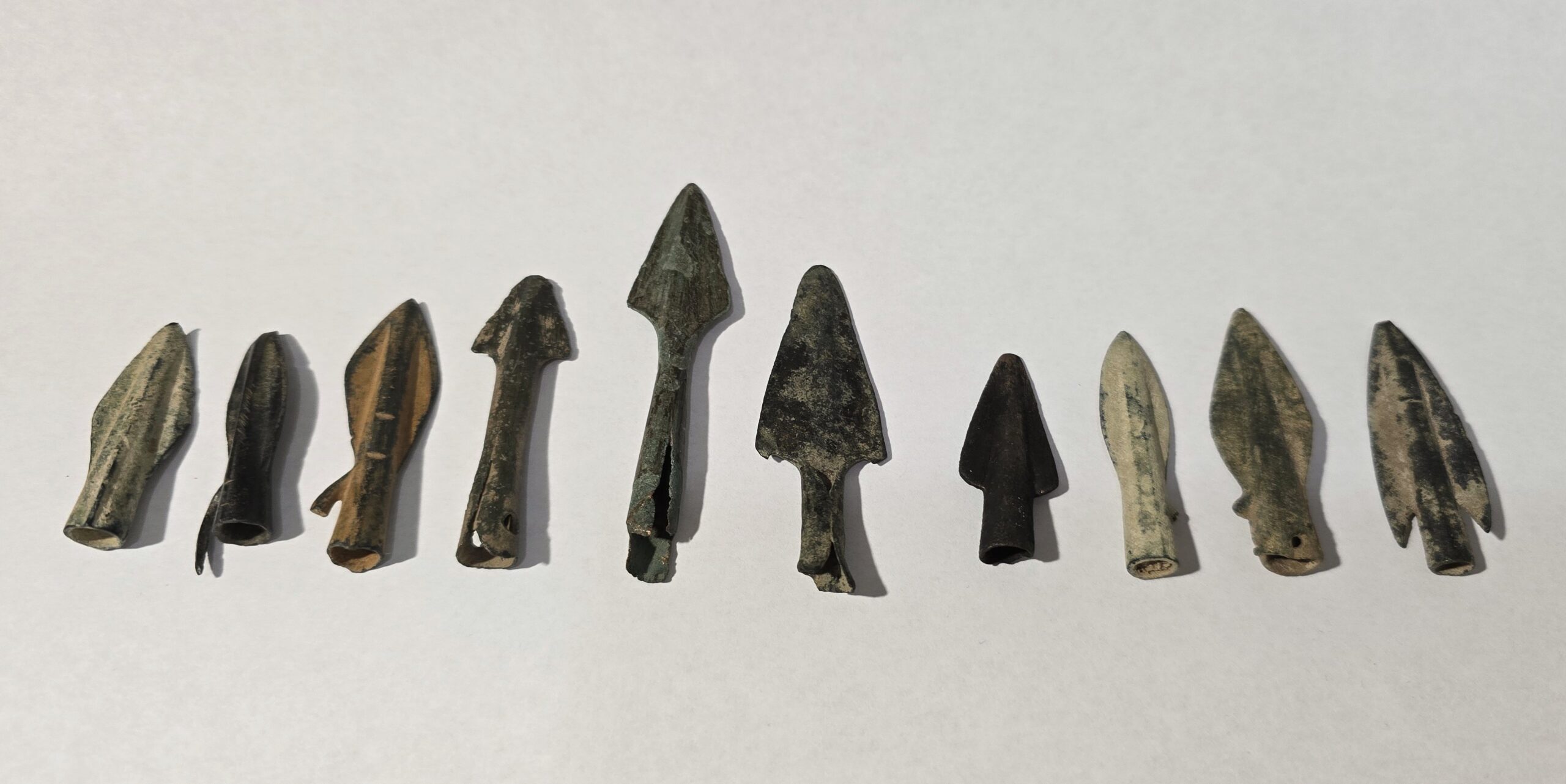
Image: bronze socketed arrowheads, bilobate (two-bladed) type, some with barbs and spurs, with morphology consistent with Tollense Valley finds, ©Sancta Clara Collection .
Read spatially, the arrowheads sketch the battle’s choreography. The exotic southern barbed forms sit at the causeway — the entry point. The fully northern Type 5 forms, and the flint, dominate the downstream flight-and-pursuit zone. The most economical reading is that a well-equipped, partly mounted force from central Europe forced the crossing and broke a local defence, and that the locals — fighting in part with flint-tipped arrows whose impact micro-fractures prove they were shot in anger — were driven downriver and cut down. That flint was still doing lethal work in 1250 BC is itself a lesson: on the metal-starved north, a neolithic-looking technology remained a serious weapon precisely because bronze was too precious to spend on every shaft.
The Sancta Clara Collection holds a representative series of socketed bronze arrowheads of just this broad tradition — bilobate and trilobate cast points designed for exactly the kind of mass-shooting the Tollense documents. They are worth examining alongside this material because they make the abstraction concrete: each one is a small, cheap, mass-produced killing tool, the Bronze Age equivalent of standardised munition. [Photographs of the relevant collection arrowheads to be inserted here — Andre to supply.]
The sword that survived: a full-hilted Riegsee blade
For all the thousands of bones, full-length bronze swords are almost absent from the river. For a long time only a single sword-blade fragment had been retrieved from the sediments — and yet the osteology is unambiguous that swords were used: dozens of bones carry deep, clean-edged sharp-force injuries that match the long, full-hilted swords of the European elite of Montelius Period III. The swords were there. They simply did not stay.
The reason is the central economic fact of this whole battlefield, to which I will return: bronze was strategic raw material, and after the fighting the victors stripped the dead methodically, recovering swords, spear points, and ornaments of gold and tin. The arrowheads we find are mostly the ones buried too deep in fleeing bodies to be worth retrieving, or lost in the mud of the fighting itself. A sword is a different proposition — far too valuable to leave.
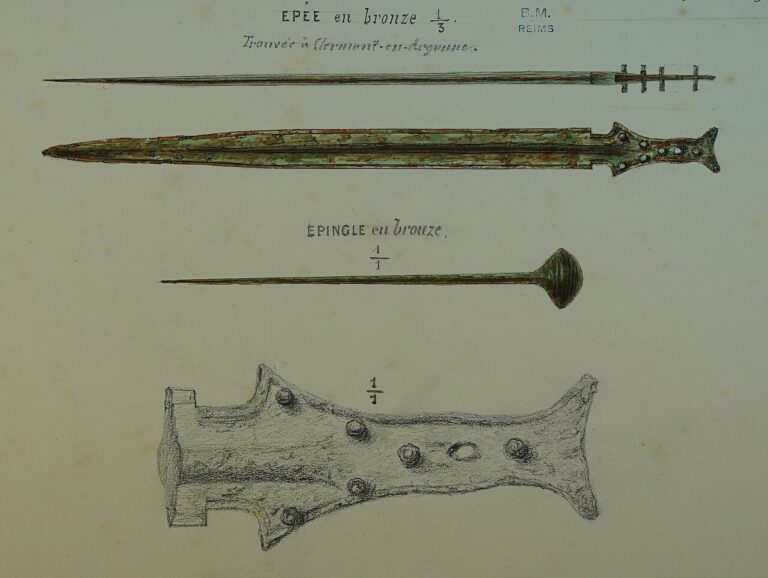
Which makes the one intact sword recovered near the site all the more remarkable. It is a fully preserved Vollgriffschwert — a full-hilted sword — of the Riegsee type, found together with two sickles, a bracelet and a piece of jewellery (whether a casualty’s gear or a separate hoard deposition is not certain). The Riegsee swords belong to the closing centuries of the period that concerns us, and the defining feature of the type for my purposes is its construction. This is not a blade with an organic grip riveted on. The hilt is cast in one with — or cast directly over — the blade, a single integrated bronze unit. In the octagonal-hilted variants the technique is explicit: the handle is cast over the already-formed blade in an overlay casting, fusing grip and blade into one object.
Morphological echo: from Arslantepe to the Tollense
This is where a thread runs back, across nearly two thousand years and three thousand kilometres, to a corpus I have written about at length: the blades from Arslantepe, in eastern Anatolia (see Arslantepe: The Rupture in Bronze Age Martial Chronologies). The Arslantepe “Hall of Weapons” swords — the oldest swords in the world, arsenical copper, c. 3400–3000 BC — are likewise integral-cast: blade and hilt formed as a single unit rather than assembled from separate pieces.
I want to be careful and precise about the nature of this echo, because it is a morphological and technological parallel, not a line of descent. There is probably no transmission, no shared workshop tradition, no genealogy connecting Malatya in the fourth millennium to Mecklenburg in the second. What links them is a recurring solution to the same problem, arrived at independently. When a smith decides to make grip and blade one continuous casting, the same consequences follow whichever millennium he works in.
The most telling of those consequences is skeuomorphism — the persistence, in the cast object, of features that only made structural sense in an earlier composite weapon built from separate parts. On the Arslantepe hilts I have argued that the cruciform broadening at the blade-hilt junction, and the way the blades splay outward at the shoulders, are cast “ghosts” of a lost multi-piece prototype: features that earn their keep only when a separately-forged guard plate has to seat and be riveted across the tang, and that are mechanically pointless on a one-piece casting. The smith reproduced the silhouette of the composite weapon his tradition remembered, even though his casting method no longer required it.
The full-hilted northern swords invite the same kind of reading. Their cast hilts carry mouldings, ribs, collars and pommel forms that imitate, in solid bronze, the bindings, rivets, and organic grip-plates of an assembled hilt. The decorative banding on a Riegsee or Nordic full-hilt is a memory of the functional wrappings of a composite handle, translated into a material that no longer needs them. In both the Anatolian and the northern cases the integral casting is a technological flex — we can make the whole thing in one pour — and in both cases the object honestly confesses, in its own ornament, the composite ancestor it has replaced. The Tollense sword is, in this narrow but real sense, a distant cousin in construction logic to the Arslantepe blades: two points, far apart in time, where European and Near Eastern metalworkers each chose to collapse a multi-part weapon into a single cast body, and each left the fingerprints of the older method in the surface of the new.
That parallel is my own argued reading, advanced here as an interpretive position and not as established consensus; I set it out more fully, with the Arslantepe evidence, in the companion article.
Wooden clubs and the ordinary soldier
Against the bronze-tipped arrows stands the humblest weapon the bog preserved: the wooden club. Two survive. The first, found beside the famous arrow-pierced humerus, is of springy ash (Fraxinus excelsior), about 73 cm long, thickened at one end — uncannily like a baseball bat. The second, of very hard blackthorn (Prunus spinosa), has a curved, carefully smoothed handle and a head 175 mm long and 50 mm across, shaped like a croquet mallet. Comparable clubs are known from other northern sites. These are the arms of the rank and file — and the osteology shows they were devastatingly effective, leaving the crushed cranial vaults that sit alongside the sword-cuts and arrow-wounds in the catalogue of death.
Reading the wounds
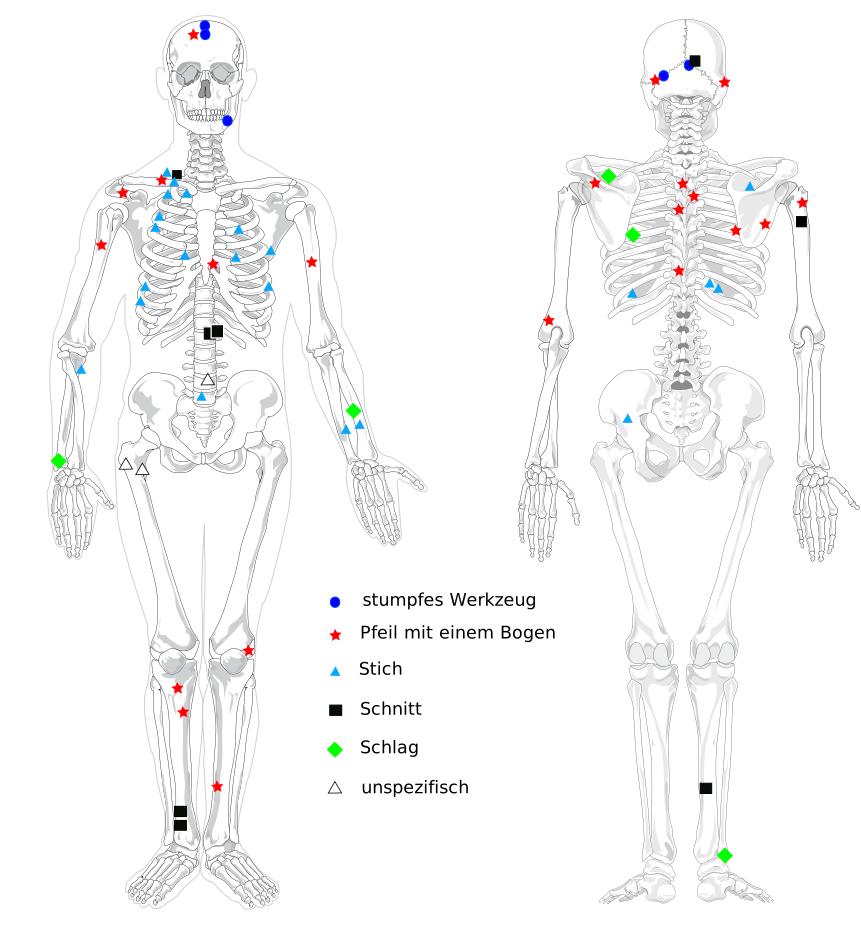
Image: Wound type and distribution in Tollense Valley schelletons, red star indicates arrow hits, green squares are the blunt force hits, and blue triangle are stab wounds; by Gżdacz ©Wikimedia Commons
The bones are the final witness, and the most direct. Perimortem injuries — inflicted at or just before death, with no sign of healing — appear in every category of Bronze Age violence. There are clean sharp-force cuts and stab wounds on skulls, ribs and limbs from swords, daggers and spears, many on the backs of skeletons, the signature of men killed from behind in flight. There is blunt-force trauma: caved frontal and parietal bones consistent with clubs and sword pommels, and parry fractures of the forearm where a victim threw up an arm against a descending blow. And there is projectile trauma — the icon of the site — including a skull shot clean through by a bronze point whose tip deformed against the dense bone of the back of the head.
The re-analysis of the original 1996 humerus deserves a note, because it corrected an early error in exactly the spirit this collection tries to maintain. First studies using clinical CT suggested slight healing, which would have made it an old wound the man survived. High-resolution micro-CT overturned that: there was no new bone formation; the apparent “healing” was compacted trabecular debris pushed ahead of the arrowhead. The wound was perimortem, and the angle shows the arrow came from below — an archer on the ground shooting up at a man on horseback.
And then there are the healed wounds. Around a quarter of the injured skeletons carry old, knitted-over trauma: closed skull fractures, mended long bones. The demographic — overwhelmingly men of twenty to forty — combined with these veteran scars tells us this was no levy of farmers pulled off the plough. These were practised fighters, men who had survived earlier violence, organised into the retinues of leaders. The Tollense killed soldiers.
Who fought, and the limits of what we can say
Isotope analysis of tooth enamel — strontium and oxygen laid down in childhood with diet and water — shows that only a minority of the fallen carried a local north-German signature. The majority grew up hundreds of kilometres away, with signatures pointing to central and southern Europe (Silesia, Bohemia, Bavaria are the candidates), a finding that dovetails neatly with the non-local arrowhead types. Ancient DNA from fourteen of the warriors, sequenced by Joachim Burger’s team and published in Current Biology in 2020, found them to be an unstructured central-and-northern European population — genetically the ancestors of the broad modern population of the region — with no evidence that men within a unit were closely related, reinforcing the picture of assembled fighting bands rather than kin-groups. (The same study produced the striking finding that only about 7% of these men carried the lactase-persistence allele, against roughly 90% in the region today — a vivid measure of how fast natural selection has run in four thousand years.)
It is essential to be disciplined about what this evidence does and does not support. The genetics establish biological ancestry; they do not license modern ethnic or national labels. The categories sometimes attached to this battle — “Germanic,” “proto-Slavic,” and the like — are anachronisms when applied to 1250 BC. The cultural names we use for this horizon — Nordic, Tumulus, Urnfield, Lusatian — denote assemblages of pottery, burial rite and metalwork style, not the self-aware ethno-linguistic nations that would emerge millennia later. What the Tollense records is a violent collision in a frontier zone, not a war between peoples in any sense we would recognise.
In the Lusatian borderland
That frontier framing is the right one for placing the battle culturally, and it is worth stating precisely. The Tollense Valley sits at the northwestern margin of the world that would crystallise as the Lusatian (Lausitz) culture — the great Urnfield-related complex of the Late Bronze Age, centred on what is now Poland and reaching into eastern Germany, Bohemia, Moravia and beyond, conventionally dated from roughly 1300 BC. At 1250 BC the valley lies in the contested overlap between the Nordic Bronze Age to the north, the Tumulus/Urnfield world to the south and west, and the emerging proto-Lusatian sphere to the south and east. Silesian-style bronze pins found among the bones, and the millet-rich diet characteristic of the Ore Mountains region and Silesia, both point southeast toward the Lusatian heartland for at least part of the host.
So the battle was fought on the northern edge of the Lusatian realm, at a junction of metalworking provinces — a meeting place for the very trade in copper, tin, amber and perhaps slaves that gave the region its strategic weight. That it became a killing ground is not incidental to its position on those routes. It is, I will argue, a direct consequence of it.
The bronze economy and a British mine running dry
Here is the synthesis I want to put forward — and I flag it clearly as my own argued hypothesis rather than settled scholarship.
The Tollense battlefield is, at bottom, a document about metal. The near-total absence of swords from the dead, the careful recovery of valuable arms by the victors, the recycled Type 5B arrowheads, the smith’s “toolkit” recovered at Weltzin 28 — a cluster of 31 objects (a curved knife, an oak-handled awl dated 1300–1250 BC, a chisel, bronze tubes, and crucially scrap bronze and ingot fragments serving as pre-monetary currency) — all of it testifies to a world in which copper and the much rarer tin were strategic commodities, hauled across the continent and hoarded, fought over, and recycled to the last gram. The man who died in the bog with that toolkit was a specialist: a smith or warrior-trader from the south, his death preserving the kit his killers never recovered.
Now set against that a fact from the far western end of the network. The Great Orme copper mine in north Wales — that is the famous deep mine of the British Bronze Age, on the Llandudno coast — had been the dominant source of British copper through a genuine “golden age” of production, roughly 1600–1400 BC, with its distinctive metal reaching across the Channel from Brittany to the Baltic and into Scandinavia. Then, between about 1400 and 1300 BC, the two richest mineralised zones were exhausted, and Great Orme’s output fell off precipitously. After 1300 BC its metal becomes, in the words of the excavators’ databases, virtually invisible. The boom turned to bust, and a major artery of the European copper trade ran dry — at very nearly the moment the Tollense was fought. British bronze smiths needed to turn to imported metal to keep working, and that meant new trade routes to be cleared.
I do not think that is a coincidence, and I want to state the causal chain plainly while owning its speculative character. The amber-and-metal corridors that knit Bronze Age Europe together ran along the river valleys radiating north and south from the watershed between the Elbe, Oder and Vistula — and the Tollense Valley, with its rare engineered causeway across the mire, sat astride one of those northern arteries. When a supplier as significant as Great Orme collapses, the network does not simply do without; it reorganises. Flows reverse, alternative sources (Alpine, Iberian, Ore-Mountain) are pulled on harder, and the relative value of every controlled crossing, every chokepoint, every stretch of navigable corridor rises. A disruption of that magnitude at the western end of the system would have sent pressure rippling eastward along precisely the routes that converge on the Tollense. The causeway that two armies fought to hold or force was, on this reading, not just a path through a bog. It was a valve on a trade network thrown into turbulence by the failure of a Welsh mountain mine — and the men who died holding it, or storming it, died over the control of metal in a year when metal had suddenly become harder to come by.
That is a hypothesis, offered as a hypothesis. The dating overlap is real and the geography is real; the causal link is an inference I am willing to defend but cannot prove. It is exactly the kind of claim that should be labelled as the author’s own, and it is.
What the Tollense leaves us
Strip away the speculation and the bedrock remains extraordinary. Around 1250 BC, on a river the later Slavs would call the Dołęża, thousands of trained, well-fed, far-travelled fighting men — some mounted, some carrying arrows tipped in bronze that had been cast a thousand kilometres to the south, some swinging ash and blackthorn clubs — met in a battle that killed hundreds and left their dismembered bodies in the peat. They shot at each other in volleys, broke a defended crossing, and ran down the losers from behind. Then the winners walked the field and gathered up the bronze.
It is the oldest battle we can see in such detail anywhere in Europe, and almost everything it shows us — the scale, the logistics, the professional warriors, the archery, the obsessive recovery of metal — was supposed to have been impossible in the quiet northern Bronze Age. The single intact sword from the valley, a one-piece cast full-hilt that wears the ornamental ghosts of an older composite weapon, ties this northern killing ground by a thread of shared technological logic to the very first swords ever made, two millennia earlier and a continent away. And the river itself, the trap and the grave, may have run red in a year when a mine in Wales fell silent and the value of every crossing in Europe quietly rose.
A note on certainty: The scale, date, weapon assemblage, isotope and aDNA results, and the wound pathology described here reflect the published consensus from the Tollense research programme and the 2024 Antiquity arrowhead study. The reading of the full-hilted sword’s cast construction as a skeuomorphic cousin to the integral-cast Arslantepe blades is my own argued interpretation, set out more fully in the companion Arslantepe article, and is a morphological and technological parallel only — not a claim of historical transmission. The link between the Great Orme copper mine’s collapse (c. 1400–1300 BC) and the strategic pressure on the Tollense crossing is advanced explicitly as the author’s own hypothesis: the chronology and geography are documented, the causal connection is inferred. Modern ethnic or national labels are deliberately avoided for a population two thousand years older than any such identity; the “Lusatian borderland” is a statement of cultural-geographic position, not of ethnicity.
Sancta Clara Collection / AncientBronzes.com. The collection’s socketed bronze arrowheads are woven through the discussion above as illustration of the mass-archery the Tollense documents; photographs to be inserted at the marked point. Cross-reference: the Arslantepe blade corpus is treated at length in Arslantepe: The Rupture in Bronze Age Martial Chronologies, and the broader sword typology in the bronze swords guide.