
By Andrzej M. Izyk — Sancta Clara Collection / AncientBronzes.com
In December 2020, the retired head of Israel’s space security programme, Professor Haim Eshed, told an interviewer that humanity was already in contact with a “Galactic Federation”, which was waiting for us to mature before announcing itself. The story went joyously viral, was denied by everyone in a position to deny it, and settled into the internet’s permanent collection of things half-remembered at parties.
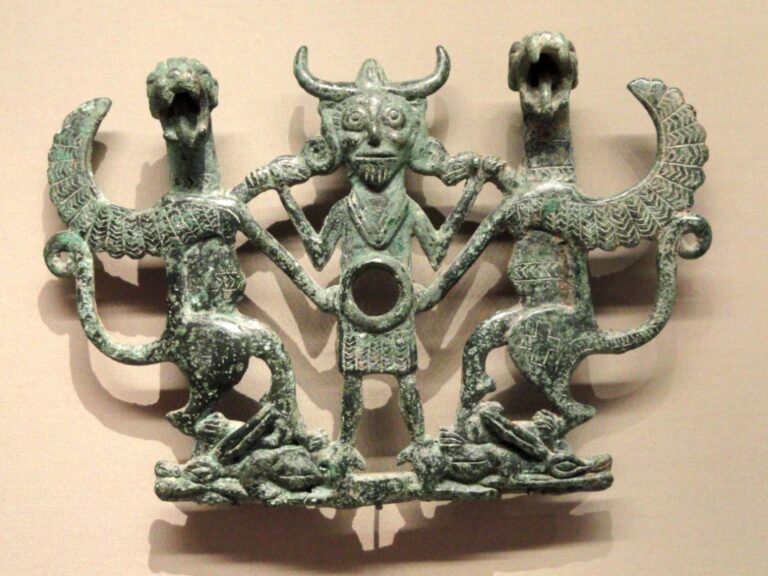
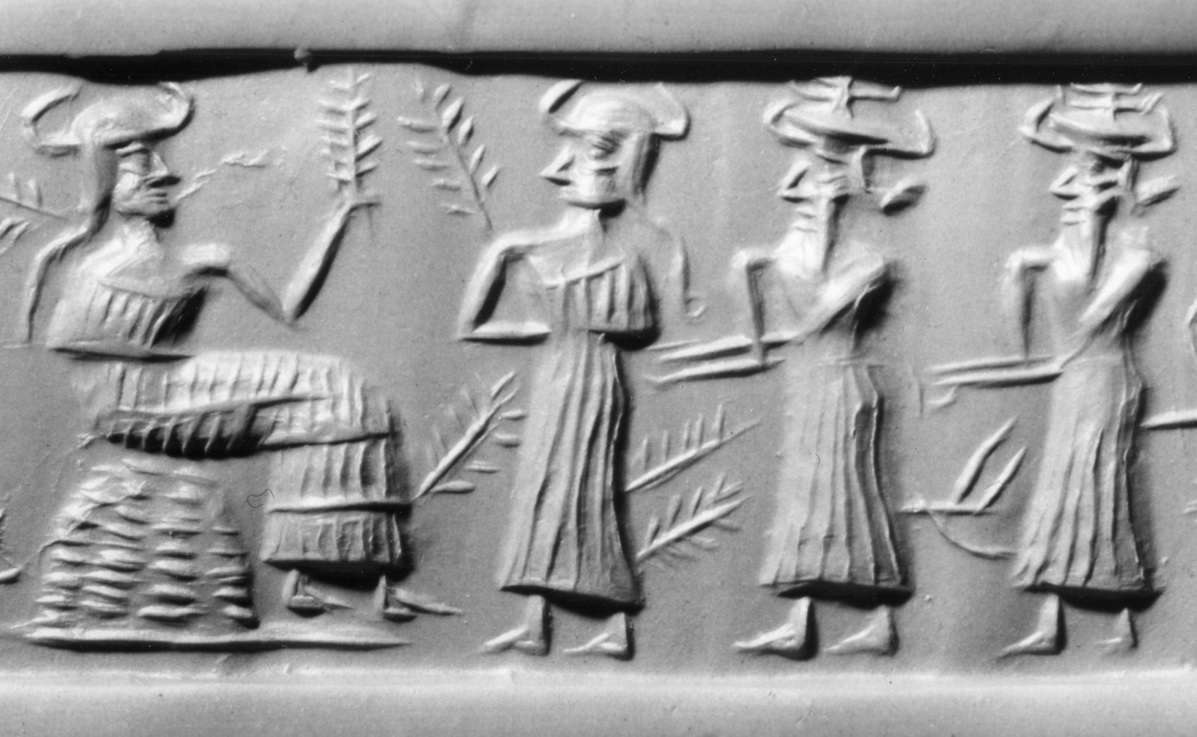
Here is what struck me about the episode, as someone who spends his days with Bronze Age metalwork: the idea itself would not have surprised a single literate person in the ancient world. A council of powerful beings above the sky, organised, hierarchical, occasionally intervening, mostly withholding itself? That is not science fiction to a scribe of Ugarit or Babylon. That is Tuesday. The tablets of the second millennium BC describe exactly such an assembly — with a chairman, a membership list, allotted territories, and, most interestingly for readers of this site, an armoury. The gods of the oldest texts are not vague luminous principles. They hold meetings and they hold weapons — weapons with individual names, named makers, and service histories.
So let us ask the question the way a collector would ask it, with the objects on the table: what was actually going on with all these ancient gods and their mighty weapons? This article walks through the evidence in three layers — the council as the texts describe it, the council as the bronze record embodies it, and the divine arsenal as both describe it — keeping my usual registers visibly separate: established scholarship (✅), argued inference (⚠️), and my own framework (◆), the last of which I develop at book length in my new book, Abandoned Children of the Gods: Still Waiting for the Return.
One housekeeping note before we begin. This article discusses ancient Near Eastern texts as historical documents, alongside the manuscript evidence for how they were edited over time. It makes no claims about any modern faith, and it picks no theological fights. We are doing here what this site always does: reading artefacts — some of bronze, some of clay — as carefully as we can.
The council on the record
Start at Ugarit, on the Syrian coast, where an entire palace archive of alphabetic cuneiform tablets came out of the ground from 1929 onward and rewrote everything we thought we knew about the religion of the Bronze Age Levant (✅).
The Ugaritic texts describe a divine world organised like a royal court. At its head sits El — the name simply means “god” — aged, bearded, enthroned at the source of the two rivers, presiding over the assembly. Around him: the “sons of El”, the council of the gods. The Baal Cycle, the great mythological epic of the archive, at one point numbers the wider family as the seventy sons of Athirat (El’s consort) — KTU 1.4 VI 46 — a figure most scholars read as rhetorical totality, seven times ten, “the whole board” (✅ for the text; ⚠️ for the interpretation; a minority reading even argues the word means seven, a heptad of astral gods, which is a live philological dispute and a good reminder that nothing here is as settled as the documentaries suggest).
Below the chairman, the active executive: Baal the storm god, fighting the council’s wars; Yam, the sea, his rival; Mot, death; Kothar-wa-Hasis, the craftsman god — hold that name, because he is about to matter enormously.
Now the part that startles newcomers. This same council structure is visible inside the Hebrew Bible, and demonstrating that requires no speculation at all — only manuscripts (✅). Psalm 82 opens with a deity taking his stand “in the council of El”, judging “among the gods”, and ends with the gods sentenced to die “like men”. In 1 Kings 22 the prophet Micaiah describes the assembly in session, hearing proposals. In Job 1–2, “the sons of the elohim” present themselves at court on an appointed day, like officers reporting.
And then there is the most famous textual variant in the whole field. Deuteronomy 32:8–9 describes the nations of the earth being divided up “according to the number of…” — of whom? The manuscripts disagree:
| Witness | Date of witness | Reading |
|---|---|---|
| Masoretic Text (medieval standard) | codices c. AD 900–1000 | “…sons of Israel“ |
| Septuagint (Greek translation) | 3rd–2nd c. BC tradition | “…angels of God / sons of God” |
| Dead Sea Scrolls, 4QDeut^j | c. 1st c. BC/AD | “…sons of elohim” (bene elohim) |
The oldest Hebrew witness we possess, the Qumran fragment 4QDeut^j, agrees with the Greek against the medieval standard: the nations were allotted to the sons of the gods, one nation per council member, and (verse 9) one particular people fell to one particular member as his portion. The mainstream position in textual criticism — argued in detail by Michael Heiser in Bibliotheca Sacra 158 (2001), and shared by scholars such as Mark S. Smith (The Origins of Biblical Monotheism, 2001) and John Day (Yahweh and the Gods and Goddesses of Canaan, 2000) — is that the Qumran/Greek reading is the older one, softened by later scribes uneasy with its implications (✅ as the majority scholarly view; I note honestly that the Qumran evidence for this verse rests on fragmentary material and has its critics, ⚠️).
Put Ugarit and Qumran side by side and the picture assembles itself: a chairman, roughly seventy members, and a territorial partition of the earth — each god assigned a province and a people. The scribes of the Iron Age were not inventing a cosmology; they were working within one their whole region had inherited. Scholars call it the divine council. If you prefer sky council, I will not stop you. If you insist on galactic federation, I will only ask you to keep your tongue visibly in your cheek, as mine is.
The Anunnaki, properly introduced
No article touching this territory escapes the word Anunnaki, so let us give the term the precision it never gets online — because the real story is better than the invented one.
In Sumerian the name is written (d)a-nun-na(-ke₄-ne) and means “princely offspring” — the descendants of An, the sky god, and Ki, the earth (✅; see Black & Green, Gods, Demons and Symbols of Ancient Mesopotamia, 1992). In the earliest texts they are the great gods collectively, the assembly that decrees fates. Later, in the Old Babylonian period, the terminology splits: the Igigi become the gods of heaven and the Anunnaki increasingly the gods of the earth and underworld — ending their career, in texts like Inanna’s Descent, as the judges of the dead. From board of directors to tribunal: a demotion worth pondering, and one my book spends some time on.
What the name does not mean is “those who from heaven to earth came”. That gloss was Zecharia Sitchin’s (The Twelfth Planet, 1976), and it is not a defensible minority translation — the Sumerian compound contains no verb of motion and no word for earth-as-destination; nun is simply “prince” (✅). I say this as someone whose readers include many friends of alternative research, and who wrote a book that mainstream reviewers would themselves file under alternative research: the alternative case does not need bad linguistics, and is actively harmed by it. The genuinely strange material — the council, the partition, the allotments, the arsenal, the departure — is sitting in the accepted translations, in plain sight, published by university presses. You do not need an invented planet. You need only the patience to read what is actually written, which is the entire method of Abandoned Children of the Gods, and of the sober end of the tradition I engage there — Mauro Biglino’s word-for-word translations, Paul Wallis’s close readings — as distinct from the end I set aside.
The council cast in bronze
Texts are one witness. This site exists because of the other one: metal.
In the National Museum of Damascus sits a small seated figure from Ugarit (inv. S 3573, RS 23.394), bronze under gold foil, dated c. 1400–1300 BC: a bearded male on a throne, hand raised in blessing, drill-holes above the ears where horns of divinity were once fitted. The identification, on stylistic grounds, is El himself — the chairman of the council, as his own city cast him (✅ for the object; ⚠️ for the identification, which is standard but inferential). He is not a warrior. He is an executive: robed, enthroned, administrative. His counterpart is the famous striding, smiting Baal type — arm cocked overhead, weapon (usually lost) raised — known from Ugarit’s finds and from the whole Levantine corpus of smiting-god bronzes. Between the two figurine types you can read the org chart: the one who presides, and the one who strikes.
And these were not illustrations. In Mesopotamian practice a cult statue was made animate through the mīs pî, the “mouth-washing” ritual, after which the god was understood to be genuinely present in the image — and was then dressed, fed two meals a day, and carried in procession, a regime A. Leo Oppenheim memorably described as “the care and feeding of the gods” (Ancient Mesopotamia, 1964) (✅). Whatever one concludes about why, the ancients’ own institutional behaviour treated their gods as beings with bodies, addresses, appetites and staff. The small bronzes that survive — the personal, hand-sized votives I wrote about in Gods in the Hand — are the household end of that same infrastructure: contact points with specific, named, located powers. The Luristan ibex finial in this collection (Lot 2248) belongs to that world of small sacred hardware, whatever precise power it once addressed.
The armoury of heaven
Now open the arsenal — because here the texts become strangely, wonderfully technical, and here a weapons collection has standing to speak.
Across the mythologies, divine power is oddly non-innate. The gods of the old texts do not simply emanate force. They carry equipment. The equipment is manufactured, by named specialist craftsmen; it is issued for specific campaigns; it has individual names, like ships or regimental colours; and it can be lost, gifted, or decommissioned. Consider the inventory (all entries ✅ as descriptions of what the texts say):
| Weapon | Owner | Forged by | Source | Service record |
|---|---|---|---|---|
| Yagrush (“Chaser”) & Ayamur (“Driver”) | Baal | Kothar-wa-Hasis | Baal Cycle, KTU 1.2 IV | Two named clubs, made and named at forging for the war with Yam; Ayamur strikes the decisive blow |
| Sharur (“Smasher of Thousands”) | Ninurta | — | Lugal-e; Angim | A sentient mace: flies reconnaissance, reports intelligence, advises its owner mid-campaign |
| Bow, mace, net, the four winds | Marduk | — | Enūma Eliš IV | The kit list for the Tiamat engagement is itemised like a quartermaster’s issue |
| Vajra (thunderbolt) | Indra | Tvashtar | Rigveda (with later traditions adding the sage Dadhichi’s bones) | The serpent-slaying weapon of the Vedic storm god |
| Mjölnir | Thor | The dwarfs Brokkr and Sindri | Skáldskaparmál | Delivered with a manufacturing defect — the short handle — duly recorded |
| Gungnir | Odin | The sons of Ivaldi | Skáldskaparmál | The spear that never misses |
| The thunderbolt | Zeus | The Cyclopes | Hesiod, Theogony 139–141, 501–506 | Supplied as payment for their release; the decisive armament of the Titan war |
| Spear of Lugh; Sword of Nuada | Tuatha Dé Danann | — | Cath Maige Tuired tradition | Two of the four treasures brought by the god-race; irresistible in engagement |
Read down that table and a pattern stares back that has nothing to do with any single culture: a logistics culture. Weapons are named at manufacture, attributed to workshops, associated with defects and delivery terms, deployed for specific wars. Kothar-wa-Hasis — craftsman, engineer, architect of Baal’s palace — is a supplier, and the Baal Cycle records his deliverables. The mainstream reading is that this reflects the Bronze Age’s own social world projected onto heaven: prestige weapons were named, smiths were semi-magical figures, and epic simply mirrors the armoury of the palace (✅ as the scholarly frame, and it is a good one). My book asks, at length, what happens if you decline the projection and read the ledger as a ledger (◆). You are free to stop at the first reading; the table is remarkable either way.
The bronze record meets this tradition at several points a collector can touch. The mace — Sharur’s category — was the divine emblem par excellence in Mesopotamia: maces were dedicated in temples by the hundred, inscribed with the names of gods and donors, long after they ceased to matter on the battlefield (✅). A small bronze mace head like Lot 5148 in this collection sits at the humble end of a class whose upper end was literally the signature of gods. The astonishing Chalcolithic hoard from Nahal Mishmar — 429 objects, mostly copper, c. 3500 BC, including dozens of elaborate “sceptres” and mace heads of no practical military use — shows the weapon-as-sacred-object tradition already fully formed before the Bronze Age proper (✅). And the practice of writing on projectiles — compare the inscribed arrowheads Lot 769 and Lot 763 here, the latter Egyptian — belongs to the same instinct that named Yagrush at the anvil: a weapon with writing on it is a weapon with an identity. Even the socketed spearhead Lot 90939651, sold to me with an Ugarit attribution I treat with explicit caution (its paperwork contradicts itself, as I have noted elsewhere), earns its place in this discussion as a specimen of the type of armament the Baal tablets take for granted.
Proxy wars, and arming the natives
One more feature of the old texts deserves a collector’s attention, because it concerns the transfer of divine equipment downward.
In the Iliad, the gods at Troy do not merely inspire; they take the field, under what read like rules of engagement — and they take casualties. In Book 5, the mortal Diomedes, his eyes opened by Athena, wounds Aphrodite in the wrist and then spears Ares himself, who bellows like ten thousand men and retreats to Olympus to complain (✅ as a plain description of the text — and it is worth pausing on how strange it is: beings of pure spirit do not need field dressings). In Book 18, Hephaistos — the Greek seat on the craftsman-god board that Kothar occupied at Ugarit — forges a complete replacement armour set for a mortal client, Achilles, on divine account. Heroes fight with issued kit; gods observe force-limitation conventions; the whole war reads, in places, like a proxy conflict between council factions, fought through favoured human clients. That last sentence is interpretation (⚠️ — though a surprisingly old and respectable one), and it is the reading my book pursues across traditions, from Troy to the Irish battle of Mag Tuired, where the god-race deploys its named weapons crew by crew (◆).
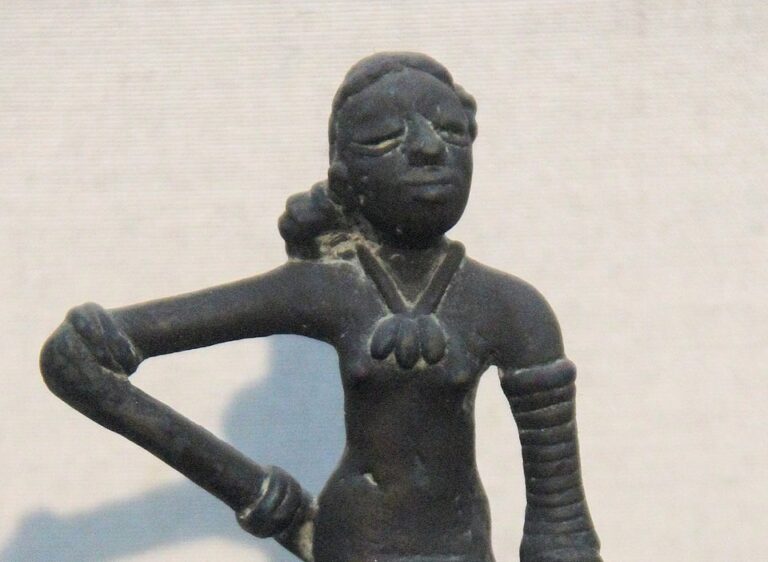
Since we are in this territory, a note on the Mahabharata, which the internet loves for the wrong reasons. The Sanskrit epic’s divine missiles — the astras, the Brahmastra above all — are described with genuinely unsettling imagery of light, heat and mass destruction, and the texts are worth reading soberly (✅ that the descriptions exist). But the claim that Mohenjo-daro preserves radioactive skeletons from an ancient detonation is debunked — the skeletons come from different strata and carry no anomalous radiation — and the famous Oppenheimer misquote implying he believed the Mahabharata described nuclear war is a quotation my book explicitly declines to use (✅ on both corrections). The discipline matters. The texts are strange enough told straight.
So — what was going on?
Three honest answers exist, and in keeping with this site’s habit I will give you all three with my confidence attached, rather than a single confident story.
1. The mainstream frame (✅ as scholarship’s consensus, and formidable). The divine council is Bronze Age political theology: heaven imagined as a royal court because the court was the most powerful thing anyone had seen. The named weapons mirror real prestige metallurgy. The manuscript softening of Deuteronomy 32:8 documents religious thought maturing over centuries. On this reading the tablets and the bronzes are a mirror — humanity describing itself at one remove. Nothing in this article is inconsistent with that frame, and the reader who stops here stops in excellent company.
2. The memory frame (⚠️). A middle position, older than it looks: that behind the mirror stands some remembered stratum of real persons and events — kings, conquerors, catastrophes — deified by time. The Greeks themselves proposed it (we call it euhemerism). It explains the administrative texture oddly well, and struggles, as it always has, with the sky.
3. The plain reading (◆ — my framework, and my book). The experiment of taking the records at their word: a conflict among powerful players; a council; a partition of the nations among its members, as the oldest manuscripts of Deuteronomy 32 state it; provinces, garrisons and proxy wars; an arsenal built by named engineers; and — the part the other frames never quite address — an ending. Because the strangest feature of the whole file is that it closes. The equipment fails and is not replaced. The interventions thin out. The judges of the dead stop visiting the living. Every tradition, from Mesopotamia to the North, remembers the powers leaving — and remembers being left. Whether that is the greatest literary theme in human history or something more like a memory is the question of Abandoned Children of the Gods: Still Waiting for the Return, and I argue it there with the same ledger method used in this article, marking on every page where scholarship ends and my own steps begin. Readers of the book will recognise this article as the armoury wing of that larger house. The book is available here.
As for the Galactic Federation — Professor Eshed’s or anyone else’s — I make no claims, and neither should you, at least not until the promised alien disclosure is effected. But the next time the notion makes the news, remember that the shape of the idea is not new. It is pressed into clay at Ugarit, cast in gilded bronze in Damascus, and hammered into a mace head you could hold in one hand. The sky council is humanity’s oldest org chart. The only open question — the one the ancients themselves kept asking, and the one my book takes seriously — is whether anyone was ever in the boardroom.
Related reading on AncientBronzes.com:
- Gods in the Hand: Ancient Bronze Figurines, Votives, and the Personal Sacred Sphere — the household end of the divine infrastructure
- The Lost Bronze Age God: The Sky Father — the council’s Indo-European counterpart, and the oath that outlived him
- [Who Came Before Zeus? The Sky Father Dyēus]([TODO: confirm slug]) — the linguistic descent of the sky god’s name
- Arslantepe: The Rupture in Bronze Age Martial Chronologies — where the world’s earliest sword corpus enters the story
- The Language of Patina — reading the surfaces of the sacred bronzes
A note on evidence and interpretation
As throughout this site, three registers are kept distinct. Established scholarship (✅): the Ugaritic divine council texts and the seventy sons of Athirat (KTU 1.4 VI 46); the manuscript variants of Deuteronomy 32:8 (Masoretic, Septuagint, 4QDeut^j) and the majority text-critical preference for the bene elohim reading (Heiser, Bibliotheca Sacra 158, 2001; Smith 2001; Day 2000); Psalm 82, 1 Kings 22 and Job 1–2 as council scenes; the meaning and career of the Anunnaki in Sumerian and Akkadian sources (Black & Green 1992) and the linguistic failure of Sitchin’s renderings; the Damascus seated-El figurine (S 3573 / RS 23.394); the mīs pî ritual and the care and feeding of divine statues (Oppenheim 1964); the named divine weapons as the texts describe them (Smith, The Ugaritic Baal Cycle vol. 1, 1994, for KTU 1.1–1.2; Lugal-e; Enūma Eliš; Skáldskaparmál; Hesiod); the Nahal Mishmar hoard; the debunking of the Mohenjo-daro radiation claim. Argued inference (⚠️): the identification of the Damascus figurine as El; the “seventy as totality” reading against the minority “seven”; the proxy-war reading of the Iliad; euhemerist middle positions. My framework (◆): the plain-reading experiment, the partition-and-departure thesis, and the wider synthesis of* Abandoned Children of the Gods*. This article discusses ancient texts and objects historically and intends no comment on any living faith. Reconstructions should be treated as reconstructions — including mine.*