
Attachments
-
 SCC 378539 1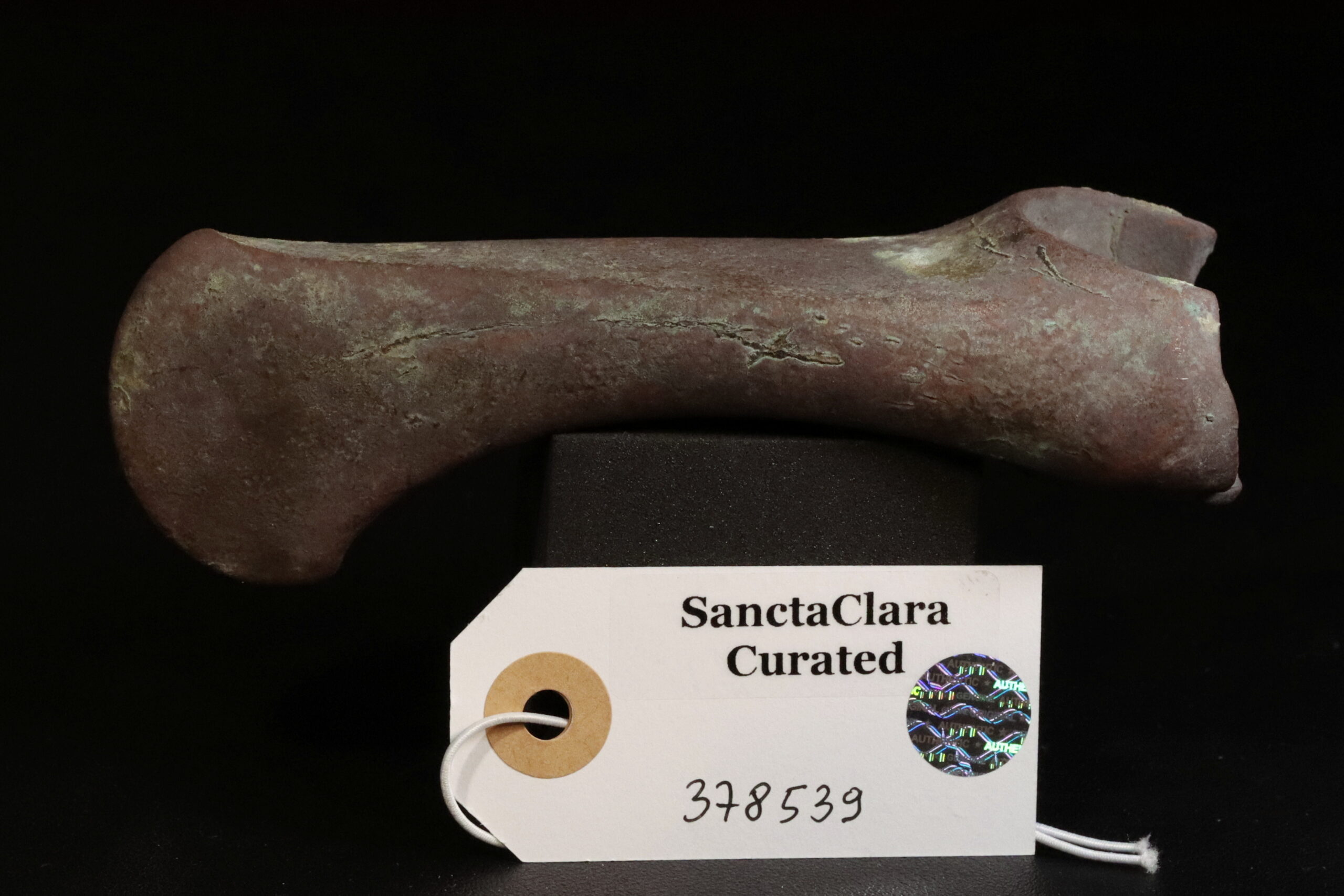
-
 SCC 378539 2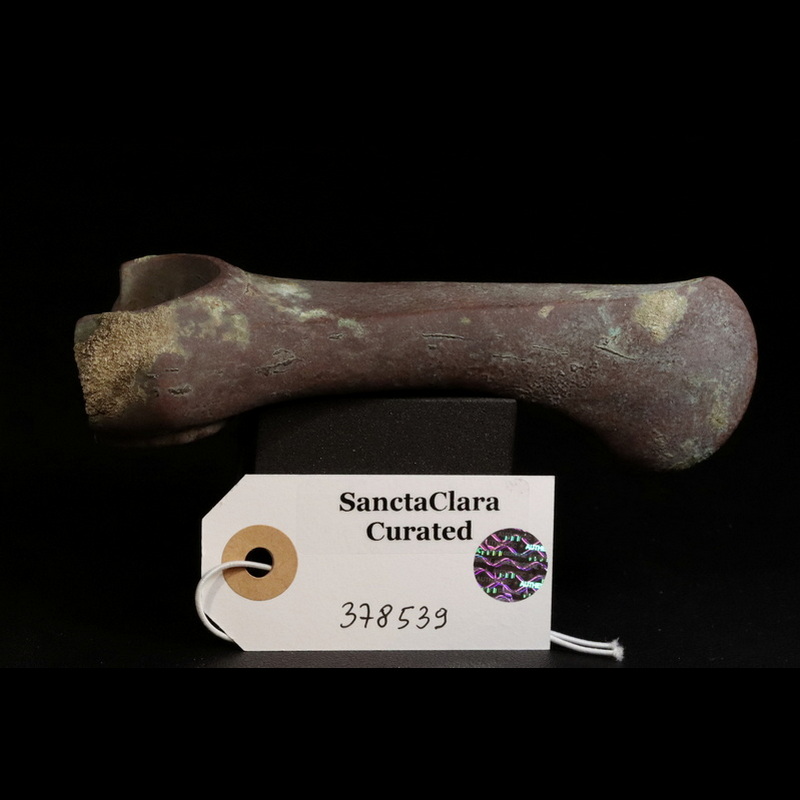
-
 SCC 378539 3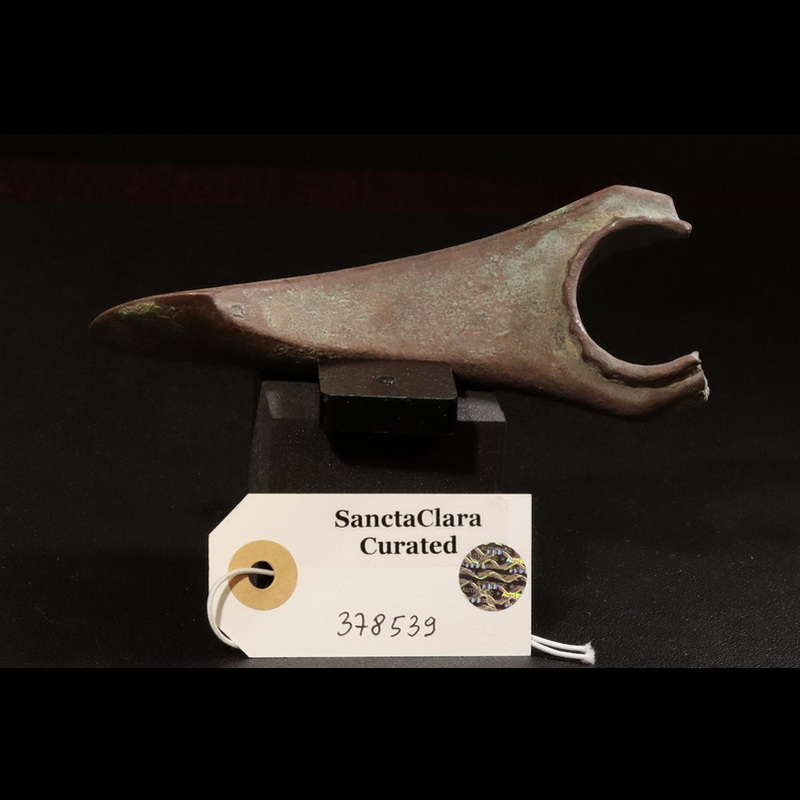
-
 SCC 378539 4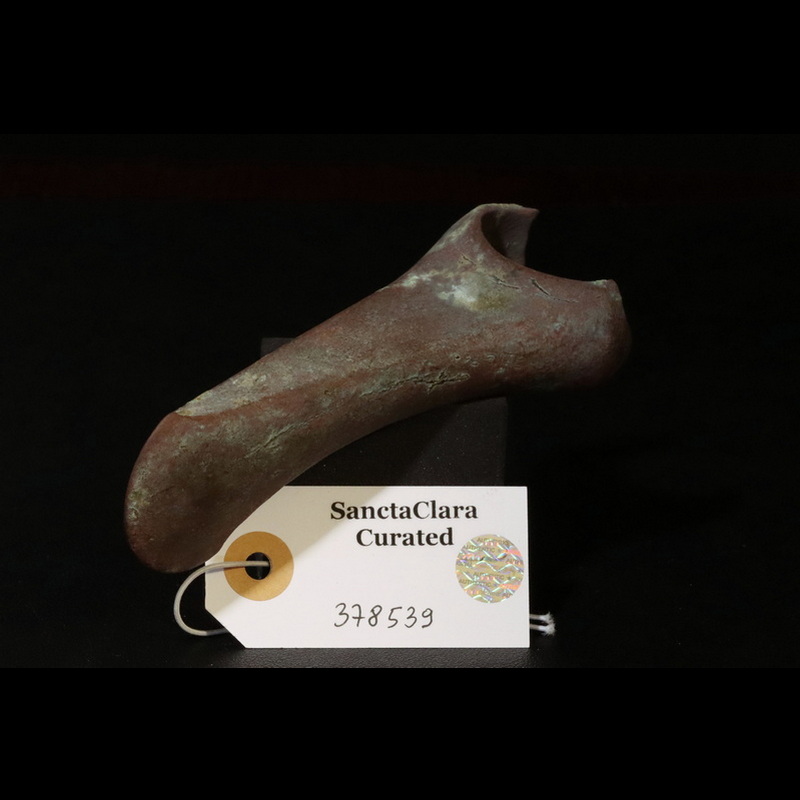
Metadata
Title
Carpathian Eneolithic axe-adze of Bodrogkeresztúr
Description
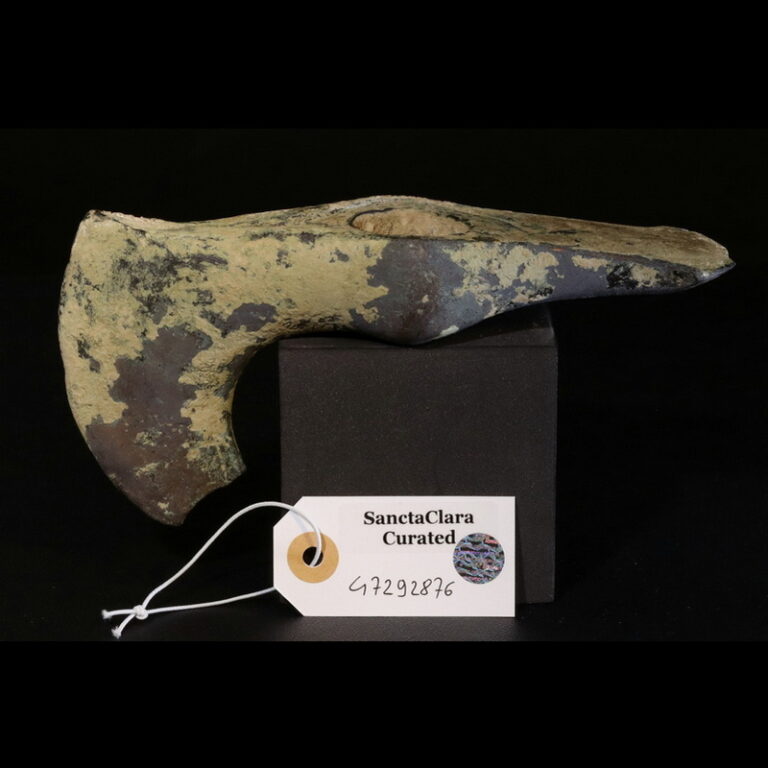
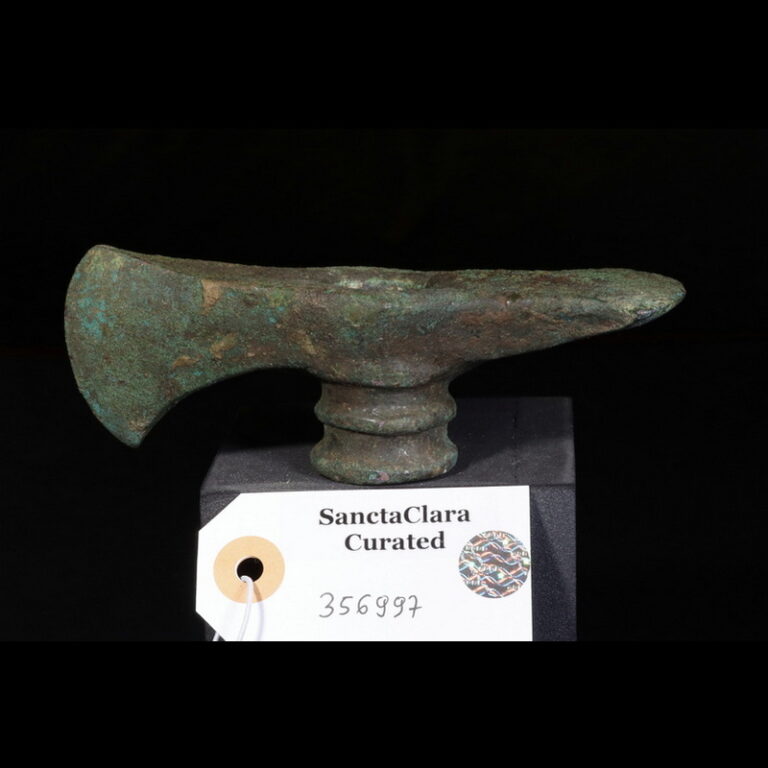
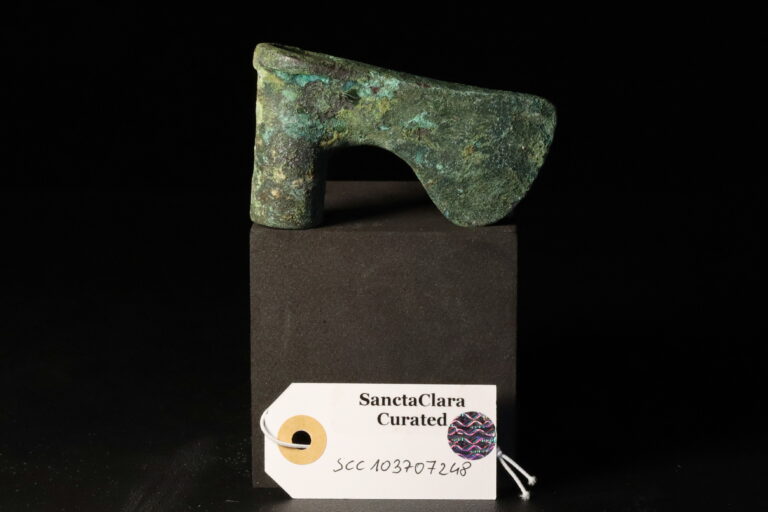
Jászladány type axe or axe – adze (Bodrogkeresztúr cultural sphere), broken at shaft hole in antiquity, classification depending on whether the broken part has had another blade. Lower sleeve decorated with serrations/protrusions. Rounded design, elongated arm, waisted at mid-length, expanding into a broad fan-shaped blade with a strongly convex, rounded cutting edge that droops markedly below the arm axis. Upper part of neck slightly convex, lower part of neck diagonally flat and axially curved downward. Very large, round shaft hole tunnel with lower sleeve. No structural weakness detected on brake surface. Cross-section rounded throughout, without defined facets.
Toward the shaft hole the arm thickens gradually from ~17 mm to ~25 mm, the swelling being entirely dorsal: the upper contour rises in a smooth convex shoulder while the underside continues essentially planar from the arm line. Beneath the shaft hole a discrete, sharply stepped collar 3 mm high projects, forming a thin plate under and slightly beyond the socket. There is no projecting upper tubular sleeve. Shaft hole large, round, and slightly conical, tapering from 32.8 mm at the upper aperture to 30.9 mm at the lower.
The fragment leaves three live possibilities: axe-adze (Jászladány), hammer-axe with cylindrical poll (Şiria/Mezőkeresztes family or Săcuieni "Felsőhegy", Iara-type hammer-axe), or a shaft-hole axe with a plain butt.
Patina: red-brown cuprite-dominated ground with malachite-green patches and pale yellowish/cream concretions.
Within European and Carpathian Basin prehistoric absolute chronology, this artifact is pinned to two synchronous cultural horizons:
Bodrogkeresztúr Culture Horizon:
This is the primary cultural framework for Jászladány-type heavy copper implements in the eastern Carpathian Basin. The classic phase of Bodrogkeresztúr is securely radiocarbon-dated to c. 3900–3600 BCE.
Cucuteni B / Tripolye B2–C1 Horizon: In terms of cross-cultural synchronization across the Carpathians, Jászladány-type axes match the Cucuteni B phase. The emergence and proliferation of these massive shaft-hole tools coincide directly with this period, dating precisely to the last quarter of the 5th millennium BCE through the first half of the 4th millennium BCE (broadly capped at c. 3700–3600 BCE before transitioning into Late Eneolithic types like Handlová)
Toward the shaft hole the arm thickens gradually from ~17 mm to ~25 mm, the swelling being entirely dorsal: the upper contour rises in a smooth convex shoulder while the underside continues essentially planar from the arm line. Beneath the shaft hole a discrete, sharply stepped collar 3 mm high projects, forming a thin plate under and slightly beyond the socket. There is no projecting upper tubular sleeve. Shaft hole large, round, and slightly conical, tapering from 32.8 mm at the upper aperture to 30.9 mm at the lower.
The fragment leaves three live possibilities: axe-adze (Jászladány), hammer-axe with cylindrical poll (Şiria/Mezőkeresztes family or Săcuieni "Felsőhegy", Iara-type hammer-axe), or a shaft-hole axe with a plain butt.
Patina: red-brown cuprite-dominated ground with malachite-green patches and pale yellowish/cream concretions.
Within European and Carpathian Basin prehistoric absolute chronology, this artifact is pinned to two synchronous cultural horizons:
Bodrogkeresztúr Culture Horizon:
This is the primary cultural framework for Jászladány-type heavy copper implements in the eastern Carpathian Basin. The classic phase of Bodrogkeresztúr is securely radiocarbon-dated to c. 3900–3600 BCE.
Cucuteni B / Tripolye B2–C1 Horizon: In terms of cross-cultural synchronization across the Carpathians, Jászladány-type axes match the Cucuteni B phase. The emergence and proliferation of these massive shaft-hole tools coincide directly with this period, dating precisely to the last quarter of the 5th millennium BCE through the first half of the 4th millennium BCE (broadly capped at c. 3700–3600 BCE before transitioning into Late Eneolithic types like Handlová)
Catalogue Number
378539
Category
Period
Late Eneolithic
Culture
Bodrogkeresztúr
Material
Copper
Dimensions and weight
Dimensions: (LxWxH) 136,6 x 53 x 44 mm, Weight: 508,4 grams, shaft hole diam up 32,8 mm, down 30,9 mm, shaft hole length with sleeve 28 mm, tunnel wall min. 9,6 mm, body thickness 17 mm, axe edge span 45,2 mm. Estimated original length 240 mm, original weight 950 g.
Reference Items
Advanced geometry and skilled casting of late Chalcolithic are in fascinating contrast to some later Early Bronze Age primitive creations.
Curator Rating
4
Comparative Examples
Comparative: Săcuieni "Felsőhegy", Iara-type hammer-axe No. 4 https://crisia.mtariicrisurilor.ro/wp-content/uploads/2020/10/40-Crisia-Muzeul-Tarii-Crisurilor-XL-2010.pdf