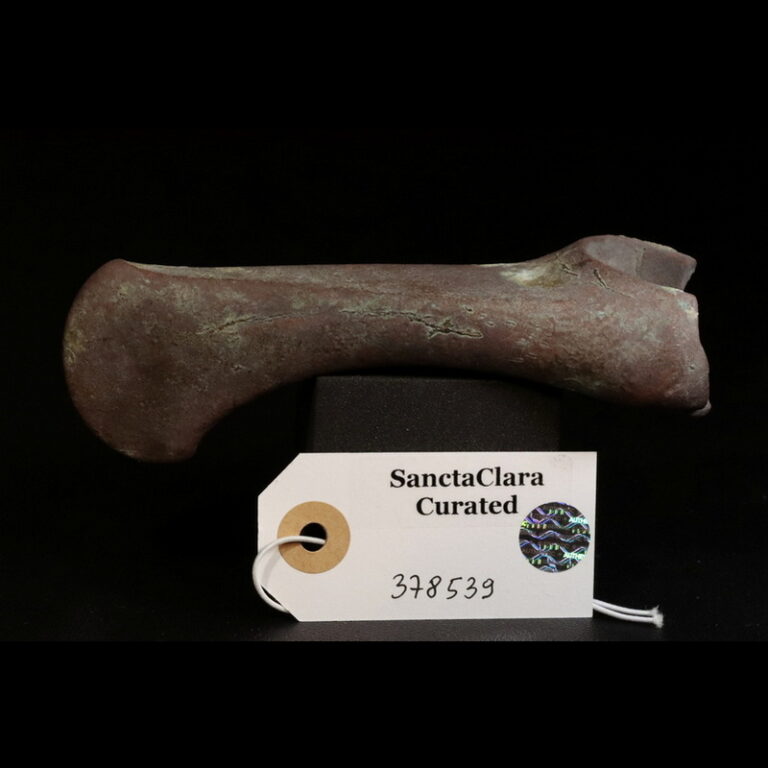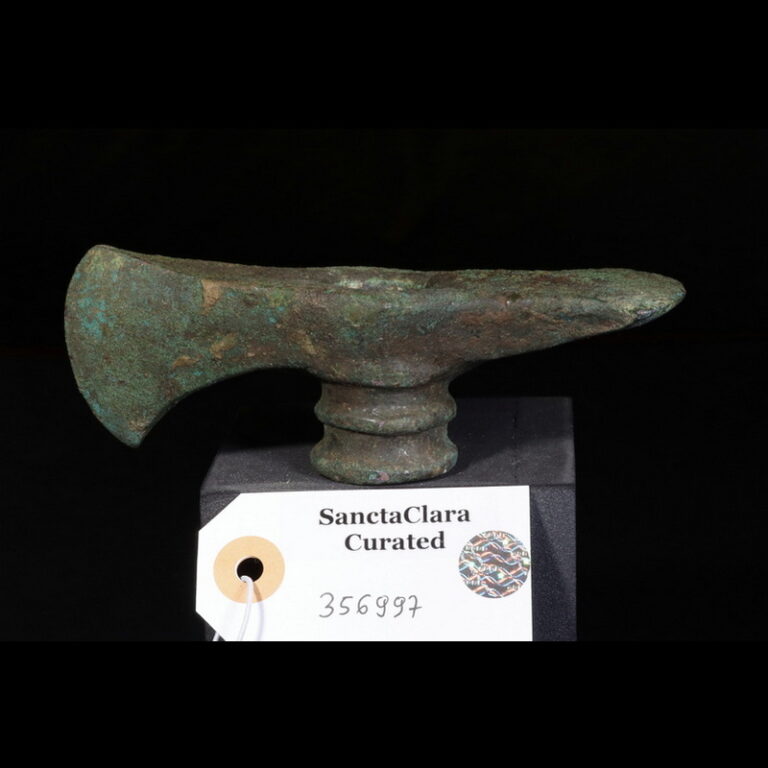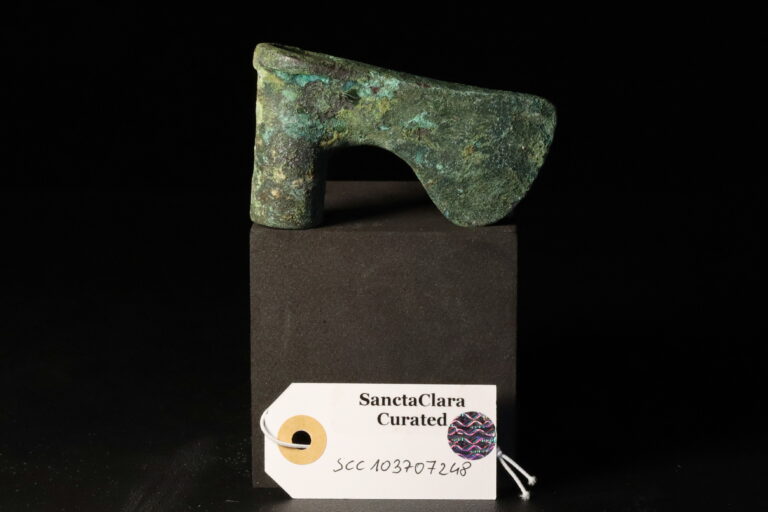

Attachments
-
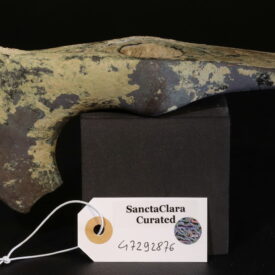 SCC 47292876 1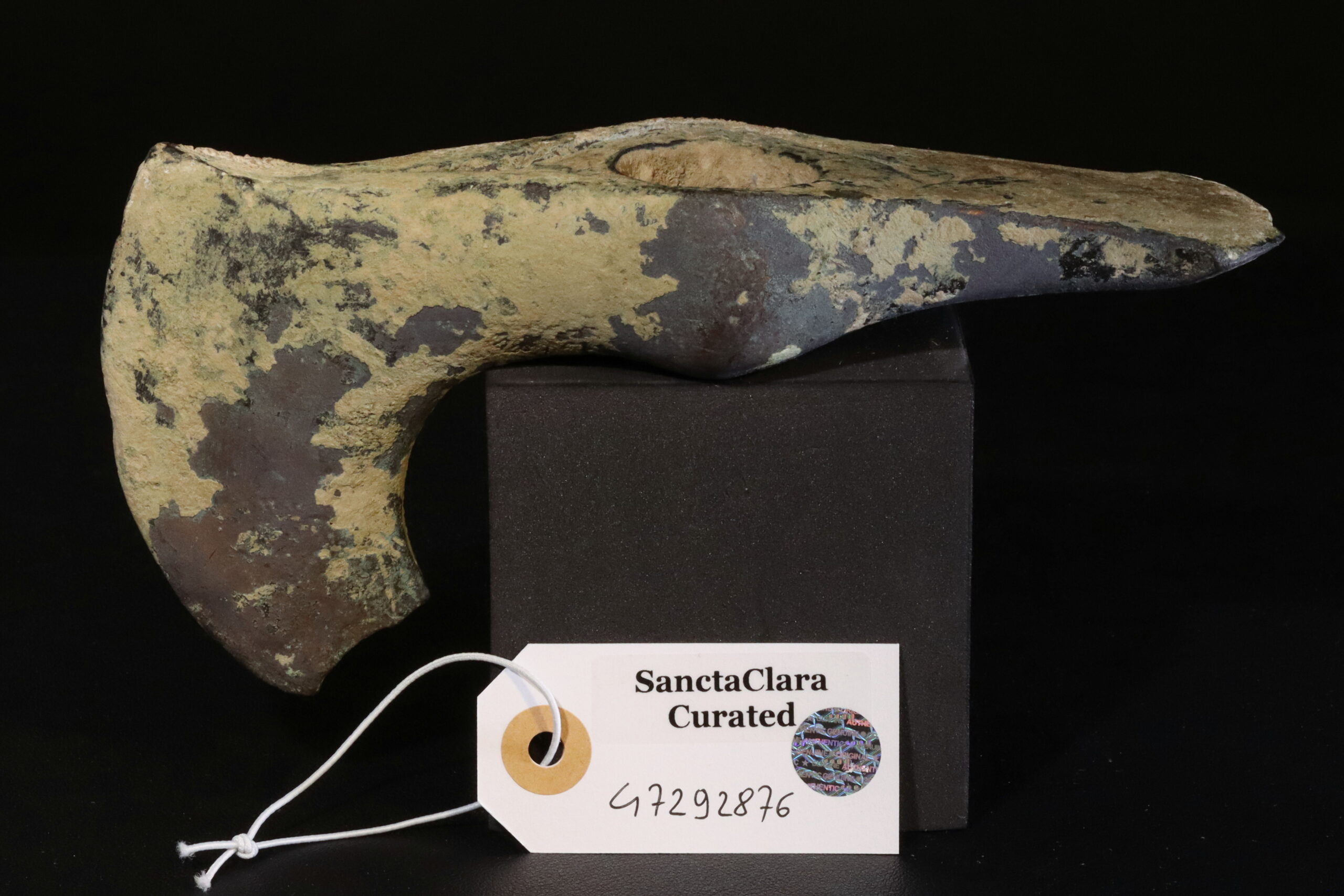
-
 SCC 47292876 2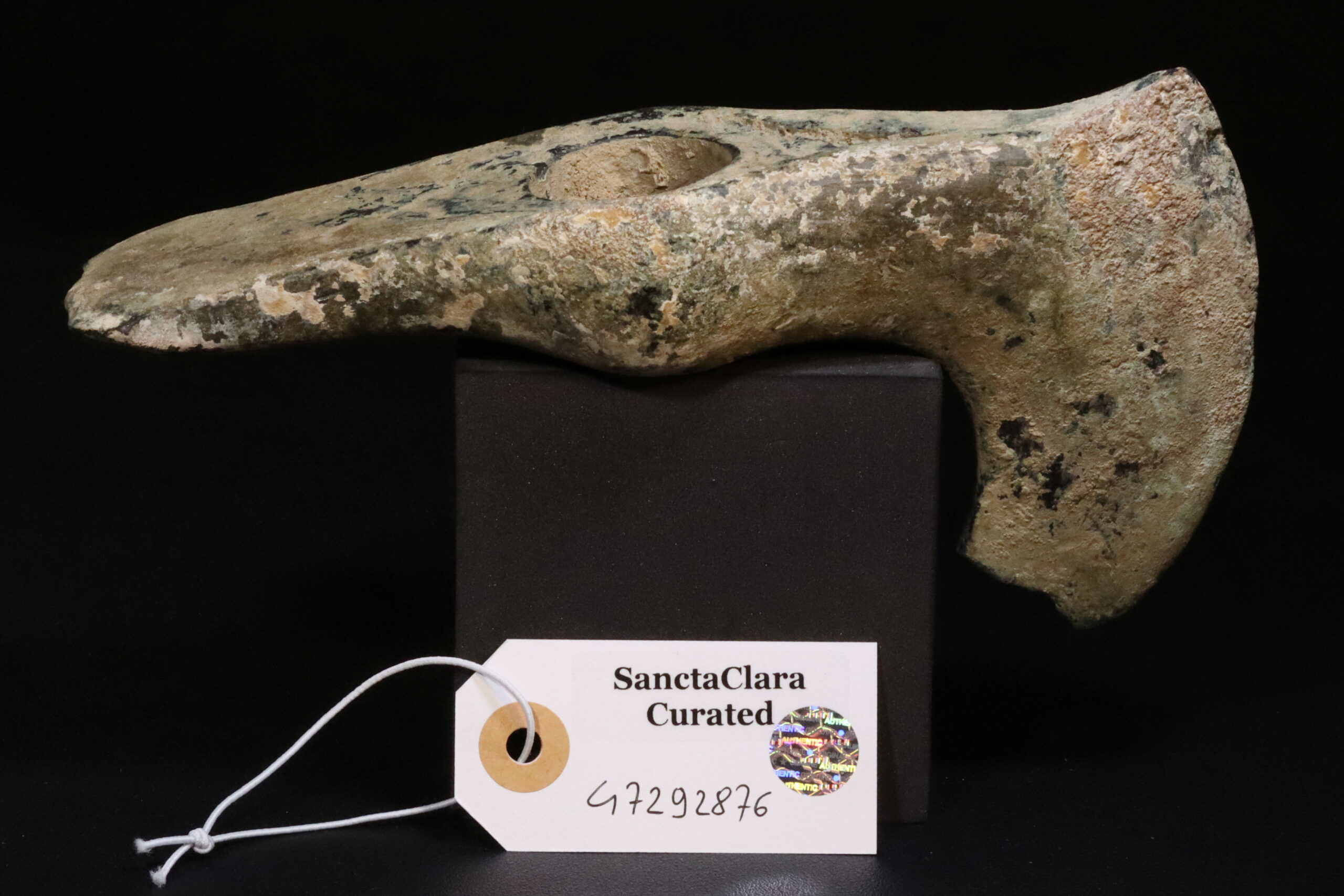
-
 SCC 47292876 3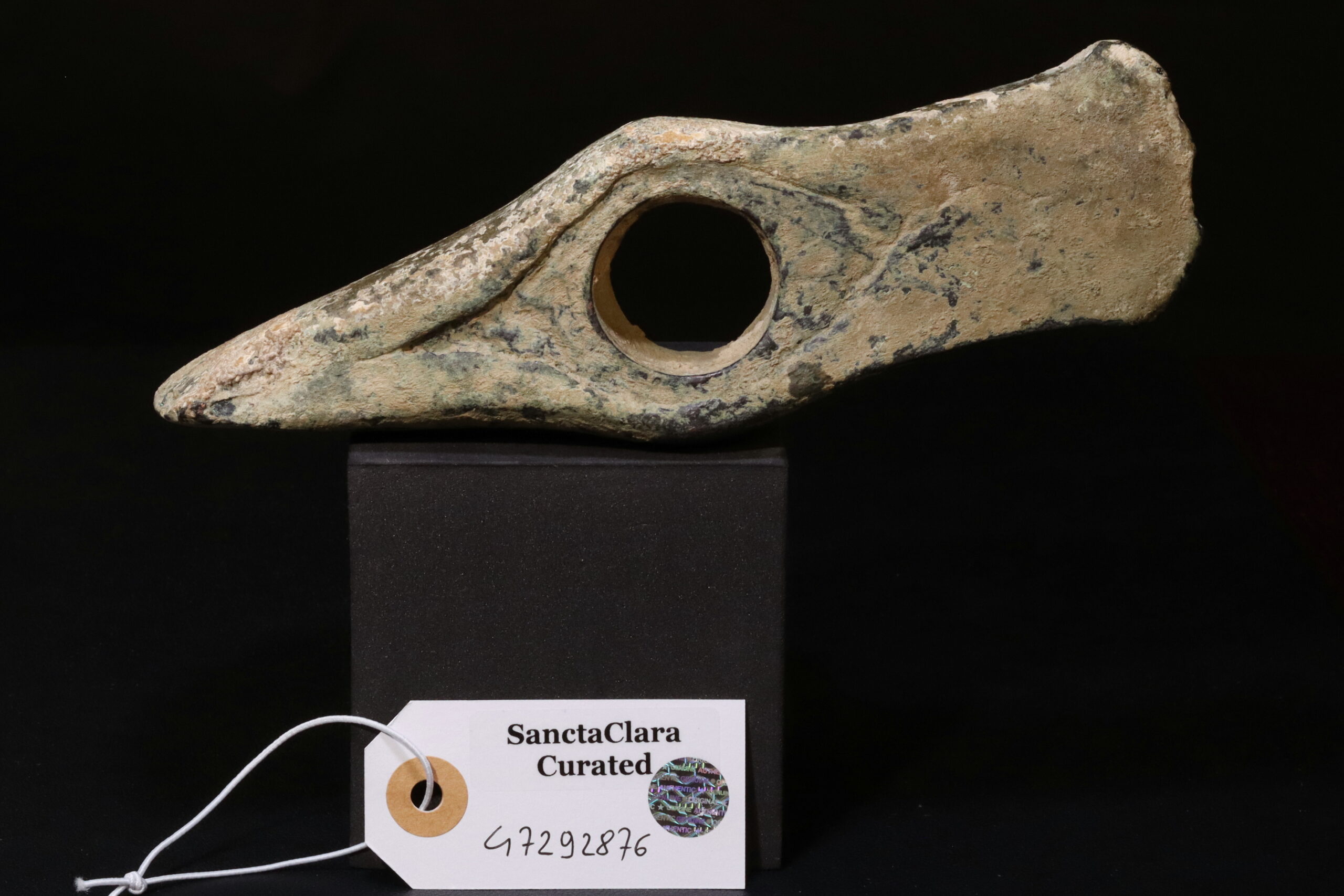
-
 SCC 47292876 4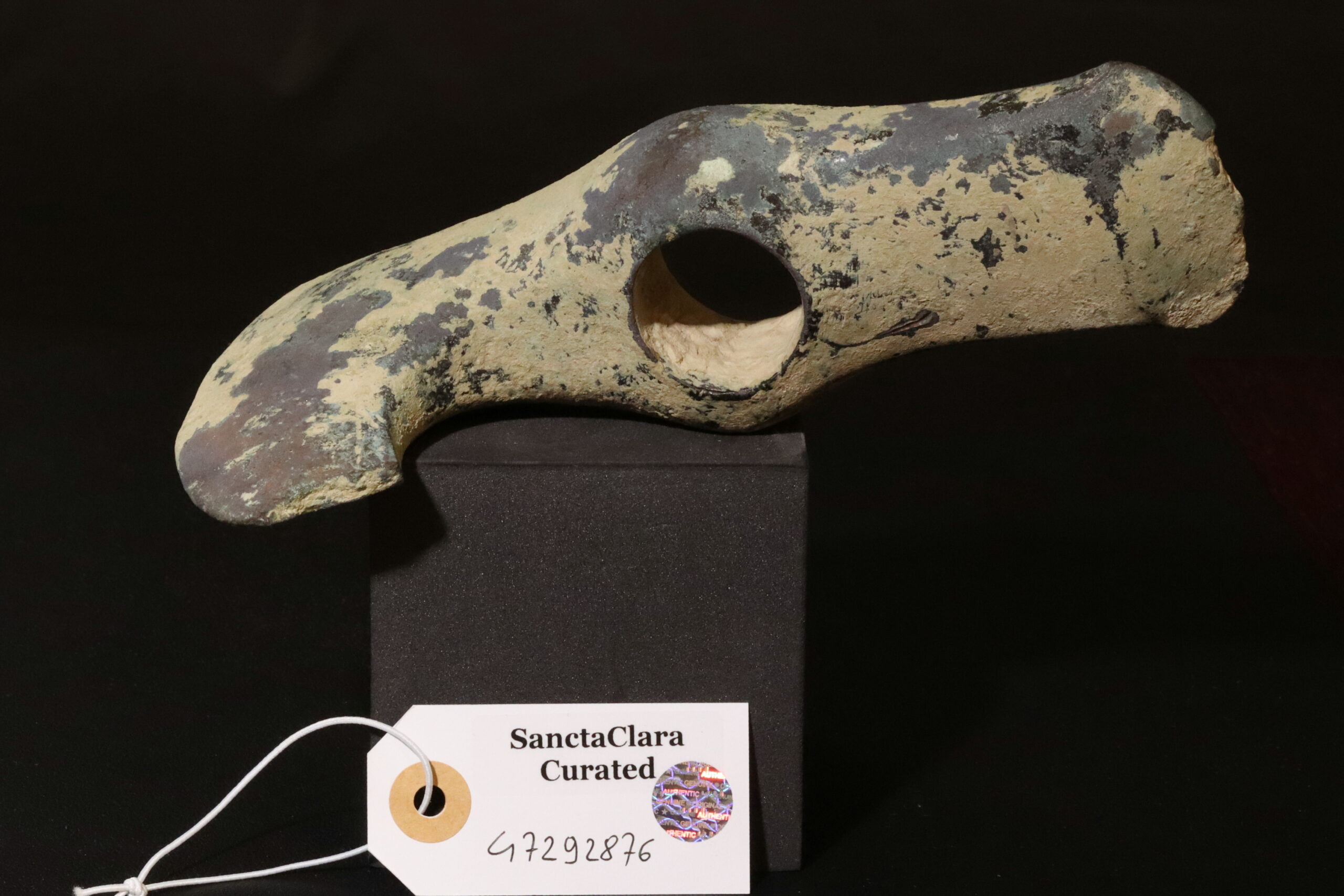
Metadata
Title
Chalcolithic Copper Şiria-type bearded axe - adze
Description
Cast Copper / Arsenical Copper Axe-Adze
Estimated Period: Late Chalcolithic to Early Bronze Age (approx. 3500–2500 BCE)
Probable Cultural Origin: Ancient Near East, Iranian Plateau, or Northern Caucasus
Current Status: Private Collection (Acquired pre-1980s via historical auction)
1. Material and Metallurgical Analysis
Composition: Microscopic analysis definitively identifies the matrix as copper or arsenical copper, strictly ruling out a tin-bronze alloy.
Density Interpretation: The measured density of 8.68 g/cm3 is entirely consistent with ancient arsenical copper casting. Pure cast copper is approximately 8.96 g/cm3; the variance is precisely accounted for by inherent micro-porosity from the casting process and the presence of surface oxides.
Surface Phenomena: The glassy black, shiny patches previously suspected to be cassiterite are re-identified as tenorite (cupric oxide, CuO) or the result of surface arsenic segregation, commonly known as "arsenic sweat." During the cooling of arsenical copper, arsenic frequently migrates to the surface, creating a hard, dark, and sometimes silvery-black finish. Ancient metallurgists often deliberately exploited this phenomenon to increase the surface hardness of the cutting edges.
2. Typological and Comparative Attribution
Morphology: The strictly curvilinear design, complete absence of flat planes, and the lack of a protruding shaft tunnel sleeve are highly diagnostic. The recessed, "eye-like" shape around the upper shaft tunnel is an advanced engineering choice designed to minimize weight at the thickest point of the cast without compromising the structural integrity of the tool.
Estimated Period: Late Chalcolithic to Early Bronze Age (approx. 3500–2500 BCE)
Probable Cultural Origin: Ancient Near East, Iranian Plateau, or Northern Caucasus
Current Status: Private Collection (Acquired pre-1980s via historical auction)
1. Material and Metallurgical Analysis
Composition: Microscopic analysis definitively identifies the matrix as copper or arsenical copper, strictly ruling out a tin-bronze alloy.
Density Interpretation: The measured density of 8.68 g/cm3 is entirely consistent with ancient arsenical copper casting. Pure cast copper is approximately 8.96 g/cm3; the variance is precisely accounted for by inherent micro-porosity from the casting process and the presence of surface oxides.
Surface Phenomena: The glassy black, shiny patches previously suspected to be cassiterite are re-identified as tenorite (cupric oxide, CuO) or the result of surface arsenic segregation, commonly known as "arsenic sweat." During the cooling of arsenical copper, arsenic frequently migrates to the surface, creating a hard, dark, and sometimes silvery-black finish. Ancient metallurgists often deliberately exploited this phenomenon to increase the surface hardness of the cutting edges.
2. Typological and Comparative Attribution
Morphology: The strictly curvilinear design, complete absence of flat planes, and the lack of a protruding shaft tunnel sleeve are highly diagnostic. The recessed, "eye-like" shape around the upper shaft tunnel is an advanced engineering choice designed to minimize weight at the thickest point of the cast without compromising the structural integrity of the tool.
Catalogue Number
47292876
Category
Period
3500 - 2500 BCE
Culture
Ancient Near East, Iranian Plateau, Northern Caucasus - Maikop
Material
Copper
Dimensions and weight
Length: 201 mm, width at shaft hole: 60,6 mm, width of adze blade 52,5 mm, axe blade height 100 mm, shaft tunnel length 34 mm, shaft hole upper diameter: 32 mm, shaft hole lower diameter: 30,5 mm Weight: 1521 g, volume 176 ml, density (corrected for incrustations) 8,68 g/cm3
Reference Items
Comparative Exclusion: While the European Chalcolithic is renowned for massive copper axe-adzes (such as those associated with the Tiszapolgár or Bodrogkeresztúr cultures in the Carpathian Basin), those typologies—specifically the Jászladány types—almost universally feature pronounced tubular sleeves and distinct, geometrically flat facets. The morphological traits of this artifact strongly exclude a Carpathian or Balkan origin.
Historical Significance
At 1521 g the piece is heavy. Near Eastern shaft-hole axes are characteristically lighter and thinner — the crescentic sheet axehead BM 116050 weighs only 121.5 g — while Carpathian Copper Age hammer-axes and axe-adzes routinely fall in the 600–1500 g range. On mass alone a Balkan attribution would be attractive. Morphology argues otherwise: the diagnostic Jászladány axe-adze is a cruciform tool with straight, wedge-sectioned arms, and does not carry a crescentic, strongly flaring, long-bearded axe blade with a concave underside returning to the shaft hole. That profile, together with the wholly curvilinear modelling, points to the Iranian series, where heavy cast axe-adzes do occur — BM 128613, at 1363 g, being the demonstration.
The absence of a projecting sleeve, collar, rim lip, and ribs removes the features on which Deshayes' Iranian Type A sub-types are discriminated, and is the principal reason the piece resists precise typological placement. The short shaft tunnel (34 mm against 201 mm overall) is proportionate to a cored, cast eye and is not independently diagnostic of region or date.
The reported bulk density of 8.68 g/cm³ does not discriminate copper from bronze. Corrosion products are substantially less dense than metal (cuprite c. 6.1, malachite c. 4.0, tenorite c. 6.3, cassiterite c. 6.9–7.1), and any internal porosity depresses the figure further; the measured value is therefore a lower bound on true alloy density and is consistent with unalloyed copper, arsenical copper, or a tin or leaded bronze alike.
The glossy black patches cannot be identified visually. Decuprification of a tin bronze does produce a hard, lustrous tin-oxide (cassiterite) surface layer, but tenorite (CuO), copper sulfides formed under anaerobic burial (chalcocite, covellite, digenite), and manganese-oxide soil crusts all present similarly. Handheld XRF would not resolve the question: on a patinated surface it reads only the outer c. 10–50 µm and reports corrosion chemistry, not bulk alloy — surface tin enrichment can make a bronze read tin-rich and can misrepresent a decuprified copper.
Nothing in the surface record is inconsistent with an ancient object: the old break carries independent patination, both edges are worn, the patina is stratified, the bore is rough and earth-filled, and there are no machining marks. None of these is individually probative. Both the Near Eastern and the Balkan Copper Age markets are heavily forged, and pastiches assembled from mismatched parts are documented (Harvard Art Museums 304534, a Luristan-style shaft-hole axe whose decorative heads proved to be bronze while blade and shaft were arsenical copper). Internal stylistic coherence is accordingly the most useful morphological test available without analysis, and this piece is internally coherent — its features belong to one tradition rather than being assembled across several.
Function — The mass and the robust, unarticulated shaft-hole zone suggest a heavy working implement (woodworking, or possibly quarrying or mining) or a prestige/deposition object, rather than a light battle-axe.
The absence of a projecting sleeve, collar, rim lip, and ribs removes the features on which Deshayes' Iranian Type A sub-types are discriminated, and is the principal reason the piece resists precise typological placement. The short shaft tunnel (34 mm against 201 mm overall) is proportionate to a cored, cast eye and is not independently diagnostic of region or date.
The reported bulk density of 8.68 g/cm³ does not discriminate copper from bronze. Corrosion products are substantially less dense than metal (cuprite c. 6.1, malachite c. 4.0, tenorite c. 6.3, cassiterite c. 6.9–7.1), and any internal porosity depresses the figure further; the measured value is therefore a lower bound on true alloy density and is consistent with unalloyed copper, arsenical copper, or a tin or leaded bronze alike.
The glossy black patches cannot be identified visually. Decuprification of a tin bronze does produce a hard, lustrous tin-oxide (cassiterite) surface layer, but tenorite (CuO), copper sulfides formed under anaerobic burial (chalcocite, covellite, digenite), and manganese-oxide soil crusts all present similarly. Handheld XRF would not resolve the question: on a patinated surface it reads only the outer c. 10–50 µm and reports corrosion chemistry, not bulk alloy — surface tin enrichment can make a bronze read tin-rich and can misrepresent a decuprified copper.
Nothing in the surface record is inconsistent with an ancient object: the old break carries independent patination, both edges are worn, the patina is stratified, the bore is rough and earth-filled, and there are no machining marks. None of these is individually probative. Both the Near Eastern and the Balkan Copper Age markets are heavily forged, and pastiches assembled from mismatched parts are documented (Harvard Art Museums 304534, a Luristan-style shaft-hole axe whose decorative heads proved to be bronze while blade and shaft were arsenical copper). Internal stylistic coherence is accordingly the most useful morphological test available without analysis, and this piece is internally coherent — its features belong to one tradition rather than being assembled across several.
Function — The mass and the robust, unarticulated shaft-hole zone suggest a heavy working implement (woodworking, or possibly quarrying or mining) or a prestige/deposition object, rather than a light battle-axe.
Comparative Examples
Early Mesopotamian Axes (c. 2500–2000 BCE): The lack of a protruding collar and the seamless, organic integration of the shaft hole into the body is a hallmark of early Mesopotamian and western Iranian metallurgy before the highly decorative styles of the Late Bronze Age took hold.
British Museum 128613 (1936,0613.77) — copper alloy shaft-hole axe/adze head, heavy, cast, curving axe blade with adze butt; acquired at Nihavand, Iran (from Ernst Herzfeld, 1936). L 218 mm, H 83 mm, W 55 mm; 1363 g. Museum date c. 1500–500 BC. The closest published parallel in both form and mass.
Deshayes 1963, "Haches-herminettes iraniennes," Syria 40, 273–276, pl. XXIV — an axe-adze of alleged (and, by Deshayes, distrusted) Luristan origin: L 180 mm; adze 26 mm; axe 72 mm; slightly elliptical, irregular, conically profiled shaft hole 25 × 27.5 mm at the mouth; principal axis appreciably curvilinear, adze broadly perpendicular to the haft, axe distinctly inclined. The same architecture as the present piece, at smaller scale.
Metropolitan Museum of Art 69.185 — shaft-hole axe head, Mesopotamia or western Iran, late 3rd–early 2nd millennium BC, bronze, L 159 mm.
Metropolitan Museum of Art 65.32 — Old Elamite shaft-hole axe head with voluted blade, south-western Iran, late 3rd millennium BC, bronze, 125 mm.
Harvard Art Museums 304526 — shaft-hole axe head; catalogued as of a form characteristic of mid- to late-3rd-millennium BC Mesopotamian and western Iranian contexts, with excavated Luristan burial parallels (citing Deshayes 1960: 158, pl. 18; Godard 1931; Haerinck & Overlaet, Bani Surmah).
Weight-class comparanda only (morphologically divergent): Carpathian Copper Age axe-adzes of Jászladány type, e.g. Sâniob, jud. Bihor, L 230 mm, 845 g; Magyarhomorog-Mogyoróstanya, L 137 mm, 685 g (Patay 1984).
Body geometry consistent with copper axes of Rákóczifalva, an Early Copper Age Site: 7: Şiria-type hammer axe from F201/S328. https://www.cambridge.org/core/journals/european-journal-of-archaeology/article/creating-histories-different-perspectives-controversial-narratives-at-rakoczifalva-an-early-copper-age-site-on-the-great-hungarian-plain/B42D45FB9523633FB1C1EAB6BBFD1EB8
British Museum 128613 (1936,0613.77) — copper alloy shaft-hole axe/adze head, heavy, cast, curving axe blade with adze butt; acquired at Nihavand, Iran (from Ernst Herzfeld, 1936). L 218 mm, H 83 mm, W 55 mm; 1363 g. Museum date c. 1500–500 BC. The closest published parallel in both form and mass.
Deshayes 1963, "Haches-herminettes iraniennes," Syria 40, 273–276, pl. XXIV — an axe-adze of alleged (and, by Deshayes, distrusted) Luristan origin: L 180 mm; adze 26 mm; axe 72 mm; slightly elliptical, irregular, conically profiled shaft hole 25 × 27.5 mm at the mouth; principal axis appreciably curvilinear, adze broadly perpendicular to the haft, axe distinctly inclined. The same architecture as the present piece, at smaller scale.
Metropolitan Museum of Art 69.185 — shaft-hole axe head, Mesopotamia or western Iran, late 3rd–early 2nd millennium BC, bronze, L 159 mm.
Metropolitan Museum of Art 65.32 — Old Elamite shaft-hole axe head with voluted blade, south-western Iran, late 3rd millennium BC, bronze, 125 mm.
Harvard Art Museums 304526 — shaft-hole axe head; catalogued as of a form characteristic of mid- to late-3rd-millennium BC Mesopotamian and western Iranian contexts, with excavated Luristan burial parallels (citing Deshayes 1960: 158, pl. 18; Godard 1931; Haerinck & Overlaet, Bani Surmah).
Weight-class comparanda only (morphologically divergent): Carpathian Copper Age axe-adzes of Jászladány type, e.g. Sâniob, jud. Bihor, L 230 mm, 845 g; Magyarhomorog-Mogyoróstanya, L 137 mm, 685 g (Patay 1984).
Body geometry consistent with copper axes of Rákóczifalva, an Early Copper Age Site: 7: Şiria-type hammer axe from F201/S328. https://www.cambridge.org/core/journals/european-journal-of-archaeology/article/creating-histories-different-perspectives-controversial-narratives-at-rakoczifalva-an-early-copper-age-site-on-the-great-hungarian-plain/B42D45FB9523633FB1C1EAB6BBFD1EB8