
Document
Attachments
-
 SCC sagaris 1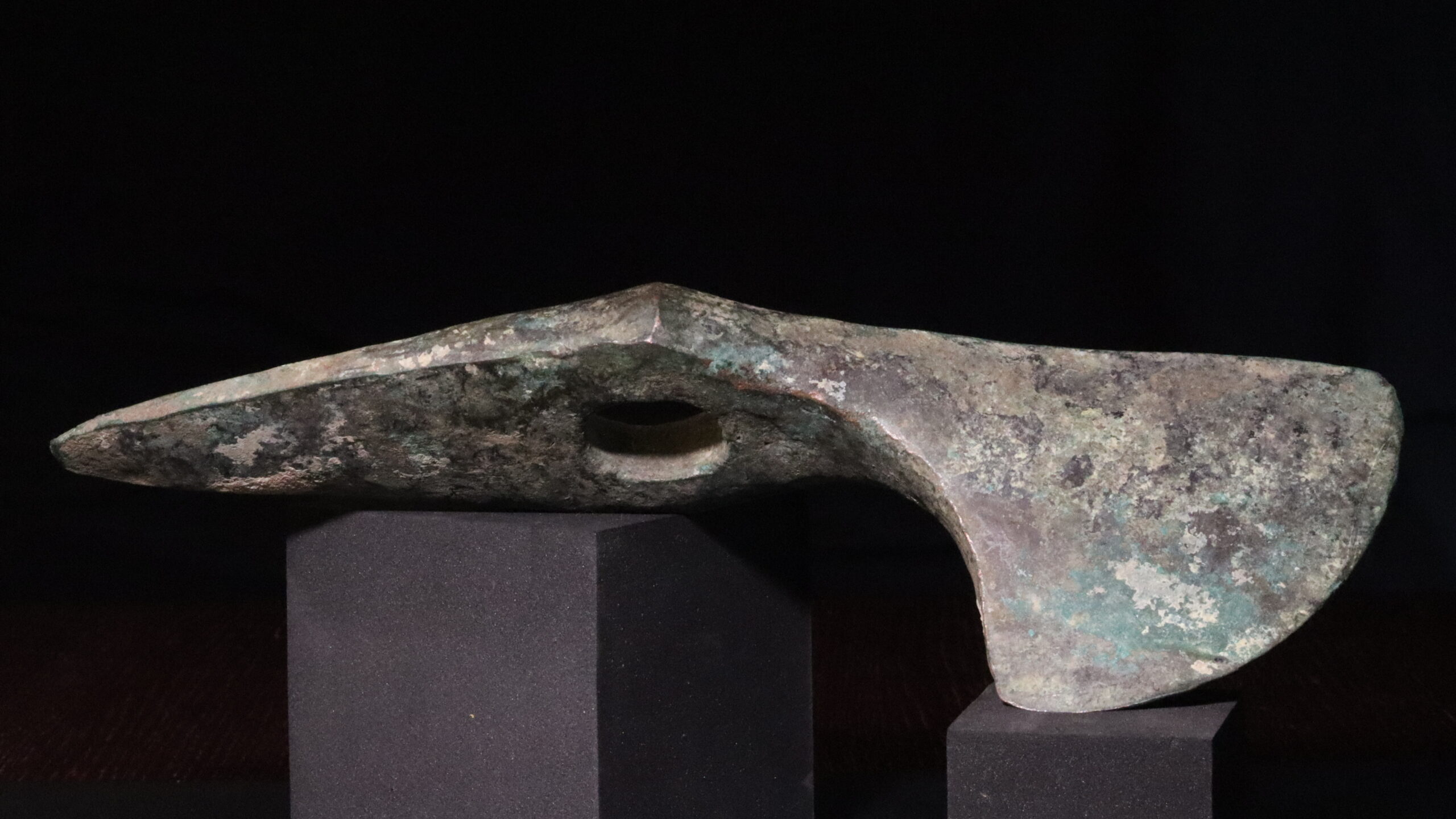
-
 SCC sagaris 3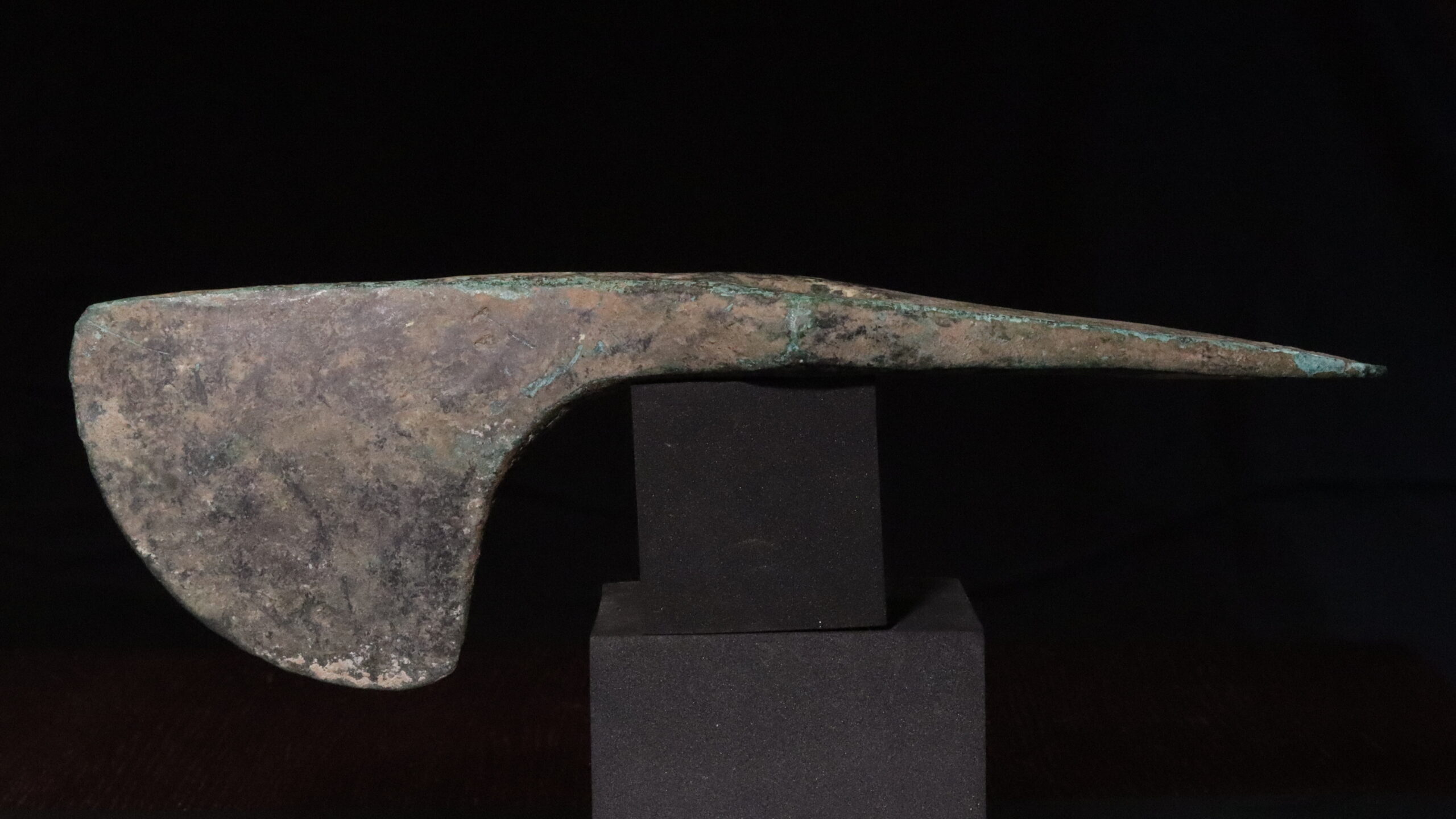
-
 SCC-43951422-2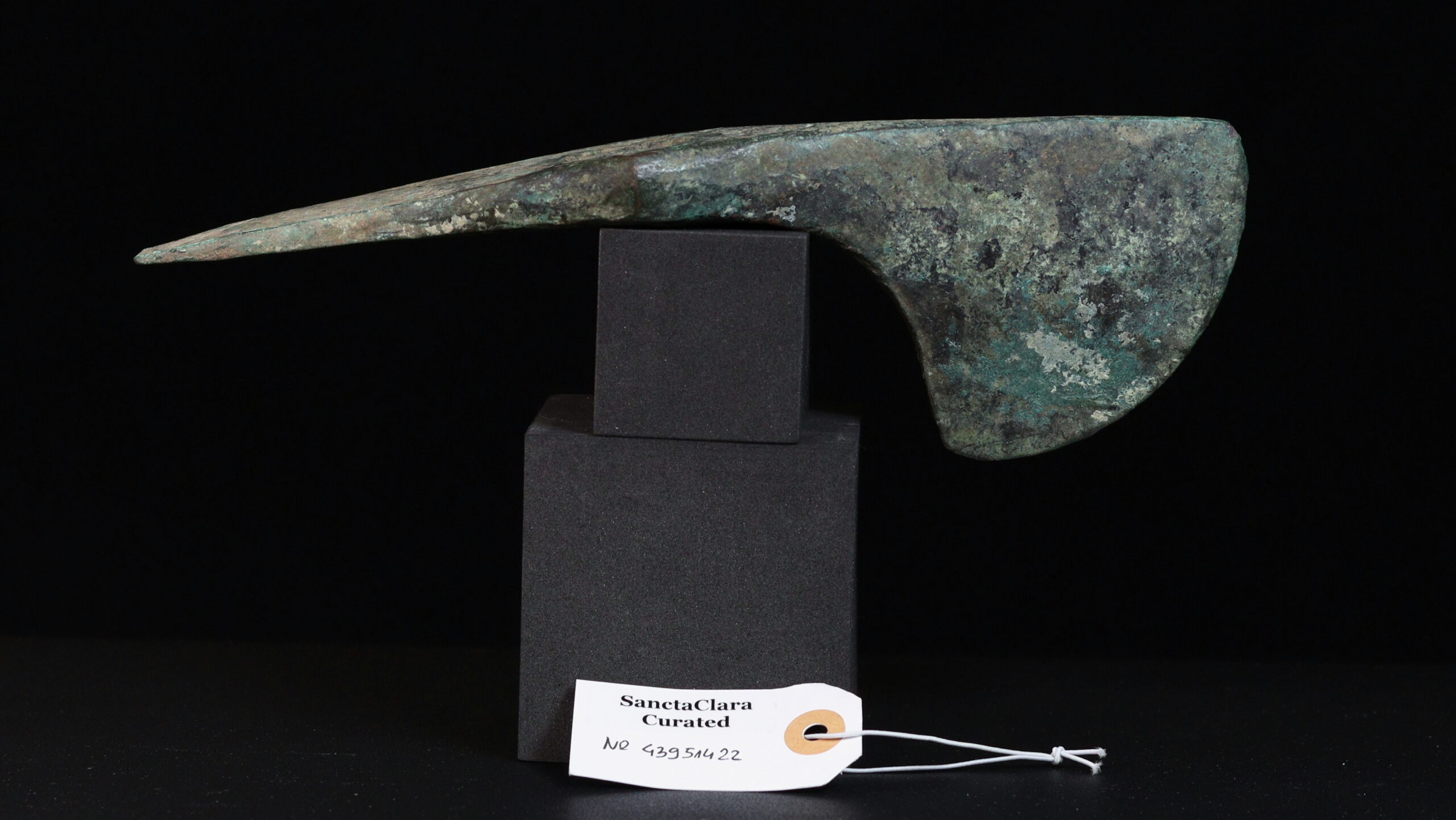
Metadata
Title
Copper "Old Europe" Axe - Adze
Description
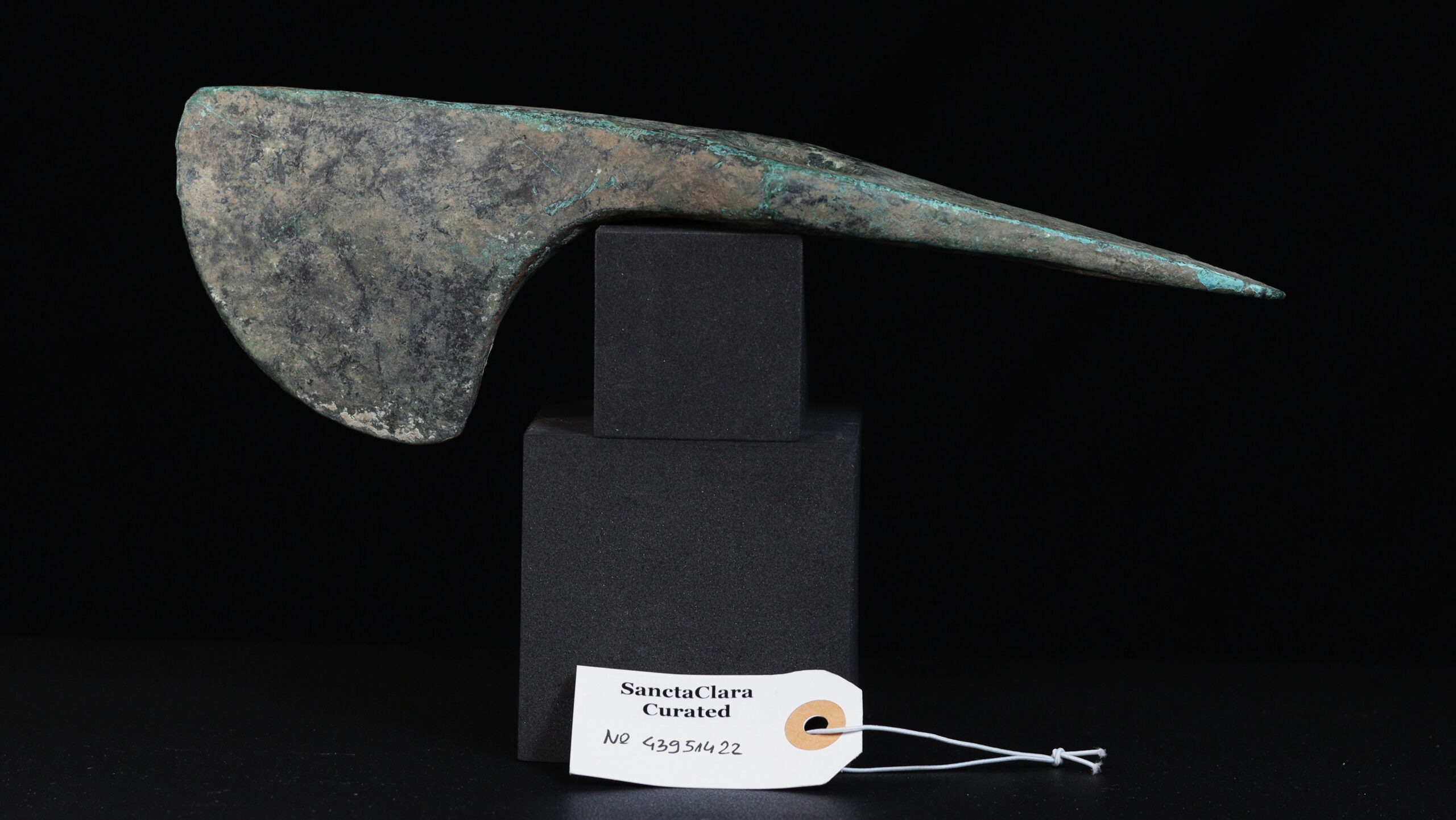
Spectacular, large copper battle axe with narrow adze or flat pick butt (later referred to as Sagaris type). Dual-purpose heavy copper Axe-Adze or Battle Pick Axe.
This artifact is an extraordinarily significant piece of Chalcolithic (Eneolithic) metalwork, representing a high concentration of wealth, power, and long-distance trade.
Comparable to Mugeni or Siria Type Hammer-Axe/Adze (Plocnik/Vidra family), typology by Schubert 1965, p. 276, morphological type described as Battle axe (Patay 1984). .
Material: Copper, with natural trace arsenic content
Period Early Chalcolithic (Eneolithic),
Late 5th to Earlier 4th Millennium BC (∼4500−3800 BC)
Cultural Sphere: Danube Civilization, Vinća, Varna or Polgár Cultural Complex and the Kodžadermen-Gumelnița-Karanovo VI (KGK VI) Complex (Carpathian Basin Origin)
Dimensions Length: 27.0 cm. Weight: 1211 g, volume 139 ml, density (average including patina) 8,71 g/cm3 (indicating copper with natural arsenic content from Carpatian mines).
Probable Function:
Specialized two-handed Battle-Pick Axe and ultimate prestige symbol. The axe's design illustrates the pivotal transition from stone to metal technology, where the aesthetics of power dictated form even when metallurgy allowed for more efficient shapes. Design and Prototype: This axe is a prime example of technological emulation (skeuomorphism). Its massive, angular profile and substantial bulk around the hafting hole (15-18 mm socket wall thickness) are metallurgically unnecessary for copper (which would save material if thinner). However, this bulk was structurally required for its Late Neolithic stone hammer-axe predecessors. By retaining this costly, massive form, the copper axe deliberately transferred the established symbolic authority of the old stone weapon to the new metal medium.
Form and Function:
The head is a single-piece, single mold casting that combines a broad, crescent-shaped cutting blade with a long, sharply tapered pike butt tapering to a transverse flat terminal, 10 mm across; neither a pike point nor a broad adze edge . The shaft tunnel doesn't extend beyond the axe head downwards nor upwards (sleeveless shaft hole) . The overall design is esthetically appealing, with softly flowing curves contrasted by the sharp edges and slim pike ,
The sleeveless tunnel configuration defines it as a "Type I axe" by N. Boroffka. Dual-purpose Axe-Adze or Battle Pick. This design maximizes the massive 1211 g weight into devastating kinetic energy upon striking, particularly with the spike.
Hafting: The overall mass strongly dictates its use as a two-handed weapon to ensure control and maximize impact force. The short metal tunnel required a robust wooden haft (likely Ash or Oak) reinforced against lateral shock.
This artifact is an extraordinarily significant piece of Chalcolithic (Eneolithic) metalwork, representing a high concentration of wealth, power, and long-distance trade.
Comparable to Mugeni or Siria Type Hammer-Axe/Adze (Plocnik/Vidra family), typology by Schubert 1965, p. 276, morphological type described as Battle axe (Patay 1984). .
Material: Copper, with natural trace arsenic content
Period Early Chalcolithic (Eneolithic),
Late 5th to Earlier 4th Millennium BC (∼4500−3800 BC)
Cultural Sphere: Danube Civilization, Vinća, Varna or Polgár Cultural Complex and the Kodžadermen-Gumelnița-Karanovo VI (KGK VI) Complex (Carpathian Basin Origin)
Dimensions Length: 27.0 cm. Weight: 1211 g, volume 139 ml, density (average including patina) 8,71 g/cm3 (indicating copper with natural arsenic content from Carpatian mines).
Probable Function:
Specialized two-handed Battle-Pick Axe and ultimate prestige symbol. The axe's design illustrates the pivotal transition from stone to metal technology, where the aesthetics of power dictated form even when metallurgy allowed for more efficient shapes. Design and Prototype: This axe is a prime example of technological emulation (skeuomorphism). Its massive, angular profile and substantial bulk around the hafting hole (15-18 mm socket wall thickness) are metallurgically unnecessary for copper (which would save material if thinner). However, this bulk was structurally required for its Late Neolithic stone hammer-axe predecessors. By retaining this costly, massive form, the copper axe deliberately transferred the established symbolic authority of the old stone weapon to the new metal medium.
Form and Function:
The head is a single-piece, single mold casting that combines a broad, crescent-shaped cutting blade with a long, sharply tapered pike butt tapering to a transverse flat terminal, 10 mm across; neither a pike point nor a broad adze edge . The shaft tunnel doesn't extend beyond the axe head downwards nor upwards (sleeveless shaft hole) . The overall design is esthetically appealing, with softly flowing curves contrasted by the sharp edges and slim pike ,
The sleeveless tunnel configuration defines it as a "Type I axe" by N. Boroffka. Dual-purpose Axe-Adze or Battle Pick. This design maximizes the massive 1211 g weight into devastating kinetic energy upon striking, particularly with the spike.
Hafting: The overall mass strongly dictates its use as a two-handed weapon to ensure control and maximize impact force. The short metal tunnel required a robust wooden haft (likely Ash or Oak) reinforced against lateral shock.
Catalogue Number
43951422
Category
Period
4300 -- 3800 BCE
Culture
Neolithic, Chalcolithic, Carpathian / Danubian
Material
Copper
Dimensions and weight
L: 270 mm, W: 60,5 mm, H: 84 mm. Weight: 1211 g, shaft hole 29x25 mm, shaft tunnel length 17 mm, shaft tunnel min. height 14,7 mm. Axe blade span 106 mm
Reference Items
- Klochko V. I., Weaponry of societies of the Northern Pontic culture circle: 5000-700 BC. Poznań : Adam Mickiewicz University, Institute of Eastern Studies, Institute of Prehistory, 2001, Fig. 43: 9
- https://www.bonhams.com/auction/28753/lot/126/a-large-central-european-copper-adze-axe/
- “Copper Shaft-Hole Axes and Early Metallurgy in South-Eastern Europe” by Julia Heeb
- some semblance of form to copper axe - adzes of Bactrian origin as described here: Deshayes 1965, "Nouveaux outils iraniens," Syria 42, 91–108, but body geometry is much less curved, with more sharp edges than the rounded design of Persian or Bactrian copper axes.
- https://www.bonhams.com/auction/28753/lot/126/a-large-central-european-copper-adze-axe/
- “Copper Shaft-Hole Axes and Early Metallurgy in South-Eastern Europe” by Julia Heeb
- some semblance of form to copper axe - adzes of Bactrian origin as described here: Deshayes 1965, "Nouveaux outils iraniens," Syria 42, 91–108, but body geometry is much less curved, with more sharp edges than the rounded design of Persian or Bactrian copper axes.
Historical Significance
A true monument of early Balkano - Carpathian copper metallurgy. The axe is an artifact of the early metal "boom" and signifies high social stratification within the Balkano-Carpathian metallurgical sphere.
Source Area and Trade: As a Siria type axe, its origin is the Polgar Cultural Complex of the Carpathian Basin (e.g., modern Romania/Hungary).
Elite Wealth and Power: The weight represents a substantial accumulation of rare copper, a material vital for societal advancement in this era. The axe functioned as a unit of capital and a manifestation of power. Its possession was likely restricted to a chieftain or warrior elite (the "Träger des Reichtums") within a developing patriarchal structure. Similar S¸iria type axes found in wet contexts (e.g., Lake Gopło, Poland).
Source Area and Trade: As a Siria type axe, its origin is the Polgar Cultural Complex of the Carpathian Basin (e.g., modern Romania/Hungary).
Elite Wealth and Power: The weight represents a substantial accumulation of rare copper, a material vital for societal advancement in this era. The axe functioned as a unit of capital and a manifestation of power. Its possession was likely restricted to a chieftain or warrior elite (the "Träger des Reichtums") within a developing patriarchal structure. Similar S¸iria type axes found in wet contexts (e.g., Lake Gopło, Poland).
Curator Rating
5.0