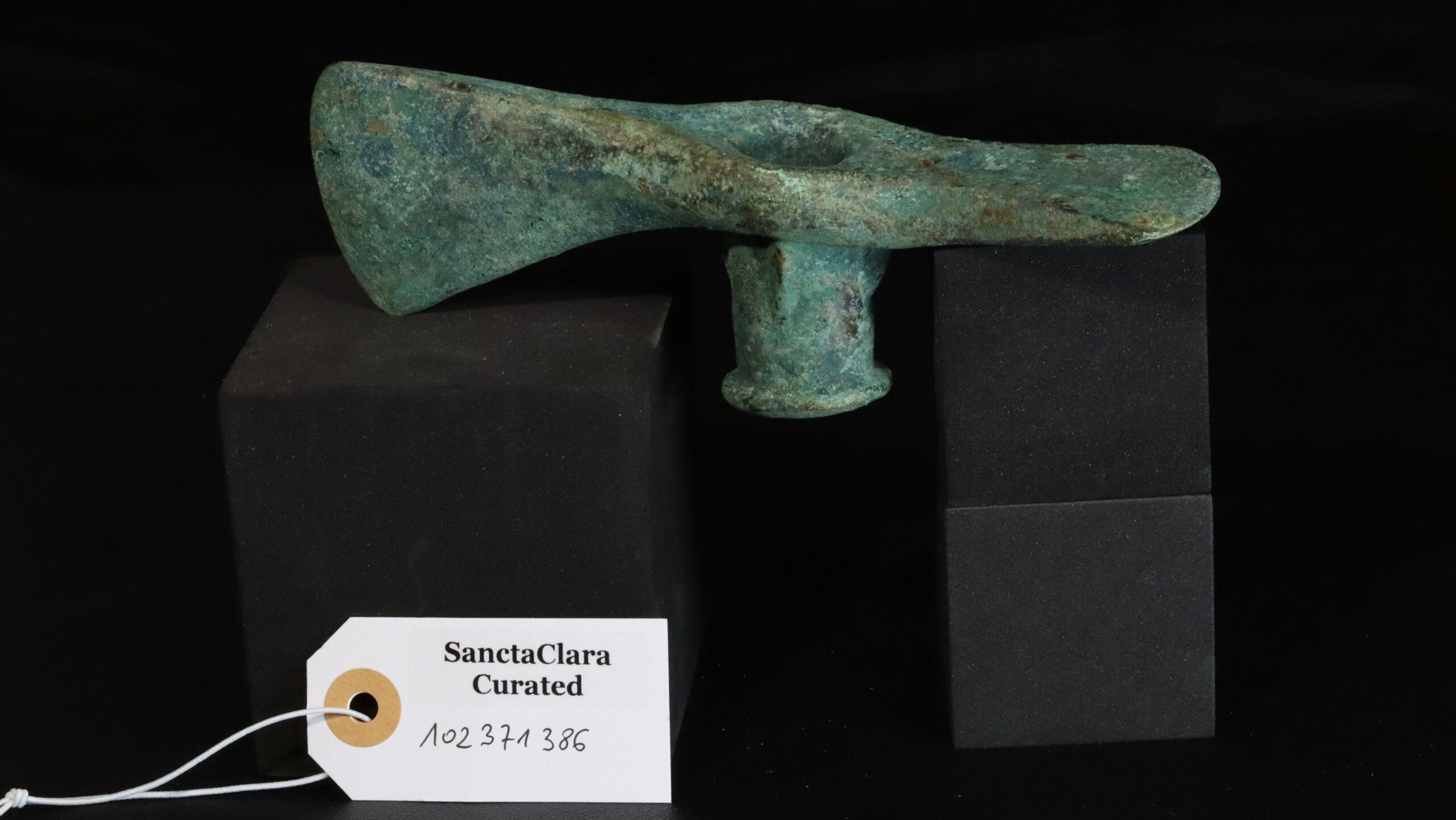
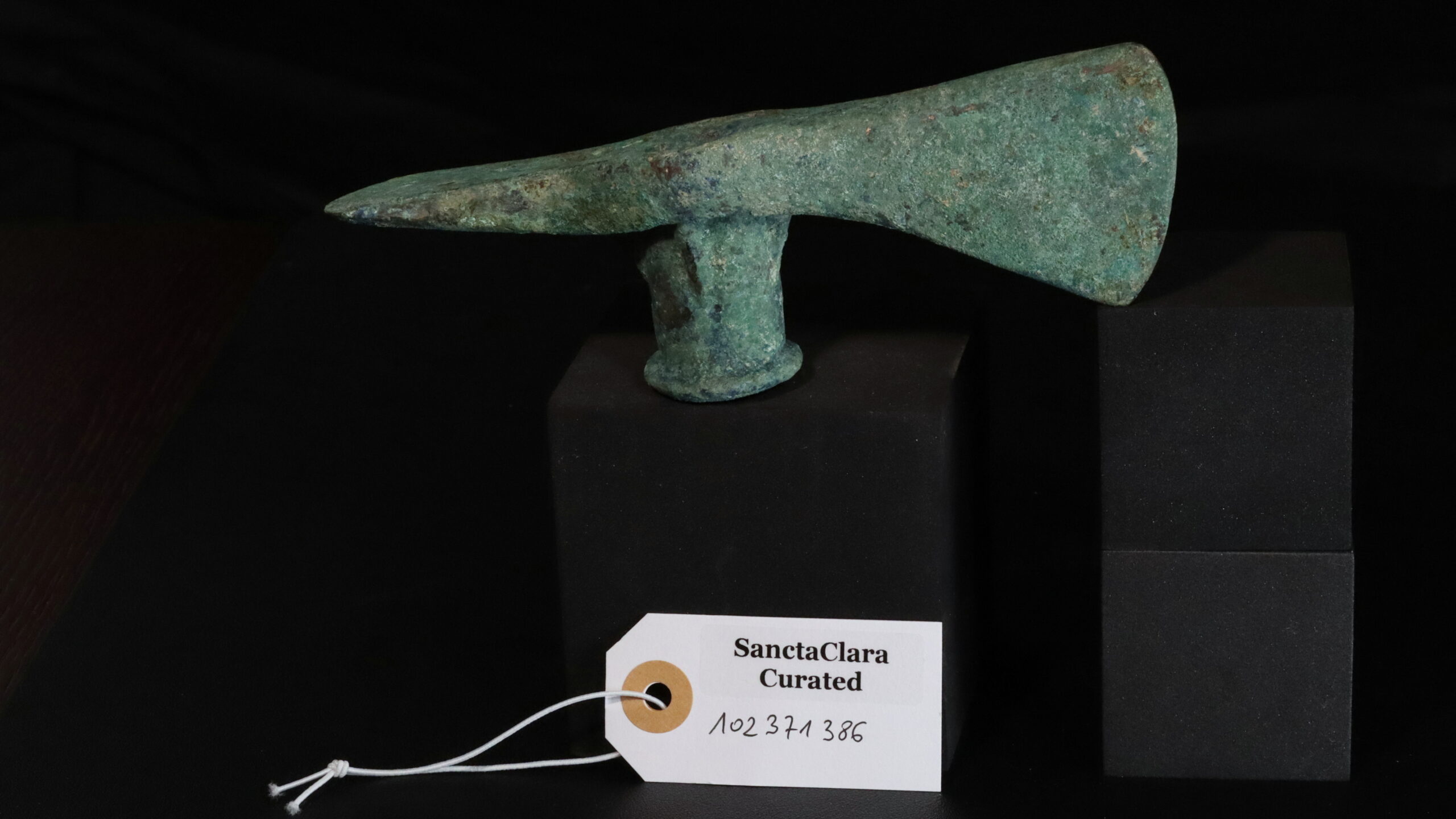
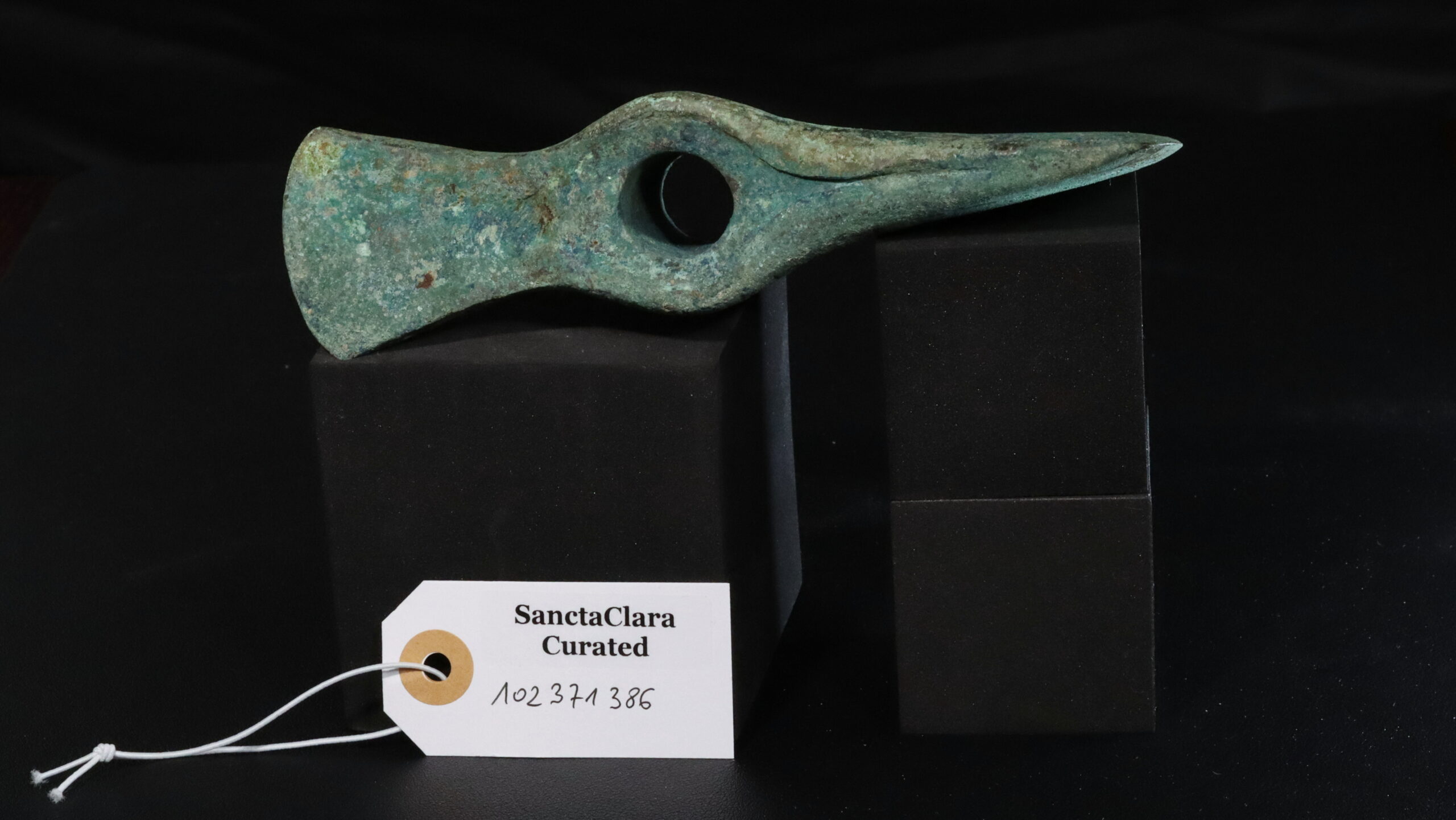
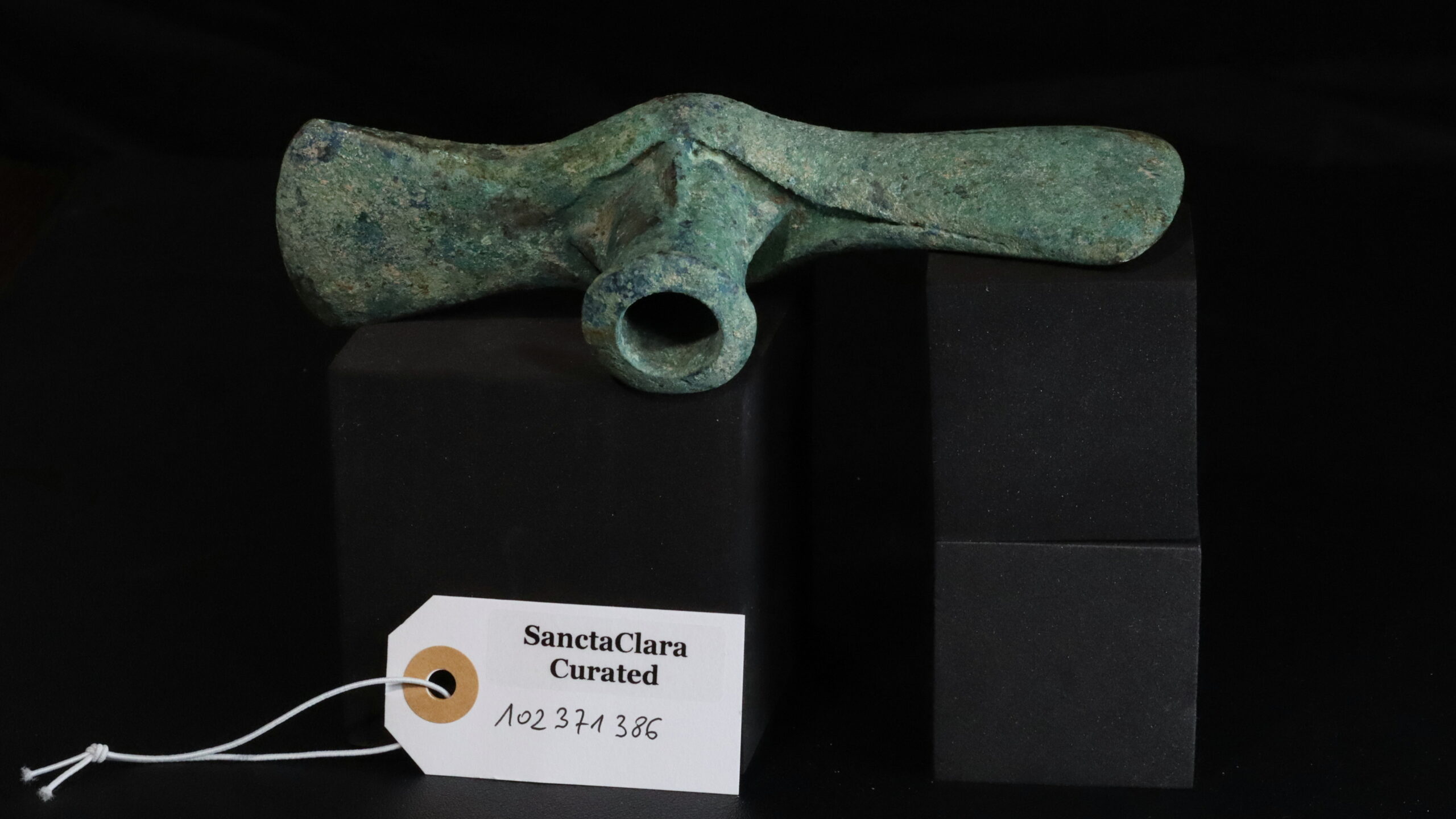
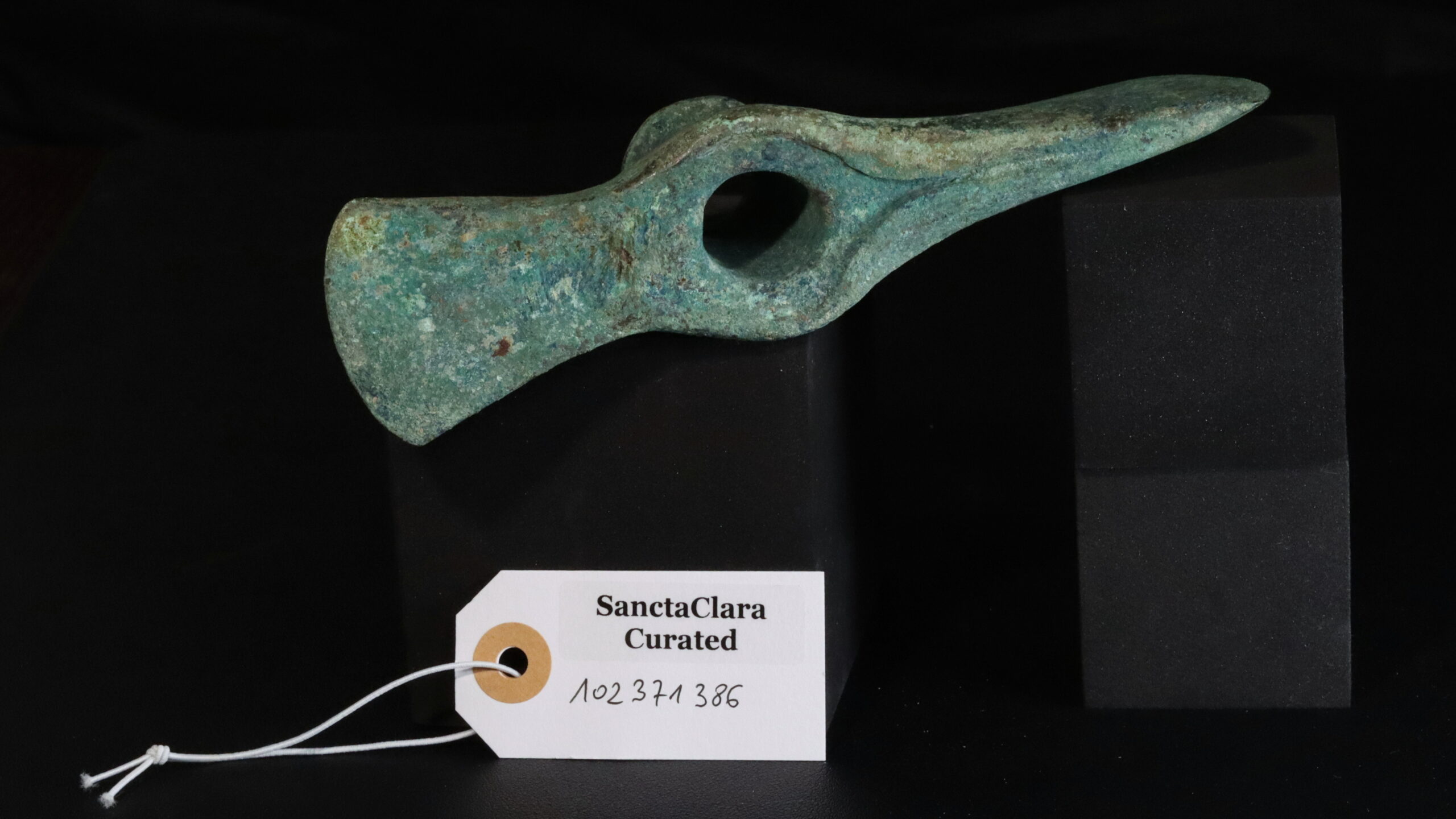
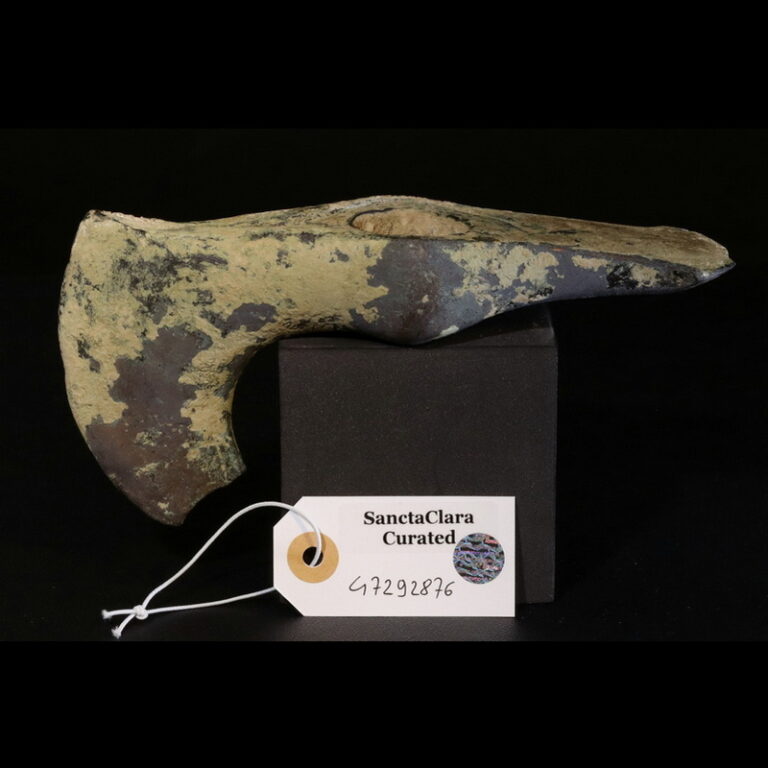
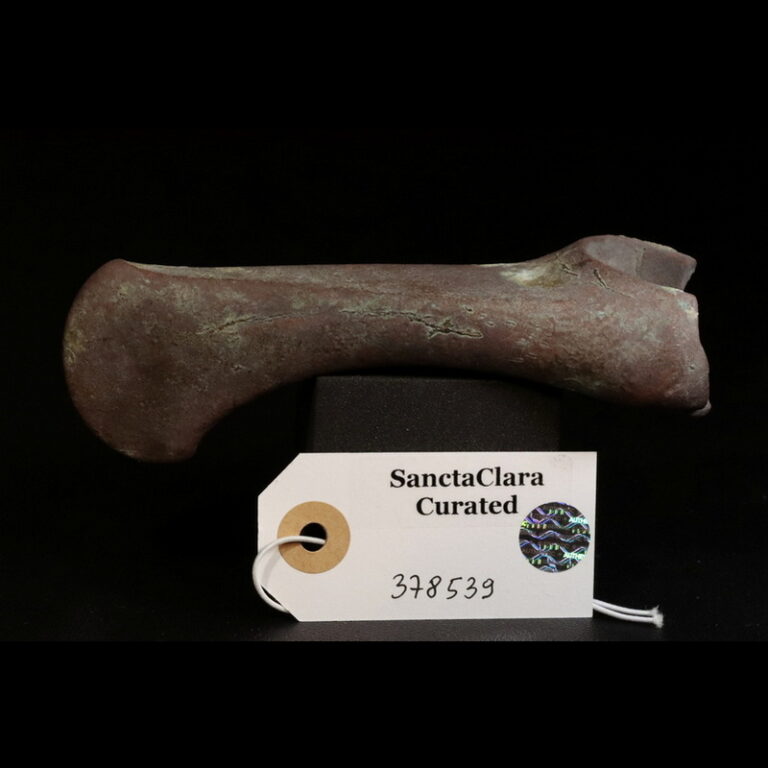
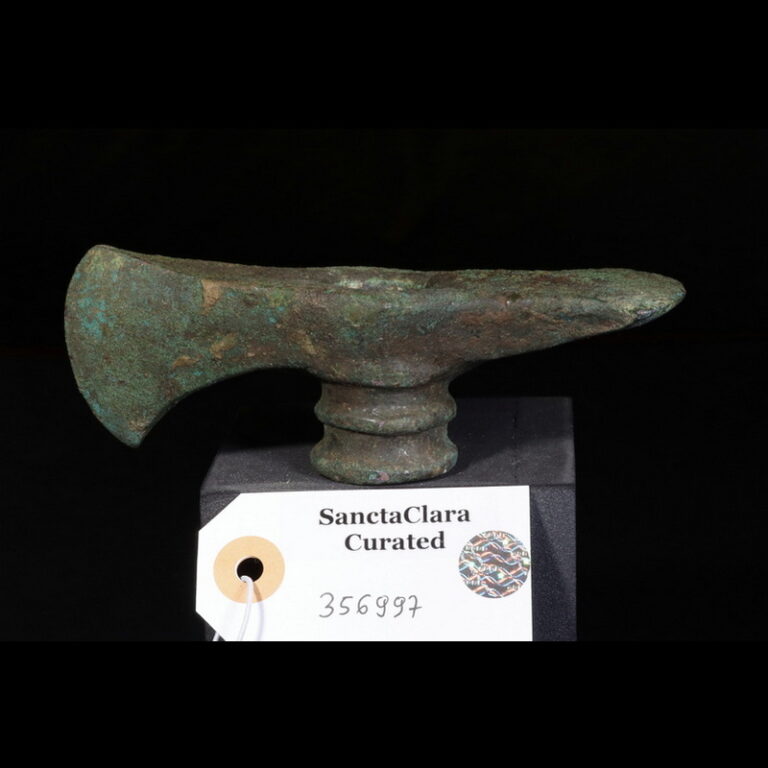
Danubian Collared Shaft-Hole Axe-Adze with Structural Buttresses and Fullers.
Description
Collared Shaft-Hole Axe-Adze with Structural Buttresses.
Copper alloy axe – adze with socket tunnel and collar.
Probable Culture/Region: The Carpathian Basin (modern-day Hungary, Romania/Transylvania) or the wider Balkan-Danubian region. There are also strong parallels in the Pontic-Caspian Steppe and the Koban Culture of the Caucasus.
Alternative assignation:
The Colchian and Koban Cultures (Caucasus Mountains, c. 1200–400 BCE): The smiths of the Koban culture were arguably the greatest bronze casters of antiquity. Their axes are famous for intricate, lace-like cutouts, deep fullers, and hollowed-out sections that look impossible to cast. They frequently used split spines to anchor their heavily decorated blades to the sockets. Period: Middle Bronze Age, approximately 2000 BCE – 1200 BCE.
This artifact represents a highly evolved phase of metallurgy where bronzesmiths were actively engineering solutions to mechanical stress. There is a distinct longitudinal line or crease along the upper ridge of the axe blade. What is visible along the upper and lower spine of the blade, particularly in the transitional zone where it emerges from the socket housing, is a thin longitudinal crevice — almost a slit — that gives the impression of two thin metal sheets pressed together along a central ridge. The feature is too thin and too clean to have been achieved by direct casting alone, yet the object is clearly a single casting, not an assembly of sheets.
Structural buttresses or struts: When a tool with a central socket strikes a target (wood or armor), massive shear forces and torsional strain are placed on the junction where the blade meets the thin-walled tubular socket. To prevent the blades from snapping off the central tube, the Transylvanian and Caucasian smiths developed these triangular buttresses to distribute the kinetic shock across a wider surface area of the socket. The "depression" (the saddle-like dip in the top profile) is a deliberate design choice: it removes unnecessary weight from the top of the axe while allowing the metal to wrap structurally around the stress-points of the shaft hole. The Weight (618 g): This piece is a perfect, nimble weight. At roughly 600 grams, it is light enough to be swung swiftly with one hand for extended periods without exhausting the user, yet heavy enough to deliver a lethal blow or bite deep into timber.
The Collar: The pronounced, flared lip at the top and bottom of the socket tunnel serve a vital purpose. They reinforce the opening of the socket, preventing the bronze from splitting outward when the wooden handle (haft) swells with moisture or takes the shock of a heavy impact. Probable Use: This is a true multi-tool, equally at home in the hands of a master carpenter, a shipwright, or a warrior. The axe blade would be used for felling or combat, while the adze blade was meant for shaping, hollowing, and planing wood. Given the refined engineering, it was likely an elite tool.
L: 175 mm, Axe 51 mm, Adze 46 mm, Tunnel length: 55 mm, tunnel inner diam.: 20 mm top, 19 mm bottom, Weight 618 g. Volume: 71,6 ml, Density (w/patina): 8,63 g/cm3 (indicating copper with natural arsenic content from Carpathian mines).
Curator Rating
5
Comparative Examples
Vs. Early Copper Age Axe-Adzes (e.g., Jászládány type): Earlier Copper Age tools from the same geographic region were massive, blocky, and lacked the elongated, collared tubular socket. They were prone to twisting on the handle. This piece shows the advanced, evolved "solution" to those early hafting problems. Vs. Near Eastern/BMAC Types: While the Near East produced many axe-adzes, they typically favor a flatter top profile and rarely feature these highly pronounced, localized triangular struts connecting the blade to the socket. The ribbing and buttressing here strongly lean toward European/Caucasian traditions.