
Document
Metadata
Title
Neolithic Polished Stone Axe
Description
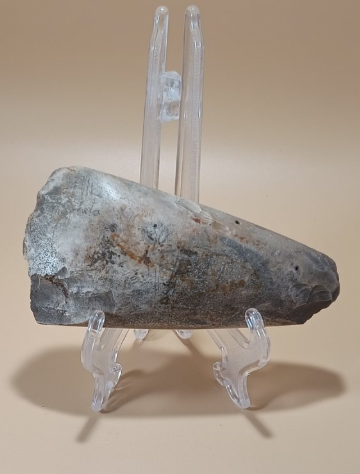
Neolithic Flint Axe, semi-ground, pointed butt
Culture: Neolithic Date: c. 4500--3000 BC
Flint piece with chalky white patina and minor iron staining. Bifacial reduction, elongated trapezoidal body, biconvex section. Convex cutting edge now rounded, pointed butt with pecking from hafting. Not fully ground (a rough-out / semi-ground axe). Probable area: France (Paris Basin / North). Condition: Structurally intact, small ancient chips to edge and butt, no visible restorations.
Culture: Neolithic Date: c. 4500--3000 BC
Flint piece with chalky white patina and minor iron staining. Bifacial reduction, elongated trapezoidal body, biconvex section. Convex cutting edge now rounded, pointed butt with pecking from hafting. Not fully ground (a rough-out / semi-ground axe). Probable area: France (Paris Basin / North). Condition: Structurally intact, small ancient chips to edge and butt, no visible restorations.
Catalogue Number
97808350
Category
Period
4500--3000 BCE
Culture
Neolithic France (Paris Basin / North)
Material
Stone (flint)
Dimensions and weight
L: 114mm, W: 58 mm, D: 28mm, weight 220 g
Reference Items
- N. V. Ryndina, A. D. Degtyareva, Non-ferrous Metal of the Yamnaya Cultural-Historical Area from Sites of Ukraine: morphology and production technology, Sthookum plus. 2, 2018, fig. 3.
Historical Significance
Axes are among the most fundamental tools in human history, evolving from stone to copper to bronze to iron. Each transition brought improvements in efficiency and durability. The progression from flint ot flat axes, to flanged and to palstave to socketed axes is one of the clearest examples of technological evolution.
Curator Rating
3