
Document
Attachments

SCC-45614471-2
Metadata
Title
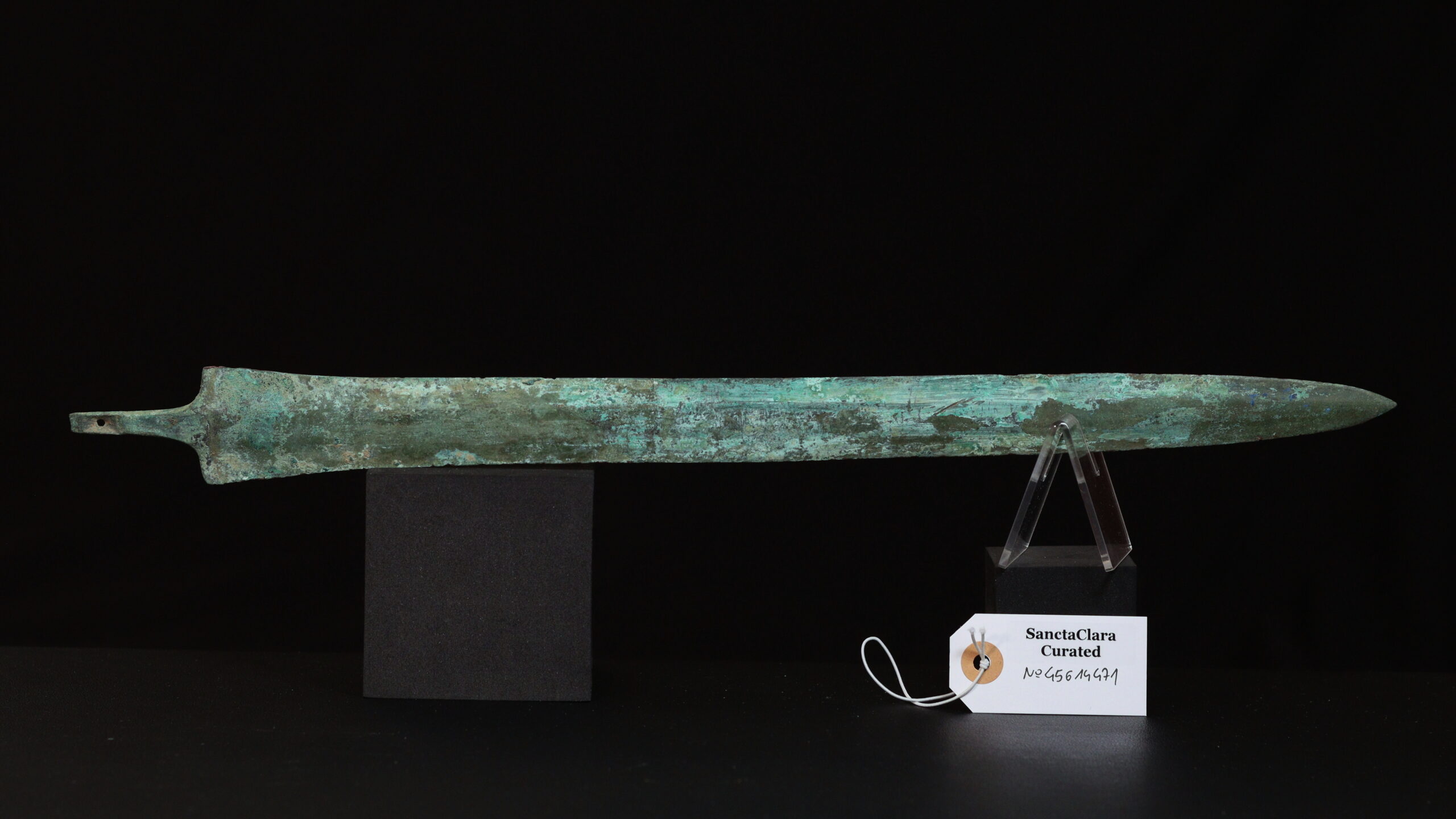
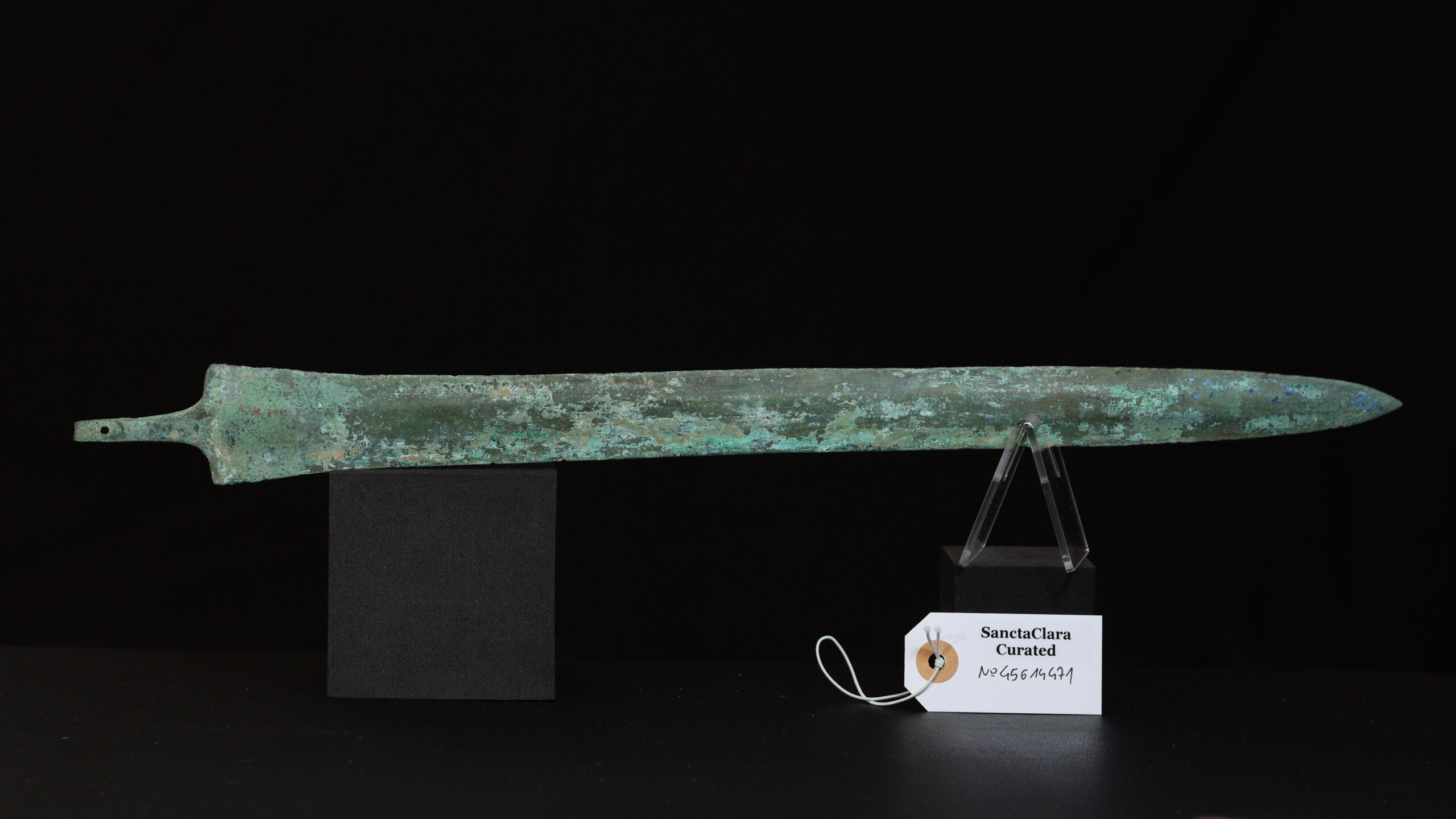
Leaf shaped bronze sword with short tang
Description
Bronze Age Mycenaean type Short Sword
category: Tang-hilted blades, characteristic of the Near East and the Eastern Mediterranean during the late 3rd to early 2nd millennium BCE. Short tang with single mounting hole. Splayed square shoulders and concave blade geometry. Hilt mounting shape visible.
Culture/Region: Likely Levantine (Canaanite) or Anatolian tradition. It shares significant similarities with weapons from the Amorite or Early Phoenician spheres. Time Period: Middle Bronze Age I--II (approx. 2000--1700 BCE). Morphological Type: This is a Square-Shouldered blade with a simple piercing on the tang for a rivet.
The Shoulders: The splayed square shoulders are a key diagnostic feature. In the Middle Bronze Age, the transition from the blade to the hilt was often the weakest point. Square shoulders provided a wide surface area for a separate hilt (likely made of organic material like wood, bone, or ivory) to be seated firmly against the metal.
Profile: The blade has a slow, elegant taper toward the point. This design suggests a weapon balanced for both thrusting and slicing. At 471 mm (approx. 18.5 inches), it sits right on the border between a long dagger and a short sword (dirk). Short Tang: The narrow, projecting tang would have been inserted into a slotted handle.
Mounting Hole: The single mounting hole is designed for a bronze or silver rivet that would pass through the handle and the tang to lock the assembly in place.
Weight (346 g): This is exceptionally light for its length, suggesting a high-quality tin-bronze alloy that allowed for a thinner, more flexible blade without sacrificing lethal strength. The surface displays a mottled, stable crusty green patina (malachite) with flecks of azurite (blue). This noble patina indicates the artifact was buried in a relatively stable environment for millennia. There are no obvious signs of notched edges (battle damage), which, combined with the elegant form, suggests it may have been a status symbol or a funerary accompaniment for a high-ranking individual.
category: Tang-hilted blades, characteristic of the Near East and the Eastern Mediterranean during the late 3rd to early 2nd millennium BCE. Short tang with single mounting hole. Splayed square shoulders and concave blade geometry. Hilt mounting shape visible.
Culture/Region: Likely Levantine (Canaanite) or Anatolian tradition. It shares significant similarities with weapons from the Amorite or Early Phoenician spheres. Time Period: Middle Bronze Age I--II (approx. 2000--1700 BCE). Morphological Type: This is a Square-Shouldered blade with a simple piercing on the tang for a rivet.
The Shoulders: The splayed square shoulders are a key diagnostic feature. In the Middle Bronze Age, the transition from the blade to the hilt was often the weakest point. Square shoulders provided a wide surface area for a separate hilt (likely made of organic material like wood, bone, or ivory) to be seated firmly against the metal.
Profile: The blade has a slow, elegant taper toward the point. This design suggests a weapon balanced for both thrusting and slicing. At 471 mm (approx. 18.5 inches), it sits right on the border between a long dagger and a short sword (dirk). Short Tang: The narrow, projecting tang would have been inserted into a slotted handle.
Mounting Hole: The single mounting hole is designed for a bronze or silver rivet that would pass through the handle and the tang to lock the assembly in place.
Weight (346 g): This is exceptionally light for its length, suggesting a high-quality tin-bronze alloy that allowed for a thinner, more flexible blade without sacrificing lethal strength. The surface displays a mottled, stable crusty green patina (malachite) with flecks of azurite (blue). This noble patina indicates the artifact was buried in a relatively stable environment for millennia. There are no obvious signs of notched edges (battle damage), which, combined with the elegant form, suggests it may have been a status symbol or a funerary accompaniment for a high-ranking individual.
Catalogue Number
45614471
Category
Period
2000-1550 BCEE
Culture
Mycenaean, Canaanite, Ugarit
Material
Bronze
Dimensions and weight
L: 471 mm, W: 40 mm, Weight: 346 g
Reference Items
Historical Significance
Iron arrowheads represent the transition from bronze to iron military technology. Unlike bronze arrowheads mass-produced by casting, iron arrowheads required individual forging. This made them more labour-intensive but ultimately cheaper, as iron ore was far more abundant than copper and tin.
Curator Rating
5.0