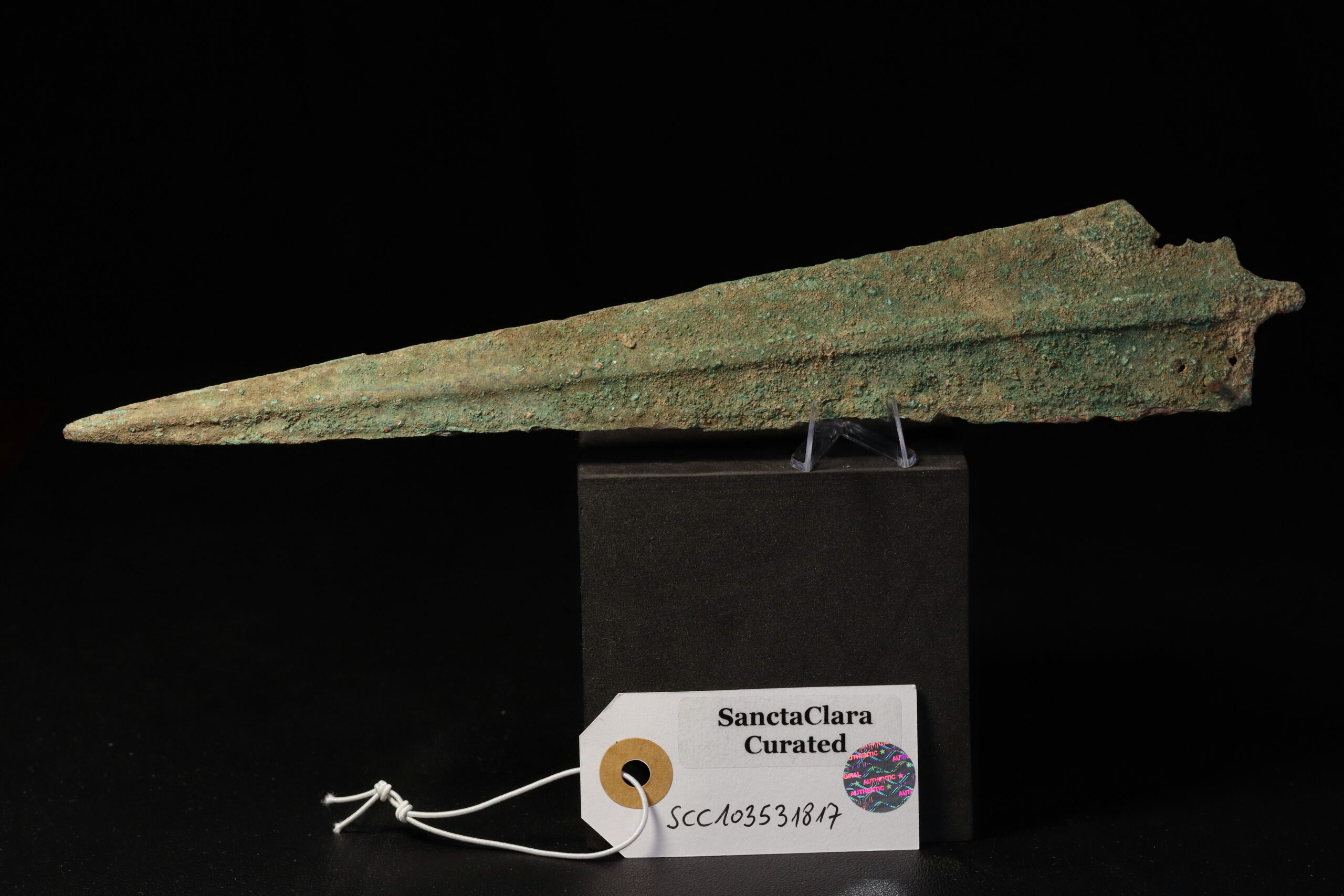
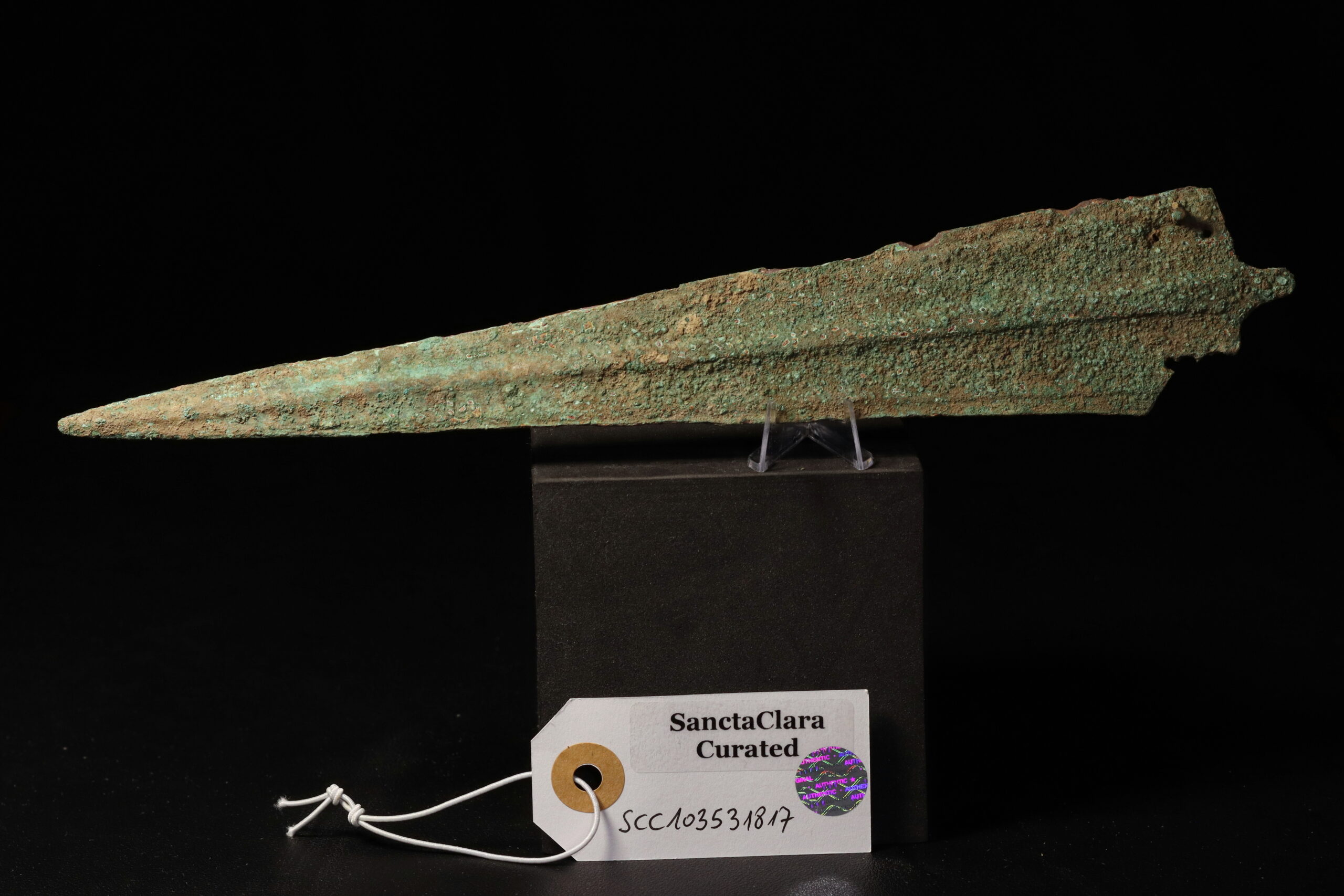
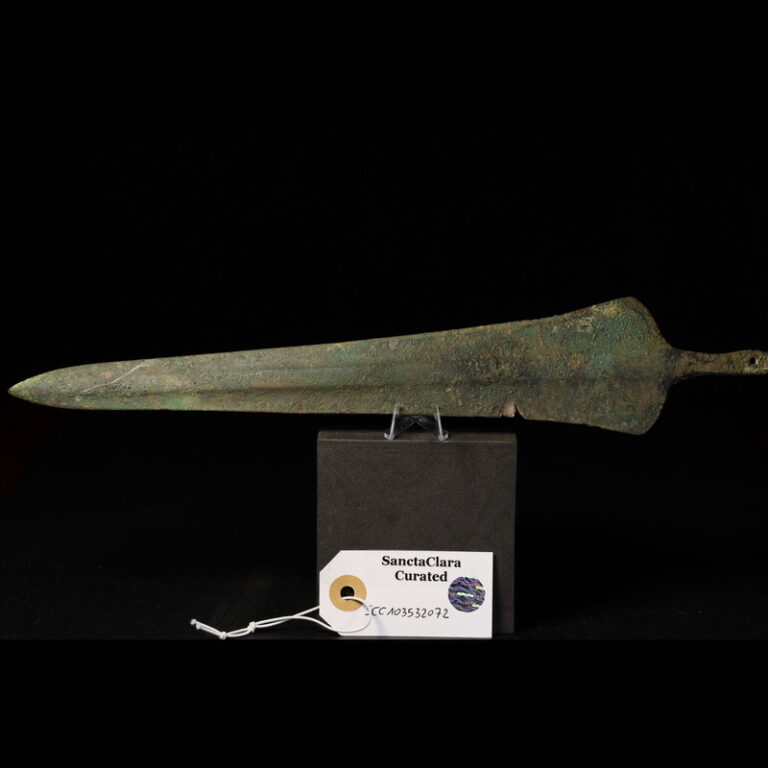
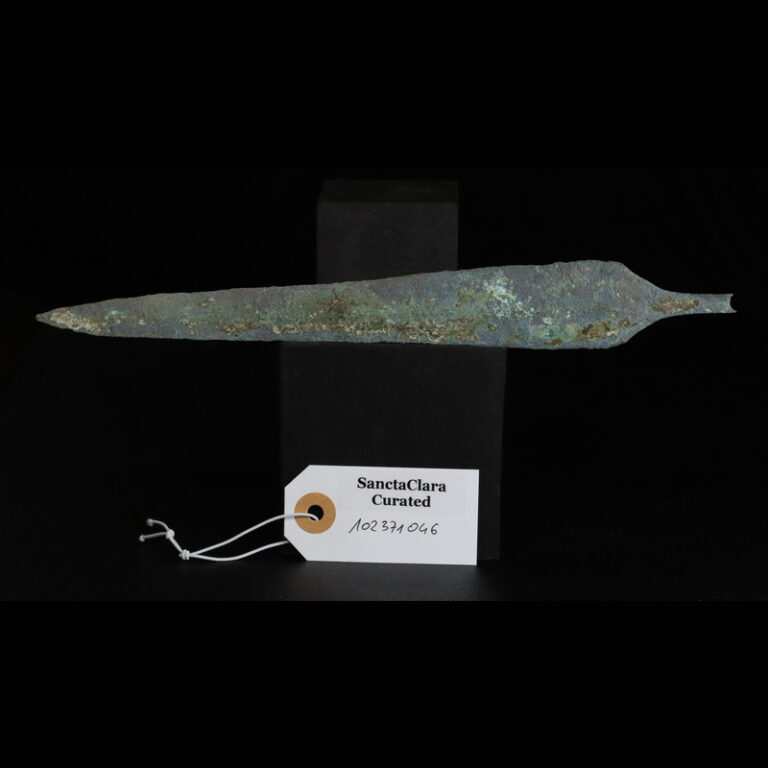
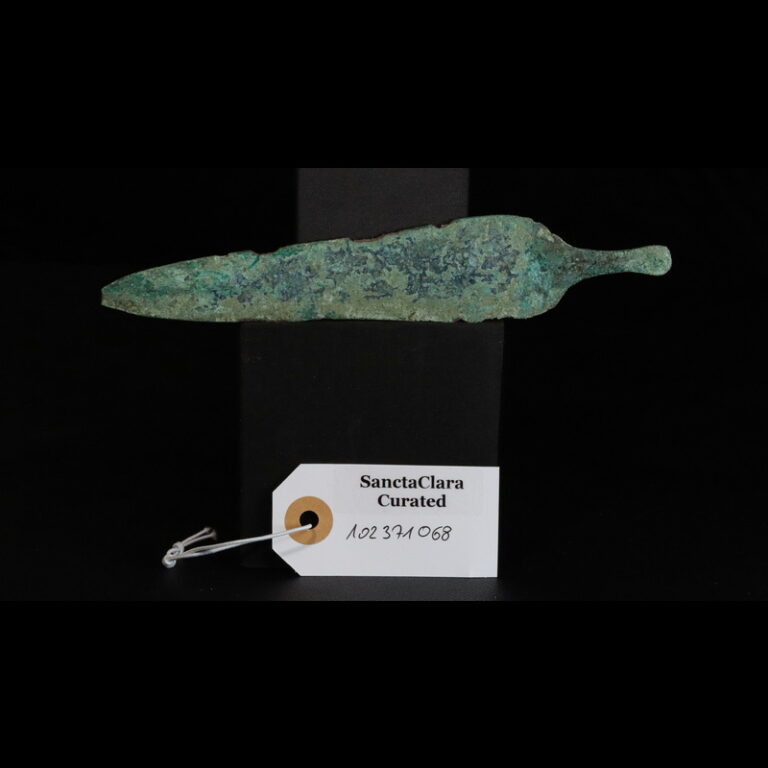
A Bronze Age bronze dagger blade, featuring a triangular blade with square shoulders and a square midrib. Distinct hammering mark in form of a thinned out blade edge of 4 mm width along the whole edge. One of the shoulders is chipped. A short tang extends from the bottom of the blade. On the side of the central midrib were three pierced holes on each side, one with the rivet still remaining.
L 258 mm x W 46 mm, 125 g, forte thickness 6 mm, tang 11 mm x 7 mm x 2,5 mm
Reference Items
Recent massive rescue excavations at the Middle Bronze Age II cemetery of Rishon Le-Zion, supervised by the Israel Antiquities Authority (IAA), have yielded one of the largest single-site assemblages of Canaanite weaponry ever recovered. Analyzing this corpus, Kan-Cipor-Meron established a refined typological sequence in which the artifact under analysis unequivocally represents a Type 2 dagger.
In Graham Philip's foundational comprehensive study, Metal Weapons of the Early and Middle Bronze Ages in Syria-Palestine (1989), the artifact fits the precise diagnostic criteria of a Type 17 dagger. Philip defines Type 17 daggers as having a long, triangular blade with slightly convex sides and a "wide, thick mid-rib". These daggers feature angular or square shoulders and short rectangular tangs, and are hafted via rivet holes pierced through the proximal end of the blade.