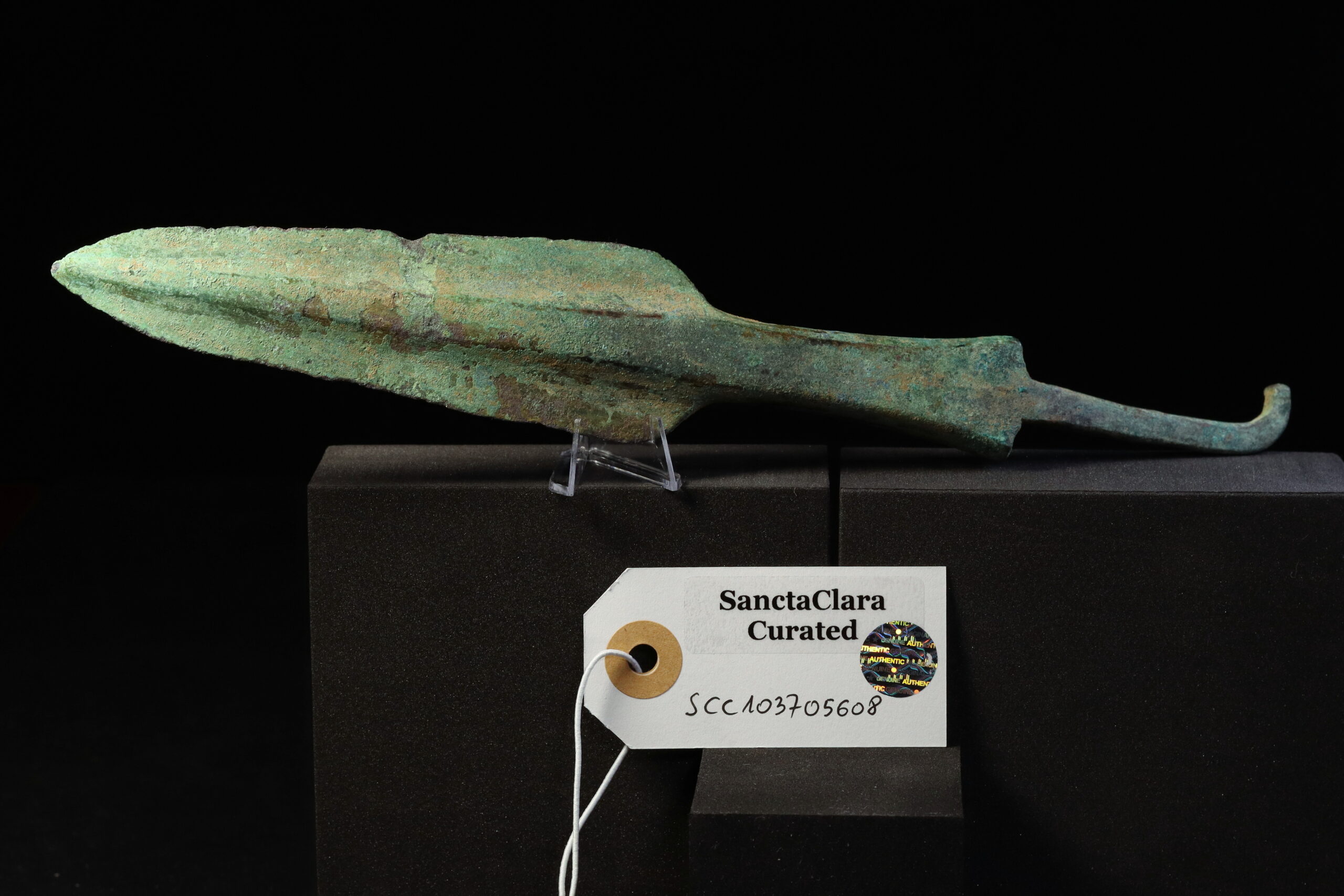
Bronze Age bronze spearhead featuring a leaf-shaped blade and a hook tail tang. The blade features lancetoid, upwards-sloping shoulders and a wide central, rounded midrib. The blade descends into a flattened stem that flares out to a stop ridge with a hooked end of tang.
Catalogue Number
103705608
Period
2300–1800 BCE
Culture
Mediterranean, Cypriot
Material
Bronze
Dimensions and weight
L 248 mm x W 38 mm, 239 g. Neck 62 mm x 16 mm x 11 mm, Tang 56 mm x 6 mm x 5 mm
Historical Significance
Weapons exhibiting this distinct "rat-tail" or hooked tang are predominantly associated with the Early to Middle Bronze Age of the Eastern Mediterranean and the Ancient Near East. Primary cultural attributions point toward Early Cypriot origins (ca. 2500–2000 BCE) where such specific typologies were highly prevalent. A secondary attribution includes the broader Ancient Near East, as similar heavy tanged weaponry persisted in Levantine and Luristan contexts into the Late Bronze Age and Early Iron Age (ca. 1200–800 BCE).
Curator Rating
5
Comparative Examples
* Early Bronze Age Cypriot copper alloy spearheads, dating to approximately 2500–2000 BCE, feature nearly identical leaf-shaped blades and hooked tangs.
* The Cesnola Collection at the Metropolitan Museum of Art contains specific examples of these Cypriot bronzes that range up to 19 1/4 inches in length.
* Central Anatolian spearheads from the Hattian culture (ca. 2300–2000 BCE) also demonstrate the regional use of bent tangs and slotted blades.
* Later Ancient Near Eastern heavy bronze spearheads from the Luristan and Levantine areas (ca. 1200–800 BCE) share the broad, leaf-shaped blade with a prominent midrib and a forged tang terminating in a curled hook (button-tang).
* These Levantine and Luristan weapons were structurally designed to provide immense armor-piercing strength without bending on impact.