
Attachments
-
 SCC 6784771
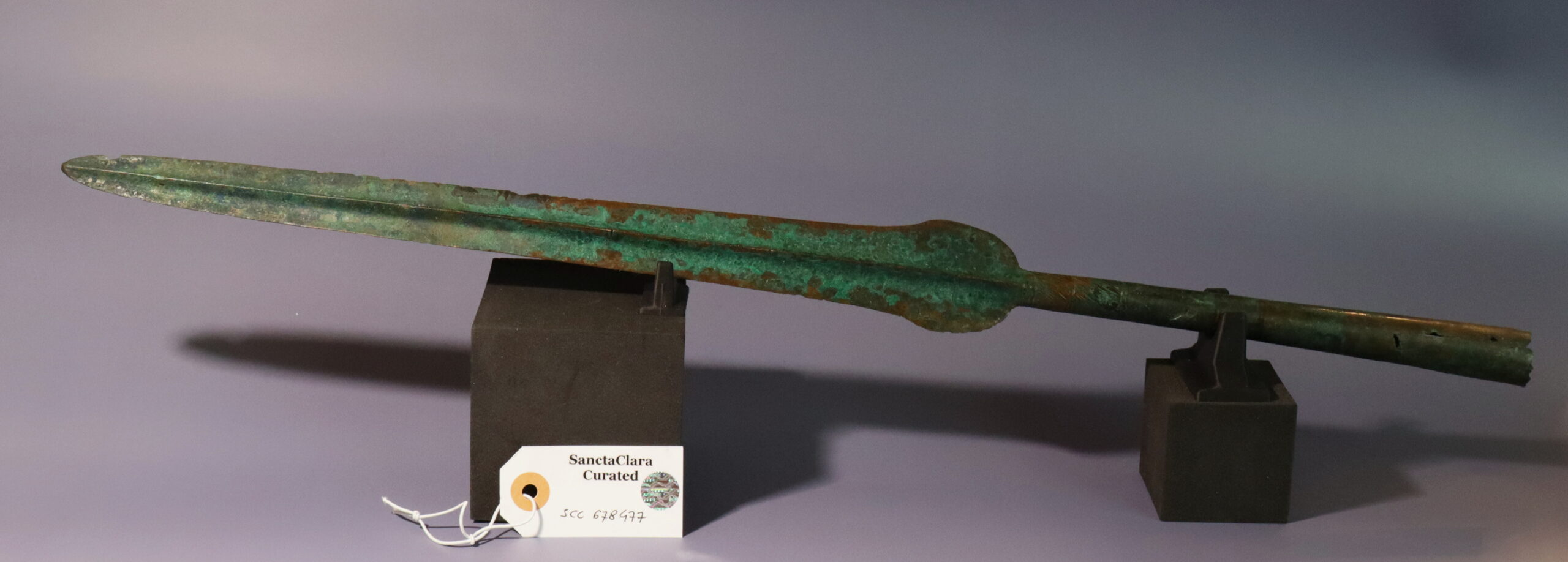
-
 SCC 6784772
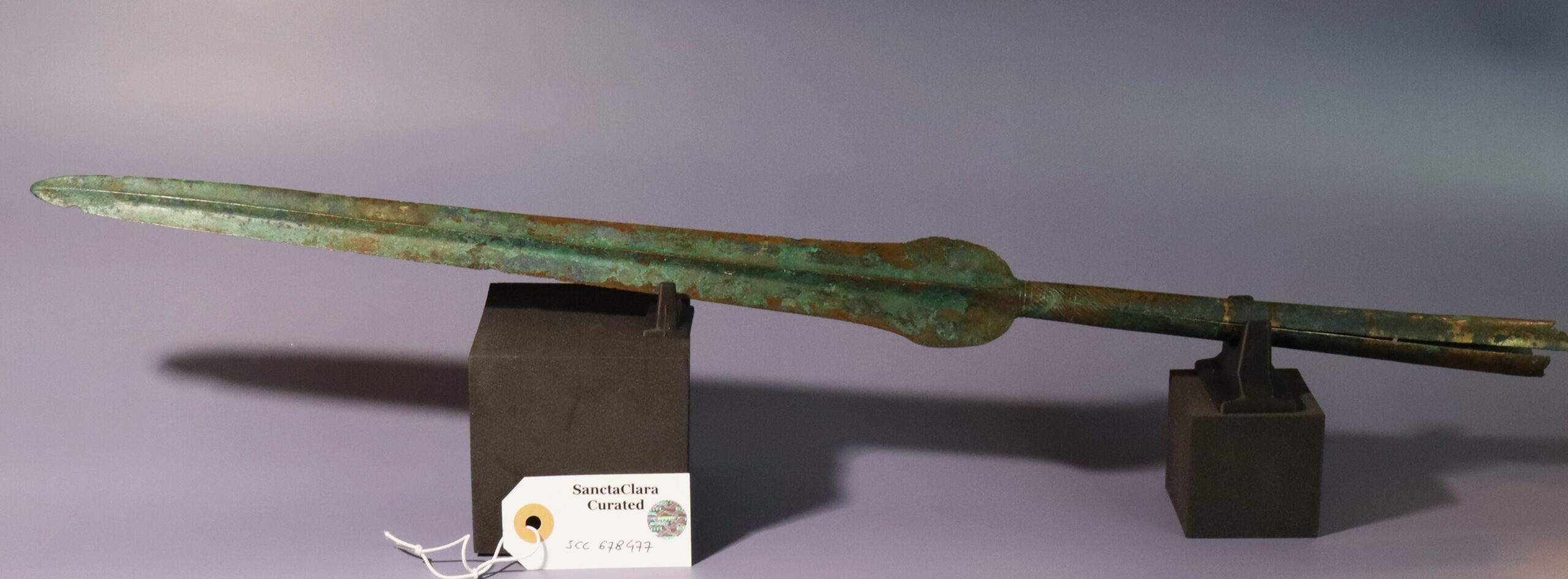
-
 SCC 6784773
Metadata
Title
Elite Minoan Split-Socketed Spearhead
Description
A striking example of decorated long spear head (pike) of late Minoan or Mycenaean characteristics.
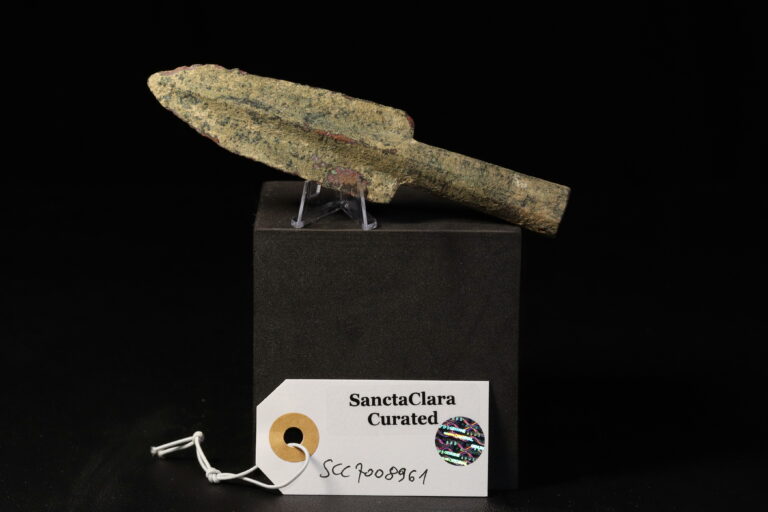
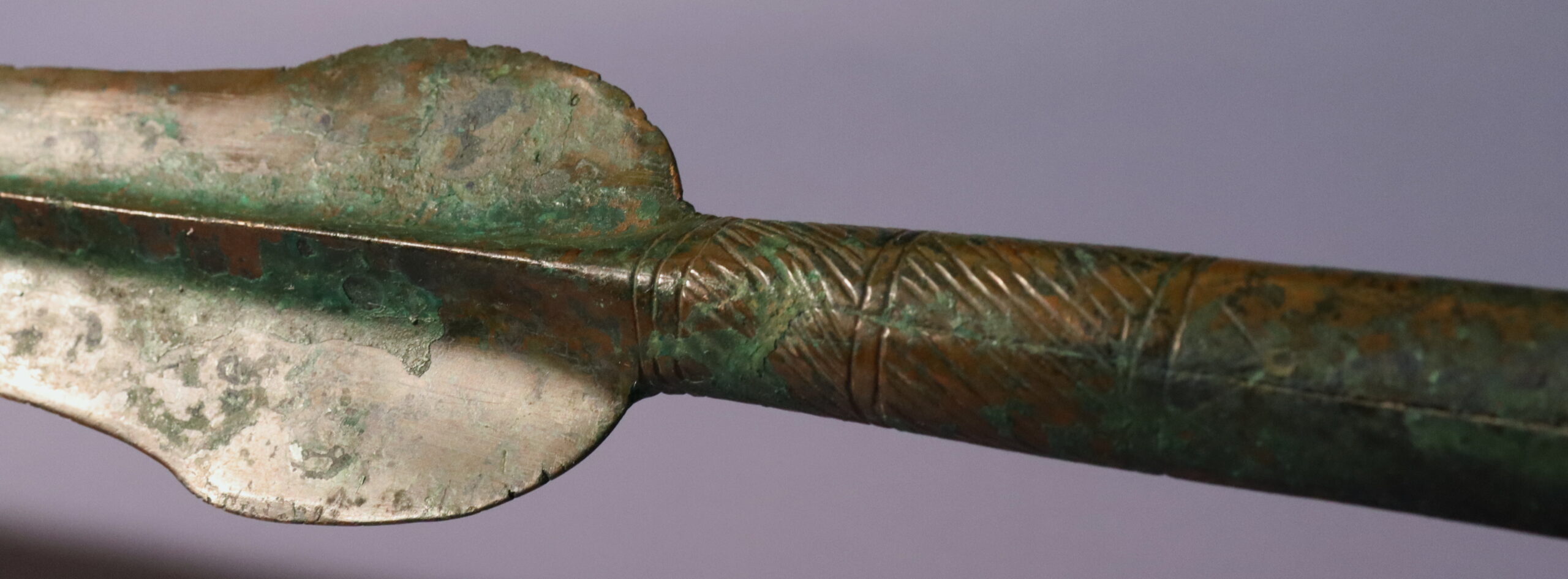
1. Socket Construction (Split-Socket / Schlitztülle): Unlike Central and Northern European Bronze Age spearheads, which were almost exclusively cast over a suspended clay core to produce a seamless hollow socket, this specimen exhibits a distinct longitudinal seam running the entire length of the lower shaft. The socket was formed by hammering broad, flat bronze wings around a cylindrical mandrel until the edges met. Near the base of the blade, the seam is tightly closed and reinforced by post-casting cold-working and chasing, while toward the proximal butt end, the seam slightly separates due to soil pressure and corrosion.
2. Blade Architecture: The blade measures approximately two-thirds of the total length (37,5 cm). It features a prominent, sharply carinated (faceted) midrib of triangular cross-section that provides essential longitudinal rigidity to an otherwise thin, very lightweight casting. The base of the blade expands into rounded, lobate shoulders before abruptly narrowing into a long, parallel-sided, narrow blade that tapers to an acute point.
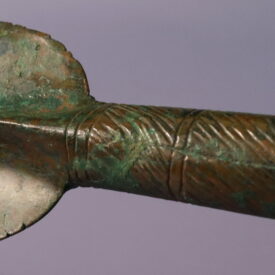
3. Ornamentation: The neck of the socket, immediately below the blade shoulders, is decorated with incised geometric registers executed via cold-chasing. The motif consists of multiple horizontal parallel bands framing two broad registers of parallel diagonal hatching (forming a continuous band pattern). A third band of faint chevron zig-zag lies further down the socket. The ornament might be skeuomorphic - visually mimicking organic binding cords used to secure the split metal sleeve around the wooden shaft.
4. Surface and Patina: The surface displays a heterogeneous, multi-layered corrosion crust consisting of dark brown cuprite overlaid by pale to dark green malachite, with localized patches of calcareous soil encrustation along the midrib recesses. Longitudinal stress cracks and minor losses are visible at the thin-walled proximal socket opening, alongside ancient micro-nicking along the cutting edges.
2. Mechanical Implications:
Thrusting vs. Slashing: The extreme length combined with thin walls and a rolled split-socket makes this artifact poorly suited for heavy lateral slashing or prying against shields, which would cause torsional bending along the blade or force the split socket to pry open around the wooden tenon.
Structural Role of the Midrib: The sharply raised, diamond-to-rhomboid midrib acts as an I-beam, maximizing resistance to bending along the thrusting axis while keeping the overall weight at the tip of a 2.2-to-2.5-meter ash or cornel wood shaft remarkably low.
3. Probable Use:
Parade / Status Panoply: Given the impressive visual length (the size of a sword), low weight, delicate socket walls, and ornate chased collar, the object most likely functioned as a ceremonial standard, funerary status symbol, or chieftain's parade lance.
Specialized Thrusting Lance: If employed in combat, it functioned strictly as a fast, nimble thrusting lance (used either on foot in open skirmishing or from a chariot platform) designed for deep penetration into unarmored or linen-armored targets rather than heavy shield-wall attrition.
Catalogue Number
SCC 678477
Category
Period
1500 BC
Culture
Late Minoan, Mycenaean
Material
Bronze
Dimensions and weight
Length: 585 mm (58,5 cm); Weight: 275 g Shaft socket: 205 mm long, 22 mm at widest to 13 mm at neck, outer diameter, 20 mm inner diameter Wall thickness 0,4 mm, blade thickness 0,4 mm Blade 375 mm long, 44 mm at shoulders, 33 mm at shoulder base, thickness at ridge-to-ridge 12 mm to 2 mm
Reference Items
Mass-to-Length Ratio Anomaly: At 58 cm in length and only 274 grams in weight, the weapon possesses an exceptionally low mass-to-length ratio. By comparison, a standard Central European Late Bronze Age functional war spearhead of similar length (e.g., Flame-shaped or Lüneburg types, or British basal-looped ceremonial spears of the Taunton/Penard phases) typically weighs between 450 g and 900 g due to thicker blade webs and heavy core-cast walls.
Curator Rating
5
Comparative Examples
Cultural Context and Typological Parallels
1. The Split-Socket Tradition: The combination of a solid or semi-hollow cast midrib with a hammered split-socket is a hallmark of the Eastern Mediterranean, Aegean, and Near Eastern metallurgical zones, standing in sharp contrast to the core-cast traditions of the Urnfield, Lusatian, or Nordic Bronze Age circles.
2. Aegean Parallels (Höckmann Type D/E & Avila Group II/III): In the Aegean Bronze Age (Middle Minoan III to Late Helladic III, c. 1700–1200 BCE), long spearheads with rolled split-sockets (Schlitztülle) were prominent elite weapons, well-documented in the Shaft Graves of Mycenae, the Hospital Site at Knossos, and Ialysos on Rhodes. While Aegean examples frequently include a separate cast collar ring to prevent the split socket from splaying upon impact, here the visual and structural function of the collar is integrated directly into the chased herringbone bands at the socket neck.
3. Levantine, Cypriot, and North Iranian Parallels: Hammered split-socket spearheads with elongated narrow blades and incised herringbone collars also appear in Late Bronze Age II to Early Iron Age I contexts across the Levant (Ugarit, Megiddo), Cyprus, and Northwestern Iran (Talysh / Amlash / Marlik horizons, c. 1350–800 BCE). In the Caspian and Transcaucasian zones, craftsmen frequently combined long, rapier-like midribbed blades with hammered sockets decorated with chased geometric triangles and herringbone zones.
4. European Outliers (Arreton Down & Reinecke A2/B1 Influence): While the split-socket is non-standard for continental Europe, the incised herringbone and chevron decoration on the socket neck shares stylistic affinities with Early-to-Middle Bronze Age decorated spearheads of the Carpathian Basin (Hajdusámson-Apa horizon) and the Nordic Valsømagle / Bagterp types, suggesting cross-regional transmission of geometric weapon motifs along amber and tin trade routes.