
Document
Metadata
Title
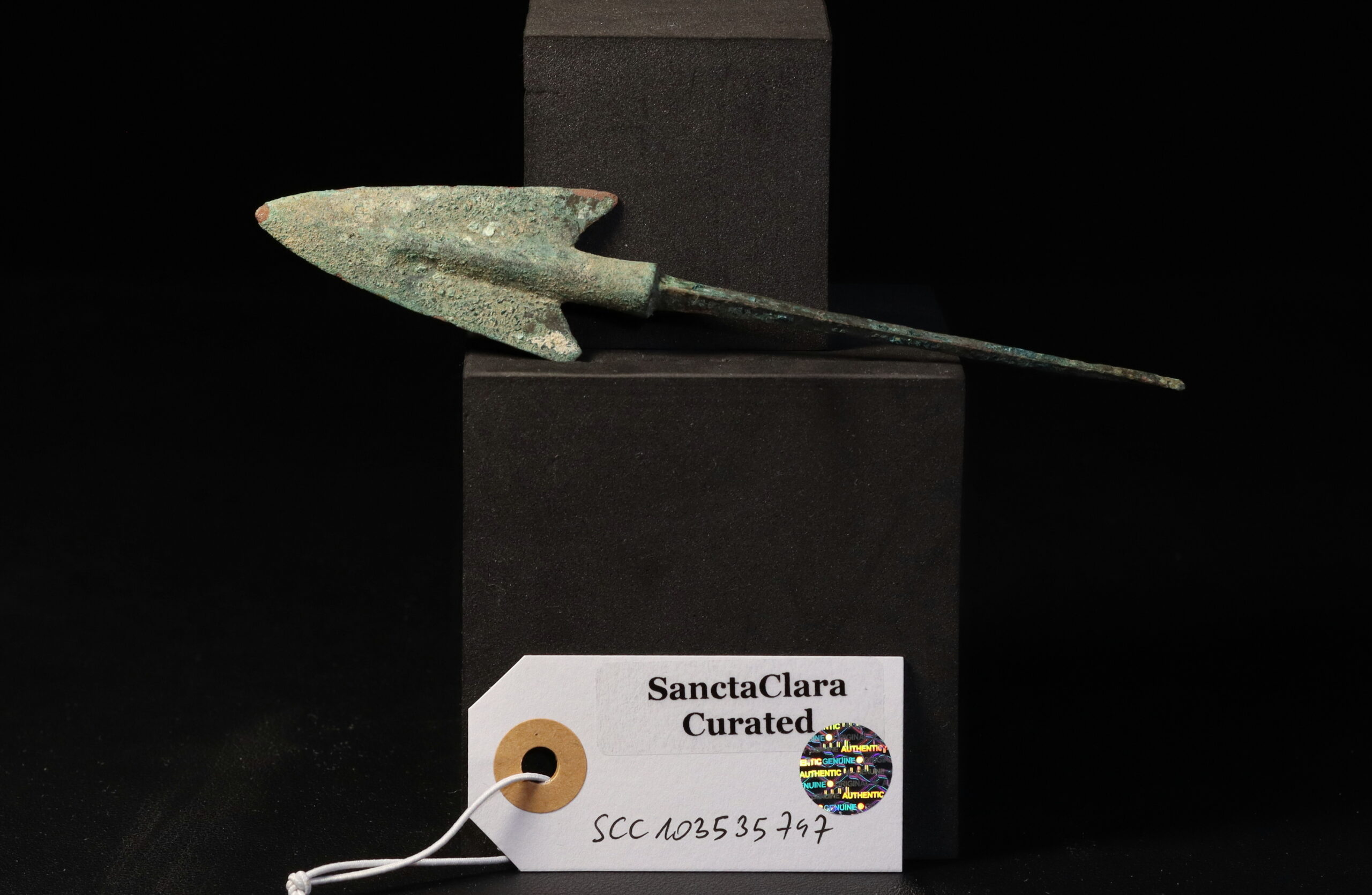
Elamite Bronze Barbed Javelin Head
Description
Bronze Age cast bronze arrowhead, featuring a triangular blade and a prominent central triangular midrib. The blade descends into a short round stem with a prominent stop-ridge, leading to a long and narrow tang. The blade presents with downward angled barbs.
Catalogue Number
103535747
Category
Period
1500 – 1100 BCE
Culture
Elam Middle Period, Amlash, Marlik Tepe
Material
Bronze
Dimensions and weight
L: 152 mm, W: 29 mm, Weight 26 g, Neck 15 mm, Stop ridge 9 mm, Tang squared 86 mm
Reference Items
The morphological traits of this piece firmly place it within the martial traditions of the ancient Near East and the Iranian Plateau, closely aligning with the military equipment of the Kassite (c. 1595–1155 BCE), Middle Elamite (c. 1500–1100 BCE), or early Median cultures.
Historical Significance
During the latter half of the 2nd millennium BCE, the regions of Mesopotamia and western Iran saw significant advancements in bronze weaponry, heavily influenced by endemic warfare and the rise of chariot combat. While socketed projectile points were becoming increasingly common in the broader Near East, tanged variants with heavy midribs remained a persistent and preferred regional typology in the Iranian highlands and surrounding areas, favored for their ease of manufacture and reliable hafting into thicker shafts.
Curator Rating
4
Comparative Examples
Susa and Elamite Excavations: Excavations at Susa (modern-day Iran) have uncovered numerous tanged bronze weapons from the Middle Elamite period. The Louvre Museum holds comparable examples of Elamite barbed and tanged projectile points that share the distinct short stem separating the blade from the tang.
Luristan Bronzes: The transition zone of Luristan (western Iran) produced vast quantities of bronze weaponry. While Luristan is famous for its elaborate daggers and axes, the utilitarian tanged spearheads and heavy arrowheads from the region frequently feature identical triangular blades and pronounced midribs.
Kassite Babylon: Weaponry associated with the Kassite dominance of Babylon also features heavily ribbed, tanged projectiles, emphasizing armor-piercing capabilities during a period when scale armor was becoming more prevalent among elite warriors.
Contrast with Later Typologies: This artifact stands in stark contrast to the small, socketed, tri-lobate (three-bladed) "Scythian-style" arrowheads that would later dominate the region in the Iron Age (c. 7th–5th centuries BCE), highlighting its earlier, Bronze Age metallurgical pedigree.
Luristan Bronzes: The transition zone of Luristan (western Iran) produced vast quantities of bronze weaponry. While Luristan is famous for its elaborate daggers and axes, the utilitarian tanged spearheads and heavy arrowheads from the region frequently feature identical triangular blades and pronounced midribs.
Kassite Babylon: Weaponry associated with the Kassite dominance of Babylon also features heavily ribbed, tanged projectiles, emphasizing armor-piercing capabilities during a period when scale armor was becoming more prevalent among elite warriors.
Contrast with Later Typologies: This artifact stands in stark contrast to the small, socketed, tri-lobate (three-bladed) "Scythian-style" arrowheads that would later dominate the region in the Iron Age (c. 7th–5th centuries BCE), highlighting its earlier, Bronze Age metallurgical pedigree.