
Document
Attachments
SCC-1018-2
Metadata
Title
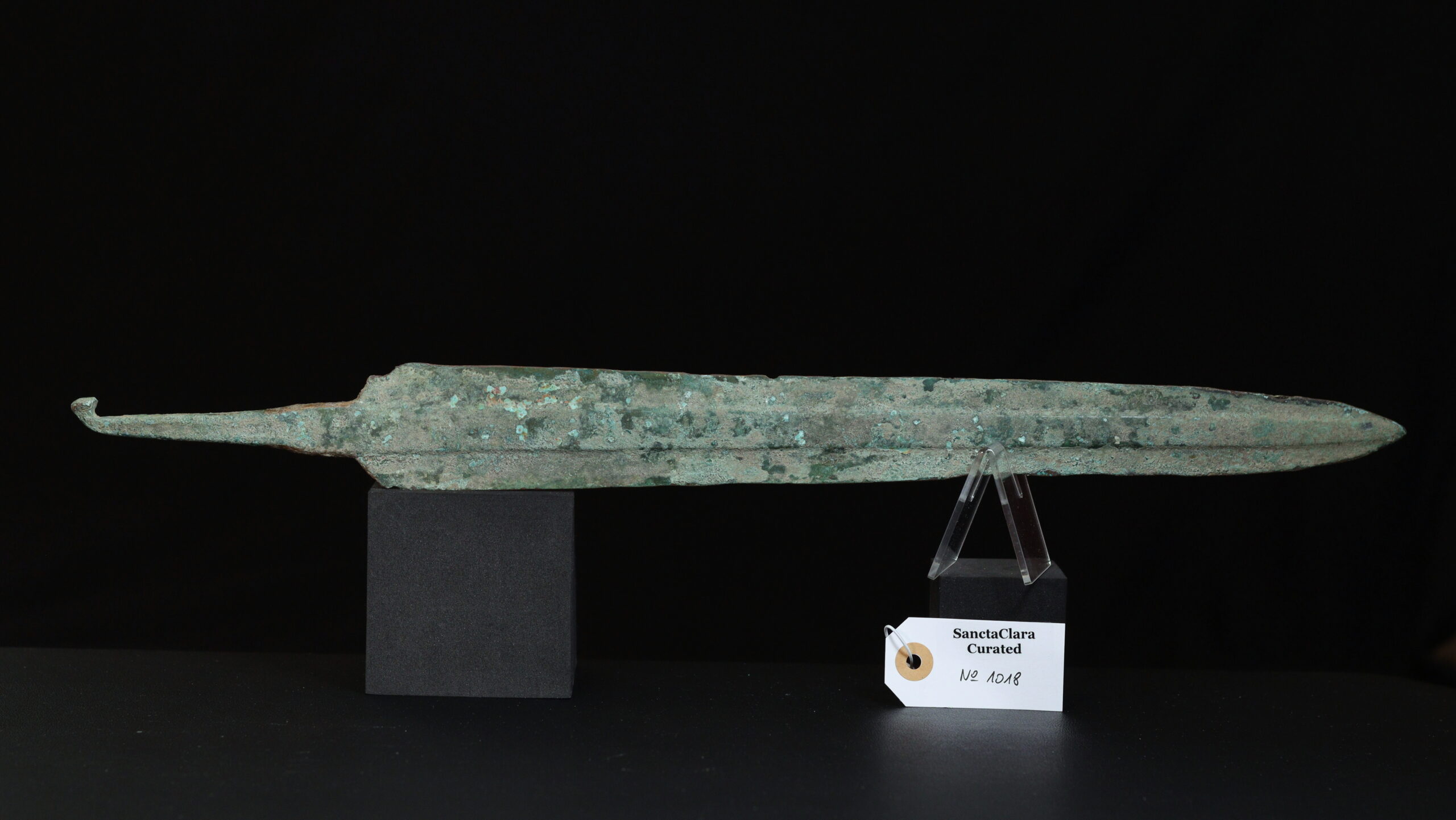
Bronze sword blade with flat midrib and hook tail rivet tang.
Description
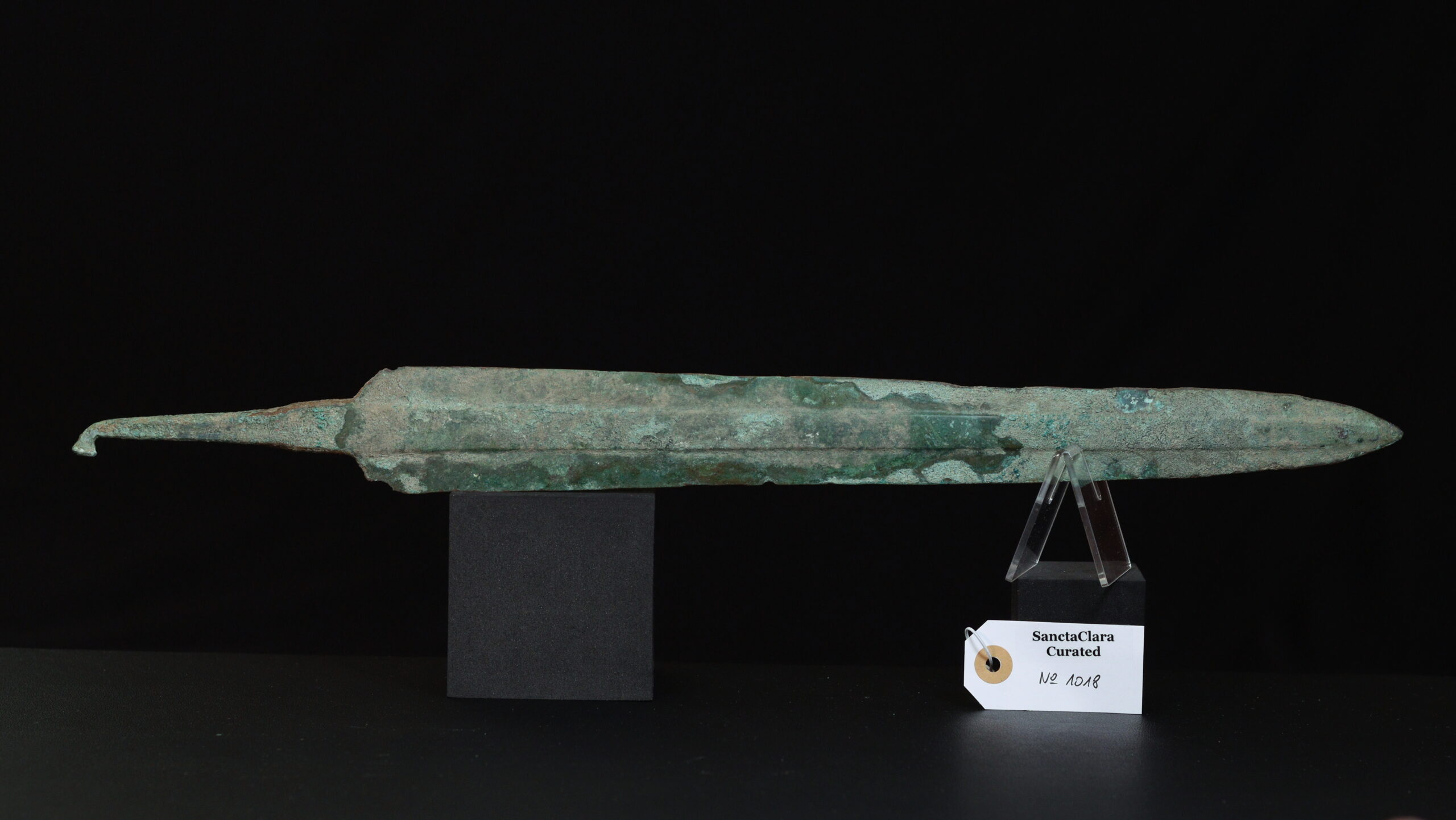
A substantial cast bronze sword, preserved through its full blade and the complete core of its grip. The 521 mm measured here is the surviving length: it carries the blade and the tang, but it does not account for the perished organic grip that was built up over the tang, nor for any pommel that capped its end. The complete weapon as wielded would have been longer — and at this surviving length already a true sword, well beyond the reach of the dirks and long daggers, intended for the cut as much as the thrust.
Form and construction
The piece is cast in a single pour, blade and tang continuous. The blade is long and sturdy with a flattened, wide raised midrib that runs almost the full length of the weapon, fading only near the point. This is not the high, sharp keel of a stabbing rapier but a broad, low ridge — a deliberate compromise that stiffens the blade against flexion while leaving generous flats on either side to take an edge. The resulting cross-section is lenticular with a thickened spine: the profile of a weapon meant to both thrust and cut.
What survives of the hilt is the tang — and it is essential to understand that the tang is the structural core of the grip, not a separate appendage to it. Around this flat strap of bronze the smith built the actual handle from organic material — wood, bone, or horn — which has long since perished. The sword therefore reaches us as its own skeleton: blade and grip-core intact, the soft cladding and any pommel gone. This is the normal condition in which such weapons come down to us, and it is no defect; it is simply what remains when only the metal endures.
The tang is of the hook-tail type and bears the weapon's most distinctive feature: a small hook finished with a button knob, projecting from the side of the grip rather than from its terminal. This lateral hook-and-button is a functional hafting device. Set against the side of the organic grip, it anchored the binding or grip-cladding and resisted the tendency of the handle to work loose under the shock of a blow — a positive catch built into the grip-core to lock the perishable handle to the enduring metal. Such side hooks are a recurring solution in the Near Eastern bronze tradition to the perennial weakness of all early swords: the union of blade and grip.
At the hilt shoulders, where blade meets tang, sit two rivet half-holes — semicircular notches opening laterally from each shoulder edge. These took the rivets that pinned the organic grip-plates against the flat of the tang, working together with the side hook to hold the handle fast. That they survive as open half-holes rather than fully enclosed perforations reflects a construction economical of bronze, the seats cut at the very margin of the metal.
Cultural attribution
The morphology places this firmly within the Western Asiatic / Near Eastern sphere of the Bronze Age. The flat broad midrib, the integral strap-tang forming the grip-core, and the side hook-and-button are features that recur across the Iranian plateau and the northern Zagros — the metallurgical world that produced the Luristan bronzes — and find echoes in the contemporary blades of the Levant and the eastern Aegean. The hook-and-button principle in particular is a hafting signature shared with several of the spear- and javelin-heads in this Collection, where a comparable hook secures the head to its shaft; the same idea is applied here to lock a grip to a sword.
I attribute the piece to the broad Near Eastern tradition, circa 1500–1000 BC, with the Iranian / Luristan workshops the most probable origin on the present evidence. The length and the deliberate edge geometry argue for a place well within the era of the mature bronze sword.
Metallurgy and surface
The weapon is cast bronze — a copper–tin alloy — and the surface tells the expected story of three millennia of burial. A stable, well-developed patina covers the piece in mottled greens, from deep malachite to paler verdigris, broken by warmer reddish-brown passages where cuprite (the red cuprous oxide that forms first directly on the metal) shows through the malachite skin. Earthen encrustations remain across both faces, undisturbed. The patina is layered and adherent rather than powdery, with no sign of the bright, active light-green spotting that would signal "bronze disease" — the corrosion is mature and at rest. The texture and stratification of these layers are exactly what one hopes to read on an authentic excavated bronze; for the principles behind that reading, see The Language of Patina.
Condition
Excellent and stable for the type. The blade is complete from point to shoulder, the midrib intact along its run. The tang — the grip-core — survives whole, retaining both the side hook with its button and the two shoulder rivet-notches. The organic grip and any pommel that once dressed the tang are lost, as is invariably the case. Minor losses and chipping to the cutting edges are consistent with ancient use and age. The survival of the complete grip-core with its hook and rivet seats intact is what distinguishes this example from the many broken-tanged blades on the market.
Form and construction
The piece is cast in a single pour, blade and tang continuous. The blade is long and sturdy with a flattened, wide raised midrib that runs almost the full length of the weapon, fading only near the point. This is not the high, sharp keel of a stabbing rapier but a broad, low ridge — a deliberate compromise that stiffens the blade against flexion while leaving generous flats on either side to take an edge. The resulting cross-section is lenticular with a thickened spine: the profile of a weapon meant to both thrust and cut.
What survives of the hilt is the tang — and it is essential to understand that the tang is the structural core of the grip, not a separate appendage to it. Around this flat strap of bronze the smith built the actual handle from organic material — wood, bone, or horn — which has long since perished. The sword therefore reaches us as its own skeleton: blade and grip-core intact, the soft cladding and any pommel gone. This is the normal condition in which such weapons come down to us, and it is no defect; it is simply what remains when only the metal endures.
The tang is of the hook-tail type and bears the weapon's most distinctive feature: a small hook finished with a button knob, projecting from the side of the grip rather than from its terminal. This lateral hook-and-button is a functional hafting device. Set against the side of the organic grip, it anchored the binding or grip-cladding and resisted the tendency of the handle to work loose under the shock of a blow — a positive catch built into the grip-core to lock the perishable handle to the enduring metal. Such side hooks are a recurring solution in the Near Eastern bronze tradition to the perennial weakness of all early swords: the union of blade and grip.
At the hilt shoulders, where blade meets tang, sit two rivet half-holes — semicircular notches opening laterally from each shoulder edge. These took the rivets that pinned the organic grip-plates against the flat of the tang, working together with the side hook to hold the handle fast. That they survive as open half-holes rather than fully enclosed perforations reflects a construction economical of bronze, the seats cut at the very margin of the metal.
Cultural attribution
The morphology places this firmly within the Western Asiatic / Near Eastern sphere of the Bronze Age. The flat broad midrib, the integral strap-tang forming the grip-core, and the side hook-and-button are features that recur across the Iranian plateau and the northern Zagros — the metallurgical world that produced the Luristan bronzes — and find echoes in the contemporary blades of the Levant and the eastern Aegean. The hook-and-button principle in particular is a hafting signature shared with several of the spear- and javelin-heads in this Collection, where a comparable hook secures the head to its shaft; the same idea is applied here to lock a grip to a sword.
I attribute the piece to the broad Near Eastern tradition, circa 1500–1000 BC, with the Iranian / Luristan workshops the most probable origin on the present evidence. The length and the deliberate edge geometry argue for a place well within the era of the mature bronze sword.
Metallurgy and surface
The weapon is cast bronze — a copper–tin alloy — and the surface tells the expected story of three millennia of burial. A stable, well-developed patina covers the piece in mottled greens, from deep malachite to paler verdigris, broken by warmer reddish-brown passages where cuprite (the red cuprous oxide that forms first directly on the metal) shows through the malachite skin. Earthen encrustations remain across both faces, undisturbed. The patina is layered and adherent rather than powdery, with no sign of the bright, active light-green spotting that would signal "bronze disease" — the corrosion is mature and at rest. The texture and stratification of these layers are exactly what one hopes to read on an authentic excavated bronze; for the principles behind that reading, see The Language of Patina.
Condition
Excellent and stable for the type. The blade is complete from point to shoulder, the midrib intact along its run. The tang — the grip-core — survives whole, retaining both the side hook with its button and the two shoulder rivet-notches. The organic grip and any pommel that once dressed the tang are lost, as is invariably the case. Minor losses and chipping to the cutting edges are consistent with ancient use and age. The survival of the complete grip-core with its hook and rivet seats intact is what distinguishes this example from the many broken-tanged blades on the market.
Catalogue Number
1018
Category
Period
1500--1000 BCE
Culture
Luristan, Assyrian, Babylonian, Near Eastern
Material
Bronze
Dimensions and weight
L: 521 mm, Weight: 462.5 g
Historical Significance
Bronze swords represent the pinnacle of pre-iron weapon technology. Casting a long blade required precise control of the copper-tin alloy ratio (typically ~10% tin), mould design, and cooling rate. This metallurgical knowledge, developed over centuries of empirical practice, represents one of the great achievements of ancient technology.
Curator Rating
5.0