
Understanding bronze aging
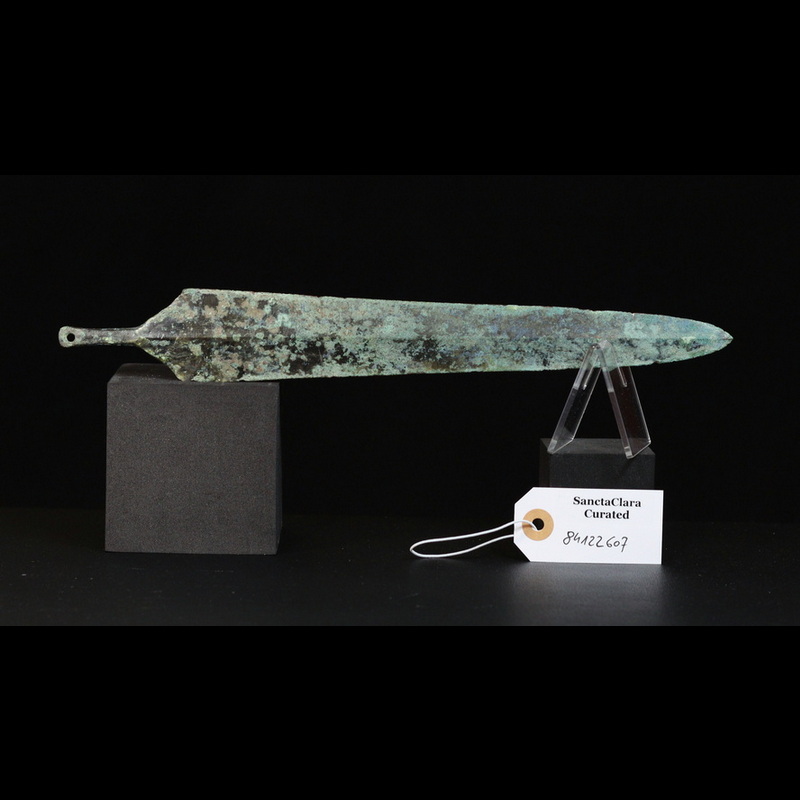
After handling hundreds of ancient bronze weapons, tools, and ritual objects spanning from the Chalcolithic through the Classical periods, one learns to read patina the way a geologist reads strata. Every layer tells a story — of burial environment, of chemical interaction over millennia, of the slow transformation of metal into mineral. For the collector, the curator, and the scholar, patina is not merely surface decoration. It is the artifact’s autobiography, written in copper carbonates, oxides, and chlorides across two, three, or four thousand years.
This article examines the principal corrosion products found on ancient copper alloy and bronze artifacts, the conditions under which they form, their visual characteristics, and their critical role in authentication.
The Structure of Ancient Patina: Reading Layers from the Inside Out
Before examining individual minerals, it is essential to understand that genuine ancient patina is not a single coating. It is a stratified system — a series of chemically distinct layers that form sequentially over centuries, each one reflecting the changing microenvironment at the metal surface as corrosion progresses inward.
On a well-preserved bronze artifact excavated from a stable burial context, the typical cross-section from the metal core outward is roughly as follows: a thin inner layer of cuprite (red copper oxide) sits directly against the surviving metal. Above that, a thicker layer of green or blue copper carbonates — malachite and sometimes azurite — forms the dominant visual patina. On tin-rich bronzes, patches or veins of cassiterite (tin oxide) may appear as dark, glassy inclusions within or beneath these layers. The outermost surface often carries encrustations of calcium carbonate, silica, iron oxides, or clay minerals absorbed from the surrounding soil.
This layered structure is the single most important indicator of authenticity. It cannot be convincingly replicated in a workshop over a period of weeks or months. The chemical gradients, the interlocking crystal growth between layers, the way corrosion follows grain boundaries in the original cast metal — these features require deep time and cannot be faked by anyone who understands what a trained eye is looking for.
Cuprite: The Foundation Layer
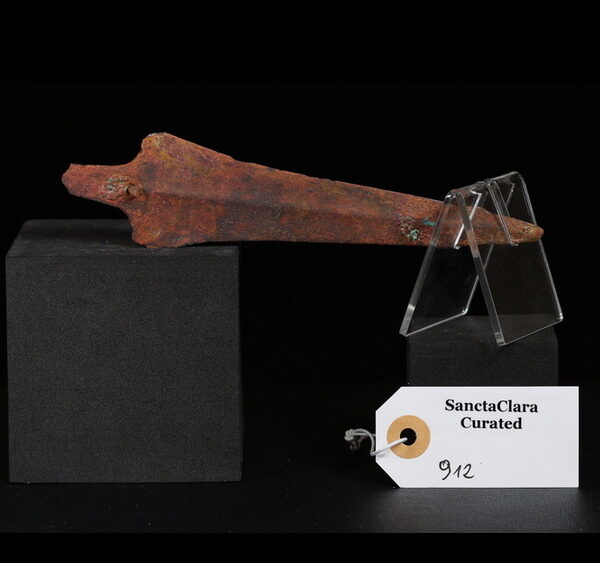
Cuprite (Cu₂O), red copper oxide, is almost always the first corrosion product to form on a copper alloy surface. It develops through direct oxidation of the metal, and on ancient artifacts it typically appears as a thin, dense, adherent layer ranging in colour from deep brick-red to a dark brownish-crimson. On polished cross-sections examined under magnification, cuprite often has a distinctive translucent, glassy quality.
This mineral forms under conditions of limited oxygen availability — exactly the conditions found in most burial environments once the soil has settled around the object and oxygen diffusion is restricted. It does not require moisture in the way that carbonate patinas do; even in relatively dry desert burials, a cuprite layer will develop over sufficient time.
Cuprite is significant for several reasons. First, it is the foundation upon which all subsequent corrosion layers build. When you see a genuine ancient patina, the cuprite layer is bonded at a molecular level to the metal substrate below it and to the carbonate or chloride layers above it. Second, cuprite is thermodynamically stable. Once formed, it persists essentially indefinitely under burial conditions. Third, its presence directly beneath a malachite layer is one of the hallmarks of authentic, naturally developed patina.
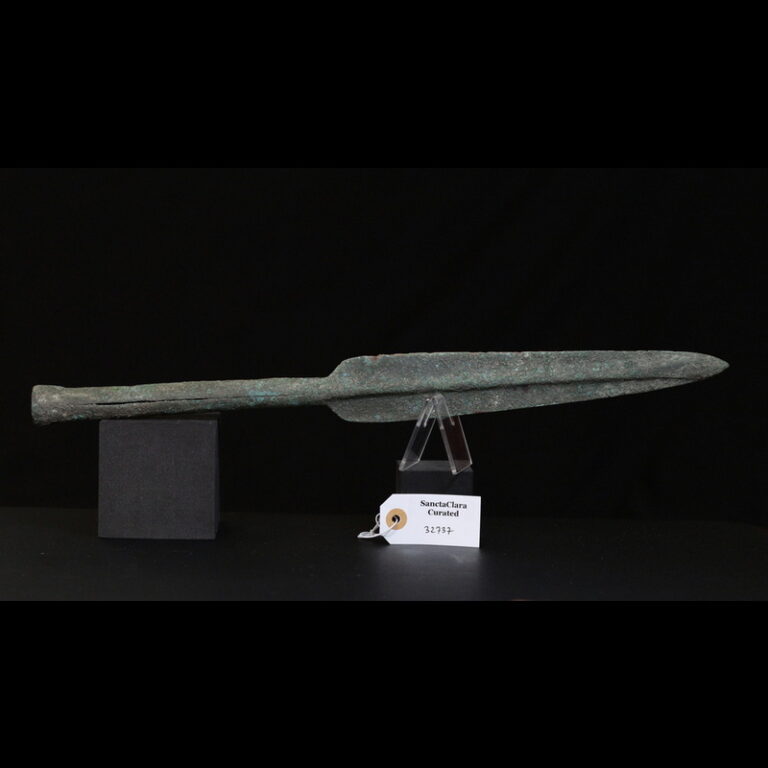
On many artifacts in the Sancta Clara Collection — particularly the Luristan spearheads and the Mycenaean dagger blades — the cuprite layer is visible where surface patina has flaked or been abraded, appearing as a warm reddish-brown undertone beneath the dominant green.
Malachite: The Green Signature of Antiquity
Malachite (Cu₂CO₃(OH)₂), basic copper carbonate, is the mineral most people associate with ancient bronze. It is responsible for the rich green patina that has become virtually synonymous with archaeological metalwork.
Formation Conditions
Malachite forms when copper ions released from the corroding metal react with water, dissolved carbon dioxide, and carbonate ions in the surrounding soil moisture. The reaction requires three things: available copper (supplied continuously as the metal corrodes), moisture (even trace amounts of groundwater or soil humidity), and a source of carbonate — typically dissolved CO₂ from the atmosphere or from the decomposition of organic matter in the burial environment.
The process is not rapid. Under typical burial conditions in temperate or Mediterranean soils, a visually significant malachite layer takes centuries to develop. In arid conditions with minimal moisture, the process is slower still, producing thinner but often exceptionally well-crystallized patinas. In waterlogged or acidic soils, malachite may be partially dissolved or replaced by other corrosion products.
Soil pH plays a critical role. Malachite is most stable in mildly alkaline to neutral conditions (pH approximately 6.5 to 8.5). In strongly acidic soils — such as those found in heavily forested or peat-rich regions — malachite tends to dissolve, and the patina may be dominated instead by cuprite or by amorphous copper compounds.
Appearance and Position
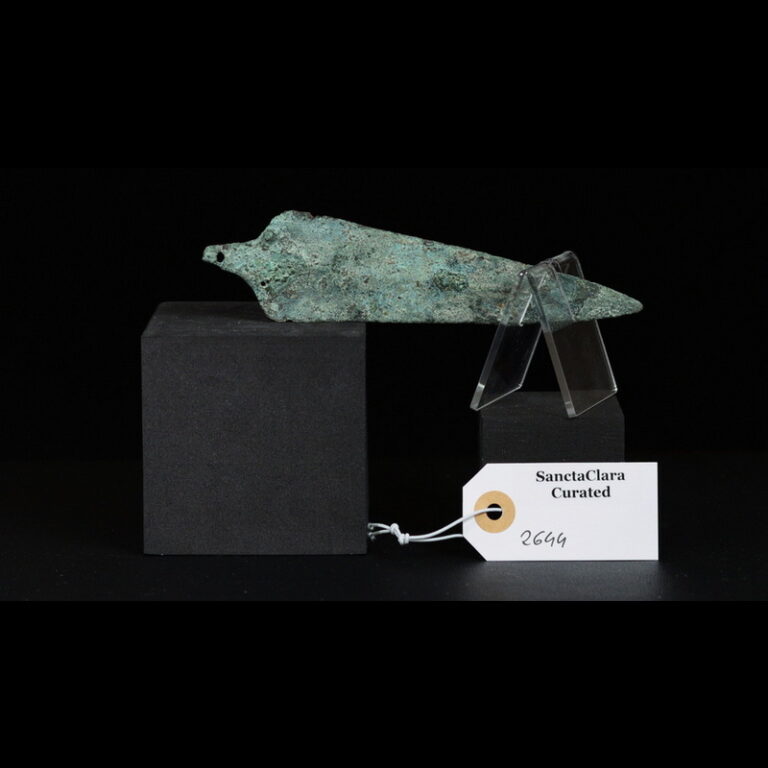
On ancient artifacts, malachite patina ranges from a pale, almost sage green to a deep, saturated emerald. The colour depends on crystal size, layer thickness, and the presence of trace impurities. Thin malachite layers over cuprite often appear as a warm olive-green, because the red of the cuprite shows through. Thicker deposits tend toward a cooler, more vivid green.
Under magnification, genuine ancient malachite displays a characteristic botryoidal (grape-like) or fibrous crystal habit. The crystals grow outward from the metal surface in radiating fans or concentric layers, producing a banded or layered appearance in cross-section. This growth pattern is a direct consequence of slow, sustained crystallization over long periods and is extremely difficult to replicate artificially.
Malachite occupies the middle zone of the patina stratigraphy — above the cuprite foundation and below any outer soil encrustations. On artifacts buried in calcareous soils, malachite crystals are often intergrown with calcium carbonate, creating a tough, composite crust that adheres tenaciously to the underlying metal.
Malachite on Luristan and Levantine Bronzes
The Luristan bronzes in the collection offer particularly instructive examples of malachite formation. Many of these pieces were buried in the alkaline, calcium-rich soils of western Iran — ideal conditions for malachite development. The result is typically a thick, hard, brilliant green patina with a slightly waxy lustre, often showing the characteristic banded structure when viewed in raking light. On spearheads with deep sockets, the interior surfaces frequently preserve an even more pristine malachite layer, protected from mechanical abrasion by the enclosed geometry.
Azurite: The Blue Companion
Azurite (Cu₃(CO₃)₂(OH)₂) is chemically related to malachite — both are basic copper carbonates — but azurite contains a higher proportion of carbonate relative to hydroxyl groups. It is the mineral responsible for the vivid blue patches and streaks sometimes seen on ancient bronzes.
Formation Conditions
Azurite forms under conditions broadly similar to malachite but with one critical difference: it requires a higher concentration of dissolved CO₂ in the groundwater. This condition is most commonly met in burial environments rich in decomposing organic matter (which generates CO₂ as it breaks down) or in areas with CO₂-rich geological formations such as limestone karst.
Azurite is thermodynamically less stable than malachite. Over very long periods, azurite slowly converts to malachite through a process called pseudomorphism — the crystal structure of azurite is gradually replaced by malachite while retaining the original crystal shape. This means that azurite is more commonly found on artifacts from relatively dry or sealed burial contexts where the conversion process has been arrested, or on artifacts that have been excavated relatively recently from CO₂-rich environments.
Appearance and Position
Azurite ranges from a deep, almost navy blue to a brilliant azure. On ancient bronzes, it typically appears as isolated patches, veins, or crystal clusters rather than as a continuous layer. It may occur within the malachite zone, often at interfaces where the local chemical environment favoured its formation — for instance, near organic residues (remnants of wooden hafts, leather bindings, or textile wrappings) that provided a localized source of CO₂.
When azurite and malachite co-occur on the same artifact, the visual effect is striking — vivid blue islands in a green field. This combination is not only beautiful but also diagnostically useful, as it indicates a complex, evolving burial chemistry that is very difficult to simulate artificially.
The Azurite-to-Malachite Transition as a Time Indicator
The presence of significant azurite on a bronze artifact is actually informative about post-excavation history. Because azurite slowly converts to malachite under normal atmospheric conditions, a piece with substantial well-preserved azurite has either been excavated relatively recently (within the past century or so), or has been stored in conditions that slowed the conversion — such as a dry, sealed collection environment. Conversely, an artifact that shows pseudomorphic malachite after azurite (malachite crystals retaining the tabular habit of azurite) has been exposed to normal atmospheric conditions for an extended period after excavation. This kind of observation can help reconstruct an artifact’s collection history and provenance.
Cassiterite and Tin Oxide Corrosion: The Dark Transformation
Cassiterite (SnO₂), tin dioxide, is a corrosion product specific to true bronze — alloys containing a significant proportion of tin (typically 8 to 12 percent in ancient weapons and tools). Its formation and behaviour are among the most fascinating aspects of ancient bronze corrosion, and its presence is a powerful indicator of both alloy composition and burial history.
Copper Ion Migration and the Formation of the Tin-Rich Ghost
When a bronze artifact corrodes in a burial environment, the copper and tin components do not corrode at equal rates. Copper is more chemically reactive than tin in most soil conditions, and copper ions are far more mobile in aqueous solution. Over centuries and millennia, copper ions migrate outward from the metal core, leaving behind a tin-enriched zone — a layer that is progressively depleted of copper and enriched in tin oxide.
This process, known technically as selective or dealloying corrosion, produces a characteristic dark layer within the corrosion stratigraphy. The tin oxide that remains is dense, hard, and remarkably stable. On artifacts where this process has progressed significantly, this tin-rich layer can appear as a dark grey, brown-black, or even jet-black band — sometimes with a glassy, almost obsidian-like lustre that is visually stunning.
In advanced cases, the migrating copper ions travel entirely through the patina and re-precipitate as malachite or azurite on the outer surface, while the interior of the artifact becomes increasingly tin-rich. This is why some heavily corroded ancient bronzes display a paradox: a brilliant green exterior over a dark, almost metallic-looking interior layer that is no longer truly bronze at all but rather a tin oxide pseudomorph — a mineral ghost that preserves the shape of the original metal but has been entirely transformed in composition.
The Path to Full Mineralization
The logical endpoint of this process is complete mineralization — the total conversion of the original metal to corrosion products. On artifacts buried for three or four thousand years in aggressive soil conditions, this transformation can be nearly complete. The object retains its original form in extraordinary detail — casting marks, tool marks, even fingerprints from the ancient metalworker may be preserved in the mineral structure — but no metallic bronze remains. The entire artifact has become a composite of tin oxide, copper carbonates, and soil minerals.
Fully mineralized bronzes are fragile and require careful handling, but they are among the most scientifically valuable artifacts in any collection. Their corrosion stratigraphy preserves a complete chemical record of the burial environment, and the tin oxide pseudomorph allows metallurgists to determine the original alloy composition even when no metal survives.
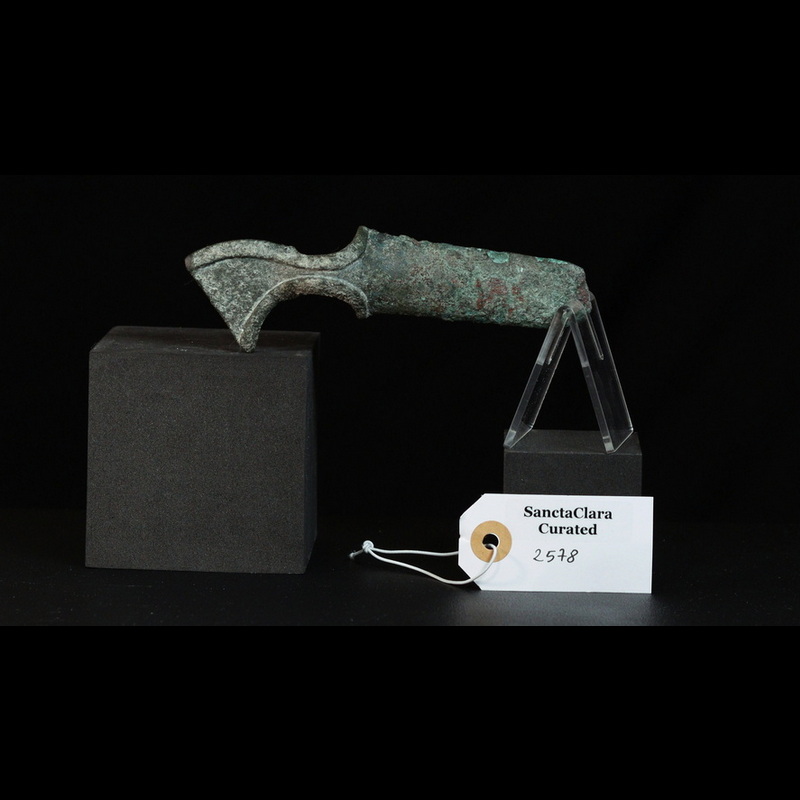
In the Sancta Clara Collection, varying degrees of this mineralization process are visible across different pieces. Some of the older copper alloy daggers — particularly those dating to the third millennium BC — show significant tin-oxide transformation in their cross-sections, while later pieces from more stable burial environments retain substantial metal cores beneath their patina.
Copper Chlorides and Bronze Disease: The Corrosion That Never Stops
Not all patina is benign. Copper chlorides — principally nantokite (CuCl) and atacamite (Cu₂Cl(OH)₃) — represent an active, destructive form of corrosion commonly known as “bronze disease.” Unlike the stable oxide and carbonate patinas discussed above, chloride corrosion is self-sustaining and will continue to destroy an artifact even after excavation unless actively treated.
How Bronze Disease Develops
Chloride ions enter the corrosion system from the burial environment — from salt-rich soils, coastal groundwater, or in some cases from handling by sweaty hands over centuries of use before burial. Once chloride ions reach the metal surface, they react with copper to form nantokite (cuprous chloride), a pale, waxy mineral that is unstable in the presence of moisture and oxygen.
When a buried artifact containing nantokite is excavated and exposed to the atmosphere, the nantokite reacts with moisture and oxygen to form atacamite or its polymorphs (paratacamite, clinoatacamite) — pale green, powdery minerals that erupt through the surface patina as characteristic warty or powdery spots. This reaction releases hydrochloric acid, which attacks fresh metal, producing more nantokite, which in turn produces more atacamite. The cycle is self-perpetuating and will progressively destroy the artifact if left untreated.
Visual Identification
Active bronze disease is recognizable by its characteristic pale green to blue-green powdery eruptions, which contrast sharply with the smooth, hard, adherent texture of stable malachite patina. The powder is often concentrated in pits or along cracks in the patina where moisture can penetrate. On a well-patinated artifact, bronze disease spots look like blisters or boils pushing up through the surface — a visual metaphor that is apt, because the process is indeed one of internal pressure as expanding corrosion products force their way outward.
Collectors and curators must be vigilant for bronze disease, particularly on artifacts from marine or coastal contexts, or on pieces that have been stored in humid conditions without climate control. Treatment typically involves mechanical removal of the chloride-bearing material followed by chemical stabilization — often with benzotriazole (BTA) — and subsequent storage at controlled humidity below 40 percent relative humidity.
Distinguishing Stable Green Patina from Active Chloride Corrosion
The distinction between malachite (stable, desirable) and atacamite (active, destructive) is critical and not always immediately obvious to the untrained eye, as both are green. The key differences are texture, hardness, and behaviour over time. Malachite is smooth, hard, and adherent — it resists scratching with a fingernail and does not transfer powder to a cotton swab. Atacamite is soft, powdery, and friable — it crumbles under gentle pressure and leaves a pale green streak on a swab. Most importantly, malachite is static: it does not change from month to month. Atacamite is dynamic: untreated spots will grow, spread, and produce new eruptions over weeks and months, particularly in humid conditions.
Patina as Authentication: The Expert’s First and Last Line of Defence
For anyone involved in the study, collection, or sale of ancient bronzes, patina analysis is the single most important tool for assessing authenticity. It is not the only tool — stylistic analysis, metallurgical composition, thermoluminescence dating, and provenance research all play roles — but patina is where the investigation begins and where the most decisive evidence is usually found.
Why Genuine Patina Is So Difficult to Fake
The fundamental challenge facing any forger is time. Genuine ancient patina is the product of chemical reactions that proceed at geological timescales — not the timescales of a workshop. The stratified, interlocking crystal structures described above develop over centuries of continuous interaction between the metal and its burial environment. Each layer grows in situ, bonded to the layers above and below it by shared crystal boundaries and chemical gradients.
A forger attempting to simulate this structure faces several insurmountable problems. First, artificially accelerated corrosion — whether by acid treatment, electrochemical methods, or burial in chemically aggressive media — produces corrosion products that are chemically similar to genuine patina but structurally distinct. Accelerated malachite tends to form amorphous or microcrystalline coatings rather than the well-developed crystal fans of natural growth. The crystals are smaller, less organized, and lack the characteristic banding visible in genuine ancient patina under moderate magnification.
Second, the layered stratigraphy of genuine patina — cuprite base, malachite middle, soil encrustations on top — is extremely difficult to replicate in sequence. Forgers who apply patina as a single mixed layer or in crude sequential applications leave tell-tale evidence: sharp boundaries between layers rather than gradual transitions, absence of the cuprite foundation layer, inconsistent crystal orientation, and lack of the chemical gradient that develops naturally as copper ions migrate outward through the corrosion zone.
Third, soil encrustations on genuine artifacts are not simply surface deposits. Over millennia, minerals from the surrounding soil — calcium carbonate, iron oxides, silica particles, clay minerals — become physically embedded in and chemically bonded to the patina surface. They fill cracks, grow into pores, and form composite structures with the copper carbonates. Artificially applied “dirt” sits on the surface and can usually be removed with a stiff brush or a solvent swab. Genuine encrustations resist removal and, when forcibly detached, bring patina with them.
Painted and Resin-Based Fakes
The crudest category of forgery involves the application of paint or pigmented resin to simulate patina. These fakes are, frankly, trivial to detect for anyone who has handled genuine ancient bronzes. Paint and resin coatings have a uniform, even appearance that lacks the natural variation of genuine corrosion. They do not follow the surface topography of the metal in the way that true patina does — pooling in recesses and thinning on high points according to chemical rather than gravitational logic.
Under magnification, paint shows brushstrokes, roller marks, or spray patterns. Resin coatings have a characteristic organic lustre — slightly waxy or plastic — that differs markedly from the mineral lustre of genuine corrosion products. A simple solvent test (acetone on a cotton swab) will dissolve or soften most organic coatings, producing a coloured streak on the swab, while genuine mineral patina is entirely unaffected by organic solvents.
More sophisticated paint fakes incorporate actual malachite powder or copper carbonate pigment in a binding medium. These can be visually convincing at arm’s length but fail under magnification: the pigment particles are randomly oriented and loosely packed, quite unlike the structured crystal growth of genuine patina. They also lack the cuprite foundation and the chemical bond to the metal surface — a gentle probe with a needle will lift the coating cleanly from the metal rather than encountering the tenacious adhesion of genuine corrosion.
Artificially Aged Patina
A more sophisticated approach involves chemically inducing genuine corrosion products on a modern or recently cast bronze. Treatments with acidified copper salt solutions, ammonia fumes, or burial in chemically treated soil can produce real malachite and cuprite on a metal surface within weeks to months.
These artificially induced patinas are more challenging to detect than paint but still reveal themselves under careful examination. The corrosion products are typically thin and uniform rather than variable in thickness. They lack the deep, multi-layered stratigraphy of ancient patina — particularly the well-developed cuprite foundation layer and the tin-oxide zone that only forms through centuries of selective dealloying. The crystal morphology, when examined under magnification or scanning electron microscopy, shows rapid, disordered growth rather than the slow, structured crystallization of genuine ancient corrosion.
Perhaps most tellingly, artificially patinated objects often show corrosion that is inconsistent with any plausible burial history. Genuine burial corrosion is influenced by the object’s orientation in the soil, by contact with other objects or organic materials, and by variations in soil chemistry over the burial period. This produces a patina that varies naturally across the surface — thicker in some areas, thinner in others, different in colour where the soil chemistry varied or where the artifact was in contact with wood, bone, or textile. An artificially patinated piece tends to show suspiciously uniform corrosion, or corrosion patterns that make no archaeological sense.
What Patina Tells Us Beyond Authenticity
Beyond the binary question of genuine versus fake, patina analysis provides a wealth of information about an artifact’s history. The dominant corrosion products indicate soil chemistry: malachite-dominated patinas point to alkaline, carbonate-rich soils; atacamite suggests proximity to salt or marine environments; heavy iron oxide encrustations indicate iron-rich clay soils. The degree of mineralization correlates roughly (though not precisely) with burial duration and soil aggressiveness. The presence or absence of azurite provides clues about the organic content of the burial environment and the artifact’s post-excavation history.
For the serious collector, learning to read patina is not optional. It is the difference between building a collection of genuine antiquity and accumulating expensive reproductions. For the scholar, patina is a primary source — as rich in information as any inscription or stylistic feature. And for anyone who simply appreciates the beauty of ancient metalwork, understanding patina deepens the experience immeasurably. The green of a three-thousand-year-old spearhead is not merely a colour. It is the visible record of a slow, silent transformation — metal becoming mineral, weapon becoming artifact, history becoming tangible.
This article is part of the reference materials published by the Sancta Clara Collection at AncientBronzes.com. Content is provided for educational purposes and reflects observations drawn from direct study of the collection’s holdings.