
Sharpness at hand.
The dagger is where it all begins. Before the sword, before the spear received a metal head, before the axe was cast in bronze, the dagger was the first bladed metal object in human hands. It is the ancestor of every edged weapon that followed — the direct progenitor of the sword, the technological cousin of the knife, and for most of the Bronze Age, the most personal and most versatile tool a person could own.
Yet the dagger is routinely undervalued in archaeological discussion, treated as a minor weapon subordinate to the sword, a small thing awaiting elongation into something more impressive. This is a misunderstanding rooted in modern assumptions about what bladed weapons are for. Ancient daggers were not miniature swords yearning to grow up. They were complete, mature tools designed for a range of practical tasks that had nothing to do with warfare — and understanding them on their own terms reveals a typological and technological history as rich and as consequential as that of any weapon class in the Bronze Age arsenal.
The Dagger as Daily Tool
Recent organic residue analysis — particularly the landmark 2022 study by Andrea Dolfini and colleagues on ten copper-alloy daggers from Bronze Age Pragatto, Italy (c. 1550–1250 BCE) — has fundamentally reframed the scholarly conversation about dagger function. Using biochemical staining and scanning electron microscopy, the researchers identified micro-residues of collagen, bone, muscle fibre, and tendon preserved on the cutting edges of the daggers. These are not combat traces. They are the signature of animal butchery: skinning, carcass disassembly, meat preparation, and hide processing.
This finding confirms what handling hundreds of ancient daggers strongly suggests: the vast majority of these objects were not primarily weapons. They were everyday tools — the Bronze Age equivalent of a utility knife. Skinning game, cutting cord, preparing food, shaping wood, working leather — these mundane tasks consumed far more of a dagger’s working life than any act of violence. The blade of a Chalcolithic copper dagger shows the same pattern of edge wear that a modern bushcraft knife displays after a season of camp use: rounded, micro-chipped edges from repeated contact with bone and wood, not the notching and tip damage characteristic of weapon-on-weapon combat.
This does not mean daggers were never weapons. They clearly were, especially the larger and more elaborately mounted examples. But the dichotomy between “tool” and “weapon” is itself a modern imposition. For most of the Bronze Age, the dagger was simply a blade — used for whatever task the moment required, whether that was slicing meat, cutting rope, or defending oneself in an encounter that turned violent.
Why Early Daggers Were Small
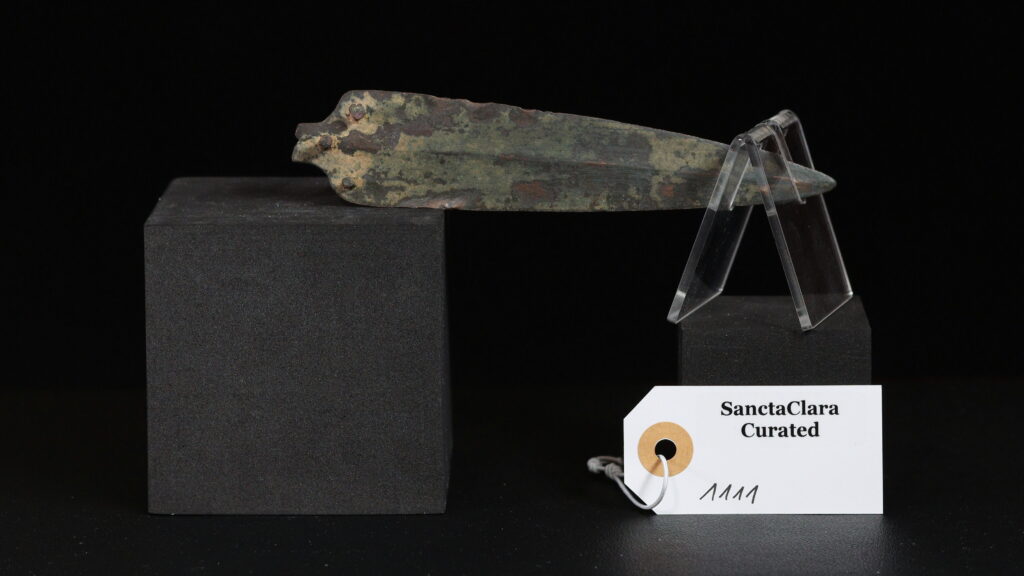
The earliest copper daggers — those from the Chalcolithic and Early Bronze Age, roughly 4000 to 2000 BC — are strikingly small by later standards. Blades of 8 to 15 centimetres are common; blades of 20 centimetres are considered large. The Minoan dagger from the Metropolitan Museum’s collection (ca. 1750–1450 BCE), with its three rivets and broad, flat blade, is a classic example of the compact, functional form that dominated for millennia.
This small size is often interpreted as a technological limitation — the implication being that early metalworkers could not produce longer blades. This is only partially true. The more fundamental constraint was economic. Copper was expensive. In the Chalcolithic and Early Bronze Age, metal of any kind was a scarce, high-value material obtained through laborious mining, smelting, or long-distance trade. A small dagger blade weighing 50 to 100 grams represented a significant investment of material and labour. Producing a blade three or four times that size would consume a proportionally larger quantity of a precious resource — an expenditure justified for a weapon of war or a prestige object, but extravagant for a daily tool.
Small daggers were also perfectly adequate for their primary functions. A blade of 10 centimetres is more than sufficient for skinning, butchery, food preparation, and the hundred other cutting tasks of daily life. Making it longer would add weight and material cost without proportionally increasing its utility for these tasks. The short copper dagger was small not because its makers could not do better, but because its makers were pragmatic.
The Evolution of Mounting: A Typological Sequence
The most instructive way to trace the development of the ancient dagger is through its mounting — the method by which the metal blade was attached to the organic (wood, bone, horn, or ivory) hilt. This is the dimension along which the most consistent typological evolution is visible, and it provides a direct record of increasing metallurgical sophistication and changing expectations of blade performance.
Stage One: The Tangless Blade, Glued to the Hilt
The earliest and simplest copper daggers have no tang at all. The blade is a flat piece of metal — leaf-shaped, triangular, or roughly trapezoidal — with a squared or slightly rounded butt end. This butt was inserted into a slot cut into a wooden or bone handle and secured entirely by adhesive: hide glue, birch-bark tar, or bitumen, sometimes reinforced with tight wrapping of sinew or cord.
This is the most primitive mounting method, and it works only for light-duty use. The adhesive provides no mechanical strength against lateral forces; if the blade is used to pry, lever, or strike a hard target, it will separate from the hilt. But for the cutting, slicing, and scraping tasks that constituted the dagger’s primary use, glue-mounted blades were serviceable.
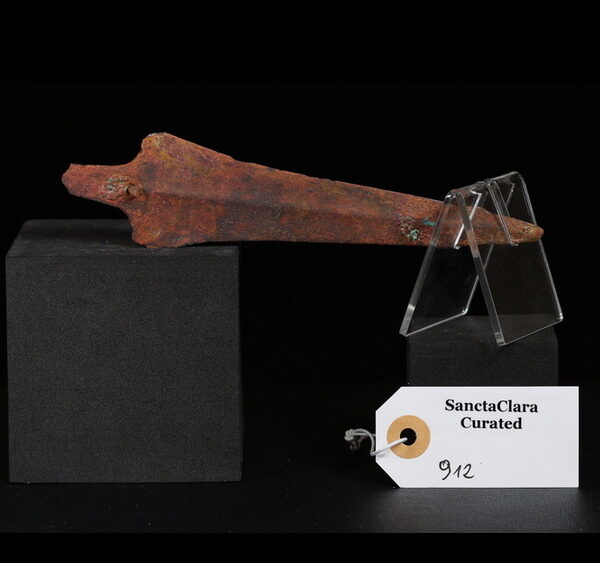
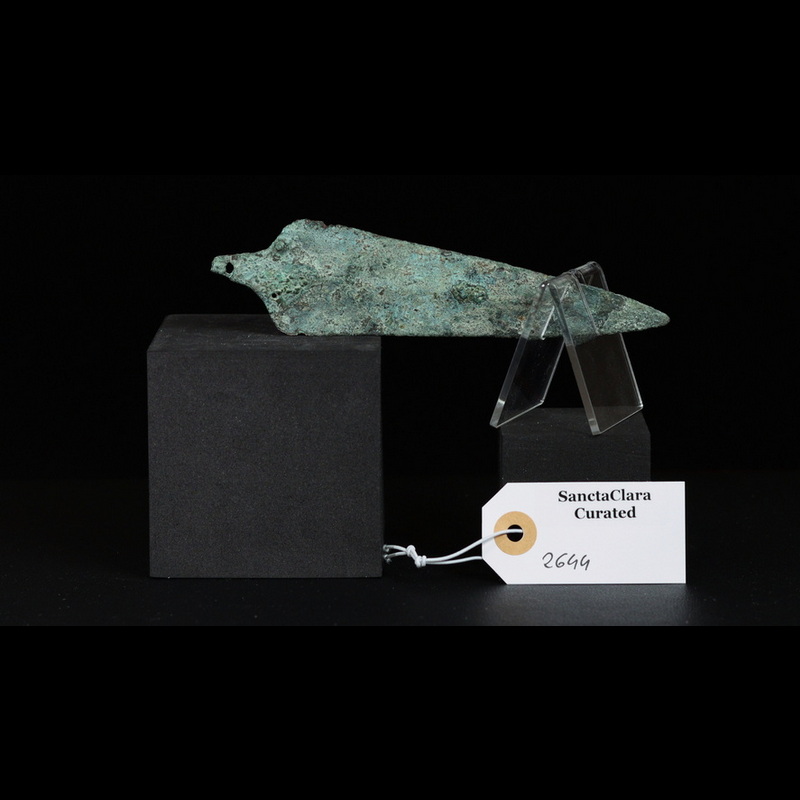
Chalcolithic copper daggers from the Levant, Anatolia, and the Balkans frequently show this construction. Several early copper daggers in the Sancta Clara Collection — including pieces from the late third millennium BC — exhibit squared butt ends with no rivet holes and no tang, consistent with adhesive-only mounting. On some of these pieces, faint discolouration at the base of the blade marks the outline of the vanished hilt: the chemical ghost of the adhesive that once held blade and handle together.
Stage Two: No Tang, Riveted Shoulders
The next evolutionary step retained the tangless blade but added mechanical fasteners: rivets driven through holes in the widened shoulders of the blade and through corresponding holes in the flanking hilt plates. The blade base was made broader than the working edge — creating pronounced “shoulders” — and two, three, or four rivet holes were drilled through this widened area.
The hilt was constructed as a sandwich: two plates of bone, horn, wood, or ivory were placed on either side of the blade’s shoulder area, and bronze rivets were driven through the holes to clamp the plates against the metal. The rivets provided mechanical strength that adhesive alone could not: the blade was physically pinned to the hilt, resisting both lateral forces and the tendency to pull free under thrust.
This is the construction visible on the Metropolitan Museum’s Minoan dagger (ca. 1750–1450 BCE) — a broad blade with three rivets in the butt end, the rivet heads still preserved, the organic hilt long since decayed. It is also the dominant construction for Cycladic and Cypriot daggers of the Early Bronze Age, where two or three rivets through a wide, flat blade base are the diagnostic feature of the type.
The rivet-and-shoulder design was enormously successful. It persisted from the late third millennium through the mid-second millennium BC across virtually the entire Bronze Age world — from Ireland to the Indus Valley, from Scandinavia to Egypt. Its longevity reflects its fundamental soundness: it was simple to produce, reliable in use, and adaptable to a wide range of blade shapes and sizes.
Stage Three: Short Tang, No Rivets
The development of the tang — a narrow extension of the blade projecting below the shoulder line, designed to be inserted into the handle — represented a conceptual advance in dagger construction. Instead of the blade sitting on the handle (riveted through the shoulders), the blade now extended into the handle (the tang buried inside the grip).
Early tanged daggers dispensed with rivets entirely, relying on the tang itself — wedged or glued into a slot in the handle — to provide the attachment. The tang was typically short (2 to 4 centimetres), flat or rectangular in cross-section, and tapered to a point. The handle was built around it: two plates glued and bound on either side, or a single piece of bone or horn with a slot carved to receive the tang.
This design offered advantages over the riveted-shoulder type. The tang concentrated the attachment at the centreline of the blade, reducing the tendency of the blade to twist under lateral forces. It also allowed the hilt to be narrower than the blade shoulders, creating a more comfortable and more controllable grip. But without rivets, the tang relied entirely on friction and adhesive to resist withdrawal forces — a significant weakness under hard use.
Stage Four: Tang with Rivets
The combination of tang and rivets brought together the strengths of both earlier approaches: the central attachment and narrower grip of the tang design, plus the mechanical security of rivet fastening. A short or medium-length tang extended below the blade shoulders, and one or more rivets passed through the tang (or through the blade at the tang junction) and through the hilt plates, locking the entire assembly together.
This is the construction found on the majority of Middle and Late Bronze Age daggers across the Near East and the Mediterranean. The number, size, and placement of rivets varied by region and period — from a single rivet through the tang to three or four rivets arranged in a triangle or line — but the underlying principle remained constant: tang for alignment and centreline strength, rivets for mechanical security.
Many of the Mycenaean, Cypriot, and Levantine daggers in the Sancta Clara Collection show this construction. The rivet holes survive even when the rivets themselves have corroded away, and on some pieces the ghost outline of the vanished hilt plates is preserved as a zone of differential patination on the blade surface.
Stage Five: Full Tang with Flanged, Inlaid Hilt
The culmination of Bronze Age dagger design was the full-tang construction with an integral flanged hilt — a technology that reached its most elaborate expression in the prestige daggers of New Kingdom Egypt, Babylonia, and the Mycenaean world.
In this construction, the tang extends the full length of the grip — from the blade shoulders to the pommel — and is cast as a single piece with the blade. Raised flanges along the edges of the tang create channels into which shaped hilt plates of bone, ivory, wood, or semi-precious stone were inset and secured with rivets, adhesive, or both. The result is a weapon in which the blade and hilt frame are a continuous piece of bronze, with the organic grip material filling the spaces between the flanges rather than forming the structural core of the handle.
This design is immensely strong. The full-length metal tang provides a rigid spine that prevents the handle from flexing or breaking under impact. The flanges protect the edges of the inlaid hilt material from chipping or splitting. And the composite construction allows for extraordinary decorative elaboration: the hilt plates can be carved, inlaid with gold or silver wire, or shaped into sculpted pommels and guards.
Prestige and Ceremony: The Dagger as Art
The Petrie classification of Egyptian bronze daggers and swords — developed by Sir William Matthew Flinders Petrie in his foundational studies of Egyptian metalwork — documents the extraordinary range of hilt designs that Egyptian and Near Eastern metalworkers produced between approximately 2000 and 1000 BC. The typological plates illustrate a progression from simple, functional blades (short tangs, minimal guards) to increasingly elaborate constructions featuring mushroom-shaped pommels, crescent-shaped guards, cast openwork hilts, and fully integrated metal handles with complex sculptural terminals.
Some of these objects transcend the category of weapon entirely. The ceremonial daggers of Tutankhamun’s tomb — one of gold, one of iron — are the most famous examples, but they represent a broader tradition of elite metalwork in which the dagger served as a vehicle for artistic expression and political symbolism. The gold dagger from Tomb 43 at Varna (c. 4500 BC), the inlaid daggers from the Shaft Graves at Mycenae (c. 1550 BC), the silver-hilted daggers of Byblos — these are objects in which the boundary between weapon and jewellery dissolves.
The Petrie plates reveal the full scope of this elaboration. Daggers numbered in the thirties and forties of his classification show cast bronze hilts of remarkable complexity: hollow pommels with openwork decoration, flanged guards with rivet patterns, and handles shaped to fit the hand with ergonomic precision that modern knife-makers would recognise and respect. The larger pieces — technically short swords rather than daggers — display hilts with crescent-shaped or mushroom-shaped pommels, cross-guards extending well beyond the blade width, and riveted or cast-on grip sections of substantial length.
These prestige daggers were not produced for daily use. They were grave goods, diplomatic gifts, and symbols of rank and authority. Their blades are often unworn — never sharpened, never used to cut anything harder than the air through which they were ceremonially displayed. Their value lay not in their function but in their material, their workmanship, and the status they conferred on their owners.
Yet even these ceremonial pieces are constructed according to the same typological principles as functional daggers. The mounting methods — rivet, tang, flange, inlay — are the same; they are simply executed with more expensive materials, finer finish, and more elaborate decoration. The prestige dagger is not a different category of object from the working dagger. It is the same object raised to the level of art.
From Dagger to Sword: The Elongation
The sword did not appear fully formed. It evolved from the dagger through a process of gradual elongation driven by changing tactical requirements — specifically, the demand for a bladed weapon with enough reach to be useful in the kind of close-order combat that characterised Late Bronze Age warfare.
The dividing line between a long dagger and a short sword is entirely arbitrary. Modern convention typically draws it at approximately 30 to 35 centimetres of blade length, but this is a scholarly convenience, not an ancient distinction. The Cycladic “copper swords” of approximately 2300 BC, with blades reaching up to 60 centimetres, are still essentially elongated daggers in their construction — flat or slightly ribbed blades with wide shoulder rivets, identical in form to contemporary daggers but scaled up.
The first weapons that are unambiguously swords — too long and too specialised for daily tool use — appear in Minoan Crete around 1700 BC. These “Type A” swords of the Sandars typology reach blade lengths exceeding 100 centimetres and feature tab-tangs (short, wide tangs) that are clearly inadequate for the forces involved in combat with such a long blade. The structural limitations of the tab-tang drove subsequent developments: horned hilts (Type C), cross hilts (Type D), and T-hilts (Types E and F) progressively improved the security of the blade-to-hilt junction, culminating in full-tang constructions that could withstand the stresses of sustained sword combat.
This evolution — from riveted flat dagger to tanged dagger to short sword to full-length sword — is visible in compressed form in the Petrie classification plates, where the sequence from small daggers (numbers 36–38, 53–58) through medium blades (49–52) to long swords (39–43) displays the full trajectory of elongation within a single cultural tradition. The hilt designs grow more complex in direct proportion to blade length: the forces generated by a metre-long blade swung in combat demand a far more robust hilt construction than those generated by a 15-centimetre dagger used for skinning.
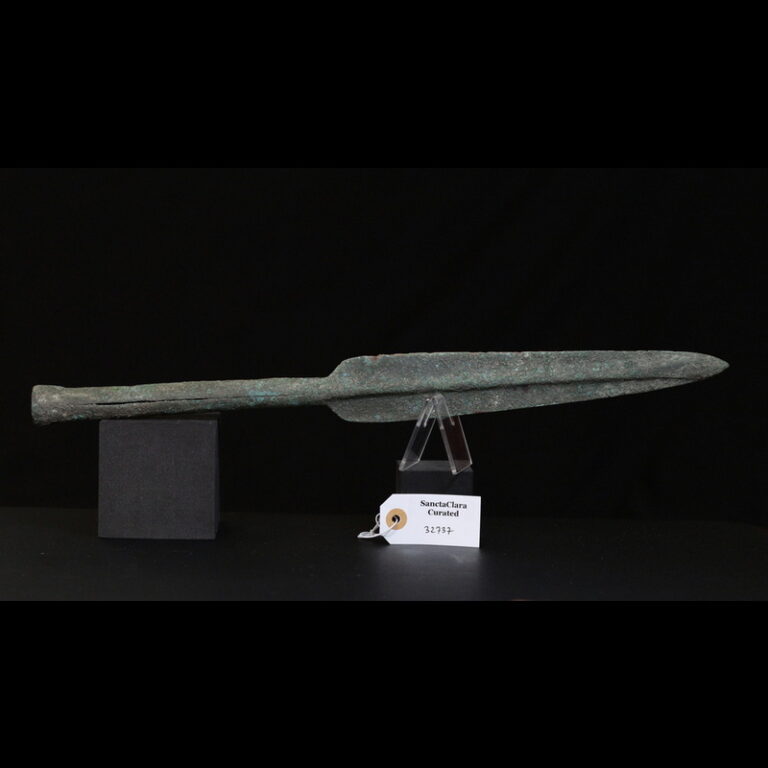
The daggers and short swords in the Sancta Clara Collection — including Mycenaean, Elamite, Luristan, and Cypriot examples — span this evolutionary arc. The smallest pieces (copper daggers of the Chalcolithic, 10 to 15 centimetres) are pure tools; the mid-range pieces (bronze daggers of the Middle Bronze Age, 20 to 30 centimetres) are dual-purpose tool-weapons; and the largest pieces (bronze short swords and rapiers, 35 to 50 centimetres) are dedicated combat weapons that have crossed the boundary from dagger into sword territory. The construction of each group reflects its position on this continuum: glue-only mounting on the smallest, riveted shoulders on the mid-range, and full-tang with flanges on the largest.
The Dagger’s Endurance
Unlike the sword, which was eventually superseded by iron and then steel, the dagger never became obsolete. Every subsequent period of military and civilian life retained a version of the short, personal blade — from the Greek encheiridion to the Roman pugio, from the medieval rondel to the Renaissance stiletto, from the Scottish dirk to the modern combat knife.
This endurance reflects the fundamental truth about the dagger that the archaeological evidence confirms: it was never just a weapon. It was a tool — the most personal, most versatile, most indispensable tool in the ancient world. The fact that it could also serve as a weapon was a secondary function, important but not defining. The dagger endures because the need for a short, sharp blade — for cutting, preparing, shaping, and defending — is as old as humanity itself and shows no sign of diminishing.
The Chalcolithic copper dagger in the Sancta Clara Collection, barely 15 centimetres long, made of soft copper with an uncertain edge and a simple adhesive-mounted hilt, is in a direct and unbroken line of descent with every blade that came after it. It is small, plain, and utilitarian — and it is the ancestor of empires.
This article is part of the reference materials published by the Sancta Clara Collection at AncientBronzes.com. Content is provided for educational purposes and reflects observations drawn from direct study of the collection’s holdings and current archaeological scholarship.