
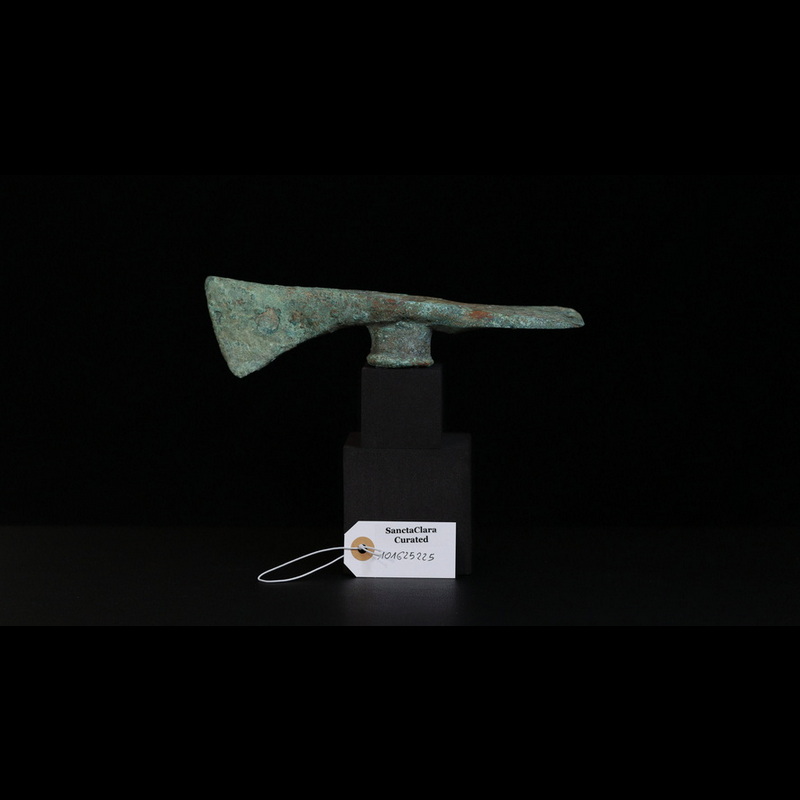
Here comes metal
The history of human toolmaking is not a neat, linear progression. It is a story of overlapping technologies, regional peculiarities, conservative habits carried forward into new materials, and the stubborn persistence of older forms long after they had been technically superseded. Nowhere is this more visible than in the archaeological record of weapons and tools from the Chalcolithic through the Iron Age — the very period represented by the artifacts in the Sancta Clara Collection. Each piece in the collection carries within its form the memory of what came before it and the promise of what would follow.
This article traces the great material transitions of antiquity: from stone to native copper, from copper to arsenical bronze and then tin bronze, and finally from bronze to iron. Along the way, it examines the phenomenon of skeuomorphism — the persistence of design features from one material into another where they no longer serve a functional purpose — and considers how each transition reshaped not only the objects themselves but the societies that produced them.
Stone: The Ten-Thousand-Year Foundation
To understand early metal tools, one must first understand the stone tools they replaced — and, just as importantly, the stone tools they imitated. By the late Neolithic, stone technology had reached a remarkable level of sophistication. Ground and polished stone axes with drilled shaft holes, pressure-flaked flint daggers with handles shaped to fit the hand, obsidian blades sharper than modern surgical steel — these were not crude implements. They were the products of generations of accumulated knowledge, refined through millennia of experimentation.
Stone imposed certain constraints on design. A shaft-hole axe made of stone required thick walls around the perforation to prevent splitting under impact. The wider the shaft hole, the thicker the surrounding stone had to be, resulting in heavy, bulky axe heads. Blades were limited to shapes that the fracture properties of the stone would allow — broadly symmetrical, with edges formed by controlled flaking or grinding. Hafting — the attachment of a blade to a handle — was accomplished by tangs inserted into split shafts and bound with sinew or cord, or by shaft holes drilled laboriously through the stone.
These design solutions were not arbitrary. They were the optimal response to the physical properties of stone. But when copper arrived, many of these solutions were carried forward wholesale into the new material — even when copper’s very different properties made them unnecessary.
Native Copper: The Oldest Metalworking Tradition
The first humans to work metal did not smelt ore. They found copper in its native state — pure metallic nuggets exposed on the surface or in shallow deposits — and treated it essentially as a malleable stone. They hammered it, annealed it (heated it to restore malleability after work-hardening), and shaped it by the same percussion techniques they had long applied to flint and obsidian.
The Old Copper Complex of the Great Lakes
The most extraordinary example of early native copper use comes not from the ancient Near East but from North America. The Old Copper Complex of the Great Lakes region represents one of the oldest metallurgical traditions anywhere in the world, with recent radiocarbon dating and sediment analysis pushing its origins back to at least 6500 BC, and possibly as early as 8500 years ago — contemporary with, or even predating, the earliest known copper working in the Middle East.
The geological conditions of the Great Lakes were uniquely favourable. Glacial activity had exposed the world’s largest deposits of naturally occurring native copper along the Keweenaw Peninsula of Lake Superior and on Isle Royale. This copper was exceptionally pure — typically over 95 percent — and occurred in nuggets ranging from small pebbles to massive boulders weighing thousands of pounds. The famous Ontonagon Boulder alone weighed over 1,600 kilograms. Crucially, this copper required no smelting. It could be picked up, hammered into shape, and used immediately.
The peoples of the Old Copper Complex exploited these deposits on an industrial scale. Thousands of prehistoric mining pits have been documented, some excavated to depths of more than six metres into bedrock using stone hammers and fire-setting techniques. Sediment cores from lakes adjacent to these mines show lead and copper pollution spikes beginning around 6500 years ago — the chemical signature of intensive metalworking activity. The volume of copper extracted and worked over the millennia was enormous; estimates suggest that hundreds of tonnes of copper were removed from the Lake Superior deposits during the Archaic period.
The artifacts produced were diverse and sophisticated: spearpoints, knives, fishhooks, chisels, awls, axes, and adzes, along with ornamental items such as beads, bracelets, and pendants. Many of these copper tools were shaped to closely resemble their stone equivalents — socketed spearpoints that mimicked stone socket designs, flat copper axes that replicated the proportions of ground stone celts. This is one of the earliest clear examples of skeuomorphism in metalwork: craftsmen working in a new material but reproducing the forms they knew from an older one.
What makes the Old Copper Complex particularly remarkable is that it developed among mobile hunter-gatherer societies — not among settled agricultural communities, as metallurgy did in the Old World. These were peoples who combined copper tool production with seasonal patterns of hunting, fishing, and gathering, creating a metallurgical tradition that persisted for roughly five thousand years before declining around 1500 to 1000 BC, after which copper was used primarily for ornamental rather than utilitarian purposes.
The reasons for this decline remain debated. Laboratory experiments replicating Old Copper-style tools have shown that, because Great Lakes native copper is so pure, it is also relatively soft. Copper spearpoints and knives were not necessarily superior to well-made stone equivalents, particularly after factoring in the considerable labour required to hammer and anneal copper into shape. Climate shifts may have also played a role, with a sustained dry period around 3000 BC disrupting the social and ecological systems that supported copper production.
Copper in the Old World: Varna and the Balkans
While the Great Lakes peoples were hammering native copper into spearpoints, a parallel revolution was unfolding in southeastern Europe. The Balkans and Carpathian region emerged as the earliest centre of Old World copper metallurgy, with evidence of copper smelting — the extraction of metal from ore, a far more complex process than simply working native nuggets — dating to the fifth millennium BC.
The Varna culture, centred on the Black Sea coast of what is now Bulgaria, represents the most spectacular expression of this early metallurgical achievement. The Varna Necropolis, accidentally discovered in 1972 by an excavator operator named Raycho Marinov, has yielded nearly three thousand gold artifacts weighing approximately six kilograms in total, along with sophisticated copper tools and weapons. The cemetery dates to approximately 4600 to 4200 BC — over a thousand years before the pyramids of Egypt, two thousand years before the founding of Troy.
The wealth concentrated in certain graves at Varna is staggering. Grave 43, containing the remains of a high-status male, held more gold than has been found in the entire rest of the world from the same millennium. The man was buried with a gold-sheathed sceptre, gold bracelets, rings, and applications — the unmistakable regalia of power. Copper axes found in the necropolis show that these early Balkan metallurgists had already developed shaft-hole casting techniques, producing functional tools that went well beyond simple hammered implements.
The copper ore for Varna’s metalwork originated from mines in the Sredna Gora mountains near Stara Zagora, and the culture maintained trade connections extending to the Cyclades, the lower Volga, and the Mediterranean. Salt from the nearby Provadiya rock salt mine (Solnitsata) and Mediterranean Spondylus shells found in the graves testify to a far-reaching exchange network. This was not a primitive village culture dabbling in shiny metal. This was a stratified society with specialized craftsmen, long-distance trade, and a sophisticated understanding of the transformative power of metallurgy.
Other early copper-producing cultures in the region — the Vinča culture, the Cucuteni-Trypillia, the Karanovo — contributed to a Balkan metallurgical tradition that was, for a time, the most advanced in the world. Many of these cultures worked with naturally arsenical copper from local ore deposits. The arsenic content — typically between one and five percent — was not deliberately added but was an inherent property of certain copper ores. Fortuitously, this natural arsenic contamination produced a harder, more workable alloy than pure copper, giving Balkan metallurgists an early and inadvertent form of bronze.
Egypt and Sumer: Later Adopters
It is one of the great ironies of archaeological narrative that the civilizations most famous in popular imagination — Egypt and Mesopotamia — were not the pioneers of metallurgy but relatively late adopters. When the pharaohs of Pre-Dynastic Egypt began working copper in earnest during the Naqada II period (approximately 3500 to 3200 BC), the Balkan copper tradition was already two thousand years old.
Egyptian copper came initially from mines in the Eastern Desert and the Sinai Peninsula. Early Egyptian copper tools — flat axes, adzes, chisels, and simple knife blades — were produced by hammering and annealing, techniques little different from those used by the Great Lakes peoples thousands of years earlier. True bronze (copper alloyed with tin) did not become common in Egypt until the Middle Kingdom, around 2000 BC, significantly later than in Mesopotamia or the Aegean.
Sumer and the broader Mesopotamian world adopted copper somewhat earlier, with evidence of copper tools appearing in the Ubaid period (approximately 5500 to 4000 BC) and becoming widespread during the Uruk period (4000 to 3100 BC). Mesopotamia faced a particular challenge: the alluvial plains of southern Iraq contained virtually no metal ores of any kind. All copper, and later tin, had to be imported — from Oman (ancient Magan), from the Iranian Plateau, from Anatolia, from as far afield as Afghanistan. This absolute dependence on long-distance trade for essential metals would become a defining feature of Mesopotamian civilization and, ultimately, a critical vulnerability.
Skeuomorphism: When New Materials Remember Old Forms
The transition from stone to copper produced one of the most instructive phenomena in the history of technology: skeuomorphism — the persistence of design features from one material in objects made from another, where those features no longer serve their original functional purpose.
The Thick-Walled Shaft Hole
The most striking example, and one directly relevant to the Sancta Clara Collection, is the thick-walled shaft hole in early copper axes. In a stone axe, thick walls around the shaft hole are structurally essential. Stone is strong in compression but weak in tension; a thin-walled shaft hole would crack and split under the repeated impact of chopping. The mass of stone around the perforation absorbs shock, distributes stress, and prevents catastrophic failure.
Copper, however, behaves entirely differently. It is ductile, malleable, and resistant to brittle fracture. A copper axe head does not need thick walls around the shaft hole — the metal flexes rather than cracks, and a relatively thin collar of copper can securely hold a wooden haft. Yet the earliest copper shaft-hole axes from the Balkans and the Caucasus reproduce the proportions of stone axes almost exactly, complete with massively thick walls around the perforation. The metalworkers were not thinking in terms of copper’s properties; they were reproducing the only axe form they knew.
This is not simply a matter of conservative habit. Skeuomorphism in early metalwork reveals something profound about how technological transitions occur. The new material is initially understood through the lens of the old. Craftsmen trained in stone-working brought their entire conceptual vocabulary to copper: the shapes, the proportions, the hafting methods, even the surface treatments. Only gradually, over generations, did metalworkers begin to exploit copper’s unique properties — its ability to be cast into complex shapes, drawn into wire, hammered into thin sheet, and joined by riveting or soldering.
Binding Marks and Casting Seams
Another category of skeuomorphism appears in the surface treatment of early cast bronze objects. Stone and bone tools were typically bound to their hafts with sinew, rawhide, or cord, and these bindings left characteristic marks — grooves, ridges, and notched areas designed to grip the wrapping. When metalworkers began casting bronze weapons and tools, they frequently included raised ridges, decorative grooves, or collar-like protrusions at the point where the blade met the haft — features that served no structural purpose on a cast metal object but faithfully replicated the binding zones of their stone predecessors.
On some early bronze spearheads, particularly those from the Levant and the Aegean, one can see ornamental flanges at the base of the blade decorated with incised lines or stripes. These are skeuomorphic references to the cord wrappings that secured stone and bone spearheads to their shafts. The cast bronze blade needs no such wrapping — the metal tang or socket provides a secure attachment on its own — but the visual language of binding persists, transformed from function into decoration.
One artifact in the Sancta Clara Collection — the early Greek bronze spearhead (Lot 98946837) — displays precisely this phenomenon. Its shoulder features ornamental flanges decorated with stripes, which the catalogue description correctly identifies as skeuomorphism: decorative elements in the new material that mimic functional features from an older one.
The Rat-Tail Tang: A Transitional Design
The “rat-tail” tang — a narrow, tapering extension at the base of a blade, often with a hooked or curled end — is another design element that bridges the stone-to-metal transition. In stone and bone tools, a long narrow tang was the standard method of inserting a blade into a split wooden haft. The tang was pushed into the wood, and the split was bound tightly with cord or sinew. The hook at the end prevented the blade from pulling free.
Early copper and bronze spearheads and daggers frequently retain this tang design even when the metal could easily have been cast with a more efficient socket or rivet-hole system. Several Luristan spearheads in the collection exhibit classic rat-tail tangs — a design inherited directly from stone prototypes. The tang works perfectly well on a metal blade, but it is not the optimal solution for copper or bronze, which can be cast into hollow sockets that grip the shaft far more securely. The rat-tail tang persists because it is familiar, because it is understood, and because the craft tradition resists change even when superior alternatives exist.
From Copper to Bronze: The Alloy Revolution
Arsenical Bronze: The Accidental Alloy
The first true bronzes were not tin bronzes but arsenical bronzes — copper alloys containing between one and eight percent arsenic. In many cases, this arsenic was not deliberately added. It was a natural constituent of certain copper ores, particularly the fahlerz (tetrahedrite and tennantite) ores common in the Caucasus, the Balkans, and parts of Anatolia. When these ores were smelted, the resulting copper naturally contained enough arsenic to produce a significantly harder, more castable material than pure copper.
The advantages of arsenical copper over pure copper were substantial. Arsenic lowers the melting point of the alloy, improves its flow during casting, and produces a harder final product that holds an edge longer. Arsenical bronze can be cold-worked and annealed much like pure copper but produces superior tools and weapons. It was the dominant metal for weapons and tools across much of the Near East, Anatolia, and the Caucasus from roughly 4000 to 2000 BC.
The disadvantage was lethal: arsenic fumes produced during smelting are highly toxic. Chronic arsenic poisoning causes peripheral neuropathy, leading to weakness and paralysis of the limbs, particularly the legs. Some scholars have speculated that the prevalence of lame smiths in ancient mythology — Hephaestus in Greek tradition, Wayland the Smith in Germanic legend — may reflect the occupational reality of arsenical bronze workers who suffered progressive disability from arsenic exposure.
Tin Bronze: The Engineered Alloy
The transition from arsenical bronze to tin bronze — copper deliberately alloyed with approximately eight to twelve percent tin — represents one of the most consequential technological shifts in human history. Tin bronze is harder than arsenical bronze, casts more cleanly, produces a more consistent product, and — crucially — does not poison the smith during production.
The problem was supply. Tin is one of the rarest metals in the Earth’s crust and occurs in usable concentrations in only a handful of locations worldwide. During the Bronze Age, the principal tin sources included Afghanistan (Badakhshan), Central Asia (modern Kazakhstan and Uzbekistan), Cornwall in Britain, Brittany in France, the Erzgebirge (Ore Mountains) on the modern Czech-German border, and possibly parts of Iberia. None of these sources were located near the major centres of Bronze Age civilization in Mesopotamia, Egypt, or the Aegean.
This geographical mismatch between tin sources and bronze consumers created the first truly global commodity trade network. Tin had to travel thousands of kilometres — by donkey caravan, by river barge, by coastal sailing vessel — from remote mountain mines to the urban workshops of the great civilizations. The trade routes that carried tin also carried copper, gold, amber, lapis lazuli, textiles, and grain, binding the civilizations of the Bronze Age into a web of commercial interdependence that was, in its scope and complexity, without precedent.
Cast Bronze and the Liberation of Form
The adoption of tin bronze, combined with advances in casting technology — particularly the development of bivalve (two-piece) moulds and lost-wax casting — liberated weapon and tool design from the constraints that stone and hammered copper had imposed. Forms that were impossible in stone and impractical in hammered copper became routine in cast bronze.
Socketed spearheads with hollow shafts could now be cast in one piece, providing a secure, lightweight attachment to a wooden haft. Leaf-shaped sword blades with pronounced midribs — combining sharpness, flexibility, and structural strength — could be produced consistently and in quantity. Complex decorative elements — raised patterns, incised designs, openwork — could be incorporated directly into the casting.
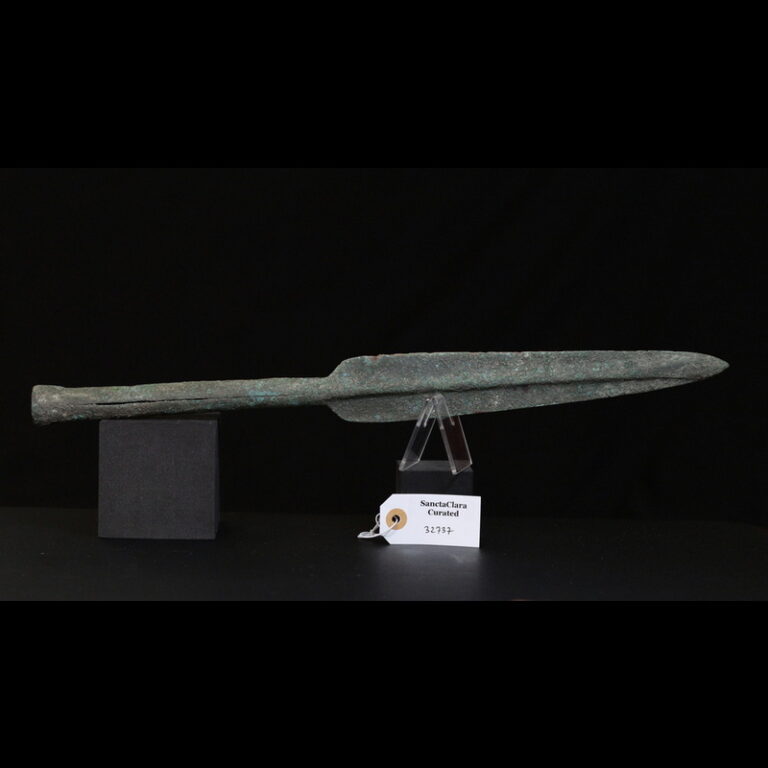
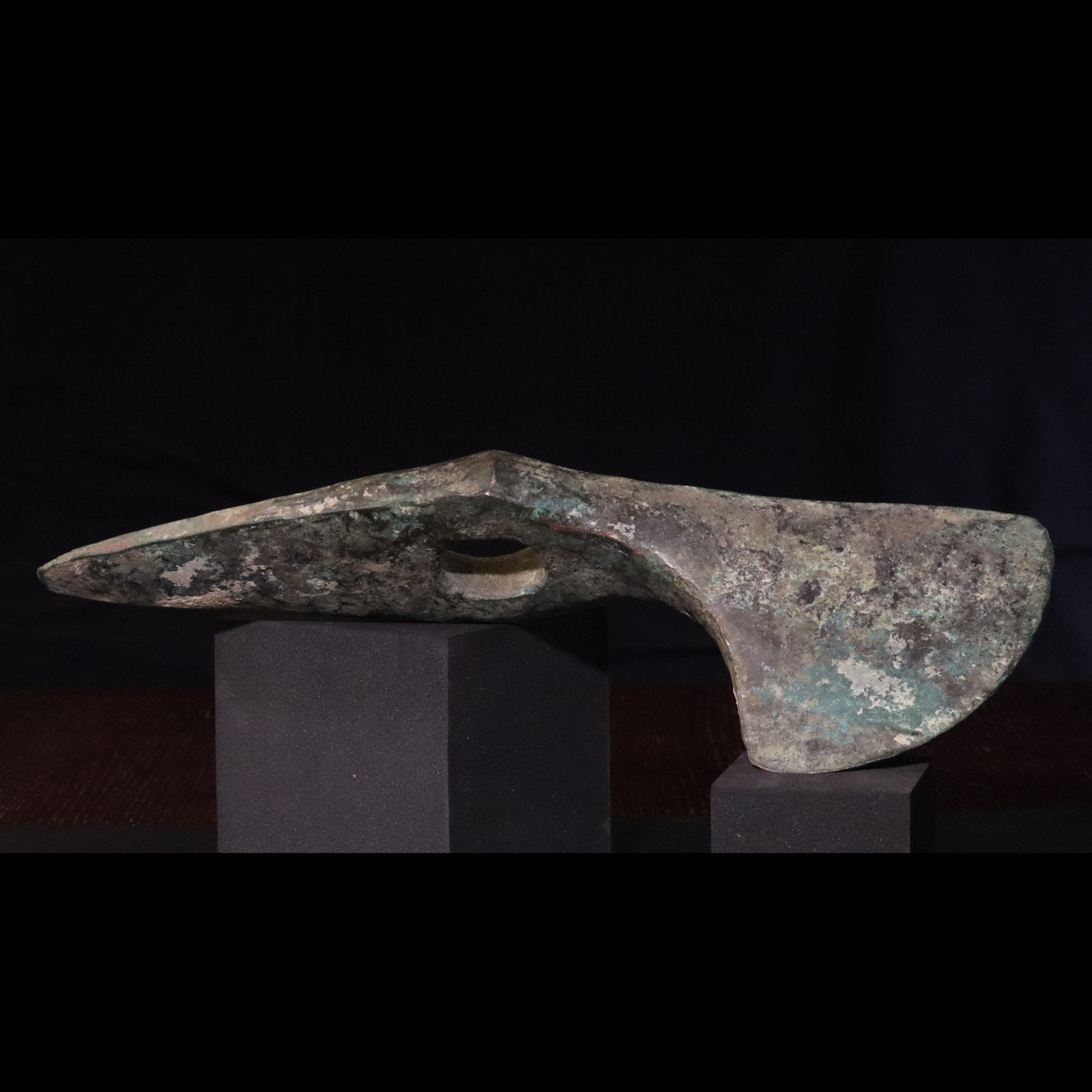
The collection contains numerous examples of this design liberation. The large socketed spearheads from the European Urnfield culture and the elaborate Luristan shaft-hole axes represent forms that could only exist in cast bronze. Their shapes are not echoes of stone predecessors; they are expressions of what bronze, and only bronze, can do.
Lost-wax casting, in particular, allowed the production of objects of extraordinary complexity and precision. The Luristan bronze industry — represented by many pieces in the collection — exploited this technique to produce weapons and ceremonial objects with flowing, organic forms, animal-headed finials, and intricate surface decoration that would have been unthinkable in any earlier material.
The Recycling Problem: Why Early Bronze Is Rare
One of the persistent puzzles of Bronze Age archaeology is the relative scarcity of early bronze artifacts compared to the volume of production implied by the archaeological evidence of mining, smelting, and trade. The explanation lies in a simple economic fact: bronze was too valuable to throw away.
Unlike stone, which was abundant and essentially free, bronze required expensive imported raw materials, specialized labour, and complex processing. A broken or worn bronze tool did not become waste; it became raw material. Damaged weapons were reforged, worn tools were recast, and obsolete designs were melted down and poured into new moulds. Bronze hoards — collections of broken, worn, and fragmentary bronze objects clearly assembled for recycling — are among the most common Bronze Age finds across Europe and the Near East.
This recycling practice had a profound effect on the archaeological record. The vast majority of bronze objects produced in antiquity were eventually melted down and recast, sometimes repeatedly over centuries. The bronze in a first-millennium BC socketed axe might contain copper originally smelted two thousand years earlier, alloyed and re-alloyed, cast and recast through dozens of iterations. Only objects that were deliberately removed from circulation — by burial with the dead, by deposition as votive offerings, or by accidental loss — survived to be found by modern archaeologists.
This means that the surviving corpus of Bronze Age artifacts represents only a tiny fraction of what was originally produced. Early forms are disproportionately rare because they had the longest exposure to recycling pressure. The simple flat axes and tanged daggers of the Early Bronze Age were overwhelmingly recast into the more complex forms of later periods. This is why even modest early bronze artifacts command scholarly attention and why the chronological range of a collection matters: each surviving piece from the earlier periods has beaten extraordinary odds simply by existing.
The Transition to Iron: Necessity, Not Choice
The shift from bronze to iron, traditionally dated to approximately 1200 to 1000 BC in the eastern Mediterranean, was not the triumphant adoption of a superior technology. It was, in significant measure, a forced accommodation to circumstance — a response to the disruption of the tin trade networks that had sustained Bronze Age civilization.
The Late Bronze Age Collapse
Around 1200 BC, the interconnected civilizations of the eastern Mediterranean experienced a cascading series of crises. Cities were destroyed, kingdoms fell, trade networks disintegrated, and writing systems were lost. The Hittite Empire collapsed. Ugarit was destroyed. Mycenaean palace civilization ended. Egypt survived but in a diminished state. The causes remain debated — climate change, drought, earthquakes, the incursions of the Sea Peoples, internal social upheaval, or more likely a compound of all these stressors amplifying one another through the very trade networks that had bound these societies together.
Whatever the combination of causes, one consequence was devastating for bronze production: the long-distance tin trade was severely disrupted. Without tin, bronze could not be made. Without bronze, the entire economic and military infrastructure of Late Bronze Age civilization was undermined. Communities that had depended on imported tin for their weapons, tools, and economic power were suddenly cut off from their essential supply.
Iron ore, by contrast, was available almost everywhere. It did not require long-distance trade. It did not depend on the survival of complex international networks. A community with access to iron ore, fuel, and a basic understanding of smelting could produce its own metal tools and weapons independently — a radical decentralisation of military and economic power.
Bronze versus Early Iron: A Question of Quality
The popular narrative presents iron as inherently superior to bronze — harder, stronger, better in every way. The reality was considerably more complicated, and for several centuries after the transition began, bronze remained in many respects the better material.
Well-made tin bronze, with optimal alloy composition (around ten to twelve percent tin), work-hardened by careful hammering and annealing, produces a blade with a Vickers hardness of approximately 250 HV — comparable to many mild steels. Bronze holds an edge well, resists corrosion (it does not rust), and — critically — its properties are highly predictable. A competent bronze smith working with quality raw materials could produce weapons and tools of consistent, reliable quality.
Early iron, by contrast, was deeply inconsistent. The carbon content of smelted iron varied enormously depending on fuel, temperature, and technique, and this variation directly affected the metal’s properties. Iron with too little carbon (wrought iron) was soft and would not hold an edge. Iron with too much carbon became brittle, prone to shattering on impact — a catastrophic failure mode for a weapon. Achieving the narrow band of carbon content that produced good steel (approximately 0.3 to 0.8 percent) was, in the early Iron Age, as much a matter of luck as skill. The metallurgy of controlled carburisation, quenching, and tempering that would eventually make steel clearly superior to bronze took centuries to develop.
For a warrior or a craftsman in the eleventh century BC, a well-made bronze sword was very likely a better weapon than the iron equivalent available to him. It was more consistent, more corrosion-resistant, and less likely to fail unpredictably. The advantage of iron was not quality but availability. When you cannot get tin, you cannot make bronze — and a mediocre iron sword is infinitely better than no sword at all.
Arrowheads: From Mass Production to Individual Forging
The transition from bronze to iron had particularly dramatic consequences for projectile production. Bronze arrowheads were cast — poured as molten metal into moulds that could produce dozens or hundreds of identical points in a single production run. A single mould could be used thousands of times. The process was fast, efficient, and ideally suited to equipping large armies with standardized ammunition.
Iron arrowheads could not be cast. Iron’s melting point is far higher than bronze’s, and early Iron Age smiths did not achieve the temperatures needed for iron casting. Instead, each iron arrowhead had to be individually forged — heated in a forge, hammered into shape on an anvil, and finished by filing and grinding. This was enormously more labour-intensive than casting. Where a bronze smith with good moulds could produce scores of arrowheads in a day, an iron smith forging individual points might manage only a handful.
This shift from cast to forged production had strategic implications. Bronze Age armies could equip archers with abundant, standardised ammunition at relatively low cost per unit. Iron Age armies faced higher per-unit costs and lower production rates for equivalent weapons. The transition period — visible in the archaeological record as mixed assemblages containing both bronze and iron arrowheads — lasted several centuries in most regions, with bronze casting continuing to supply arrowheads long after iron had replaced bronze for larger weapons and tools.
The Long Transition: Overlap, Coexistence, and Conservatism
It is important to resist the temptation to see these material transitions as clean breaks. They were not. Stone tools continued to be used alongside copper for millennia. Copper and arsenical bronze coexisted with tin bronze for centuries. Bronze production continued well into the Iron Age — and for certain applications, such as arrowhead casting, it never entirely ceased in some regions.
Each transition was shaped by local conditions — the availability of raw materials, the strength of existing craft traditions, the demands of warfare and agriculture, and the conservatism inherent in any established technology. A stone axe maker who had spent decades perfecting his craft did not abandon his knowledge the first time he saw a copper tool. A bronze smith whose livelihood depended on tin trade did not willingly switch to iron. Technological change in antiquity, as in the modern world, was driven not by the abstract superiority of new materials but by the complex interplay of need, opportunity, tradition, and crisis.
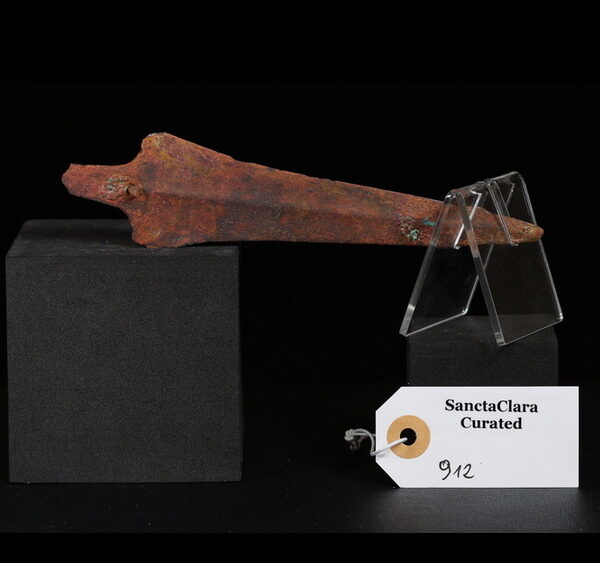
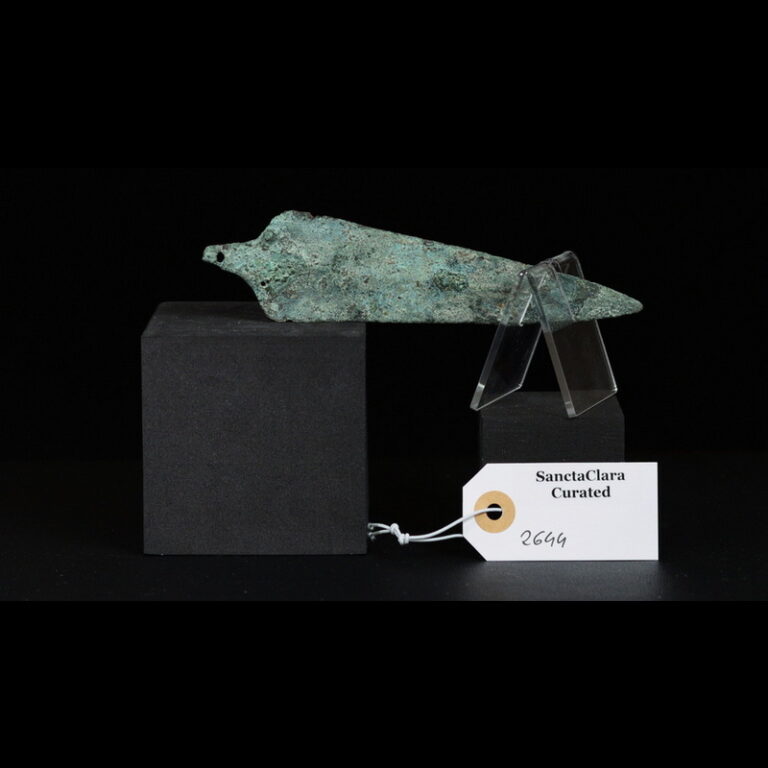
The artifacts in the Sancta Clara Collection span this entire arc of transformation — from Neolithic polished stone axes to Chalcolithic copper daggers, from arsenical bronze spearheads to Hallstatt iron axes. In their forms, their materials, their design choices, and their patinas, they embody four thousand years of human ingenuity and adaptation. Each one is a chapter in the longest story our species has ever told about the materials from which we build our world.
This article is part of the reference materials published by the Sancta Clara Collection at AncientBronzes.com. Content is provided for educational purposes and reflects observations drawn from direct study of the collection’s holdings and current archaeological scholarship.