
Black Copper
The Daggers That Should Not Rust
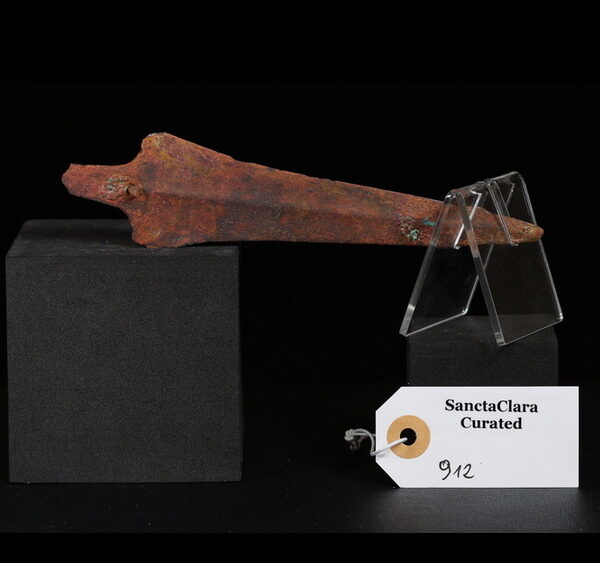
Among the most deceptive objects in any collection of ancient metalwork are daggers that appear, at first glance, to be iron — or at least some awkward hybrid of iron and copper. Their surfaces are mottled with reddish-brown corrosion rather than the familiar green patina we associate with ancient bronze. A magnet, brought close, will slighlty stick. These artifacts are ferrian copper: objects smelted from complex ores that trapped metallic iron within a copper matrix, producing a material unknown to any ancient metallurgical handbook yet widespread across the Early and Middle Bronze Age eastern Mediterranean.
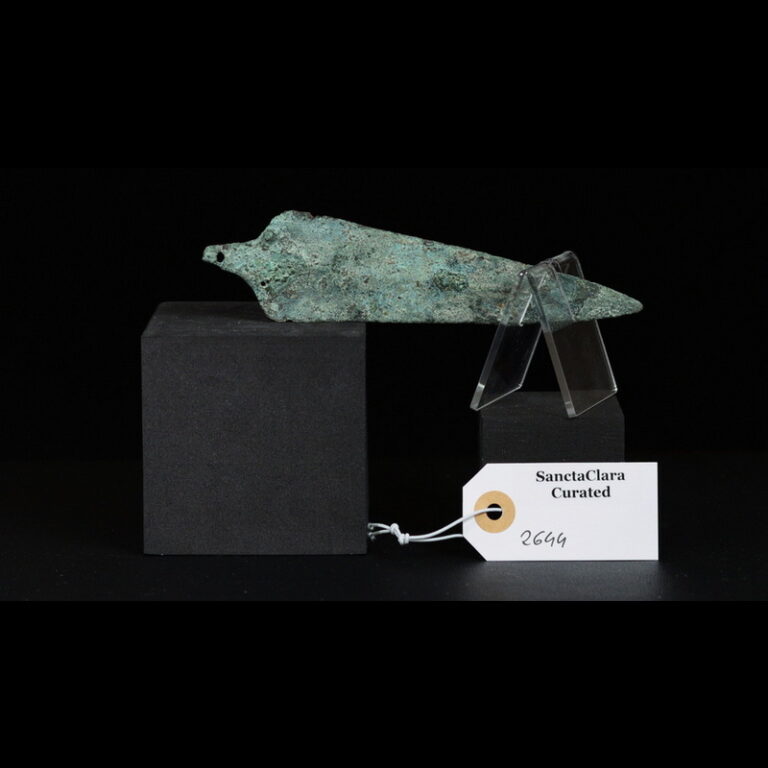
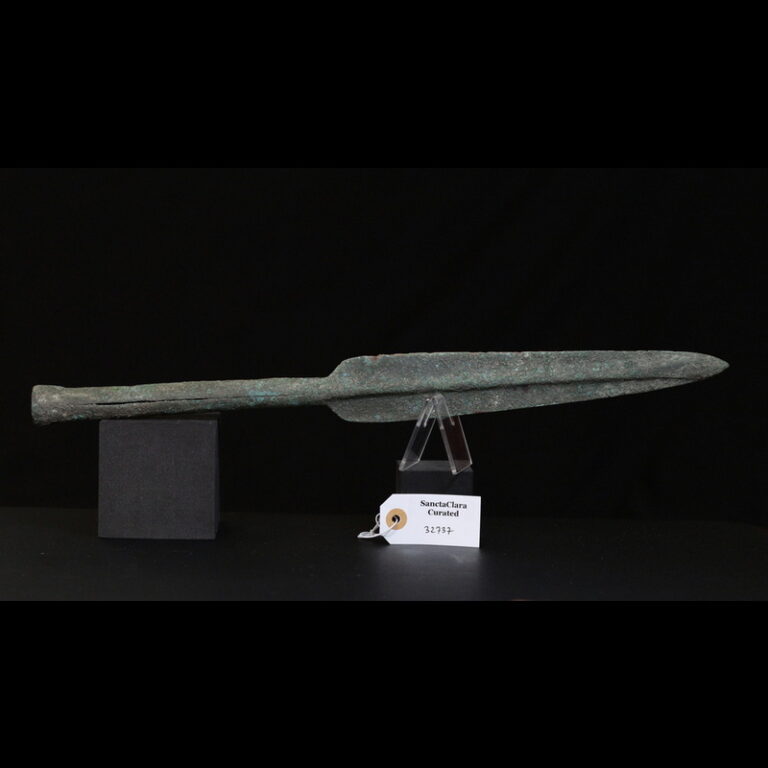
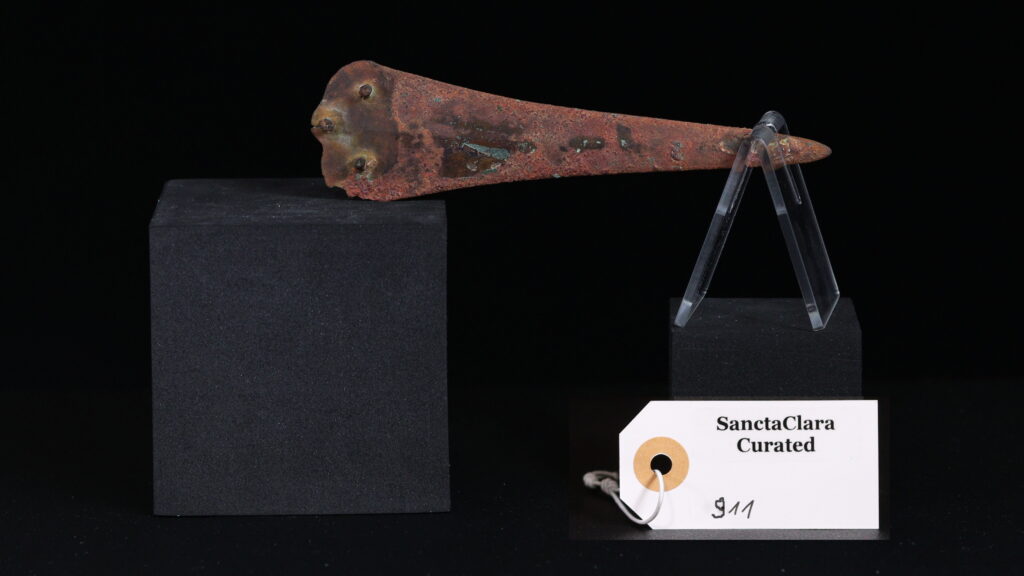
The Sancta Clara Collection holds three such daggers — Lots 911, 912, and 913 — all probably Minoan/Cypriot in origin, spanning roughly a millennium from the Early Bronze Age into the Middle Bronze Age. Together, they form a small but revealing sequence: Lot 911, dated approximately 2450–2000 BC, is a Minoan-type copper alloy tang-less dagger from the Early Bronze Age with classic Cypriot typology; Lots 912 and 913, dated 2200–1800 BC, belong to the transitional period between the Early and Middle Bronze Age. Some display the telltale ferromagnetic response, and all present rusty surface oxidation that mark them as products of sulfidic ore smelting — a technology that fundamentally transformed Bronze Age civilization.
From Green Stone to Yellow Rock: The Ore Transition
The story of ferrian copper is inseparable from the story of ore depletion. The earliest copper smelters, working from roughly 5000 BC onward, had access to the so-called oxide zone — the weathered upper layers of copper deposits where the original sulfide minerals had been transformed by millennia of exposure to air and groundwater into vivid green and blue secondary minerals. Malachite (copper carbonate hydroxide), azurite (a deeper blue copper carbonate), and native copper nuggets were the raw materials of the Chalcolithic revolution. These ores are chemically simple: heat malachite with charcoal and you reduce it directly to metallic copper. The process requires no special knowledge of fluxing, no careful management of furnace atmosphere, and produces a relatively pure copper with few problematic impurities.
But oxide zones are shallow. The green-stained outcrops that guided ancient prospectors to copper sources were, in geological terms, a thin skin overlying vastly larger deposits of primary sulfide ores. As the easily accessible oxides were worked out — a process that accelerated dramatically during the third millennium BC as demand for copper exploded across the Near East and eastern Mediterranean — smelters were forced deeper, into rock that looked and behaved nothing like what they were accustomed to. Instead of soft, vivid green malachite, they encountered hard, brassy-yellow chalcopyrite (CuFeS₂), the dominant primary copper mineral in most ore bodies worldwide, along with associated iron sulfides like pyrite (FeS₂) and pyrrhotite.
Chalcopyrite presented a fundamentally different metallurgical problem. It contains not just copper and sulfur — which must be driven off — but iron in equal atomic proportion to the copper. You cannot simply heat chalcopyrite with charcoal and expect copper. The sulfur must first be removed through roasting (heating in air), and the iron must be separated from the copper during the smelt itself. This is where fluxing enters the story, and with it, the accidental creation of ferrian copper.
The Iron Flux and the Fayalite Bargain
To extract copper from chalcopyrite and other sulfidic ores, ancient metallurgists — probably through generations of trial and error rather than any theoretical understanding — developed a co-smelting process that exploited iron’s affinity for silica. The principle, reconstructed from slag analysis at Bronze Age smelting sites across Cyprus, the Levant, and Iran, works as follows.
Iron-rich materials — hematite, magnetite, or the iron-bearing gossans (weathered caps) that typically overlay sulfide ore bodies — were deliberately added to the smelting charge as a flux. At smelting temperatures (roughly 1100–1250°C, achievable in a well-managed charcoal-fueled shaft furnace with bellows), the iron oxide reacts with the silica naturally present in the ore’s gangue (waste rock) to form fayalite (Fe₂SiO₄), a fluid, low-melting-point slag. This fayalite slag serves a critical mechanical purpose: it is liquid enough at furnace temperature to flow, carrying away the unwanted silica and allowing the heavier copper prills — tiny droplets of reduced metallic copper — to coalesce and sink to the bottom of the furnace.
The system is elegant, and it works. But it contains an inherent instability: the boundary between “iron entering the slag as fayalite” and “iron reducing to metal” is determined by the furnace atmosphere, and that atmosphere is extraordinarily difficult to control in a charcoal-fired installation.
If the furnace runs too reducing — if the ratio of carbon monoxide to carbon dioxide rises above the equilibrium threshold for iron reduction — some of the iron flux will reduce to metallic iron rather than combining with silica to form slag. This is not a catastrophic failure. The smelt still produces copper. But the copper it produces now contains suspended particles of metallic iron that refused to enter the slag phase.
Inside Ferrian Copper: Dendrites, Domains, and Decay
The microstructural consequences of this “over-reduction” are distinctive and, for the modern collector and researcher, diagnostically valuable. Because iron and copper are largely immiscible in the solid state — they do not form a continuous alloy the way copper and tin do in true bronze — the iron separates as the melt cools, forming microscopic α-iron dendrites (tree-like crystalline precipitates) suspended within the copper matrix. These iron particles, typically ranging from a few micrometers to several hundred micrometers in diameter, are scattered irregularly through the metal. They are individually too small to see with the naked eye, but collectively they produce two effects that are immediately apparent even without laboratory analysis.
First, the trapped metallic iron makes the bulk object ferromagnetic. Hold a neodymium magnet near a ferrian copper dagger and it will attract — weakly compared to a solid iron object, but unmistakably. This ferromagnetic response is a reliable field test, though it must be applied with caution: some natural copper ores contain trace magnetite inclusions that can produce a faint magnetic response even in “clean” copper, and heavily corroded iron objects can sometimes lose their magnetism entirely. In the case of the three Sancta Clara daggers, all three respond clearly to a magnet, indicating a non-trivial iron content distributed throughout the metal.
Second, and more visually dramatic, the iron particles at the surface oxidize preferentially as the artifact ages. Over millennia of burial, these iron inclusions convert to iron oxides and hydroxides — the same compounds responsible for ordinary rust — producing a distinctive reddish-brown to orange surface discoloration. This rusty patina overlays or intermixes with the more typical copper carbonates (green malachite, blue azurite) and copper chlorides (the pale green of atacamite/paratacamite) that form on ancient copper alloy surfaces. The result is an artifact that looks, to the uninitiated eye, like a failed experiment — too rusty to be bronze, too green to be iron. In fact, it is a precise material record of its own manufacturing conditions.
Cyprus and the Sulfide Revolution
The Cypriot attribution of Lots 911, 912, and 913 is significant because Cyprus was arguably the epicentre of the sulfidic ore revolution in the eastern Mediterranean Bronze Age. The island’s very name may derive from the Latin cuprum (copper), and its massive sulfide ore bodies — particularly the deposits at Skouriotissa, Apliki, and Politiko-Phorades — were among the largest and most intensively exploited in the ancient world.
Archaeological and archaeometallurgical work at sites like Enkomi, Kition, and the smelting installations at Politiko-Phorades has documented the transition from oxide to sulfide smelting in extraordinary detail. At Phorades, excavations revealed a Late Bronze Age workshop that processed sulfidic ores on an industrial scale, producing massive quantities of fayalite slag whose chemical composition records exactly the iron-fluxing process described above. Crucially, analysis of copper prills trapped in these slags shows elevated iron content — precisely the microstructural signature we see in ferrian copper artifacts.
The chronological spread of the three Sancta Clara daggers maps onto this technological transition. Lot 912, the earliest at 2400–2200 BC, dates to the period when Cypriot smelters were first confronting sulfide ores in earnest. Lot 913, from the transitional Early-to-Middle Bronze Age (2200–1800 BC), sits in the period of most active experimentation. Lot 911, the tangless Minoan-type dagger at 1600–1450 BC, is contemporary with the mature Cypriot copper industry that supplied much of the eastern Mediterranean — an era when large-scale sulfide smelting was fully established but quality control over iron contamination remained variable.
The Tangless Dagger: Lot 911 and Minoan Connections
Lot 911 deserves particular attention. It is a tangless dagger — a blade form where the metal terminates at the widened shoulders without any projecting tang for handle attachment. Instead, the handle would have been affixed using rivets through holes in the blade’s shoulder area, or by binding directly to the blade’s base with organic materials (cord, leather, or a resinous compound). This tangless form is characteristic of Minoan metalwork from Early Minoan through Late Minoan I (roughly 2450–1450 BC), and its appearance in a Cypriot-attributed ferrian copper dagger points to the dense web of metallurgical exchange that connected Crete and Cyprus during this period.
The tangless design is sometimes interpreted as “primitive,” but this is misleading. It is better understood as a specific functional adaptation: tangless daggers distribute stress across the full width of the blade shoulder rather than concentrating it at a narrow tang junction, making them resistant to the lateral torque that snaps tanged blades. The design is well suited to a thrusting weapon used in close combat — exactly the role that Minoan and Mycenaean dagger typology suggests.
Reading Ferrian Copper: Authentication and Interpretation
For collectors and researchers, ferrian copper artifacts occupy an interesting position in authentication discussions. The ferromagnetic response and rusty patina of these objects can initially raise suspicion — the untrained eye may wonder whether the object is a modern fabrication incorporating iron, or whether the rust indicates a much later date than claimed. In fact, the opposite is more nearly true: ferrian copper is extremely difficult to fake convincingly, because the distribution of iron dendrites within the copper matrix is a product of specific smelting conditions that would be laborious and pointless to replicate. A modern forger would simply use commercially pure copper or a standard tin bronze, both of which are readily available and produce predictable results.
The rusty surface, far from being a warning sign, is actually a strong positive indicator of authenticity. The iron oxidation pattern in a genuine ferrian copper artifact develops over centuries or millennia of burial, and it interpenetrates with the copper corrosion products in a way that is characteristic of long-term, undisturbed co-corrosion. Fresh iron oxide applied to a copper surface — as a forger might attempt — sits on top of the copper patina rather than growing through it, and the boundary between the two is typically sharp and unconvincing under magnification.
Cross-sectional metallography, when available, is definitive. A polished and etched section of ferrian copper reveals the α-iron dendrites in their original crystallographic orientation within the copper matrix, a structure that can only form during solidification from a melt. No surface treatment, electroplating, or mechanical process can replicate this internal microstructure.
Slag, Ore, and Furnace: Reconstructing the Smelt
The broader archaeological context of ferrian copper production illuminates a critical moment in the history of technology. The transition from oxide to sulfide ore smelting was not merely a change in raw material — it was a fundamental reorganization of metallurgical knowledge and practice. Oxide smelting is, in principle, a one-step process: ore plus charcoal plus heat produces copper. Sulfide smelting requires, at minimum, a two-step process (roasting to remove sulfur, then smelting with flux to remove iron and silica), and in practice often involved intermediate steps like matte smelting, where a copper-iron sulfide “matte” is produced as an intermediate product and then re-smelted under oxidizing conditions to remove the remaining iron and sulfur.
The archaeological evidence suggests that this multi-stage process was not invented all at once but developed incrementally, with considerable regional variation. Cypriot smelters seem to have adopted a relatively direct approach, roasting sulfide ores and then smelting them with iron flux in a single furnace operation. Smelters in the Iranian plateau — the Luristan and Elamite cultural spheres also well represented in the Sancta Clara Collection — appear to have developed somewhat different techniques, potentially reflecting different ore compositions and local traditions. The variability in iron content among ferrian copper artifacts from different regions and periods is itself a map of this technological experimentation.
Copper, Iron, and the Coming of the Iron Age
There is a deep irony in ferrian copper production. The smelters who struggled to keep iron out of their copper were, in a sense, rehearsing the metallurgy that would eventually make copper obsolete as a weapon material. The reducing conditions that accidentally produced metallic iron in a copper smelt are essentially the same conditions required to smelt iron intentionally. Several scholars have argued that the Iron Age transition — traditionally dated to around 1200–1000 BC in the eastern Mediterranean — was not a sudden discovery but a gradual recognition that the “waste product” of copper smelting was itself a useful material.
The ferrian copper daggers of the Sancta Clara Collection sit at the threshold of this transition. They are copper objects contaminated with iron, made by smelters who were trying to produce pure copper and falling short. Within a few centuries of Lot 911’s manufacture, the relationship would reverse: iron would become the desired product, and copper the lesser metal. The rusty daggers in the collection, humble and unpretentious, are material witnesses to one of the most consequential technological shifts in human history.
This article is part of the AncientBronzes.com educational series on Bronze Age metallurgy and material culture. All artifacts referenced are from the Sancta Clara Collection. Text © AncientBronzes.com. All rights reserved.