
Forging the Future: The Evolution of Ancient Axe Morphology
The evolution of axe morphology from the Eneolithic through the Bronze Age to the Early Iron Age reflects profound technological and cultural advancements. The transition of the axe from a simple lithic tool to a complex, multi-functional metal implement represents not just a change in material, but a shifting understanding of physics, metallurgy, and wood-to-metal ergonomics.
I. The Alchemy of the Edge: Material Evolution
The journey of the axe is defined by the quest for a cutting edge that could be both razor-sharp and structurally resilient.
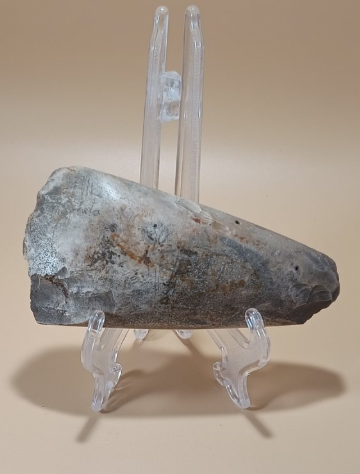
- Flint and Ground Stone (Eneolithic): During the Eneolithic period, axes were predominantly made from knapped flint or tough, ground igneous rocks. While flint provides a remarkably sharp edge, it is fundamentally brittle and prone to chipping upon heavy impact. Ground stone axes, though slower to manufacture, offered the blunt durability necessary for clearing the dense primary forests of early Europe and the Near East.
- Natural and Arsenic Copper (Chalcolithic): With the advent of the Copper Age, flat axes emerged. Initially forged from native copper or smelted high-purity ores, these tools were relatively soft. However, craftsmen soon discovered that copper containing natural arsenic—or later, intentionally alloyed arsenic—produced arsenical bronze. This material was a game-changer; it was significantly harder than pure copper and could be work-hardened by hammering the cutting edge without shattering.
- Tin Bronze (Early to Late Bronze Age): The true “Golden Age” of the axe arrived with the widespread adoption of tin bronze (typically an alloy of copper with 10% to 12% tin). Tin bronze was superior to arsenical copper because it was far less toxic for the smiths to produce, offered superior fluidity during the casting process, and provided highly predictable hardness and edge retention.
- Iron (Early Iron Age): The eventual shift to iron was driven largely by the collapse of Late Bronze Age trade networks, which choked off the supply of rare tin. Early “wrought” iron was actually softer and less efficient than high-quality bronze. However, once smiths mastered carburization (adding carbon to create steel) and the processes of quenching and tempering, iron axes offered unprecedented strength, ultimately replacing bronze entirely.
II. Engineering the Strike: Mounting Evolution
The primary weakness of early axes was the hafting. The force of a blow naturally tries to drive the axehead backward, which frequently caused the wooden handle to split or the head to fly off. The evolution of mounting moved progressively toward “locking” the metal to the wood.
- The Flat Axe: Characteristic of the Chalcolithic and Early Bronze Age, this was a simple, wedge-shaped piece of metal. It was typically inserted into a cleft in an L-shaped wooden handle (a “knee-haft”). While effective, the wedge shape meant that every heavy blow drove the metal deeper like a chisel, often splitting the wooden shaft.
- The Flanged Axe: To prevent the head from wobbling side-to-side, Early Bronze Age smiths began hammering or casting raised lips along the sides of the flat axe, creating flanges. This provided much-needed lateral stability.
- The Palstave: A defining innovation of the Middle Bronze Age. The palstave advanced the flanged design by incorporating a stop-ridge—a horizontal bar of metal running across the middle of the blade. The split wooden handle would wrap around the top half of the axe, but the stop-ridge physically prevented the metal wedge from being driven any further back into the wood, dramatically increasing the lifespan of the haft.
- The Socketed Axe: The culmination of Bronze Age casting technology. Instead of the wood wrapping around the metal, the metal wrapped around the wood. Using complex clay-core molds, smiths cast axes with a hollow socket at the top. The “L” shaped wooden handle was inserted directly into this void. This design drastically reduced the risk of the axehead detaching and often featured a small side-loop so the head could be tied securely to the shaft.
- The Round Socket / Shaft-Hole Axe: As metallurgy advanced into the Late Bronze and Early Iron Ages, the modern concept of the axe emerged: the shaft-hole design. A circular or oval hole was forged or cast completely through the center of the heavy metal head, allowing for a straight, highly durable handle to be passed directly through the tool.
III. Form Follows Function: Blade Morphology
As casting techniques improved, the shape of the blade diverged to serve highly specific utilitarian, martial, and ceremonial purposes.
- The Single Blade: The standard morphology for forestry and carpentry. Over time, the single blade evolved from a narrow, chisel-like profile to a broad, flared, crescent-shaped cutting edge, maximizing the surface area of the cut.
- The Axe-Adze: Prominent in the Chalcolithic and Early Bronze Age (particularly in the Carpathian Basin and the Near East), this was the ancient world’s premier multi-tool. It featured a vertical axe blade on one side of a central shaft-hole and a horizontal adze blade on the other. It was heavily utilized for felling trees and subsequently shaping the timber into planks or dugout canoes.
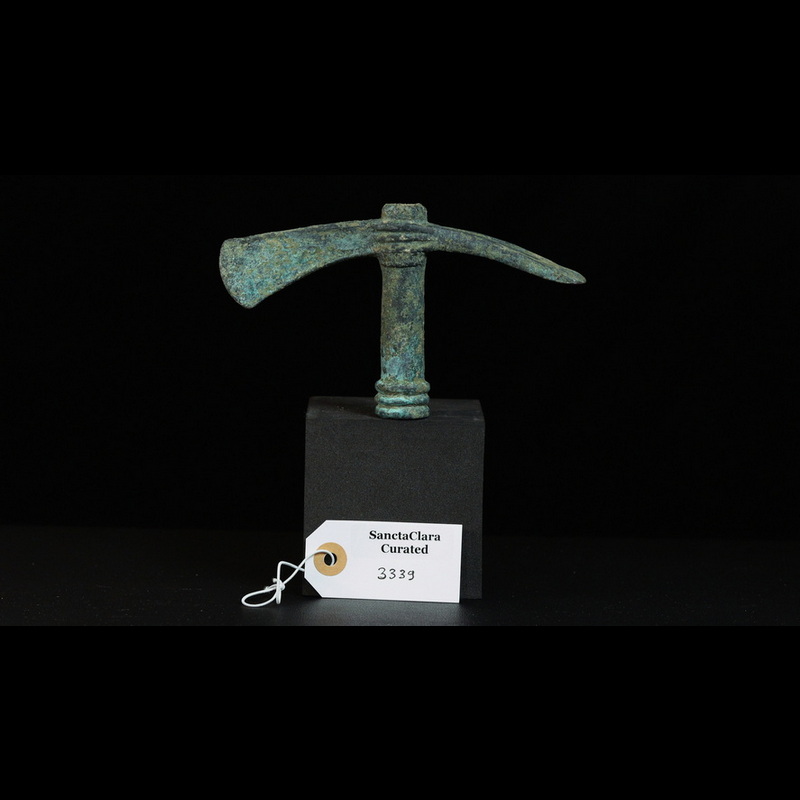
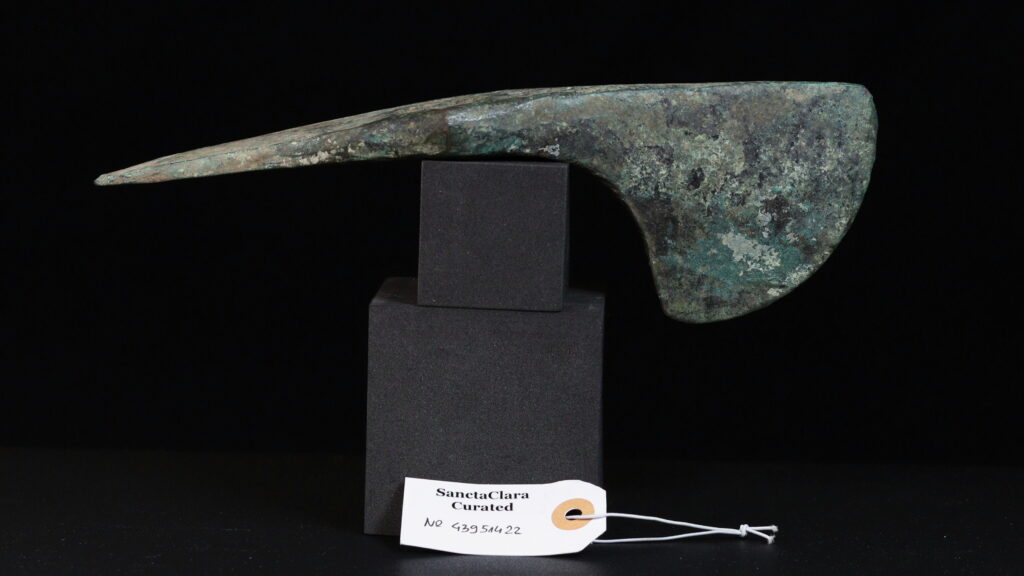
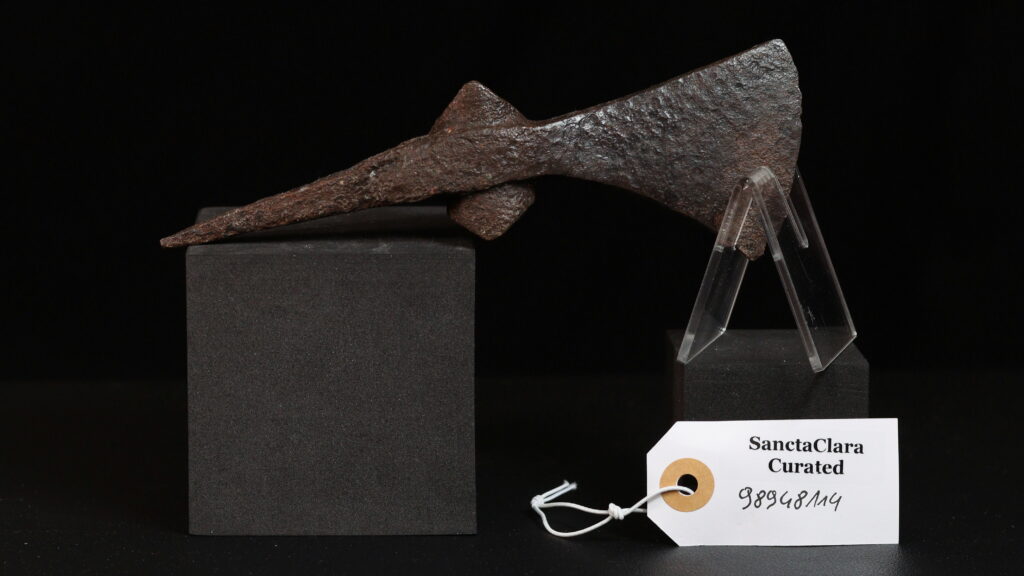
- The Axe-Pike: During the Middle and Late Bronze Age, as organized warfare intensified, axes evolved into dedicated armor-piercing weapons. The axe-pike (or pick-axe) featured a traditional blade on one face and a long, narrow, armor-puncturing spike on the reverse.
- The Double Axe (Labrys): Featuring two opposing vertical blades, the double axe is famously associated with Minoan Crete but is found across broader contexts. While utilitarian versions existed (allowing a lumberjack to switch to a fresh edge when one dulled), highly decorated, oversized, and ultra-thin double axes were cast purely as potent religious and cultural symbols, never intended to strike wood.
In summary, the evolution of the axe from the Eneolithic through the Early Iron Age is a testament to human ingenuity. From crude stones lashed with sinew to elegantly cast, socketed bronze blades, each morphological shift was a direct response to the limits of the previous generation’s technology, perfectly reflecting the increasing complexity and capability of ancient societies.